Digital Advertising Measurement B2B: The 2026 Playbook
Clicks and impressions don't close deals. Here's how to measure B2B digital advertising by pipeline and revenue in 2026 — attribution models, metrics, and the tooling that ties ad spend to closed-won.
Measuring a B2B ad campaign like a B2C one wastes six-figure budgets. A shoe store knows within hours if an ad worked. Someone clicked, someone bought. B2B is slower. The "buy" is a committee of seven people and a 94-day sales cycle. The contract gets signed long after the ad has scrolled out of the report. This is why digital advertising measurement B2B needs its own playbook. If you still grade ads by click-through rate, you are aiming at the wrong finish line.
This guide breaks down how digital advertising measurement B2B actually works in 2026 — which metrics matter, which attribution models survive a long sales cycle, and how to tie ad spend to closed-won revenue your finance team will sign off on.
TL;DR#
- Clicks and impressions are diagnostics, not outcomes. In B2B, the only metrics that matter to leadership are pipeline generated, revenue influenced, and cost per opportunity (CPO).
- Attribution is a spectrum, not a switch. Last-touch overcredits the bottom of the funnel; first-touch overcredits the top. Multi-touch and data-driven models are the realistic middle ground.
- The measurement gap is an identity gap. You can't attribute revenue to an ad if you can't connect the anonymous visitor to a company, a contact, and eventually a deal in your CRM.
- Offline conversions are the missing link. Feeding closed-won data from your CRM back into ad platforms is what lets Google and LinkedIn optimize for revenue instead of form fills.
- Enrichment and visitor identification close the loop — turning anonymous ad traffic into named accounts you can actually track through the pipeline.
Why is B2B digital advertising so hard to measure?#
Three structural realities break the simple "spend in, sales out" model that works for e-commerce.
1. The sales cycle is long and non-linear. A prospect might see a LinkedIn ad in January, download a report in March, attend a webinar in June, and finally request a demo in September through a branded search. Which touch gets the credit? A naive tool says the last one. Reality says all of them mattered.
2. Buying is a committee sport. Gartner's research on B2B buying groups puts the typical purchase decision in the hands of six to ten stakeholders, each doing independent research. Your ad might influence the champion, the economic buyer, and the end user in completely different sessions on different devices. Person-level tracking misses the account-level story.
3. The conversion happens offline. The moment that actually matters — a signed contract — happens in your CRM or a sales call, not in the ad platform. Unless that revenue event flows back to the platform, Google and LinkedIn are optimizing blind, chasing cheap clicks instead of valuable customers.
Digital advertising measurement B2B: which metrics matter?#
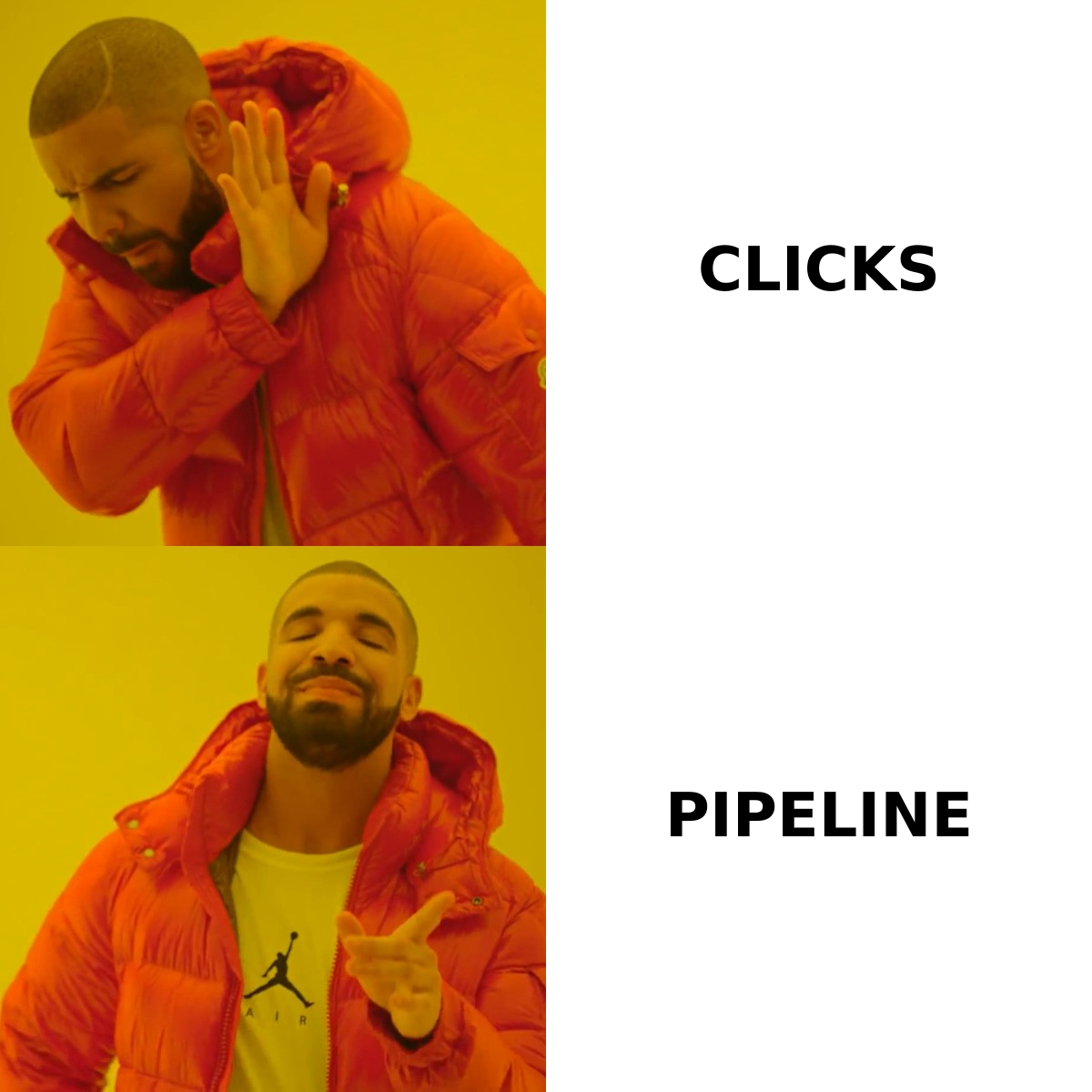
The trap is measuring what's easy instead of what's true. Ad platforms hand you impressions, clicks, and CTR because those numbers are instant and abundant. But a healthy CTR on a campaign that generates zero pipeline is a failure dressed as a success.
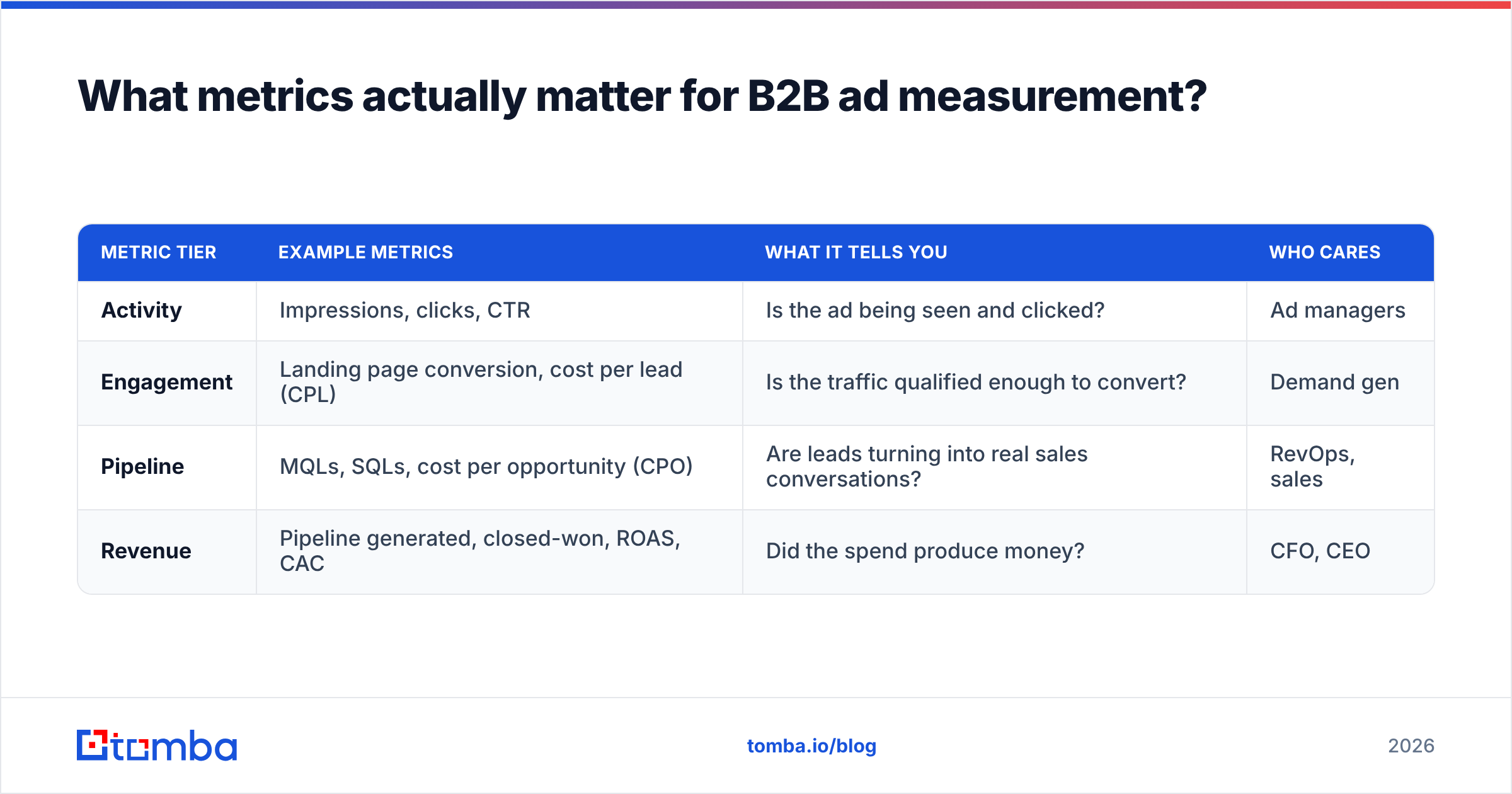
Organize your metrics into a hierarchy, from "activity" (least meaningful to the business) to "outcome" (what the board asks about):
| Metric tier | Example metrics | What it tells you | Who cares |
|---|---|---|---|
| Activity | Impressions, clicks, CTR | Is the ad being seen and clicked? | Ad managers |
| Engagement | Landing page conversion, cost per lead (CPL) | Is the traffic qualified enough to convert? | Demand gen |
| Pipeline | MQLs, SQLs, cost per opportunity (CPO) | Are leads turning into real sales conversations? | RevOps, sales |
| Revenue | Pipeline generated, closed-won, ROAS, CAC | Did the spend produce money? | CFO, CEO |
The rule of thumb: the further down this table you can measure, the more defensible your budget. Anyone can report a $2 CPC. The marketer who can say "this LinkedIn campaign sourced $340K in pipeline at a $1,900 cost per opportunity" is the one who keeps their budget in a downturn.
A few metrics worth defining precisely, because teams argue about them constantly:
- Cost per opportunity (CPO) — total ad spend divided by qualified opportunities created. This is the single most useful mid-funnel efficiency number in B2B.
- Pipeline generated — the total dollar value of opportunities that can be traced back to a campaign. This is your leading indicator of revenue.
- Revenue influenced — closed-won deals where the campaign was any touch in the journey, not necessarily the last. Broader than "sourced," and honest about how committees buy.
- Return on ad spend (ROAS) and customer acquisition cost (CAC) — the two numbers that translate marketing into finance's language. Tie every campaign back to at least one of them.
If your reporting stops at CPL, you're handing leadership a number they can't connect to revenue — which is exactly why marketing budgets are the first to get cut. Building the connective tissue is a core revenue operations function.
Which attribution model should you use?#
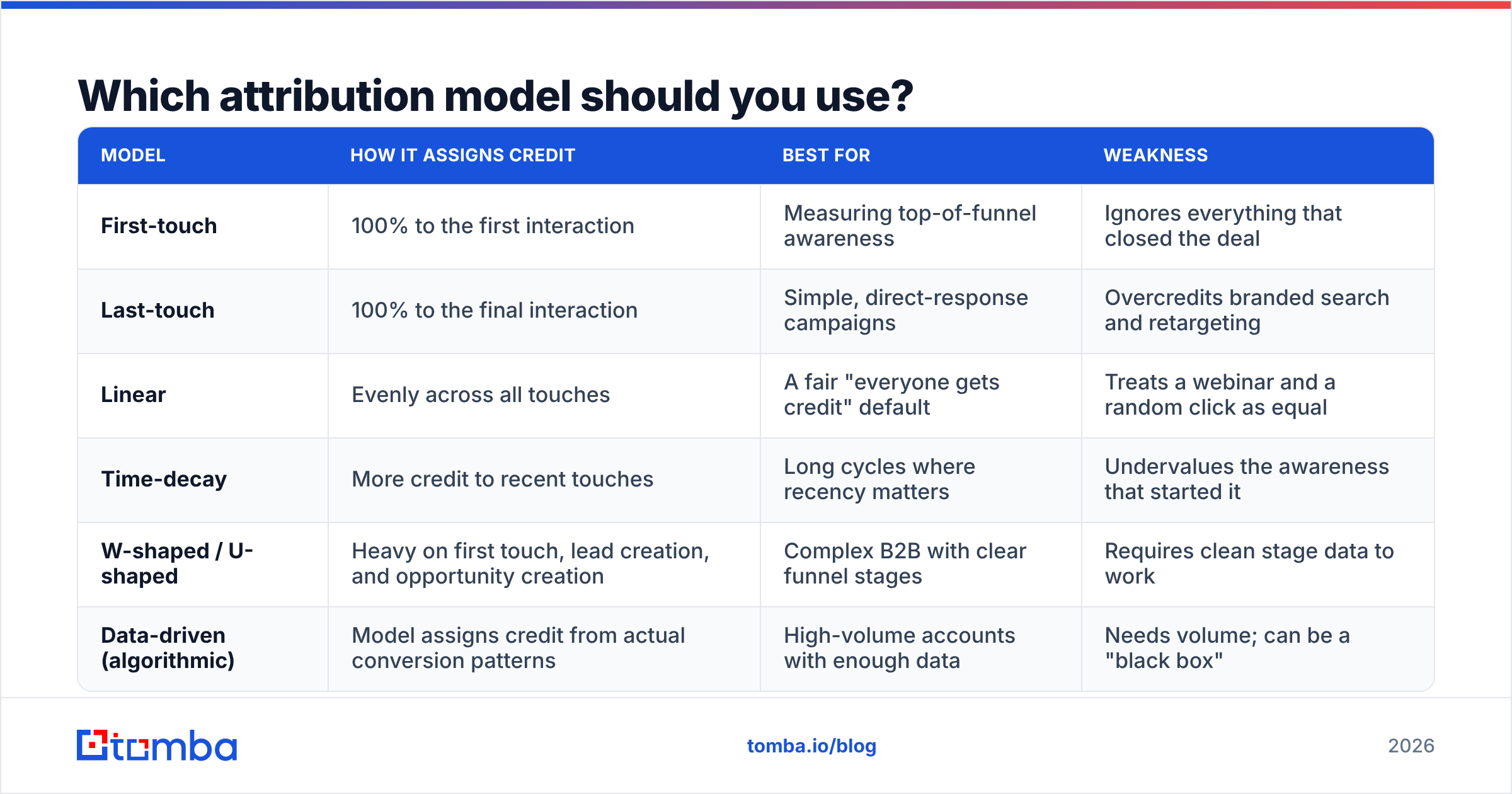
Attribution is how you assign credit for a conversion across multiple touchpoints. There's no perfect model — only trade-offs. Here's how the main options behave in a real B2B journey.
| Model | How it assigns credit | Best for | Weakness |
|---|---|---|---|
| First-touch | 100% to the first interaction | Measuring top-of-funnel awareness | Ignores everything that closed the deal |
| Last-touch | 100% to the final interaction | Simple, direct-response campaigns | Overcredits branded search and retargeting |
| Linear | Evenly across all touches | A fair "everyone gets credit" default | Treats a webinar and a random click as equal |
| Time-decay | More credit to recent touches | Long cycles where recency matters | Undervalues the awareness that started it |
| W-shaped / U-shaped | Heavy on first touch, lead creation, and opportunity creation | Complex B2B with clear funnel stages | Requires clean stage data to work |
| Data-driven (algorithmic) | Model assigns credit from actual conversion patterns | High-volume accounts with enough data | Needs volume; can be a "black box" |
For most B2B teams, the honest answer is: start with a multi-touch model (W-shaped is a strong default), and move to data-driven once you have the conversion volume to support it. Single-touch models are fine for a quick gut check but dangerous as the basis for budget decisions — they'll systematically over-invest in whatever sits closest to the conversion.
Google's own documentation walks through how data-driven attribution distributes credit based on modeled conversion paths rather than a fixed rule — worth reading before you assume last-click is "good enough."
One caveat that trips everyone up: attribution models only reallocate credit among touches you can actually see. If half your buying committee researches anonymously and never fills out a form, no model — however sophisticated — can credit the ad that reached them. That's a data problem, not a modeling problem.
How do you connect ad clicks to actual revenue?#
This is where most B2B measurement setups quietly fall apart. The click lives in Google Ads. The revenue lives in your CRM. Nothing connects them by default. Closing that gap is the whole game.
Step 1 — Identify the anonymous visitor. The majority of B2B ad traffic never converts on the first visit. Website visitor identification tools de-anonymize a portion of that traffic by matching IP and behavioral signals to a company. Instead of "1,400 unknown visitors," you get "37 target accounts visited your pricing page." Tomba's website visitor reveal is built for exactly this — turning anonymous ad traffic into named companies you can track.
Step 2 — Enrich the contact. A company name isn't enough to tie a visit to a deal. You need the people. Data enrichment fills in the decision-makers, their roles, and verified contact details, so an anonymous session becomes a real record your sales team and CRM can act on.
Step 3 — Sync to the CRM as a first-class object. Every ad-sourced lead needs a UTM-tagged, source-stamped record in your CRM so that when it becomes an opportunity — and eventually closed-won — the lineage back to the campaign survives. This is where a clean HubSpot integration or Salesforce pipeline earns its keep.
Step 4 — Push offline conversions back to the ad platform. This is the step teams skip and shouldn't. When a deal closes in your CRM, send that event — with its value — back to Google Ads and LinkedIn via offline conversion import or the conversions API. Now the platform's algorithm optimizes toward accounts that actually buy, not toward whoever clicks cheapest. HubSpot has a good primer on closed-loop reporting if you want the marketing-ops version of this workflow.

Get these four steps working and you've built a closed loop: ad → visitor → contact → opportunity → revenue → back into the ad platform. That loop is the difference between reporting activity and proving ROI.
What does a practical B2B measurement stack look like?#
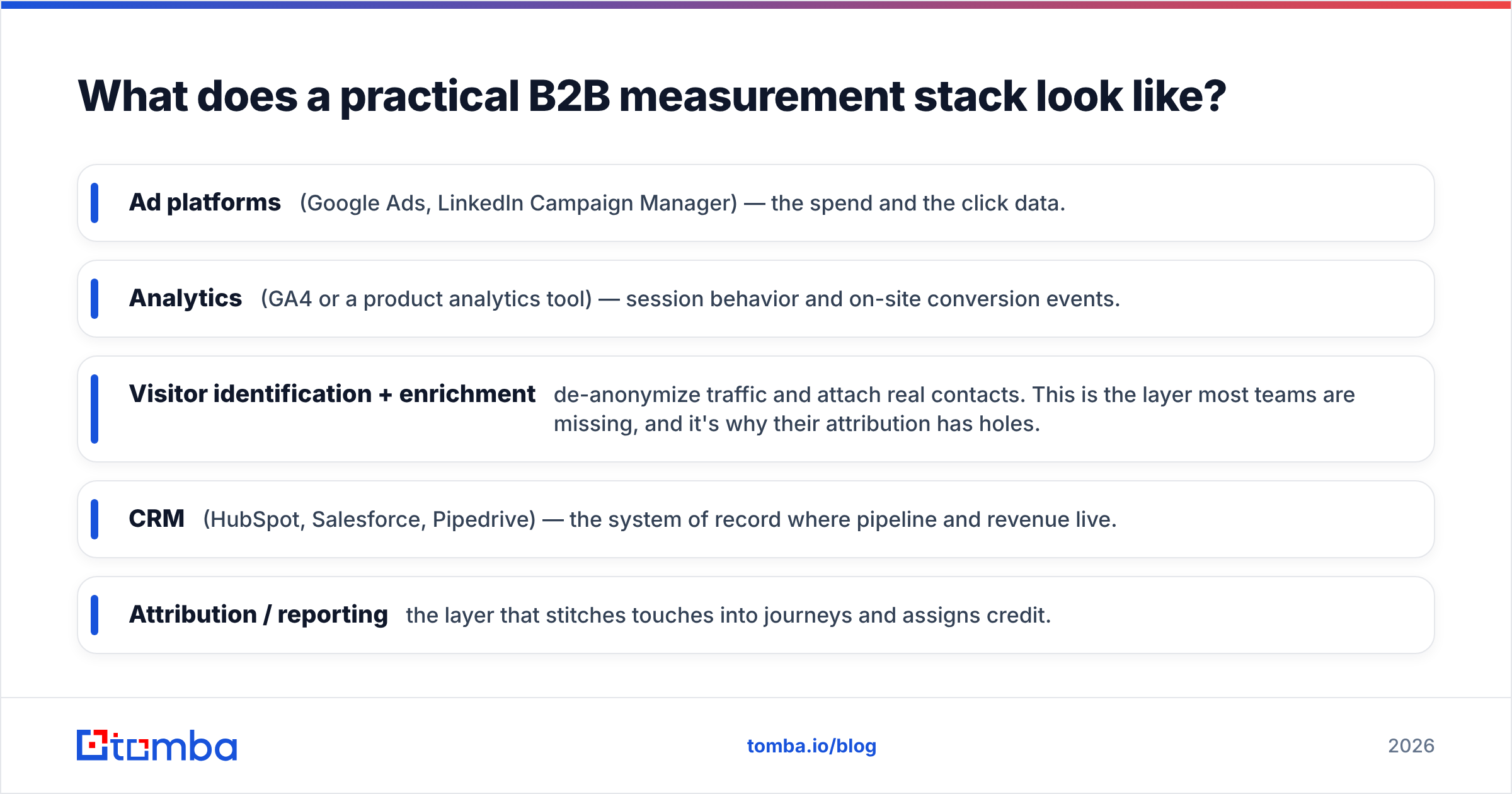
You don't need fifteen tools. You need coverage across five jobs. Here's the minimum viable stack and what each layer does:
- Ad platforms (Google Ads, LinkedIn Campaign Manager) — the spend and the click data.
- Analytics (GA4 or a product analytics tool) — session behavior and on-site conversion events.
- Visitor identification + enrichment — de-anonymize traffic and attach real contacts. This is the layer most teams are missing, and it's why their attribution has holes.
- CRM (HubSpot, Salesforce, Pipedrive) — the system of record where pipeline and revenue live.
- Attribution / reporting — the layer that stitches touches into journeys and assigns credit.
The connective tissue between these — the part that quietly determines whether your whole measurement effort works — is data quality. Bad email addresses, duplicate records, and unverified contacts corrupt attribution silently. A lead attributed to the wrong account, or a bounced contact that never should have entered the funnel, poisons every downstream report. Keeping records clean with an email verifier and deduplicated enrichment isn't glamorous, but it's the foundation everything else sits on.
How do you report B2B ad performance to leadership?#
Executives don't want a dashboard of 40 metrics. They want three questions answered: Are we generating pipeline? Is it efficient? Is it turning into revenue?
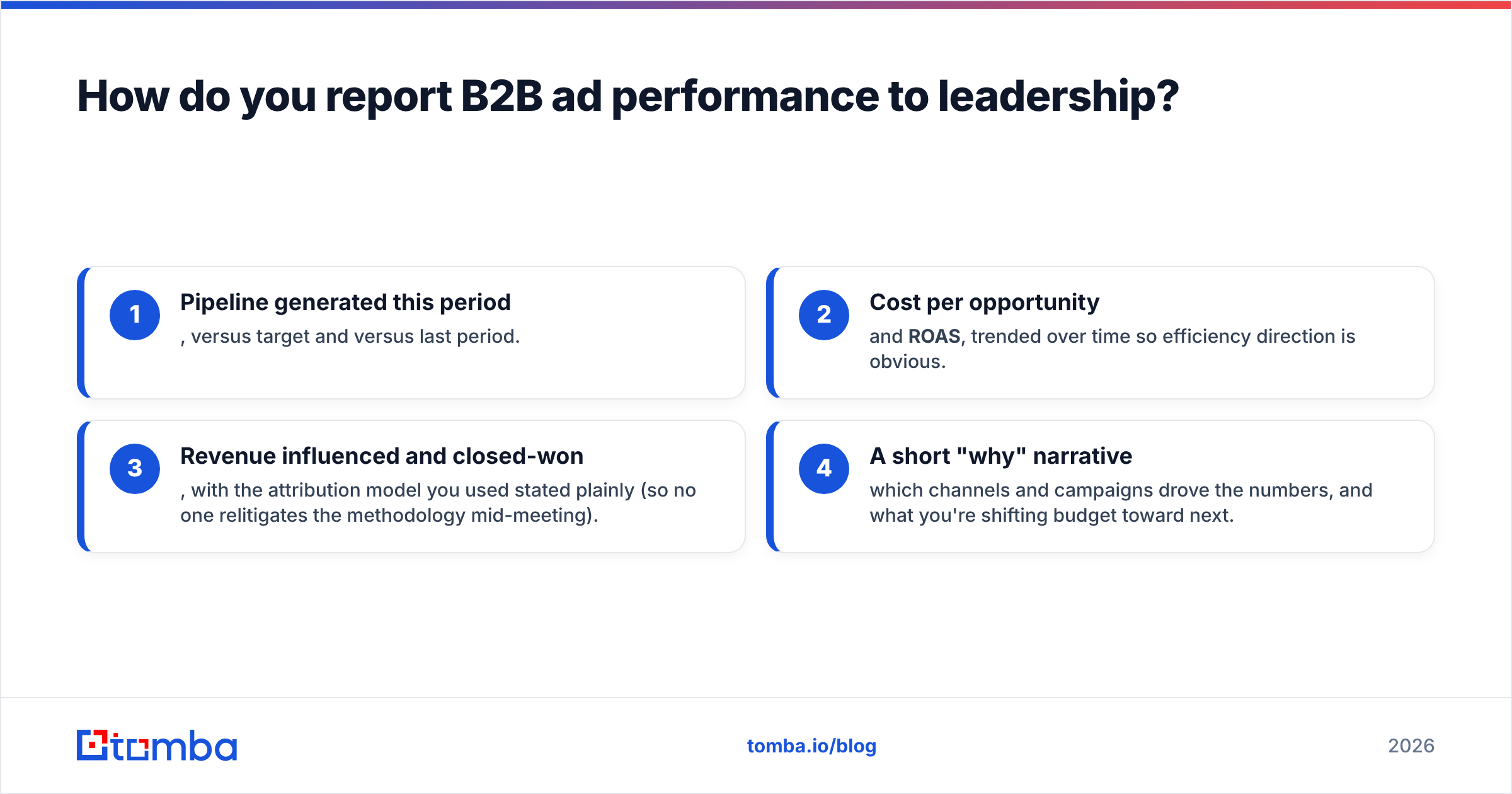
Structure your reporting around those, and lead with the outcome tier:
- Pipeline generated this period, versus target and versus last period.
- Cost per opportunity and ROAS, trended over time so efficiency direction is obvious.
- Revenue influenced and closed-won, with the attribution model you used stated plainly (so no one relitigates the methodology mid-meeting).
- A short "why" narrative — which channels and campaigns drove the numbers, and what you're shifting budget toward next.
The discipline here is subtraction. Every vanity metric you include invites a question that pulls the conversation away from ROI. Report clicks internally for optimization; report pipeline and revenue upward.
Common measurement mistakes to avoid#
- Grading long cycles on short windows. A 90-day sales cycle judged on a 30-day attribution window will always look like a failure. Match your measurement window to your actual cycle length.
- Trusting last-click by default. It's the platform default because it's easy, not because it's right. It systematically overcredits branded search and retargeting.
- Ignoring anonymous traffic. If you only measure form-fillers, you're blind to most of the committee. Visitor identification is not optional in 2026.
- Letting data rot. Unverified emails and duplicate records quietly break attribution. Clean data in, trustworthy reports out.
- Optimizing to CPL. Cheap leads that never become opportunities are the most expensive thing in your budget.
The bottom line#
Digital advertising measurement B2B isn't about better dashboards. It is about closing the loop between the click and the contract. That means three things. Measure pipeline and revenue instead of clicks. Choose an attribution model that respects how committees actually buy. Most of all, build the identity layer that connects anonymous ad traffic to named accounts and real deals.
Most of that comes down to data. You can't attribute revenue to an ad if you can't identify who the ad reached. That's where Tomba fits: turn anonymous visitors into named companies, enrich them into complete, verified contact records, and push clean data into your CRM so every campaign traces cleanly to pipeline. Start with the Tomba Email Finder and enrichment stack on the free tier (25 searches a month), and scale up through the Growth and Pro plans as your measurement loop tightens. Better data is the cheapest attribution upgrade you'll ever buy.
Related guides#
Ready to find emails that actually work?
Join 150,000+ professionals who stopped guessing and started sending. Free credits on signup — no credit card required.
Get the Tomba newsletter
Practical outbound tactics and product updates — once every two weeks.
About the author