Digital Customer Acquisition Cost: The 2026 Benchmark Guide
Digital customer acquisition cost has climbed for a decade. Here's what a healthy CAC looks like in 2026, how to calculate it correctly, and the levers that actually bring it down.
Digital customer acquisition cost is the total you spend on marketing and sales to win one new paying customer through digital channels. It has crept upward every year since paid platforms matured, and 2026 is no exception. This guide shows you what a defensible number looks like, how to calculate it without fooling yourself, and the levers that actually move it.
TL;DR#
- Digital customer acquisition cost (CAC) = all sales + marketing spend in a period divided by the number of new customers won in that period.
- Paid CAC has risen roughly 60–70% over five years as ad auctions crowded and tracking degraded; blended CAC hides how expensive paid really is.
- A healthy business keeps its LTV:CAC ratio at 3:1 or better and recovers CAC in under 12 months.
- The biggest wins come from cheaper top-of-funnel (owned data, outbound, referrals), higher conversion, and better targeting — not from squeezing ad bids.
- Feeding your funnel with accurate first-party contact data is one of the most underrated ways to lower cost per acquired customer.
What is digital customer acquisition cost?#
Think of CAC like the price tag on a fish you caught. It is not just the bait — it is the boat, the fuel, the rod, the hours, and the one fish you actually landed, all divided into a single number. Digital customer acquisition cost applies that same accounting to every dollar you spend online — ads, content, SEO, email, sales salaries, tooling — measured against the customers those efforts produced.
Formally:
CAC = (Total sales spend + Total marketing spend) ÷ New customers acquired
The word digital narrows the numerator to online channels: paid search, paid social, display, digital sales tooling, content production, and the people running them. It is a foundational metric in revenue operations, because almost every growth decision — budget, hiring, pricing, channel mix — traces back to what a customer costs and what they return.
Two versions matter, and confusing them is the most common CAC mistake:
- Blended CAC — every new customer divided into total spend, including the ones who arrived "for free" via organic search, word of mouth, or direct traffic. It flatters you.
- Paid CAC — spend divided only by customers attributable to paid effort. It tells you the truth about your ad engine's efficiency.
How do you calculate CAC correctly?#
Most teams get the formula right and the inputs wrong. Here is the disciplined version.
- Pick a clean time window. Use a full month or quarter. Match the period of spend to the period of new customers, or you will divide January's ad bill by March's signups.
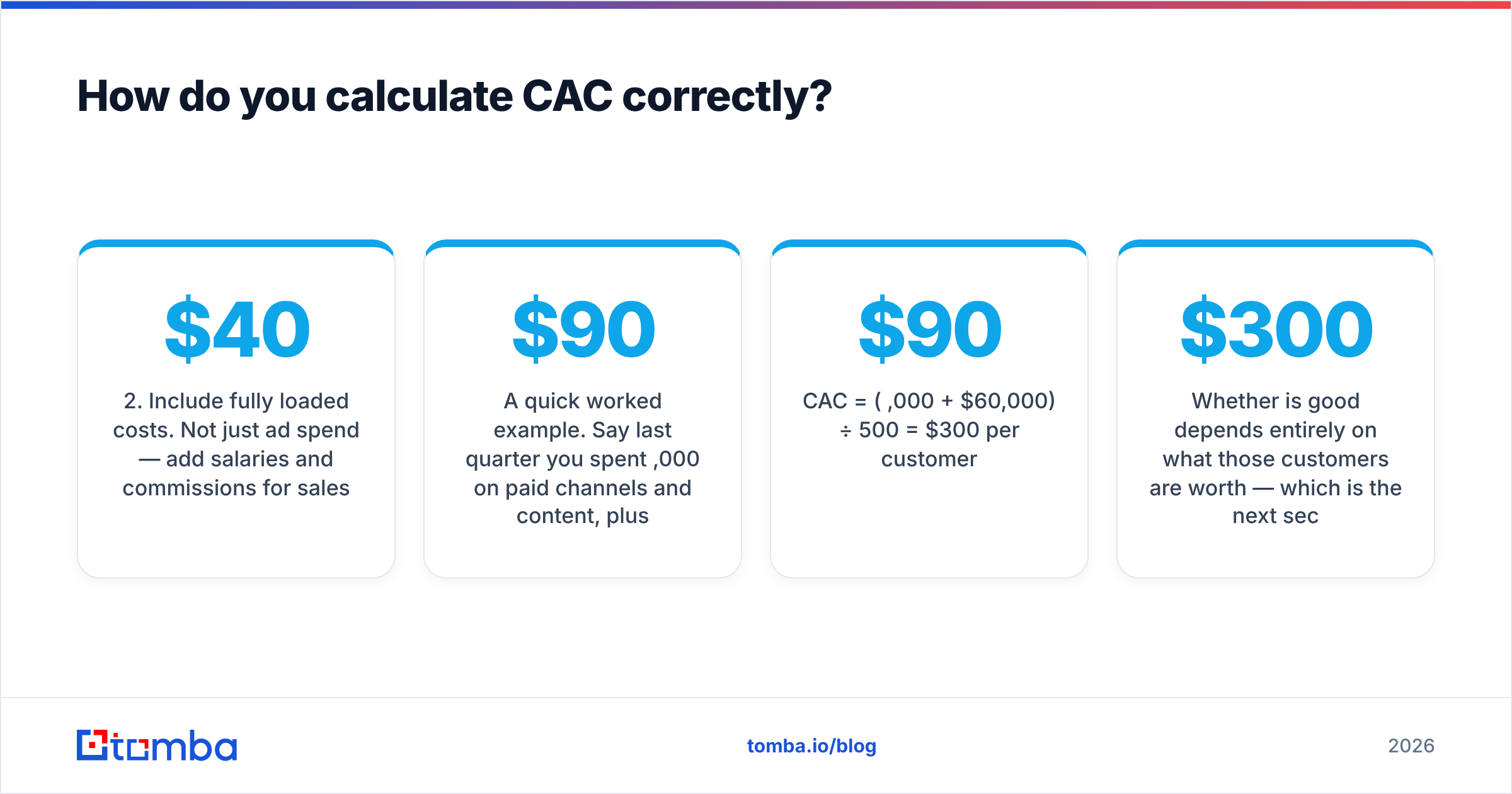
- Include fully loaded costs. Not just ad spend — add salaries and commissions for sales and marketing headcount, agency retainers, martech subscriptions, and creative production. This is where "our CAC is $40" quietly becomes $160.
- Count real customers, not leads. The denominator is paying customers, not signups, MQLs, or trials. Mixing these inflates or deflates the number depending on your funnel.
- Separate new from expansion. Revenue from existing accounts upgrading is not acquisition. Strip it out or you understate CAC.
- Segment by channel. A single company-wide CAC hides that paid social costs 4x what referrals do. Channel-level CAC is where decisions actually get made.
A quick worked example. Say last quarter you spent $90,000 on paid channels and content, plus $60,000 in loaded sales-and-marketing salaries, and closed 500 new customers:
CAC = ($90,000 + $60,000) ÷ 500 = $300 per customer
Whether $300 is good depends entirely on what those customers are worth — which is the next section.
What is a good digital customer acquisition cost in 2026?#
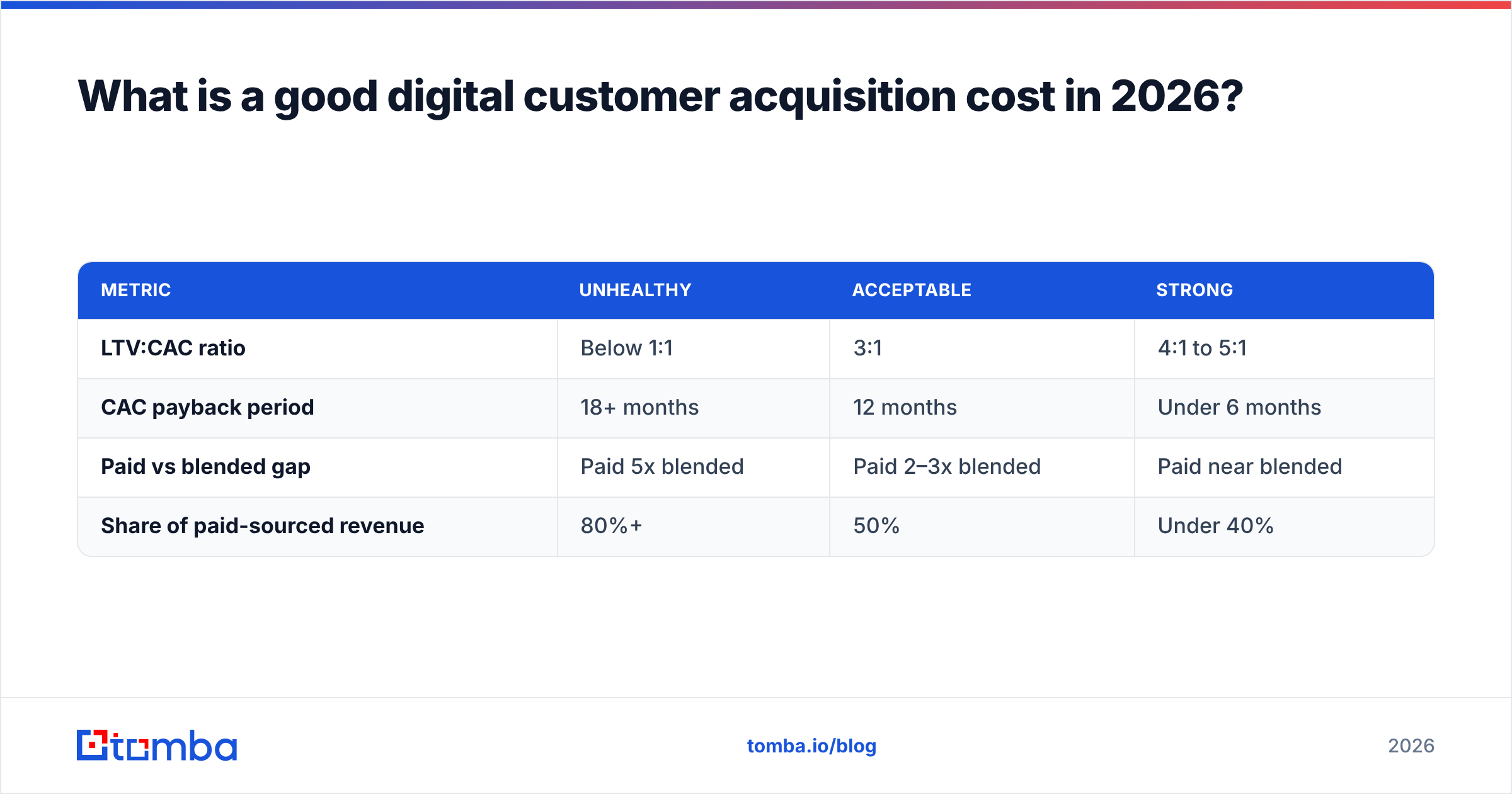
There is no universal "good" number, but there are universal ratios. The one that matters most is LTV:CAC — the lifetime value of a customer divided by what they cost to acquire.
| Metric | Unhealthy | Acceptable | Strong |
|---|---|---|---|
| LTV:CAC ratio | Below 1:1 | 3:1 | 4:1 to 5:1 |
| CAC payback period | 18+ months | 12 months | Under 6 months |
| Paid vs blended gap | Paid 5x blended | Paid 2–3x blended | Paid near blended |
| Share of paid-sourced revenue | 80%+ | 50% | Under 40% |
A ratio above 5:1 is not always a trophy — it can mean you are underinvesting and leaving growth on the table. Below 1:1 means you pay more to acquire a customer than they will ever return, which is a fire, not a metric.
CAC also varies wildly by industry. According to widely cited benchmark data compiled across B2B and B2C sectors, HubSpot's research on acquisition costs shows software and financial services routinely sit at the high end because deal values — and competition for keywords — are high. A SaaS product with a $6,000 annual contract can absorb a $1,200 CAC comfortably; a $9/month app cannot.
Why does digital customer acquisition cost keep rising?#
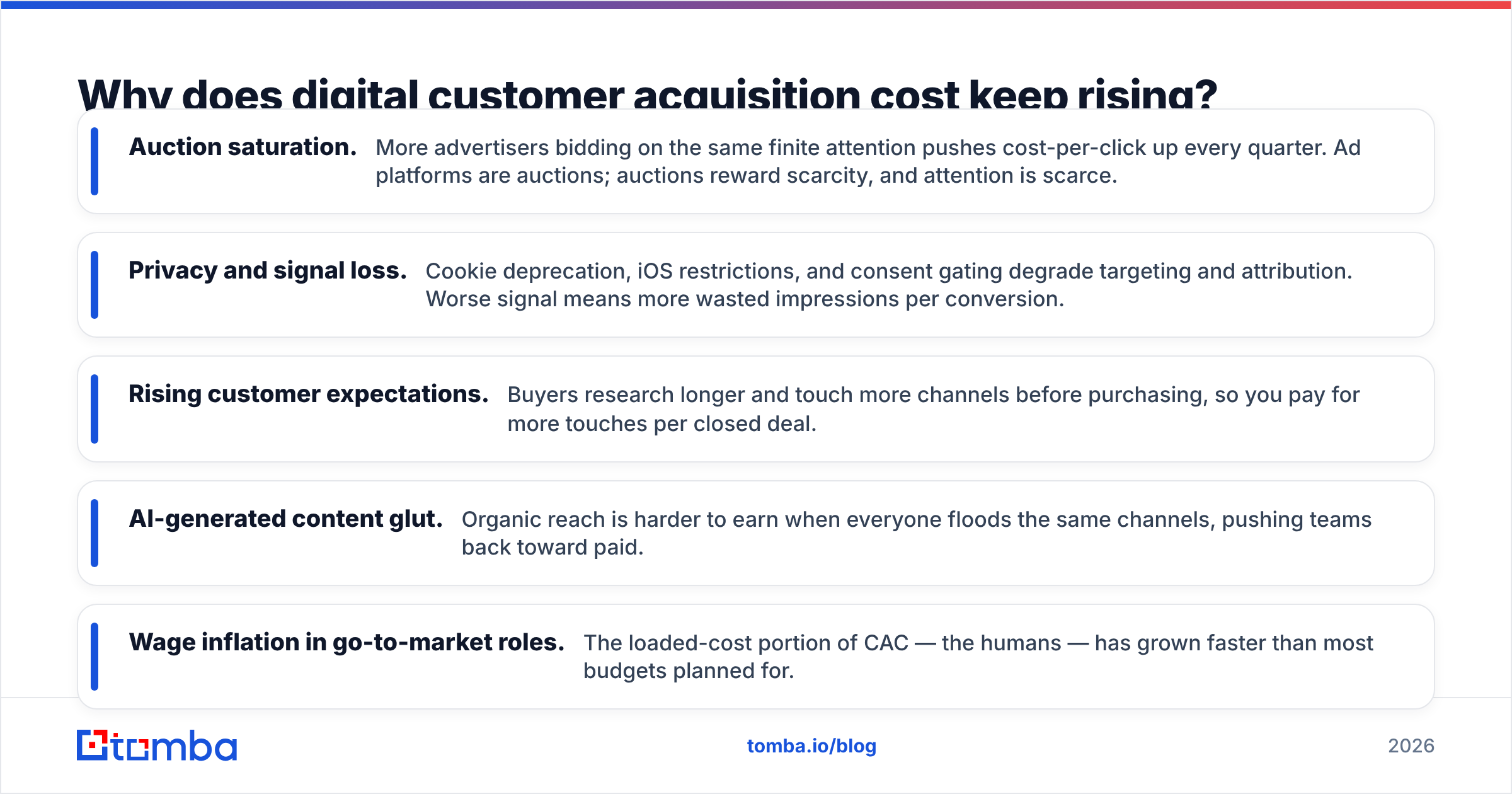
Because the channels that once felt cheap got crowded, measured worse, and priced higher. Five forces are compounding:
- Auction saturation. More advertisers bidding on the same finite attention pushes cost-per-click up every quarter. Ad platforms are auctions; auctions reward scarcity, and attention is scarce.
- Privacy and signal loss. Cookie deprecation, iOS restrictions, and consent gating degrade targeting and attribution. Worse signal means more wasted impressions per conversion.
- Rising customer expectations. Buyers research longer and touch more channels before purchasing, so you pay for more touches per closed deal.
- AI-generated content glut. Organic reach is harder to earn when everyone floods the same channels, pushing teams back toward paid.
- Wage inflation in go-to-market roles. The loaded-cost portion of CAC — the humans — has grown faster than most budgets planned for.
None of these are reversing. The winning move is not to wait for ad prices to fall — it is to reduce dependence on the most inflated channels.
How do you lower digital customer acquisition cost?#
Lowering CAC is a math problem with two levers: spend less to reach the right people, or convert more of the people you reach. Everything below is one of those two.
1. Diversify away from paid-only acquisition#
Every dollar concentrated in paid search and social is a dollar exposed to auction inflation. Building owned channels — SEO, email lists, community, referral loops — lowers blended CAC over time because their marginal cost per customer drops as they compound. Paid buys attention; owned earns it and keeps it.
2. Improve targeting with better first-party data#
A huge share of wasted acquisition spend goes to the wrong people: bad-fit accounts, stale contacts, undeliverable emails. Tightening who you target is often cheaper and faster than optimizing creative. This is where accurate contact data earns its keep — a verified, well-segmented list means your outbound and retargeting dollars land on real prospects instead of bouncing.
Using a reliable email finder and email verifier before you spend keeps your funnel clean, which directly lowers cost per acquired customer. You can also enrich existing records with data enrichment so segmentation is based on real firmographics, not guesses.
3. Raise conversion rates across the funnel#
If CAC is spend ÷ customers, then doubling conversion halves CAC without touching the budget. Landing-page tests, faster lead follow-up, tighter lead scoring, and better sales enablement all attack the denominator. A 30% lift in trial-to-paid conversion is usually cheaper to win than a 30% cut in ad prices.
4. Shorten the payback period#
Even if CAC stays flat, recovering it faster frees cash to reinvest. Annual prepay incentives, onboarding that drives quick activation, and upsell paths that lift early revenue all compress payback — which behaves like a CAC reduction on your balance sheet.
5. Build referral and word-of-mouth loops#
Referred customers arrive with near-zero acquisition cost and typically convert and retain better. A structured referral program is one of the few levers that lowers CAC while improving customer quality at the same time.
How does CAC fit alongside your other growth metrics?#
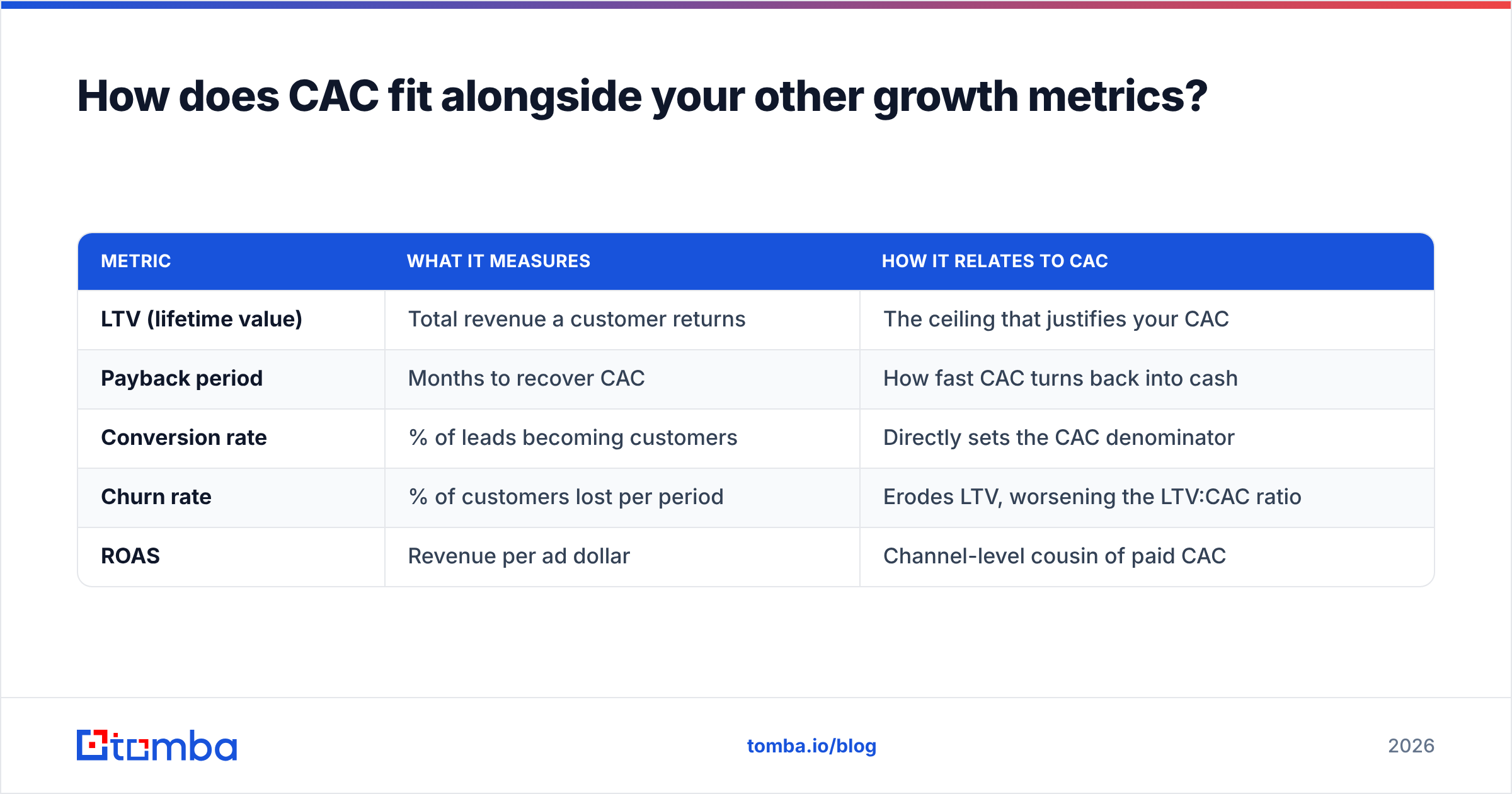
CAC is never read alone. It lives in a small constellation of numbers, and the relationships between them tell the real story.
| Metric | What it measures | How it relates to CAC |
|---|---|---|
| LTV (lifetime value) | Total revenue a customer returns | The ceiling that justifies your CAC |
| Payback period | Months to recover CAC | How fast CAC turns back into cash |
| Conversion rate | % of leads becoming customers | Directly sets the CAC denominator |
| Churn rate | % of customers lost per period | Erodes LTV, worsening the LTV:CAC ratio |
| ROAS | Revenue per ad dollar | Channel-level cousin of paid CAC |
The trap is optimizing one in isolation. Slashing CAC by cutting brand spend can quietly lower LTV as lead quality drops. Chasing LTV with heavy discounting can spike CAC. RevOps exists to keep these in balance rather than letting one team win its metric while the business loses.
For a deeper treatment of how these connect to pipeline health, the analyst frameworks from Gartner are a solid neutral reference, and peer-review sites like G2 are useful for benchmarking what tooling actually costs before you add it to your loaded CAC.
What role does contact data quality play in CAC?#
More than most teams admit. Every wasted send, every bounced email, every rep hour spent chasing a disconnected number is acquisition cost with nothing to show for it. If 20% of your outreach list is undeliverable, you are effectively paying a 20% tax on the labor and tooling in your CAC numerator.
Cleaning and enriching your data before campaigns is one of the cheapest CAC reductions available:
- Verify before you send so bounces do not damage sender reputation and drag down deliverability.
- Enrich for segmentation so spend concentrates on best-fit accounts.
- Deduplicate and standardize so you are not paying to acquire someone you already have.
- Find decision-makers directly with a domain search instead of buying broad, low-intent audiences.
This is unglamorous work, but it moves CAC more reliably than another round of ad-copy testing. Reputable data providers — including peers like BookYourData for prebuilt B2B lists — and self-serve finders both have a place, depending on whether you want ready-made volume or precise, on-demand lookups.
Common CAC mistakes to avoid#
- Reporting blended CAC as if it were paid CAC. It hides how expensive your ad engine really is and delays hard decisions.
- Excluding salaries. Fully loaded CAC is the only honest CAC. The humans are usually the biggest line item.
- Ignoring the payback period. A "good" CAC with an 18-month payback can still starve you of cash.
- Optimizing CAC while churn quietly rises. A cheap customer who leaves in two months is a loss, not a win.
- Spending before cleaning your data. Targeting bad contacts converts CAC into pure waste.
Bringing digital customer acquisition cost under control#
Digital customer acquisition cost will keep rising in the channels everyone crowds into — that trend is structural. Your defense is not to outbid the auction; it is to depend on it less, convert more of what you already reach, and stop paying to chase contacts who were never reachable. Measure CAC fully loaded, split paid from blended, watch it against LTV and payback, and treat data quality as a first-class CAC lever rather than an afterthought.
If cleaner targeting is where you want to start, the fastest lever is better contact data at the top of the funnel. Tomba's Email Finder helps you reach verified, best-fit decision-makers by domain, name, or company — so the money in your CAC numerator lands on real prospects instead of bounces. Pair it with the built-in verifier, start on the free tier of 25 searches a month, and scale on a Tomba plan from $49/mo when your pipeline grows. Lower waste, cleaner data, cheaper customers.
Related guides#
Ready to find emails that actually work?
Join 150,000+ professionals who stopped guessing and started sending. Free credits on signup — no credit card required.
Get the Tomba newsletter
Practical outbound tactics and product updates — once every two weeks.
About the author