Digital Marketing Cold Calling Script: 2026 Playbook & Examples
A word-for-word digital marketing cold calling script that opens strong, handles the brush-offs, and books discovery calls — plus objection responses and metrics that actually matter.
Cold calling is not dead for digital marketing agencies — bad cold calling is. The reps who still book meetings in 2026 open with a reason, talk less than the prospect, and follow a script tight enough to stay on message but loose enough to sound human. This is that script.
TL;DR#
- Use a permission-based opener, not "How are you today?" — earn 30 seconds before you pitch anything.
- Lead with a specific, observable problem on the prospect's website, ads, or SEO — generic "we do marketing" calls get hung up on.
- The goal of the call is the meeting, not the sale. Every line should move toward a 15-minute discovery slot.
- Have three objection rebuttals memorized: "not interested," "send me an email," and "we already have an agency."
- Feed the script warm, accurate contact data. A perfect script dialing wrong numbers still fails — verify emails and confirm direct lines before you dial.
Does cold calling still work for digital marketing agencies in 2026?#
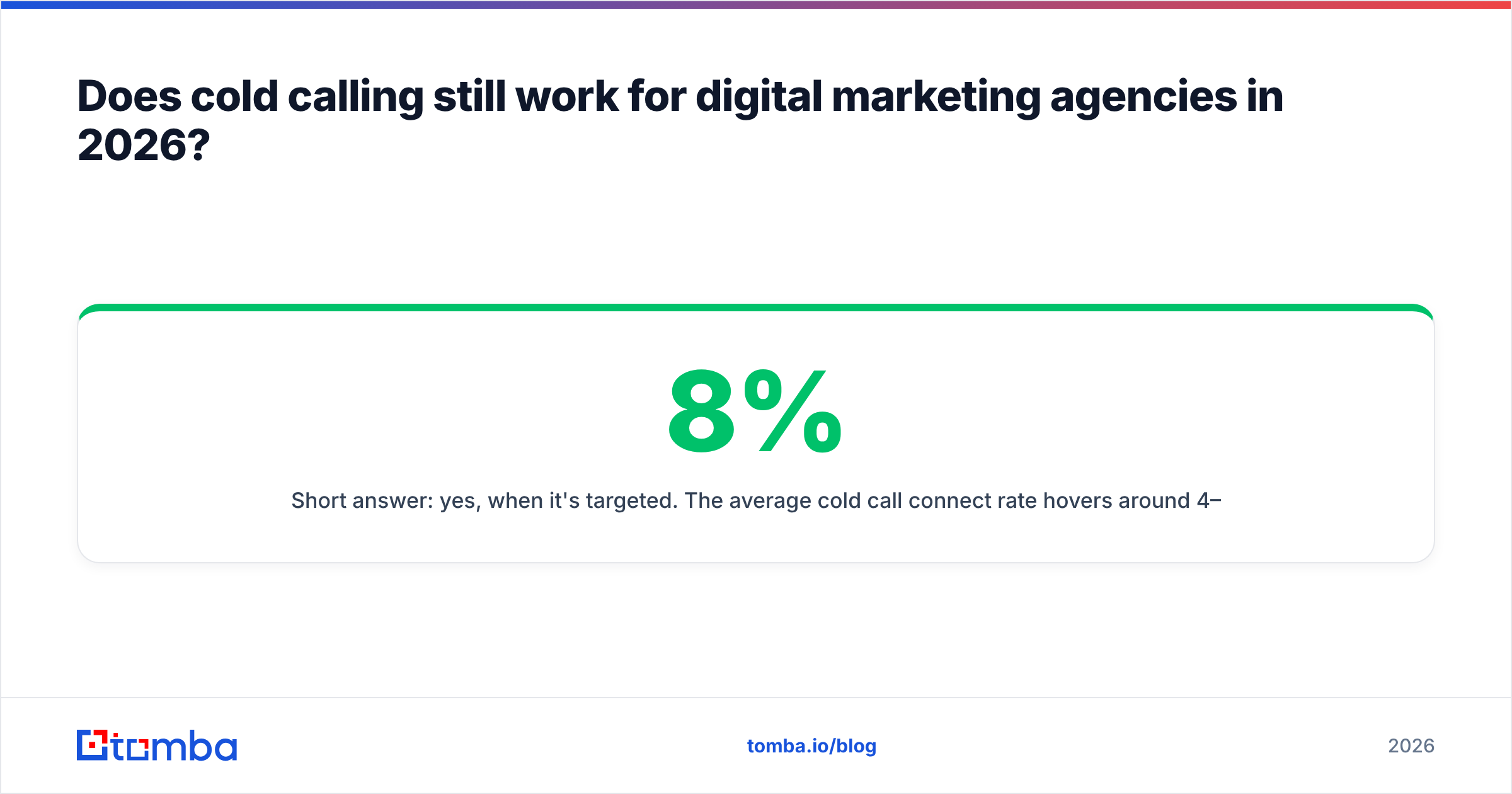
Short answer: yes, when it's targeted. The average cold call connect rate hovers around 4–8%, and booking rates on connected calls range from 1% to 3% for cold lists — but agencies running tight, research-backed scripts against qualified lists routinely beat that. The difference is never the phone. It's the list and the first 15 seconds.
Digital marketing is uniquely suited to cold calling because your prospect's problems are public. You can see a slow Core Web Vitals score, a Google Business Profile with no reviews, an ad that's been running the same creative for six months, or a blog that hasn't published since 2023. That observable evidence is your opener — and it's what separates a booked meeting from a dial tone.
The problem is most reps skip the research because it's slow. That's a data problem, not a calling problem. Pull a clean list of local businesses or SaaS companies, enrich it with the decision-maker's name and direct line, and note one specific issue per account before you pick up the phone. A B2B database plus 90 seconds of manual review per prospect turns a spray-and-pray dial session into a series of relevant conversations.
What does a digital marketing cold calling script look like?#
Here's the full framework, section by section. Read it out loud — if it sounds like a robot, cut words until it doesn't.
The opener (0–20 seconds)#
"Hi [Name], it's [You] from [Agency]. I know I'm an interruption — can I take 30 seconds to tell you why I called, and you can tell me to buzz off if it's not relevant?"
This works because it's honest, it's short, and it hands control to the prospect. Nine times out of ten they say "go ahead" — because you didn't pretend the call was anything other than what it is.
The reason (20–45 seconds)#
"I was looking at [Company]'s Google Ads and noticed you're bidding on your own brand terms but not on three of your competitors' — [Competitor A] is showing up above you when people search for the exact service you sell. We help [industry] agencies plug that gap, and it usually takes about two weeks to see the first leads. That's the whole reason I called."
Specific. Observable. Tied to money. You've now proven you did homework, which almost no cold caller does.
The ask (45–60 seconds)#
"I'm not going to try to sell you anything on this call — you don't know me yet. Would you be open to a 15-minute call Thursday where I walk you through exactly what I'm seeing and what it's likely costing you? If it's not useful, you've lost 15 minutes."
Notice the ask is tiny and reversible. You're selling the meeting, not the retainer.
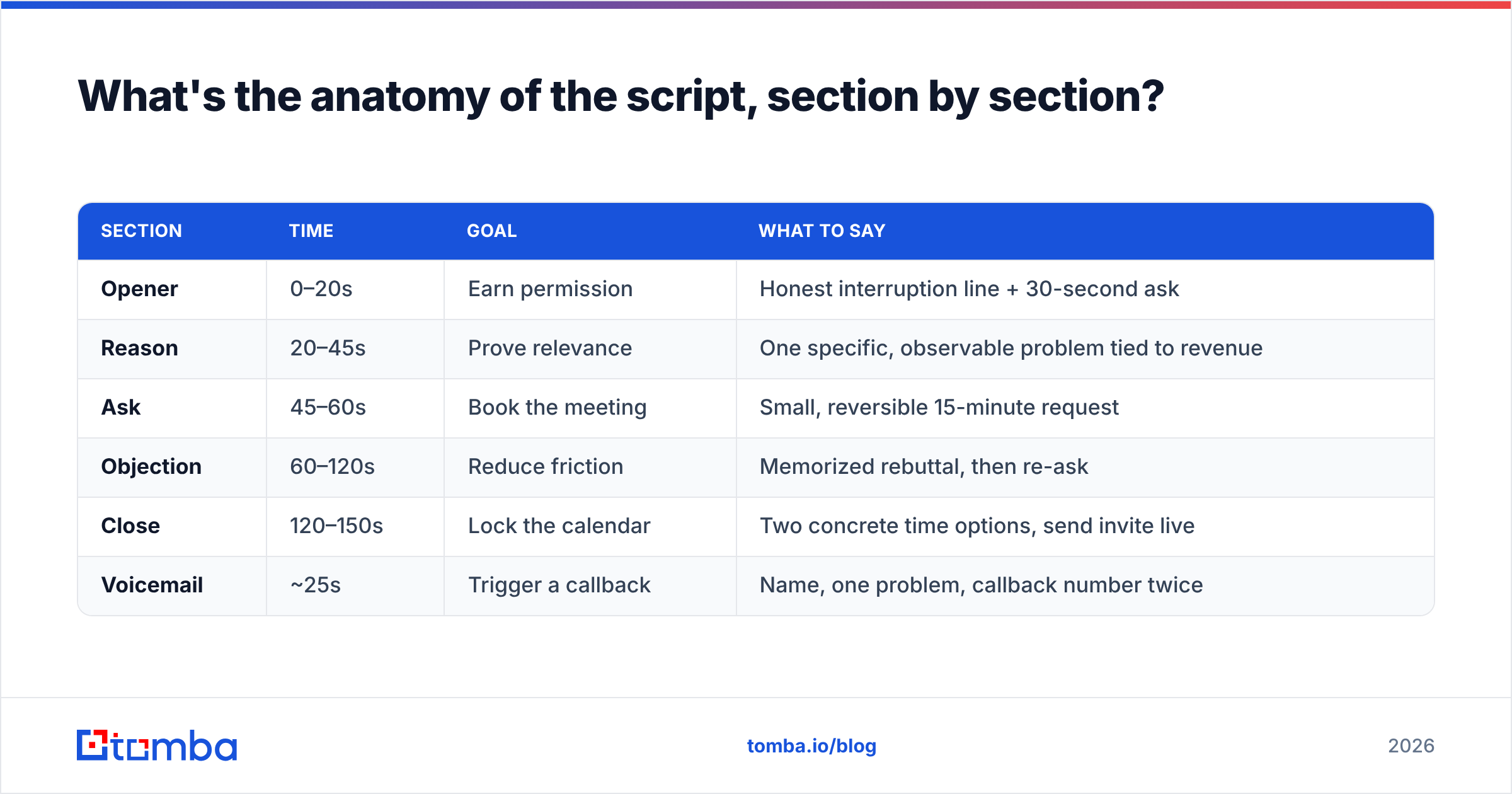
What's the anatomy of the script, section by section?#
Use this table as your call map. Keep it on one screen while you dial.
| Section | Time | Goal | What to say |
|---|---|---|---|
| Opener | 0–20s | Earn permission | Honest interruption line + 30-second ask |
| Reason | 20–45s | Prove relevance | One specific, observable problem tied to revenue |
| Ask | 45–60s | Book the meeting | Small, reversible 15-minute request |
| Objection | 60–120s | Reduce friction | Memorized rebuttal, then re-ask |
| Close | 120–150s | Lock the calendar | Two concrete time options, send invite live |
| Voicemail | ~25s | Trigger a callback | Name, one problem, callback number twice |
The whole successful call is under three minutes. If you're on the phone for ten, you're either talking too much or selling instead of qualifying.
How do you handle the three most common objections?#
You will hear the same three brush-offs on 80% of your connected calls. Memorize a response to each so you never freeze.
- "I'm not interested." — "Totally fair, you don't know yet whether there's anything to be interested in. The reason I called is [specific problem]. If I'm wrong about that, I'll hang up. If I'm right, it's worth 15 minutes. Which is it?"
- "Just send me an email." — "Happy to — most people say that to end the call politely, so let me ask: if I send it, is there a real chance you'll read it and reply? If yes, what's the best address? If it's more of a soft no, just tell me and I'll stop bugging you." (Then actually find the right email and send something specific.)
- "We already have an agency." — "Good — that means you already believe in this channel, which is most of the battle. I'm not asking you to fire anyone. I'm asking for 15 minutes to show you one thing your current team isn't doing. If they're already doing it, you've lost nothing."
The pattern is identical every time: acknowledge, re-state the specific reason, re-ask for the small commitment. Never argue. Never oversell.
Cold call script vs. cold email vs. LinkedIn — which channel wins?#
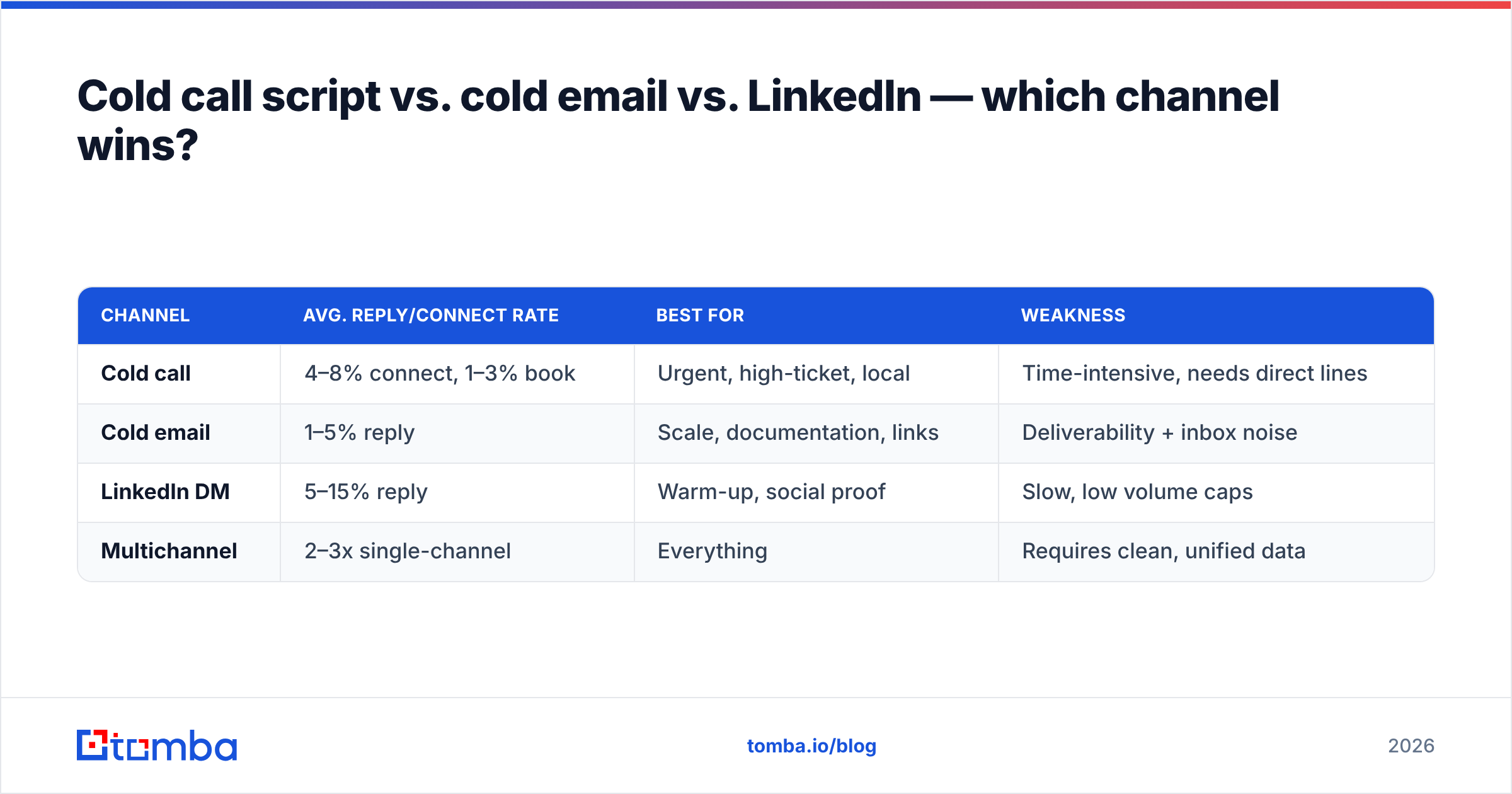
None of them win alone. The agencies booking the most meetings run all three against the same list. Here's how the channels stack up so you can sequence them intelligently.
| Channel | Avg. reply/connect rate | Best for | Weakness |
|---|---|---|---|
| Cold call | 4–8% connect, 1–3% book | Urgent, high-ticket, local | Time-intensive, needs direct lines |
| Cold email | 1–5% reply | Scale, documentation, links | Deliverability + inbox noise |
| LinkedIn DM | 5–15% reply | Warm-up, social proof | Slow, low volume caps |
| Multichannel | 2–3x single-channel | Everything | Requires clean, unified data |
The winning sequence for most digital marketing agencies: a LinkedIn view and connection request, then a specific cold email, then the call referencing both. By the time you dial, you're a name the prospect has seen twice — not a stranger. To run that, you need matching contact records across channels, which is where contact enrichment and B2B phone numbers earn their keep.
How do you leave a voicemail that gets a callback?#
Assume 80% of your dials go to voicemail. If you hang up, you wasted the dial. Leave a 25-second message built to trigger curiosity, not to pitch.
"Hi [Name], it's [You] at [Agency] — [number]. Quick one: I noticed [Company] is [specific problem, e.g., not showing up for 'emergency plumber near me' while three competitors are]. I have a two-minute fix I wanted to run by you. Call me back at [number again], that's [number]. Thanks [Name]."
Say your number twice, slowly. Name the company and the problem. Keep the promise small ("two-minute fix," not "grow your revenue 300%"). Then send a matching email the same day so the two touches reinforce each other.
What metrics tell you the script is working?#
Don't judge a script by "how it feels." Judge it by numbers. Track these from day one:
- Connect rate — dials that reach a human. Below 4%? Your list or your call times are the problem, not the script.
- Pitch rate — connects where you got past the opener into your reason. This measures your first 20 seconds.
- Book rate — connects that turned into a scheduled meeting. This measures the whole script.
- Show rate — booked meetings that actually happened. Low show rates mean you booked people who were being polite.
If your connect rate is healthy but your book rate is low, fix the reason and the ask. If your connect rate itself is low, the script is irrelevant — you have a data and timing problem. According to HubSpot's sales research, the best times to reach prospects are late morning and late afternoon, and persistence matters: most connects happen after multiple attempts, not the first dial.
How do you build the list the script runs on?#
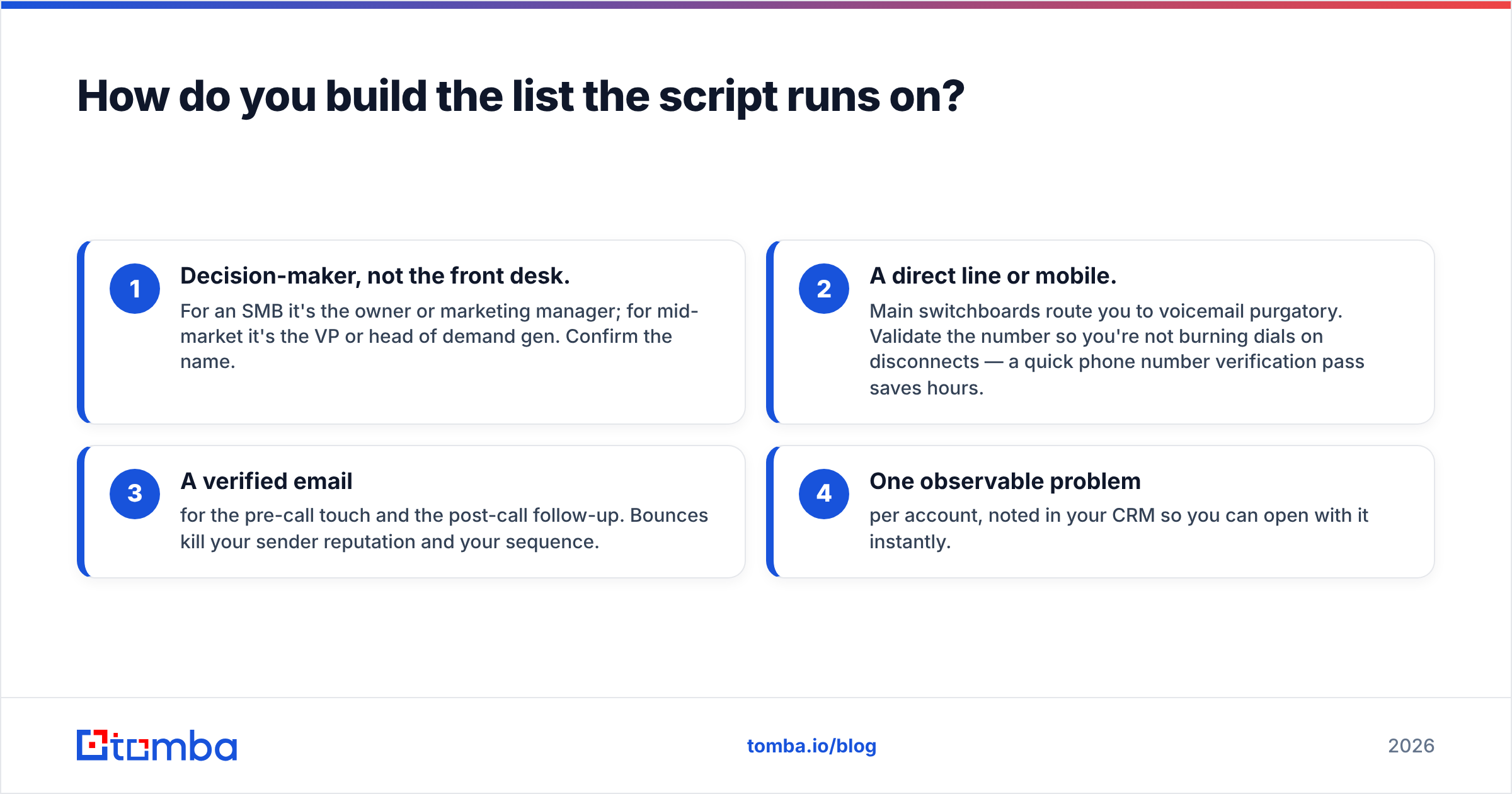
A great script against a bad list is the single most common way agencies waste a calling program. The script assumes three things are true before you dial: you have the right person, a reachable direct line, and one specific problem to open with. Get those wrong and the best openers in the world die on impossible connects.
Here's the pre-call data checklist:
- Decision-maker, not the front desk. For an SMB it's the owner or marketing manager; for mid-market it's the VP or head of demand gen. Confirm the name.
- A direct line or mobile. Main switchboards route you to voicemail purgatory. Validate the number so you're not burning dials on disconnects — a quick phone number verification pass saves hours.
- A verified email for the pre-call touch and the post-call follow-up. Bounces kill your sender reputation and your sequence.
- One observable problem per account, noted in your CRM so you can open with it instantly.
You can assemble this manually from company websites and LinkedIn, or pull it in bulk. Tools vary widely on accuracy — reputable providers like BookYourData and Tomba focus on verified, compliant B2B records rather than scraped guesswork, which is what keeps your connect rate up and your bounce rate down.
Where does Tomba fit into your cold calling workflow?#
Tomba is the data layer that feeds the script — it finds and verifies the contacts you dial and email, so your reps spend their time talking to real decision-makers instead of chasing dead numbers.
The Tomba Email Finder locates professional email addresses by name, company, or domain, so your pre-call and post-call touches actually land. Pair it with the email verifier to keep bounces near zero, the phone finder for direct lines, and data enrichment to fill in the decision-maker details your script depends on. Pricing runs from a free tier with 25 searches a month up to Starter at $49/mo and Growth at $99/mo — see the full Tomba pricing for team plans.
Build the clean, verified list first. Then run the script above against it. That's the combination that still books meetings in 2026 — start free and dial your first accurate list this week.
Related guides#
Ready to find emails that actually work?
Join 150,000+ professionals who stopped guessing and started sending. Free credits on signup — no credit card required.
Get the Tomba newsletter
Practical outbound tactics and product updates — once every two weeks.
About the author