Digital Marketing Demand Generation: A Practical 2026 Guide
Demand generation is not lead gen with a new label. Here's how modern B2B teams build pipeline in 2026 — the channels, the metrics, and the data layer that makes it work.
Demand generation is the discipline of creating and capturing buyer interest across the entire funnel — not just harvesting the people who already raised their hand. Done well, it turns cold markets into a predictable pipeline. Done badly, it becomes an expensive way to inflate MQL counts that sales quietly ignores.
This guide breaks down what digital marketing demand generation actually means in 2026, how it differs from lead generation, the channels and metrics that matter, and the data layer that separates programs that build pipeline from programs that just burn budget.
TL;DR#
- Demand generation ≠ lead generation. Demand gen creates and captures interest across the whole buyer journey; lead gen is the narrower act of collecting contact details. You need both, sequenced correctly.
- The 2026 shift is toward "dark funnel" demand creation — podcasts, communities, LinkedIn, and content that buyers consume without ever filling a form — paired with tight capture on the ~5% who are in-market.
- Metrics that matter: pipeline sourced/influenced, cost per opportunity, and win rate — not raw lead volume or MQLs.
- Data quality is the hidden lever. Even a perfect campaign fails if the contact records feeding your CRM and outreach are stale or wrong.
- A practical stack blends brand/demand creation, a capture layer, and clean enrichment so sales gets contacts they can actually reach.
What is digital marketing demand generation?#
Demand generation is a full-funnel go-to-market approach that combines marketing, content, and sales motions to build awareness, shape buying criteria, and convert interest into revenue. The word "demand" is doing real work here: you are not just collecting people who already want your product, you are creating want in a market that didn't know it had a problem worth solving.
Think of it like a restaurant. Lead generation is taking reservations from people already walking past the door. Demand generation is the neighborhood reputation, the smell drifting down the street, and the friend who insists you have to try the place — the reasons people decide they want to eat there before they ever check the menu. Technically, demand gen spans awareness content, community and channel presence, retargeting, and the capture and qualification systems that route interest to sales.
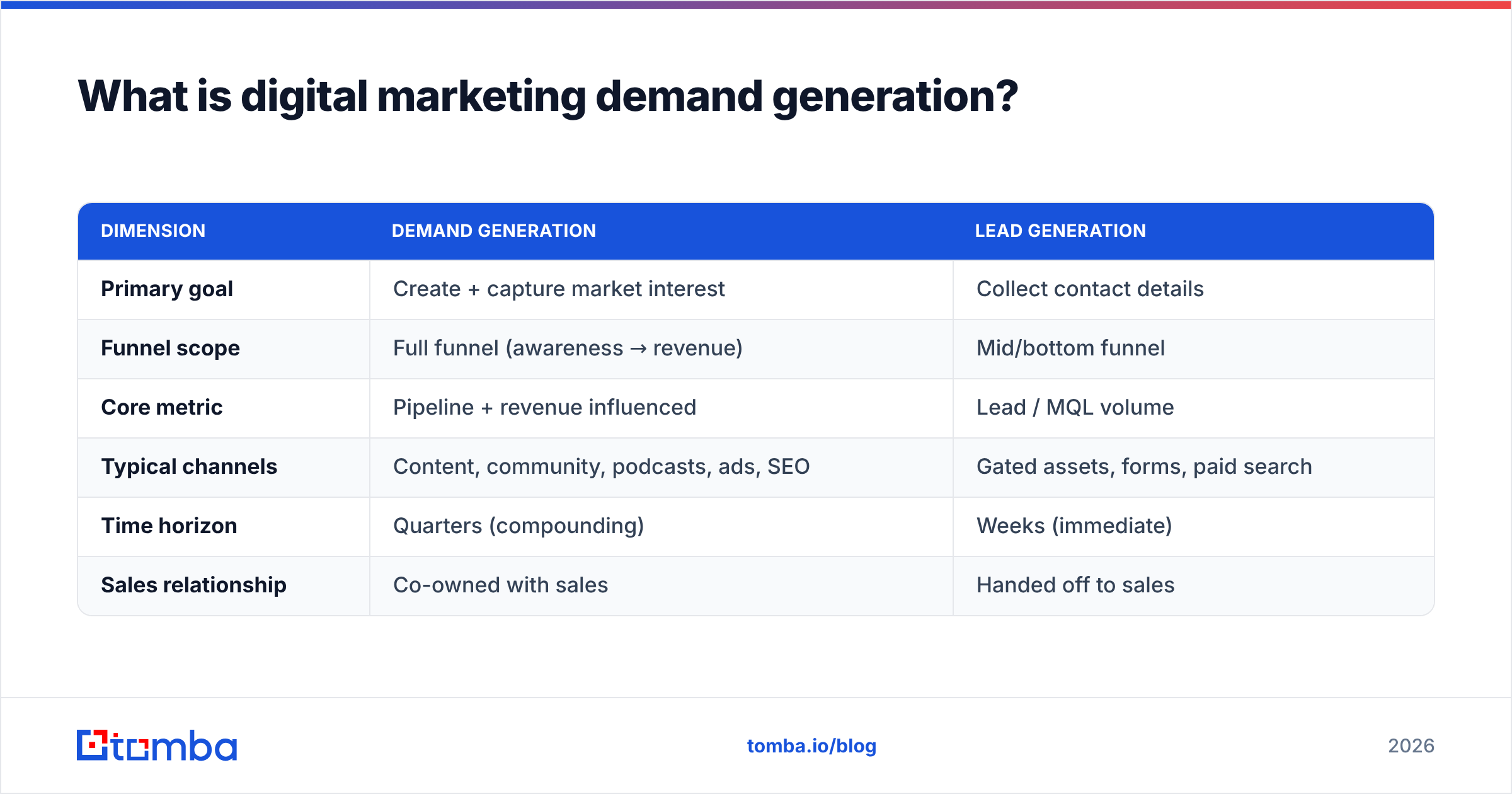
Here's how the two disciplines split in practice:
| Dimension | Demand Generation | Lead Generation |
|---|---|---|
| Primary goal | Create + capture market interest | Collect contact details |
| Funnel scope | Full funnel (awareness → revenue) | Mid/bottom funnel |
| Core metric | Pipeline + revenue influenced | Lead / MQL volume |
| Typical channels | Content, community, podcasts, ads, SEO | Gated assets, forms, paid search |
| Time horizon | Quarters (compounding) | Weeks (immediate) |
| Sales relationship | Co-owned with sales | Handed off to sales |
The mistake most teams make is treating these as synonyms. When "demand gen" quietly means "gate every asset and count downloads," you get volume without intent — and a sales team that stops trusting marketing's handoffs.
Why does demand generation matter more in 2026?#
Three shifts made full-funnel demand generation the default B2B playbook rather than a nice-to-have.
- Buyers self-educate before they talk to you. The majority of a B2B purchase decision now happens in the "dark funnel" — Slack communities, LinkedIn feeds, peer reviews, and podcasts — where you can't attribute a single click. If you only invest where you can track a form fill, you're invisible during the exact window when criteria get set.
- Form-fill volume is cheap and worthless. Anyone can buy a list and inflate lead counts. What's scarce is qualified pipeline, and boards increasingly ask for pipeline sourced, not leads generated.
- Data decay accelerated. With ongoing job changes and reorganizations, contact records go stale fast. A demand program that generates interest but routes it to a wrong or bounced email address leaks revenue silently.
According to research summarized by Gartner, buyers spend only a small fraction of the buying journey with any given sales rep — which means the rest of that journey is won or lost on the demand and content side. That's the core argument for investing upstream.
What are the core components of a demand generation engine?#
A modern engine has three layers. Miss one and the whole thing underperforms.
- Demand creation — Top-of-funnel work that builds awareness and shapes buying criteria: thought-leadership content, SEO, podcasts, LinkedIn presence, paid social for reach, and community participation. Success here looks like branded search volume and "how did you hear about us: a podcast" survey answers.
- Demand capture — The systems that convert existing intent: paid search on high-intent keywords, retargeting, comparison and bottom-funnel content, and low-friction conversion paths. This is where in-market buyers self-identify.
- Data + enrichment — The connective tissue. When someone converts, you need accurate firmographics, a reachable email, and a clean CRM record so sales can act fast. This layer is invisible when it works and catastrophic when it doesn't.
Most teams over-invest in capture and under-invest in creation, then wonder why their capture channels get more expensive every quarter. Capture without creation is just competing for the same small pool of in-market buyers everyone else is bidding on.
How do you measure demand generation performance?#
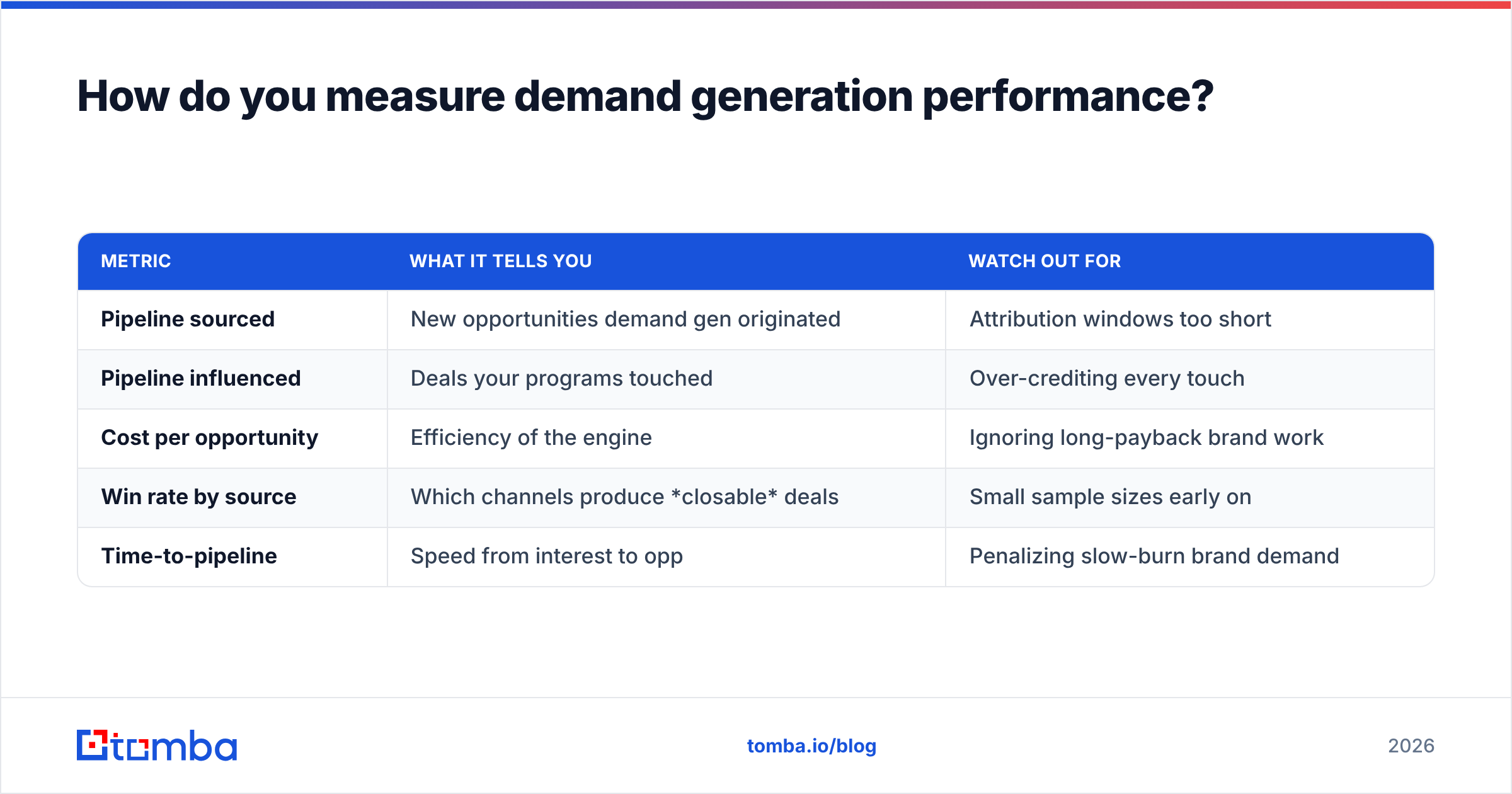
Measure pipeline and revenue, not activity. The vanity-metric trap is real: impressive dashboards full of clicks and downloads that never correlate with closed deals.
| Metric | What it tells you | Watch out for |
|---|---|---|
| Pipeline sourced | New opportunities demand gen originated | Attribution windows too short |
| Pipeline influenced | Deals your programs touched | Over-crediting every touch |
| Cost per opportunity | Efficiency of the engine | Ignoring long-payback brand work |
| Win rate by source | Which channels produce closable deals | Small sample sizes early on |
| Time-to-pipeline | Speed from interest to opp | Penalizing slow-burn brand demand |
A healthy program tracks a blend: leading indicators (branded search, engaged accounts, community growth) for creation, and lagging indicators (pipeline, win rate, CAC payback) for the whole engine. If your only dashboard is MQL count, you're optimizing the one number that predicts revenue the least. For a deeper primer on funnel definitions, the marketing qualified lead glossary entry is a useful reference point when aligning with sales.
Which channels drive demand generation in 2026?#
There's no universal ranking — the right mix depends on where your buyers actually spend attention. That said, the channels doing the heaviest lifting for B2B teams right now cluster into a few groups:
- Organic + SEO — Still the compounding foundation. Content that ranks for problem-aware and comparison queries captures intent 24/7 at near-zero marginal cost.
- LinkedIn (organic + paid) — The dominant B2B demand-creation channel. Personal and executive posting outperforms brand pages for reach and trust.
- Podcasts + partnerships — High-trust, hard-to-attribute, and increasingly central to how buyers form vendor shortlists.
- Paid search + retargeting — The capture workhorse. Keep it, but don't confuse "we captured demand" with "we created it."
- Community + events — Owned and third-party communities where buyers ask peers what to buy.
The through-line: creation channels are hard to attribute and easy to cut when budgets tighten — which is exactly why disciplined teams protect them. HubSpot's marketing research consistently shows that brand-led demand pays back over longer horizons than last-click capture, even though capture looks better in a monthly report.
Why is data quality the hidden lever in demand generation?#
Because a demand program is only as good as the contact records it feeds into sales. You can run a flawless campaign, generate genuine interest, and still lose the deal if the email bounces, the phone number is dead, or the record says "Marketing Coordinator" when the person is now a VP.
This is where demand gen quietly connects to operations. Every form fill, every enriched account, every list handed to SDRs passes through a data layer. If that layer is stale, three things break:
- Deliverability drops as bounces accumulate and your sending sender reputation erodes, so even your good contacts stop seeing your emails.
- Sales wastes cycles chasing wrong contacts, which trains reps to distrust marketing-sourced leads.
- Attribution lies because the CRM record is too incomplete to connect the deal back to the program that created it.
The fix is a clean capture-and-enrichment routine. When a lead converts, you want to verify the email is real, enrich the record with accurate firmographics, and make sure the reachable contact — not just the form-filler — is in the CRM. Tools like the Tomba email verifier exist to keep bounce rates low, and a domain search helps sales find the right decision-maker at an account that showed intent, rather than emailing whoever happened to download an ebook. Reliable data enrichment turns a thin lead into an account record a rep can act on immediately.
None of this is glamorous. But it's the difference between a demand engine that compounds and one that leaks.
How do demand generation and lead generation work together?#
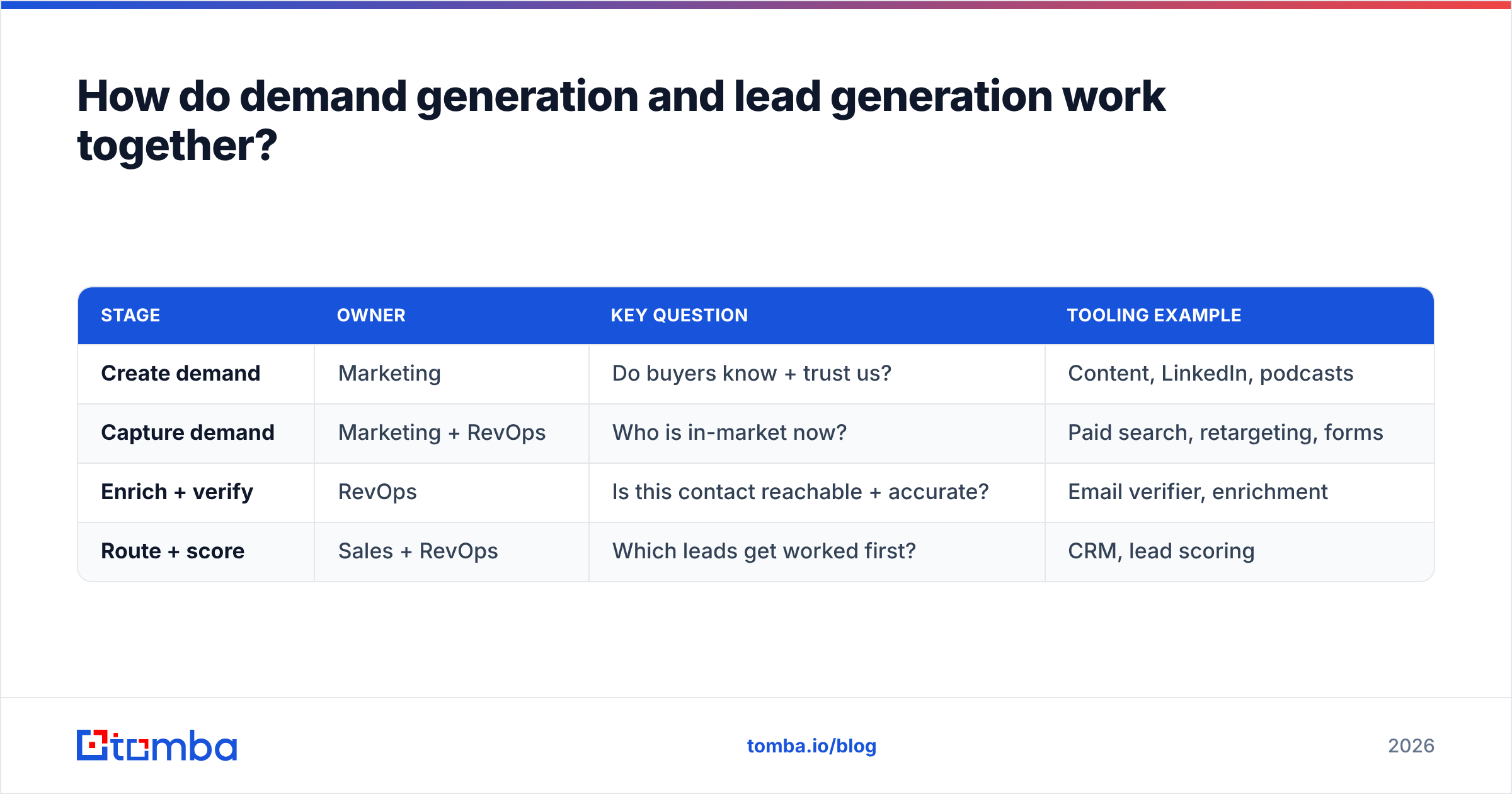
Sequence them: create demand, then capture it, then enrich and route it. They're stages, not competitors.
A practical flow looks like this. Demand creation builds a pool of aware, interested accounts. Capture channels convert the in-market slice of that pool into identified leads. Then enrichment and verification make those leads actionable, and lead management scores and routes them so sales works the hottest ones first. Skip creation and your capture costs balloon; skip enrichment and your captured demand rots before sales can act.
| Stage | Owner | Key question | Tooling example |
|---|---|---|---|
| Create demand | Marketing | Do buyers know + trust us? | Content, LinkedIn, podcasts |
| Capture demand | Marketing + RevOps | Who is in-market now? | Paid search, retargeting, forms |
| Enrich + verify | RevOps | Is this contact reachable + accurate? | Email verifier, enrichment |
| Route + score | Sales + RevOps | Which leads get worked first? | CRM, lead scoring |
The teams that win treat the whole chain as one system with shared ownership between marketing and sales — not a relay race where marketing throws leads over a wall and hopes.
What does a starter demand generation stack look like?#
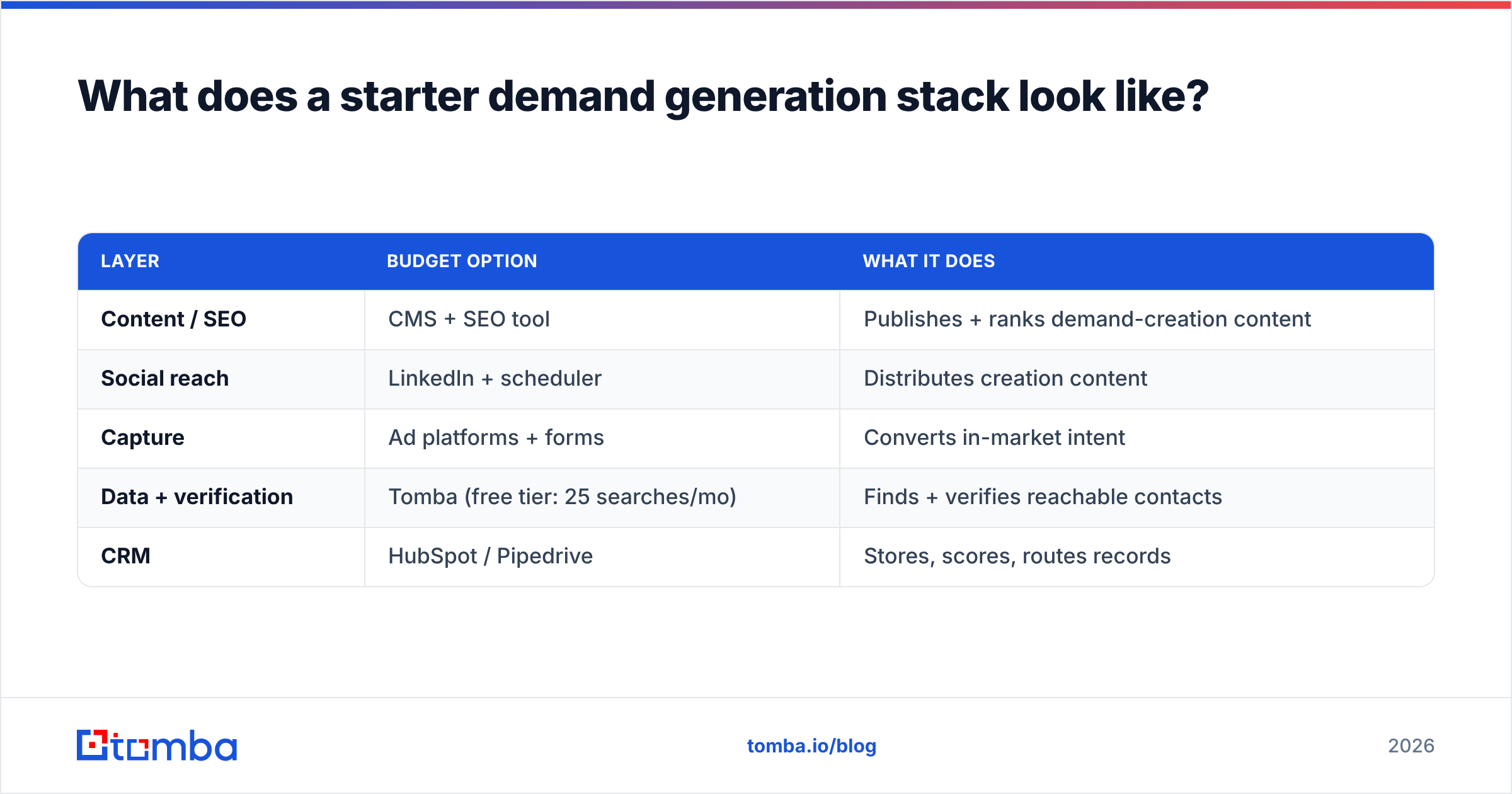
You don't need forty tools. You need coverage across creation, capture, and data. Here's a lean starting point and where a data provider like Tomba fits relative to broader platforms.
| Layer | Budget option | What it does |
|---|---|---|
| Content / SEO | CMS + SEO tool | Publishes + ranks demand-creation content |
| Social reach | LinkedIn + scheduler | Distributes creation content |
| Capture | Ad platforms + forms | Converts in-market intent |
| Data + verification | Tomba (free tier: 25 searches/mo) | Finds + verifies reachable contacts |
| CRM | HubSpot / Pipedrive | Stores, scores, routes records |
On pricing, Tomba starts free at 25 searches per month, with paid plans at $49/mo (Starter), $99/mo (Growth), and $249/mo (Pro) — full Tomba pricing is public if you want to size it against volume. The point of the table isn't to prescribe exact vendors; it's to show that a working demand engine needs something in every row. Gaps in the data row are the most common — and most invisible — reason programs underdeliver.
Common demand generation mistakes to avoid#
- Gating everything. Locking top-of-funnel content behind forms kills the reach that creates demand in the first place. Gate the bottom-funnel assets, free the rest.
- Measuring MQLs as the goal. MQL is a checkpoint, not an outcome. Report pipeline.
- Ignoring data hygiene. The fastest way to waste a great campaign is to route its leads to bounced emails and outdated titles.
- Cutting brand the moment budgets tighten. Creation is what makes capture cheap. Cutting it first is eating your seed corn.
- Treating sales as a downstream recipient. If sales doesn't help define what "qualified" means, they won't trust what you send.
The bottom line#
Digital marketing demand generation in 2026 is a full-funnel system: create interest where buyers actually spend attention, capture the in-market slice with low-friction conversion, and — critically — feed sales clean, verified, enriched contact data so none of that hard-won demand leaks. The creation and capture halves get all the attention, but the data layer is what quietly determines whether your pipeline number is real.
If your demand program is generating interest but sales keeps hitting dead contacts, start by fixing the reachability problem. The Tomba Email Finder helps you turn a company or a captured lead into a verified, reachable decision-maker — so the demand you worked hard to create actually reaches a human who can buy. Start on the free tier and see how much of your current pipeline data is quietly broken.
Related guides#
Ready to find emails that actually work?
Join 150,000+ professionals who stopped guessing and started sending. Free credits on signup — no credit card required.
Get the Tomba newsletter
Practical outbound tactics and product updates — once every two weeks.
About the author