Digital Marketing Lead Generation: A 2026 Playbook That Works
A no-fluff 2026 guide to digital marketing lead generation: the channels that convert, the metrics that matter, and how to turn anonymous traffic into pipeline.
Digital Marketing Lead Generation: A 2026 Playbook That Works
Most "lead generation" advice is a list of channels with no connective tissue. You end up running ads, publishing blog posts, and buying a list — three disconnected motions that never compound. This guide fixes that. It treats digital marketing lead generation as one system: attract the right traffic, convert it into contactable records, and route those records to sales fast enough to matter.
TL;DR#
- Digital marketing lead generation is the process of using online channels (search, content, paid, social, email) to turn strangers into identified, contactable prospects your sales team can work.
- The channels that still convert in 2026 are SEO/content, paid search, LinkedIn, and email — but the differentiator is what you do after the click.
- Anonymous traffic is wasted pipeline. Website visitor identification plus contact enrichment recovers leads you already paid to attract.
- Measure cost per qualified lead (CPQL) and lead-to-opportunity rate, not raw form fills. Volume flatters; quality pays.
- A clean data layer — verified emails, deduped records, enriched firmographics — is what separates a working funnel from a spreadsheet of bounces.
What is digital marketing lead generation?#
Digital marketing lead generation is the practice of attracting online audiences and capturing enough information about them to start a sales conversation. A "lead" is not a pageview or a follower — it's a named person or account with a valid way to reach them and a signal that they might buy.
Think of it like fishing versus stocking a pond. Brand marketing stocks the pond: it makes people aware you exist. Lead generation is the actual line in the water — the offer, the form, the retargeting sequence, the enrichment step — that pulls a specific fish out and puts it in your boat. Both matter, but only one produces a name your reps can call this week.
The mechanics break into three jobs:
- Attract — earn or buy attention from people who match your ideal customer profile (ICP).
- Capture — convert that attention into a record: an email, a company, a role, an intent signal.
- Activate — verify, enrich, and route that record to sales or nurture before it goes cold.
Teams obsess over step one and neglect two and three. That's why so many funnels are "full" at the top and empty at the bottom.
Which digital marketing channels actually generate leads in 2026?#
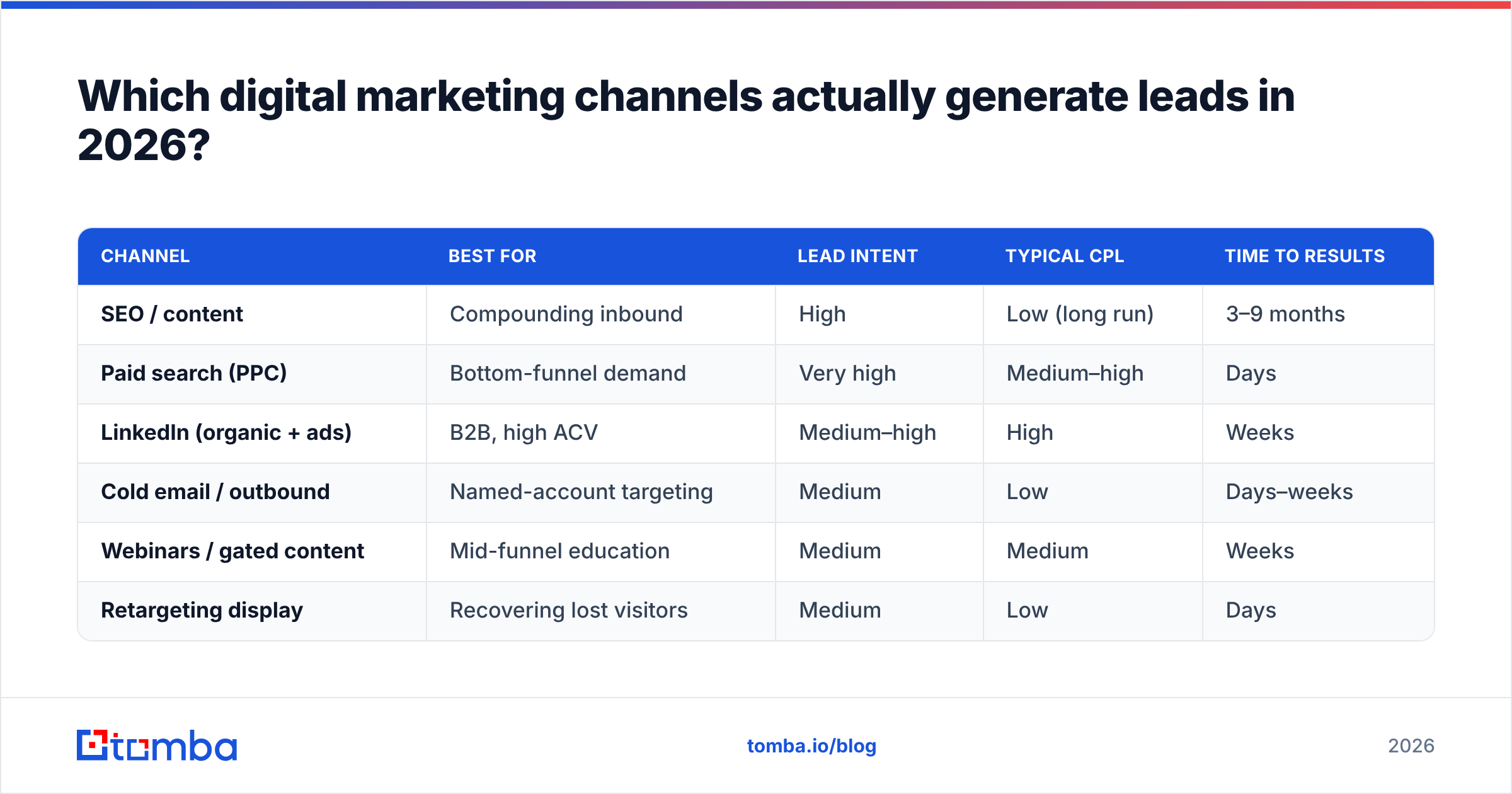
No single channel wins. The right mix depends on deal size, sales cycle, and where your buyers already spend time. Here's how the major channels compare on the attributes that decide whether they belong in your plan.
| Channel | Best for | Lead intent | Typical CPL | Time to results |
|---|---|---|---|---|
| SEO / content | Compounding inbound | High | Low (long run) | 3–9 months |
| Paid search (PPC) | Bottom-funnel demand | Very high | Medium–high | Days |
| LinkedIn (organic + ads) | B2B, high ACV | Medium–high | High | Weeks |
| Cold email / outbound | Named-account targeting | Medium | Low | Days–weeks |
| Webinars / gated content | Mid-funnel education | Medium | Medium | Weeks |
| Retargeting display | Recovering lost visitors | Medium | Low | Days |
A few honest takeaways from that table:
- Paid search buys intent, not loyalty. The moment you stop paying, the leads stop. Use it to validate demand and fill gaps, not as your only engine.
- SEO and content are the cheapest leads you'll ever get — eventually. The cost is patience. Start now so the compounding has started by the time you need it.
- Outbound is the fastest lever you fully control. You don't wait for an algorithm; you pick the accounts and reach out. Its ceiling is entirely determined by your data quality and your email deliverability.
How does the digital lead generation funnel work?#
The funnel is less a shape than a series of conversion gates. Each gate loses people; your job is to widen the ones with the worst pass-through rate.
- Traffic → Visitor identified. Most sites convert 1–3% of traffic on a form. The other 97% leave anonymous. Website visitor identification tools recover a slice of that by matching IPs and behavior to companies — turning "someone from Acme visited pricing three times" into an outreach trigger.
- Visitor → Lead. A form fill, a demo request, a content download. Keep forms short; every extra field costs conversions. Capture the email, then enrich the rest.
- Lead → MQL. Not every lead is ready. A marketing qualified lead has shown enough intent (pages viewed, emails opened, ICP fit) to hand toward sales.
- MQL → SQL → Opportunity. Sales accepts, qualifies, and creates a deal. This is where data hygiene pays off: a rep who dials a validated phone number and emails a verified address wastes zero time on dead records.
The single biggest leak in most B2B funnels is between "lead" and "contactable lead." You collected an email, but it bounces. You got a company name, but no direct contact. Closing that gap is a data problem, not a creative one.
Why does data quality make or break lead generation?#
Because you can't market to a record you can't reach. A lead with a bounced email or a wrong number is a rounding error dressed up as pipeline.
Three data problems quietly kill campaigns:
- Bounces wreck sender reputation. Send to a list full of invalid addresses and mailbox providers throttle you. Even your good emails stop landing. Running your list through an email verifier before a send protects the sender reputation you depend on.
- Missing fields break personalization and routing. No industry, no company size, no role means no segmentation and no scoring. Data enrichment fills those gaps so your automation actually has something to work with.
- Duplicates and decay inflate your numbers. Contacts change jobs constantly. A database you enriched a year ago is partly fiction today. Regular re-verification keeps CPQL honest.

The uncomfortable truth: you can nail targeting, copy, and timing, and still get zero replies if the emails never arrive. Data is the floor everything else stands on.
How do you turn website traffic into named leads?#
You already paid to bring people to your site. Recovering the anonymous majority is the highest-ROI move available because the traffic cost is sunk.
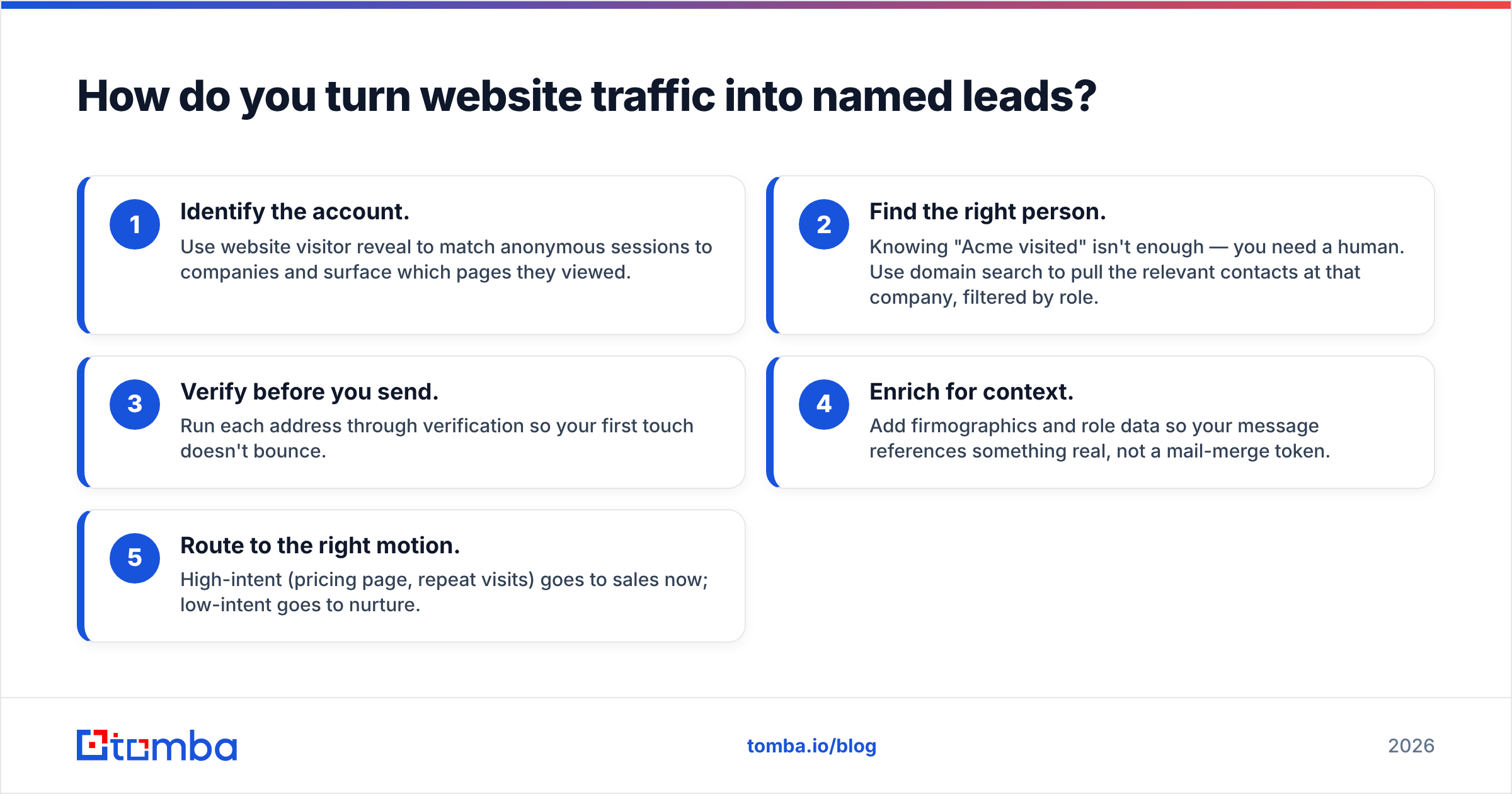
A practical sequence:
- Identify the account. Use website visitor reveal to match anonymous sessions to companies and surface which pages they viewed.
- Find the right person. Knowing "Acme visited" isn't enough — you need a human. Use domain search to pull the relevant contacts at that company, filtered by role.
- Verify before you send. Run each address through verification so your first touch doesn't bounce.
- Enrich for context. Add firmographics and role data so your message references something real, not a mail-merge token.
- Route to the right motion. High-intent (pricing page, repeat visits) goes to sales now; low-intent goes to nurture.
This is where an email finder earns its keep. Instead of guessing formats or scraping LinkedIn by hand, you go from company domain to verified, role-matched contacts in one step — and feed them straight into your CRM or sequencer.
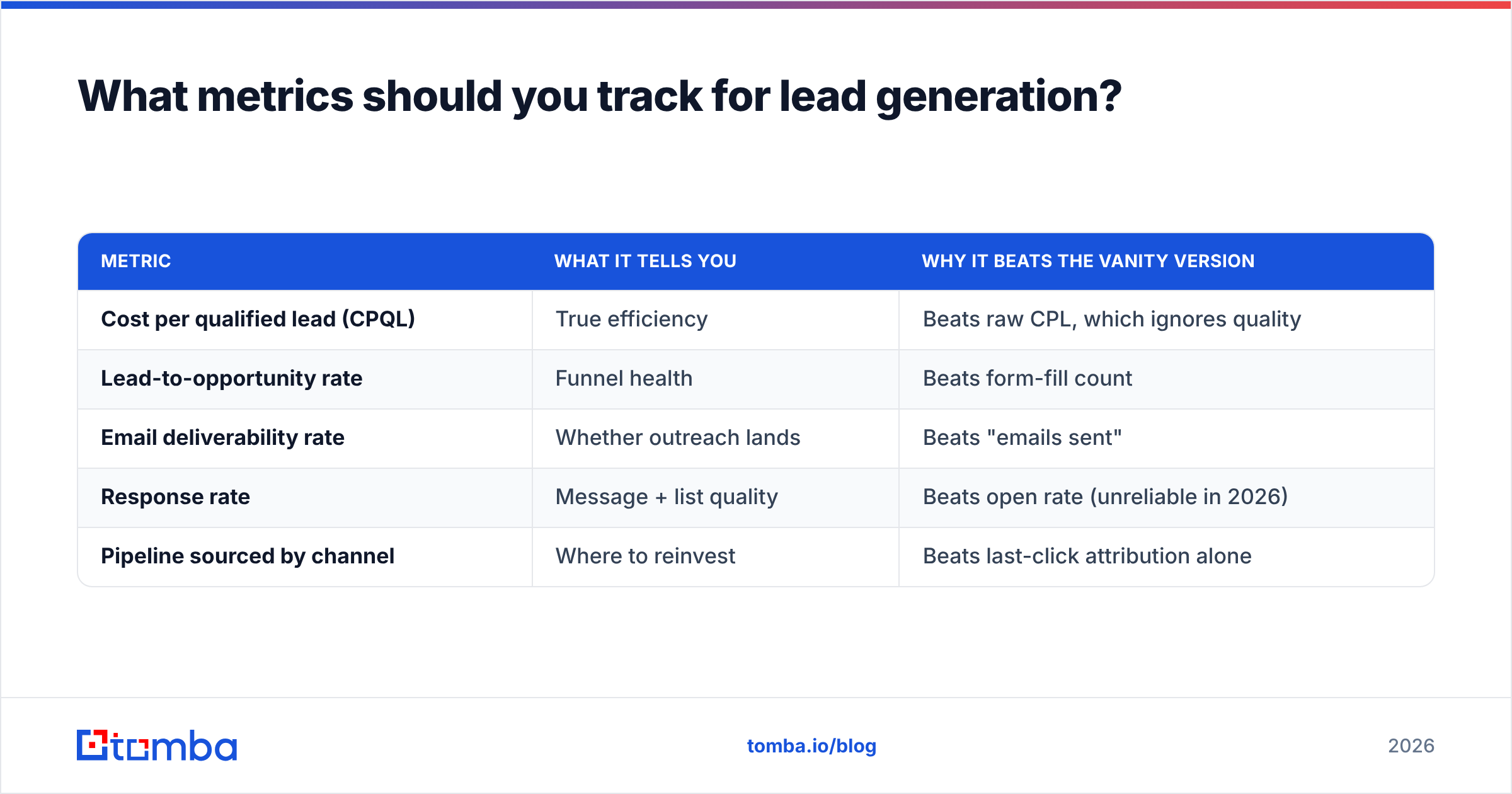
What metrics should you track for lead generation?#
Track the metrics that connect spend to revenue, not the vanity ones that only make dashboards look busy.
| Metric | What it tells you | Why it beats the vanity version |
|---|---|---|
| Cost per qualified lead (CPQL) | True efficiency | Beats raw CPL, which ignores quality |
| Lead-to-opportunity rate | Funnel health | Beats form-fill count |
| Email deliverability rate | Whether outreach lands | Beats "emails sent" |
| Response rate | Message + list quality | Beats open rate (unreliable in 2026) |
| Pipeline sourced by channel | Where to reinvest | Beats last-click attribution alone |
Two rules keep you honest:
- Optimize for qualified, not raw. A campaign producing 500 leads at a 2% opportunity rate is worse than one producing 120 at 15%. Chase CPQL down, not lead count up.
- Instrument the whole path. If you can't tie a closed deal back to the channel and campaign that sourced it, you're guessing when you reallocate budget. Track response rate and pipeline by source together.
How do inbound and outbound work together?#
They're not rivals — they're a relay. Inbound builds a pool of interested accounts; outbound reaches the specific people inbound can't wait for.
- Inbound warms the market. Content, SEO, and social make your brand familiar so that when you do reach out, you're not a total stranger.
- Outbound targets the accounts you actually want. You don't get to pick who fills out a form. You do get to pick which 200 dream accounts get a personalized sequence. Pair account selection with a reliable phone finder and verified emails, and outbound becomes a precision tool rather than spray-and-pray.
- The handoff is the magic. A prospect downloads your guide (inbound), gets enriched and scored, then receives a relevant, human follow-up from a rep (outbound). Neither motion alone closes as well as the two chained together.
Here's a lightweight way to combine them without a huge stack:
- Publish content that ranks for a problem your buyer searches.
- Identify the companies reading it via visitor reveal.
- Enrich and find verified contacts at those companies.
- Send a short, relevant sequence referencing the exact problem.
- Route replies to a rep with full context already in the CRM.
What tools do you need to build a lead gen engine?#
You need less than the software vendors imply. The core stack has four jobs: attract, capture, enrich, and route. Many teams over-buy on attraction tools and under-invest in the enrichment layer that actually makes the leads usable.
A minimum viable stack:
- Attraction: an SEO/content workflow plus one paid channel you can measure.
- Capture: short forms, a visitor-reveal tool, and a chat or booking widget.
- Data layer: an email finder, an email verifier, and enrichment — ideally from one provider so records stay consistent. This is where Tomba fits: finder, verifier, domain search, phone finder, and enrichment in one place, plus a Tomba API to wire it into your own automation.
- Routing: a CRM and a sequencer connected to your data layer so enriched leads flow without copy-paste. Check the integrations you already use — HubSpot, Salesforce, Pipedrive, Zapier — before adding another tool.
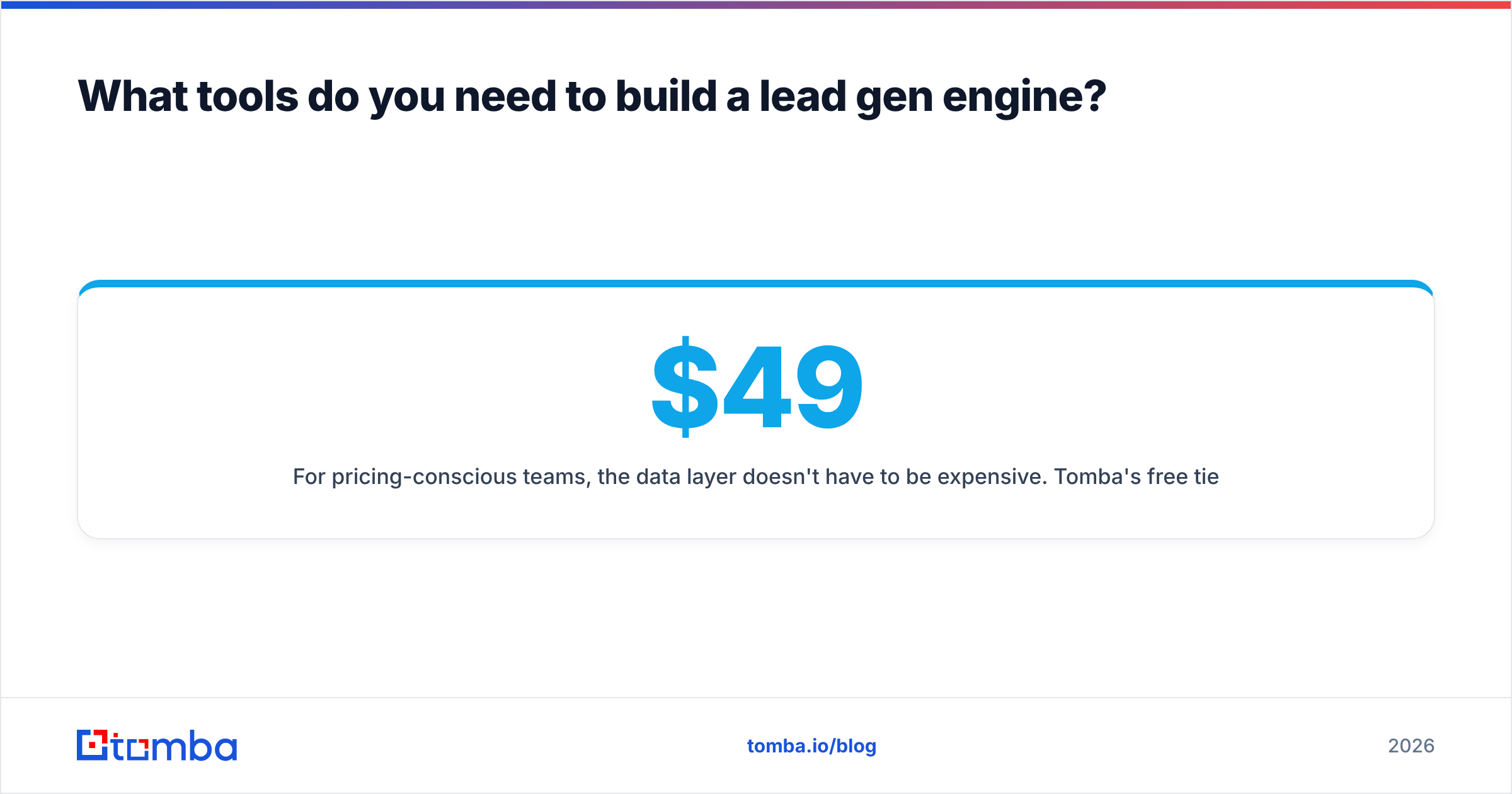
For pricing-conscious teams, the data layer doesn't have to be expensive. Tomba's free tier gives you 25 searches a month to test the workflow, and paid plans start at $49/mo — see full Tomba pricing for the Growth ($99/mo) and Pro ($249/mo) tiers as volume grows.
Common lead generation mistakes to avoid#
- Buying a giant unverified list. It feels like a shortcut and ends as a deliverability crater. If you buy data, verify it before the first send. (Reputable providers like BookYourData sell verified B2B data, but you should still re-verify at send time.)
- Optimizing for form fills over fit. More leads of the wrong shape just makes sales resent marketing.
- Ignoring the anonymous 97%. Traffic you don't identify is budget you set on fire.
- Letting leads age. Response rates collapse within hours. Route in minutes, not days.
- Treating data as a one-time task. Contacts decay ~2–3% per month. Re-verify and re-enrich on a schedule.
For a broader benchmark on lead-gen tactics and benchmarks, HubSpot's research and third-party reviews on G2 are useful reality checks against any vendor's own claims.
Frequently asked questions#
What's the difference between a lead and a prospect? A lead is anyone who's shown interest or been captured into your system. A prospect is a lead that fits your ICP and has been qualified as worth pursuing. Every prospect is a lead; not every lead is a prospect.
How much should a B2B lead cost? It varies wildly by industry and deal size, so ignore blanket benchmarks. Track your own CPQL and the lead-to-opportunity rate behind it. A $200 lead that closes beats a $20 lead that never replies.
Is cold email still effective in 2026? Yes — when the list is verified and the message is relevant. The failures you hear about are almost always data failures (bounces, wrong contacts) or relevance failures, not a problem with the channel itself.
How do I generate leads without a big budget? Start with the traffic you already have. Identify anonymous visitors, find verified contacts at those accounts, and run a small, personalized outbound sequence. It costs a data tool and your time, not an ad budget.
Start with the data layer#
If you take one thing from this guide: attraction gets attention, but a clean, verified, enriched data layer is what turns attention into pipeline. You can fix mediocre copy in an afternoon. You can't out-write a list that bounces.
The fastest place to feel the difference is the moment between "a company visited my site" and "I emailed the right person and they replied." That's the Tomba Email Finder: go from a domain or a name to a verified, role-matched contact, then verify and enrich before you send. Start free with 25 searches, wire it into your CRM, and stop letting hard-won traffic leave anonymous.
Related guides#
Ready to find emails that actually work?
Join 150,000+ professionals who stopped guessing and started sending. Free credits on signup — no credit card required.
Get the Tomba newsletter
Practical outbound tactics and product updates — once every two weeks.
About the author