How to Build a Digital Marketing Sales Pitch That Closes in 2026
Most digital marketing pitches lose because they lead with services, not results. Here's a repeatable structure — plus the prospecting data step that separates reps who close from reps who chase.
Selling digital marketing is harder than it looks. The prospect has heard "we'll boost your traffic" a hundred times, usually from someone who never showed up in their inbox again. Your pitch is not competing against silence — it is competing against fatigue.
This guide breaks down what a digital marketing sales pitch actually needs to do in 2026, gives you a structure you can reuse across SEO, paid, social, and full-funnel offers, and shows you the prospecting step most agencies skip that quietly decides whether your pitch ever gets read.
TL;DR#
- Lead with the prospect's problem and a number, not your service list. "You're paying for clicks that never convert" beats "we do PPC."
- Use a five-part structure: hook, diagnosis, proof, offer, and a single clear next step.
- The pitch is only as good as the contact. A brilliant deck sent to
info@or the wrong stakeholder dies on arrival. - Personalization at scale is a data problem, not a copywriting problem — you need verified decision-maker emails before you write a word.
- Follow-up is where deals close. Most reps quit after one touch; the winners run a 4–6 step sequence.
What is a digital marketing sales pitch?#
A digital marketing sales pitch is the structured argument you make to convince a business that your marketing services will produce more revenue than they cost. It is not a feature dump. It is a short, evidence-backed story that moves a prospect from "who is this?" to "let's talk."
Think of it like a doctor's visit. A bad doctor lists every treatment they offer the moment you walk in. A good doctor asks where it hurts, runs a quick diagnostic, tells you what's wrong, and then prescribes. Your pitch should follow the same order: diagnose before you prescribe. Prospects trust specialists who understand their symptoms, not vendors reciting a menu.
The pitch shows up in several formats — a cold email, a LinkedIn message, a discovery call opener, a one-page proposal, or a slide deck. The channel changes; the underlying logic does not.
Why do most digital marketing pitches fail?#
Most pitches fail before the content even matters, for three reasons.
- They lead with the seller, not the buyer. "We're an award-winning agency with 10 years of experience" tells the prospect nothing about their own business.
- They're generic. A pitch that could be sent to any company gets treated like it was sent to every company.
- They reach the wrong person — or no person at all. A pitch mailed to a shared inbox or an outdated address never enters the decision-maker's world.
That third point is the silent killer. You can write the sharpest pitch of your career, but if it lands in a catch-all mailbox nobody checks, your close rate is zero. This is why serious teams treat contact accuracy as part of the pitch, not a separate chore.

What is the structure of a digital marketing sales pitch that closes?#
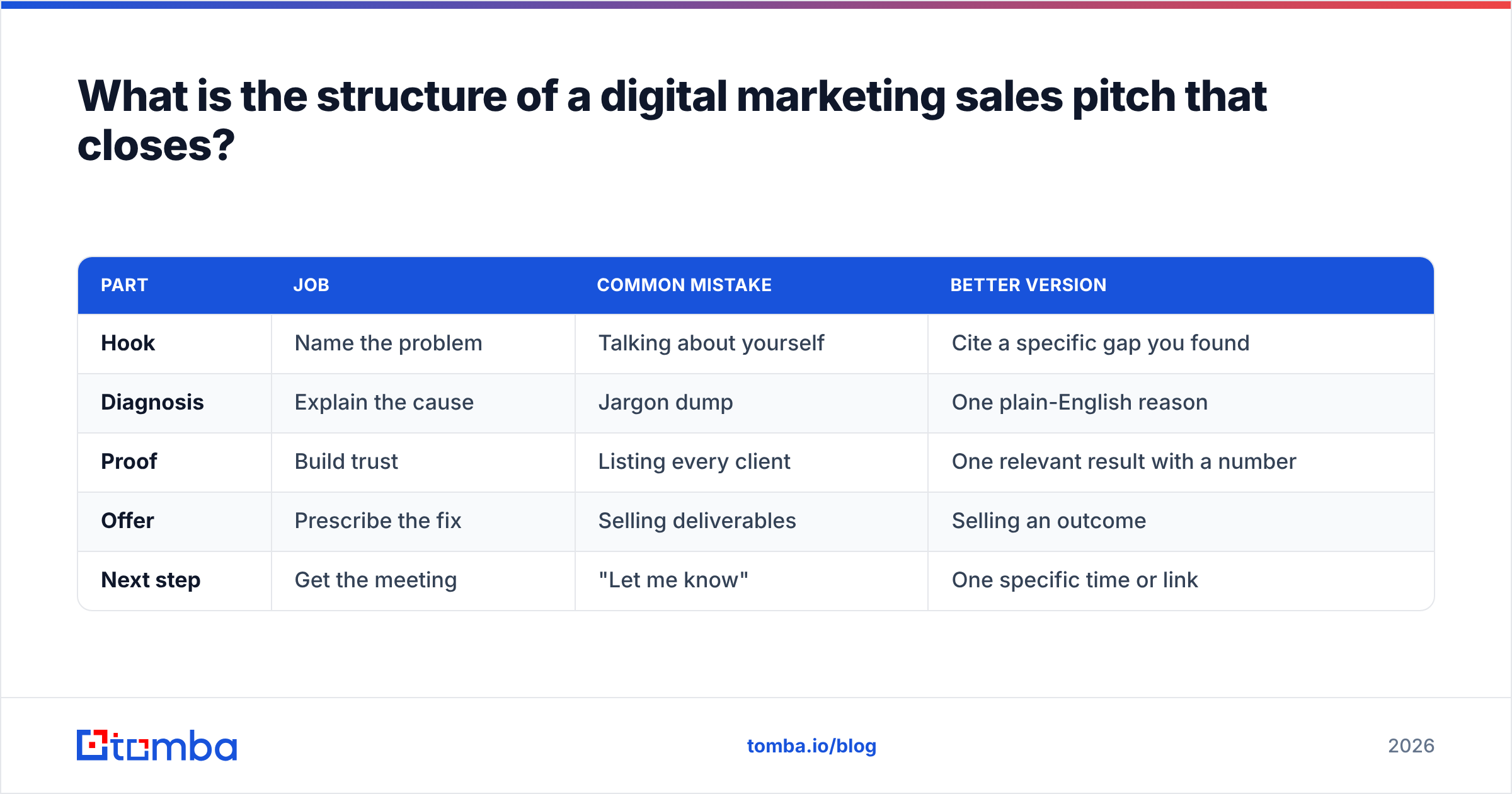
Here is a five-part structure you can adapt to any digital marketing offer. Each part has one job. Resist the urge to add more.
- Hook (the problem). Open with a specific, observable problem. "Your top three competitors all rank on page one for 'commercial HVAC repair' — you're on page four." Specificity signals you did homework.
- Diagnosis (the why). Explain briefly why the problem exists. "Your site has no location pages and no review schema, so Google can't tell it which city you serve."
- Proof (the credibility). Show one relevant result. A mini case study with a number: "We took a similar HVAC company from 40 to 210 monthly leads in five months." One proof point beats five.
- Offer (the prescription). State what you'd do, framed as an outcome. Not "SEO audit and content plan" but "a 90-day plan to own local search in your three highest-value cities."
- Next step (the ask). One clear, low-friction action. "Worth a 15-minute call Thursday to walk through the plan?" Never end with "let me know."
Pitch structure at a glance#
| Part | Job | Common mistake | Better version |
|---|---|---|---|
| Hook | Name the problem | Talking about yourself | Cite a specific gap you found |
| Diagnosis | Explain the cause | Jargon dump | One plain-English reason |
| Proof | Build trust | Listing every client | One relevant result with a number |
| Offer | Prescribe the fix | Selling deliverables | Selling an outcome |
| Next step | Get the meeting | "Let me know" | One specific time or link |
Notice that four of the five parts are about the prospect. Only "proof" is about you — and even that is framed around a result they want.
How do you personalize a digital marketing pitch at scale?#
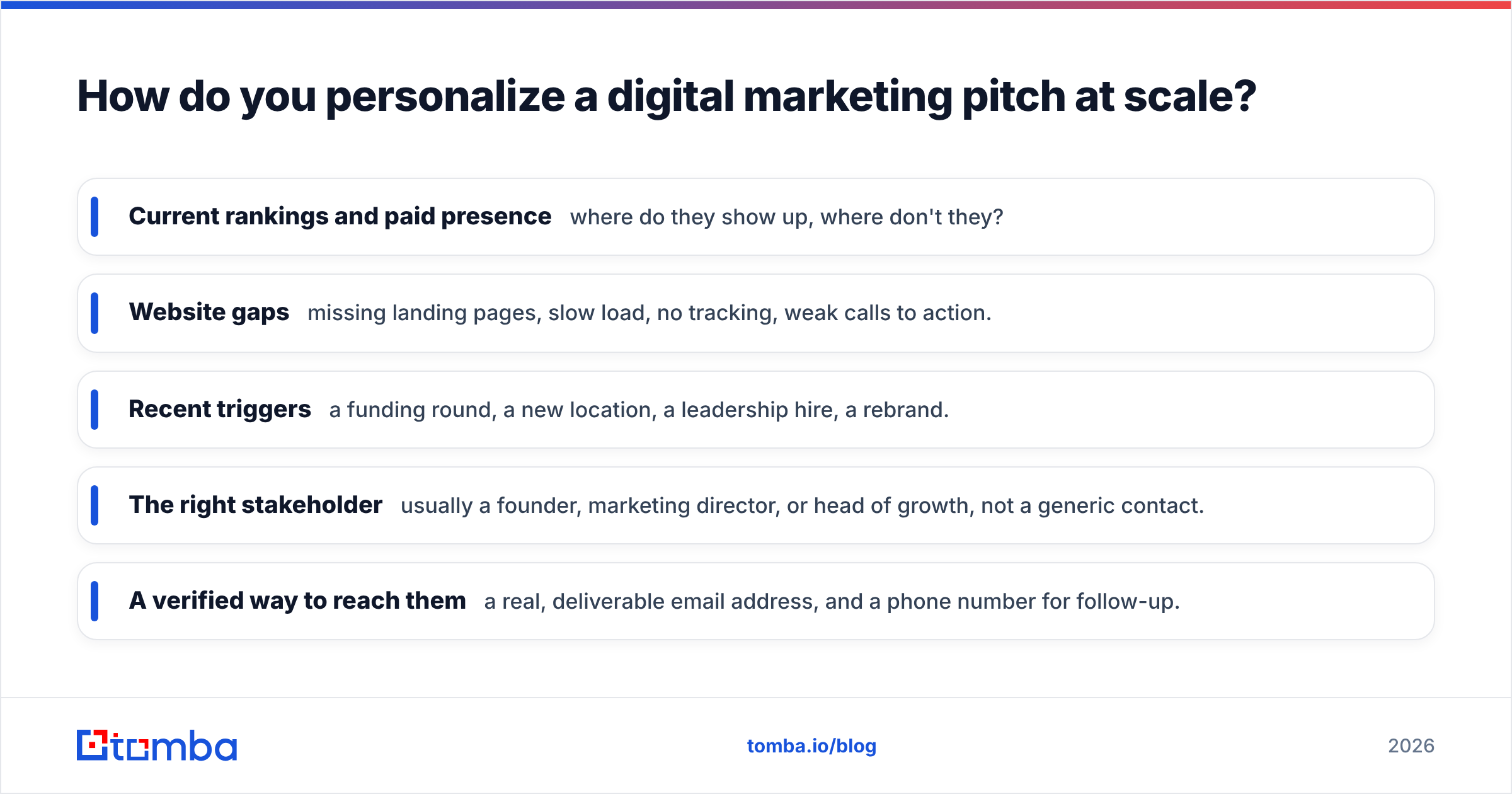
Personalization is what separates a pitch from spam, but "personalize everything by hand" does not scale past a handful of prospects a day. The fix is to separate the research layer from the writing layer.
Build a repeatable research checklist you run on every target account before writing:
- Current rankings and paid presence — where do they show up, where don't they?
- Website gaps — missing landing pages, slow load, no tracking, weak calls to action.
- Recent triggers — a funding round, a new location, a leadership hire, a rebrand.
- The right stakeholder — usually a founder, marketing director, or head of growth, not a generic contact.
- A verified way to reach them — a real, deliverable email address, and a phone number for follow-up.
The first four items are marketing research. The fifth is a data problem, and it is where pitches quietly break. Guessing firstname@company.com gets you bounces, spam complaints, and a damaged sender reputation. Instead, pull decision-maker contacts with a purpose-built tool. Tomba's email finder resolves a name and company domain into a verified professional address, and its domain search returns every public email pattern for a company so you can identify the marketing lead directly rather than routing through reception.
For account-based pushes, layer on data enrichment to append job titles, company size, and tech stack, so your hook writes itself: you already know they run Shopify, spend on Google Ads, and just hired a VP of Marketing.
What does a good cold email pitch look like?#
Cold email is still the highest-leverage channel for pitching digital marketing, precisely because most competitors do it badly. Here is a compact example that follows the five-part structure:
Subject: page 4 for "commercial HVAC repair"
Hi Dana,
Quick one — I searched "commercial HVAC repair Denver" this morning and your three biggest competitors all rank on page one. Northwind's on page four.
The gap looks fixable: no city landing pages and no review schema, so Google can't confirm which metros you cover.
We ran the same playbook for a Phoenix HVAC firm and took them from ~40 to 210 monthly leads in five months.
Worth 15 minutes Thursday to show you the exact 90-day plan for Denver, Boulder, and Aurora?
— Sam
That email is under 120 words, names a real problem, offers a real outcome, and ends with one clear ask. It works because it reads like it was written for one company — which it was.
Keep a small library of these frameworks rather than rewriting from scratch. If you want a starting point, Tomba's free cold email templates give you tested skeletons you can adapt to each offer.
Cold email vs. LinkedIn vs. cold call: which pitch channel wins?#
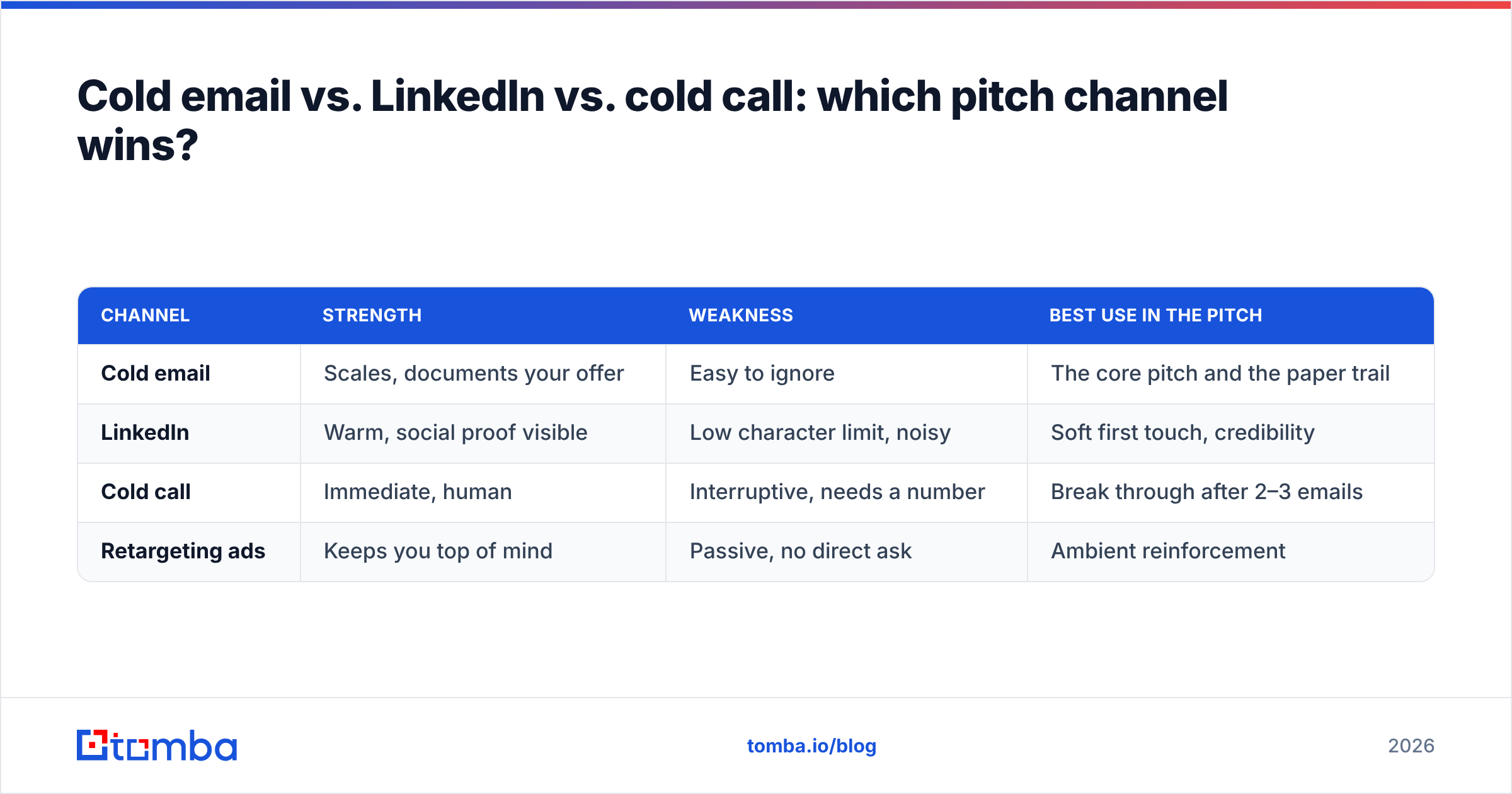
There is no single best channel — there's a best sequence. Each channel does something the others can't.
| Channel | Strength | Weakness | Best use in the pitch |
|---|---|---|---|
| Cold email | Scales, documents your offer | Easy to ignore | The core pitch and the paper trail |
| Warm, social proof visible | Low character limit, noisy | Soft first touch, credibility | |
| Cold call | Immediate, human | Interruptive, needs a number | Break through after 2–3 emails |
| Retargeting ads | Keeps you top of mind | Passive, no direct ask | Ambient reinforcement |
The winning teams combine them. Warm up on LinkedIn, deliver the real pitch by email, and follow up by phone using a verified number from a phone finder when email goes quiet. A multi-touch sequence built on accurate contact data consistently outperforms any single channel run in isolation.
How many follow-ups does a digital marketing pitch need?#
More than one, and almost certainly more than you're doing now. Industry data has long shown that the majority of B2B sales require five or more touches, yet most reps stop after one or two. According to HubSpot's sales research, persistence past the first follow-up is where a large share of meetings are actually booked.
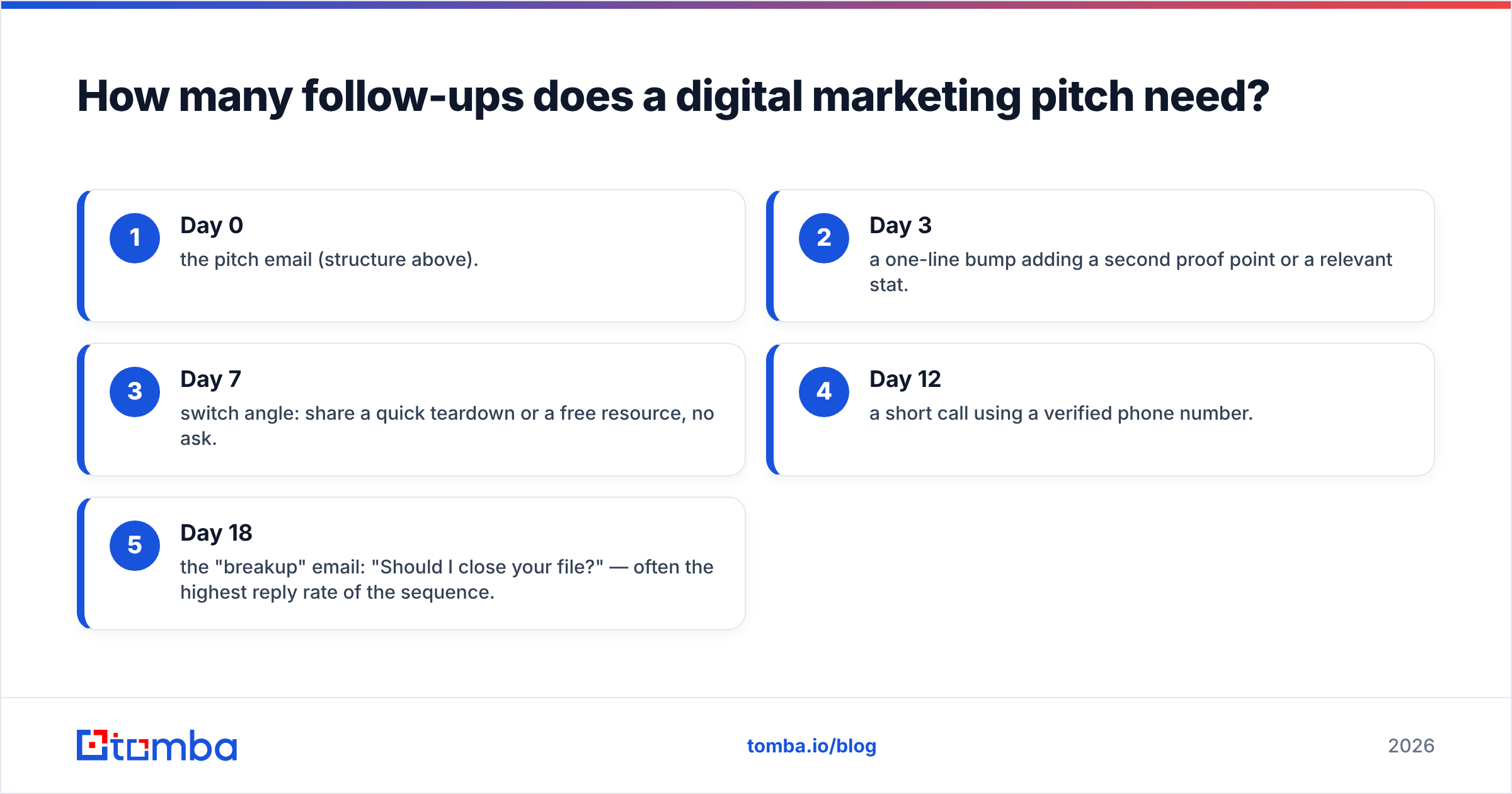
A simple, non-annoying follow-up cadence for a digital marketing pitch:
- Day 0 — the pitch email (structure above).
- Day 3 — a one-line bump adding a second proof point or a relevant stat.
- Day 7 — switch angle: share a quick teardown or a free resource, no ask.
- Day 12 — a short call using a verified phone number.
- Day 18 — the "breakup" email: "Should I close your file?" — often the highest reply rate of the sequence.
Every step in that cadence depends on reaching a real person. If step one bounced, steps two through five are wasted effort. That is why verification isn't optional busywork — running your list through an email verifier before you send protects both your deliverability and your calendar.
How do you measure whether your pitch is working?#
Pitch quality is not a feeling; it's a funnel. Track four numbers and you'll know exactly where to fix things.
- Deliverability rate — how many pitches actually land. Below ~95%? Your data or sender reputation is the problem, not your copy.
- Open rate — how compelling your subject line and sender are.
- Reply rate — how relevant your hook and offer feel to the recipient.
- Meeting rate — the only number that pays rent.
If deliverability is low, fix your list before touching your words. If opens are fine but replies are flat, your hook is generic. If replies are strong but meetings are rare, your ask has too much friction. Analysts at Gartner have repeatedly noted that B2B buyers spend only a small fraction of their journey with any single sales rep — which means every touch has to earn the next one. Diagnose the funnel stage, not the whole thing.
Common mistakes that sink digital marketing pitches#
- Pitching services instead of outcomes. Nobody buys "content marketing." They buy more qualified leads.
- One long email. If your pitch needs three scrolls, it needs an edit.
- No social proof. One specific, relevant result outperforms a wall of logos.
- Sending to unverified contacts. Bounces wreck your sender reputation and hide your best prospects.
- Quitting after one touch. The follow-up is the pitch. The first email is just the introduction.
Fix these five and you'll out-close agencies with bigger teams and flashier decks, because you'll be reaching the right people with a message built for them.
The bottom line#
A digital marketing sales pitch closes when it names a real problem, prescribes a real outcome, proves you can deliver, and — crucially — actually reaches the person who can say yes. The copy gets the credit, but the contact data does the quiet work. You can compare plans and volume tiers on the Tomba pricing page when you're ready to scale.
Before you write your next pitch, fix the layer underneath it. Use the Tomba Email Finder to turn target accounts into verified decision-maker emails, so every carefully written pitch lands in a real inbox instead of a catch-all void. Start free with 25 searches a month, confirm the address is deliverable, and send your pitch to the one person who can actually hire you.
Related guides#
Ready to find emails that actually work?
Join 150,000+ professionals who stopped guessing and started sending. Free credits on signup — no credit card required.
Get the Tomba newsletter
Practical outbound tactics and product updates — once every two weeks.
About the author