Digital Marketing Strategy for B2B: The 2026 Playbook
A practical, channel-by-channel B2B digital marketing strategy for 2026 — how to build demand, capture intent, and turn traffic into pipeline without wasting budget.
Most B2B marketing budgets are spent on activity, not outcomes. You can run ads, publish posts, and send newsletters every week and still watch pipeline flatline. A real digital marketing strategy for B2B connects each channel to a buying decision — and to a revenue number you can defend in a board meeting.
This guide gives you the framework, the channel mix, and the budget logic to build that in 2026.
TL;DR#
- Strategy beats channels. Pick your ICP and buying triggers first; the channels are just delivery mechanisms.
- Split spend across demand creation and demand capture. A rough 60/40 or 70/30 split stops you from harvesting demand you never built.
- Data quality decides everything downstream. Bad contact data quietly kills your best campaigns. Clean, verified records are the cheapest ROI lever you have.
- Attribution should inform, not paralyze. Track pipeline influence, not vanity clicks.
- Compound channels win. SEO, owned media, and a warm database outlast any single paid tactic.
What is a digital marketing strategy for B2B?#
A digital marketing strategy for B2B is a documented plan. It turns strangers into pipeline through digital channels — search, social, email, content, and paid media. Every channel maps to one ideal customer profile (ICP) and one buying journey.
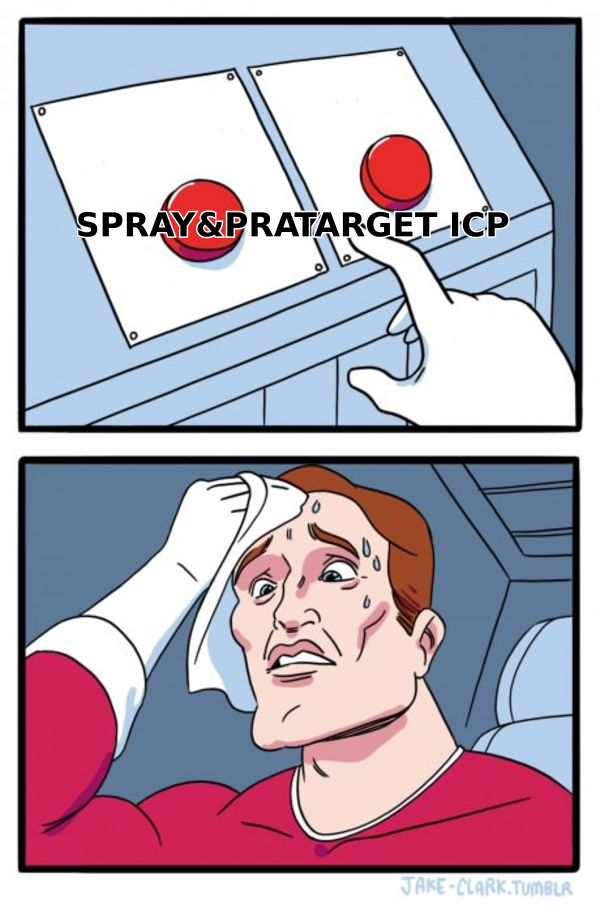
Think of it like a fishing operation, not a lottery ticket. Amateurs cast randomly and hope. A strategy tells you which lake (your ICP), which bait (your message), and which season (buying triggers) actually produce a catch. Everything else is noise you can measure and cut.
The difference between B2C and B2B is structural. B2B deals involve multiple stakeholders, longer cycles, and higher contract values. So your strategy has to nurture a buying committee over months. You won't convert one person in a single session.
What are the core pillars of a digital marketing strategy for B2B?#
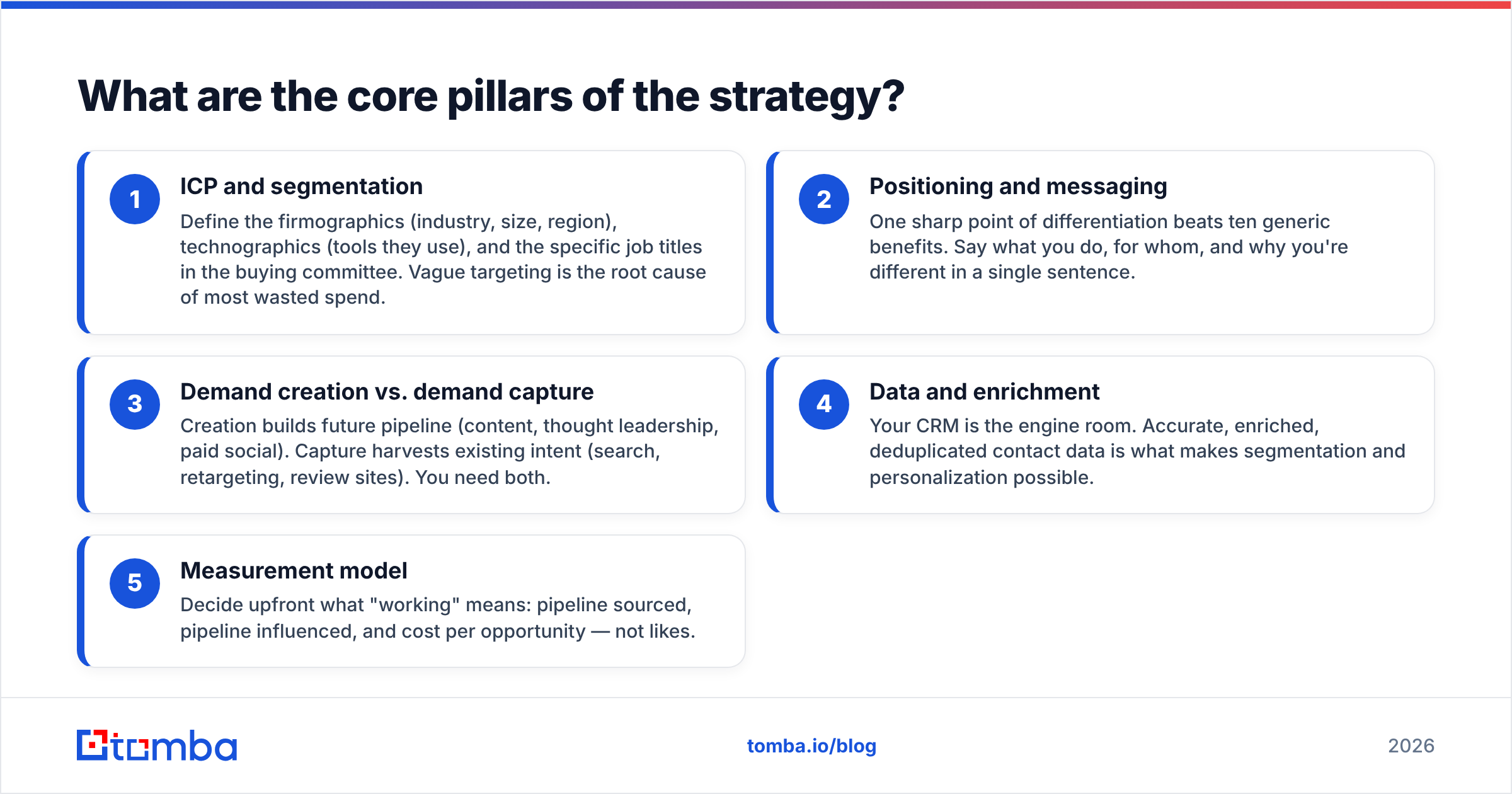
Before you touch a single channel, lock down five pillars. Skip any one and the channels underperform, no matter how well you execute them.
- ICP and segmentation — Define the firmographics (industry, size, region), technographics (tools they use), and the job titles in the buying committee. Vague targeting is the root cause of most wasted spend.
- Positioning and messaging — One sharp point of differentiation beats ten generic benefits. Say what you do, for whom, and why you're different in one sentence.
- Demand creation vs. demand capture — Creation builds future pipeline (content, thought leadership, paid social). Capture harvests existing intent (search, retargeting, review sites). You need both.
- Data and enrichment — Your CRM is the engine room. Accurate, enriched, deduplicated contact data makes segmentation and personalization possible.
- Measurement model — Decide upfront what "working" means: pipeline sourced, pipeline influenced, and cost per opportunity — not likes.
These pillars map to a healthy revenue operations function, where marketing, sales, and data share one definition of a qualified lead.
Which digital channels actually drive B2B pipeline?#
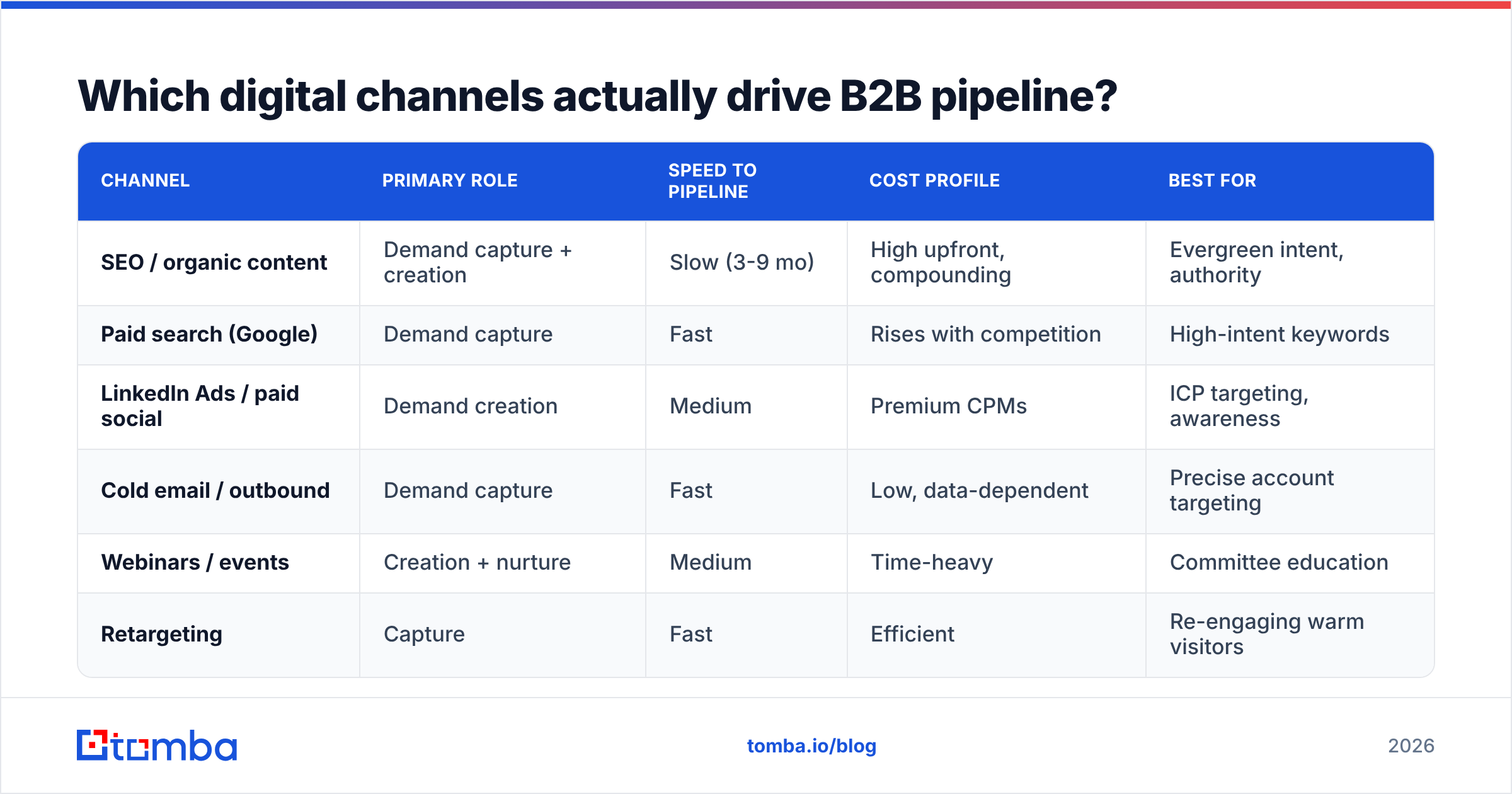
Not all channels pull the same weight in B2B. Here's how the major ones compare on the metrics that matter for a considered, high-value purchase.
| Channel | Primary role | Speed to pipeline | Cost profile | Best for |
|---|---|---|---|---|
| SEO / organic content | Demand capture + creation | Slow (3-9 mo) | High upfront, compounding | Evergreen intent, authority |
| Paid search (Google) | Demand capture | Fast | Rises with competition | High-intent keywords |
| LinkedIn Ads / paid social | Demand creation | Medium | Premium CPMs | ICP targeting, awareness |
| Cold email / outbound | Demand capture | Fast | Low, data-dependent | Precise account targeting |
| Webinars / events | Creation + nurture | Medium | Time-heavy | Committee education |
| Retargeting | Capture | Fast | Efficient | Re-engaging warm visitors |
The winning mix is rarely one channel. Paid search captures the buyers already looking. LinkedIn and content create the demand that later shows up in search. Outbound lets you reach named accounts that will never fill in a form. Treat them as a system, not a menu.
![Product screenshot placeholder: LinkedIn Campaign Manager audience targeting by job title and company size]
Where outbound fits in 2026#
Inbound alone can't reach the accounts you most want. Outbound — cold email and calls to a defined target list — is the fastest way to test a new segment. But it lives or dies on data. Send to stale or unverified addresses and you tank your sender reputation. You also burn the domain you spent months warming.
That's why the first step of any outbound motion is building a clean, verified contact list. A reliable email finder plus an email verifier pass turns a raw account list into deliverable pipeline fuel. For account-based plays, domain search pulls every reachable contact at a target company in one pass.
How should you split a B2B marketing budget?#
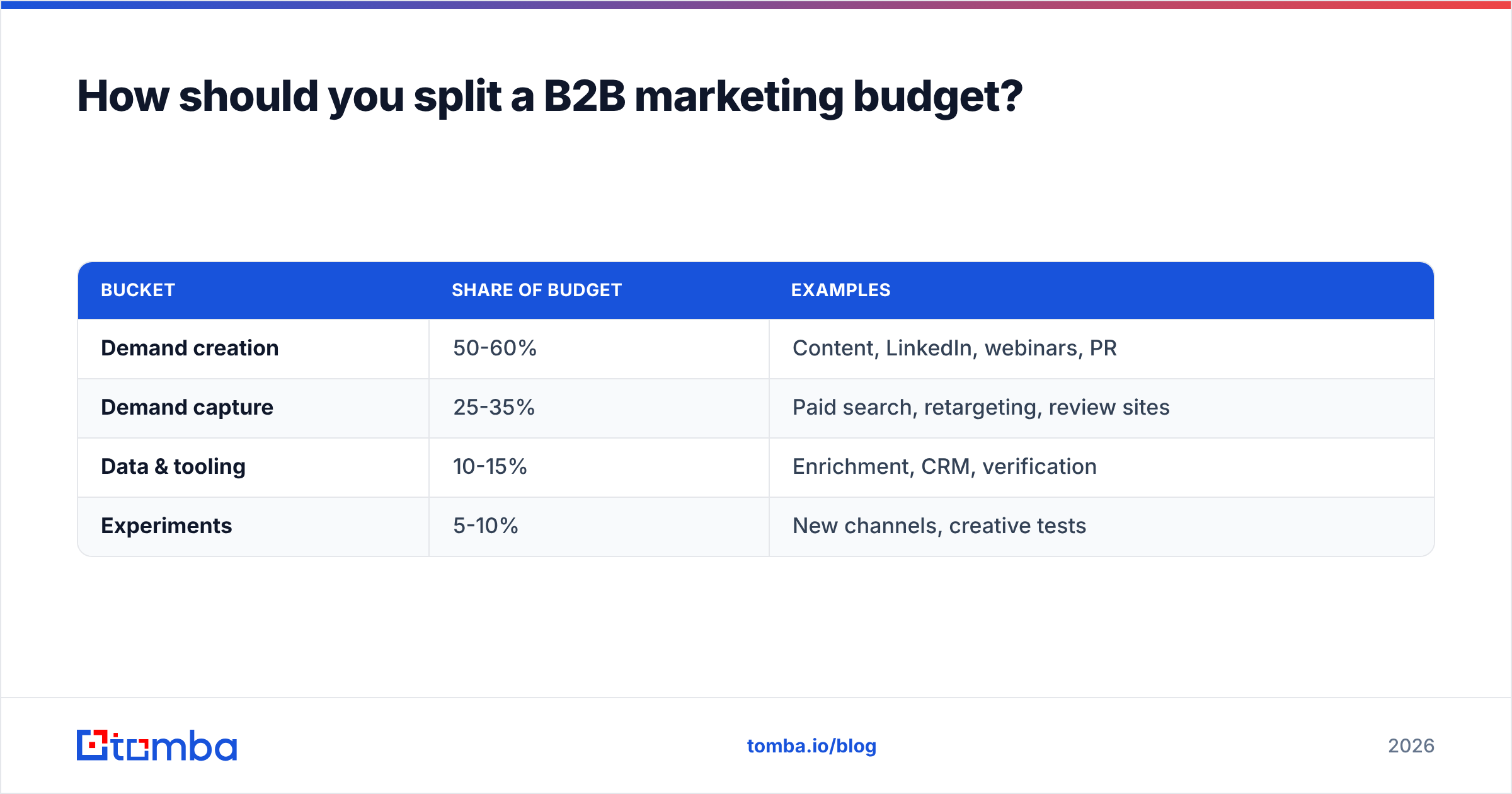
Conclusion first: spend the majority on creating demand, and protect a fixed slice for capturing it. Most teams over-invest in capture because it's easier to measure. Then they wonder why growth stalls once they've harvested all existing intent.
A defensible starting split for a mid-market B2B team:
| Bucket | Share of budget | Examples |
|---|---|---|
| Demand creation | 50-60% | Content, LinkedIn, webinars, PR |
| Demand capture | 25-35% | Paid search, retargeting, review sites |
| Data & tooling | 10-15% | Enrichment, CRM, verification |
| Experiments | 5-10% | New channels, creative tests |
Adjust by stage. Early companies with no brand skew toward capture to prove the motion works. Established players skew toward creation to build a moat rivals can't buy overnight.
The line item teams cut first — data and tooling — is the one that quietly multiplies everything else. If 20% of your database is wrong, you pay full price to reach a fifth of the people who will never respond.
How do you build a digital marketing strategy for B2B step by step?#
Here's the sequence that turns the pillars above into a running program.
- Define one primary ICP segment. Don't target everyone. Nail one segment, then expand.
- Map the buying committee. List the roles — champion, economic buyer, technical evaluator, blocker — and what each needs to hear.
- Build and clean your target account list. Enrich firmographic data, then verify every record so outreach lands. Use data enrichment to fill gaps your forms miss.
- Choose two creation channels and one capture channel. Focus beats spreading thin. Master three before you add a fourth.
- Create a content spine. One pillar asset per quarter — a report, a guide, or a tool — sliced into posts, emails, and ads.
- Set up nurture. Score leads by fit and engagement, then route them to sales at the right threshold. Define marketing qualified leads jointly with sales.
- Instrument measurement. Track pipeline sourced and influenced per channel in your CRM. Review monthly, then reallocate.
![Product screenshot placeholder: CRM dashboard showing pipeline sourced by channel]
What metrics prove the strategy is working?#
Vanity metrics feel good and predict nothing. Anchor your reporting to metrics tied to revenue.
- Pipeline sourced — new opportunity value directly attributable to marketing.
- Pipeline influenced — deals marketing touched at any stage.
- Cost per opportunity (CPO) — total spend divided by qualified opportunities created.
- Sales-accepted lead rate — the share of leads sales actually works, a direct read on data and targeting quality.
- Velocity — how fast leads move from first touch to closed-won.
Watch the sales-accepted rate closely. When it drops, the culprit is almost always targeting or data quality — not effort. Teams that skip verification see this number quietly decay while everyone blames the SDRs.
Which tools make up a lean B2B marketing stack?#
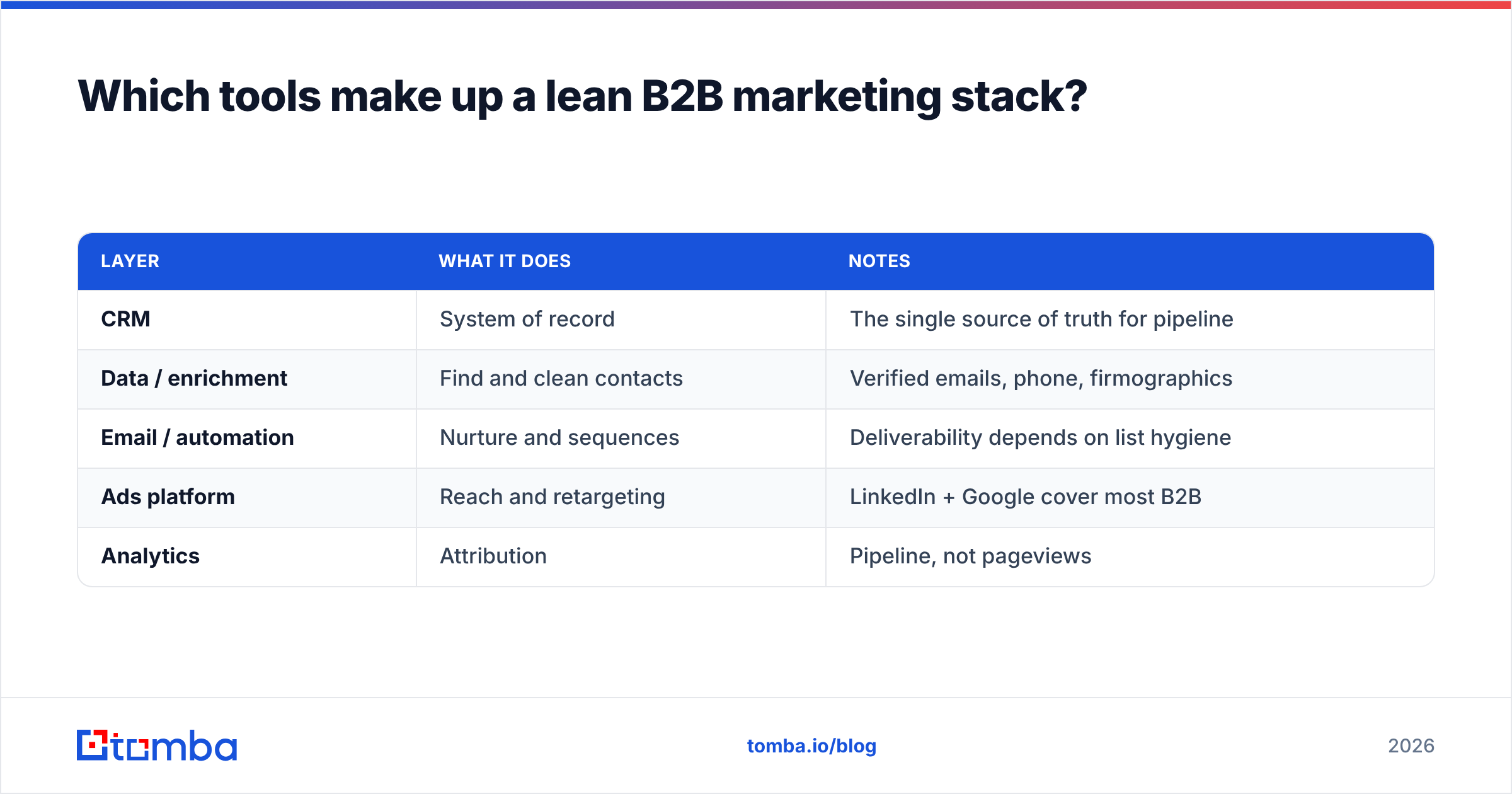
You don't need forty tools. You need one solid option in each layer and the discipline to keep the data flowing between them.
| Layer | What it does | Notes |
|---|---|---|
| CRM | System of record | The single source of truth for pipeline |
| Data / enrichment | Find and clean contacts | Verified emails, phone, firmographics |
| Email / automation | Nurture and sequences | Deliverability depends on list hygiene |
| Ads platform | Reach and retargeting | LinkedIn + Google cover most B2B |
| Analytics | Attribution | Pipeline, not pageviews |
On the data layer, honest comparison matters. Broad platforms like Apollo bundle prospecting with sequencing, while focused providers concentrate on data accuracy. Peers such as BookYourData offer strong prepackaged B2B lists for teams that want ready-made audiences. The right pick depends on your needs. Do you want an all-in-one motion, or the most accurate contact data feeding tools you already own?
For most teams running lean, a dedicated finder-and-verifier keeps costs down and data quality up. You can pull contacts on demand, verify them before they ever hit a sequence, and push clean records into the CRM. See Tomba pricing for how the free tier (25 searches/mo) and paid plans from $49/mo scale with your list volume.
How does data quality change your results?#
Data quality is the multiplier hiding under every other metric. A perfect campaign sent to a 70%-deliverable list is a 70% campaign — before anyone reads a word.
Three failure modes to design against:
- Bounces damage sender reputation, which drags down deliverability on your good sends too. Run every list through verification first.
- Catch-all domains hide invalid addresses behind servers that accept everything. A catch-all verifier tells you which are safe to send.
- Stale records — people change jobs constantly. Re-enrich your database on a schedule instead of letting it rot.
The payoff compounds. Clean data lifts deliverability. Better deliverability lifts reply rates, and reply rates lift pipeline. Solid email deliverability also protects the domain you rely on for every future campaign.
What's the biggest mistake B2B teams make?#
Conclusion first: chasing more channels instead of fixing the fundamentals. Adding TikTok or a new ad network feels like progress. But if your ICP is fuzzy and your data is dirty, you've just multiplied the ways to waste money.
The teams that win in 2026 do the boring things well. They pick a tight segment, obsess over data hygiene, run two or three channels with real depth, and measure pipeline instead of applause. Everything compounds from there.
Start with the layer that touches everything downstream — your data. Build a verified, enriched contact base with the Tomba Email Finder. Confirm every address before it enters a sequence. Clean records make every other channel work harder. The best digital marketing strategy for B2B is only as good as the data underneath it — so fix that first, and the pipeline follows.
Related guides#
Ready to find emails that actually work?
Join 150,000+ professionals who stopped guessing and started sending. Free credits on signup — no credit card required.
Get the Tomba newsletter
Practical outbound tactics and product updates — once every two weeks.
About the author