Digital Marketing to Generate Leads: The 2026 Playbook for B2B
Most lead-gen advice is channel worship. This is the opposite: a clear-eyed look at which digital marketing channels actually generate B2B leads in 2026, what they cost, and how to build a system that fills your pipeline instead of your vanity metrics.
Using digital marketing to generate leads sounds simple until you look at your pipeline and realize you have 4,000 newsletter subscribers, 90 webinar signups, and three deals. Traffic is not pipeline. Clicks are not leads. And most "lead gen" content is really channel worship dressed up as strategy.
This guide is the opposite. Below is a channel-by-channel look at what actually produces qualified B2B leads in 2026, what each channel really costs, and the plumbing that turns anonymous demand into contacts your sales team can call.
TL;DR#
- Lead generation is a system, not a channel. Demand (SEO, ads, social) creates attention; capture (forms, enrichment, visitor de-anonymization) turns attention into contacts; qualification decides who sales calls.
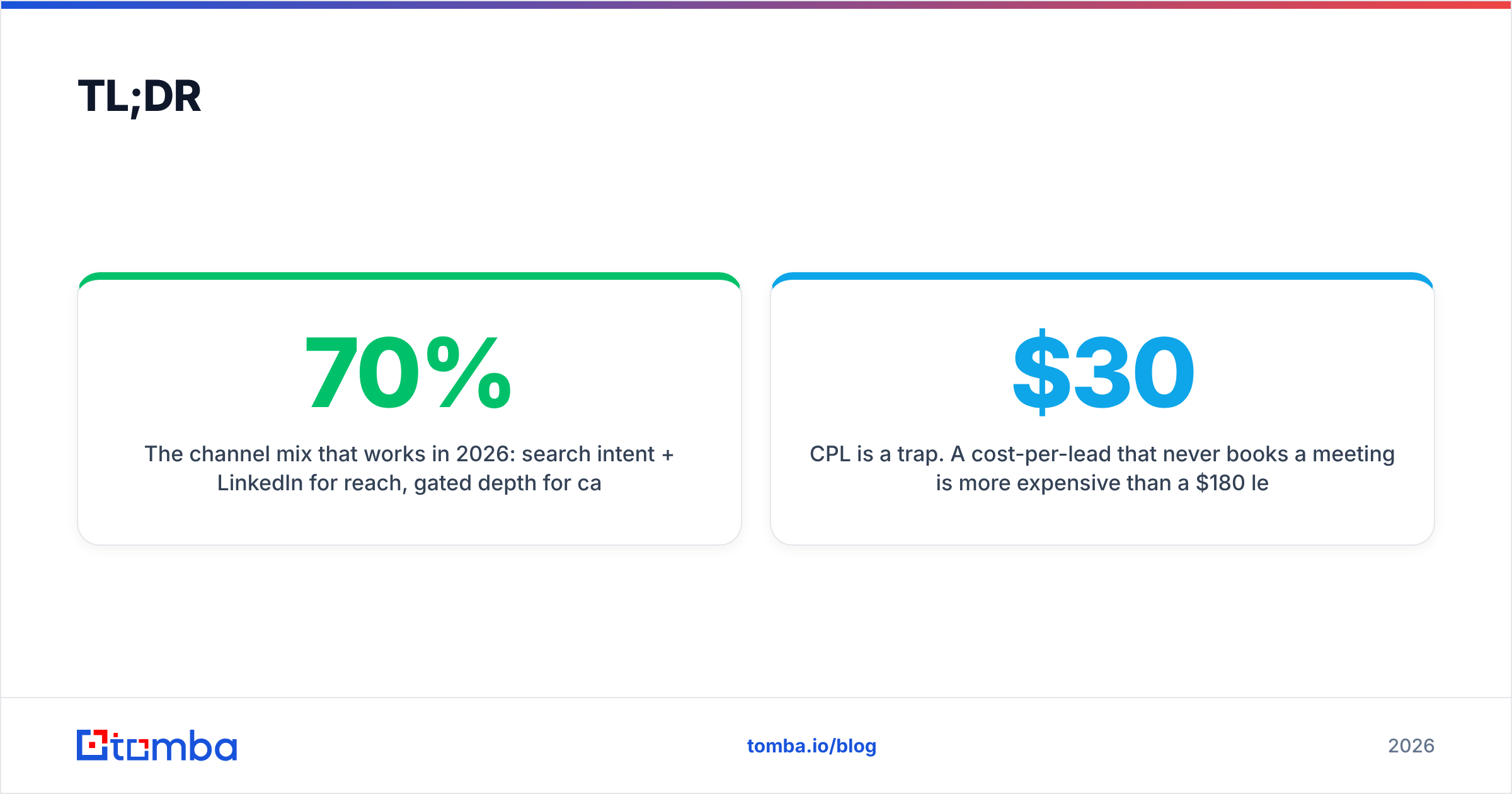
- The channel mix that works in 2026: search intent + LinkedIn for reach, gated depth for capture, and enrichment to fill the 60–70% of form and visitor data that arrives incomplete.
- CPL is a trap. A $30 cost-per-lead that never books a meeting is more expensive than a $180 lead that closes. Measure cost-per-qualified-opportunity instead.
- Most captured leads are half-blank. Progressive forms plus a data-enrichment layer beat 12-field forms that kill your conversion rate.
- Deliverability decides outcomes. Even perfect targeting fails if your follow-up emails bounce, so verification is not optional.
What does "digital marketing to generate leads" actually mean?#
Think of lead generation like fishing, not hunting. Hunting is one perfect shot at one known target. Fishing is building a system — the right water, the right bait, the right net — so fish come to you repeatedly. Digital marketing to generate leads is that fishing system: channels that attract intent, offers that capture identity, and a qualification process that sorts keepers from throwbacks.
Technically, a "lead" is a person or account that has shown enough interest to justify a sales or nurture touch. That definition matters because the fastest way to look busy and stay broke is to count the wrong thing. A newsletter signup and a demo request are both "leads" in a spreadsheet and worlds apart in a pipeline.
Every lead-generation system has three moving parts:
- Demand generation — SEO, paid search, paid social, organic social, partnerships, and events that create attention among people who fit your ideal customer profile.
- Lead capture — landing pages, forms, chat, gated assets, and website visitor identification that convert that attention into a named contact.
- Qualification and routing — scoring, enrichment, and hand-off rules that decide who gets a sales call, who gets nurtured, and who gets ignored.
Skip any one of the three and the other two leak. Great demand with weak capture is a party nobody can RSVP to. Great capture with no qualification buries reps in tire-kickers.
Which digital marketing channels generate the most B2B leads in 2026?#
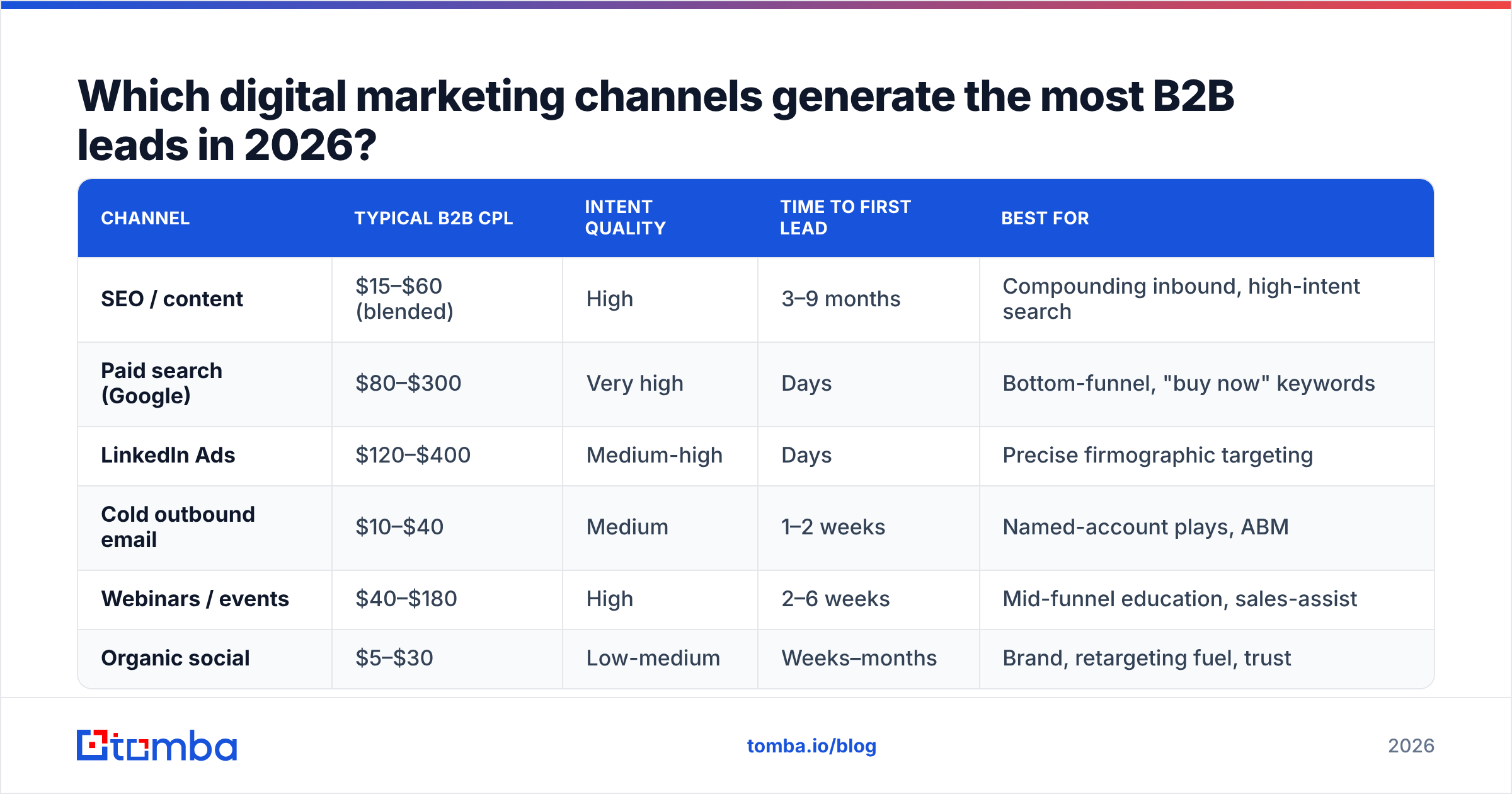
There is no single best channel — there is a best mix for your motion, price point, and sales cycle. Here is how the major channels compare on the metrics that decide whether they earn a place in your budget.
| Channel | Typical B2B CPL | Intent quality | Time to first lead | Best for |
|---|---|---|---|---|
| SEO / content | $15–$60 (blended) | High | 3–9 months | Compounding inbound, high-intent search |
| Paid search (Google) | $80–$300 | Very high | Days | Bottom-funnel, "buy now" keywords |
| LinkedIn Ads | $120–$400 | Medium-high | Days | Precise firmographic targeting |
| Cold outbound email | $10–$40 | Medium | 1–2 weeks | Named-account plays, ABM |
| Webinars / events | $40–$180 | High | 2–6 weeks | Mid-funnel education, sales-assist |
| Organic social | $5–$30 | Low-medium | Weeks–months | Brand, retargeting fuel, trust |
Read that table as ranges, not gospel — your numbers move with vertical, ACV, and offer quality. The pattern that holds: search captures existing demand, social and content create it, and outbound targets accounts that never raised a hand. A serious 2026 program runs at least one channel from each group so you are not betting the quarter on a single algorithm.

For a deeper channel-by-channel breakdown of tactics, Gartner's marketing research and HubSpot's annual State of Marketing report are two of the more honest public benchmarks; treat their CPL figures as directional and validate against your own cohort.
Why do most lead-gen programs stall even with good traffic?#
Because they optimize the top of the funnel and ignore the middle. The classic failure looks like this: a team pours budget into ads, celebrates a low cost-per-lead, then watches sales complain that "the leads are garbage." Nobody is lying. The leads are cheap and bad, because CPL rewards volume, not fit.
Here is where programs actually break, in rough order of frequency:
- The 12-field form. Every extra required field cuts conversion. Ask for an email and a company, then enrich the rest silently in the background rather than interrogating the prospect.
- Half-blank records. Even good forms deliver incomplete data — a personal Gmail, no job title, no company size. Without a data enrichment layer, reps waste hours researching instead of selling.
- No visitor identification. 95%+ of your site traffic leaves without filling anything out. Website visitor identification recovers a slice of that anonymous demand as named companies you can pursue.
- Bounced follow-up. You captured the lead, but the work email is dead or a typo. If your outreach bounces, deliverability craters and the lead is functionally lost.
- No qualification gate. Everything routes to sales, reps drown, and genuinely good leads sit for three days and go cold.
Notice that four of those five failures happen after the click. That is the uncomfortable truth of using digital marketing to generate leads in 2026: the channel is rarely the bottleneck. The capture-and-qualify plumbing is.
How do you turn anonymous traffic into contacts you can actually reach?#
Build a capture stack that works in layers, each catching what the previous one missed. Think of it like a series of nets with progressively smaller holes.
- Layer one — explicit capture. Short forms on high-intent pages (pricing, demo, comparison). Keep required fields to two or three and use progressive profiling to collect more over repeat visits.
- Layer two — enrichment. The moment an email arrives, append firmographics: company size, industry, role, tech stack. This is what lets you score and route instantly instead of manually.
- Layer three — visitor de-anonymization. For the traffic that never fills a form, identify the company and pull decision-maker contacts so outbound can follow up on demonstrated interest.
- Layer four — verification. Before anything hits your sending domain, verify the address. A clean list protects email deliverability and your sender reputation, which decides whether the next thousand emails even reach the inbox.
The enrichment and identification layers are where most teams find their fastest ROI, because they convert traffic you already paid for into pipeline instead of buying more traffic. If you are running outbound off named accounts, an accurate email finder and a verification pass turn a list of company domains into reachable, qualified contacts — no extra ad spend required.
A quick note on data hygiene: incomplete and stale records are the silent tax on every lead program. Independent review sites like G2 catalog dozens of enrichment and lead-intelligence tools precisely because no single database is complete. The practical move is to enrich and verify at the point of capture, not months later when the record is already rotting in your CRM.
What does a 2026 lead-generation funnel look like end to end?#
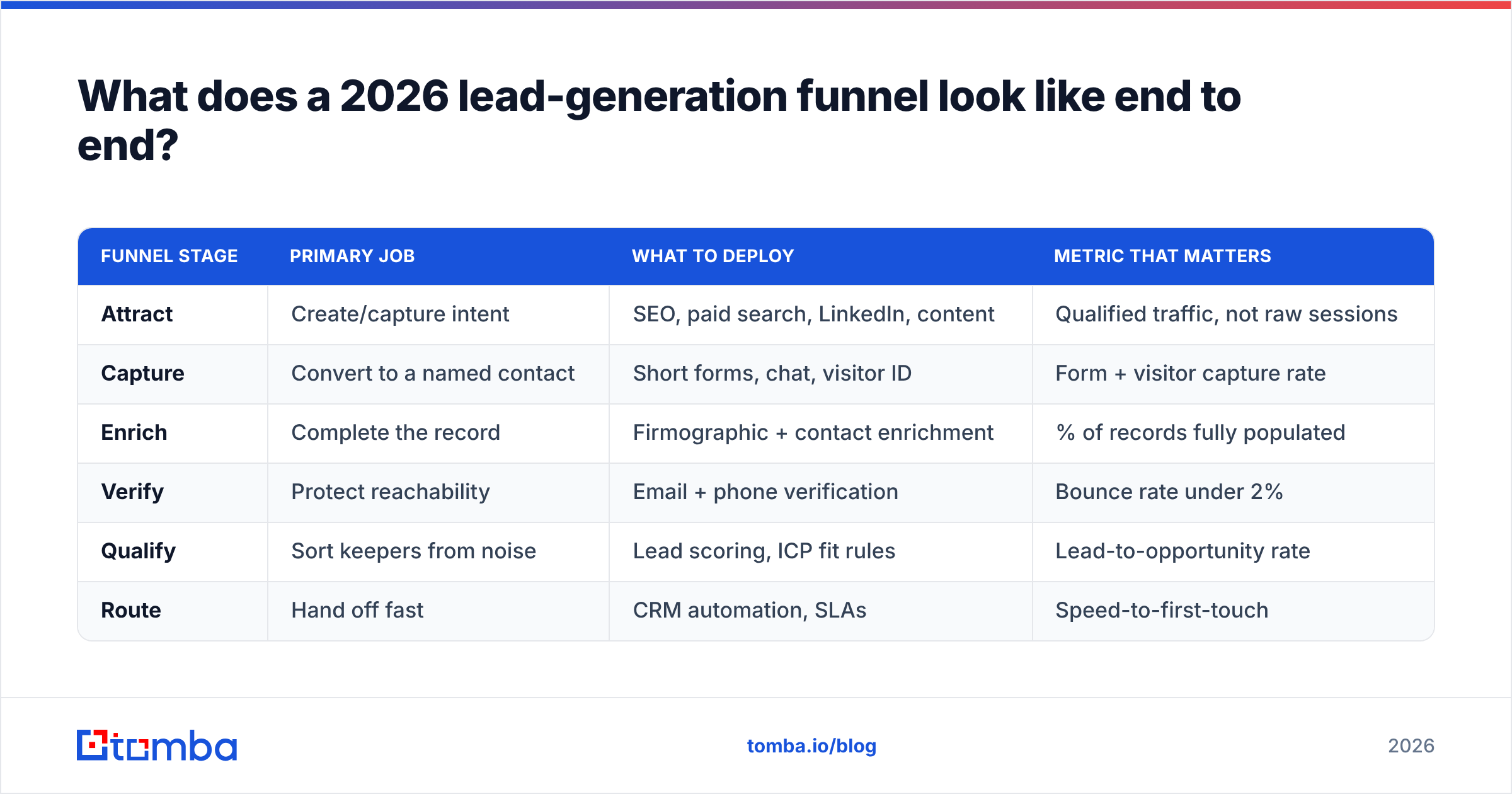
Here is the full system, mapped stage by stage, with the job each stage does and the metric that tells you it is working.
| Funnel stage | Primary job | What to deploy | Metric that matters |
|---|---|---|---|
| Attract | Create/capture intent | SEO, paid search, LinkedIn, content | Qualified traffic, not raw sessions |
| Capture | Convert to a named contact | Short forms, chat, visitor ID | Form + visitor capture rate |
| Enrich | Complete the record | Firmographic + contact enrichment | % of records fully populated |
| Verify | Protect reachability | Email + phone verification | Bounce rate under 2% |
| Qualify | Sort keepers from noise | Lead scoring, ICP fit rules | Lead-to-opportunity rate |
| Route | Hand off fast | CRM automation, SLAs | Speed-to-first-touch |
The point of laying it out this way is to show that lead generation is not a marketing project handed to sales at the end. It is a shared assembly line. Marketing owns attract and capture, RevOps owns enrich and qualify, sales owns route and close — and the whole thing is only as strong as the weakest stage.
If you want the same logic applied to specific tools and pricing, our Tomba pricing page shows how enrichment, verification, and finding stack into one workflow, and the B2B glossary defines the terms your ops team keeps arguing about.
How much should digital lead generation cost — and how do you know it is working?#
Stop reporting cost-per-lead as your headline number. Report cost-per-qualified-opportunity and pipeline-to-spend ratio. Those two survive contact with a CFO; CPL does not.
Here is why. Imagine two campaigns:
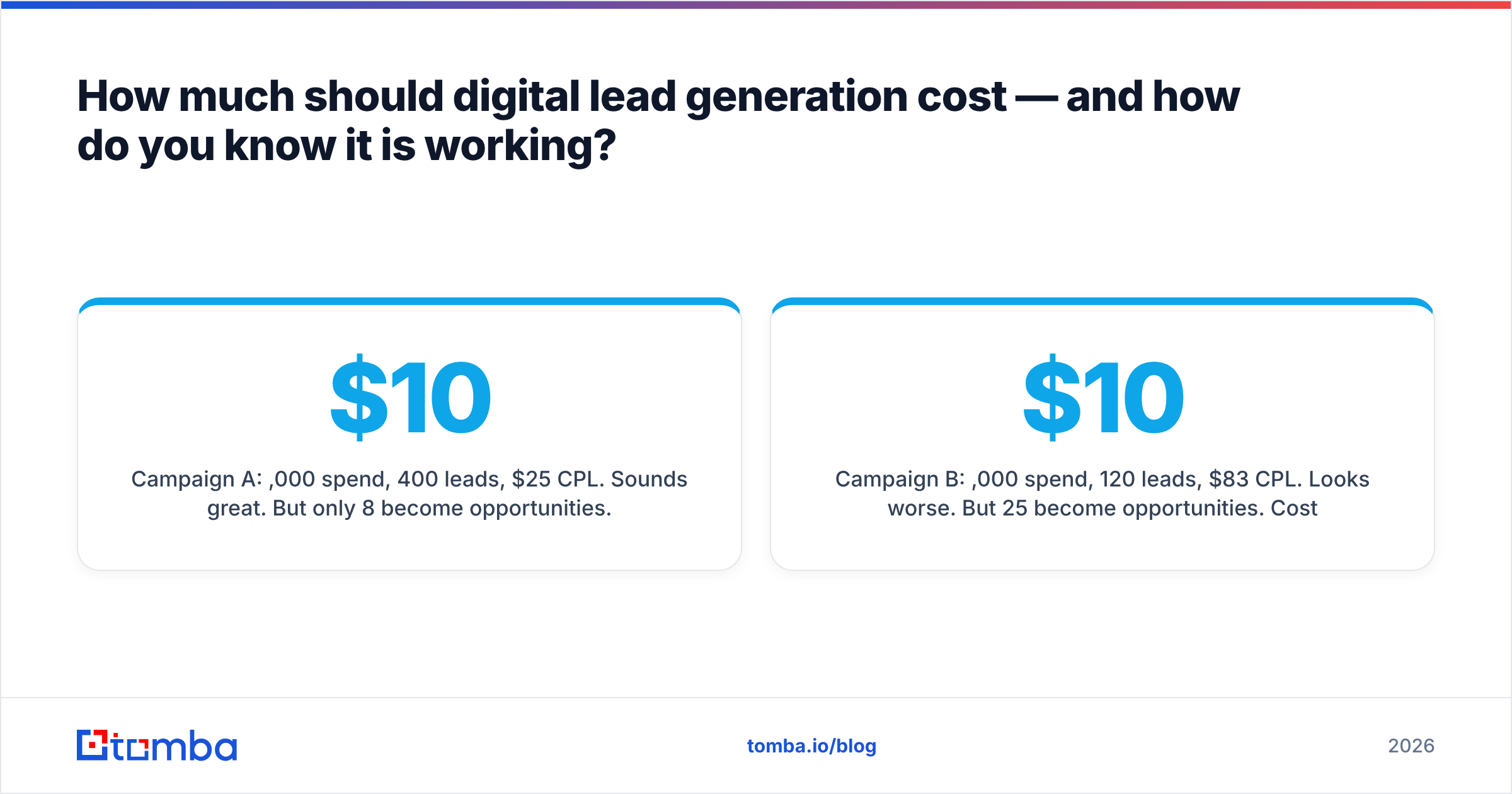
- Campaign A: $10,000 spend, 400 leads, $25 CPL. Sounds great. But only 8 become opportunities. Cost per opportunity: $1,250.
- Campaign B: $10,000 spend, 120 leads, $83 CPL. Looks worse. But 25 become opportunities. Cost per opportunity: $400.
Campaign B is three times more efficient at the only thing that matters — creating deals — despite a CPL that is more than triple. Teams that optimize CPL systematically defund their best channel. Teams that optimize cost-per-opportunity fund reality.
To measure it honestly, you need three things wired together:
- Closed-loop tracking — every lead source flows into the CRM with its origin intact, so you can trace revenue back to channel.
- Consistent qualification — the same ICP-fit and scoring rules applied to every lead, so "qualified" means the same thing across channels.
- Clean contact data — because a lead you cannot reach never becomes an opportunity, and your channel numbers will lie if half your records bounce. This is where verification and enrichment quietly protect your entire analytics layer.
Benchmark yourself against your own trailing cohort, not a blog's global average. The single most useful dashboard in a 2026 lead program is a simple cohort chart: leads by source, opportunity rate by source, and cost-per-opportunity by source, refreshed monthly. It kills bad channels and doubles down on good ones faster than any strategy deck.
What is the fastest way to improve lead quality this quarter?#
Fix the data before you touch the channels. Most teams reflexively reach for "more traffic" when their real problem is that the traffic they have arrives as incomplete, unverified, unreachable records. Three moves, in order:
- Shorten your forms and enrich the difference. Cut required fields to email + company, append the rest automatically. Expect a conversion lift and better data, not worse.
- De-anonymize and pursue warm accounts. Identify companies already on your site and route them to sales as demonstrated-intent accounts before they go to a competitor.
- Verify every address before it sends. One verification pass drops your bounce rate, protects sender reputation, and lifts the deliverability of every future send.
None of these require a bigger ad budget. They require treating your contact data as the asset it is.
Where does Tomba fit in a lead-generation stack?#
Tomba sits in the capture-to-verify layers — the exact place most programs leak. When your ads, SEO, and outbound generate demand, Tomba turns partial signals into reachable, qualified contacts: find the right professional email from a name and domain, enrich the record with firmographics, and verify the address before it ever touches your sending domain.
If your 2026 goal is to make digital marketing to generate leads that sales can actually close, start where the leaks are. Use the Tomba Email Finder to turn named accounts and half-blank form fills into verified, ready-to-contact leads — on a free tier of 25 searches a month, scaling to a Starter plan at $49/mo when you are ready to run it at volume. Fix the plumbing first, and every channel above it starts paying off.
Related guides#
Ready to find emails that actually work?
Join 150,000+ professionals who stopped guessing and started sending. Free credits on signup — no credit card required.
Get the Tomba newsletter
Practical outbound tactics and product updates — once every two weeks.
About the author