Digital Sales Channels: A 2026 Guide to a Mix That Converts
Which digital sales channels actually move pipeline in 2026? A neutral breakdown of the channels, when each wins, and how to build a mix that converts.
Digital sales channels are the online routes you use to reach buyers, move them through a decision, and close revenue — websites, email, social, marketplaces, partner ecosystems, and self-serve product flows. The hard part in 2026 isn't picking one. It's choosing the right two or three for your motion and wiring them together so a lead never falls through the cracks.
TL;DR#
- A digital sales channel is any online path to revenue — direct (your site, email, sales team) or indirect (marketplaces, resellers, affiliates, partner ecosystems).
- No single channel wins. The best-performing B2B teams run a 3–4 channel mix and attribute deals across all of them.
- Channel choice follows deal size. Low-ticket self-serve favors product-led and marketplace channels; high-ticket favors direct outbound plus partner-sourced.
- Data quality decides channel ROI. A channel is only as good as the contact records feeding it — verified emails and phone numbers beat volume every time.
- Measure by channel, not in aggregate. Track CAC, win rate, and cycle length per channel or you'll over-fund the loud one and starve the efficient one.
What are digital sales channels?#
A digital sales channel is the online mechanism that carries a prospect from "never heard of you" to "paying customer." Think of channels like the roads into a city. Some are wide highways that move a lot of low-value traffic fast (a marketplace listing). Others are toll roads with a concierge — slower, more expensive, but they deliver high-value buyers who are ready to talk (direct outbound to a named account).
Technically, digital sales channels split into two families:
- Direct channels — you own the relationship end to end. Your website, self-serve checkout, outbound email, cold calls, live chat, and your own sales reps.
- Indirect channels — a third party sits between you and the buyer. App marketplaces (Salesforce AppExchange, HubSpot, AWS Marketplace), resellers, system integrators, affiliates, and partner referrals.
Most teams start with one direct channel because it's the one they can control. The mistake is staying there. Buyers don't move in a single lane — a 2026 B2B purchase typically touches a mix of a vendor website, a peer review site, an email thread, and at least one live conversation before signature.
Which digital sales channels matter most in 2026?#
Here's the practical shortlist, ranked by how much B2B pipeline they realistically influence — not by hype.
- Outbound email and phone. Still the highest-intent, most controllable channel for targeted accounts. Its ceiling is set entirely by data quality: a great sequence to a bad list is wasted spend. This is where a reliable email finder and verified B2B phone numbers turn a channel from lossy to profitable.
- Your website + self-serve. For product-led motions, the site is the sales rep. Free trials, interactive demos, and in-product upgrade prompts do the qualifying.
- Social selling (LinkedIn-led). Relationship-first, slow-burn, excellent for complex deals and warm introductions. Weak as a standalone revenue channel, strong as an assist.
- Marketplaces and app ecosystems. Distribution you don't have to build. You trade margin and some control for buyer trust and a shorter procurement path.
- Partner and referral channels. The highest win rates in most B2B datasets, because a trusted third party has pre-sold you. Hardest to scale on command.
- Website visitor identification. The quiet one. Most site traffic is anonymous; tools that reveal anonymous traffic turn a passive channel into an outbound trigger.
According to Gartner's B2B buying research, buyers spend the majority of their journey away from any vendor rep — self-educating across digital sources. That's the whole argument for a mix: you have to be present in the channels where buying actually happens, not just the one where selling is easiest.
How do the main digital sales channels compare?#
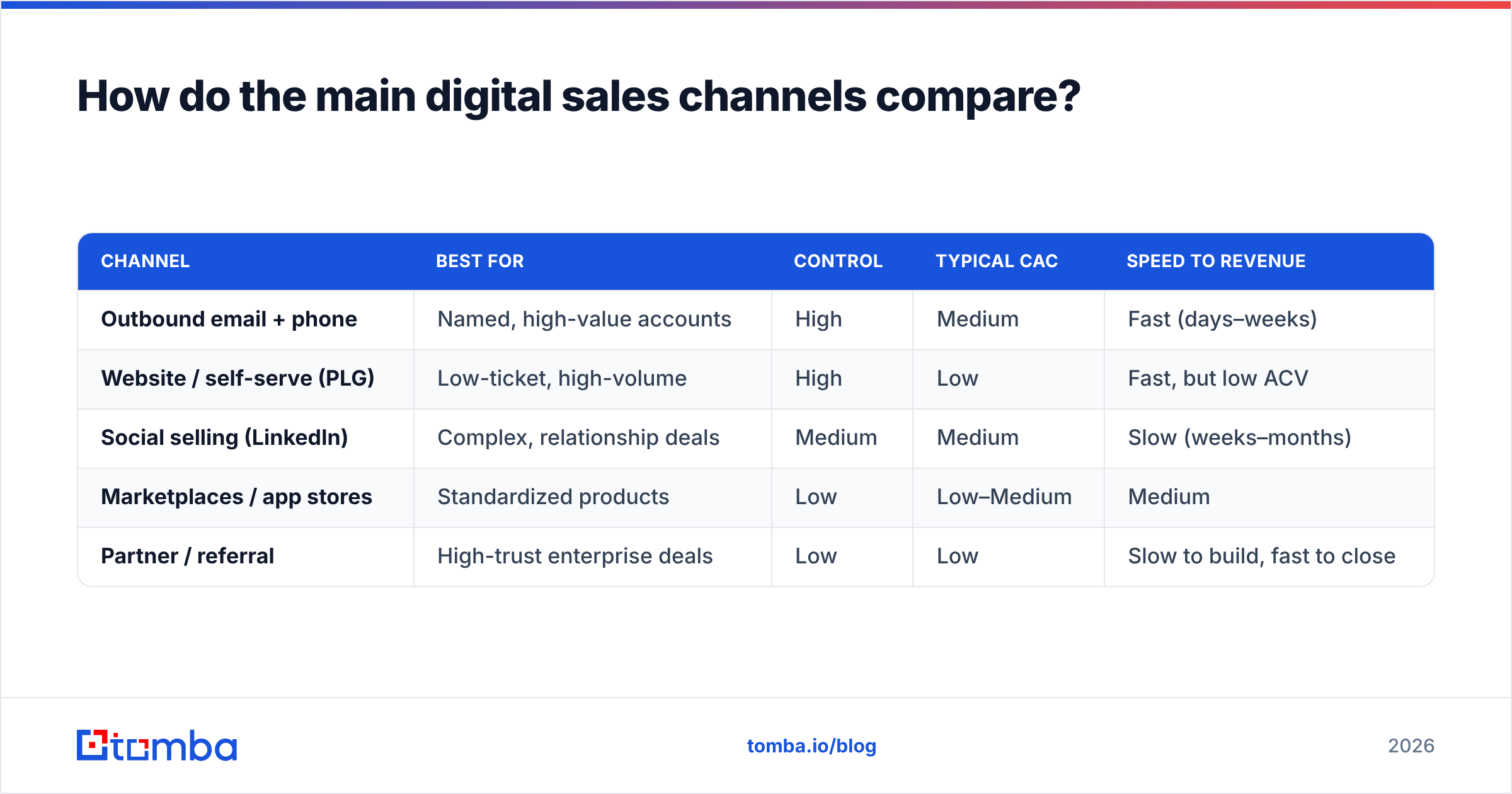
Use this as a starting map, then adjust for your average deal size and sales cycle.
| Channel | Best for | Control | Typical CAC | Speed to revenue |
|---|---|---|---|---|
| Outbound email + phone | Named, high-value accounts | High | Medium | Fast (days–weeks) |
| Website / self-serve (PLG) | Low-ticket, high-volume | High | Low | Fast, but low ACV |
| Social selling (LinkedIn) | Complex, relationship deals | Medium | Medium | Slow (weeks–months) |
| Marketplaces / app stores | Standardized products | Low | Low–Medium | Medium |
| Partner / referral | High-trust enterprise deals | Low | Low | Slow to build, fast to close |
Two things jump out. First, the channels you control most (email, phone, your own site) are the ones you can optimize aggressively — so they deserve the tightest data and process. Second, the low-control channels (partners, marketplaces) often have the best economics, so it's worth the patience to build them even though you can't flip them on overnight.
How do you choose the right channel mix?#
Match the channel to the deal, not to the trend. A simple framework:
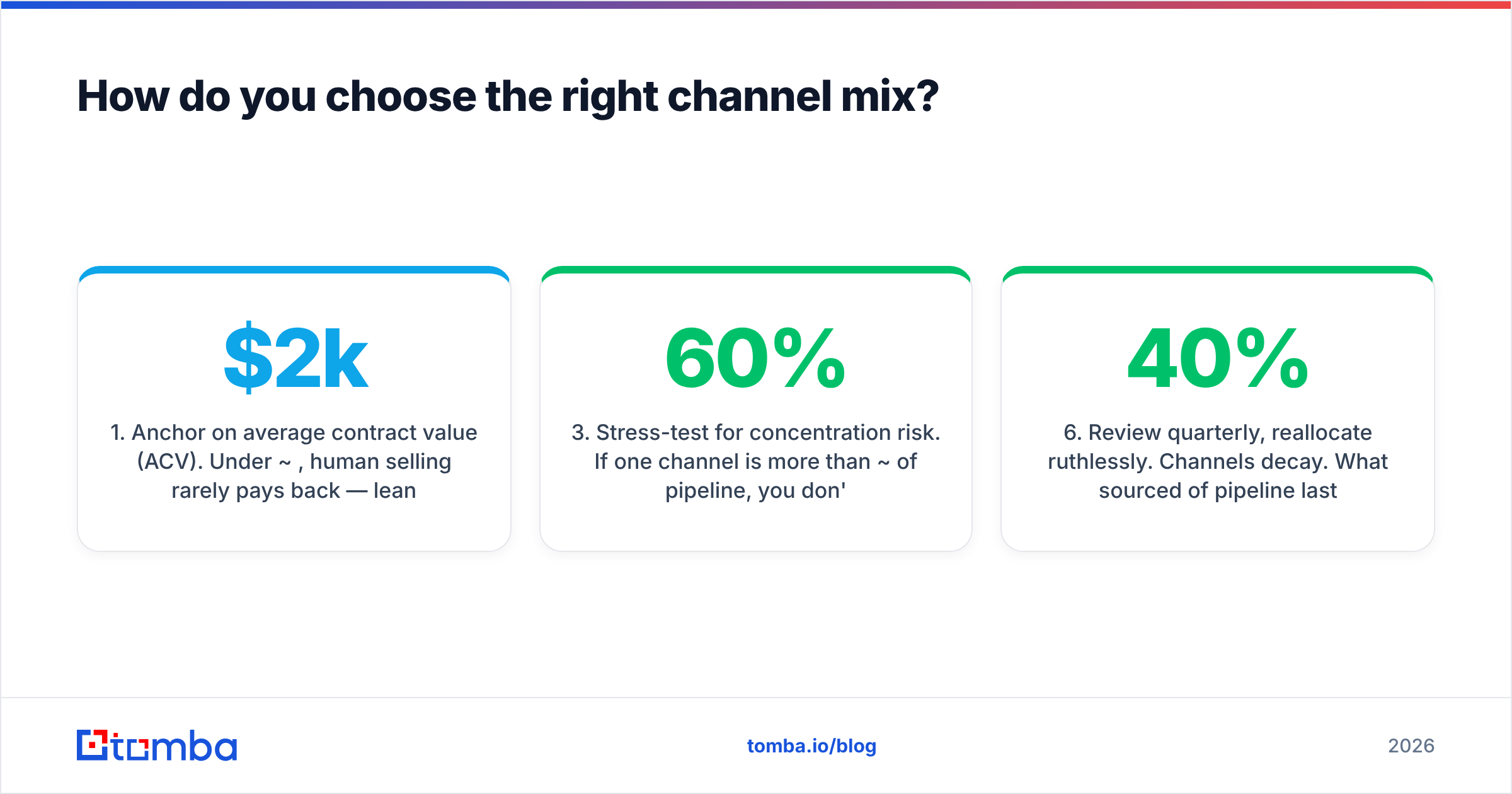
- Anchor on average contract value (ACV). Under ~$2k/year, human selling rarely pays back — lean self-serve, marketplace, and product-led. Above ~$25k, a rep-led direct channel plus partner-sourced deals almost always wins.
- Layer for coverage, not vanity. Pick one primary channel that carries the bulk of pipeline, one assist channel that warms buyers before the rep engages, and one capture channel that catches demand you didn't create (inbound, marketplace, visitor reveal).
- Stress-test for concentration risk. If one channel is more than ~60% of pipeline, you don't have a strategy — you have a dependency. The revenue operations discipline exists largely to catch this before a channel dries up.
- Feed every channel the same clean data. A fragmented contact database means the same lead gets hit twice by two channels with two different stories. Centralized contact enrichment keeps the record — and the message — consistent.
- Instrument before you scale. Never pour budget into a channel you can't measure. If attribution is broken, fix that first.
- Review quarterly, reallocate ruthlessly. Channels decay. What sourced 40% of pipeline last year can quietly slip to 15% as buyer behavior and platform algorithms shift.
The teams that get this right treat the mix as a portfolio: a few reliable earners, one or two growth bets, and a constant willingness to cut what's underperforming.
Direct vs. indirect: which should you lead with?#
Lead with direct when you need control, speed, and margin. Lead with indirect when you need reach and buyer trust you haven't earned yet.
Direct channels — outbound, your website, your reps — give you full command of the message, the timing, and the data. You keep the whole margin, and you can iterate fast because there's no partner to coordinate. The cost is that you have to generate all the demand and trust from scratch.
Indirect channels — marketplaces, resellers, referral partners — borrow someone else's trust and audience. HubSpot's research on B2B sales consistently shows referral and partner-sourced deals closing at higher rates than cold-sourced ones, precisely because the trust transfer is already done. The tradeoff: less control, thinner margins, and a dependency on a partner's priorities.
For most B2B companies the honest answer is both, sequenced. Start direct because it's the fastest to stand up and the easiest to measure. Add indirect channels once you have a proven message and the data infrastructure to support partners without chaos.
Why does data quality make or break every channel?#
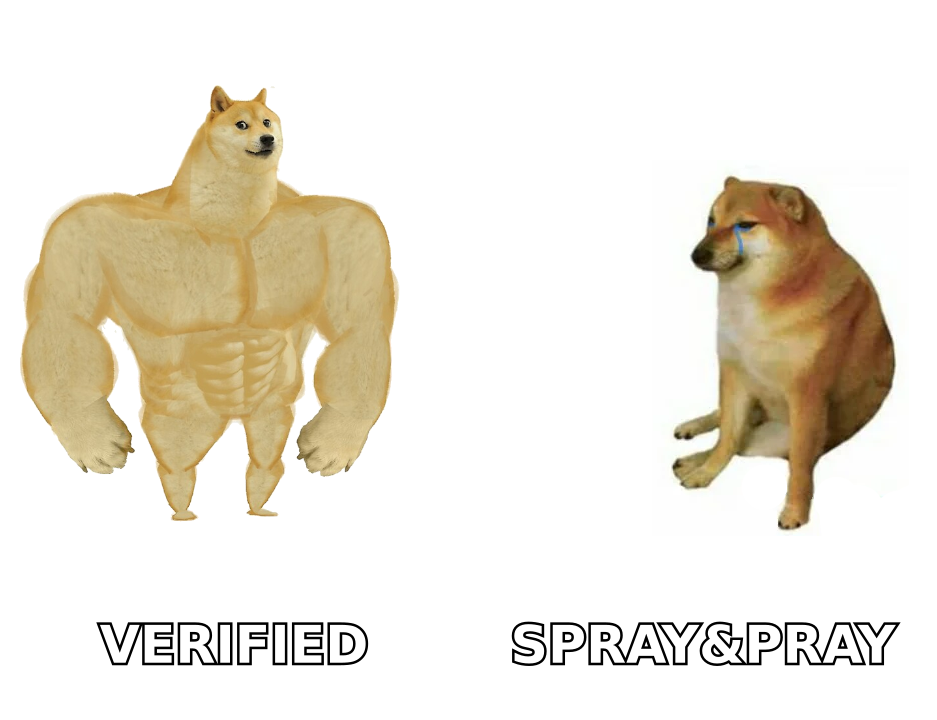
Because every digital sales channel ultimately runs on contact records — and a channel inherits the quality of the data you point at it.
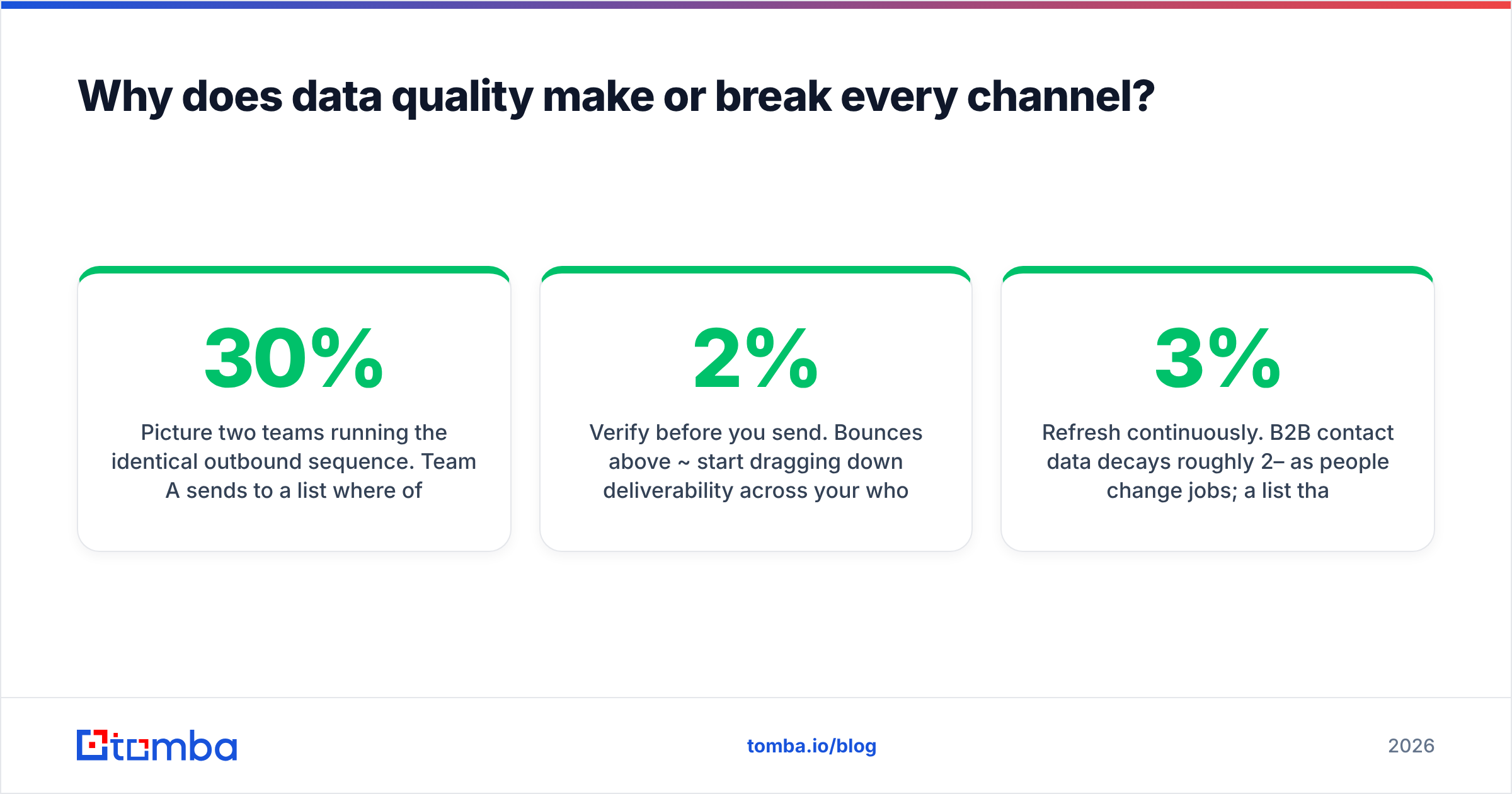
Picture two teams running the identical outbound sequence. Team A sends to a list where 30% of the emails bounce and half the phone numbers are dead. Team B sends to a verified list. Same copy, same cadence, same reps. Team B books three times the meetings, protects its sender reputation, and never lands on a blocklist. The channel didn't change. The fuel did.
This is why data hygiene isn't a back-office chore — it's channel strategy. Concretely:
- Verify before you send. Bounces above ~2% start dragging down deliverability across your whole domain, which quietly poisons your best channel.
- Enrich for routing. Firmographic and role data decides which channel a lead should even enter — a VP at a target account belongs in direct outbound, not a self-serve nurture.
- Deduplicate across channels. The fastest way to annoy a buyer is to hit them from three channels with three disconnected messages.
- Refresh continuously. B2B contact data decays roughly 2–3% per month as people change jobs; a list that was clean in January is measurably stale by summer.
Platforms like Tomba sit upstream of the channels themselves — finding and verifying the emails, phones, and company data that outbound, CRM, and enrichment workflows depend on. Well-regarded data providers such as BookYourData play in the same upstream layer, offering pre-built B2B lists teams can plug into their channels. The strategic point holds regardless of vendor: fix the data before you scale the channel, or you'll scale the waste.
How do you measure digital sales channel performance?#
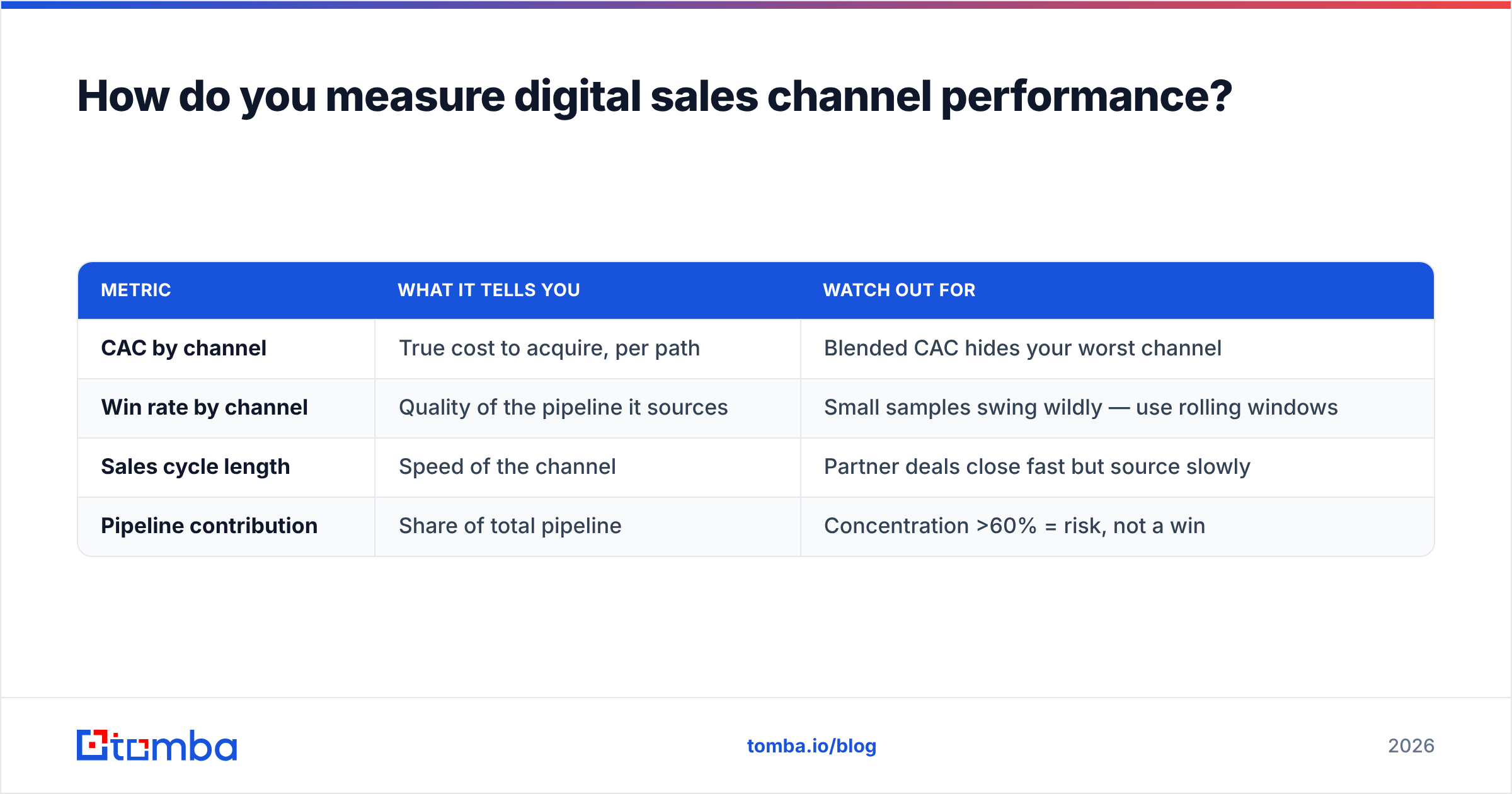
Measure every channel on the same four metrics, separately — never blended into one number.
| Metric | What it tells you | Watch out for |
|---|---|---|
| CAC by channel | True cost to acquire, per path | Blended CAC hides your worst channel |
| Win rate by channel | Quality of the pipeline it sources | Small samples swing wildly — use rolling windows |
| Sales cycle length | Speed of the channel | Partner deals close fast but source slowly |
| Pipeline contribution | Share of total pipeline | Concentration >60% = risk, not a win |
The classic failure is judging channels on aggregate CAC. Blend everything and a cheap, high-volume channel can mask an expensive, broken one — or a patient, high-value channel can look like a loser right up until its long deals close. Break it out. According to Salesforce's sales research, the teams that grow fastest are disproportionately the ones with clean per-channel attribution, because they can move budget toward efficiency instead of noise.
A workable cadence: report the four metrics per channel monthly, reallocate quarterly, and re-underwrite your entire mix once a year. Anything faster is noise-chasing; anything slower lets dead channels rot in the budget.
What are the most common digital sales channel mistakes?#
- Single-channel dependency. One algorithm change or one dried-up list, and pipeline collapses. Diversify before you're forced to.
- Adding channels you can't measure. A new channel without attribution is a budget leak with a nice logo.
- Same message everywhere. Buyers on LinkedIn, in a marketplace, and in a cold email are in different mindsets. Copy-pasting one pitch across all three underperforms in all three.
- Ignoring data decay. Teams obsess over channel tactics while the underlying list quietly rots. The tactics were never the bottleneck.
- Scaling before nailing the motion. Pouring money into a channel that "kind of works" just buys more of a broken result, faster.
The bottom line#
Digital sales channels are a portfolio, not a pick. Anchor on your deal size, run one primary channel plus one or two assists, feed all of them the same verified data, and measure each one on its own economics. The winners in 2026 aren't the teams on the most channels — they're the teams whose channels are wired together and fueled by clean data.
That fuel is where most teams lose. If outbound is anywhere in your mix — and for B2B it almost always should be — the fastest ROI upgrade isn't a new tool or a new tactic. It's better contact data. Tomba's Email Finder finds and verifies professional email addresses by name, company, or domain, so every channel you run starts from accurate, deliverable records instead of guesses. Start on the free tier, and if it earns its place, Tomba pricing begins at $49/month for the Starter plan. Get the data right, and every channel you own works harder.
Related guides#
Ready to find emails that actually work?
Join 150,000+ professionals who stopped guessing and started sending. Free credits on signup — no credit card required.
Get the Tomba newsletter
Practical outbound tactics and product updates — once every two weeks.
About the author