Digital Sales Transformation in 2026: The Complete Playbook
Digital sales transformation is where most B2B teams stall — not on tools, but on data, process, and adoption. Here's a practical 2026 roadmap that actually ships.
Digital sales transformation gets pitched as a software purchase. It isn't. Buying a new CRM, an AI dialer, and a sequencing tool changes your invoice, not your revenue. Real transformation is a change to how your team finds buyers, qualifies them, and moves them through a pipeline — with software as the enabler, not the strategy.
This guide is the version nobody selling you a platform will write: what to actually change, in what order, and where teams quietly waste a year.
TL;DR#
- Digital sales transformation is the shift from manual, gut-driven selling to a data-driven, tooled, and measurable revenue process — not a single tool purchase.
- The bottleneck is almost never the CRM. It's clean contact data, a documented process, and rep adoption.
- Sequence the work: fix data → define the process → layer automation → then add AI. Skipping to AI first is the most common failure.
- Measure leading indicators (data coverage, pipeline velocity, activity quality), not just closed revenue.
- A transformation stalls the day reps go back to spreadsheets. Adoption is the whole game.
What is digital sales transformation?#
Digital sales transformation is the process of re-tooling and re-wiring how a sales organization operates so that decisions, outreach, and forecasting run on data and software instead of memory and manual effort.
Think of it like a restaurant moving from a paper ticket rail to a kitchen display system. The food doesn't change because you bought screens. What changes is that orders stop getting lost, timing becomes visible, and the head chef can finally see where the line backs up. The screens only help because the kitchen redesigned its flow around them.
In sales, the same principle holds. A modern stack — CRM, sales automation, enrichment, conversation intelligence — only pays off when the underlying process is defined and the data feeding it is trustworthy. Bolt tools onto a broken process and you get a faster broken process.
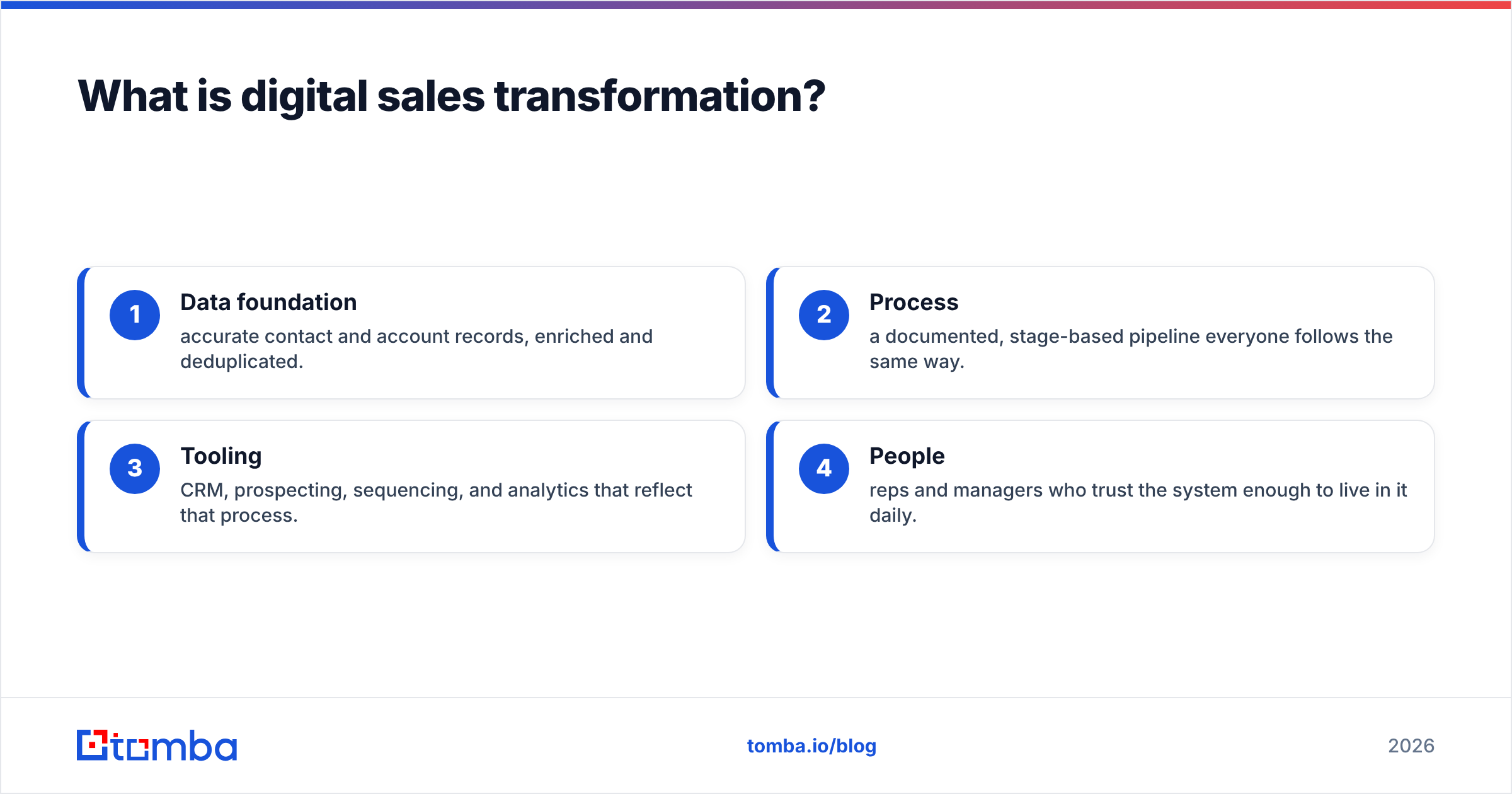
The scope usually spans four layers:
- Data foundation — accurate contact and account records, enriched and deduplicated.
- Process — a documented, stage-based pipeline everyone follows the same way.
- Tooling — CRM, prospecting, sequencing, and analytics that reflect that process.
- People — reps and managers who trust the system enough to live in it daily.
Miss any one layer and the other three underperform.
Why do most digital sales transformations stall?#
Most transformations stall because teams treat it as an IT project with a go-live date instead of a behavior change with no finish line.
The pattern is predictable. Leadership buys a platform, runs a two-week rollout, declares victory, and moves on. Six months later reps are back in personal spreadsheets, the CRM is 40% empty, and the forecast is still a gut number in a nicer dashboard.
Here are the failure modes that actually kill these projects:
- Dirty data at the base. If reps don't trust the contact record, they won't use it. Bounced emails and wrong numbers train them to work around the system.
- No documented process. Ten reps run ten different pipelines, so no dashboard means the same thing twice.
- Tool sprawl. Seven overlapping tools, none fully adopted, each with its own login and its own version of the truth.
- AI before basics. Teams buy an AI SDR before they can export a clean list of target accounts. The AI just automates the mess.
- No adoption incentive. Reps are measured on bookings, so anything that doesn't obviously help this quarter's number gets ignored.
The fix isn't more budget. It's sequence and discipline.
What does the modern digital sales stack look like?#
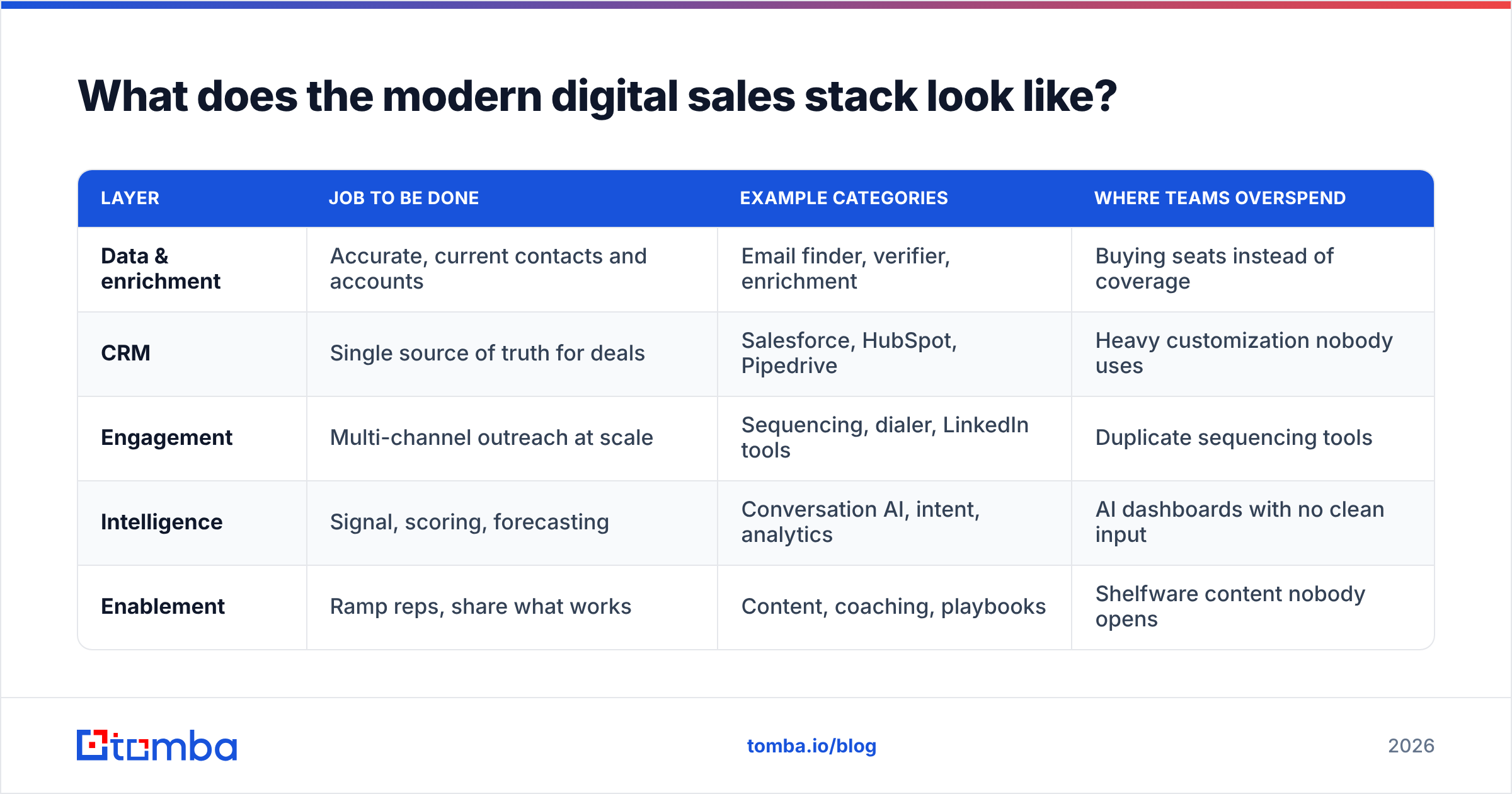
A modern stack has a clear job at each layer, and the layers feed each other. Below is a reference architecture most B2B teams converge on, and where the money actually goes.
| Layer | Job to be done | Example categories | Where teams overspend |
|---|---|---|---|
| Data & enrichment | Accurate, current contacts and accounts | Email finder, verifier, enrichment | Buying seats instead of coverage |
| CRM | Single source of truth for deals | Salesforce, HubSpot, Pipedrive | Heavy customization nobody uses |
| Engagement | Multi-channel outreach at scale | Sequencing, dialer, LinkedIn tools | Duplicate sequencing tools |
| Intelligence | Signal, scoring, forecasting | Conversation AI, intent, analytics | AI dashboards with no clean input |
| Enablement | Ramp reps, share what works | Content, coaching, playbooks | Shelfware content nobody opens |
Notice the base layer. Everything above the data row inherits the quality of the data row. A B2B database that's 80% accurate quietly caps the effectiveness of every tool sitting on top of it. This is why the smartest transformations start at the bottom, not with the flashiest AI tier.
If you're consolidating vendors, G2's grid reports and Gartner's Magic Quadrant are useful for cutting through vendor claims — but weight real trial data over analyst placement.
How should you sequence a digital sales transformation?#
Sequence it bottom-up: fix the data, document the process, automate the repetitive work, then apply AI. Each phase makes the next one cheaper and more effective.
Phase 1 — Fix the data foundation#
You cannot automate outreach to contacts you can't reach. Start by auditing your existing records: what percentage of emails are valid, how many accounts are missing a decision-maker, how stale is the phone data.
Then close the gaps. Use an email finder to fill missing contacts by domain and role, an email verifier to strip out bounces before they hit your sender reputation, and data enrichment to append firmographics and job titles. Run everything in bulk so the cleanup is a batch job, not a rep-by-rep chore.
Target: a contact record your reps trust on sight. Everything downstream depends on this.
Phase 2 — Document the process#
Write down your pipeline stages, entry and exit criteria for each, and the definition of a qualified opportunity. This is unglamorous and it is the single highest-leverage step. A shared definition of win rate and stage progression is what turns a CRM from a filing cabinet into a forecasting instrument.
Phase 3 — Layer automation#
Now automate the repetitive, low-judgment work: data entry, sequence enrollment, follow-up reminders, handoffs. Connect your stack with native integrations so data flows without copy-paste. Automation applied to a clean, documented process compounds. Applied to chaos, it just speeds up the chaos.
Phase 4 — Add intelligence and AI#
Only now — with clean data and a real process — does AI earn its keep. Scoring, next-best-action, conversation analysis, and forecasting all need trustworthy inputs. Feed a model your Phase 1 data and it works. Feed it your pre-transformation mess and you've bought an expensive random number generator.
Which metrics prove the transformation is working?#
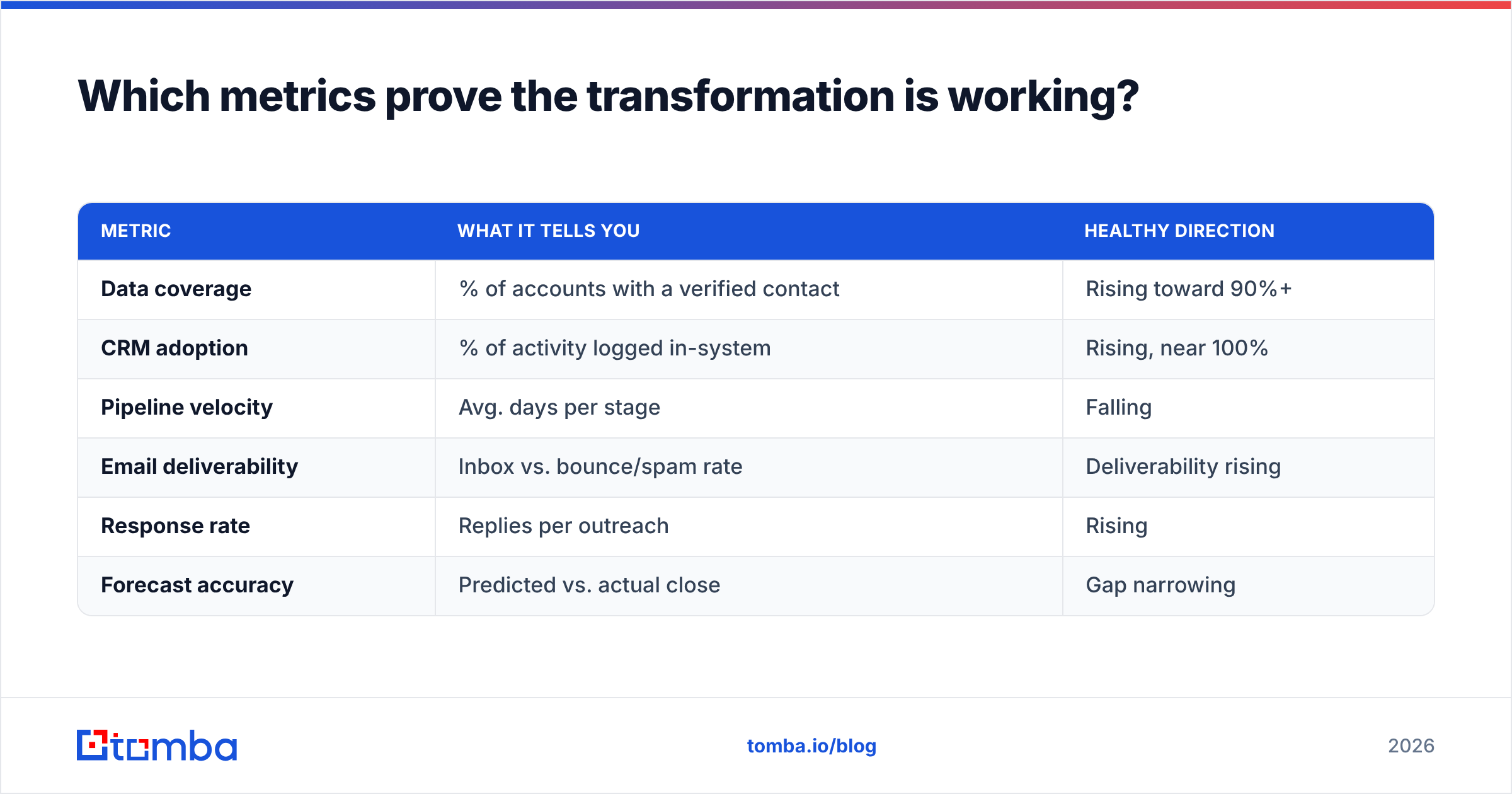
Track leading indicators that move weeks before revenue does, not just the lagging bookings number. If you only watch closed deals, you'll find out the transformation failed a quarter too late to fix it.
| Metric | What it tells you | Healthy direction |
|---|---|---|
| Data coverage | % of accounts with a verified contact | Rising toward 90%+ |
| CRM adoption | % of activity logged in-system | Rising, near 100% |
| Pipeline velocity | Avg. days per stage | Falling |
| Email deliverability | Inbox vs. bounce/spam rate | Deliverability rising |
| Response rate | Replies per outreach | Rising |
| Forecast accuracy | Predicted vs. actual close | Gap narrowing |
Two of these deserve special attention. CRM adoption is your canary — the day it dips, reps are working around the system and your data is rotting in real time. And email deliverability is the quiet killer of digital outreach; sending to unverified lists tanks your sender reputation and drags every campaign down with it, which is exactly why Phase 1 verification pays for itself.
For a broader benchmark on how digital-first revenue teams measure themselves, HubSpot's annual sales research is a solid external reference point.
Build vs. buy: how much should you customize?#
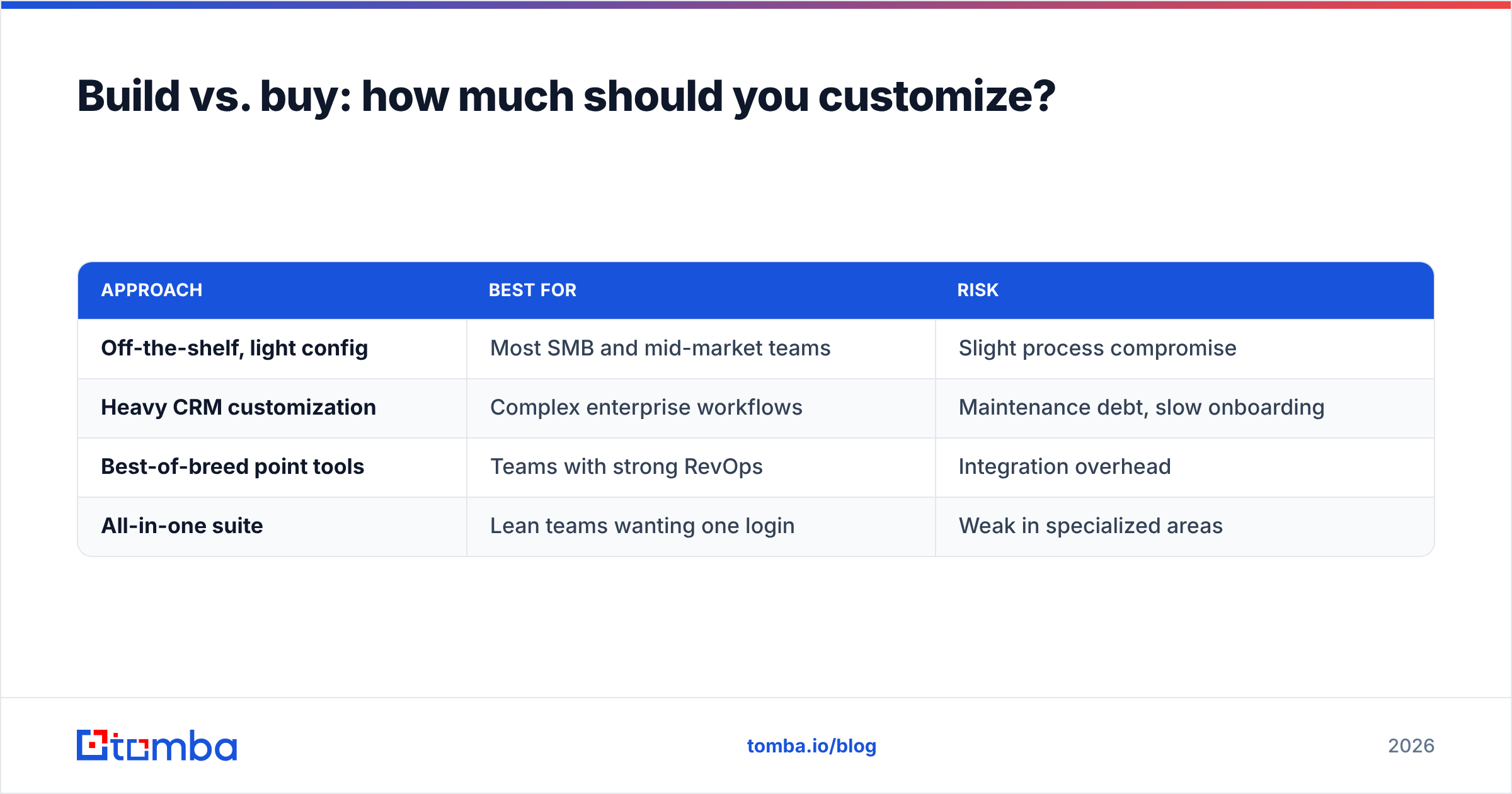
Buy the platform, customize the process — not the other way around. The most expensive transformation mistakes come from teams bending a CRM into a bespoke snowflake that no new hire can learn and no integration can talk to.
| Approach | Best for | Risk |
|---|---|---|
| Off-the-shelf, light config | Most SMB and mid-market teams | Slight process compromise |
| Heavy CRM customization | Complex enterprise workflows | Maintenance debt, slow onboarding |
| Best-of-breed point tools | Teams with strong RevOps | Integration overhead |
| All-in-one suite | Lean teams wanting one login | Weak in specialized areas |
For most teams under a few hundred reps, off-the-shelf tools with a well-documented process beat a heavily customized platform every time. Save customization for the two or three workflows that are genuinely unique to how you sell. Everything else should follow the vendor's paved path so upgrades, integrations, and new-hire ramp stay cheap. Strong revenue operations discipline is what keeps this line from drifting over time.
How do you drive adoption so it actually sticks?#
Adoption sticks when the system is the path of least resistance, not an extra tax on top of selling. If logging a deal takes longer than not logging it, reps won't — no matter how many mandates you send.
Practical levers that work:
- Make the data good first. Reps adopt tools that save them time. A Chrome extension that finds a verified email in one click earns loyalty faster than any training deck.
- Reduce manual entry to near zero. Auto-capture activity, auto-enrich records, auto-log emails. Every field a rep types by hand is a field they'll eventually skip.
- Manage from the system. When forecasts, one-on-ones, and deal reviews all run off the CRM, reps keep it current because their manager is looking at it.
- Celebrate the metric, not the tool. Reward pipeline velocity and response rate improvements. The tool is a means; the number is the point.
- Kill redundant tools. Every tool you retire is one fewer place data can hide. Consolidation is an adoption strategy.
The uncomfortable truth: a mediocre tool everyone uses beats a best-in-class tool half the team ignores. Design for the reluctant rep, not the power user.
What's changed for 2026?#
Two shifts define digital sales transformation in 2026. First, data decay accelerated — job changes and company churn mean contact records go stale faster than ever, making continuous enrichment (not one-time cleanup) table stakes. Second, AI moved from novelty to baseline, which paradoxically raises the value of clean data, because everyone now has the same models and the differentiator is what you feed them.
The teams pulling ahead aren't the ones with the most AI. They're the ones whose AI runs on the cleanest inputs. That advantage is built in Phase 1, not Phase 4.
Where does Tomba fit?#
The base layer of every transformation is contact data you can trust, and that's exactly the problem Tomba is built to solve. Start with the Tomba Email Finder to fill missing decision-maker contacts by domain, name, or company, then verify the whole list to protect deliverability before your first send. On the free tier you get 25 searches a month to test coverage against your own target accounts; paid plans start at $49/mo when you're ready to run cleanup and enrichment in bulk across the whole pipeline.
Fix the foundation first, and every tool you layer on top of it — CRM, sequencing, AI — starts working the way the demo promised. Try it against a list you already know, and let the accuracy make the case.
Related guides#
Ready to find emails that actually work?
Join 150,000+ professionals who stopped guessing and started sending. Free credits on signup — no credit card required.
Get the Tomba newsletter
Practical outbound tactics and product updates — once every two weeks.
About the author