Digital Selling in 2026: A Practical Guide for B2B Sales Teams
Digital selling isn't just cold outreach with new tools. Here's what it actually means in 2026, the stack that powers it, and how to build a repeatable motion that books meetings.
Digital selling is the practice of using digital channels, data, and tools across the entire buying journey — not just to send more cold emails, but to research, engage, and convert buyers where they already spend their time. If you still think of it as "cold calling with LinkedIn open in another tab," this guide will reset that picture.
TL;DR#
- Digital selling ≠ social selling. Social selling is one channel inside a broader digital motion that spans research, multi-channel outreach, buyer enablement, and data hygiene.
- Data quality is the foundation. No digital tactic survives a bounce rate above 5% — verified contact data is the difference between a warm reply and a spam folder.
- The modern stack is layered: intent + research, contact data, outreach/sequencing, and CRM/RevOps glue. Miss a layer and the motion leaks.
- Buyers self-educate. Around 70% of the B2B buying journey happens before a rep is contacted, so your digital presence has to sell while you sleep.
- Start small: pick one ICP, build a clean verified list, run a 3-touch multi-channel sequence, and measure reply rate before scaling.
What is digital selling, exactly?#
Digital selling is the end-to-end use of digital tools and data to find, engage, and win buyers. Think of it like fishing with sonar instead of casting blindly. The old motion was volume: dial 100 numbers, hope 3 pick up. The digital motion is precision: identify the 20 accounts showing buying signals, learn who the decision-makers are, reach them on the channel they prefer, and give them content that answers the question they're actually asking.
It pulls together several disciplines that used to live in separate silos:
- Prospect research — using data platforms and intent signals to build a target list instead of a spreadsheet of guesses.
- Multi-channel outreach — email, LinkedIn, phone, and sometimes video, sequenced deliberately rather than fired at random.
- Social selling — building credibility and relationships on platforms like LinkedIn. This is where social selling fits: it's a channel, not the whole strategy.
- Buyer enablement — giving prospects self-serve content, ROI calculators, and clear next steps so they can move themselves forward.
- Data operations — keeping contact records clean, enriched, and deduplicated so the whole engine runs on accurate fuel.
The unifying idea: meet buyers on their terms, backed by data, at every stage.
How is digital selling different from traditional selling?#
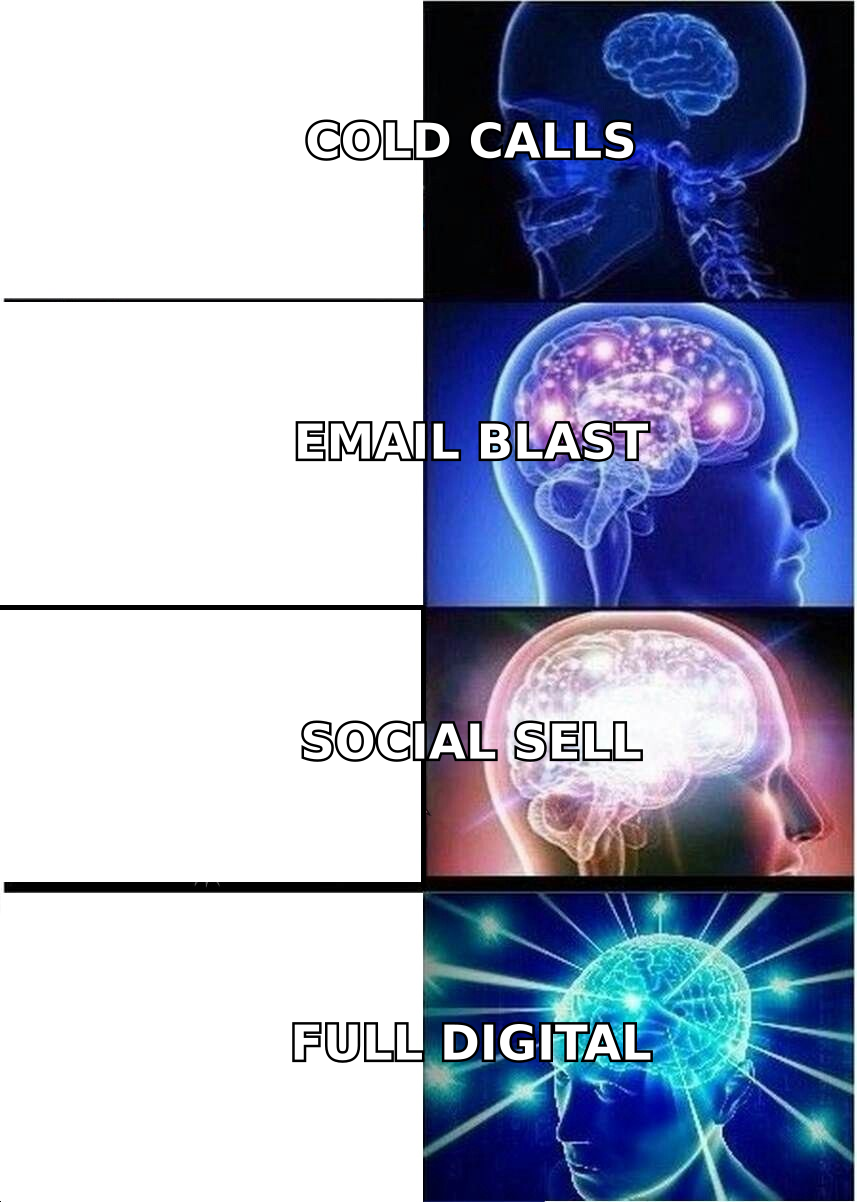
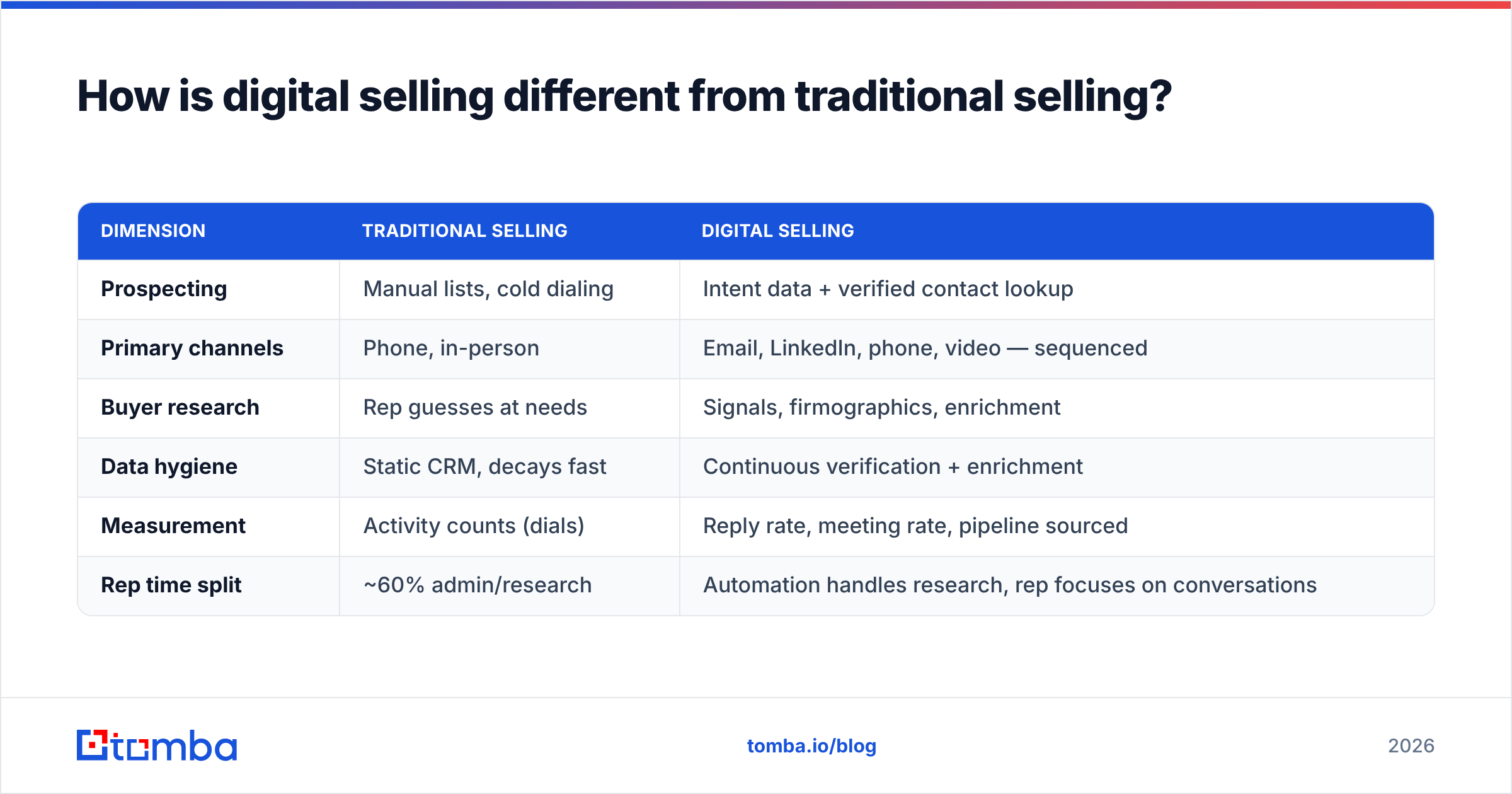
The shift is less about replacing reps and more about changing what reps spend their time on. A traditional rep spent hours dialing and manually researching. A digital seller lets tooling handle discovery and data, then spends human time on the parts that need judgment: framing value, handling objections, and building trust.
| Dimension | Traditional selling | Digital selling |
|---|---|---|
| Prospecting | Manual lists, cold dialing | Intent data + verified contact lookup |
| Primary channels | Phone, in-person | Email, LinkedIn, phone, video — sequenced |
| Buyer research | Rep guesses at needs | Signals, firmographics, enrichment |
| Data hygiene | Static CRM, decays fast | Continuous verification + enrichment |
| Measurement | Activity counts (dials) | Reply rate, meeting rate, pipeline sourced |
| Rep time split | ~60% admin/research | Automation handles research, rep focuses on conversations |
Notice the last row. The point of a digital motion isn't to make reps do more — it's to make the machine do the repetitive work so humans do the human work.
Why does data quality decide whether digital selling works?#
Because every digital tactic sits on top of a contact record, and a wrong record poisons everything downstream. Send a sequence to an outdated email and you don't just miss one prospect — you damage your sender reputation, which quietly lowers deliverability for every other prospect on that domain.
Industry research from Gartner has long flagged that B2B data decays fast — people change jobs, companies rebrand, domains shift. A list that was clean six months ago is measurably worse today. That's why verification isn't a one-time cleanup; it's a standing process.
Here's the practical chain of consequences:
- Bad email → hard bounce → mailbox provider flags you → good emails start landing in spam.
- Missing title/company → generic messaging → lower reply rate.
- Duplicate records → prospect gets three sequences → you look disorganized and burn the relationship.
A disciplined digital seller runs new contacts through a verifier before the first send. Tools like Tomba's email verifier check whether an address is deliverable, catch-all, or risky — so your sequences reach real inboxes. Pair that with data enrichment to fill in the title, company size, and role details your messaging depends on.
What does a digital selling tech stack look like in 2026?#
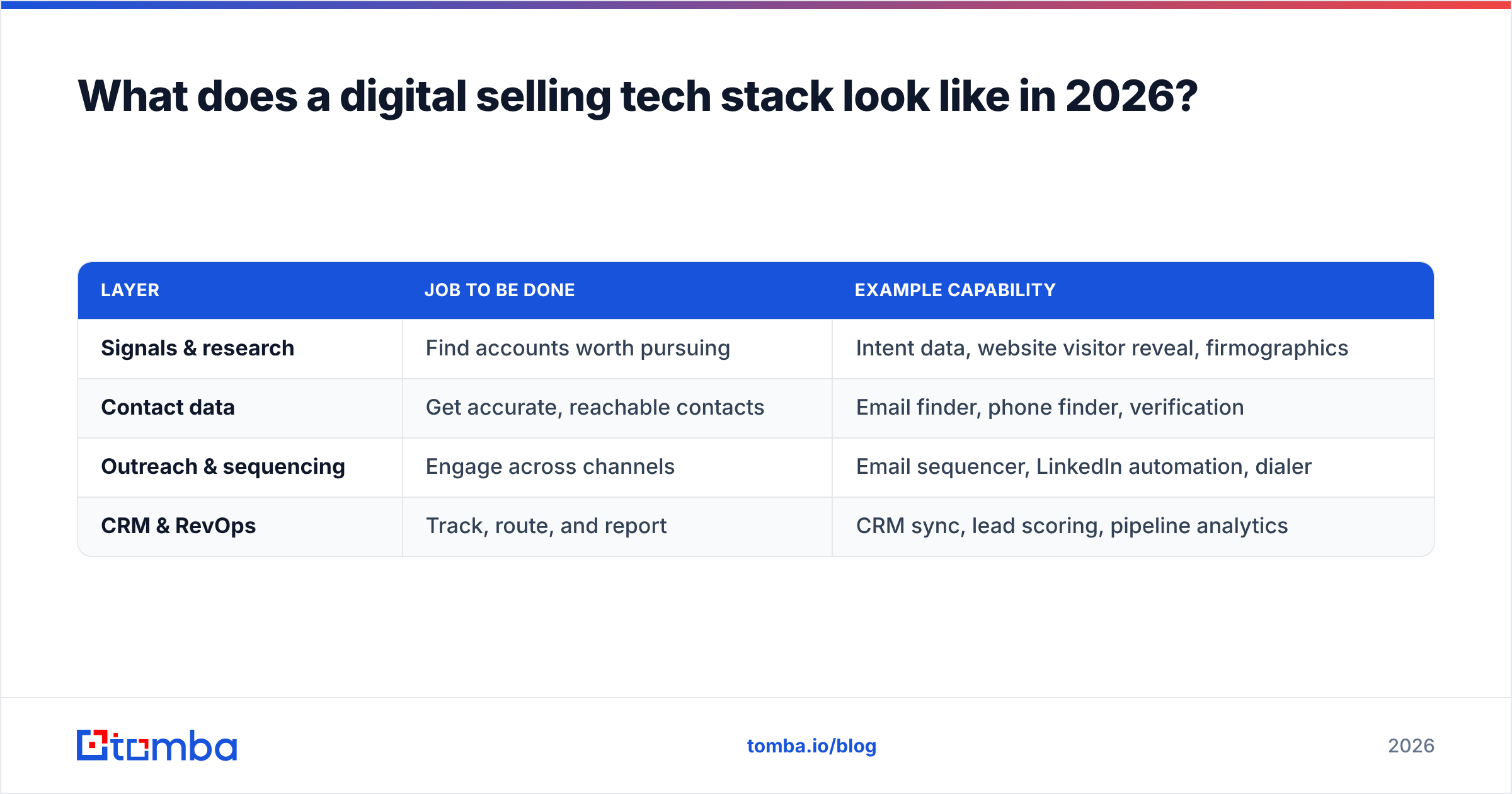
You can group the stack into four layers. You don't need the most expensive option in each — you need coverage across all four, because a gap in any layer breaks the chain.
| Layer | Job to be done | Example capability |
|---|---|---|
| Signals & research | Find accounts worth pursuing | Intent data, website visitor reveal, firmographics |
| Contact data | Get accurate, reachable contacts | Email finder, phone finder, verification |
| Outreach & sequencing | Engage across channels | Email sequencer, LinkedIn automation, dialer |
| CRM & RevOps | Track, route, and report | CRM sync, lead scoring, pipeline analytics |
A few notes on getting the layers right:
- Signals & research: This is where you decide who to contact. Getting this wrong means the rest of the stack works perfectly to reach the wrong people. Intent tools and visitor identification help you prioritize accounts already in-market.
- Contact data: The layer most teams underinvest in. An email finder turns a name and company into a reachable, verified address. This is the bridge between "I know the account" and "I can actually reach the buyer."
- Outreach & sequencing: Automation multiplies whatever you feed it. Feed it clean data and good copy, and it scales results. Feed it junk, and it scales your bounce rate.
- CRM & RevOps: The connective tissue. A mature revenue operations practice keeps these tools talking to each other so a signal in one system triggers action in the next.
How do you build a digital selling motion step by step?#
Start narrow and prove the loop before you scale it. Here's a motion you can stand up in a week.
- Define one ICP segment. Not "SaaS companies." Something like "Series B fintech companies in the US, 50–200 employees, with a VP of Engineering." Specific enough that your messaging can be specific.
- Build the target account list. Use firmographic filters and intent signals to assemble 50–100 accounts, not 5,000. Quality over quantity at this stage.
- Find and verify contacts. For each account, identify the 1–3 relevant buyers, find their emails, and verify before adding them to a sequence. This single discipline separates teams that hit inboxes from teams that hit spam folders.
- Enrich the records. Add title, seniority, tech stack, and any personalization hook. Your reply rate lives and dies on the first line feeling relevant.
- Design a 3-touch multi-channel sequence. For example: Day 1 email, Day 3 LinkedIn connection with a note, Day 6 follow-up email that adds a new angle (not "just bumping this").
- Measure the right metric. Track reply rate and meeting rate, not open rate (opens are increasingly unreliable in 2026). Iterate on the message before you touch volume.
The trap most teams fall into is scaling step 5 before nailing steps 3 and 4. Automation is a multiplier — if your data is a 2/10, a sequencer just sends bad outreach faster.
Which metrics actually matter in digital selling?#
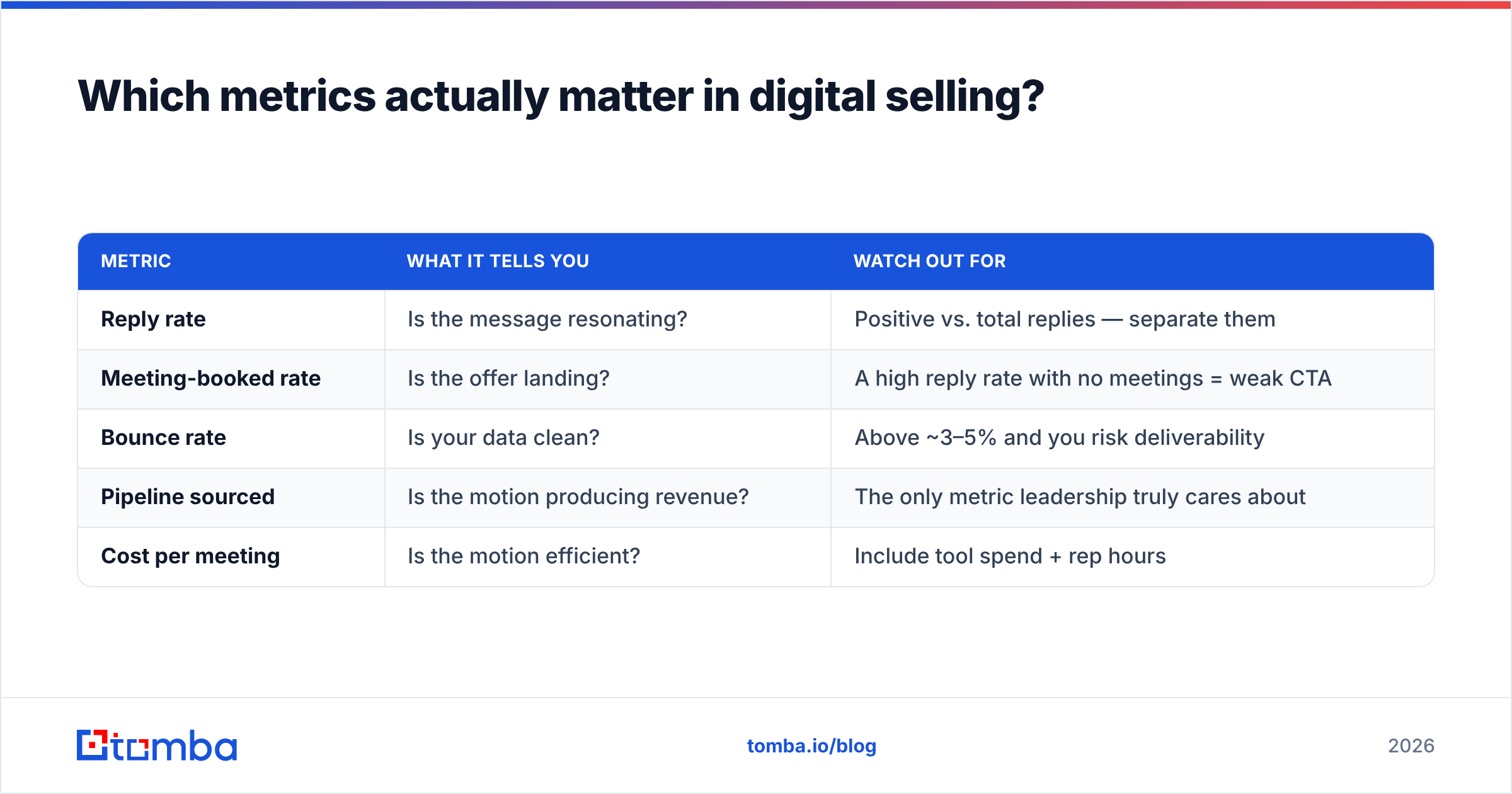
Vanity metrics feel productive but hide the truth. Anchor on outcomes.
| Metric | What it tells you | Watch out for |
|---|---|---|
| Reply rate | Is the message resonating? | Positive vs. total replies — separate them |
| Meeting-booked rate | Is the offer landing? | A high reply rate with no meetings = weak CTA |
| Bounce rate | Is your data clean? | Above ~3–5% and you risk deliverability |
| Pipeline sourced | Is the motion producing revenue? | The only metric leadership truly cares about |
| Cost per meeting | Is the motion efficient? | Include tool spend + rep hours |
Open rate is deliberately absent. With privacy changes and image-proxy prefetching, opens now overcount badly. Judge messages by replies and meetings.
How does social selling fit into a digital strategy?#
Social selling is the relationship-building channel — it warms accounts so your outreach doesn't land cold. Sharing useful content, engaging thoughtfully on prospects' posts, and building a credible profile all lower the barrier when your email arrives. Platforms like LinkedIn Sales Navigator make this systematic.
But treat it as one gear in the machine, not the whole engine. Social selling builds familiarity; it rarely closes deals on its own. The strongest motions layer it with verified email and phone outreach so a prospect sees you in their feed, then hears from you in their inbox, then recognizes your name on a call. That repetition — across channels the buyer actually uses — is what modern digital selling is about.
For teams that want to benchmark tools before committing, third-party review sites like G2 are a useful, vendor-neutral starting point.
What are the common digital selling mistakes to avoid?#
- Automating dirty data. The single most expensive mistake. Verify first, always.
- Confusing activity with progress. 500 sends with a 40% bounce rate is worse than 100 sends that all land. More is not better; clean is better.
- One-channel dependence. Email-only or LinkedIn-only motions cap out. Buyers are multi-channel; your outreach should be too.
- Personalization theater. "I loved your recent post" when you clearly didn't read it fools no one. Real personalization comes from real enrichment data.
- Ignoring deliverability. Warm your domains, authenticate them, and monitor your sender reputation. Great copy in the spam folder converts at zero.
- Scaling before proving. Nail the loop on one ICP, then expand. Scaling a broken motion just breaks it faster.
Is digital selling worth the investment?#
For B2B teams, yes — but the ROI comes from discipline, not from buying more tools. The teams that win aren't the ones with the biggest stack; they're the ones whose data is clean, whose channels are coordinated, and whose reps spend their time on conversations instead of copy-paste research.
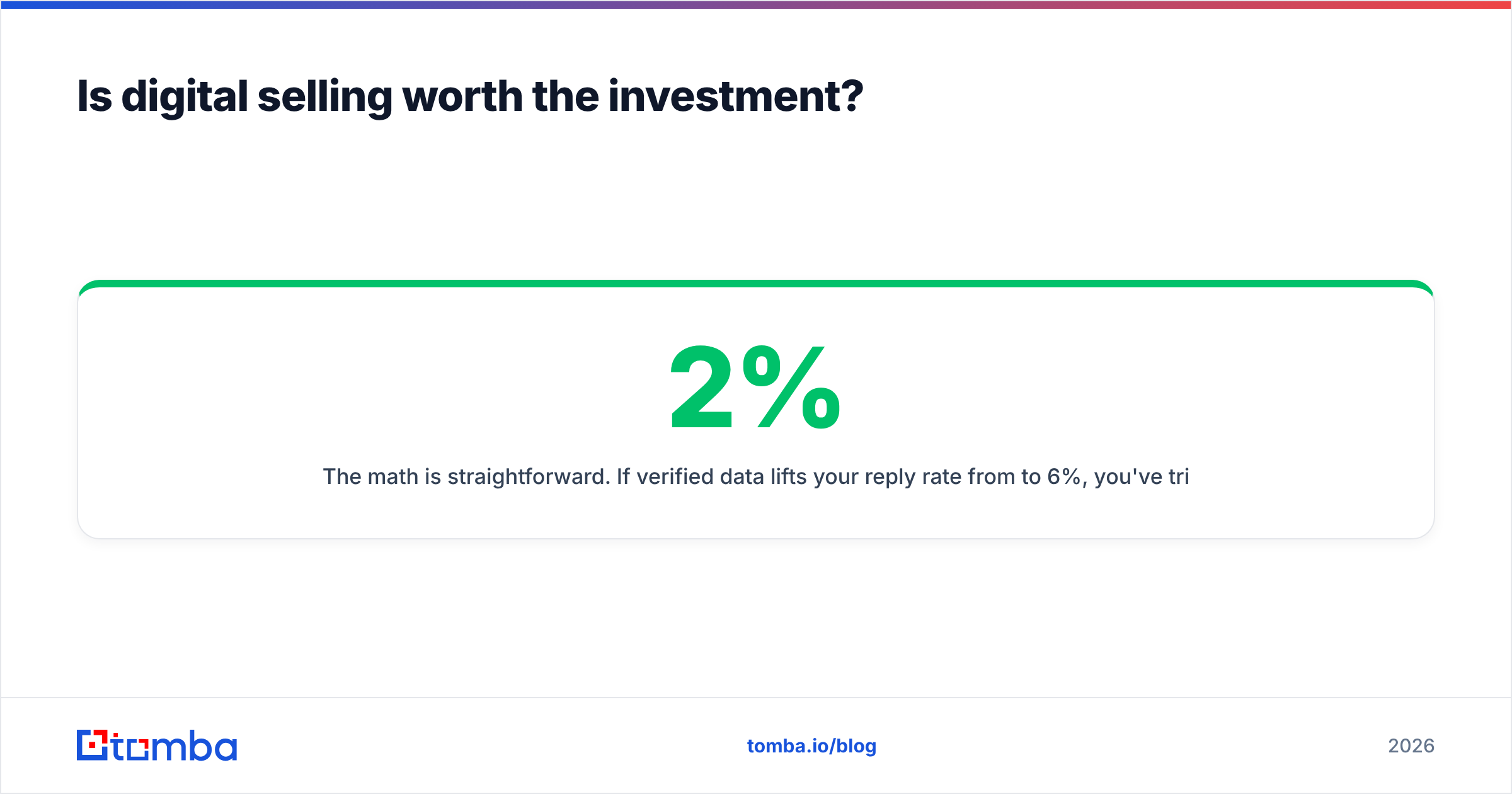
The math is straightforward. If verified data lifts your reply rate from 2% to 6%, you've tripled meetings from the same effort. If clean data drops your bounce rate below 3%, your whole domain's deliverability improves, compounding across every campaign. Those gains stack, and they compound quietly over quarters.
Start where the leverage is highest: your data foundation. You can review Tomba pricing — including a free tier with 25 searches a month — before committing to anything larger.
Get your digital selling foundation right with Tomba#
Every digital selling tactic in this guide depends on one thing: reaching a real person at a real address. The Tomba Email Finder turns a name and company domain into a verified, deliverable email so your sequences land in inboxes instead of spam traps. Combine it with built-in verification and enrichment, and you've got the clean, accurate foundation that makes every downstream channel — email, LinkedIn, phone — actually work. Start free with 25 searches a month, prove the loop on one ICP, and scale the motion once the replies start rolling in.
Related guides#
Ready to find emails that actually work?
Join 150,000+ professionals who stopped guessing and started sending. Free credits on signup — no credit card required.
Get the Tomba newsletter
Practical outbound tactics and product updates — once every two weeks.
About the author