Digital Transformation in Sales: The 2026 Playbook for Revenue Teams
Buying tools isn't transformation. Here's the framework, tech stack, and metrics that actually move digital transformation sales from slideware to pipeline in 2026.

Most "digital transformation" in sales fails for the same reason: teams buy tools instead of changing how they sell. A new CRM on top of the same broken process just digitizes the dysfunction faster.
This guide skips the buzzwords. You'll get a concrete definition, a phased framework, the stack that matters, the metrics that prove it worked, and the traps that quietly kill these programs.
TL;DR#
- Digital transformation in sales means re-engineering how you find, qualify, and close buyers using data and automation — not just installing software.
- The winners fix data quality first. Automation on top of bad contact data amplifies waste; clean, verified data is the foundation everything else stands on.
- A realistic rollout runs in four phases: audit → data foundation → automation → intelligence, not a big-bang "rip and replace."
- Measure it with revenue per rep, sales cycle length, and data accuracy, not "number of tools adopted."
- Start small and cheap: a verified data enrichment layer and an email finder API deliver ROI before you touch the org chart.
What is digital transformation in sales?#
Digital transformation in sales is the shift from manual, gut-driven selling to a data-driven, automated revenue engine — where software handles the repetitive work and reps spend their time on human judgment.
Think of it like modernizing a restaurant kitchen. You don't just buy a fancier oven and keep chopping every onion by hand. You redesign the whole line — prep stations, ticket flow, inventory sensors — so the chef spends time on the food that actually needs a human. Technically, that means connecting your CRM, prospecting data, outreach, and analytics into one workflow where a lead's status, contact info, and next action update automatically.
Crucially, transformation is a process change first and a technology change second. Gartner's research on sales technology consistently shows that tool adoption without workflow redesign produces near-zero productivity gain. The software is the enabler; the operating model is the product.
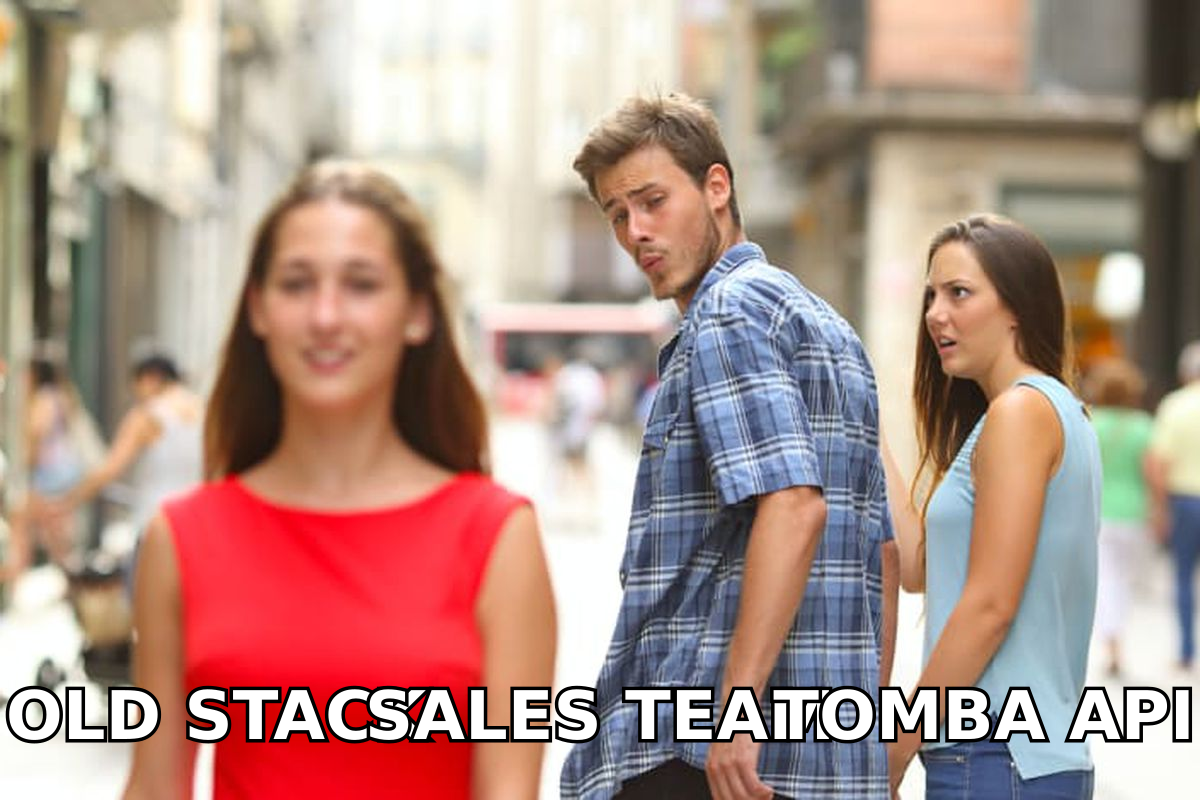
Here's the trap in one image.
The four pillars of a modern sales stack#
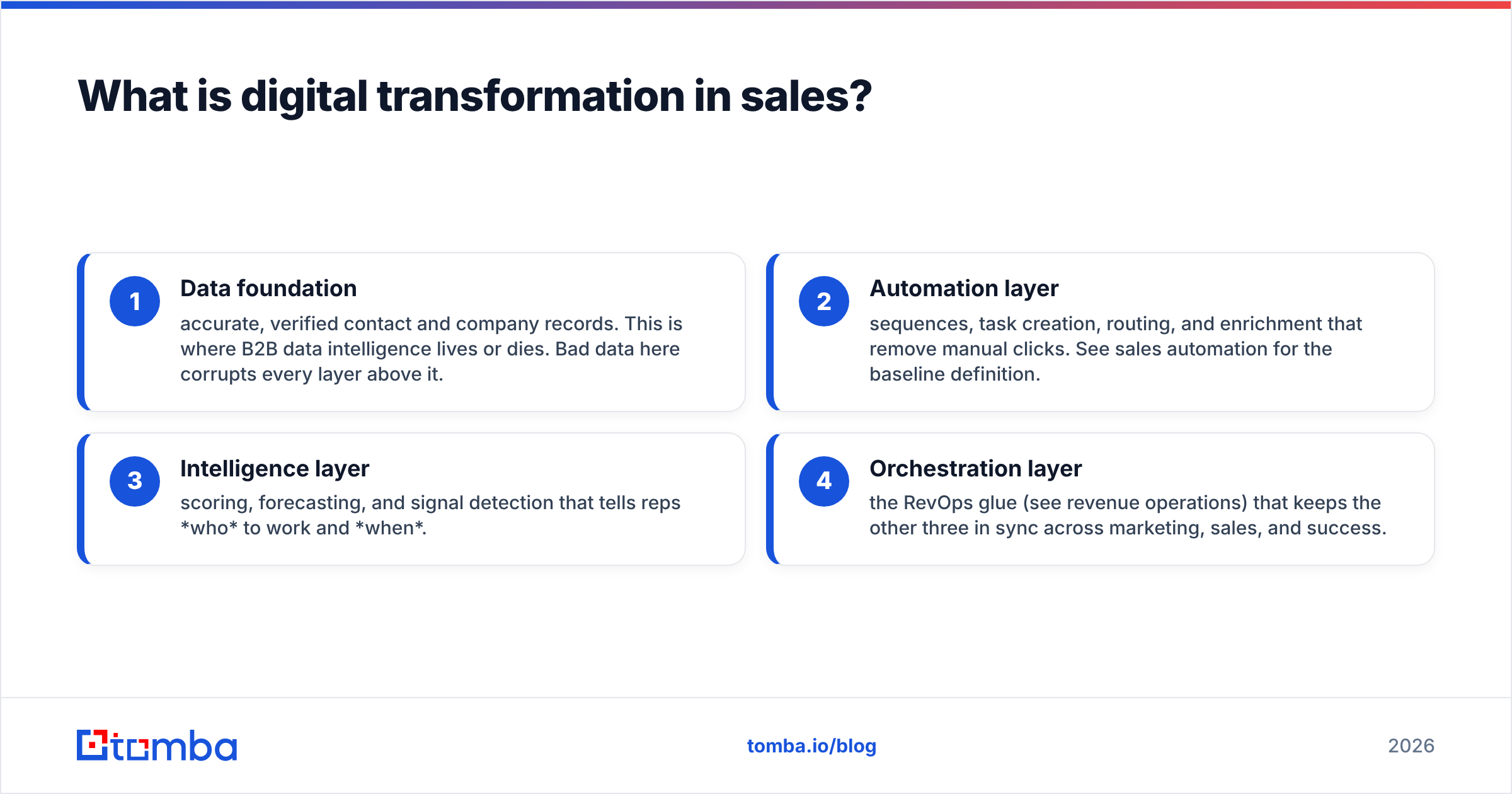
Before you spend a dollar, know which of these four layers you're actually fixing. Most stalled programs over-invest in one and ignore the rest.
- Data foundation — accurate, verified contact and company records. This is where B2B data intelligence lives or dies. Bad data here corrupts every layer above it.
- Automation layer — sequences, task creation, routing, and enrichment that remove manual clicks. See sales automation for the baseline definition.
- Intelligence layer — scoring, forecasting, and signal detection that tells reps who to work and when.
- Orchestration layer — the RevOps glue (see revenue operations) that keeps the other three in sync across marketing, sales, and success.
A program that upgrades the intelligence layer while sitting on a rotten data foundation is the most common and most expensive mistake in the category.
Why do most sales digital transformation projects fail?#
They fail because leaders treat it as a purchase, not a rebuild. According to McKinsey's long-running work on digital transformation, roughly 70% of transformation programs miss their goals — and the pattern in sales is specific and predictable.
The failure modes cluster into four buckets:
- Digitizing a broken process. If your qualification is guesswork on paper, it's still guesswork in Salesforce — just with more dashboards to ignore.
- Bad data underneath. Reps stop trusting a CRM the moment they hit three dead emails in a row. Trust never comes back, and adoption collapses.
- Tool sprawl. The average B2B sales team now juggles 10+ tools that don't talk to each other. Every disconnect is a manual copy-paste that reintroduces error.
- No owner. Without a RevOps function accountable for the end-to-end funnel, each team optimizes its own slice and the handoffs rot.
Notice that two of the four are data problems. That's not a coincidence — and it's why the sequencing below puts data before automation, always.
What does a digital transformation roadmap look like?#
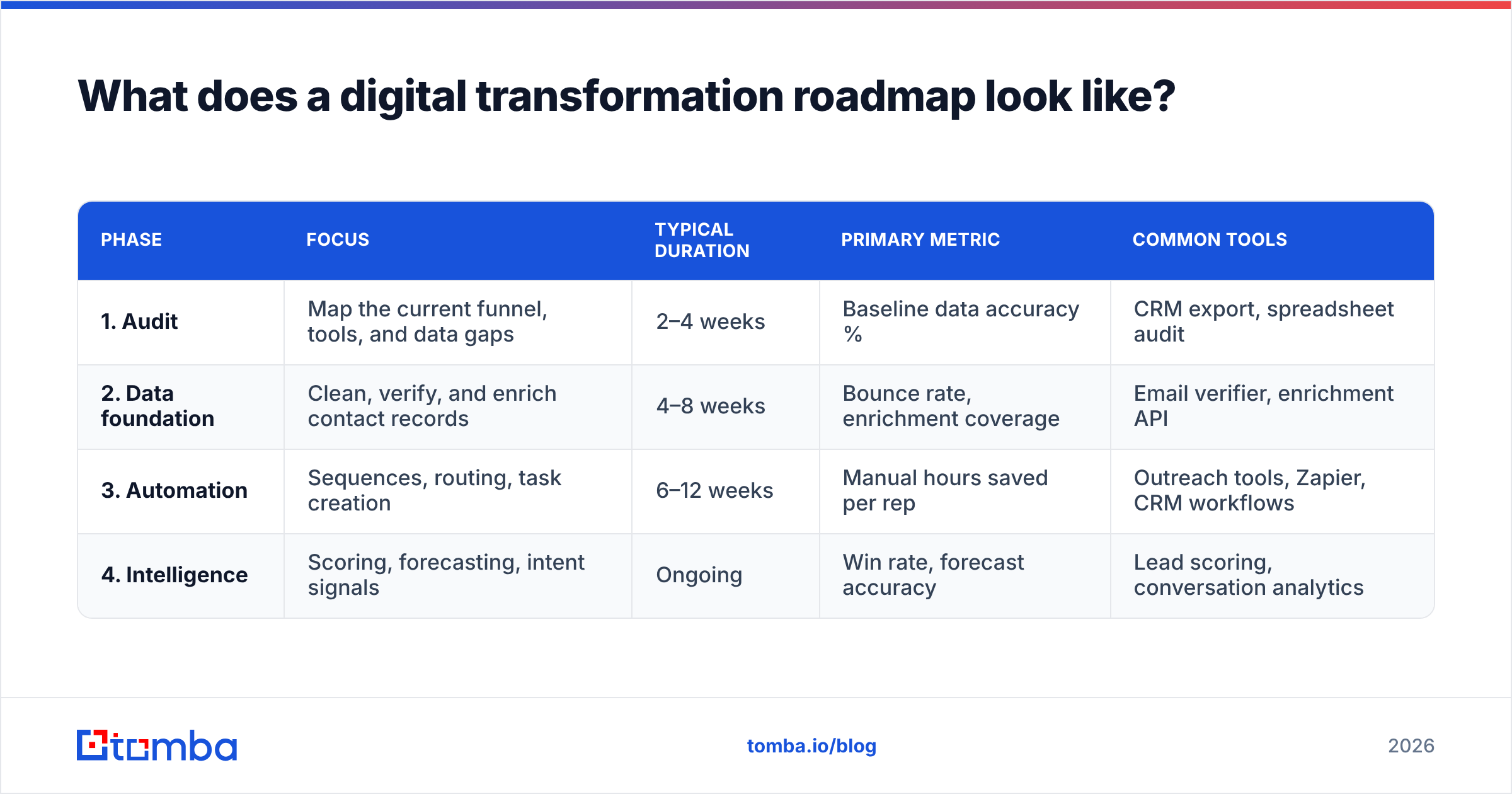
A working roadmap is phased and boring on purpose. You sequence for compounding value: each phase makes the next one cheaper and safer. Big-bang rewrites look decisive and almost always stall.
| Phase | Focus | Typical duration | Primary metric | Common tools |
|---|---|---|---|---|
| 1. Audit | Map the current funnel, tools, and data gaps | 2–4 weeks | Baseline data accuracy % | CRM export, spreadsheet audit |
| 2. Data foundation | Clean, verify, and enrich contact records | 4–8 weeks | Bounce rate, enrichment coverage | Email verifier, enrichment API |
| 3. Automation | Sequences, routing, task creation | 6–12 weeks | Manual hours saved per rep | Outreach tools, Zapier, CRM workflows |
| 4. Intelligence | Scoring, forecasting, intent signals | Ongoing | Win rate, forecast accuracy | Lead scoring, conversation analytics |
The order is the whole point. Phase 2 has to precede Phase 3, because automating outreach to unverified contacts just sends more email to dead addresses — faster, and at a scale that torches your sender reputation.
Phase 2 is the one everyone skips — don't#
If you have budget for exactly one phase this quarter, run Phase 2. A verified data foundation delivers the highest ROI per dollar because it removes waste from every downstream activity at once: fewer bounces, higher connect rates, cleaner analytics, and reps who actually trust the system.
This is where a programmatic approach pays off. Instead of buying static lists that decay 30% a year, you enrich and re-verify continuously through an API. Tomba's email finder API and bulk email finder let you rebuild and refresh contact data as part of an automated pipeline rather than a one-time cleanse that's stale by next quarter.
How do you choose the right sales technology stack?#
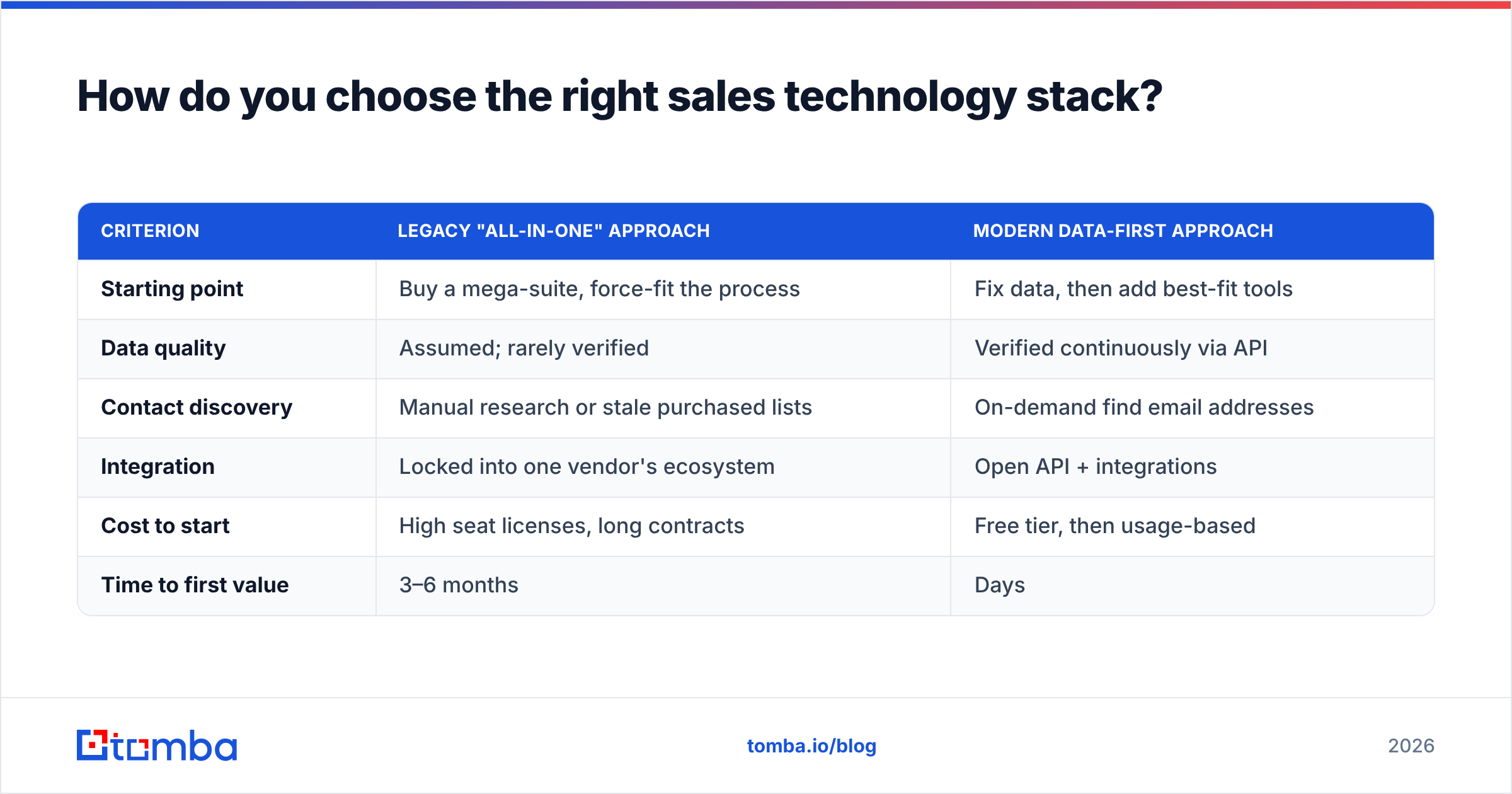
Choose by workflow fit and data ownership, not feature-count. The flashiest platform loses to a lean stack that keeps your data clean and portable. Here's how a bloated legacy approach compares to a modern, data-first one.
| Criterion | Legacy "all-in-one" approach | Modern data-first approach |
|---|---|---|
| Starting point | Buy a mega-suite, force-fit the process | Fix data, then add best-fit tools |
| Data quality | Assumed; rarely verified | Verified continuously via API |
| Contact discovery | Manual research or stale purchased lists | On-demand find email addresses |
| Integration | Locked into one vendor's ecosystem | Open API + integrations |
| Cost to start | High seat licenses, long contracts | Free tier, then usage-based |
| Time to first value | 3–6 months | Days |
When you evaluate vendors, pressure-test them against neutral sources like G2 and HubSpot's sales research rather than the vendor's own case studies. And weigh the mundane stuff — data portability, API rate limits, and export rights — because those decide whether you're building an asset or renting a cage.
For teams still comparing entry costs, transparent Tomba pricing starts with a free tier (25 searches/mo) and a $49/mo Starter plan — usage-based, no annual lock-in, which is exactly the shape a phased rollout wants.
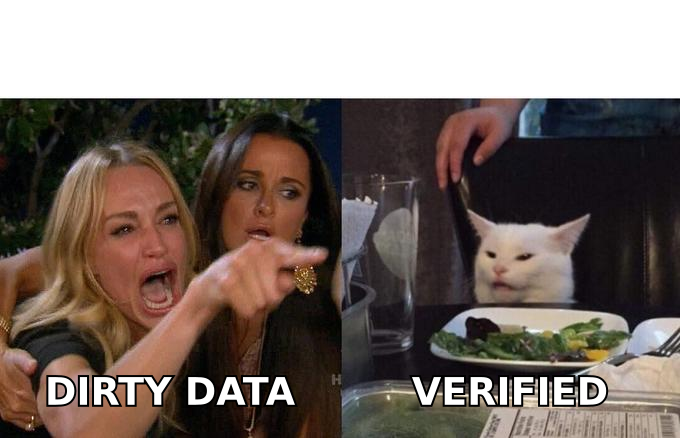
The internal fight this usually kicks off looks like this.
Which metrics prove the transformation worked?#
Measure business outcomes, not activity. "We adopted 12 tools" is a vanity metric; "our sales cycle dropped 18 days" is transformation. Track a tight set and review it monthly.
- Revenue per rep — the single best summary metric. If automation is working, each rep should carry more pipeline without more hours.
- Sales cycle length — cleaner data and faster routing compress the time from lead to close.
- Data accuracy / bounce rate — your leading indicator. When accuracy drops, everything downstream degrades weeks before revenue shows it.
- Win rate — see win rate for how to calculate it cleanly; improvements here signal better targeting, not just more volume.
- Rep adoption rate — the tool nobody uses has zero ROI, however good the demo was.
- Forecast accuracy — the quiet proof that your intelligence layer reflects reality.
Set a baseline in Phase 1 so you can attribute changes later. Without a baseline, you'll spend Q4 arguing about whether anything improved instead of knowing.
How does AI change sales transformation in 2026?#
AI moves sales from reactive to predictive — but only for teams whose data can feed it. This is the part most vendors bury: AI models are exactly as good as the contact and activity data underneath them. Garbage in, confident garbage out.
Where AI is genuinely earning its keep right now:
- Signal detection — surfacing which accounts are showing buying intent so reps work the warmest 10% first.
- Auto-enrichment — filling and correcting CRM fields the moment a lead enters, so no rep ever hand-types a job title again.
- Drafting and personalization — generating first-pass outreach that a human edits, cutting writing time without shipping robotic spam.
- Forecasting — pattern-matching across historical deals to flag which open opportunities are actually at risk.
The prerequisite for all four is a clean, structured data layer. A model can't detect intent from a contact record that's missing an email and lists a company that was acquired two years ago. That's why 2026's most effective "AI transformation" budgets are quietly spending the first third on data hygiene — verification, deduplication, and enrichment — before a single model touches the pipeline. If you want the AI to work, you feed it verified data, not hope.
What's the fastest, lowest-risk way to start?#
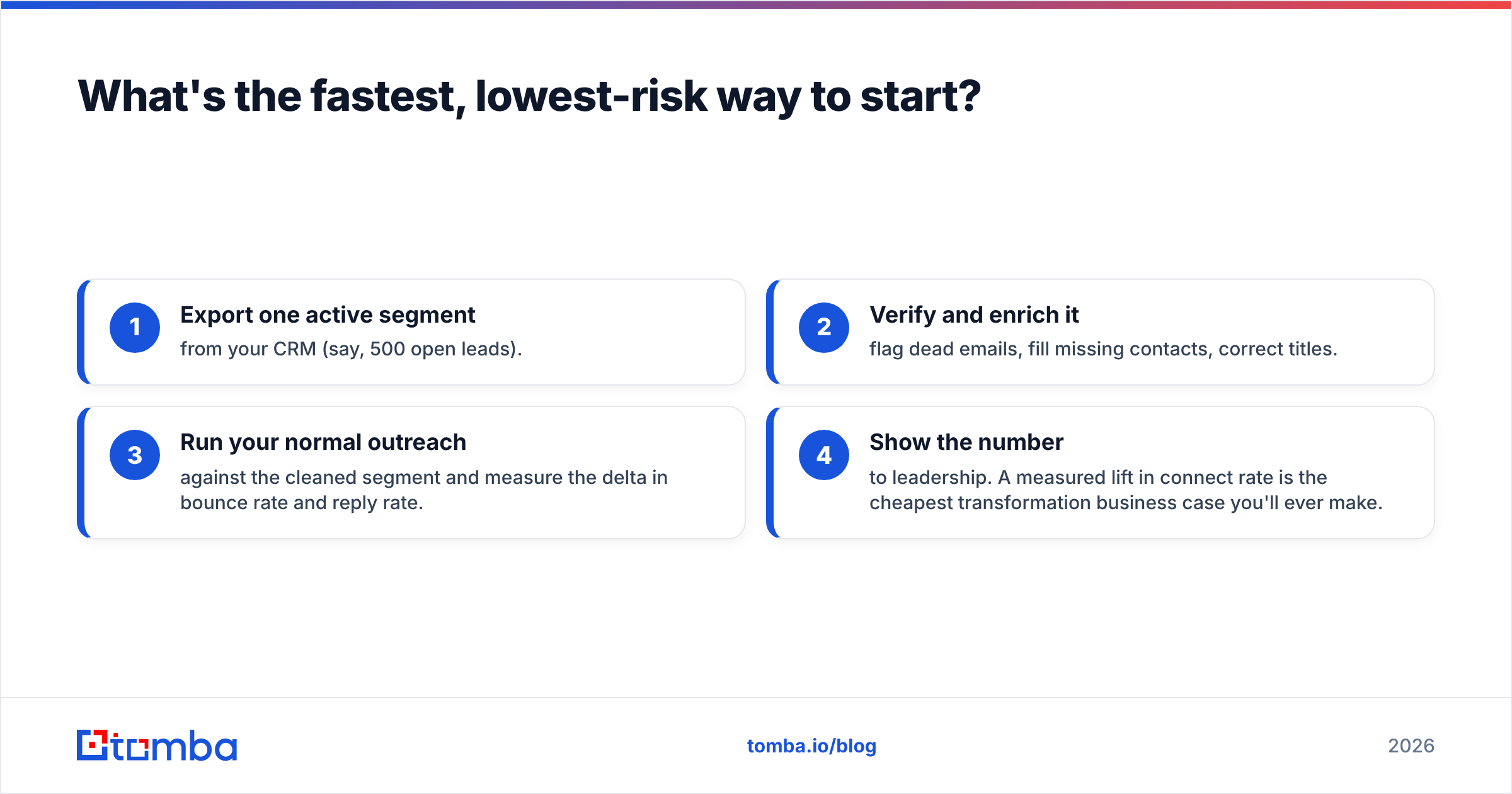
Start with the layer that pays back fastest and threatens nothing: your data foundation. You don't need executive sign-off, a six-figure contract, or a reorg to prove value — you need one clean, enriched segment and a before/after number.
A pragmatic first 30 days:
- Export one active segment from your CRM (say, 500 open leads).
- Verify and enrich it — flag dead emails, fill missing contacts, correct titles.
- Run your normal outreach against the cleaned segment and measure the delta in bounce rate and reply rate.
- Show the number to leadership. A measured lift in connect rate is the cheapest transformation business case you'll ever make.
That single loop demonstrates the entire thesis of this article in one month: fix the data, and every downstream metric moves — no rip-and-replace required.
The bottom line#
Digital transformation sales isn't a software purchase; it's a sequencing decision. Fix the data foundation first, automate second, add intelligence third, and measure in revenue — not tool count. Teams that respect that order compound their gains. Teams that skip to the shiny AI layer just automate their existing mistakes.
Your foundation starts with contact data you can actually trust. Tomba's Email Finder gives you verified professional emails by domain, name, or company — via UI, API, or bulk — so the automation and AI you build on top of it are standing on solid ground instead of guesses. Start free with 25 searches a month, prove the lift on one segment, then scale the rollout you just de-risked.
Related guides#
Ready to find emails that actually work?
Join 150,000+ professionals who stopped guessing and started sending. Free credits on signup — no credit card required.
Get the Tomba newsletter
Practical outbound tactics and product updates — once every two weeks.
About the author