How to Build a Digital Transformation Sales Pitch That Closes
A digital transformation sales pitch fails when it leads with features instead of outcomes. Here's the 2026 framework, structure, and objection playbook that actually moves deals.
Most digital transformation pitches die in the room where the CFO is sitting. Not because the technology is weak, but because the seller pitched a platform when the buyer needed a business case. If you sell software, services, or infrastructure that asks a company to change how it operates, the pitch is the deal. Get it wrong and you get "let's revisit next quarter." Get it right and you compress a 12-month cycle into a signed order.
This guide breaks down what a modern digital transformation sales pitch actually needs in 2026, how to structure it, and the objections that will kill it if you don't disarm them first.
TL;DR#
- Lead with a business outcome, not a capability. Buyers fund revenue, risk reduction, and cost — not "AI-powered dashboards."
- Anchor to one measurable problem. A pitch that fixes everything convinces no one; quantify a single painful gap.
- Structure beats charisma. Use the Problem → Cost of Inaction → Future State → Proof → Path sequence every time.
- Pre-load the CFO objections. ROI timeline, integration risk, and change-management cost are where deals stall.
- Build the pitch on clean data. A transformation story falls apart if your prospect research and contact data are wrong — start accurate.
What is a digital transformation sales pitch?#
A digital transformation sales pitch is the argument you make to convince an organization to change how it works — replacing a manual process, migrating a system, adopting automation or AI — and to pay you to lead that change. It is not a product demo. A demo shows what the tool does. A pitch shows what the buyer's business looks like after they adopt it, and why that's worth the disruption.
Think of it like proposing a home renovation. Nobody hires a contractor because they love drywall. They hire one because they can picture the finished kitchen and they trust the crew won't blow the budget or the timeline. Your pitch has to paint the finished kitchen and prove you're the crew that delivers on schedule.
The distinction matters because transformation deals carry something ordinary software sales don't: switching cost and organizational risk. You're not asking a buyer to try a new app. You're asking them to bet part of their operation — and their internal reputation — on your roadmap. That raises the bar on trust, proof, and financial clarity.
Why do most digital transformation pitches fail?#
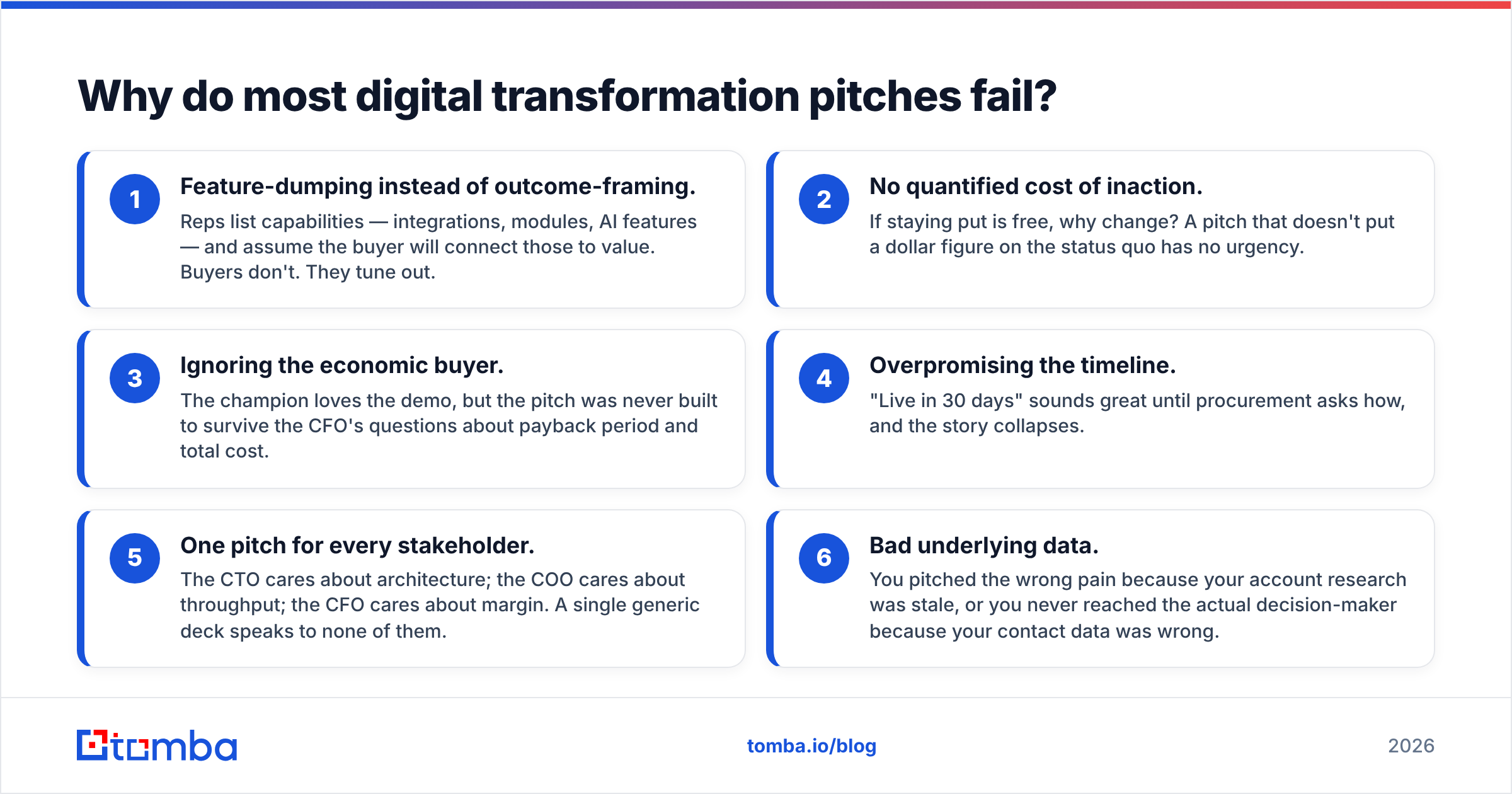
They fail for a predictable set of reasons, and almost all of them trace back to talking about the seller instead of the buyer.
- Feature-dumping instead of outcome-framing. Reps list capabilities — integrations, modules, AI features — and assume the buyer will connect those to value. Buyers don't. They tune out.
- No quantified cost of inaction. If staying put is free, why change? A pitch that doesn't put a dollar figure on the status quo has no urgency.
- Ignoring the economic buyer. The champion loves the demo, but the pitch was never built to survive the CFO's questions about payback period and total cost.
- Overpromising the timeline. "Live in 30 days" sounds great until procurement asks how, and the story collapses.
- One pitch for every stakeholder. The CTO cares about architecture; the COO cares about throughput; the CFO cares about margin. A single generic deck speaks to none of them.
- Bad underlying data. You pitched the wrong pain because your account research was stale, or you never reached the actual decision-maker because your contact data was wrong.
That last point is quiet but lethal. According to Gartner research on B2B buying, the average purchase involves six to ten decision-makers, each armed with their own information. If your pitch targets the wrong person or the wrong problem, no amount of polish saves it.
What does a winning pitch structure look like?#
The best transformation pitches follow the same five-beat sequence. It works because it mirrors how buyers actually make decisions: they need to feel the problem before they'll consider the solution.
- 1. The Problem (their words). Open by naming the specific operational gap the buyer already feels. Use their language, their metrics. This earns the right to keep talking.
- 2. The Cost of Inaction. Quantify what the gap costs per month or per quarter — lost revenue, wasted hours, compliance exposure. Make standing still feel expensive.
- 3. The Future State. Describe the "after" concretely. Not "streamlined operations" but "your onboarding drops from 14 days to 3, freeing two FTEs for revenue work."
- 4. The Proof. One tight case study from a comparable company, with a before/after number. Social proof from a peer beats any feature claim.
- 5. The Path. A low-risk, phased rollout that shows you've de-risked the change. First milestone in weeks, not a big-bang cutover.
Notice what's missing from the first three beats: your product. You don't introduce the "how" until the buyer is bought into the "why." This is the single biggest structural fix most reps need.
How should you tailor the pitch to each stakeholder?#
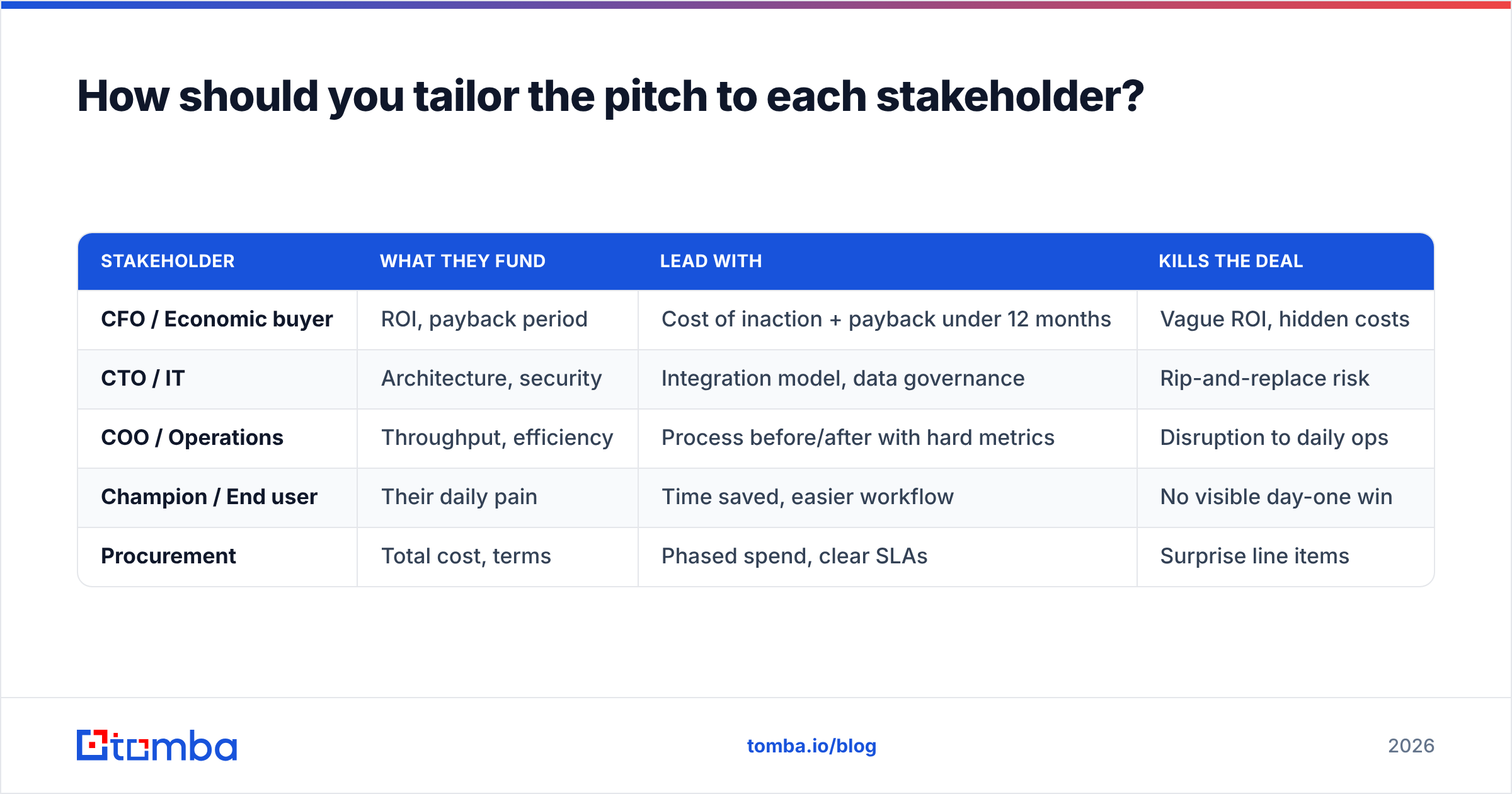
A transformation deal is really several pitches wrapped in one narrative. Each buyer weighs a different risk. Map your message to their scorecard.
| Stakeholder | What they fund | Lead with | Kills the deal |
|---|---|---|---|
| CFO / Economic buyer | ROI, payback period | Cost of inaction + payback under 12 months | Vague ROI, hidden costs |
| CTO / IT | Architecture, security | Integration model, data governance | Rip-and-replace risk |
| COO / Operations | Throughput, efficiency | Process before/after with hard metrics | Disruption to daily ops |
| Champion / End user | Their daily pain | Time saved, easier workflow | No visible day-one win |
| Procurement | Total cost, terms | Phased spend, clear SLAs | Surprise line items |
The narrative stays constant — you're solving one core problem — but the emphasis shifts per audience. When you present to a committee, sequence the deck so each stakeholder hears their concern addressed within the first few minutes. People stop listening once they decide you're not talking to them.
How do you build the business case that survives the CFO?#
The CFO is where transformation deals go to die, so build the pitch backward from their objections. Three numbers carry the room: cost of inaction, total cost of ownership, and payback period.
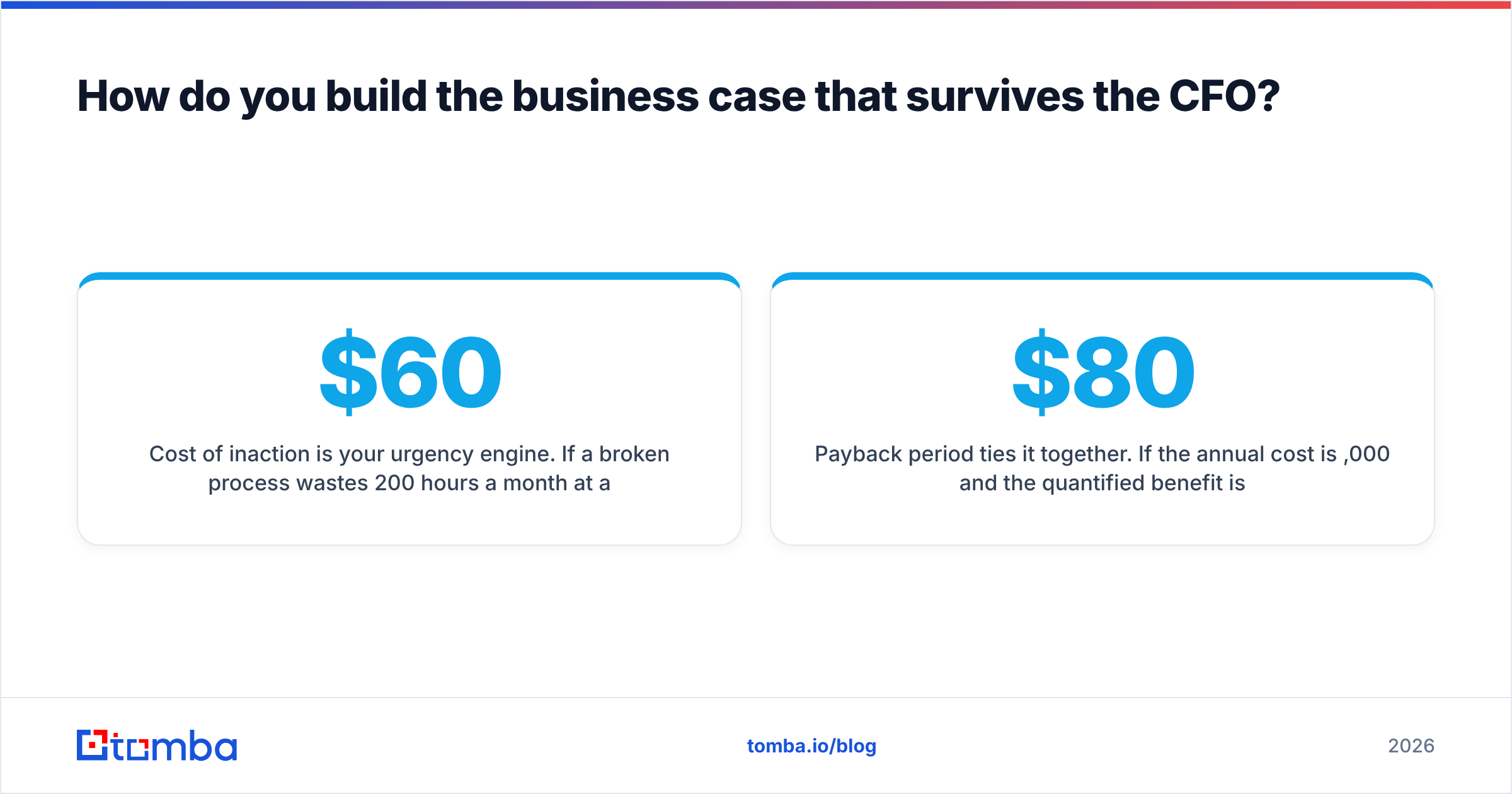
Cost of inaction is your urgency engine. If a broken process wastes 200 hours a month at a loaded rate of $60/hour, that's $12,000 monthly — $144,000 a year — bleeding out while the buyer "thinks about it." Put that number on a slide.
Total cost of ownership must be honest. Buyers have been burned by software that looked cheap and cost a fortune to implement. Include license, implementation, training, and internal time. Understating TCO to win the pitch guarantees you lose the renewal.
Payback period ties it together. If the annual cost is $80,000 and the quantified benefit is $144,000, you're at a payback under seven months. That's a number a CFO can defend to a board. Forrester and other analysts have long shown that buyers approve deals faster when the ROI story is specific and conservative rather than aggressive and hand-wavy.

Which objections should you pre-load — and how?#
Great reps don't wait for objections; they raise and resolve them inside the pitch. Here are the four that stall transformation deals, and the move for each.
- "We don't have budget this year." Reframe from cost to cost-of-inaction. The budget question is really a priority question. Show that not acting costs more than acting.
- "Integration will be a nightmare." Bring an architecture slide and a named reference who integrated with a similar stack. Specificity beats reassurance.
- "Our team won't adopt it." Lead with change management, not features. Show the phased rollout, the training plan, and a day-one win that makes users' lives easier immediately.
- "How do we know the ROI is real?" Hand them a one-page model with conservative assumptions they can edit. Buyers trust numbers they can stress-test themselves.
The meta-move: name the objection before they do. "You're probably wondering how this integrates with your existing ERP — let's go there now." It signals confidence and steals the objection's power.
What role does clean data play in the pitch?#
More than most reps admit. A transformation pitch is only as good as the research behind it, and research is only as good as your contact and account data. Two failure modes come straight from bad data:
First, you pitch the wrong problem. If your account intelligence is stale, you anchor on a pain the company already solved, and you lose credibility in the first two minutes.
Second, you pitch the wrong person. Reaching a mid-level manager with a board-level transformation story wastes everyone's time. You need verified contact paths to the economic buyer and the technical evaluator before you ever build the deck.
This is where your prospecting stack earns its keep. Reliable data enrichment tells you who sits on the buying committee, what tools they run, and how to reach the decision-maker directly. A verified email finder means your outreach lands with the person who actually controls the budget, and a solid email verifier keeps your sequences out of spam so the pitch even gets read. The flashiest deck in the world can't fix a meeting booked with the wrong stakeholder.
How do you close and set up the next step?#
A transformation pitch shouldn't end with "so, what do you think?" That hands control to the buyer and invites the polite stall. End with a concrete, low-commitment next step that keeps momentum: a scoped technical workshop, a data audit, a pilot on one team.
The psychology matters. Asking a committee to approve a full rollout at the end of the first pitch triggers risk aversion. Asking them to green-light a two-week discovery workshop is easy to say yes to — and it advances the deal into a stage where you control the narrative. Small yes now, big yes later.
Reinforce the path you laid out in beat five. "The next step is a two-week process audit with your ops lead. We'll come back with a phased plan and a validated ROI model your CFO can take to the board." That's specific, low-risk, and it assumes the sale.
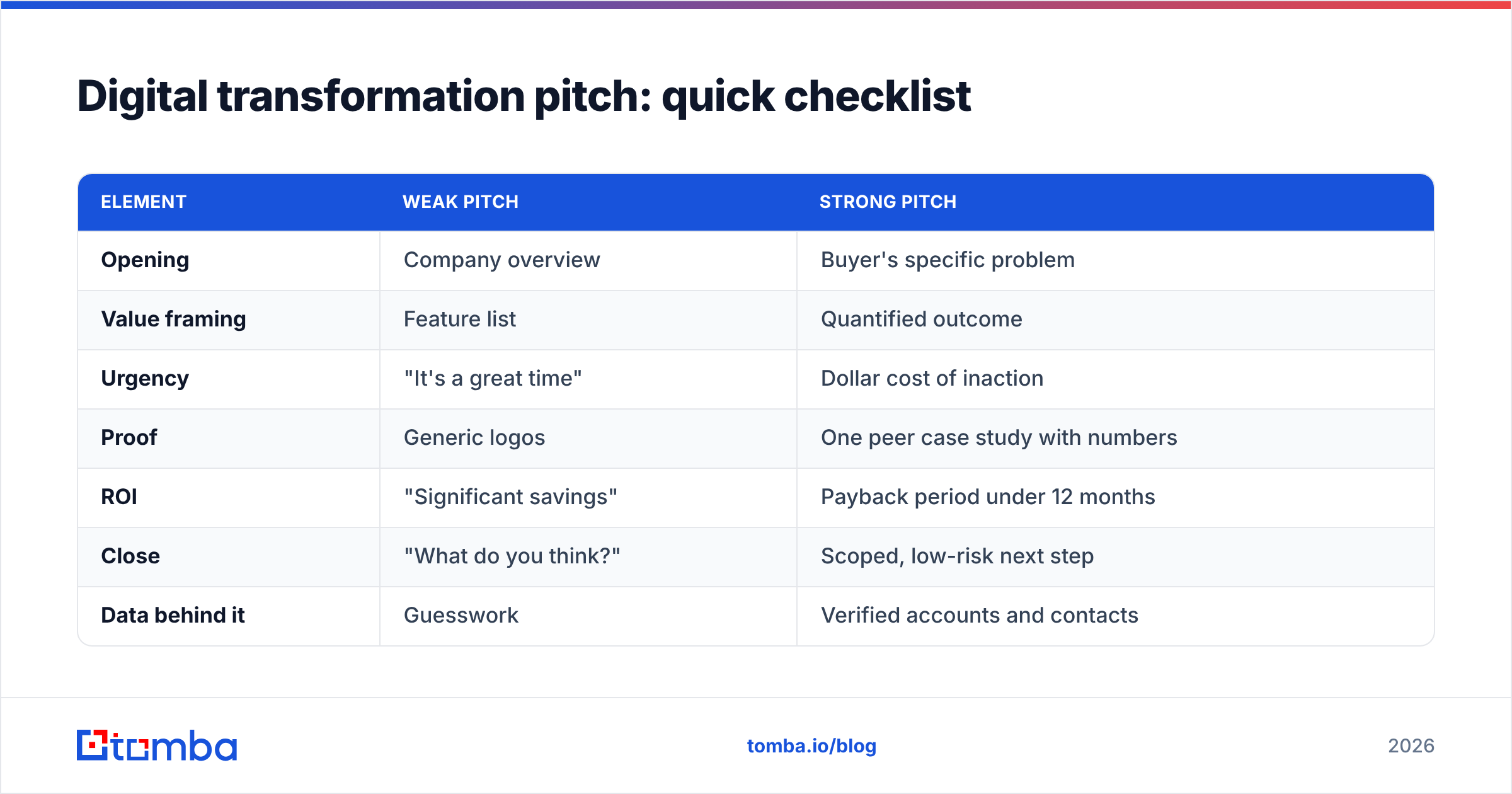
Digital transformation pitch: quick checklist#
| Element | Weak pitch | Strong pitch |
|---|---|---|
| Opening | Company overview | Buyer's specific problem |
| Value framing | Feature list | Quantified outcome |
| Urgency | "It's a great time" | Dollar cost of inaction |
| Proof | Generic logos | One peer case study with numbers |
| ROI | "Significant savings" | Payback period under 12 months |
| Close | "What do you think?" | Scoped, low-risk next step |
| Data behind it | Guesswork | Verified accounts and contacts |
If your current pitch lives in the left column on more than two rows, that's your rework list.
Frequently asked questions#
How long should a digital transformation sales pitch be? The live pitch should run 20–30 minutes with room for discussion, not a 60-slide monologue. Front-load the problem and cost of inaction; keep product detail in an appendix you pull up only when asked.
Should I show pricing in the first pitch? Show the shape of the investment and the payback math, not a final quote. Committing to an exact number before you've scoped the work invites a discount negotiation you're not ready for.
How do I pitch to a committee versus one person? Keep one core narrative but address each stakeholder's specific risk early. Identify the buying committee before the meeting so nobody in the room feels ignored — that's a research and data problem as much as a messaging one.
What's the biggest mistake reps make? Leading with the product. Buyers fund outcomes and fear risk. Spend the first third of the pitch on their world, not yours.
Start your pitch with the right data#
A great digital transformation pitch is built long before the meeting — in the research that tells you who to pitch, what pain to anchor on, and how to reach the decision-maker. That starts with accurate contact data. Use the Tomba Email Finder to reach the actual economic buyer instead of a gatekeeper, verify every address before you sequence, and enrich each account so your business case speaks to the pain that's real today. Check the Tomba pricing plans — including a free tier to test the data quality on your own target accounts — and build your next pitch on facts, not guesses. The deck wins the room; the data gets you in it.
Related guides#
Ready to find emails that actually work?
Join 150,000+ professionals who stopped guessing and started sending. Free credits on signup — no credit card required.
Get the Tomba newsletter
Practical outbound tactics and product updates — once every two weeks.
About the author