Direct Close Examples: Scripts That Actually Win Deals
The direct close is the simplest way to ask for the sale: state the ask plainly and let the prospect answer. Here are real scripts, the exact moments to use each, and the mistakes that kill the yes.

Direct Close Examples: Scripts That Actually Win Deals
Most deals do not die because the prospect hated your product. They die because nobody ever clearly asked for the business. The direct close fixes that. It is the plainest closing move in sales: you name the next step, ask for a decision, and then you stop talking.
This guide gives you real, copy-ready direct close examples, the exact moments to use each one, and the errors that quietly cost you the yes.
TL;DR#
- The direct close is asking for the sale in plain language — no tricks, no manufactured urgency, just "Do you want to move forward?"
- It works best when you have already confirmed budget, need, and authority, and the prospect has stopped raising objections.
- Below you get seven word-for-word scripts for email, phone, and live meetings, plus a table matching each close to the right situation.
- The biggest mistake is talking past the ask. State it, then go silent.
- A direct close only lands if you reached the right person — verified contact data is the unglamorous half of closing.
What Is a Direct Close?#
A direct close is a closing technique where you explicitly ask the buyer to commit, using clear and confident language, without softening it into a hint. Think of it like a waiter asking "Will that be all, or shall I bring the dessert menu?" — the question forces a decision instead of leaving you to wander out hungry.
Compare these two endings to the same sales call:
- Indirect: "So, yeah, let me know if you have any other questions and we can maybe circle back next week..."
- Direct: "Everything we discussed fits what you need. Do you want to get started today?"
The first invites a stall. The second invites an answer. The direct close is not aggressive — it is respectful of the buyer's time and honest about what you want. Buyers who are ready to purchase often prefer it, because it removes the awkward dance of who brings up money first.
When the Direct Close Works Best#
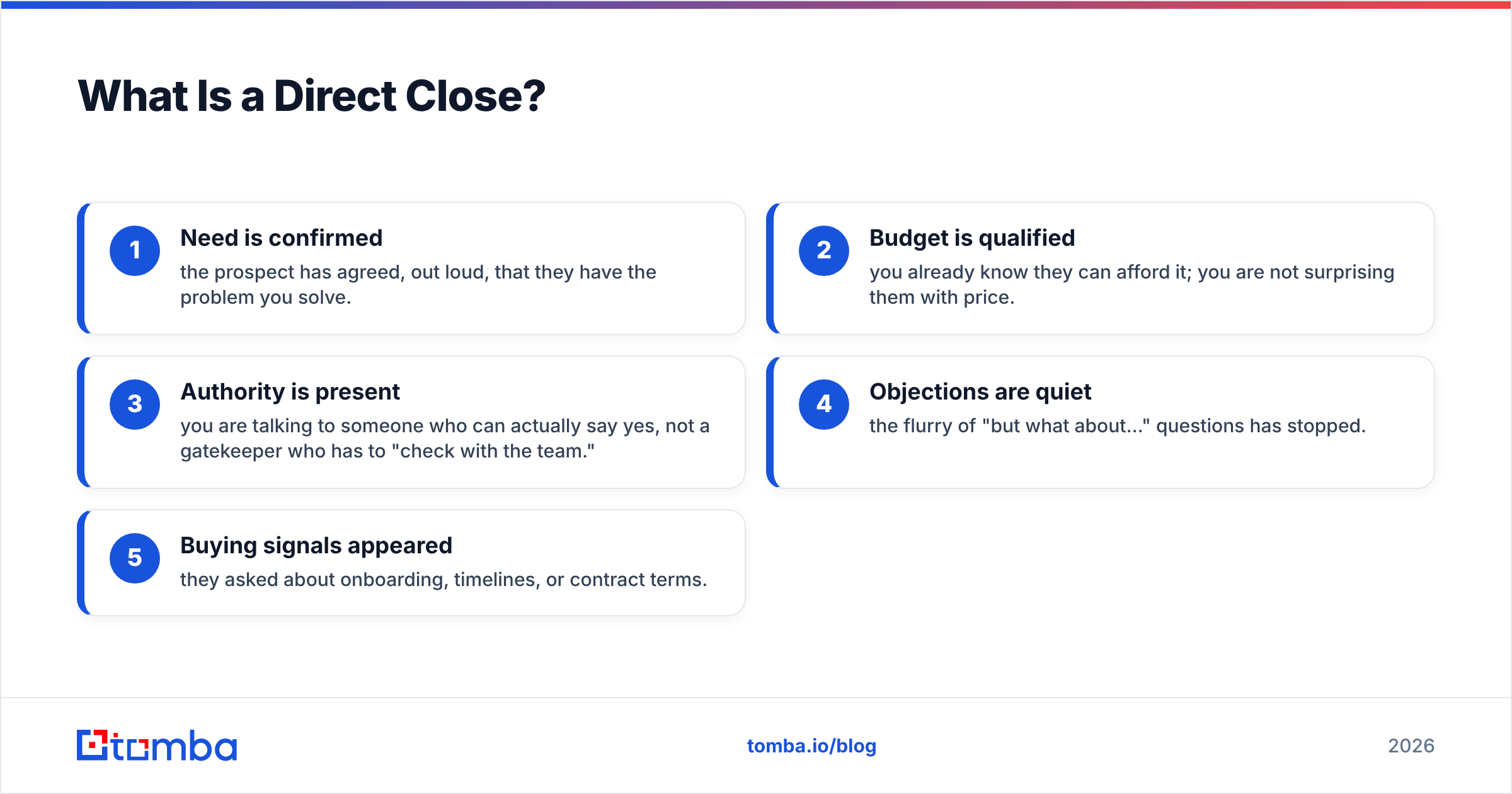
The direct close is powerful but situational. Use it when these boxes are checked:
- Need is confirmed — the prospect has agreed, out loud, that they have the problem you solve.
- Budget is qualified — you already know they can afford it; you are not surprising them with price.
- Authority is present — you are talking to someone who can actually say yes, not a gatekeeper who has to "check with the team."
- Objections are quiet — the flurry of "but what about..." questions has stopped.
- Buying signals appeared — they asked about onboarding, timelines, or contract terms.
Miss two or more of those and a direct close feels premature — like proposing on a first date. Nail them, and asking directly is simply the natural next sentence.
What Are the Best Direct Close Examples?#
Here are seven scripts you can adapt today. Each is short on purpose. The shorter the ask, the harder it is to wriggle away from.
1. The classic ask (live or phone).
"Based on everything we've covered, this looks like the right fit. Are you ready to move forward?"
2. The start-date close.
"We can have your account live by Monday. Do you want me to send the paperwork over today?"
3. The plan-selection close.
"You're between the Growth and Pro plans. Which one should I set up for you?"
This is a direct close wearing an alternative-choice coat — either answer moves the deal forward.
4. The email close.
Subject: Ready to start?
"Hi Dana — you've seen how this solves the reporting gap your team flagged. Reply 'yes' and I'll send the agreement this afternoon."
5. The renewal close.
"Your results this quarter beat the target by 18%. Should we lock in the same plan for next year?"
6. The post-demo close.
"That's the full workflow. Is there any reason we shouldn't get you started?"
The negative framing catches lingering objections while still asking directly.
7. The urgency-free deadline close.
"Onboarding slots for this month fill by Friday. Want me to hold one for you?"
Notice none of these beg, discount, or invent fake scarcity. They ask a plain question and then wait. That pause is where the sale happens — resist the urge to fill it. Reps who talk through the silence routinely lower their win rate without realizing it.
Direct Close vs Other Closing Techniques#
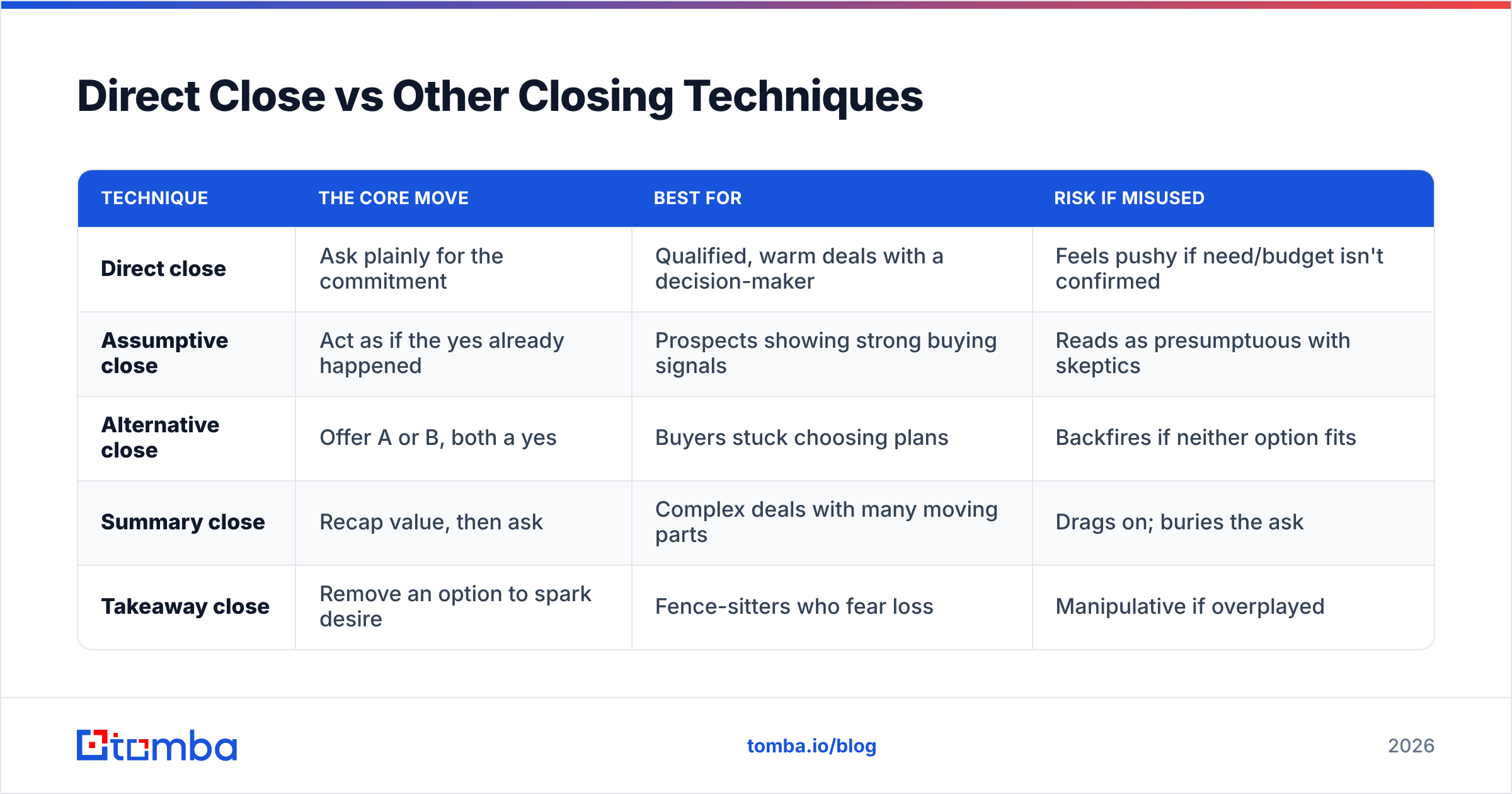
The direct close is not the only tool in the box. It is the right tool in specific conditions. Here is how it stacks up against the closes reps reach for most, so you can pick deliberately instead of by habit.
| Technique | The core move | Best for | Risk if misused |
|---|---|---|---|
| Direct close | Ask plainly for the commitment | Qualified, warm deals with a decision-maker | Feels pushy if need/budget isn't confirmed |
| Assumptive close | Act as if the yes already happened | Prospects showing strong buying signals | Reads as presumptuous with skeptics |
| Alternative close | Offer A or B, both a yes | Buyers stuck choosing plans | Backfires if neither option fits |
| Summary close | Recap value, then ask | Complex deals with many moving parts | Drags on; buries the ask |
| Takeaway close | Remove an option to spark desire | Fence-sitters who fear loss | Manipulative if overplayed |
The pattern: the direct close is the fastest and cleanest when the deal is genuinely ready. The others are detours you take when a condition is missing — the summary close buys time to re-establish value, the alternative close breaks a tie, the takeaway close pokes a stalled buyer. Master the direct close first; it is the baseline every other technique borrows from. HubSpot's sales team makes a similar case in their breakdown of proven closing techniques, and peer reviews on G2 consistently show that clarity, not cleverness, drives buyer trust.
How Do You Deliver a Direct Close Without Sounding Pushy?#
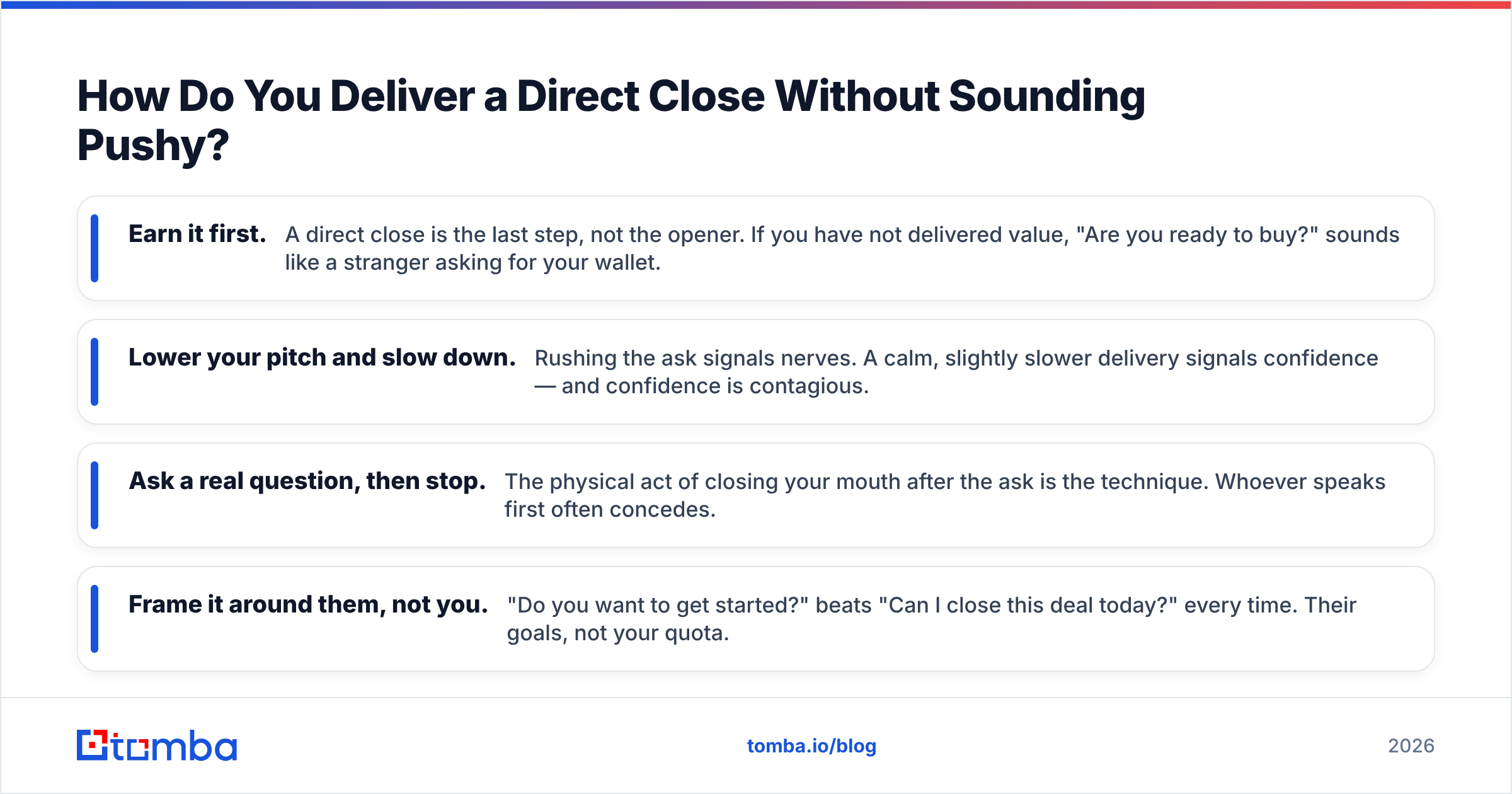
Tone is everything. The same sentence can feel like a warm invitation or a hard shove depending on how you carry it. Four rules keep you on the right side:
- Earn it first. A direct close is the last step, not the opener. If you have not delivered value, "Are you ready to buy?" sounds like a stranger asking for your wallet.
- Lower your pitch and slow down. Rushing the ask signals nerves. A calm, slightly slower delivery signals confidence — and confidence is contagious.
- Ask a real question, then stop. The physical act of closing your mouth after the ask is the technique. Whoever speaks first often concedes.
- Frame it around them, not you. "Do you want to get started?" beats "Can I close this deal today?" every time. Their goals, not your quota.
A useful analogy: delivering a direct close is like handing someone a pen across the table. You are not grabbing their hand and forcing a signature — you are simply making it effortless to say yes. If they are ready, they take the pen. If they hesitate, that hesitation tells you exactly which objection to handle next.
Handling the "Let Me Think About It" Response#
When a direct close meets a stall, do not retreat — clarify. Try:
"Totally fair. Just so I understand — is it the price, the timing, or something about the fit that's giving you pause?"
This narrows a vague delay into a specific, solvable objection. Once you know the real blocker, you can address it and re-close. A "let me think about it" is rarely a no; it is usually an unspoken question you have not answered yet.
Why Do Direct Closes Fail (and How to Fix Them)?#
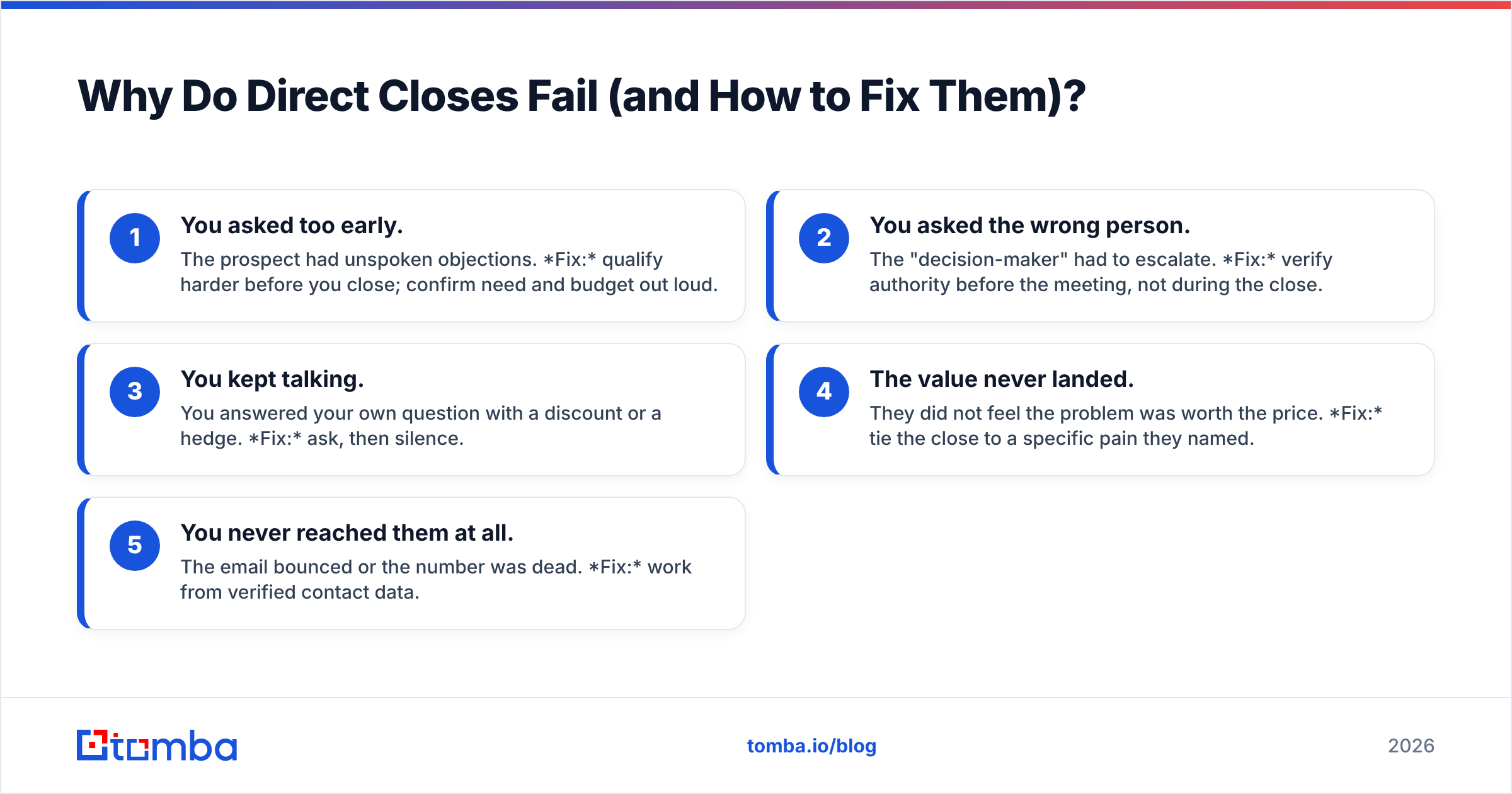
When a clean direct close flops, it is almost always one of these five causes. Diagnose honestly:
- You asked too early. The prospect had unspoken objections. Fix: qualify harder before you close; confirm need and budget out loud.
- You asked the wrong person. The "decision-maker" had to escalate. Fix: verify authority before the meeting, not during the close.
- You kept talking. You answered your own question with a discount or a hedge. Fix: ask, then silence.
- The value never landed. They did not feel the problem was worth the price. Fix: tie the close to a specific pain they named.
- You never reached them at all. The email bounced or the number was dead. Fix: work from verified contact data.
That last one is invisible and brutal. You can master every script above and still lose the deal because your outreach hit a stale inbox. If your response rate is quietly sinking, bad data — not bad closing — is often the culprit. This is where the boring infrastructure of prospecting meets the art of the close: a verified email and a direct-dial phone number put your perfect ask in front of a person who can actually act on it. Salesforce's research on pipeline hygiene echoes this — data quality is a top predictor of forecast accuracy.
How to Practice Direct Closes on Your Team#
Reading scripts is not the same as delivering them under pressure. Build the reflex:
- Role-play the pause. Have reps ask a direct-close question and then time how long they can stay silent. Most cave in three seconds. Train them to hold for ten.
- Record real calls. Review where the ask happened — or where it should have and didn't. Pattern-match the deals that closed against the ones that drifted.
- Standardize the moment, not the words. Every rep should have a personal direct close they can deliver naturally. Scripted-sounding closes break trust; a comfortable, in-your-own-words ask builds it.
- Log outcomes in the CRM. Track which close you used against whether it landed. Over a quarter, your CRM data will tell you which asks work for which segments.
The teams that win are not the ones with the slickest lines. They are the ones who consistently remember to ask — and who ask the right, reachable person.
Frequently Asked Questions#
Is the direct close outdated? No. Buyer preferences have shifted toward transparency, which actually favors the direct close — it is honest and respects their time. What is outdated is the manipulative, high-pressure version. A clear, low-pressure direct ask is more relevant than ever.
How is a direct close different from an assumptive close? A direct close asks for the commitment ("Do you want to move forward?"). An assumptive close behaves as if the commitment already exists ("I'll get your onboarding scheduled for Thursday"). Use direct when you want an explicit yes; use assumptive when the buying signals are overwhelming.
Can I use a direct close in a cold email? Yes, but only after value is established in the thread. A direct ask in a first-touch cold email usually lands too early. Save it for the moment the prospect has engaged and shown interest.
What if they say no? A no to a direct close is valuable — it surfaces the real objection fast. Respond with a calm "Understood — what would need to change for this to be a yes?" and you turn a dead end into a diagnostic.
Close the Deal — and Reach the Right Person First#
The best script in the world is wasted on a bounced email or a wrong number. Every direct close example here assumes one thing: your ask actually reaches a real, verified decision-maker. That is the half of closing nobody frames on the wall, and it is where deals silently leak.
Tomba's Email Finder gets you accurate, verified professional emails by name, company, or domain — so the confident ask you just practiced lands in a live inbox instead of a black hole. Start free with 25 searches a month, and when you scale, the Starter plan is $49/mo. Ask directly. Ask the right person. Close more.
Related guides#
Ready to find emails that actually work?
Join 150,000+ professionals who stopped guessing and started sending. Free credits on signup — no credit card required.
Get the Tomba newsletter
Practical outbound tactics and product updates — once every two weeks.
About the author