Direct Dial Numbers in 2026: The Complete B2B Sales Guide
Direct dial numbers skip the gatekeeper and put reps straight through to decision-makers. Here's how they work, what they cost, and how to get accurate ones at scale in 2026.
Cold calling still works in 2026 — but only if the phone you dial actually rings on your prospect's desk or in their pocket. That is the entire promise of a direct dial number, and it is why revenue teams pay a premium for them over generic company switchboard lines.
TL;DR#
- A direct dial is a phone number that connects you straight to a specific person, bypassing the main company line, the IVR menu, and the gatekeeper.
- Direct dials — especially direct-dial mobiles — routinely triple connect rates versus corporate HQ numbers, because you skip the routing maze entirely.
- Accuracy is the whole game: a stale or wrong direct dial wastes dials, burns rep morale, and can hurt your caller reputation.
- Expect to pay per-contact or per-credit for verified direct dials; quality varies wildly between providers, so test accuracy before you commit budget.
- Pair verified direct dials with verified email and enrichment data so every contact record is multi-channel and current.
What is a direct dial number?#
A direct dial number is a phone line that rings a single person, not an organization. Think of it as the difference between knocking on a building's front door and having a key to one specific office. When you call the main corporate number, you land in a lobby — an auto-attendant, a receptionist, or a phone tree — and you have to talk your way to the person you actually want. A direct dial skips the lobby.
In practice, "direct dial" covers two related things:
- Direct dial desk lines (DID). A Direct Inward Dialing number is an extension a company assigns so an outside caller can reach an employee without going through the switchboard. It usually looks like a normal office number but routes to one desk or softphone. (See the DID overview on Wikipedia for the telephony background.)
- Direct dial mobiles. The prospect's actual cell number. In a hybrid and remote-first sales world, this is often the single most valuable data point you can hold, because it reaches the person no matter where they are working that day.
Both beat a generic HQ number. The mobile usually wins on pickup rate, but a verified desk DID is more likely to be answered during working hours and is often easier to source at scale.
Why do direct dials matter more than ever in 2026?#
The short answer: routing friction kills cold-calling productivity, and direct dials remove almost all of it.
When your rep dials a corporate mainline, four things can go wrong before a conversation even starts. The call hits an IVR and gets misrouted. A receptionist screens it and takes a message that never surfaces. The extension is wrong. Or the prospect simply is not in the building — which, post-2020, is the norm rather than the exception. Every one of those failure points is a dial that produced zero pipeline.
Direct dials collapse that funnel. One number, one person, one ring. That is why sales orgs measuring connect rate (the percentage of dials that reach a live target) see the metric jump when they switch from HQ numbers to verified direct dials. HubSpot's sales research has repeatedly shown that reaching the right person on the first attempt is the biggest lever on call productivity — you can read more in HubSpot's sales statistics roundup.
There is a second, quieter reason direct dials matter: rep morale and caller reputation. A rep who connects with a human every fifth dial stays energized and on-script. A rep grinding through 40 switchboard transfers to reach two people burns out and starts sounding like it. Fewer, better-targeted dials also mean fewer flagged/spam-labeled calls against your outbound numbers.
How is a direct dial different from other B2B phone data?#
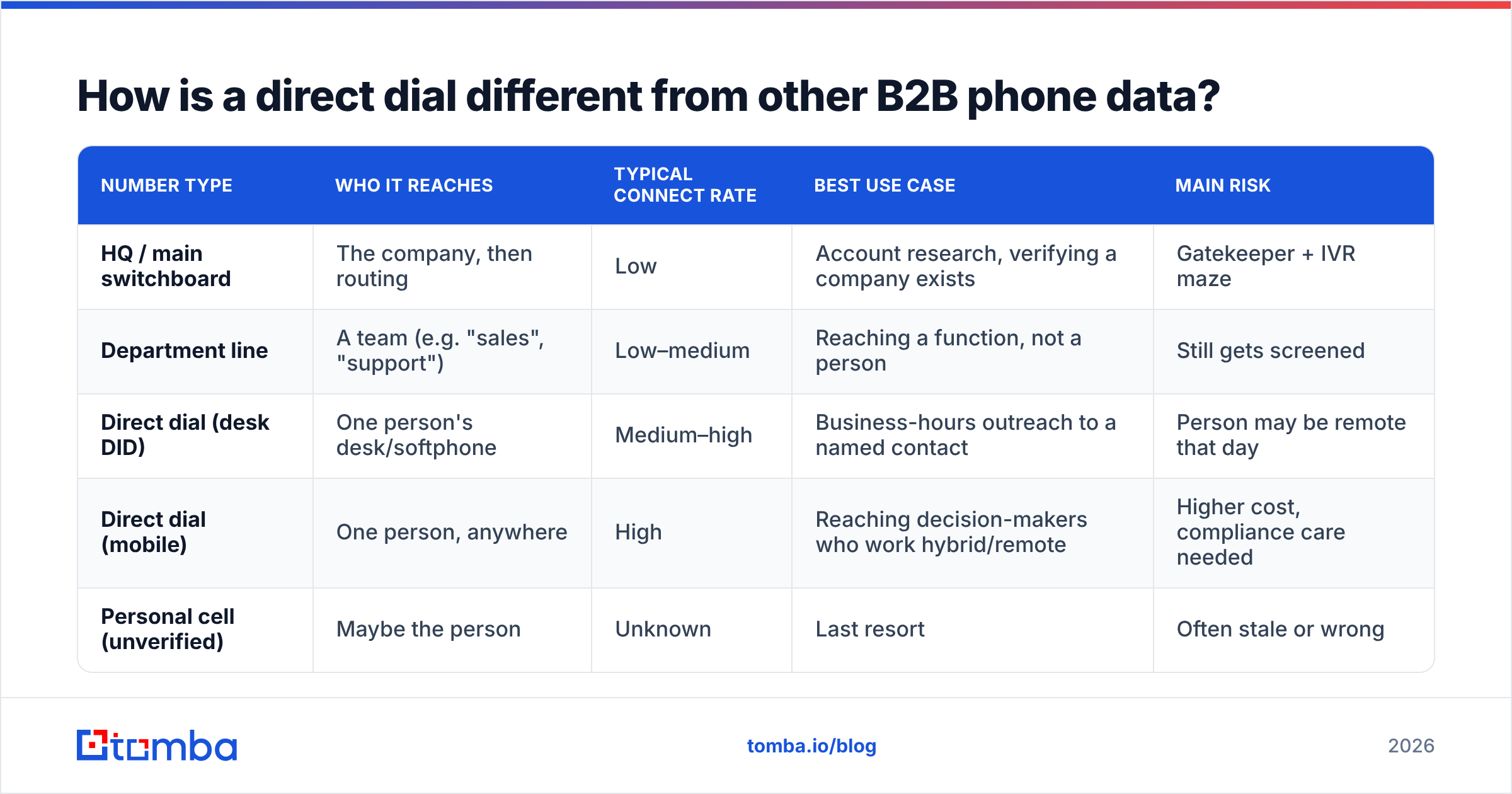
Not all phone numbers on a contact record are created equal. Here is how the common types stack up for an outbound caller.
| Number type | Who it reaches | Typical connect rate | Best use case | Main risk |
|---|---|---|---|---|
| HQ / main switchboard | The company, then routing | Low | Account research, verifying a company exists | Gatekeeper + IVR maze |
| Department line | A team (e.g. "sales", "support") | Low–medium | Reaching a function, not a person | Still gets screened |
| Direct dial (desk DID) | One person's desk/softphone | Medium–high | Business-hours outreach to a named contact | Person may be remote that day |
| Direct dial (mobile) | One person, anywhere | High | Reaching decision-makers who work hybrid/remote | Higher cost, compliance care needed |
| Personal cell (unverified) | Maybe the person | Unknown | Last resort | Often stale or wrong |
The pattern is clear: the more specific the number, the higher the connect rate — and the more it matters that the data is fresh and verified. A wrong mobile number is worse than no number, because it costs a dial and can annoy the wrong person.
How do you find accurate direct dial numbers?#
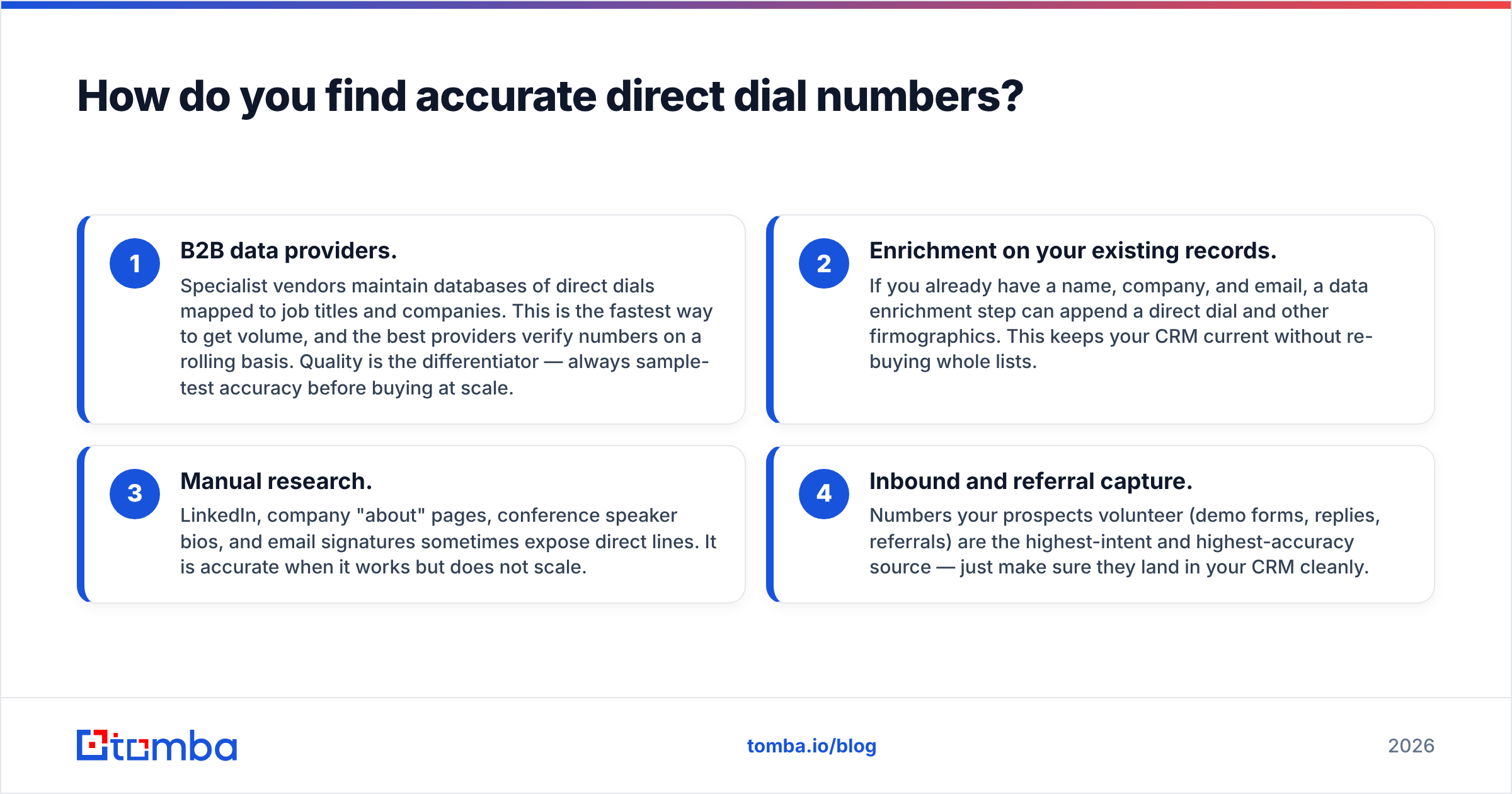
There are four realistic sourcing paths, and most teams end up combining them.
- B2B data providers. Specialist vendors maintain databases of direct dials mapped to job titles and companies. This is the fastest way to get volume, and the best providers verify numbers on a rolling basis. Quality is the differentiator — always sample-test accuracy before buying at scale.
- Enrichment on your existing records. If you already have a name, company, and email, a data enrichment step can append a direct dial and other firmographics. This keeps your CRM current without re-buying whole lists.
- Manual research. LinkedIn, company "about" pages, conference speaker bios, and email signatures sometimes expose direct lines. It is accurate when it works but does not scale.
- Inbound and referral capture. Numbers your prospects volunteer (demo forms, replies, referrals) are the highest-intent and highest-accuracy source — just make sure they land in your CRM cleanly.
Whichever path you use, the number is only as good as its last verification. Direct dials decay fast — people change roles, companies re-provision extensions, and mobiles get swapped. Treat phone data like produce, not canned goods.

What makes direct dial data accurate — and how do you check it?#
Accuracy comes down to three things: recency, verification method, and coverage honesty.
- Recency. When was the number last confirmed? A provider that re-verifies quarterly will beat one selling a two-year-old dump, regardless of headline database size.
- Verification method. The best signal is a number that has been checked against live telco data, not just scraped once and forgotten. A phone validator confirms a number is live, correctly formatted, and reachable before your rep ever dials it.
- Coverage honesty. A good vendor tells you their match rate for your target segment instead of promising "100% coverage." No one has every direct dial; the useful question is how many of your accounts they cover accurately.
Before you commit budget, run a simple accuracy test: pull 100 direct dials for a segment you know well, dial or validate them, and measure the true connect rate. If a provider's real-world accuracy is far below their marketing claim, walk. G2 reviews are a decent sanity check on this — see how buyers rate B2B data providers on G2 before you trust a pitch.
What does direct dial data cost in 2026?#
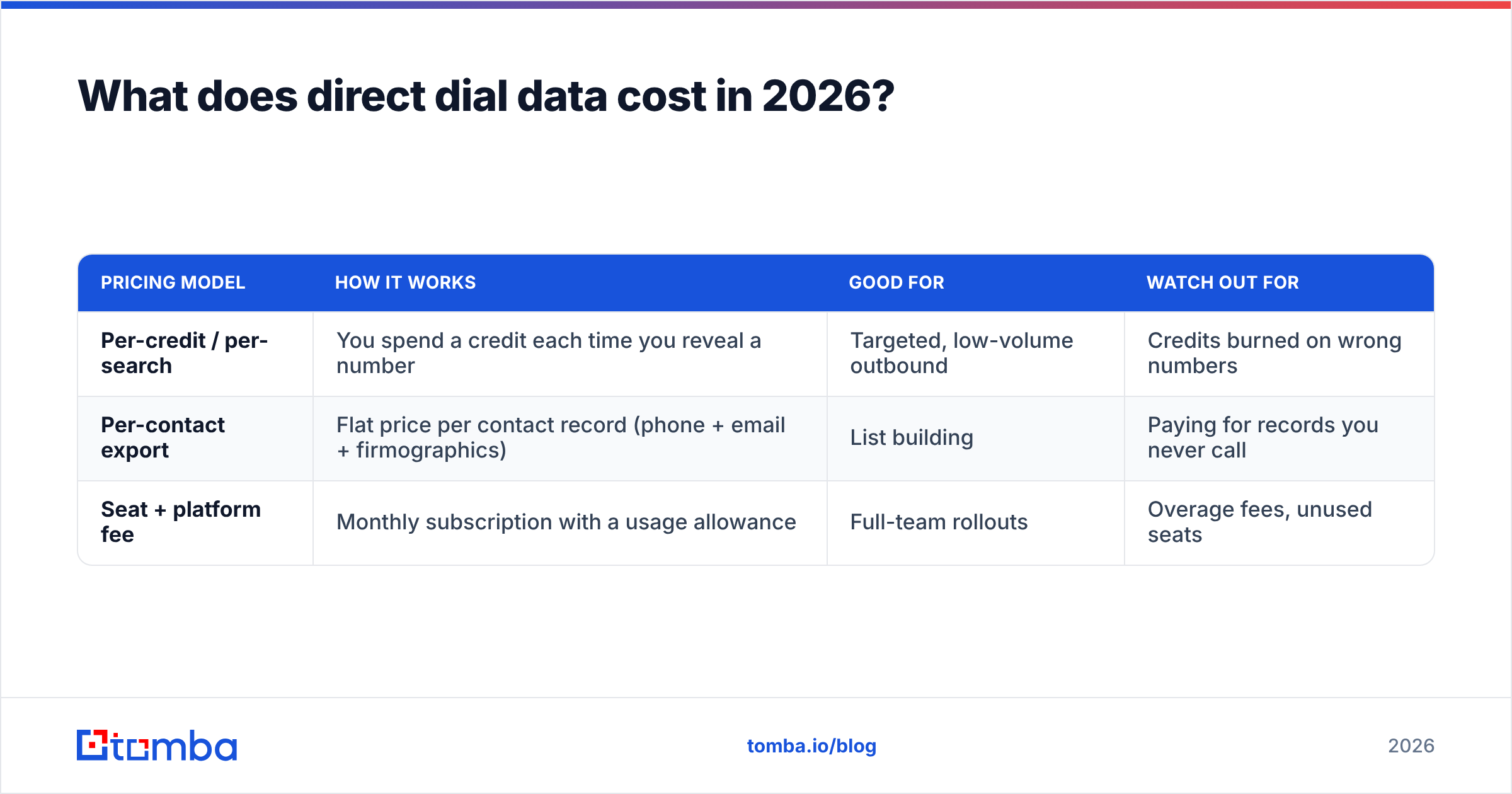
Pricing almost always follows one of three models:
| Pricing model | How it works | Good for | Watch out for |
|---|---|---|---|
| Per-credit / per-search | You spend a credit each time you reveal a number | Targeted, low-volume outbound | Credits burned on wrong numbers |
| Per-contact export | Flat price per contact record (phone + email + firmographics) | List building | Paying for records you never call |
| Seat + platform fee | Monthly subscription with a usage allowance | Full-team rollouts | Overage fees, unused seats |
The right model depends on volume. A two-rep team doing surgical outbound is better served by a credit model where they pay only for the contacts they actually pursue. A 30-rep org building territories every quarter usually wants a platform plan with predictable seats.
For reference, a modern data platform like Tomba uses a transparent credit approach — a free tier to test, then Starter at $49/mo, Growth at $99/mo, and Pro at $249/mo — so you can validate accuracy on real accounts before scaling spend. You can compare the tiers on the Tomba pricing page. The principle holds no matter which vendor you choose: never pay platform pricing before you have proven segment-level accuracy with a small credit test.
How should you use direct dials in a real outbound sequence?#
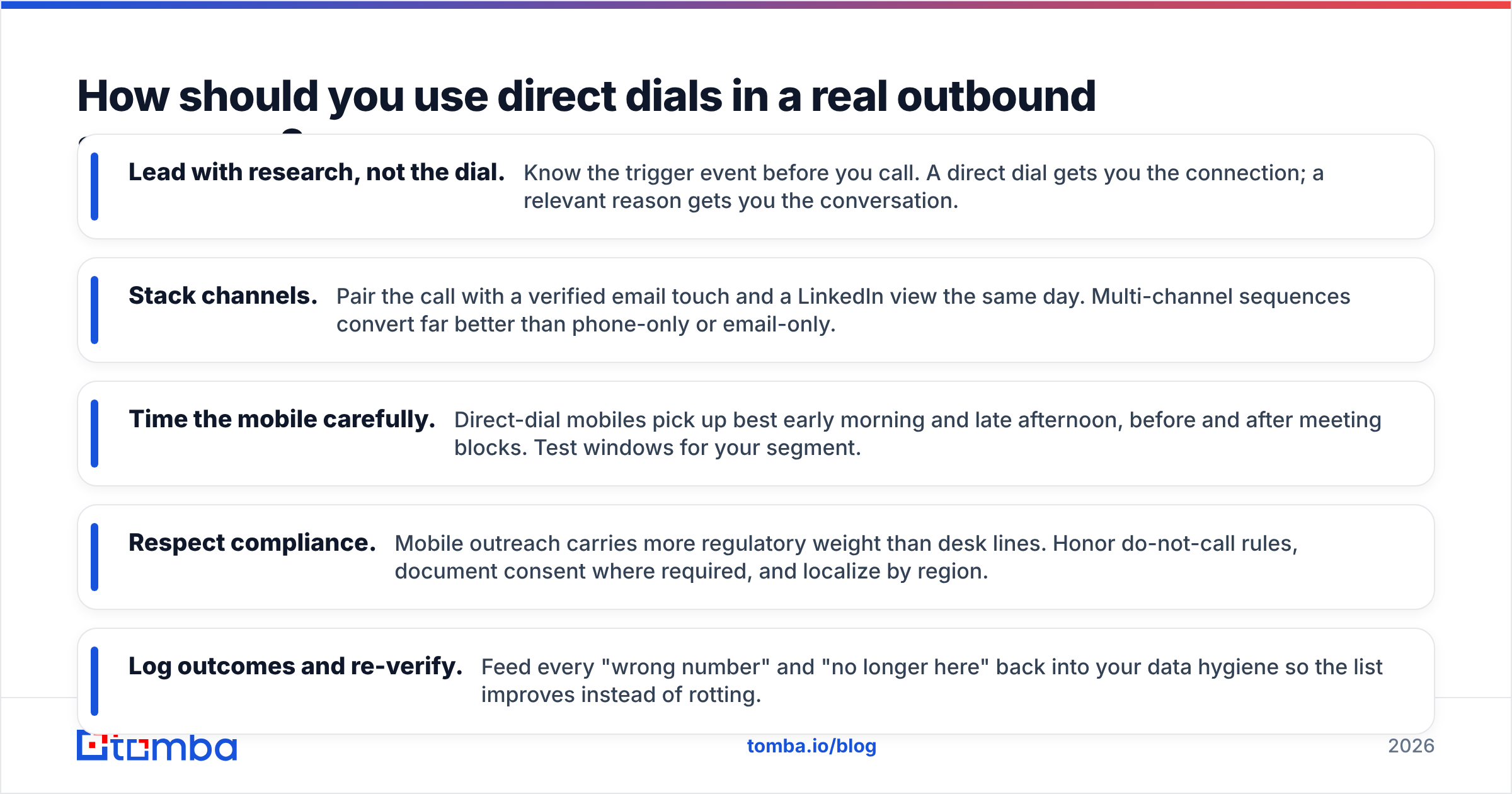
A direct dial is a multiplier, not a standalone tactic. The teams that get the most from them wire the call into a coordinated sequence:
- Lead with research, not the dial. Know the trigger event before you call. A direct dial gets you the connection; a relevant reason gets you the conversation.
- Stack channels. Pair the call with a verified email touch and a LinkedIn view the same day. Multi-channel sequences convert far better than phone-only or email-only.
- Time the mobile carefully. Direct-dial mobiles pick up best early morning and late afternoon, before and after meeting blocks. Test windows for your segment.
- Respect compliance. Mobile outreach carries more regulatory weight than desk lines. Honor do-not-call rules, document consent where required, and localize by region.
- Log outcomes and re-verify. Feed every "wrong number" and "no longer here" back into your data hygiene so the list improves instead of rotting.
The connective tissue here is data quality across every channel. A verified direct dial paired with a bounced email is a half-built contact record. That is why the strongest outbound motions treat phone, email, and enrichment as one pipeline rather than three separate purchases.
Is direct dial data worth it for your team?#
Yes — if you actually call, and if you keep the data fresh. Direct dials are wasted money for a team that does email only, and they are actively harmful when they are stale. But for any org running real outbound, verified direct dials are one of the highest-leverage data investments available, because they attack the single biggest bottleneck in cold calling: reaching a live human.
The decision is less "direct dials, yes or no" and more "how do I source accurate ones and keep them accurate." Get that right and your connect rate, rep morale, and pipeline all move together.
Get accurate direct dials and multi-channel contact data with Tomba#
If you want direct dials that reach real people — not a switchboard and not a dead extension — start with data you can verify. Tomba's phone finder surfaces B2B direct dial and mobile numbers tied to named contacts, and its phone validator confirms they are live before your reps burn a dial. Because Tomba also covers email finding, verification, and contact enrichment in one platform, every record you build is multi-channel and current — phone, email, and firmographics from a single source.
Spin up the free tier, run an accuracy test on a segment you know cold, and scale only once the connect rates prove out. That is how you turn direct dials from a line item into a repeatable pipeline engine. Start finding verified direct dials with Tomba today.
Related guides#
Ready to find emails that actually work?
Join 150,000+ professionals who stopped guessing and started sending. Free credits on signup — no credit card required.
Get the Tomba newsletter
Practical outbound tactics and product updates — once every two weeks.
About the author