Direct Dial Connect Rate: 2026 Benchmarks and How to Improve It
What counts as a good direct dial connect rate in 2026, how it's calculated, and the data-quality moves that lift it from single digits to double digits.
Direct Dial Connect Rate: 2026 Benchmarks and How to Improve It
If your reps are dialing all day and talking to almost no one, the number that explains why is your direct dial connect rate. It is the single cleanest read on whether your phone motion is healthy or quietly bleeding hours. This guide defines it precisely, gives you honest 2026 benchmarks, and walks through the levers that actually move it.
TL;DR#
- Direct dial connect rate = live conversations with the target person ÷ dials to direct (non-switchboard) numbers. It isolates the human-reached moment, not just "someone picked up."
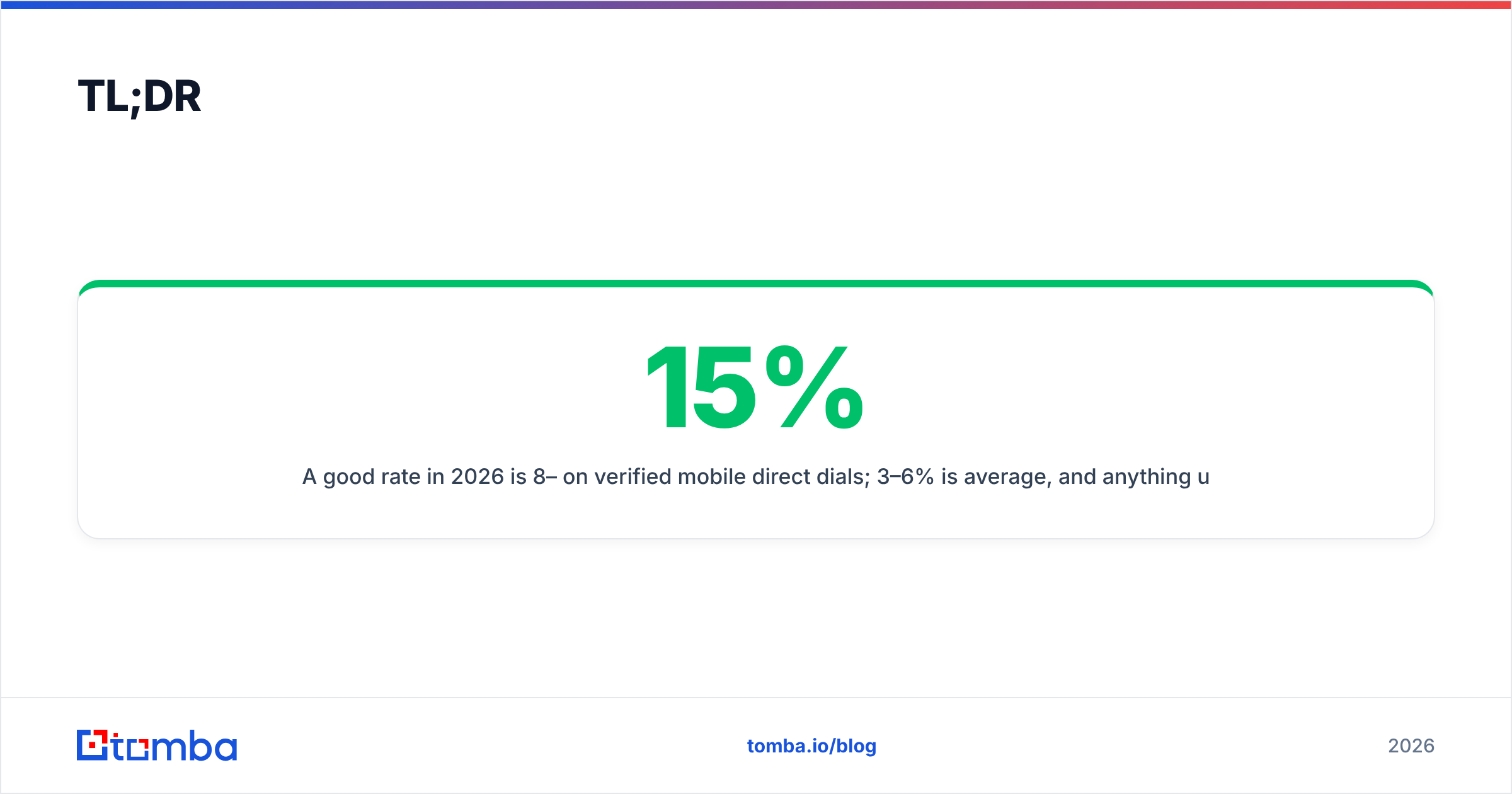
- A good rate in 2026 is 8–15% on verified mobile direct dials; 3–6% is average, and anything under 3% usually signals a data problem, not a talent problem.
- Number quality is the biggest lever — mobile beats desk, verified beats scraped, and a fresh number beats a two-year-old one by a wide margin.
- Timing, local presence, and caller ID reputation each add a few points; stacked, they can double a weak baseline.
- Fix the data first. Cadence tuning on top of a bad list is polishing a flat tire.
What is a direct dial connect rate?#
Your direct dial connect rate is the percentage of dials to a direct line that result in a live, two-way conversation with the person you were trying to reach.
Think of it like fishing. Casts into an empty pond and casts into a stocked one look identical from the dock — the difference only shows up in what you pull out. Dials are casts. Connects are fish. The connect rate tells you whether you're fishing where the fish are.
The word direct matters. A direct dial is a number that rings the prospect's own phone — their mobile or their personal desk line — not a company switchboard, IVR menu, or shared reception queue. Switchboard dials inflate "pickup" numbers while producing almost no real conversations, so serious phone teams measure connects against direct lines only.
Here's the formula stated cleanly:
Direct dial connect rate = (conversations with the target contact ÷ dials to direct numbers) × 100
A few definitions that keep the metric honest:
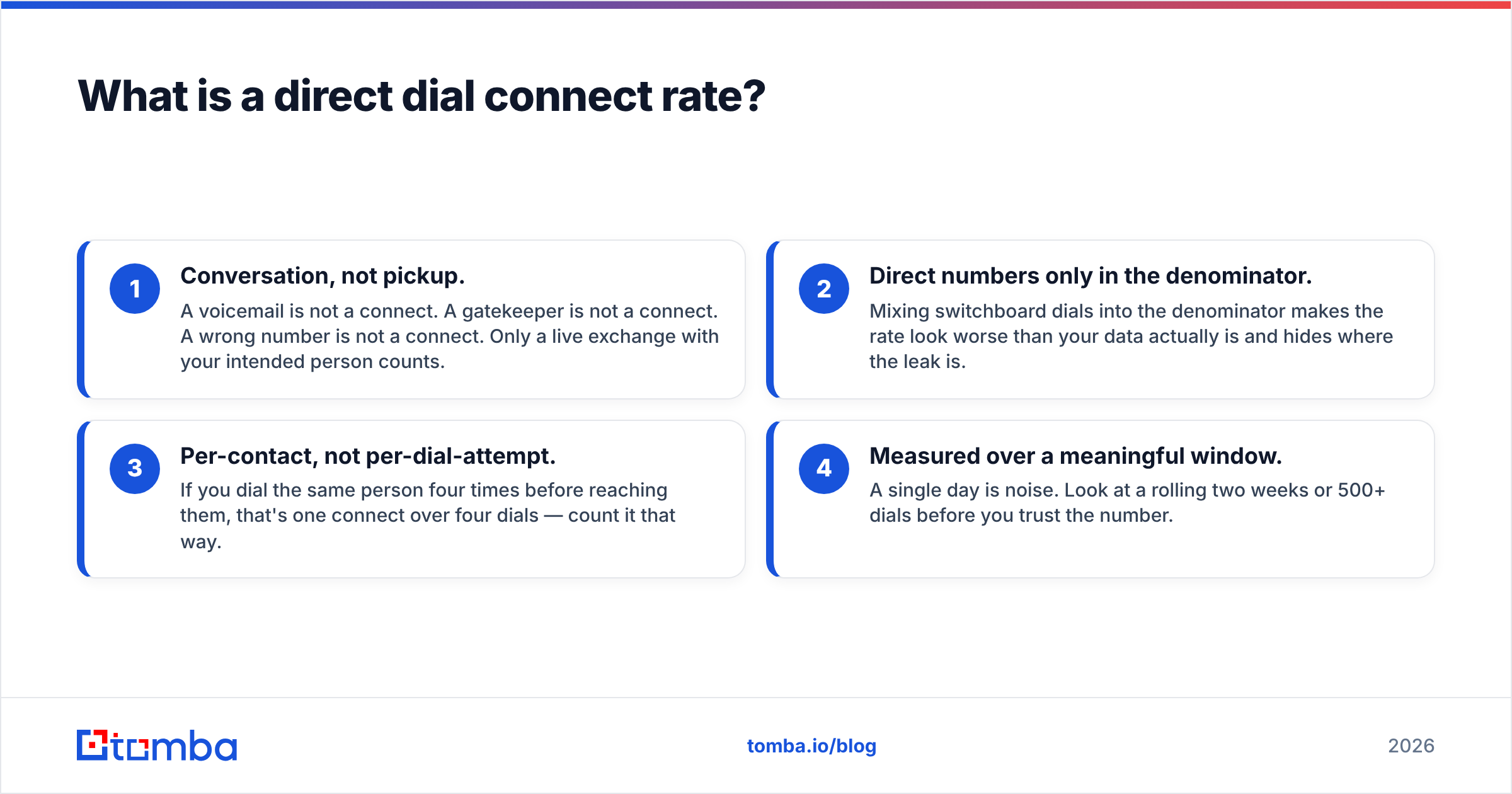
- Conversation, not pickup. A voicemail is not a connect. A gatekeeper is not a connect. A wrong number is not a connect. Only a live exchange with your intended person counts.
- Direct numbers only in the denominator. Mixing switchboard dials into the denominator makes the rate look worse than your data actually is and hides where the leak is.
- Per-contact, not per-dial-attempt. If you dial the same person four times before reaching them, that's one connect over four dials — count it that way.
- Measured over a meaningful window. A single day is noise. Look at a rolling two weeks or 500+ dials before you trust the number.

Why does the direct dial connect rate matter more than dial volume?#
Because dial volume is an activity vanity metric and connect rate is an efficiency metric. Two reps can log the same 80 dials; the one connecting at 12% has six live conversations and the one at 3% has two. Same effort, three times the pipeline surface.
Connect rate compounds through your whole funnel. Every downstream number — conversations-to-meetings, meetings-to-opportunities, win rate — sits on top of how many humans you actually reach. Double the connect rate and you have effectively doubled the top of your phone funnel without adding a single hour of dialing. That is why RevOps teams treat it as a leading indicator and why it belongs on the same dashboard as your response rate for email.
It's also the fastest diagnostic you have. A slumping meeting count could be messaging, targeting, timing, or list quality. Connect rate splits that in half instantly: if reps aren't reaching people, the problem is upstream of the pitch entirely.
What is a good direct dial connect rate in 2026?#
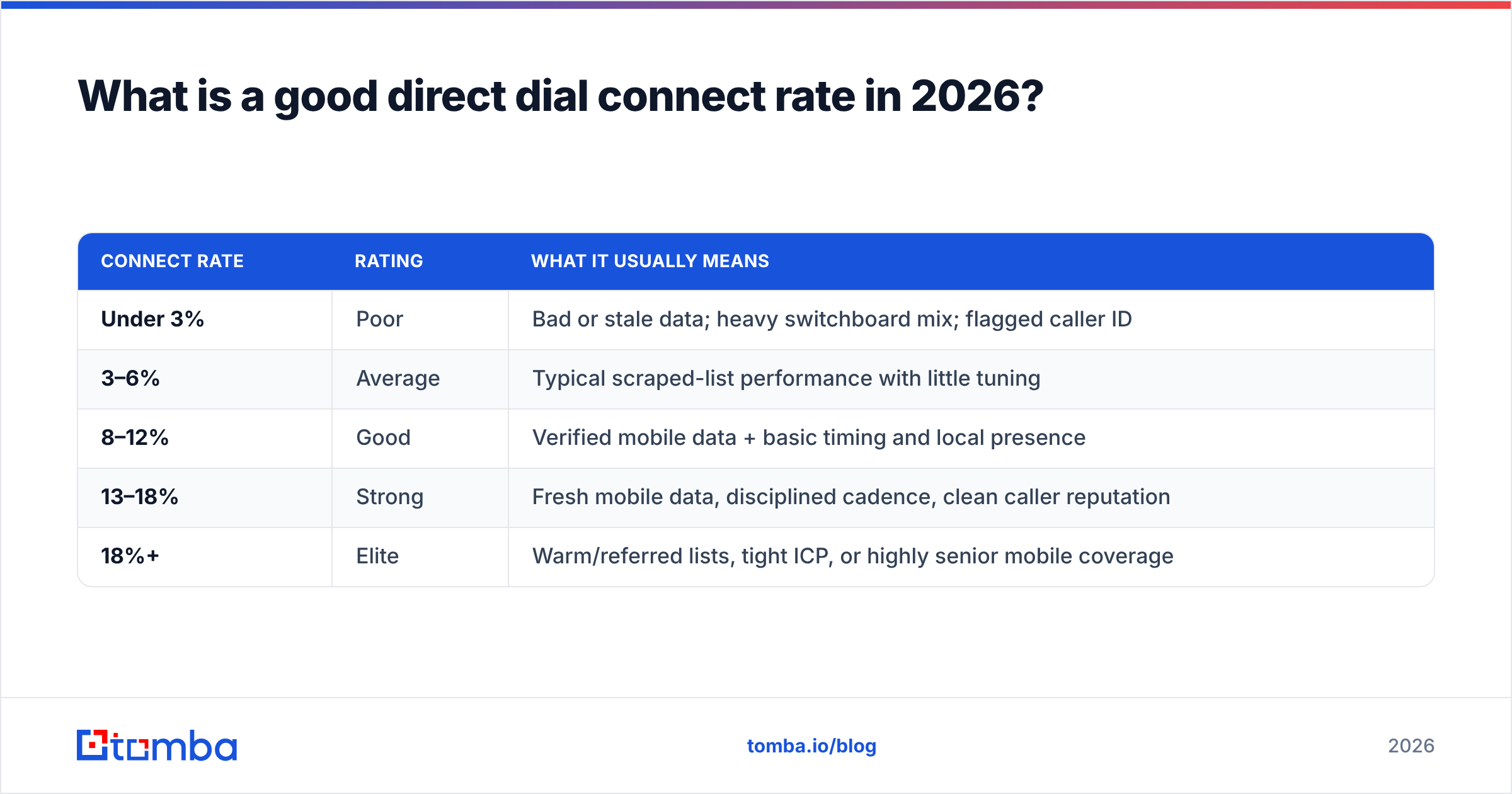
A good direct dial connect rate in 2026 is 8–15% for verified mobile numbers in most B2B segments. Below is how the tiers break down based on aggregated industry reporting and vendor benchmark studies.
| Connect rate | Rating | What it usually means |
|---|---|---|
| Under 3% | Poor | Bad or stale data; heavy switchboard mix; flagged caller ID |
| 3–6% | Average | Typical scraped-list performance with little tuning |
| 8–12% | Good | Verified mobile data + basic timing and local presence |
| 13–18% | Strong | Fresh mobile data, disciplined cadence, clean caller reputation |
| 18%+ | Elite | Warm/referred lists, tight ICP, or highly senior mobile coverage |
Two honest caveats. First, seniority drags the rate down: VPs and C-suite are harder to reach than managers and ICs, so an "elite" number when dialing directors might be a "good" number when dialing CROs. Second, mobile versus desk changes everything. Verified mobile direct dials routinely connect 2–3x better than desk lines because the desk is increasingly empty in hybrid and remote orgs.
If you want an external gut check, browse category reviews on G2 where practitioners frequently report their real connect rates by tool and segment — it's a useful sanity band against your own numbers.
Why is your direct dial connect rate low? The usual culprits#
Most low connect rates trace back to a small set of causes. Work them in this order, because they're ranked by how much damage they typically do.
- Stale or scraped numbers. Phone data decays fast — people change roles, companies, and cell plans. A number scraped 18 months ago may be dead or reassigned. This is the number-one cause of sub-5% rates.
- Switchboard numbers dressed up as direct dials. Many cheap lists pad coverage with main office lines. You dial, reception answers, and it never becomes a conversation. Segment these out and your true direct-dial rate often looks far better than you feared.
- Wrong number type. Desk lines in a remote-heavy org are near-dead. If your data skews desk-heavy, mobile enrichment alone can lift connects several points.
- Flagged caller ID. If carriers or spam-labeling apps have flagged your outbound number as "Spam Likely," prospects never even see a real caller. Rotate numbers and monitor reputation.
- Bad timing. Dialing at low-availability hours wastes casts. Reachability clusters at specific windows (more below).
- No local presence. An out-of-area or toll-free caller ID gets ignored far more than a local-looking number.
Notice that four of the six are data problems. That's not an accident — the data layer is where connect rate is won or lost.
How do you improve a direct dial connect rate?#
Improve your direct dial connect rate by fixing number quality first, then layering timing, local presence, and cadence on top. In that order — because tuning cadence on a bad list just helps you reach nobody more efficiently.
1. Start with verified, mobile-first data#
The highest-leverage move is feeding reps numbers that are (a) direct, (b) mobile where possible, and (c) recently verified. This is where a quality data source earns its keep. A B2B phone number tool that returns verified mobile direct dials — rather than recycled switchboard lines — can move a 4% list to double digits before you change anything else about the motion.
Two supporting steps close the loop:
- Validate before you dial. Running numbers through a phone validator removes disconnected and invalid lines so reps don't burn casts on dead water.
- Enrich to fill and refresh. Use data enrichment to append mobile numbers where you only have desk lines and to refresh records that have aged out. Where your provider sources its records matters too — it's worth understanding a vendor's data sources before you standardize on it.
2. Dial when people are actually reachable#
Connect rate has a time-of-day shape. Aggregated dialer data consistently points to two productive windows — mid-to-late morning and late afternoon — with a dead zone around lunch and the first hour of the workday. You don't need to obsess; you just need to stop wasting your best list on your worst hours. Test your own data over a few weeks and let it tell you where your pond is stocked.
3. Use local presence and protect caller reputation#
A caller ID that looks local gets answered more often than an unfamiliar area code or a toll-free number. Most modern dialers offer local-presence dialing; turn it on. Just as important, monitor whether your outbound numbers are getting spam-flagged, and rotate them before reputation craters. A flagged number quietly zeroes out even a perfect list.
4. Tune cadence, then leave it alone#
Once the data and timing are right, cadence is the final few points. A reasonable pattern is 3–5 direct-dial attempts per contact spread across different days and times, paired with your email and LinkedIn outreach so the phone isn't carrying the whole relationship alone. Multi-thread across channels; the phone converts far better when the name is already familiar.
How to calculate and track it correctly#
Set your tracking up so the number can't lie to you. HubSpot's own sales metrics guidance and most CRM reporting stacks let you tag call outcomes — use those tags deliberately.
- Log outcomes granularly. Distinguish connect, voicemail, gatekeeper, wrong number, no answer, and bad number. Without this split you can't tell a data problem from a timing problem.
- Separate direct from switchboard in the denominator. Report two rates if you can: true direct-dial connect rate and blended. The gap between them is your data-quality tax.
- Watch the bad-number rate. If "wrong number" plus "disconnected" climbs above ~10–15% of dials, stop tuning cadence and go fix the list.
- Trend it, don't snapshot it. Track the rolling rate per rep and per data source. When a new list drops your connect rate, you'll see it within a week.
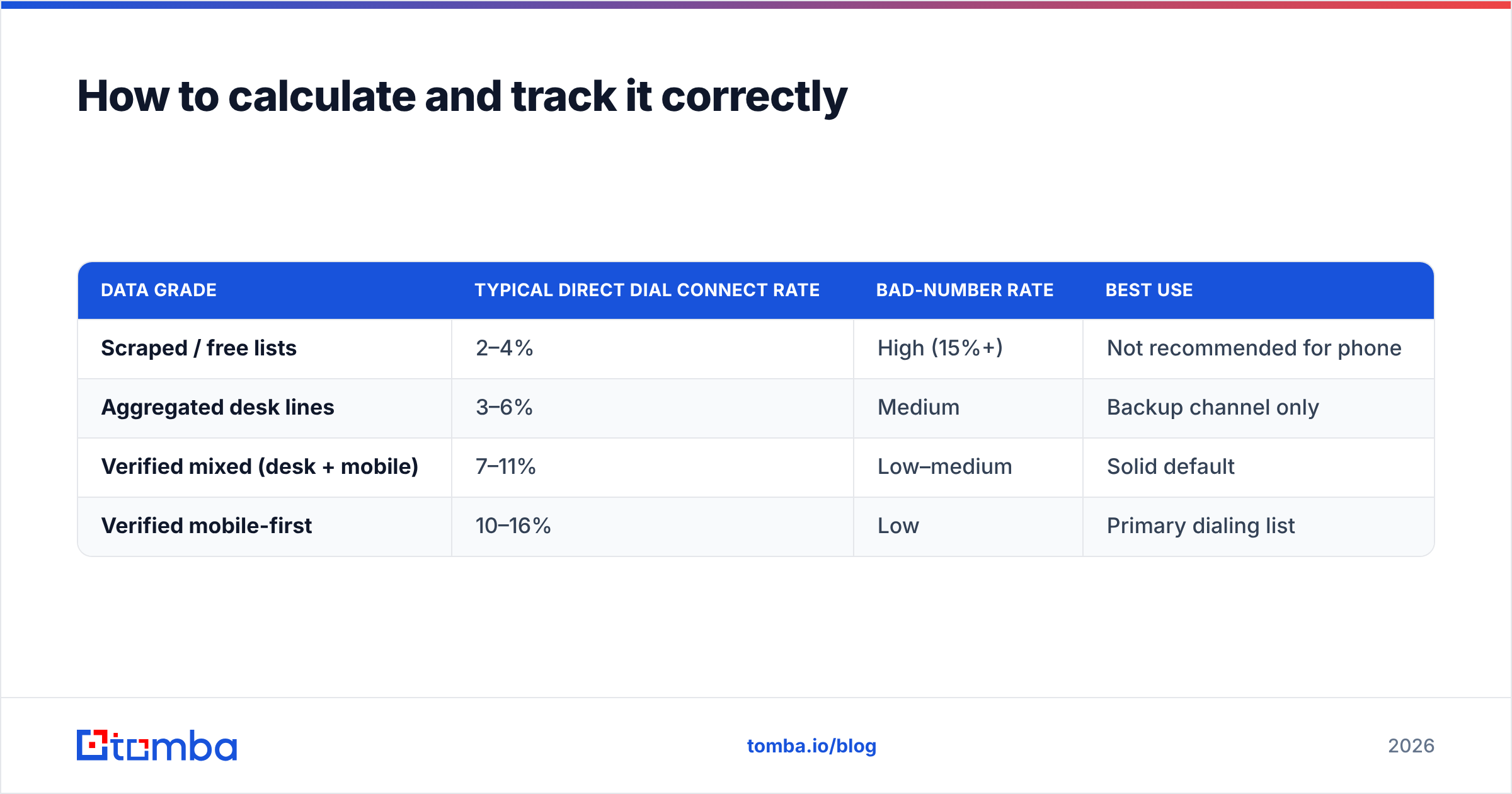
Here's a quick side-by-side of what each data grade tends to produce, so you can place your own list:
| Data grade | Typical direct dial connect rate | Bad-number rate | Best use |
|---|---|---|---|
| Scraped / free lists | 2–4% | High (15%+) | Not recommended for phone |
| Aggregated desk lines | 3–6% | Medium | Backup channel only |
| Verified mixed (desk + mobile) | 7–11% | Low–medium | Solid default |
| Verified mobile-first | 10–16% | Low | Primary dialing list |
Frequently asked questions#
Is direct dial connect rate the same as answer rate?#
No. Answer rate counts anyone picking up, including gatekeepers and voicemail. Direct dial connect rate counts only live conversations with your intended contact. Answer rate always looks higher and hides the truth.
What's a realistic connect rate when dialing executives?#
For VP-and-above on verified mobile, 6–10% is a strong result. Senior people are harder to reach, so judge executive dialing against a lower bar than manager-level dialing.
Does buying a bigger list improve connect rate?#
Rarely. Volume without verification usually lowers your rate because more dead and switchboard numbers dilute the good ones. Quality and recency beat raw count every time.
How often should phone data be refreshed?#
Every 3–6 months at minimum. B2B phone data decays roughly 20–30% per year as people change roles and numbers, so a list you loved last year is quietly rotting.
The bottom line#
Your direct dial connect rate is the honest scoreboard of your phone motion, and in 2026 the difference between a 4% list and a 12% list is mostly the quality of the numbers you feed your reps. Fix the data, dial at the right hours, protect your caller ID, and cadence takes care of the rest.
If your connect rate is stuck in the single digits, start where the leverage is: the data. Pull verified, mobile-first direct dials with the Tomba Phone Finder, validate them before your reps ever dial, and enrich the gaps so every cast lands where the fish are. Check current Tomba pricing to match a plan to your dial volume — the Free tier is enough to test the lift on a sample list before you commit. Better numbers in, more conversations out. That's the whole game.
Related guides#
Ready to find emails that actually work?
Join 150,000+ professionals who stopped guessing and started sending. Free credits on signup — no credit card required.
Get the Tomba newsletter
Practical outbound tactics and product updates — once every two weeks.
About the author