Direct Dials vs Mobile Numbers: The 2026 Sales Guide
Direct dials and mobile numbers both promise a live conversation, but they connect very differently. Here's when each wins, what they cost, and how to source them at scale.
Reps argue about this in every pipeline review: should you chase the direct dial to someone's desk, or the mobile number in their pocket? The two look interchangeable on a contact card. They are not. They route differently, connect at different rates, cost different amounts, and carry very different compliance weight.
This guide breaks down direct dials vs mobile numbers the way a sales leader actually needs it — connect rates, cost, use cases, and how to source both without burning your team's time on dead digits.
TL;DR: Direct Dials vs Mobile Numbers#
- Direct dials ring a specific person's desk extension (a DID/DDI), skipping the switchboard and gatekeeper. Mobile numbers ring the person's cell, wherever they are.
- Mobiles win on connect rate — reps reach a live human far more often on a cell than on a desk line, especially post-2020 hybrid work.
- Direct dials win on office-bound roles and compliance comfort — think finance, healthcare admin, on-site operations, and regulated outreach.
- Cost differs: verified mobiles are scarcer and pricier per record; direct dials are cheaper and more abundant.
- The real answer is "both, prioritized" — lead with mobile for hybrid roles, fall back to direct dial, and verify every number before you dial.
What Is a Direct Dial?#
A direct dial (also called a DID or DDI — Direct Inward Dialing) is a phone number that rings one specific person's desk line without routing through a company's main switchboard. Instead of calling the front desk and asking to be transferred to "Sarah in procurement," you dial Sarah's extension directly.
Think of a direct dial like the side entrance to an office building. The main line is the front lobby with a receptionist who screens everyone. The direct dial is the door with Sarah's name on it — you skip the queue and the gatekeeper entirely.
Direct dials are tied to a desk and a physical location. That's their strength and their weakness. When your prospect is at their desk, a direct dial is the most reliable way to reach them. When they're working from home three days a week, that desk phone rings into an empty office.
What Is a Mobile Number in B2B Sales?#
A mobile number is the prospect's personal or company-issued cell phone. It follows the person, not the building. Whether they're at their desk, in a coffee shop, or between meetings, the phone in their pocket rings.
For B2B sellers, mobiles have become the default target since hybrid and remote work fragmented the traditional office. If your buyer only comes into the office two days a week, a desk-only strategy misses them 60% of the time.
Mobiles also carry a psychological weight: answering a cell is more personal. That cuts both ways — higher intent when they pick up, but stricter expectations around relevance and consent.
Direct Dials vs Mobile Numbers: The Core Differences#
Here's the head-to-head that matters when you're building a calling motion.
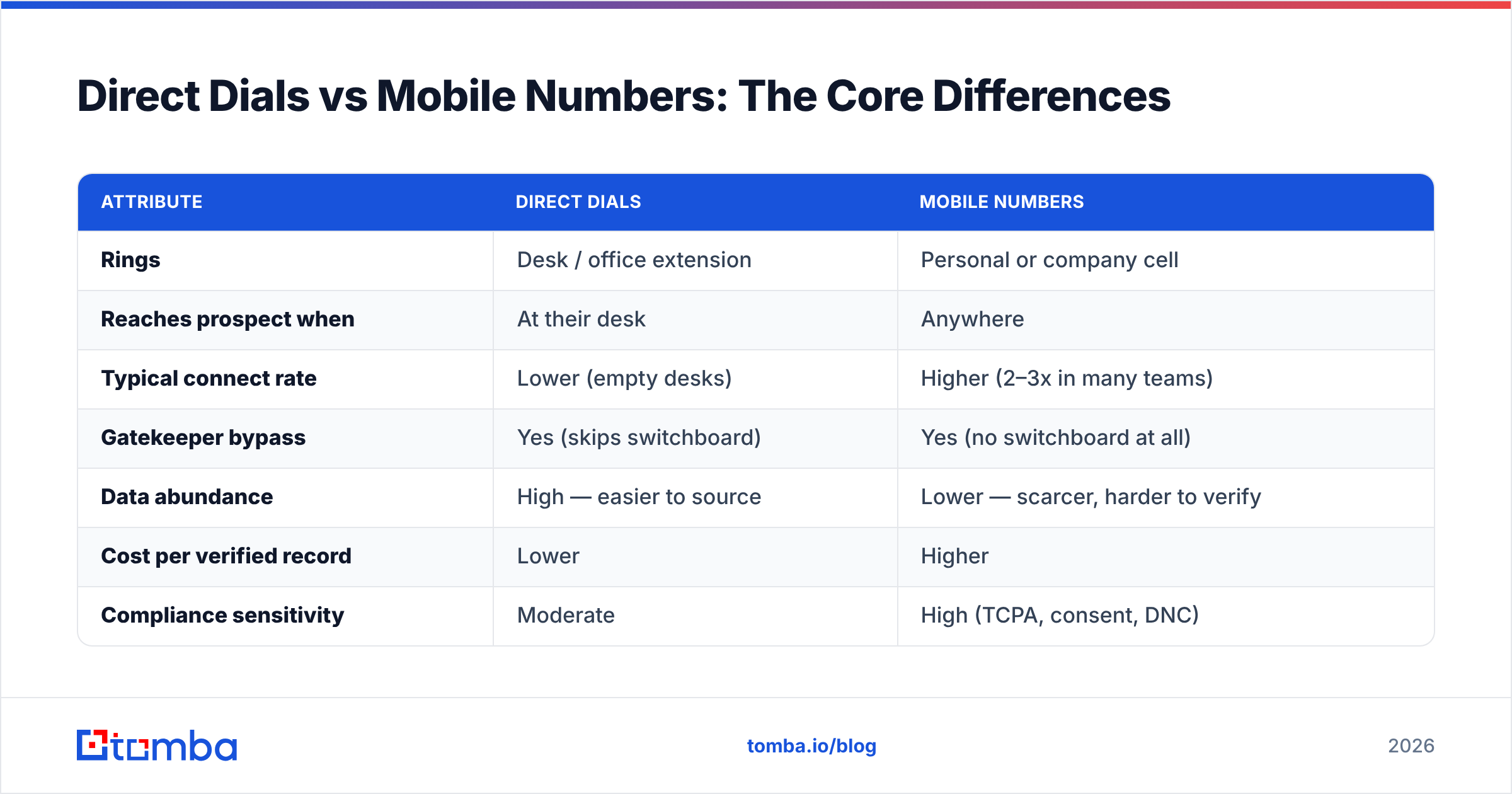
| Attribute | Direct Dials | Mobile Numbers |
|---|---|---|
| Rings | Desk / office extension | Personal or company cell |
| Reaches prospect when | At their desk | Anywhere |
| Typical connect rate | Lower (empty desks) | Higher (2–3x in many teams) |
| Gatekeeper bypass | Yes (skips switchboard) | Yes (no switchboard at all) |
| Data abundance | High — easier to source | Lower — scarcer, harder to verify |
| Cost per verified record | Lower | Higher |
| Compliance sensitivity | Moderate | High (TCPA, consent, DNC) |
| Best for | Office-bound, regulated roles | Hybrid/remote, senior buyers |
| Voicemail value | Office voicemail, often ignored | Personal voicemail, higher listen rate |
The pattern is clear: mobiles connect more often, direct dials cost less and feel safer. Neither is universally "better." The winner depends on who you're calling and how you're calling them.
Which Gets Higher Connect Rates?#
Mobiles, in most modern B2B teams — often by a wide margin.
The reason is structural, not magical. A direct dial depends on the prospect physically sitting at the desk that phone is wired to. In a hybrid world, that's a coin flip on any given afternoon. A mobile depends only on the prospect being awake and near their phone, which is nearly always.
Sales teams that switched to mobile-first dialing routinely report 2–3x more live conversations per hour of calling. That doesn't mean you should throw out direct dials — it means you should sequence them correctly. Lead with the channel most likely to produce a live human, then fall back.
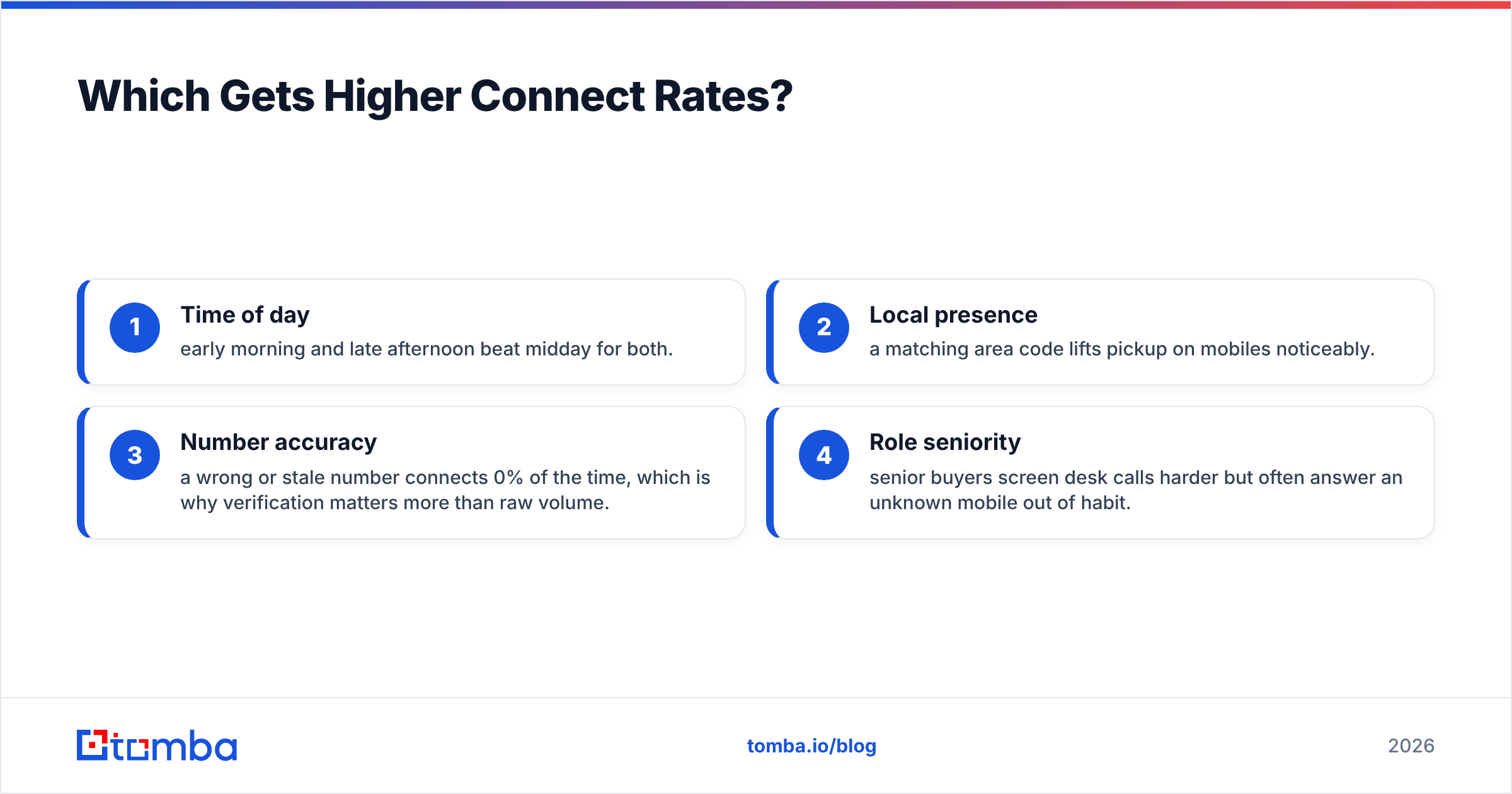
A few factors that swing connect rate regardless of number type:
- Time of day — early morning and late afternoon beat midday for both.
- Local presence — a matching area code lifts pickup on mobiles noticeably.
- Number accuracy — a wrong or stale number connects 0% of the time, which is why verification matters more than raw volume.
- Role seniority — senior buyers screen desk calls harder but often answer an unknown mobile out of habit.
That third point is the quiet killer. Half of a bad calling day isn't rejection — it's dialing numbers that no longer belong to the person. Verifying numbers before they hit the dialer is the cheapest connect-rate boost available. A quick pass through a phone validator removes disconnected and reassigned lines before your reps waste a single dial.
When Should You Use Direct Dials?#
Direct dials still win in specific, predictable situations. Reach for them when:
- The role is office-bound. On-site operations, lab staff, manufacturing, front-desk-adjacent roles, and many finance functions still sit at a physical desk most of the day.
- You're in a regulated or conservative industry. Government, healthcare administration, and legal contacts often expect business calls on business lines. A desk dial reads as more professional and lower-risk.
- Consent for mobile is unclear. If you can't establish a lawful basis to call a cell, a business direct dial is the safer channel (still respect DNC and local rules).
- Budget is tight. Direct dials are cheaper and more plentiful, so a high-volume, top-of-funnel motion may get more coverage per dollar from direct dials.
Direct dials also pair well with a strong cold calling script that assumes the prospect is at their desk and expecting business calls. The context is right; you just have to be there when they are.
When Should You Use Mobile Numbers?#
Reach for mobiles when connect rate is the priority and the contact is likely mobile-first:
- Hybrid and fully remote buyers. If the person isn't reliably at a desk, the desk phone is dead weight.
- Senior decision-makers. VPs and C-level contacts are rarely at a fixed desk and often screen switchboard calls hard, but pick up unknown mobiles.
- Time-sensitive follow-up. After a demo, event, or inbound signal, a text-then-call mobile motion moves faster than desk tag.
- Field and travel-heavy roles. Sales, consulting, and executives who live on the road are only reachable on a cell.
The catch is compliance. Mobile calling in the US falls under the TCPA, and autodialers plus cell phones is a combination regulators watch closely. Scrub against the national Do-Not-Call registry, honor opt-outs immediately, and know your lawful basis before you dial a personal number. The reward — dramatically higher connect rates — is real, but only if you earn it cleanly.

How Much Do Direct Dials and Mobiles Cost?#
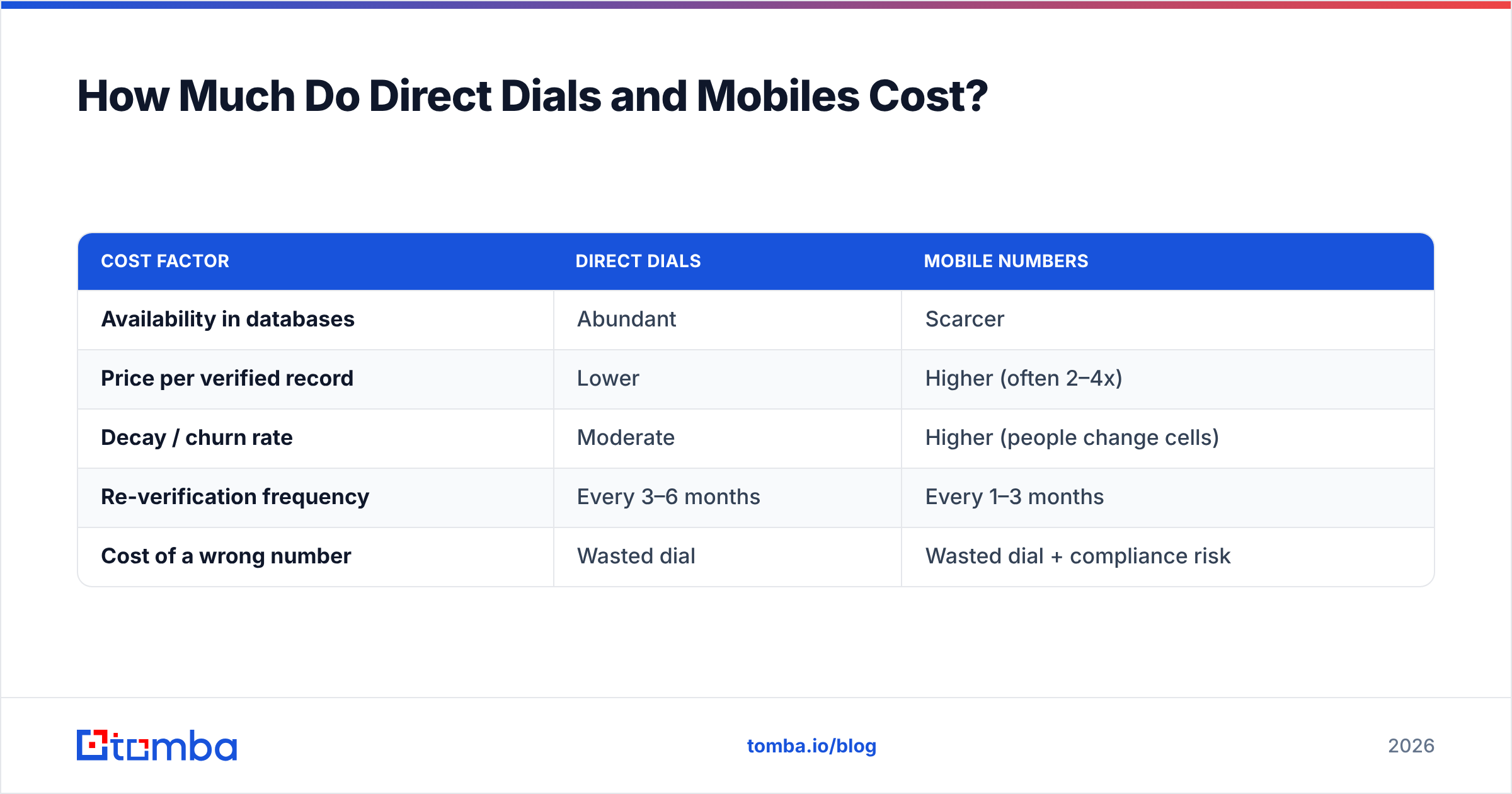
The economics tilt toward direct dials on price and toward mobiles on value.
| Cost factor | Direct Dials | Mobile Numbers |
|---|---|---|
| Availability in databases | Abundant | Scarcer |
| Price per verified record | Lower | Higher (often 2–4x) |
| Decay / churn rate | Moderate | Higher (people change cells) |
| Re-verification frequency | Every 3–6 months | Every 1–3 months |
| Cost of a wrong number | Wasted dial | Wasted dial + compliance risk |
Mobiles cost more because verified, opt-in-clean cell data is genuinely harder to compile and it decays faster. A direct dial tied to a company DID system stays stable for years. A personal mobile can change with a job switch or a carrier port.
That decay rate is why buying a giant static list of either number type ages badly. Fresh sourcing and regular re-verification beat a one-time bulk purchase. For teams comparing vendors on data quality and price, it's worth reviewing Tomba pricing against pure phone-data providers — because in most cases you also need the matching email and company context, not just a raw number.
Direct Dials vs Mobile Numbers vs Main Line: Full Comparison#
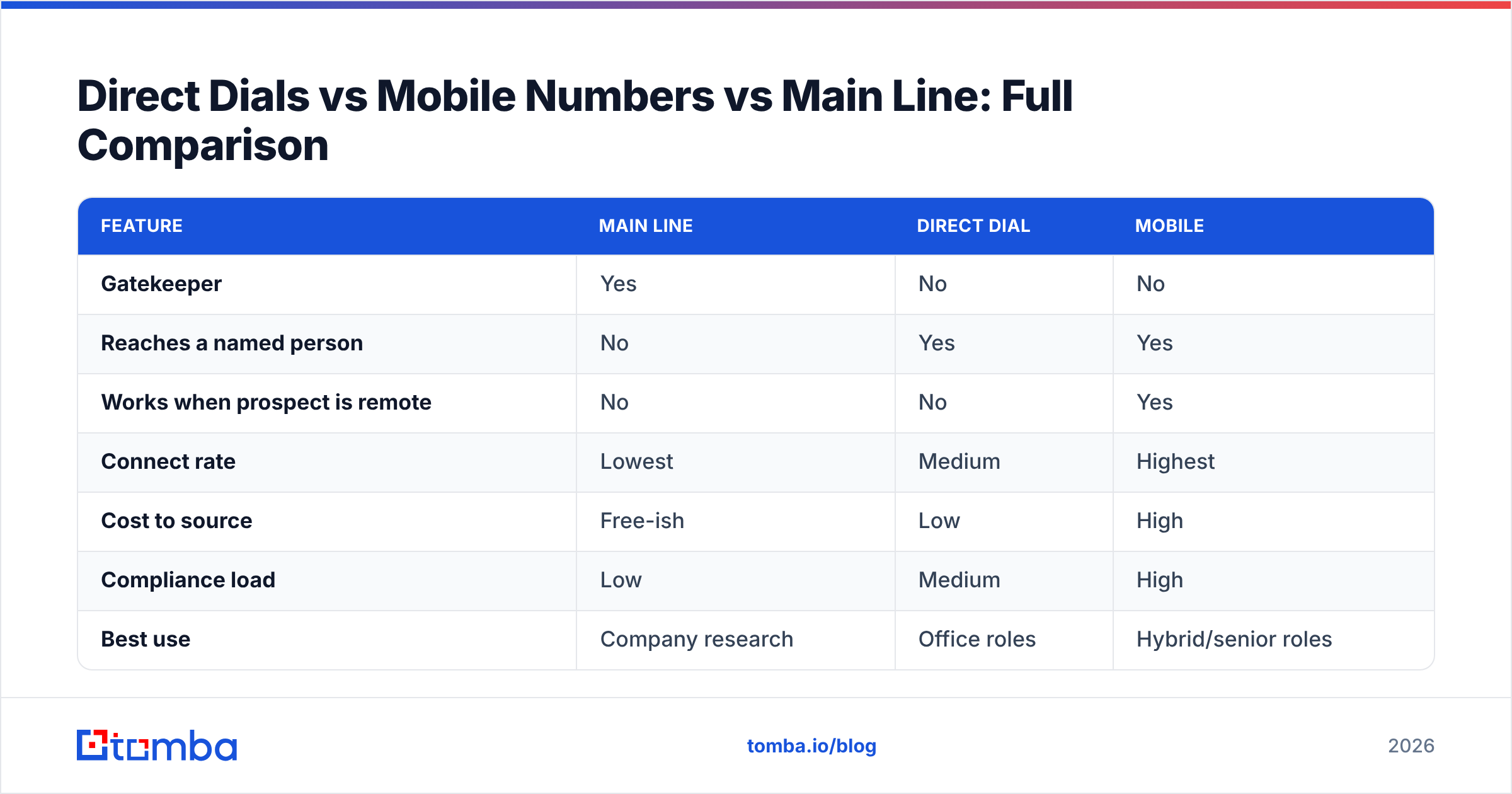
To put all three routing options side by side:
| Feature | Main Line | Direct Dial | Mobile |
|---|---|---|---|
| Gatekeeper | Yes | No | No |
| Reaches a named person | No | Yes | Yes |
| Works when prospect is remote | No | No | Yes |
| Connect rate | Lowest | Medium | Highest |
| Cost to source | Free-ish | Low | High |
| Compliance load | Low | Medium | High |
| Best use | Company research | Office roles | Hybrid/senior roles |
The main line is really only useful for verifying a company exists and occasionally charming a receptionist into a transfer. The serious debate is direct dials vs mobile numbers — and for most 2026 outbound teams, a mobile-first, direct-dial-backup sequence wins.
How Do You Source Accurate Direct Dials and Mobiles?#
The number is only as good as its source and its freshness. A cheap list full of disconnected lines costs more in wasted rep time than a smaller set of verified numbers.
A practical sourcing stack looks like this:
- Find the person first. Confirm the right contact and company before chasing a phone number. Start from a verified work email via an email finder, then enrich outward.
- Enrich for phone. Attach direct dial and mobile numbers to the confirmed contact using a phone finder rather than guessing formats.
- Verify before dialing. Run every number through validation to strip disconnected, reassigned, and invalid lines.
- Re-verify on a cadence. Mobiles monthly, direct dials quarterly — decay is the silent connect-rate killer.
- Sync to your dialer and CRM so reps always call from the freshest record, not a stale export.
This is where combining channels pays off. A phone number without the matching email leaves you one-dimensional; an email without a phone limits your touchpoints. Enriching a contact with verified email and phone lets reps run a coordinated multi-channel play instead of hammering a single dead line. Tomba's data enrichment fills both sides of the record from a single lookup, so your direct-dial-vs-mobile decision is based on real, verified options rather than whatever a broker happened to sell you.
So, Which Should You Prioritize in 2026?#
Lead with mobile, keep direct dial as a smart fallback, and verify everything.
For most B2B teams selling to hybrid, senior, or field-based buyers, mobiles produce more live conversations per hour, and live conversations are the only phone metric that pays. Reserve direct dials for office-bound and regulated roles where a desk line is both reliable and expected. Treat the main line as research, not outreach.
Whatever mix you choose, the deciding factor is data quality. The fastest way to tank a calling program is to feed it stale, unverified numbers — you'll blame the script, the timing, or the market when the real problem was the digits. Verify first, dial second.
Get Verified Numbers That Actually Connect#
Stop guessing which number to call. Start from a confirmed contact and let the data tell you whether the direct dial or the mobile is the better bet. Tomba's Email Finder gives you the verified professional identity to build on — then enrich outward to direct dials and mobiles, validate every line, and sync clean records straight into your dialer. Try the free tier (25 searches a month), and only pay for the volume once your reps are booking real conversations instead of ringing empty desks.
Related guides#
Ready to find emails that actually work?
Join 150,000+ professionals who stopped guessing and started sending. Free credits on signup — no credit card required.
Get the Tomba newsletter
Practical outbound tactics and product updates — once every two weeks.
About the author