Direct Mail for Lead Generation in 2026: A Complete Playbook
Direct mail isn't dead — for B2B lead generation it's quietly outperforming crowded inboxes. Here's when it works, what it really costs, and how to feed it clean data.
Direct mail keeps getting written off, and it keeps refusing to die. While every SDR on the planet fights for attention in the same inbox, the physical mailbox has quietly become one of the least crowded channels in B2B. If you run the numbers, direct mail for lead generation is not a nostalgia play — it's a targeting and deliverability arbitrage that still works in 2026.
This guide is a practical playbook: what direct mail is good for now, how it stacks up against email and paid ads, what it actually costs per lead, and how to feed it accurate data so you're not printing postcards for people who left the company two years ago.
TL;DR: Is direct mail still worth it in 2026?#
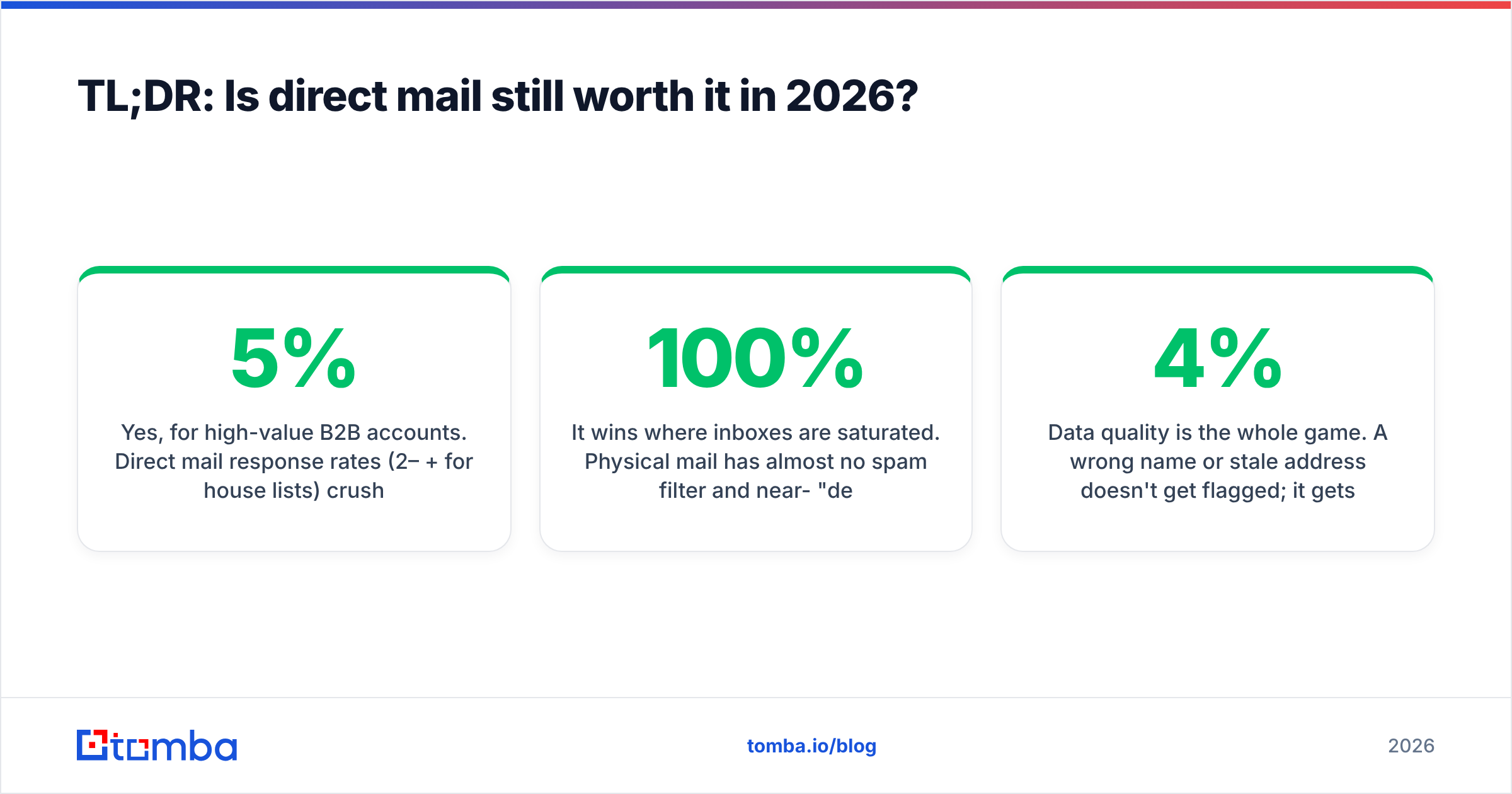
- Yes, for high-value B2B accounts. Direct mail response rates (2–5%+ for house lists) crush the sub-1% you see from cold email, but the cost per touch is far higher, so it only pencils out when deal sizes are large.
- It wins where inboxes are saturated. Physical mail has almost no spam filter and near-100% "deliverability" — the constraint is data accuracy, not algorithms.
- Data quality is the whole game. A wrong name or stale address doesn't get flagged; it gets thrown out. Clean, enriched contact data is the difference between 4% and 0.4% response.
- It's best as one lane in a multichannel play. Mail plus a coordinated email and LinkedIn sequence beats any single channel run alone.
- Track it like digital. Personalized URLs, QR codes, and unique promo codes make direct mail as measurable as a paid campaign.
What is direct mail for lead generation?#
Direct mail for lead generation is the practice of sending physical mail — postcards, letters, dimensional packages, or gifts — to a targeted list of prospects to start or advance a sales conversation. Think of it like a cold email you can hold: same goal (get a reply, book a meeting), different delivery truck.
The key difference is friction, in both directions. It costs more and takes longer to send a letter than to blast an email, which naturally forces you to be selective. That selectivity is a feature, not a bug. When each touch costs a few dollars instead of a fraction of a cent, you stop spraying and start choosing accounts that actually deserve a personalized approach.
Modern direct mail also isn't the "batch and blast" postal junk of the 2000s. It's triggered, personalized, and integrated with your CRM. A prospect books a demo, and a handwritten thank-you note goes out automatically. A target account goes dark, and a dimensional mailer nudges them back. The channel is old; the orchestration is new.
Here are the formats you'll actually choose between:
- Postcards — Cheapest and fastest. Best for volume plays, event invites, and simple offers where the whole message fits on one side.
- Letters — Higher perceived value, room for a real pitch. The workhorse of B2B financial, insurance, and enterprise outreach.
- Dimensional mailers — Boxes and lumpy packages that beg to be opened. Highest response, highest cost; reserve for named target accounts.
- Gifting / swag — Coffee, books, branded gear tied to a call-to-action. Strong for booking meetings with senior buyers.
- Handwritten notes — Robotic-handwriting services make these scalable. Excellent for post-demo follow-up and renewals.
- Programmatic direct mail — API-triggered mail from CRM events, so a postcard fires the same way an email would in a sequence.
How does direct mail compare to email and paid ads?#
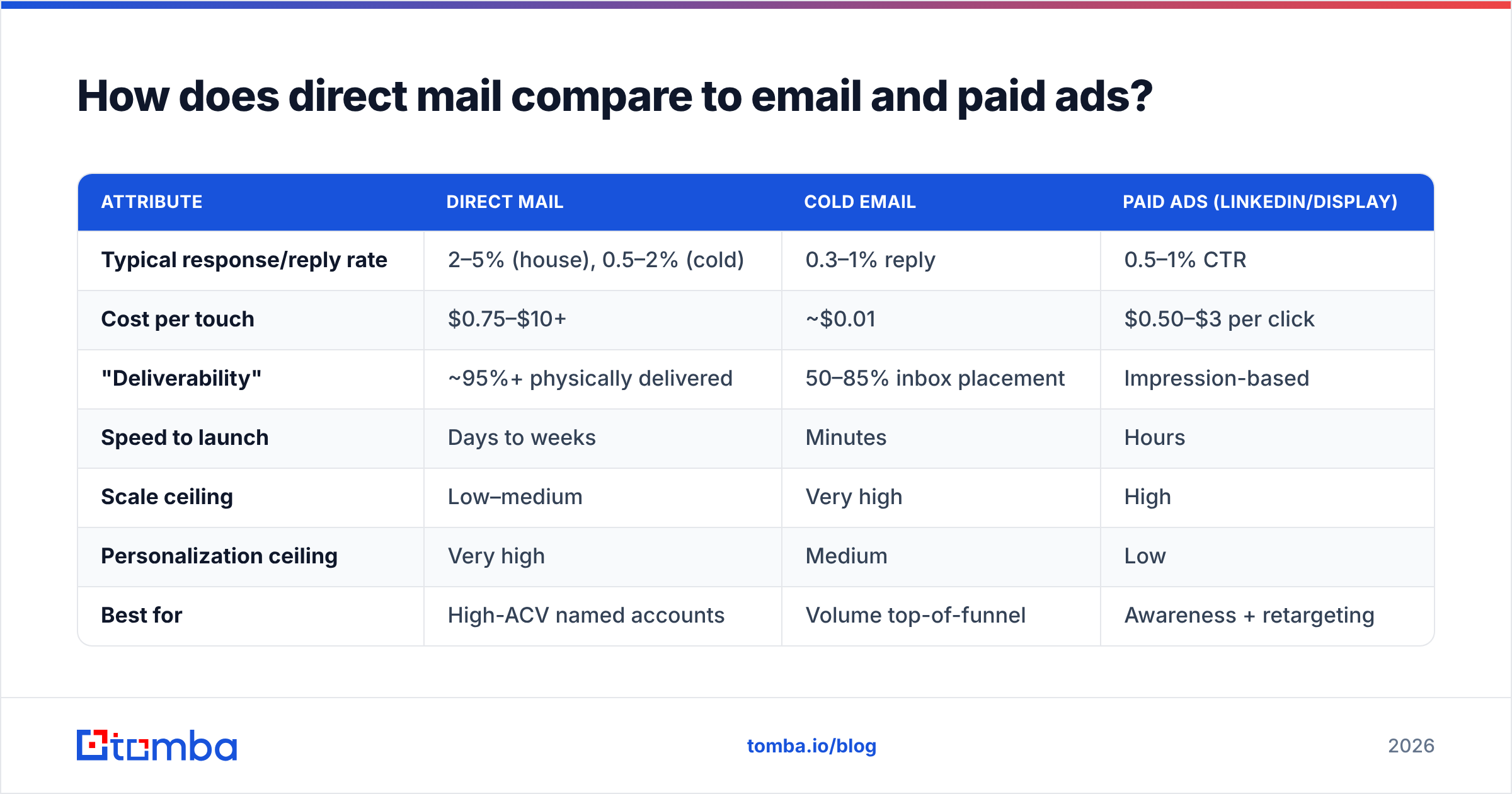
The honest answer: no single channel wins on every axis. Direct mail trades cost and speed for attention and deliverability. Email trades attention for scale and near-zero marginal cost. Paid ads trade intent for reach.
| Attribute | Direct Mail | Cold Email | Paid Ads (LinkedIn/Display) |
|---|---|---|---|
| Typical response/reply rate | 2–5% (house), 0.5–2% (cold) | 0.3–1% reply | 0.5–1% CTR |
| Cost per touch | $0.75–$10+ | ~$0.01 | $0.50–$3 per click |
| "Deliverability" | ~95%+ physically delivered | 50–85% inbox placement | Impression-based |
| Speed to launch | Days to weeks | Minutes | Hours |
| Scale ceiling | Low–medium | Very high | High |
| Personalization ceiling | Very high | Medium | Low |
| Best for | High-ACV named accounts | Volume top-of-funnel | Awareness + retargeting |
Read that table as a portfolio, not a leaderboard. If you sell a $2,000 annual tool, direct mail's cost per touch will bury you — stick to email and ads. If you sell a $60,000 platform to 300 named accounts, spending $8 to land on the right VP's desk is trivial, and the response rate advantage compounds fast.
The channels also reinforce each other. A prospect who receives a postcard and then sees your name in their inbox and on LinkedIn experiences three impressions that feel coordinated rather than three isolated interruptions. According to research long cited by direct marketers via the Data & Marketing Association, response rates rise meaningfully when mail is paired with a digital follow-up rather than run in isolation.
Why does data quality decide direct mail ROI?#
Direct mail has one brutal characteristic email doesn't: there's no bounce message. Send an email to a dead address and you get a hard bounce you can suppress. Send a letter to the wrong person or a stale address, and it silently disappears into a recycling bin. You paid full freight for a touch that never happened, and nothing told you.
That makes data accuracy the single biggest lever on your cost per lead. If 30% of your list is wrong — wrong name, wrong title, someone who left the company — you've inflated your real cost per delivered piece by more than 40% before a single prospect reads a word.
So the workflow that matters happens before anything gets printed:
- Confirm the person still works there. Titles and tenure change constantly. Verify the contact against current data, not a list you bought 18 months ago.
- Get the name and title exactly right. "Dear Head of Marketing" is a tell that you're mass-mailing. The correct name and role is table stakes for the personalized formats that justify the cost.
- Enrich for the mail merge fields you'll personalize. Company, role, and firmographics power the variable copy that lifts response.
- Deduplicate. Two pieces to the same person waste money and read as sloppy.
This is where a solid data layer pays for itself. Using an email finder and data enrichment to confirm who's actually in the seat — and to append the email you'll use for the digital half of the campaign — keeps your printed list tight. And because you'll almost always run mail alongside email, running the same contacts through an email verifier before launch means both lanes fire at the same clean audience. You can even pull entire company rosters with domain search to build account-based mailing lists from scratch.
How do you build a direct mail campaign that converts?#
A direct mail campaign is a system with five moving parts. Get all five right and you have a repeatable channel; miss one and response collapses.
1. Define the segment narrowly. Direct mail rewards precision. Pick a tight ICP — one industry, one role band, one trigger (funding round, new hire, tech-stack signal). A list of 400 perfectly-fit accounts beats 4,000 loose ones almost every time, because your per-piece budget goes further and your copy can be specific.
2. Match the format to the account value. Use the cost of the format as a filter. Postcards for a broad tier, letters for mid-tier, dimensional mailers and gifts for your named top accounts. Never send a $12 box to a $500 deal.
3. Write for the mailbox, not the inbox. You have about three seconds during the walk from the mailbox to the recycling bin. Lead with the offer or a pattern-interrupt, keep copy short, and make the call-to-action a single, low-friction next step. Personalize with real merged data — name, company, a relevant trigger.
4. Make it measurable. Every piece should carry a tracking mechanism: a personalized URL (yourname.com/acme), a unique QR code, or a promo code. Without this, direct mail becomes the one channel you can't attribute — and the first one cut at budget time.
5. Coordinate the follow-up. Mail is the opener, not the whole play. Sequence an email a few days after estimated delivery, then a LinkedIn touch, then an SDR call referencing the mailer ("Did the package arrive?"). The physical piece gives every subsequent touch a reason to exist.
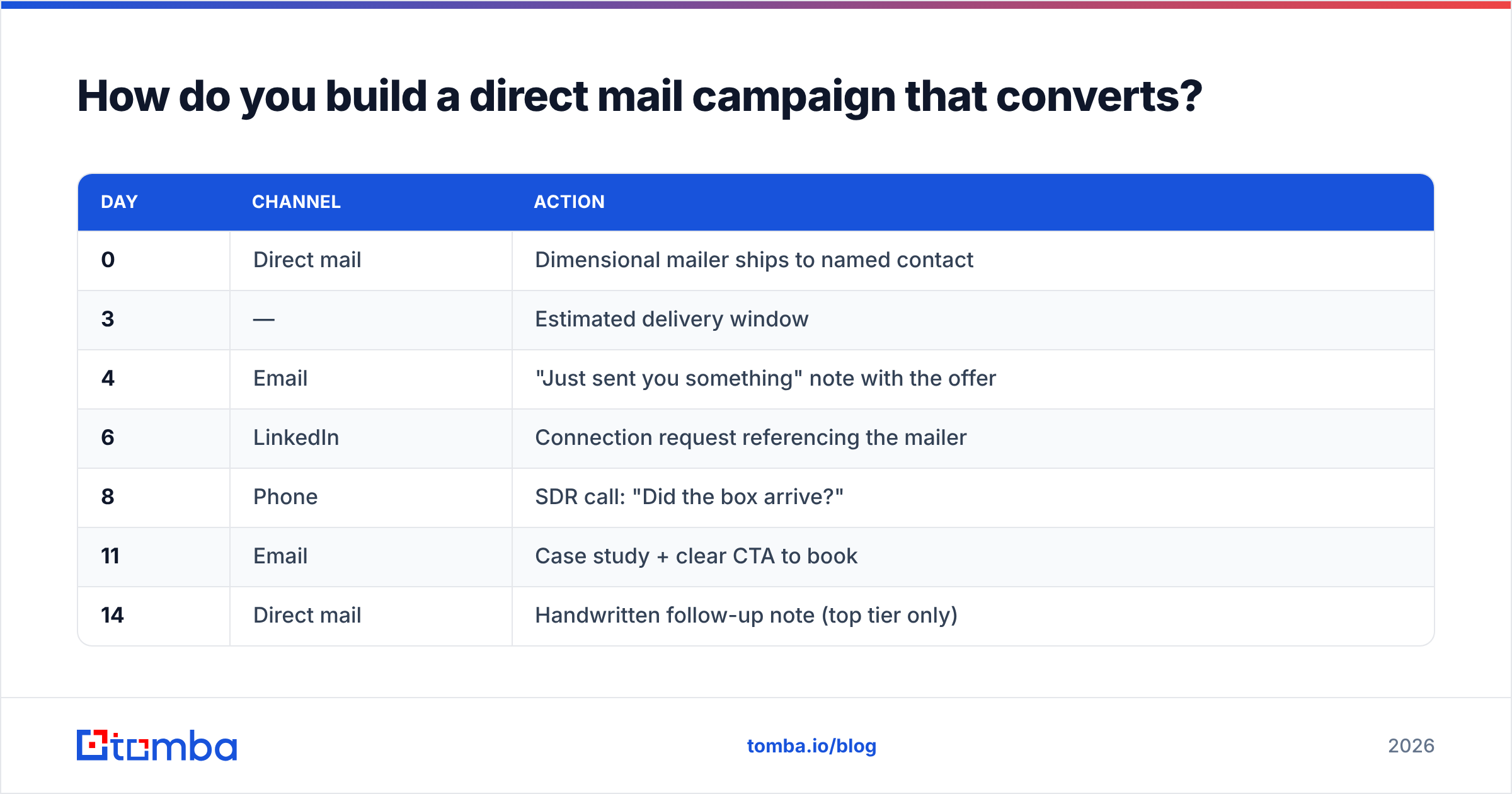
Here's how a typical B2B mail-led sequence lays out across two weeks:
| Day | Channel | Action |
|---|---|---|
| 0 | Direct mail | Dimensional mailer ships to named contact |
| 3 | — | Estimated delivery window |
| 4 | "Just sent you something" note with the offer | |
| 6 | Connection request referencing the mailer | |
| 8 | Phone | SDR call: "Did the box arrive?" |
| 11 | Case study + clear CTA to book | |
| 14 | Direct mail | Handwritten follow-up note (top tier only) |
What does direct mail cost per lead in 2026?#
Costs vary widely by format, but you can model them cleanly. The formula is simple: cost per lead = (pieces × cost per piece) ÷ (pieces × delivery rate × response rate × qualification rate).
Work a realistic example. Say you mail 1,000 letters at $1.50 all-in (print, postage, list). That's $1,500. At a 95% delivery rate and a 2% response, you get roughly 19 responders. If 60% are qualified, that's about 11 leads — a cost per lead near $135. For a product with a $30,000 ACV and a 25% close rate, each lead is worth thousands in pipeline. The math works.
Now run the same 1,000 pieces as $8 dimensional mailers to a tighter, better-fit list. Cost jumps to $8,000, but response climbs to 6% and qualification to 75%. That's about 43 qualified leads at roughly $186 each — more expensive per lead, but aimed at your highest-value accounts where a single close pays for the entire campaign many times over.
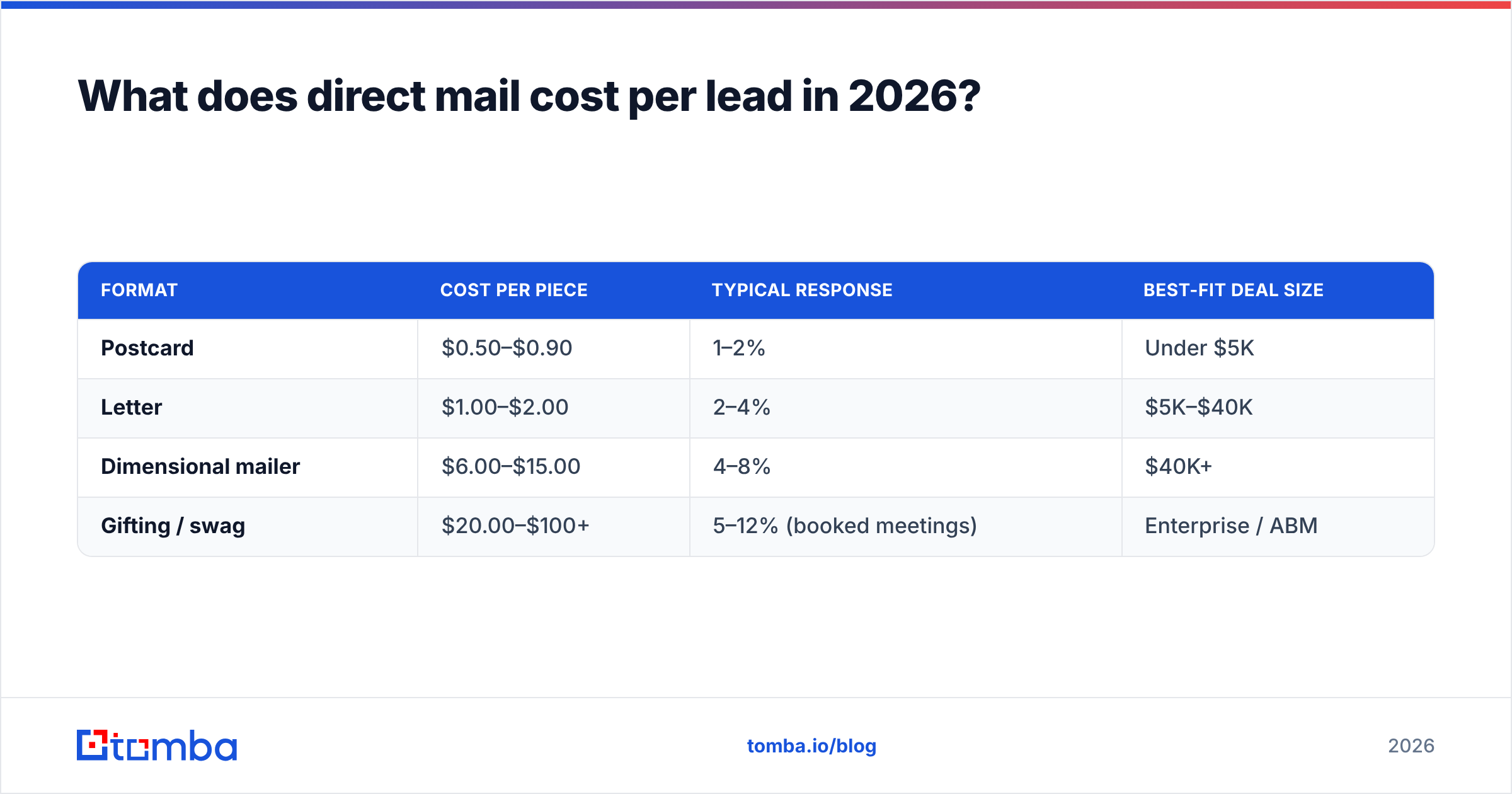
| Format | Cost per piece | Typical response | Best-fit deal size |
|---|---|---|---|
| Postcard | $0.50–$0.90 | 1–2% | Under $5K |
| Letter | $1.00–$2.00 | 2–4% | $5K–$40K |
| Dimensional mailer | $6.00–$15.00 | 4–8% | $40K+ |
| Gifting / swag | $20.00–$100+ | 5–12% (booked meetings) | Enterprise / ABM |
The takeaway: direct mail's cost per lead is high in absolute terms and only sensible when your average deal is large enough to absorb it. This is the opposite of email, where the marginal cost is near zero and the constraint is deliverability and reply rate. That's exactly why the two belong together — email carries the volume, mail carries the accounts that deserve a heavier touch.
When should you NOT use direct mail?#
Skip direct mail — or heavily limit it — in these cases:
- Low deal value. If your ACV is under a few thousand dollars, the cost per lead almost never clears. Lead with email and cold outreach instead.
- You lack accurate addresses or contacts. Without verified, current data, you're lighting money on fire. Fix the data problem before you print anything.
- You need speed or rapid iteration. Mail has a multi-day production and delivery cycle. For fast A/B testing, digital channels win.
- Your buyer is fully remote with no reliable mailing address. Post-2020, plenty of B2B buyers work from home addresses you don't have. If you can't reach the desk, the channel breaks down.
In those situations, put your budget into verified email and multichannel digital sequences, and reserve mail for the slice of your list where the economics genuinely favor it.
How do you keep a direct mail list clean over time?#
Lists decay fast — B2B contact data goes stale at roughly 25–30% per year as people change jobs. A pristine list you built in January is meaningfully wrong by December. Treat list hygiene as an ongoing process, not a one-time cleanup.
Build a simple maintenance loop: re-verify contacts quarterly, re-enrich when firmographics change, and suppress anyone who's moved on. Pulling fresh rosters via domain search and appending current details through contact enrichment keeps your ABM lists aligned with reality. For teams running this at scale, the Tomba API can wire verification and enrichment directly into your CRM so lists refresh automatically instead of rotting between campaigns. You can compare tiers and volume on the Tomba pricing page to size the plan to your mailing cadence.
The tools you use for digital prospecting are the same ones that keep a mail list accurate — because at bottom, both channels depend on knowing exactly who your buyer is and how to reach them. Platforms like G2 list dozens of data providers, but the practical test is simple: does the tool tell you who's really in the seat today?
The bottom line: mail is a scalpel, not a firehose#
Direct mail for lead generation isn't a replacement for digital outreach and it never was. It's a scalpel — expensive per cut, but precise where precision pays. Use it on the accounts that justify a personalized, physical touch; use email and ads for everything else; and coordinate all three so each touch makes the next one stronger.
And whichever channel does the sending, the foundation is the same: accurate, current contact data. Bad data quietly kills mail campaigns because there's no bounce to warn you. Start by verifying and enriching your list, then match format to account value, then measure everything.
Ready to build a mailing list that doesn't waste postage? Start with the Tomba Email Finder to confirm exactly who's in the seat, enrich each record with the firmographics your mail-merge needs, and feed both your postal and digital campaigns from one clean, verified source. Tomba's free tier gives you 25 searches a month to test the workflow before you commit a single dollar to print.
Related guides#
Ready to find emails that actually work?
Join 150,000+ professionals who stopped guessing and started sending. Free credits on signup — no credit card required.
Get the Tomba newsletter
Practical outbound tactics and product updates — once every two weeks.
About the author