Direct Mail Prospecting in 2026: A Complete B2B Playbook
Direct mail prospecting is quietly outperforming crowded inboxes in 2026. Here's how to build target lists, control cost-per-lead, and blend physical mail with email and phone for warm B2B replies.
Direct mail prospecting sounds like a throwback in a world of automated sequences and AI SDRs. It isn't. In 2026, a well-targeted physical piece lands on a desk while your competitors' cold emails fight for attention in a spam-filtered inbox. This guide covers what actually works, what it costs, and how to run mail as one channel inside a modern outbound motion — not as a nostalgic gamble.
TL;DR#
- Direct mail prospecting still converts because inboxes are saturated and physical mail is scarce; average B2B response rates run 2–5x cold email when the list is tight.
- Data is the whole game. A beautiful mailer sent to a stale address is money set on fire. Verified contact and company data decides your ROI before design ever matters.
- It is a premium, low-volume channel. Expect $1–$15+ per piece, so reserve it for high-value accounts, not spray-and-pray blasts.
- Multichannel beats mail-only. Pairing a mailer with email and a phone touch lifts reply rates far more than any single channel alone.
- Track it like digital. Personalized URLs, QR codes, and unique promo codes let you measure direct mail with the same rigor you apply to email.
What is direct mail prospecting?#
Direct mail prospecting is outbound sales outreach delivered as a physical item — a letter, postcard, dimensional package, or handwritten note — sent to a targeted prospect to start a conversation. Think of it like showing up to a networking event in a sharp jacket while everyone else emails from home in pajamas. The medium itself signals effort, and effort earns attention.
Unlike bulk consumer "junk mail," B2B direct mail prospecting is deliberately low-volume and high-intent. You are not carpet-bombing a zip code. You are hand-picking 50, 200, or 1,000 named decision-makers at accounts that fit your ideal customer profile, then giving each one a reason to reply.
The channel breaks into a few common formats:
- Postcards — cheapest, fastest, best for a single sharp offer or event invite.
- Letters — a personalized note in an envelope; higher open intent, still affordable.
- Dimensional mail — a box or bulky package that cannot be ignored; expensive but high-impact for enterprise accounts.
- Handwritten notes — real or robotic-handwriting; excellent for follow-up after a meeting or demo.
- Gifting — a coffee voucher, book, or branded item tied to a clear call to action.
Does direct mail still work in 2026?#
Yes — and the reason is scarcity. According to HubSpot, the average professional is buried under dozens of cold emails a day, while their physical mailbox holds almost nothing personal. When a channel gets crowded, the uncrowded one wins attention. Direct mail is now the contrarian move.
The United States Postal Service and multiple B2B marketing studies consistently report that direct mail earns higher recall and response than email when the targeting is tight. That last clause matters. Direct mail does not work as a volume play. It works as a precision play. The moment you loosen your list and mail everyone, your cost-per-reply collapses and the channel looks "dead" — when really your data was the problem.
A useful mental model: email is a slot machine you pull thousands of times for cheap; direct mail is a single well-aimed dart. You would never throw darts blindfolded, and you should never mail a list you have not verified.
How does direct mail prospecting compare to email and cold calling?#
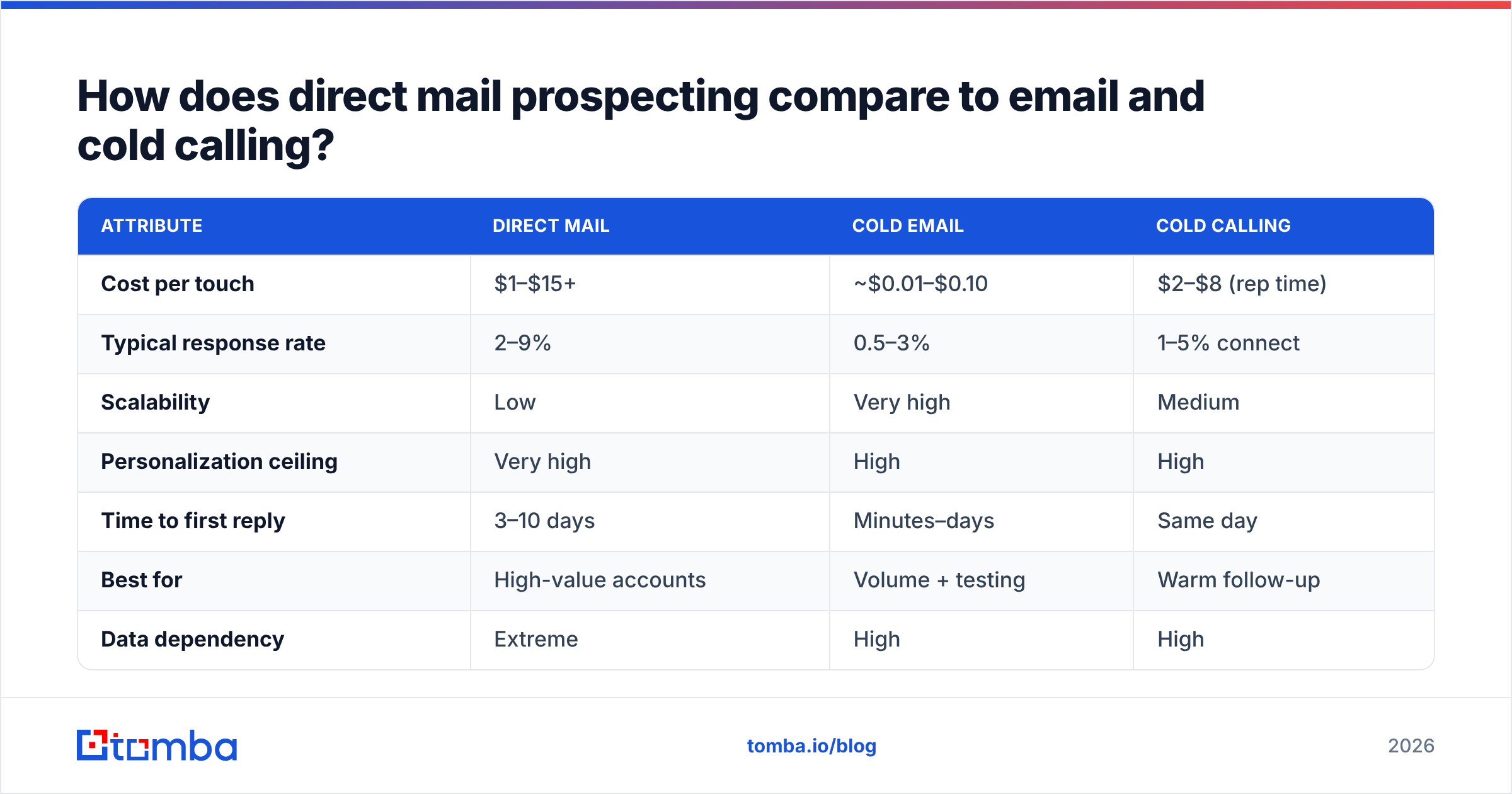
Each outbound channel trades cost against attention. Direct mail buys attention at a higher price; email buys volume at a lower one; the phone buys real-time conversation. The winning teams do not pick one — they sequence them.
| Attribute | Direct Mail | Cold Email | Cold Calling |
|---|---|---|---|
| Cost per touch | $1–$15+ | ~$0.01–$0.10 | $2–$8 (rep time) |
| Typical response rate | 2–9% | 0.5–3% | 1–5% connect |
| Scalability | Low | Very high | Medium |
| Personalization ceiling | Very high | High | High |
| Time to first reply | 3–10 days | Minutes–days | Same day |
| Best for | High-value accounts | Volume + testing | Warm follow-up |
| Data dependency | Extreme | High | High |
The pattern is clear: direct mail is your premium tier. You would not mail 10,000 unqualified names any more than you would have your best AE dial them one by one. Reserve physical mail for accounts where a closed deal is worth thousands, and let email carry the top-of-funnel volume. For a deeper look at building the email side of this motion, our guide to the Tomba Email Finder walks through sourcing verified addresses at scale.
What makes a direct mail campaign succeed or fail?#
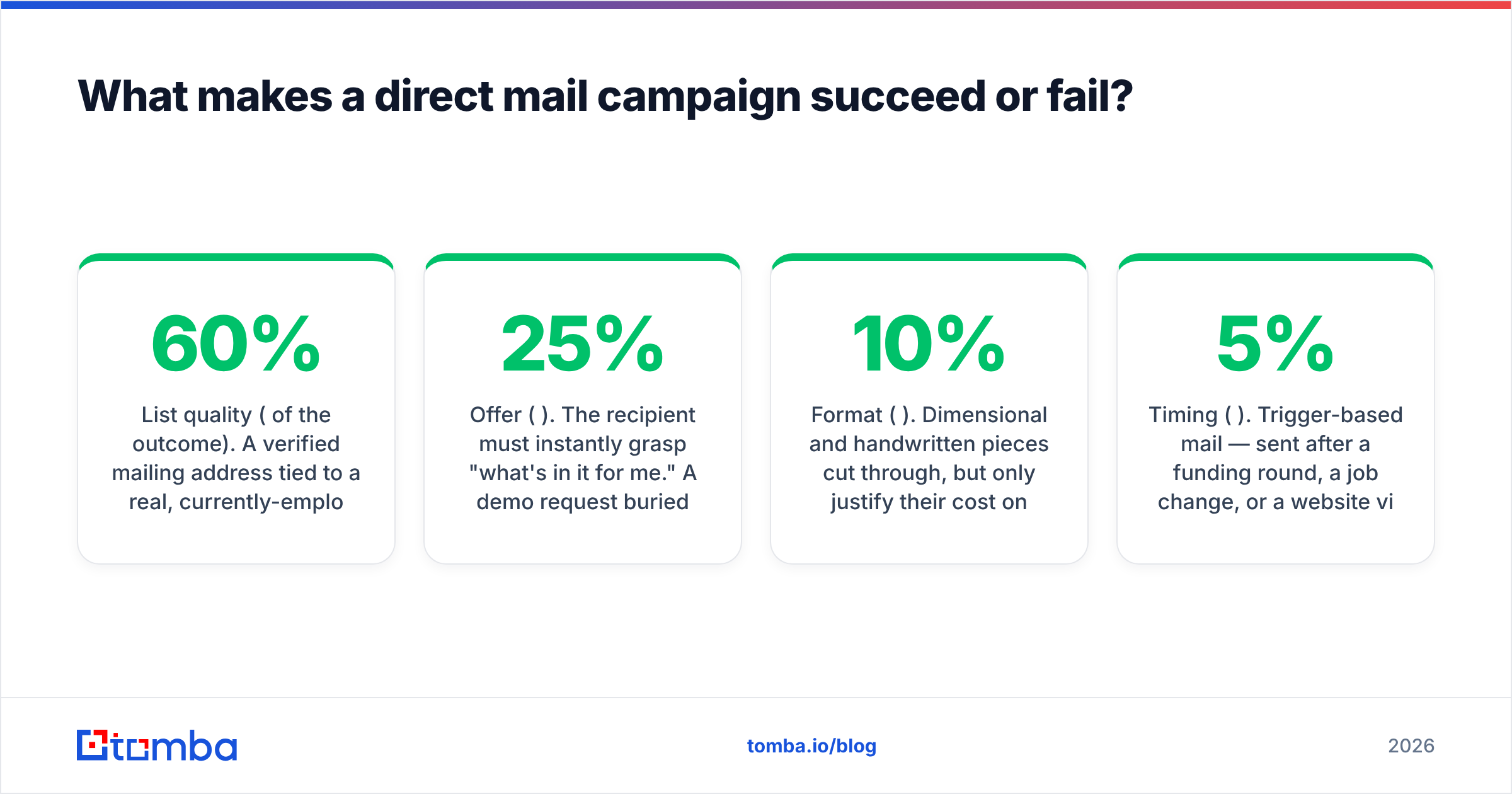
Direct mail lives or dies on four levers, in order of importance: list, offer, format, timing. Most failed campaigns blame the creative when the real culprit was the list.
- List quality (60% of the outcome). A verified mailing address tied to a real, currently-employed decision-maker is the foundation. Bad data means returned mail, wrong names, and wasted spend. Contact data enrichment that appends verified titles, company details, and mailing addresses is what separates a 6% response rate from a 0.8% one.
- Offer (25%). The recipient must instantly grasp "what's in it for me." A demo request buried in a paragraph loses to a bold, single call to action — a free audit, an exclusive event seat, a gift they unlock by booking a call.
- Format (10%). Dimensional and handwritten pieces cut through, but only justify their cost on high-value accounts. Match the format to the deal size.
- Timing (5%). Trigger-based mail — sent after a funding round, a job change, or a website visit — outperforms calendar-based blasts.
Notice that creative design isn't even on this list until format. Marketers love to obsess over the postcard's color palette. Prospects care whether the piece is relevant and whether the offer is worth their time.
How do you build a target list for direct mail prospecting?#
Start narrow and verify everything. A direct mail list is not an email list with addresses bolted on — the accuracy bar is higher because every wasted piece costs real money, not fractions of a cent.
A repeatable workflow looks like this:
- Define the ICP tightly. Industry, company size, region, and the exact job titles who sign off on your product. For a $30k deal, mailing 150 perfect-fit accounts beats mailing 3,000 loose ones.
- Source the accounts. Pull target companies from your CRM, a B2B database, or intent signals showing accounts in-market now.
- Find the decision-makers. Identify named contacts, not "Head of Marketing" placeholders. Personalized mail addressed to a real person gets opened; "To whom it may concern" gets recycled.
- Enrich and verify. Append the mailing address, confirm the person still holds the role, and validate the data before printing. Job changes are the silent killer of direct mail ROI.
- Layer a digital touchpoint. Capture each prospect's work email and, where relevant, a B2B phone number so you can follow the mailer with email and a call.
- Suppress and dedupe. Remove existing customers, active opportunities, and duplicates so you don't mail the same account three times.
The teams that win at direct mail treat the list-build as the campaign. If your data is 70% accurate, three of every ten pieces are pre-doomed before design begins. That is why enrichment and verification, not paper stock, determine your return.
How much does direct mail prospecting cost — and what's the ROI?#
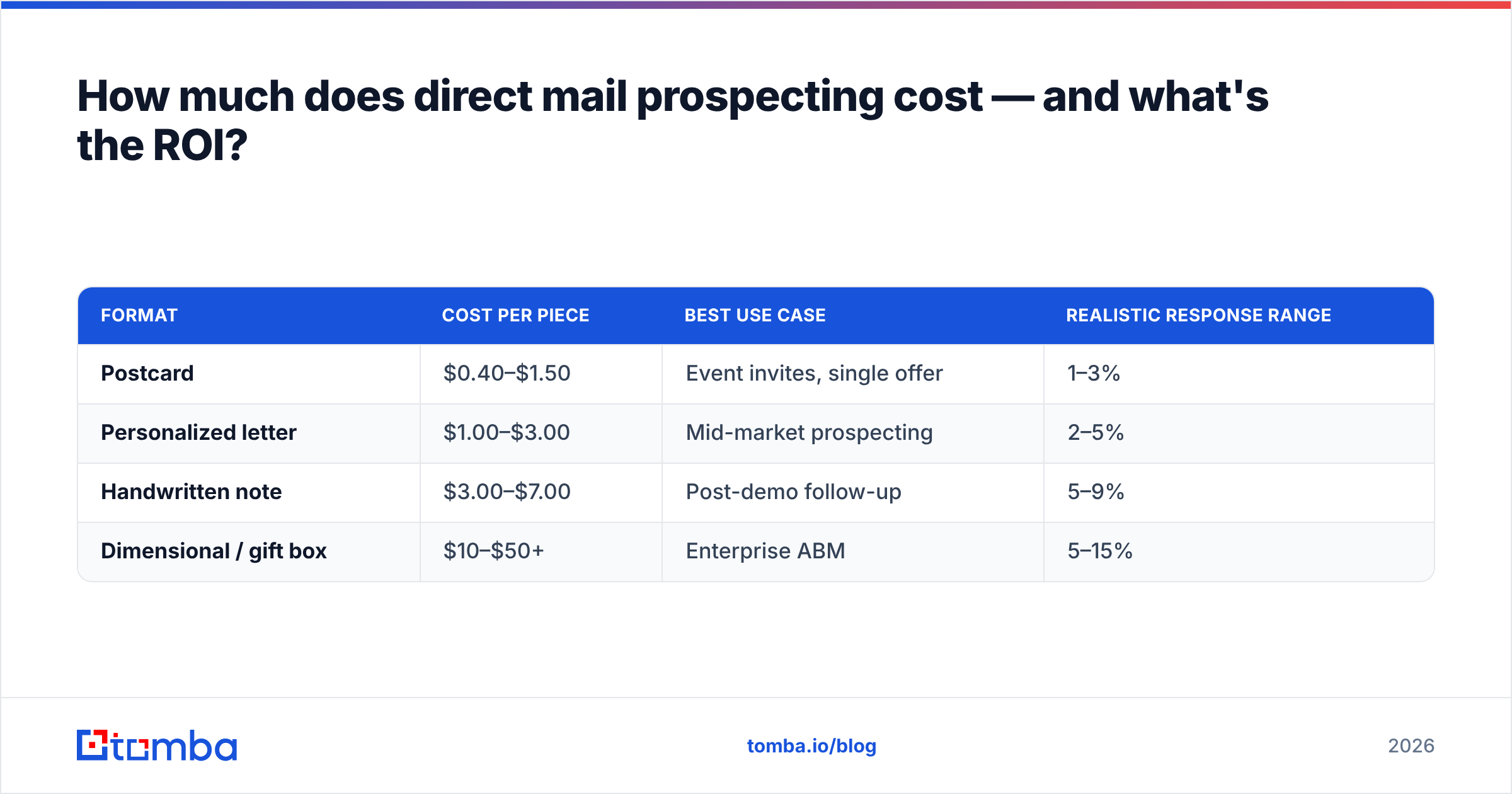
Budget by cost-per-acquisition, not cost-per-piece. A $12 dimensional mailer that books a $40,000 deal is dramatically cheaper than a $0.40 postcard that converts no one. Direct mail looks expensive per unit and cheap per outcome — the exact inverse of how it feels.
| Format | Cost per piece | Best use case | Realistic response range |
|---|---|---|---|
| Postcard | $0.40–$1.50 | Event invites, single offer | 1–3% |
| Personalized letter | $1.00–$3.00 | Mid-market prospecting | 2–5% |
| Handwritten note | $3.00–$7.00 | Post-demo follow-up | 5–9% |
| Dimensional / gift box | $10–$50+ | Enterprise ABM | 5–15% |
To model ROI, work backward: take your average deal value, multiply by close rate from a booked meeting, and compare against total campaign cost including data, printing, and postage. As a rule of thumb, direct mail pencils out when your average contract value clears roughly $5,000 — below that, email and phone usually carry a better cost structure. You can pair mail spend against your other channels using standard Tomba pricing tiers to keep the digital side of the sequence lean.
How do you measure and track direct mail?#
Treat physical mail like a landing page. The old objection — "you can't measure direct mail" — is obsolete. Every piece can carry a trackable trigger:
- Personalized URLs (PURLs) — a unique landing page per recipient, e.g.
yoursite.com/john-at-acme. - QR codes — scannable, and modern phones make them frictionless.
- Unique promo or reference codes — tie a redemption directly to a mailed contact.
- Dedicated phone numbers — call-tracking numbers per campaign or segment.
- CRM offer tokens — log which account received which piece, then attribute pipeline.
Wire these into your CRM so a scan or visit creates a task for the rep within minutes. Speed-to-lead applies to mail too: a prospect who scans your QR code is raising their hand right now.
How do you combine direct mail with email and phone?#
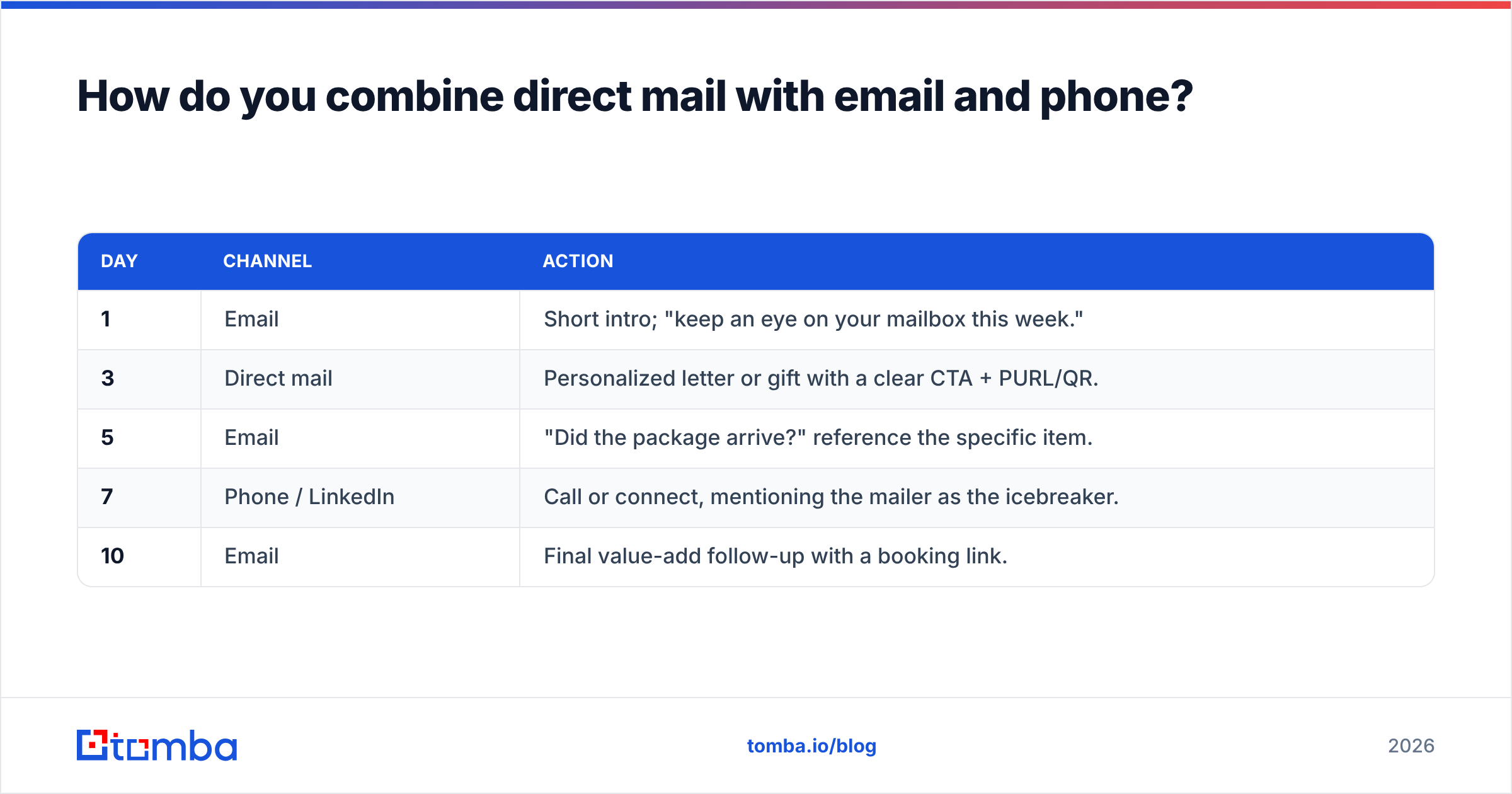
Sequence the channels so each one warms the next. A mailer alone is a single touch; a mailer that a prospect expects — because your email told them to watch for it — becomes a conversation. This is where direct mail stops being a gamble and becomes a system.
A proven multichannel play:
| Day | Channel | Action |
|---|---|---|
| 1 | Short intro; "keep an eye on your mailbox this week." | |
| 3 | Direct mail | Personalized letter or gift with a clear CTA + PURL/QR. |
| 5 | "Did the package arrive?" reference the specific item. | |
| 7 | Phone / LinkedIn | Call or connect, mentioning the mailer as the icebreaker. |
| 10 | Final value-add follow-up with a booking link. |
The mailer gives every other touch a reason to exist. Your call is no longer cold — you are "the one who sent the box." Your follow-up email is not ignored — it references a real object on their desk. To run this at scale you need clean, verified contact data feeding all three channels at once, which is exactly the gap enrichment tools fill. Reviews on G2 consistently show that reps rate multichannel sequences well above any single-channel approach for reply rate.
Common direct mail prospecting mistakes to avoid#
- Mailing an unverified list. The single most expensive error. Verify addresses and confirm roles before printing.
- No clear call to action. "Learn more about our solutions" is not a CTA. "Book your 20-minute audit by Friday" is.
- Treating it as a standalone channel. Mail without email and phone follow-up wastes most of its potential.
- Skipping tracking. No PURL, no QR, no code means no attribution and no way to prove ROI.
- Over-scaling. Direct mail is a scalpel. The moment you use it like a firehose, unit economics break.
- Generic personalization. A mail-merged first name isn't personalization. Reference the account's context, industry, or a recent trigger event.
Is direct mail prospecting right for your team?#
Direct mail earns its place when three things are true: your average deal value is high, your target account list is finite and well-defined, and your data is accurate enough to trust. If you sell a $99/month self-serve product to a broad market, email and product-led motions will out-earn mail every time. If you sell a five-figure solution to a few hundred named accounts, direct mail can be the sharpest tool in your outbound kit.
The deciding factor, again, is data. Physical mail punishes bad data more harshly than any digital channel because each mistake has a hard cost. Get the list right and the channel rewards you; get it wrong and it drains budget fast.
Start with the data that makes mail work#
Every high-performing direct mail campaign starts the same way: with verified, enriched contact data for the exact people you want to reach. Before you spend a dollar on paper, postage, or design, make sure the names and addresses are real, current, and complete. That is where Tomba Email Finder fits — find and verify decision-maker contact details, enrich them with company and role data, and export a clean, deduplicated list you can trust across mail, email, and phone. Build the list right, and direct mail stops being a gamble and starts being your unfair advantage in a crowded market.
Related guides#
Ready to find emails that actually work?
Join 150,000+ professionals who stopped guessing and started sending. Free credits on signup — no credit card required.
Get the Tomba newsletter
Practical outbound tactics and product updates — once every two weeks.
About the author