Direct Mail vs Email in 2026: Which Channel Actually Wins?
Direct mail costs 40-100x more per touch than cold email but lands 90% of the time. Here's the real cost-per-meeting math, plus when each channel wins for B2B outbound in 2026.
TL;DR
- Direct mail wins on attention (80-90% of physical pieces get opened) but costs $1.50-$8.00 per touch. Email costs $0.01-$0.05 per touch and gets opened 25-45% of the time on a clean list.
- On raw cost-per-meeting, email still beats direct mail for anything under a ~$25K ACV. Above ~$50K ACV with a named-account list, mail closes the gap and sometimes wins.
- The channels are not substitutes. Mail buys you a reason to email; email buys you the address and the timing to make mail land.
- The single biggest lever in both channels is list quality, not creative. A 30% bounce list burns email reputation and physically burns cash in mail.
- Best-performing 2026 play: verified email as the primary channel, mail reserved for your top 5-10% of accounts as a sequence unlocker.
Every quarter someone in your GTM meeting says "email is dead, let's send boxes." Someone else says "mail is a boomer channel, we're not spending $6 a prospect." Both are arguing from vibes. The actual answer depends on three numbers you can calculate today: your average contract value, your list accuracy, and your sales cycle length.
This post gives you the math, the benchmarks, and the decision rule.
What is the real difference between direct mail and email?#
Think of it like knocking on a door versus sliding a note under it. The knock is impossible to ignore — but you can only knock on so many doors in a day, and each trip costs you gas. The note is nearly free, so you can slide thousands, but most get swept up with the junk.
Direct mail is a physical piece — a letter, dimensional mailer, gift box, handwritten note — delivered to a business or home address. Email is a digital message delivered to an inbox you've sourced or been given.
The structural differences that actually matter:
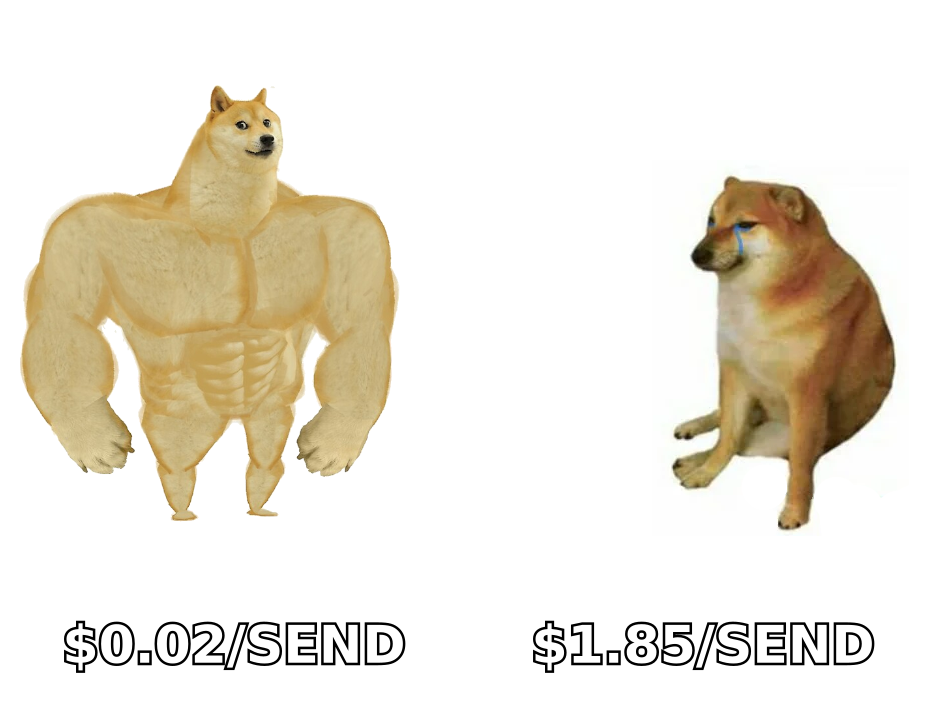
- Cost scaling. Email cost is near-flat as volume grows. Mail cost is linear and steep — every additional prospect costs the same as the first.
- Attention economics. A physical piece competes against ~5-10 other items in a mail pile. An email competes against 120+ messages a day. Scarcity is direct mail's entire moat.
- Feedback speed. Email tells you within 48 hours whether the message works. Mail takes 7-21 days from drop to reply, so iteration cycles are 10x slower.
- Data requirements. Email needs a verified address and a working domain. Mail needs a physical address, a current job title, and confidence the person still sits at that desk — a harder data problem in a hybrid-work world.
- Compliance surface. Email is governed by CAN-SPAM, GDPR, and increasingly by mailbox-provider rules (Google and Yahoo's bulk-sender requirements). Mail has almost no equivalent gatekeeper.
- Reversibility. A bad email costs you a bounce. A bad mailer costs you the piece, the postage, and the fulfillment labor — unrecoverable.
How do the numbers actually compare?#
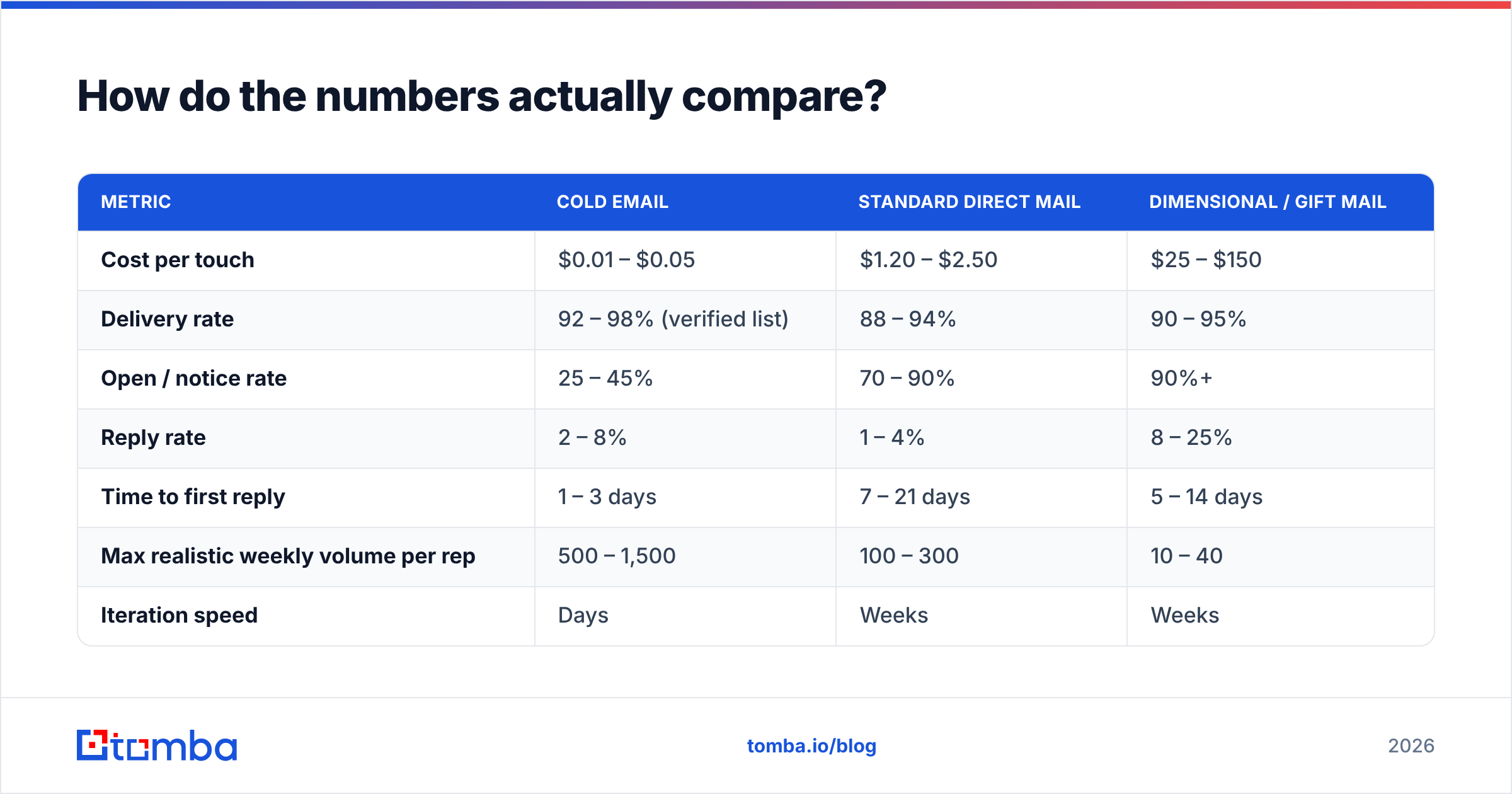
Here are the benchmark ranges most B2B teams see. Treat them as starting assumptions to replace with your own data, not gospel.
| Metric | Cold email | Standard direct mail | Dimensional / gift mail |
|---|---|---|---|
| Cost per touch | $0.01 – $0.05 | $1.20 – $2.50 | $25 – $150 |
| Delivery rate | 92 – 98% (verified list) | 88 – 94% | 90 – 95% |
| Open / notice rate | 25 – 45% | 70 – 90% | 90%+ |
| Reply rate | 2 – 8% | 1 – 4% | 8 – 25% |
| Time to first reply | 1 – 3 days | 7 – 21 days | 5 – 14 days |
| Max realistic weekly volume per rep | 500 – 1,500 | 100 – 300 | 10 – 40 |
| Iteration speed | Days | Weeks | Weeks |
| Setup cost | $50 – $300/mo tooling | $500+ minimum print run | Vendor platform + inventory |
Run the cost-per-meeting math with those numbers and the picture sharpens.
Cold email: 1,000 sends × 4% reply × 30% of replies become meetings = 12 meetings. Cost: ~$40 in sending and data, plus rep time. Roughly $3-$15 per meeting all-in.
Standard mail: 1,000 pieces × 2.5% reply × 40% of replies become meetings = 10 meetings. Cost: ~$1,800. Roughly $180 per meeting.
Gift mail to 100 named accounts: 100 pieces × 15% reply × 60% become meetings = 9 meetings. Cost: ~$6,000. Roughly $666 per meeting.
Email is 12-50x cheaper per meeting. That is the honest headline. But cost per meeting is the wrong single metric if the meetings aren't equivalent — and they usually aren't. A meeting sourced from a $120 dimensional mailer to a named VP at a target enterprise account is not the same asset as a meeting from a spray-and-pray sequence. Mail buys you selection: you only send to accounts worth the spend, so the meetings skew larger and further along.
The rule of thumb: if your ACV divided by 100 is bigger than your cost per mail touch, mail is defensible. A $50K ACV supports a $500 all-in mail investment per account. A $6K ACV does not support a $60 gift box.
Is direct mail better than email for cold outbound?#
For pure cold outbound at volume, no. Email wins on economics and speed, and it isn't close.
Direct mail becomes better in four specific situations:
- Your ICP is under 500 accounts total. When the entire market fits on one spreadsheet, per-touch cost stops mattering and per-account attention starts mattering.
- Your email deliverability is already compromised. If your domain is burned or your industry (finance, healthcare, legal) has aggressive filtering, mail routes around the gatekeeper entirely.
- You're re-engaging closed-lost or dormant accounts. These contacts have already learned to ignore your emails. A physical piece resets the pattern.
- The buying committee includes people who don't live in email. Plant managers, franchise owners, medical directors, field operations leaders — email penetration and open rates in these roles are materially worse than in tech and finance.
Conversely, email wins outright when you need volume, when you're still testing messaging (you cannot A/B test a $40 mailer efficiently), when your sales cycle is under 30 days, or when your ACV is under about $15K.
Why does list quality decide both channels?#
Because bad data destroys direct mail loudly and email quietly — and the quiet destruction is worse.
In direct mail, a 20% bad-address rate is visible: you get returns, you eat the cost, you know it. In email, a 20% invalid rate doesn't just waste sends. It signals to mailbox providers that you're sending to addresses you shouldn't have, which drags down your sender reputation, which then suppresses delivery to the 80% of addresses that were good. You lose the bad contacts and a chunk of the good ones.
This is why verification is upstream of everything. Before you spend on either channel:
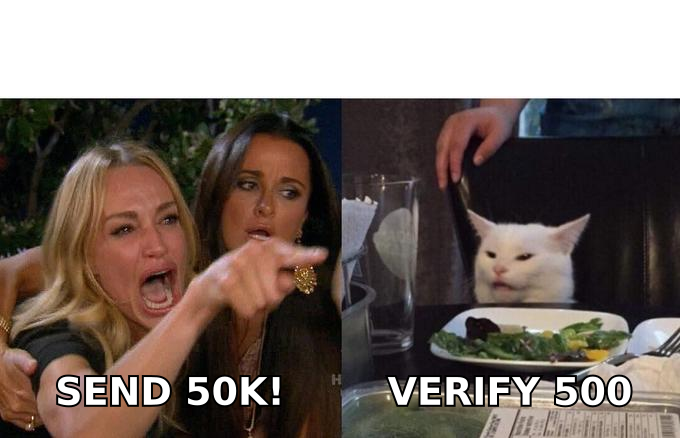
- Verify the email exists. An email verifier catches syntax errors, dead mailboxes, role accounts, and spam traps before they touch your sender score. Run every list, every time — B2B data decays roughly 25-30% per year as people change jobs.
- Confirm the person is still there. Job change is the number one cause of both bounced emails and returned mail. A contact sourced 14 months ago is a coin flip.
- Handle catch-all domains deliberately. Catch-all servers accept everything, so standard verification returns "unknown." A catch-all verifier applies pattern and deliverability signals to separate the real mailboxes from the void. Don't just delete catch-alls — a large share of enterprise domains are catch-all, and deleting them removes your best accounts.
- Match the physical address to the current office. Post-2020, a meaningful share of HQ addresses in legacy databases point at empty floors. Verify against the company's current site or filings before a mail drop.
- Dedupe before you spend. Sending two mailers to the same person at two spellings of their name costs real money and looks amateurish. Remove duplicates first.
If you're building the list from scratch, a domain search pulls every discoverable address at a target company along with the company's dominant email pattern, which gives you both the contact and a template for colleagues you find later. For LinkedIn-sourced prospecting, a LinkedIn finder resolves profiles to verified business addresses so you're not guessing at first.last@ formats.
What does a combined mail-plus-email sequence look like?#
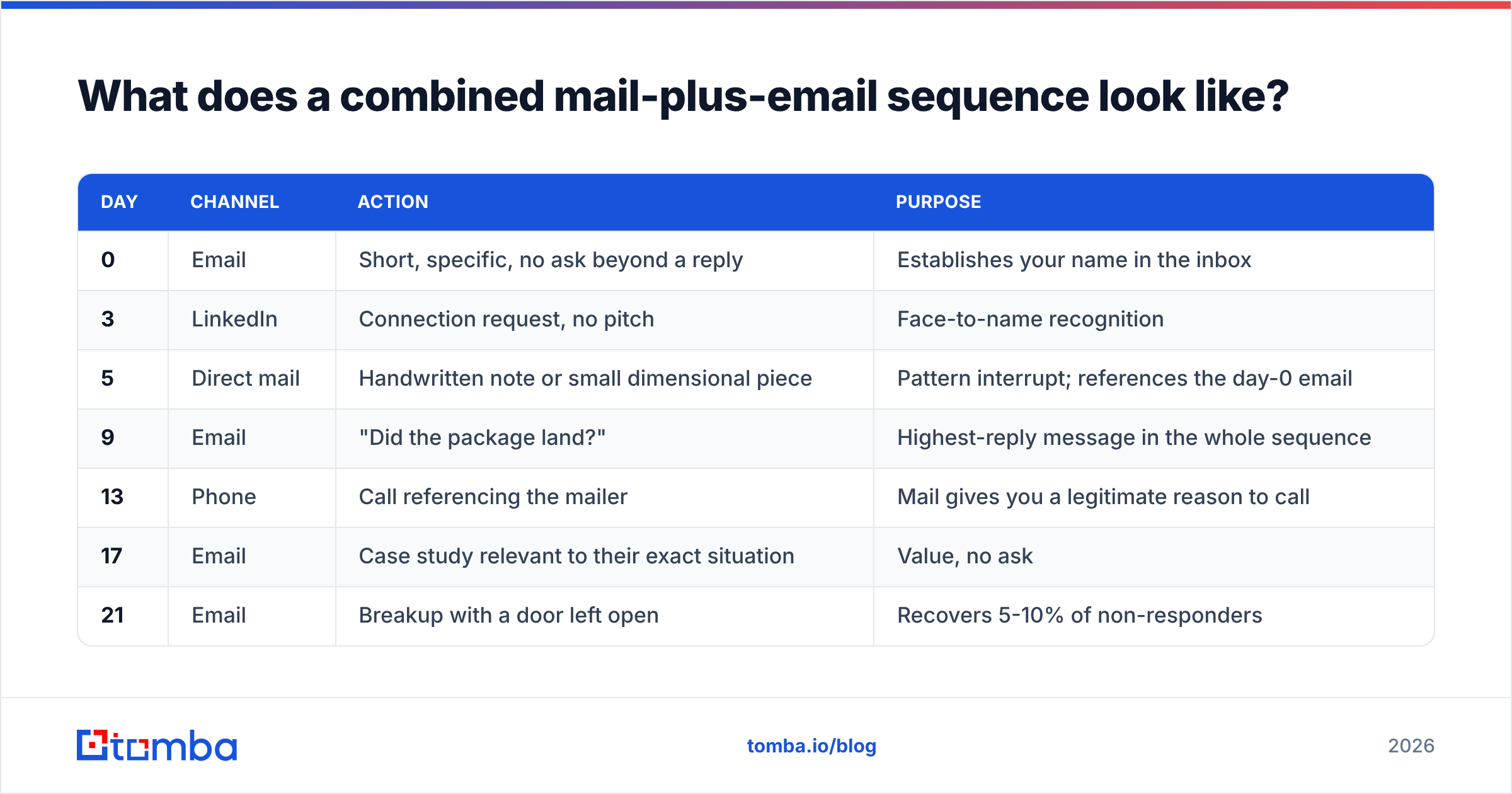
The highest-performing 2026 pattern isn't either channel alone. It's mail as an unlock for email — you send something physical to earn the right to a warm follow-up, then run the actual conversation over email where iteration is cheap.
A concrete 21-day sequence for a tier-one account:
| Day | Channel | Action | Purpose |
|---|---|---|---|
| 0 | Short, specific, no ask beyond a reply | Establishes your name in the inbox | |
| 3 | Connection request, no pitch | Face-to-name recognition | |
| 5 | Direct mail | Handwritten note or small dimensional piece | Pattern interrupt; references the day-0 email |
| 9 | "Did the package land?" | Highest-reply message in the whole sequence | |
| 13 | Phone | Call referencing the mailer | Mail gives you a legitimate reason to call |
| 17 | Case study relevant to their exact situation | Value, no ask | |
| 21 | Breakup with a door left open | Recovers 5-10% of non-responders |
The day-9 email is the whole point. "Did the package land?" is not a cold email — it's a follow-up on a real event, and it reads that way to both the recipient and the spam filter. Teams running this pattern report reply rates on that specific step 3-5x their baseline cold email.
Two rules make or break it. First, the mailer must reference something they can verify (their recent funding round, a job posting, a product launch), or it reads as generic swag. Second, don't gate the gift behind a meeting — "book a call to get your $50 gift card" converts worse than just sending the thing, and it makes you look like you're buying time you haven't earned.
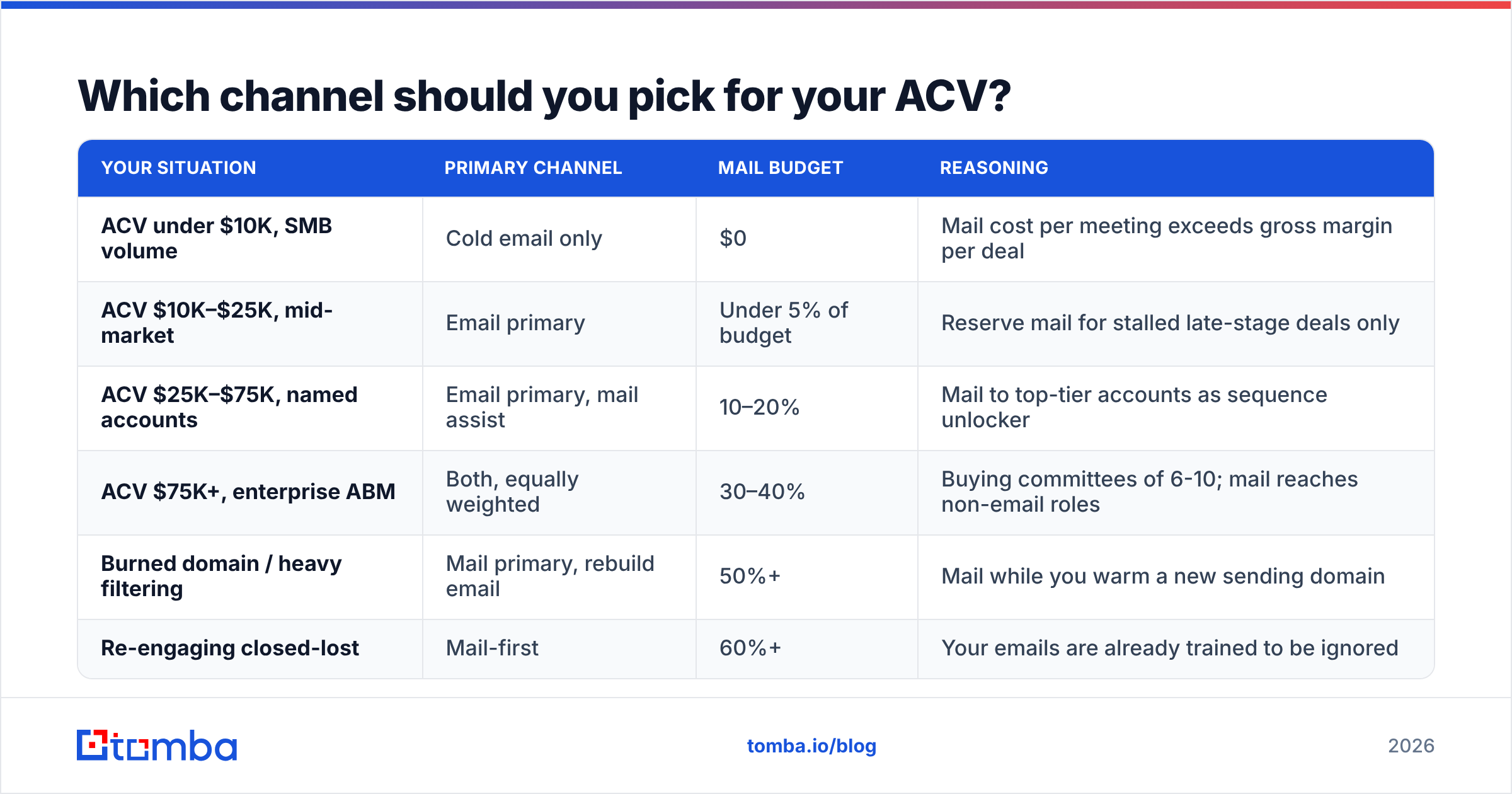
Which channel should you pick for your ACV?#
| Your situation | Primary channel | Mail budget | Reasoning |
|---|---|---|---|
| ACV under $10K, SMB volume | Cold email only | $0 | Mail cost per meeting exceeds gross margin per deal |
| ACV $10K–$25K, mid-market | Email primary | Under 5% of budget | Reserve mail for stalled late-stage deals only |
| ACV $25K–$75K, named accounts | Email primary, mail assist | 10–20% | Mail to top-tier accounts as sequence unlocker |
| ACV $75K+, enterprise ABM | Both, equally weighted | 30–40% | Buying committees of 6-10; mail reaches non-email roles |
| Burned domain / heavy filtering | Mail primary, rebuild email | 50%+ | Mail while you warm a new sending domain |
| Re-engaging closed-lost | Mail-first | 60%+ | Your emails are already trained to be ignored |
Notice what's constant: email is never zero. Even in the enterprise ABM row, email is how you actually run the conversation once mail opens the door. Mail is the door-opener; it's a terrible medium for scheduling, follow-up, and content sharing.
What tooling do you need for each channel?#
Direct mail needs a fulfillment partner (Sendoso, Reachdesk, PFL, or a local print shop for simple letters), a design asset, and an address-verified account list. The tooling is the easy part; the address data is the hard part.
Email needs three things in order: a source of verified addresses, a warmed sending infrastructure, and a sequencer. Most teams get the last two right and the first one wrong, then blame the sequencer.
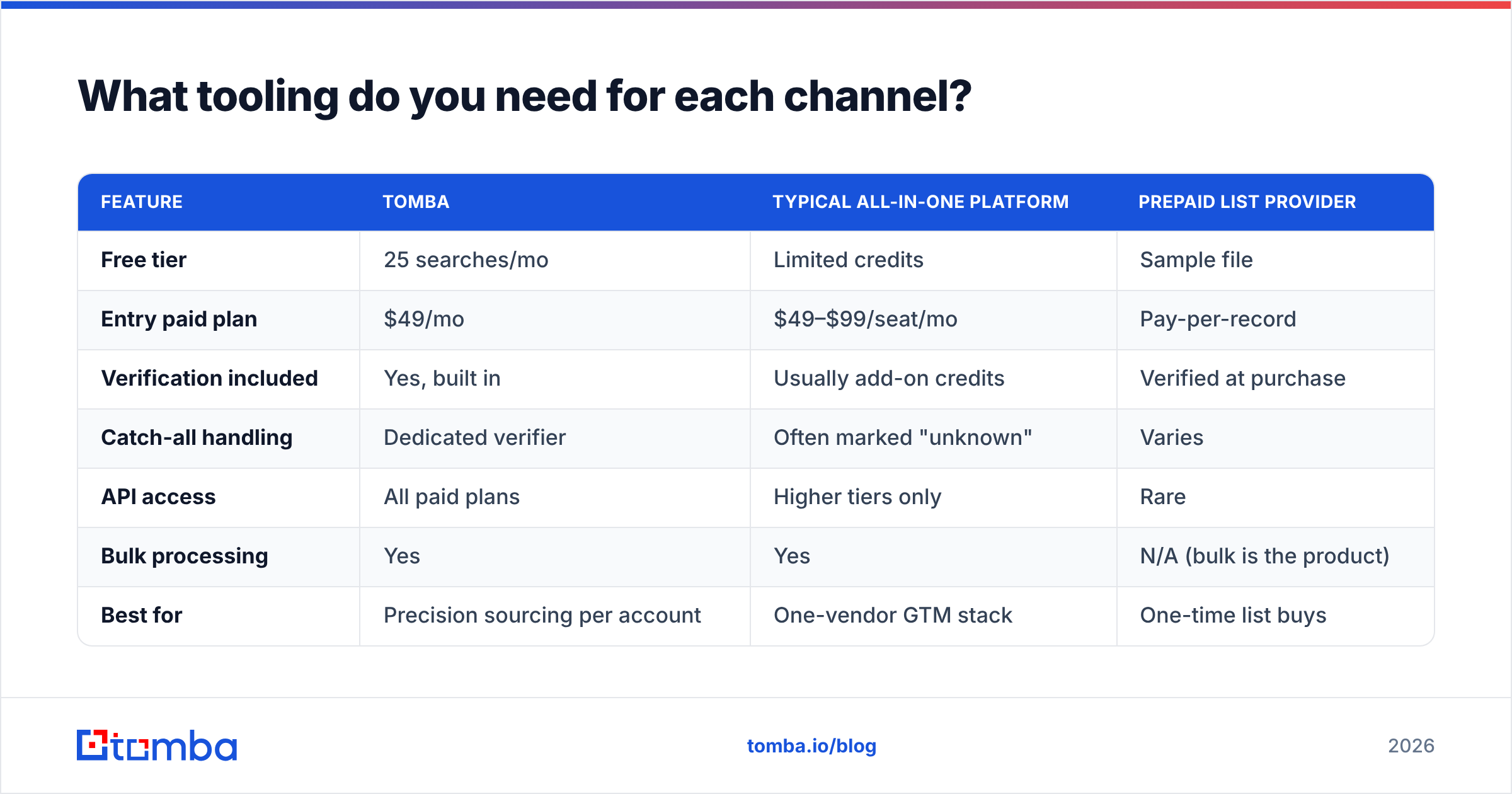
For sourcing, the market splits into three tiers. All-in-one platforms like Apollo bundle a database with a sequencer, which is convenient but ties your data quality to one vendor's refresh cycle. Prepaid B2B list providers like BookYourData sell verified contact lists outright, which suits teams that want a one-time named-account pull without a subscription — a good fit for a defined direct-mail drop. Dedicated finder-and-verifier tools sit in between: you bring the target accounts, they return verified addresses on demand.
| Feature | Tomba | Typical all-in-one platform | Prepaid list provider |
|---|---|---|---|
| Free tier | 25 searches/mo | Limited credits | Sample file |
| Entry paid plan | $49/mo | $49–$99/seat/mo | Pay-per-record |
| Verification included | Yes, built in | Usually add-on credits | Verified at purchase |
| Catch-all handling | Dedicated verifier | Often marked "unknown" | Varies |
| API access | All paid plans | Higher tiers only | Rare |
| Bulk processing | Yes | Yes | N/A (bulk is the product) |
| Best for | Precision sourcing per account | One-vendor GTM stack | One-time list buys |
For a direct-mail program specifically, the workflow that works is: build the named-account list, run bulk verify on every email before the mail drop (so your day-9 follow-up actually lands), then send the physical piece. Verifying after the mail goes out means you paid $6 for a piece you can't follow up on. Check Tomba pricing against your monthly account volume — most mail-assisted ABM programs need fewer lookups than they expect, because the account list is deliberately small.
How do you measure whether mail is working?#
Attribution is where most direct-mail programs die. The piece arrives Tuesday, the prospect googles you Thursday, fills out a demo form Friday, and your CRM credits "organic search."
Three fixes, in order of effort:
- Tag the account, not the touch. Before the drop, flag every account in the mailing as
dm-q3-2026. Then measure pipeline created by tagged accounts versus a matched control group of untagged accounts over the next 90 days. This is the only measurement that survives scrutiny. - Hold out a control group. Take 20% of your target list and don't mail them. Run identical email sequences to both groups. The delta is your mail lift. Teams that skip this can never answer "would they have replied anyway?"
- Use a unique landing path. A short vanity URL or personalized page per account catches direct-response traffic that would otherwise be attributed to nothing.
Measure over 90 days, not 14. Mail's effect is slow and shows up in downstream conversion rates — reply-to-meeting and meeting-to-opportunity — more than in raw reply rate. If you judge a mail program on week-two reply rate, you'll kill programs that were working.
For the email side, watch bounce rate and spam-complaint rate as leading indicators of list health. If bounces creep above 3%, stop sending and re-verify before your sender reputation takes damage that takes weeks to repair. Google's own bulk sender guidelines are the authoritative reference for the thresholds that matter.
What's the verdict for 2026?#
Email is the default. Direct mail is the exception you earn.
Run cold email as your primary volume channel, with a verified list and honest bounce hygiene. Carve out 10-20% of your outbound budget for physical touches aimed exclusively at accounts where a single close pays for the entire year's mail spend. Sequence them together — mail creates the event, email works the event.
The teams that lose are the ones that treat this as an either/or ideology question. The teams that win treat it as a portfolio allocation problem and let the ACV math decide.
Everything downstream of this decision depends on having addresses that are actually real. Start there: run your target-account list through the Tomba Email Finder to source verified professional addresses by domain or name, then verify the whole file before you spend a dollar on postage or a byte of sender reputation. The free tier covers 25 searches a month if you want to test the accuracy on accounts you already know, and the $49/mo Starter plan handles most mail-assisted ABM programs without a seat commitment.
Related guides#
Ready to find emails that actually work?
Join 150,000+ professionals who stopped guessing and started sending. Free credits on signup — no credit card required.
Get the Tomba newsletter
Practical outbound tactics and product updates — once every two weeks.
About the author