Direct Phone Numbers: How B2B Teams Find and Verify Them
Direct dials connect 3-5x more often than switchboard lines, but most vendor databases quietly pass off HQ numbers as direct. Here's how to tell the difference and what accuracy actually costs in 2026.
TL;DR
- A direct phone number rings one person's desk or mobile. A switchboard number rings a receptionist, an IVR tree, or nobody. Vendors sell both under the same label.
- Connect rates on verified mobile direct dials sit around 3-5x higher than main-line numbers, mostly because you skip the gatekeeper entirely.
- Most B2B phone databases quote "accuracy" without saying whether they mean the number is live or the number belongs to this person. Those are different claims.
- Cost per usable conversation matters more than cost per record. A $0.10 record at 40% accuracy is more expensive than a $0.30 record at 85%.
- Verify before you dial, respect DNC and consent rules, and treat every phone record as decaying at roughly 2-3% per month.
What is a direct phone number?#
A direct phone number routes to one specific human without passing through a company switchboard. In practice it comes in two flavors: a direct inward dial (DID) desk extension assigned to an individual, and a personal or company-issued mobile.
Think of it like an apartment building. The switchboard is the buzzer panel in the lobby — you press it, someone asks who you are, and they decide whether to let you up. A direct dial is having the tenant's own door number. Same building, radically different odds of getting in.
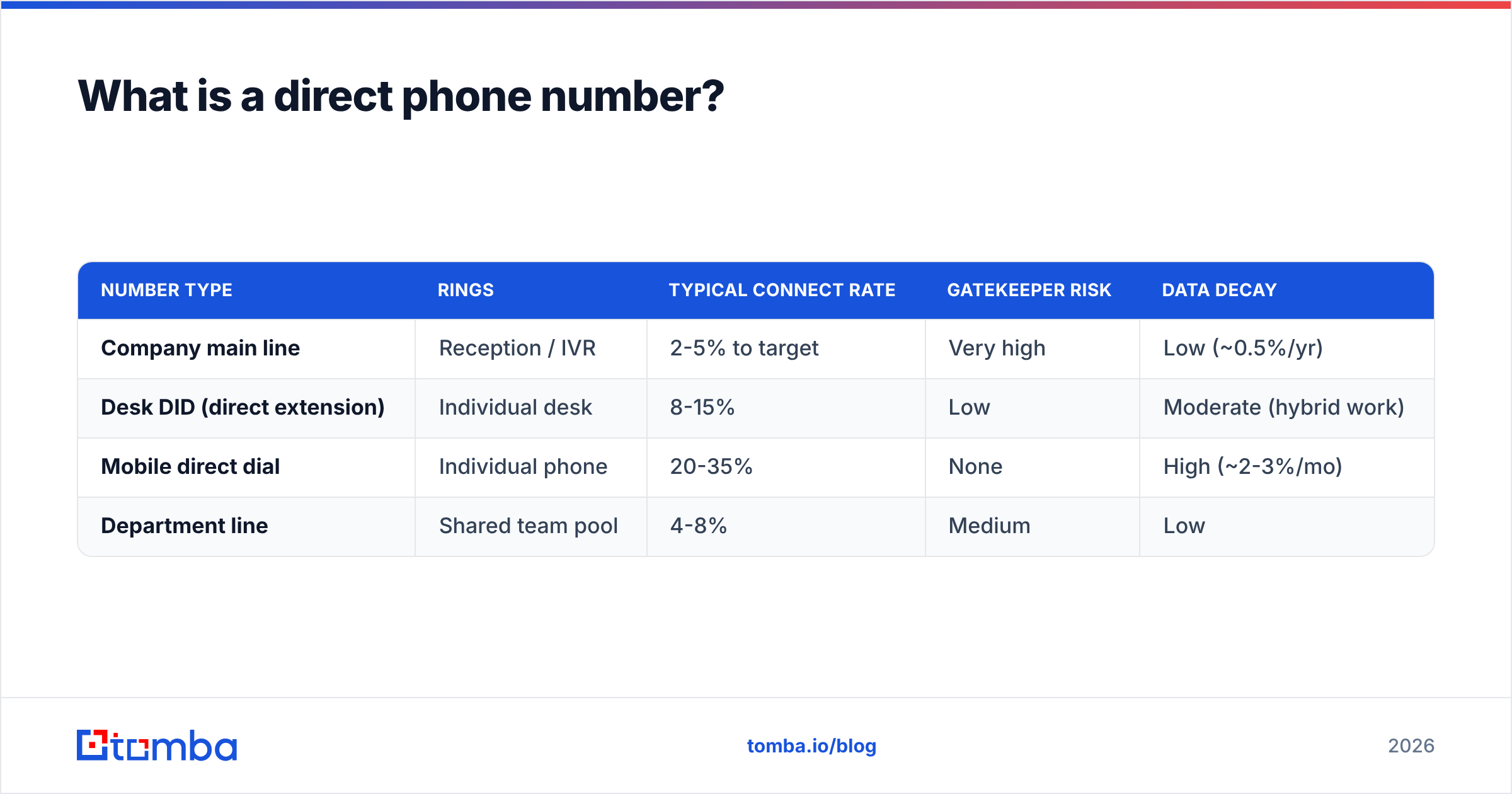
Here's what separates the three number types you'll encounter in any B2B dataset:
| Number type | Rings | Typical connect rate | Gatekeeper risk | Data decay |
|---|---|---|---|---|
| Company main line | Reception / IVR | 2-5% to target | Very high | Low (~0.5%/yr) |
| Desk DID (direct extension) | Individual desk | 8-15% | Low | Moderate (hybrid work) |
| Mobile direct dial | Individual phone | 20-35% | None | High (~2-3%/mo) |
| Department line | Shared team pool | 4-8% | Medium | Low |
The distinction sounds pedantic until you look at your dialer logs. Teams that discover half their "direct dials" are actually main lines usually find it after burning through a quarter's worth of dial capacity.
Why do direct phone numbers still matter in 2026?#
Because email response rates keep sliding and phone hasn't. Cold email reply rates across most B2B categories now sit in the low single digits, and the inbox filters that Google and Yahoo tightened in 2024 have only gotten stricter since. A phone that rings in someone's pocket doesn't get filtered.
The realistic case for phone in a modern sequence:
- Speed of qualification. A two-minute call surfaces budget, timing, and authority faster than a four-email thread.
- Multithreading beats single-channel. Combining email, LinkedIn, and a direct dial lifts total touch effectiveness well beyond any one channel alone.
- Inbound speed-to-lead. If a demo request comes in and you have the prospect's mobile on file, you call in under five minutes instead of waiting on an email reply.
- Deal rescue. When a deal goes dark, a direct dial to your champion is the only channel that reliably breaks silence.
- Enterprise navigation. Big orgs bury individuals behind IVR trees. A direct number is often the only practical route to a named buyer.
None of this works if the number is wrong. Which is the actual problem.
How do vendors define "accuracy" — and why does it mislead?#
There are three separate claims hiding inside the word "accuracy," and vendors rarely tell you which one their number refers to.
- Line validity. The number is a working, assigned line. Checked with an HLR lookup or carrier query. Cheap and easy to verify — and the most commonly quoted stat.
- Ownership match. The number belongs to the specific person named on the record. Much harder to prove, much more expensive to maintain.
- Currency. The person still holds the role you think they hold, at the company you think they're at. Decays fastest of the three.
A vendor advertising "95% accurate phone data" almost always means line validity. Ownership match across large B2B databases realistically lands somewhere in the 45-75% band depending on region, seniority, and how recently the record was sourced. Mobile numbers for VPs at US mid-market companies tend to sit near the top of that range. Desk numbers for individual contributors in EMEA sit near the bottom.
Ask any vendor these three questions before you sign:
- When was this specific record last verified, and by what method?
- What is your ownership-match rate, measured separately from line validity?
- Do you charge for records that fail verification, or only for confirmed connects?
If a rep can't answer question two without a follow-up call to their data team, that's your answer.
Where do direct phone numbers actually come from?#
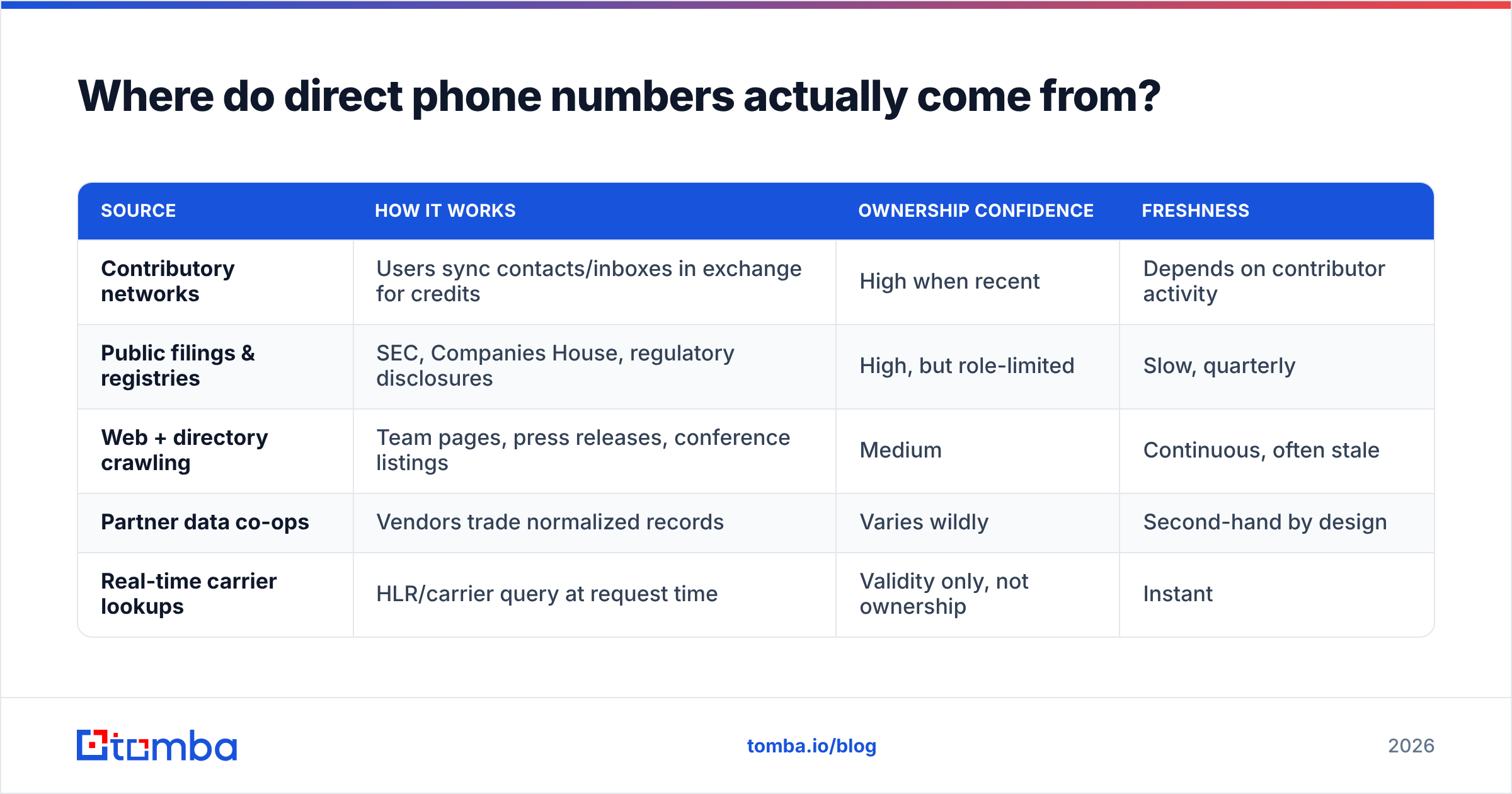
Understanding sourcing tells you what you're buying. Most providers blend several of these:
| Source | How it works | Ownership confidence | Freshness |
|---|---|---|---|
| Contributory networks | Users sync contacts/inboxes in exchange for credits | High when recent | Depends on contributor activity |
| Public filings & registries | SEC, Companies House, regulatory disclosures | High, but role-limited | Slow, quarterly |
| Web + directory crawling | Team pages, press releases, conference listings | Medium | Continuous, often stale |
| Partner data co-ops | Vendors trade normalized records | Varies wildly | Second-hand by design |
| Real-time carrier lookups | HLR/carrier query at request time | Validity only, not ownership | Instant |
The pattern worth noticing: nothing on that list proves ownership on its own. The strongest providers cross-reference at least three sources and only surface a number when signals agree. That's also why coverage drops when accuracy standards rise — a 60% coverage database with 85% ownership match beats a 90% coverage database at 45% match on every metric that touches revenue.
If you want to see how a provider documents this, check whether they publish their data sources openly. Vendors that won't describe sourcing usually have a reason.
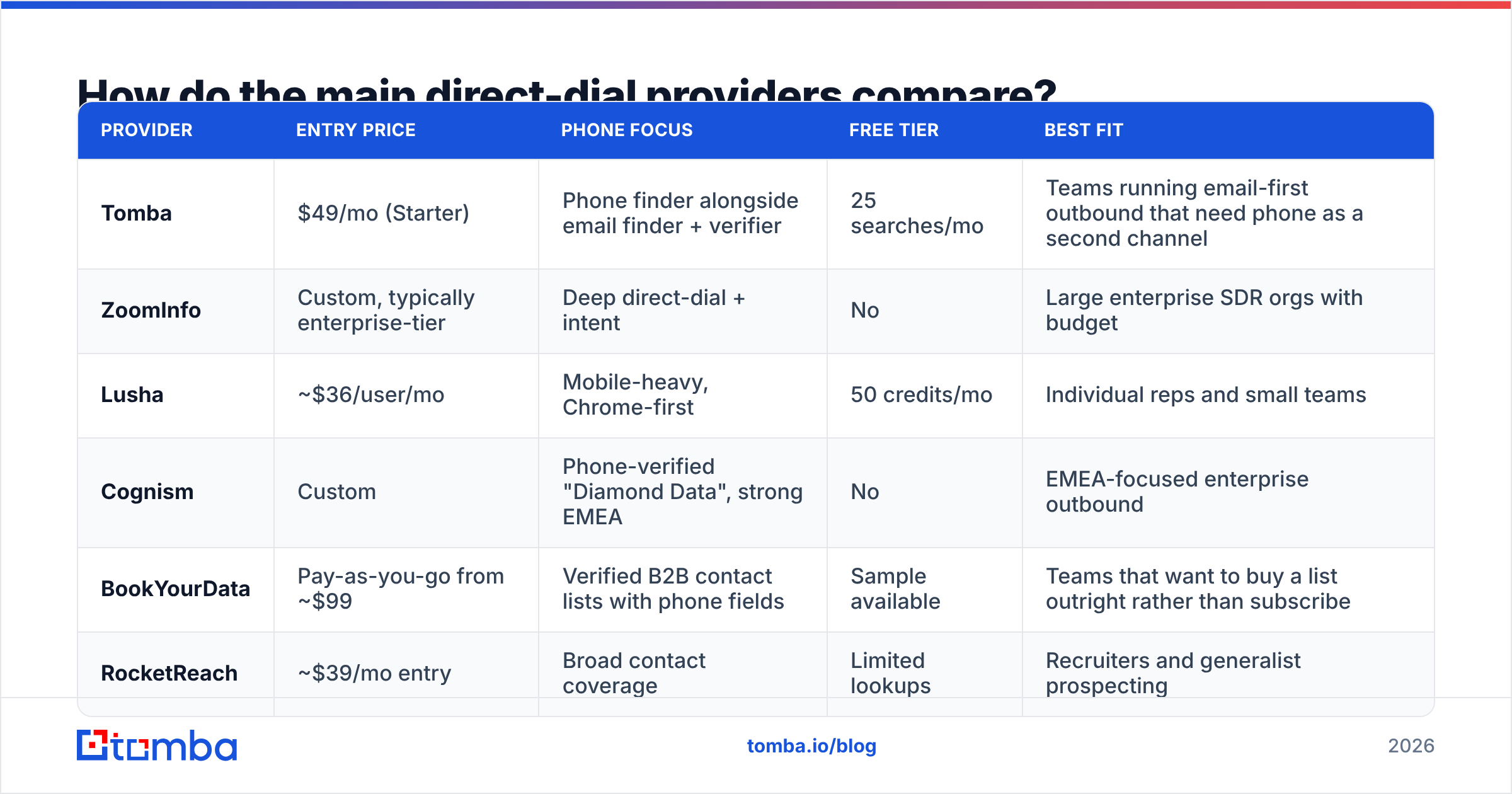
How do the main direct-dial providers compare?#
Pricing and positioning shift constantly, so treat this as a shape-of-the-market snapshot rather than a live price sheet. Verify current terms on each vendor's site.
| Provider | Entry price | Phone focus | Free tier | Best fit |
|---|---|---|---|---|
| Tomba | $49/mo (Starter) | Phone finder alongside email finder + verifier | 25 searches/mo | Teams running email-first outbound that need phone as a second channel |
| ZoomInfo | Custom, typically enterprise-tier | Deep direct-dial + intent | No | Large enterprise SDR orgs with budget |
| Lusha | ~$36/user/mo | Mobile-heavy, Chrome-first | 50 credits/mo | Individual reps and small teams |
| Cognism | Custom | Phone-verified "Diamond Data", strong EMEA | No | EMEA-focused enterprise outbound |
| BookYourData | Pay-as-you-go from ~$99 | Verified B2B contact lists with phone fields | Sample available | Teams that want to buy a list outright rather than subscribe |
| RocketReach | ~$39/mo entry | Broad contact coverage | Limited lookups | Recruiters and generalist prospecting |
A few honest caveats on that table. Per-user pricing at the low end looks cheap until you multiply by seat count and add credit overages. Enterprise vendors bundle phone into platform deals, so the marginal cost of a direct dial is genuinely hard to isolate. And "pay-as-you-go" providers like BookYourData suit a different buying motion entirely — one-time list purchases for a defined campaign rather than continuous enrichment.
Tomba sits in the middle of this: the core product is the email finder, with phone finder and data enrichment sitting alongside it. If phone is your primary channel and email is secondary, a phone-first specialist may serve you better. If email is primary and you want direct dials on your best-fit accounts without a second contract, the bundled approach is cheaper. Full Tomba pricing runs Free (25 searches/mo), Starter $49/mo, Growth $99/mo, Pro $249/mo, and Enterprise.
How do you verify direct phone numbers before dialing?#
Dialing unverified numbers wastes rep time and, at scale, damages your outbound number's reputation through elevated invalid-call rates. Run this sequence:
- Format and normalize. Strip extensions, apply E.164 formatting, confirm country codes. Roughly 5-10% of raw records fail here alone.
- Line-type check. Determine mobile vs landline vs VoIP. This changes both connect expectations and, in the US, your TCPA obligations.
- HLR / carrier lookup. Confirms the line is live and reachable without ringing it. Use a phone validator or your provider's API.
- DNC and suppression screening. Scrub against national do-not-call registries and your own suppression list before any list touches a dialer.
- Ownership cross-check. Match the number against a second source — a reverse email lookup or enrichment pass that independently returns the same contact.
- Sample-dial before scaling. Take 50 records, dial them manually, log the outcome. If connects come in under 10%, the list has a problem no amount of scripting will fix.
Step six is the one teams skip and the one that saves the most money. Fifty manual dials costs a rep two hours. Discovering a 12,000-record list is garbage after four weeks of automated dialing costs considerably more.
What are the compliance rules you cannot ignore?#
Short version: calling a mobile you sourced from a database is legal in many B2B contexts and illegal in others, and the line moves by jurisdiction.
- United States. TCPA governs autodialed and prerecorded calls to mobiles. Manual dialing of business contacts for B2B purposes has more latitude, but automated dialing to cell phones without consent carries per-call statutory damages. State-level rules (Florida, Oklahoma, Washington) add stricter requirements on top. The FCC's TCPA guidance is the primary reference.
- EU / UK. GDPR treats a work mobile as personal data. You need a lawful basis — legitimate interest is defensible for B2B outreach, but you must document the balancing test and honor objections immediately. Corporate Telephone Preference Service screening is mandatory in the UK.
- Canada. CASL covers electronic messages; the National DNCL covers voice. Business-to-business exemptions exist but are narrower than most vendors imply.
Practical rule: keep a record of where every phone number came from and when. If a regulator or an angry prospect asks, "we bought a list" is a much weaker answer than "sourced from X on date Y, verified on date Z, legitimate-interest assessment on file."
What does a realistic direct-dial workflow look like?#
Here's a workflow that holds up in practice for a team running roughly 200 accounts per rep per quarter:
- Build the account list first, contacts second. Use domain search to map who's actually at each target company before you spend a phone credit.
- Enrich email first, phone second. Email credits are cheaper. Confirm the person exists and is current, then pull the phone.
- Tier your phone spend. Pull direct dials only for tier-1 accounts and for contacts who've shown any engagement signal. Phone-enriching a cold tier-3 list is how credit budgets evaporate.
- Verify in bulk, dial in batches. Run a bulk verify pass, then release 200-300 numbers per rep per week rather than dumping 5,000 into a dialer.
- Log outcome codes religiously. Wrong-person, disconnected, and gatekeeper outcomes are your accuracy audit. Feed them back to your vendor — good ones will credit failed records.
- Re-verify quarterly. At 2-3% monthly decay, a year-old phone list is roughly a quarter wrong.
Pair this with a disciplined email sequence and you get a genuinely multithreaded motion. G2's sales intelligence category is a reasonable place to sanity-check vendor claims against practitioner reviews before you commit.
Is buying direct phone numbers worth it?#
It depends entirely on your ACV and your sales motion. Run the arithmetic before you buy.
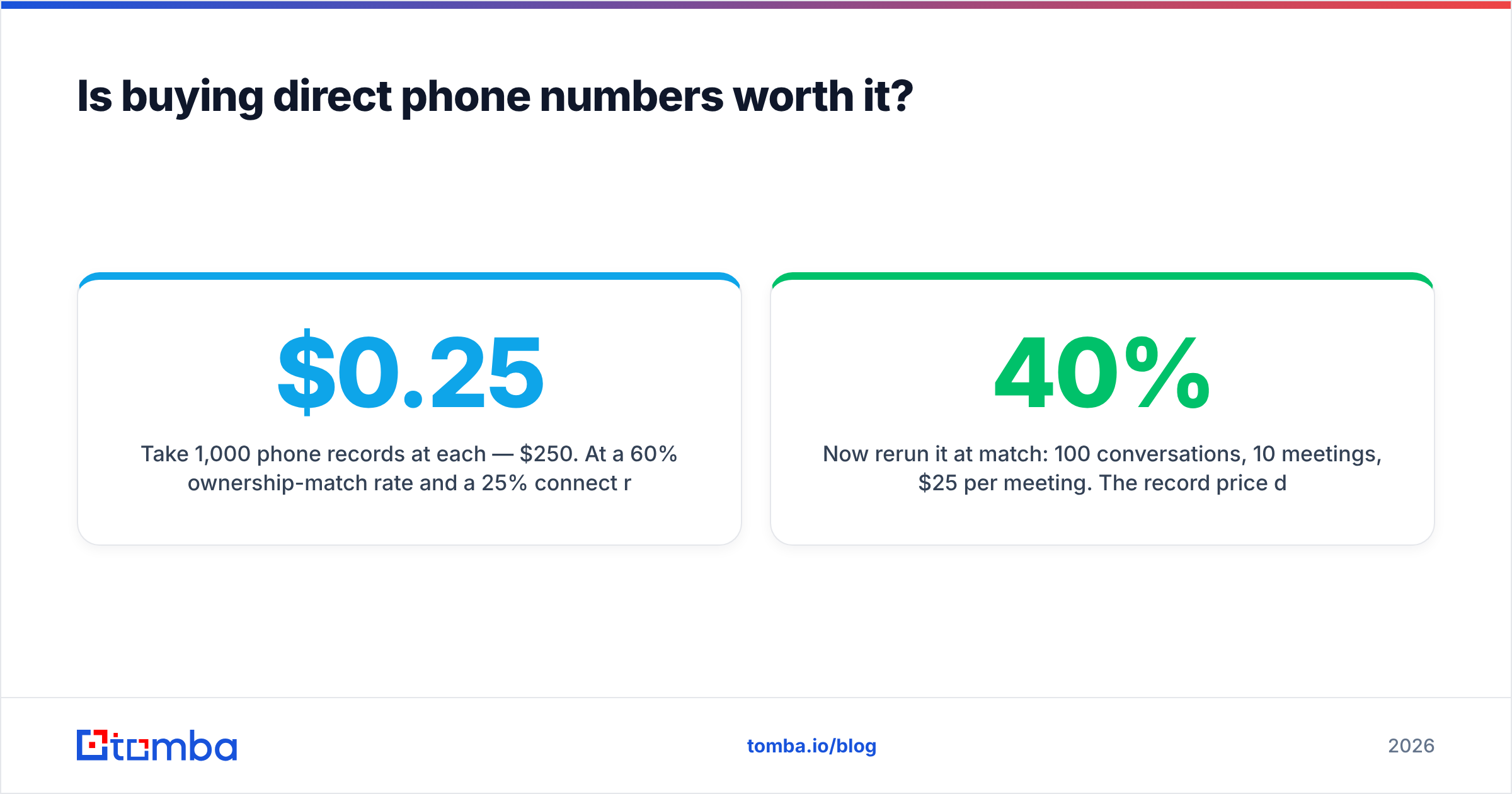
Take 1,000 phone records at $0.25 each — $250. At a 60% ownership-match rate and a 25% connect rate on the valid ones, you get roughly 150 conversations. If 10% become meetings, that's 15 meetings for $250, or about $17 per meeting in data cost. For a $30k ACV product, that's excellent. For a $500/year SaaS tool, it isn't close.
Now rerun it at 40% match: 100 conversations, 10 meetings, $25 per meeting. The record price didn't change; your cost per outcome went up 47%. That's why match rate is the number to negotiate on, not price per record.
Phone also stops making sense when your buyer persona genuinely doesn't answer calls — some developer and security audiences are close to unreachable by phone regardless of data quality. Test with 100 dials before you buy 10,000 records.
Getting started#
If your outbound is email-led and you want direct dials as a second channel without signing a separate contract, start with the Tomba Email Finder and layer phone enrichment onto your tier-1 accounts. The free tier gives you 25 searches a month to test data quality against contacts you already know — which is the only benchmark that matters. Run 50 known records through it, count the matches, and let the result decide. Every vendor claim in this post, including ours, should survive that test before it gets your budget.
Related guides#
Ready to find emails that actually work?
Join 150,000+ professionals who stopped guessing and started sending. Free credits on signup — no credit card required.
Get the Tomba newsletter
Practical outbound tactics and product updates — once every two weeks.
About the author