Direct Sales in 2026: How the Model Actually Works Now
Direct sales is not MLM, and it is not dead. Here is how the model works in 2026, what it costs per rep, when it beats channel sales, and the stack that makes it profitable.
TL;DR
- Direct sales means your own reps sell your own product straight to the buyer — no distributor, no reseller, no marketplace taking a cut. It is not multi-level marketing, and conflating the two costs companies good hires.
- The model wins when your ACV is above roughly $5,000, the buying decision is complex, or the category is new enough that nobody is searching for it yet.
- A fully loaded direct rep in B2B SaaS costs $180K–$250K/year all-in. You need about 4–5x that in quota coverage to make the math work.
- The whole model collapses at the data layer. Reps who spend 40% of their week hunting contact details are not selling — they are doing unpaid research.
- Channel sales scales reach cheaper; direct sales scales margin and control. Most companies above $20M ARR run both.
What is direct sales?#
Direct sales is a go-to-market model where the company that makes the product sells it straight to the end buyer using its own people. No wholesaler marks it up. No reseller owns the relationship. No app marketplace skims 15–20%.
Think of it like a bakery. You can sell your bread to a grocery chain and let them stock it (channel), or you can open a storefront and hand loaves to customers yourself (direct). The grocery chain gets you into 400 locations tomorrow. The storefront gets you the full price, the customer's name, and the ability to hear "your sourdough is too sour" before it shows up in a review.
In B2B, direct sales usually means:
- An SDR or BDR who sources and qualifies accounts, books meetings, and hands off.
- An AE (account executive) who runs discovery, demos, negotiation, and closes.
- A solutions or sales engineer who handles technical validation on anything above mid-market.
- A CSM or AM who owns expansion and renewal after the ink dries.
- A RevOps function that keeps the CRM, forecast, and territory rules honest.
That's the full-stack version. Early-stage teams compress it — a founder doing all five roles is still running direct sales, just badly resourced.
What direct sales is not#
This matters because the term is polluted. Direct sales is not direct selling in the MLM sense. Tupperware parties, distributor downlines, and "be your own boss" recruiting decks are a consumer channel model that borrowed the name. The Direct Selling Association tracks that industry; it has almost nothing in common with a B2B AE running a $60K deal through a procurement review.
It is also not the same as inside sales (that's a location descriptor — inside vs. field), and not the same as outbound (that's a sourcing motion — you can run direct sales entirely on inbound leads).
Is direct sales still worth it in 2026?#
Yes, but the threshold moved. Product-led growth ate the bottom of the market. If your product costs $20/seat/month and a user can self-serve in nine minutes, putting a human on that deal destroys value.
Direct sales earns its cost when at least two of these are true:
- ACV above ~$5,000. Below that, the fully loaded cost of a rep rarely clears CAC payback inside 18 months.
- Multiple stakeholders. Gartner has consistently found B2B buying groups sit around six to ten people. Software cannot navigate that. A person can.
- The category is new. Nobody searches for a solution to a problem they haven't named yet. Outbound direct sales creates demand that SEO can't capture.
- Compliance, security, or procurement gates exist. Enterprise legal review is not a self-serve flow.
- Expansion revenue is large. If land-and-expand is your model, a human relationship compounds in a way a billing page does not.
If none of those apply, you are better off spending the headcount budget on activation and lifecycle marketing.
How does direct sales compare to channel and PLG?#
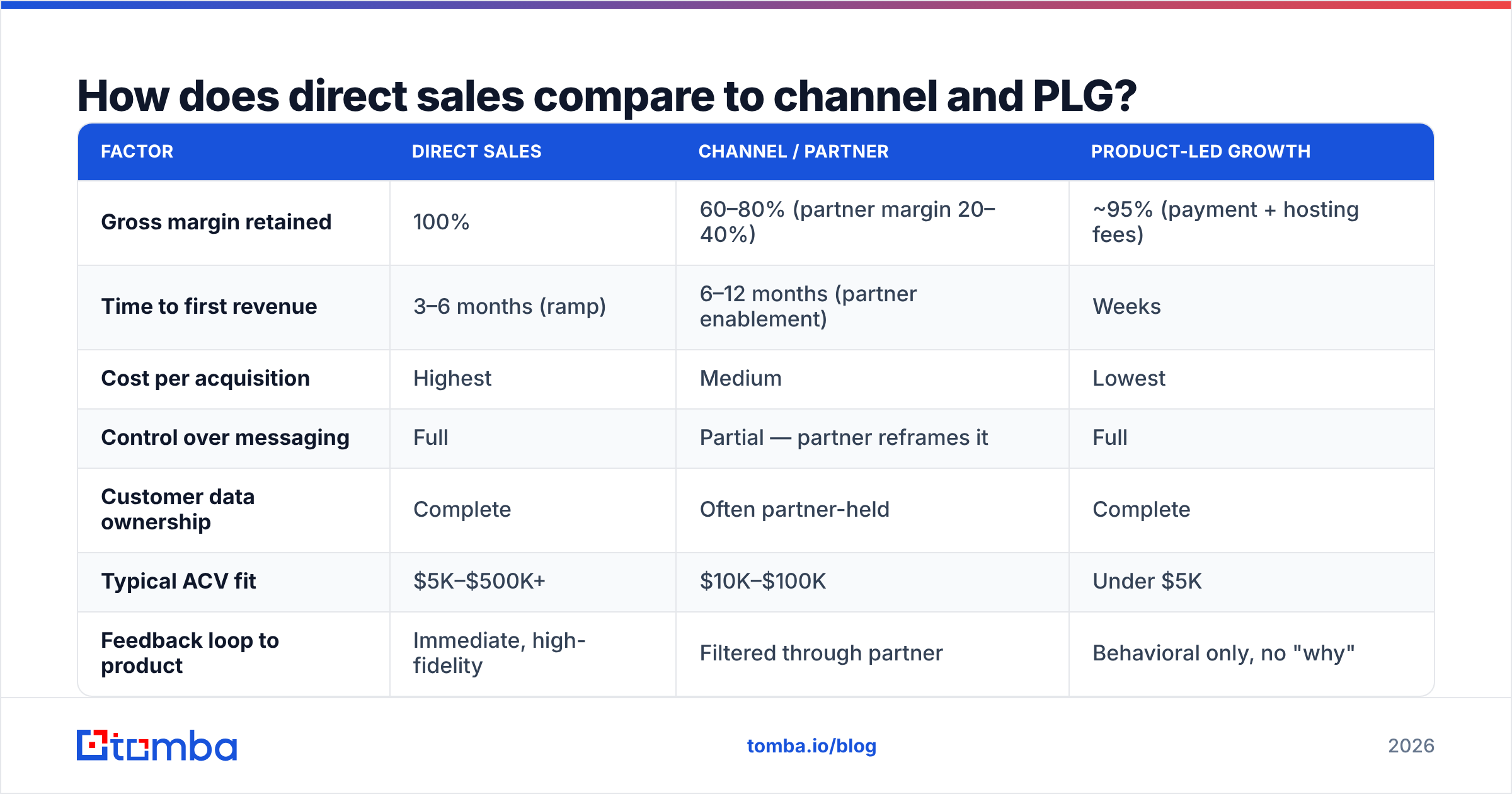
Here is the honest side-by-side. Numbers are typical B2B SaaS ranges, not guarantees.
| Factor | Direct sales | Channel / partner | Product-led growth |
|---|---|---|---|
| Gross margin retained | 100% | 60–80% (partner margin 20–40%) | ~95% (payment + hosting fees) |
| Time to first revenue | 3–6 months (ramp) | 6–12 months (partner enablement) | Weeks |
| Cost per acquisition | Highest | Medium | Lowest |
| Control over messaging | Full | Partial — partner reframes it | Full |
| Customer data ownership | Complete | Often partner-held | Complete |
| Typical ACV fit | $5K–$500K+ | $10K–$100K | Under $5K |
| Feedback loop to product | Immediate, high-fidelity | Filtered through partner | Behavioral only, no "why" |
| Scales by | Hiring | Recruiting partners | Traffic + activation |
| Breaks when | Rep costs outpace ACV | Partner priorities shift | Buying group gets complex |
Most companies do not pick one. They sequence. PLG captures the self-serve tail, direct sales works the accounts worth working, and channel opens geographies where hiring locally is impractical. The mistake is running all three at once before $10M ARR, because they compete for the same accounts and your comp plan will start a civil war.
What does a direct sales process actually look like?#
Strip the frameworks away and every direct sales cycle runs the same seven steps. The names change; the physics don't.
- Territory and ICP definition. Who you sell to, drawn tight enough that a rep can name 200 target accounts by heart. Vague ICPs produce vague pipelines.
- Sourcing. Building the account and contact list. This is where most teams quietly lose the most hours.
- Outreach and qualification. Multi-channel sequences — email, phone, LinkedIn — until you get a meeting or a hard no. Track response rate by segment, not in aggregate.
- Discovery. The only call that matters. If you cannot articulate the buyer's cost of inaction in their own words afterward, you did not run discovery — you ran a demo with extra steps.
- Technical and commercial validation. Security review, pilot, pricing negotiation, procurement.
- Close. Signature, and the handoff document that tells CS what was promised.
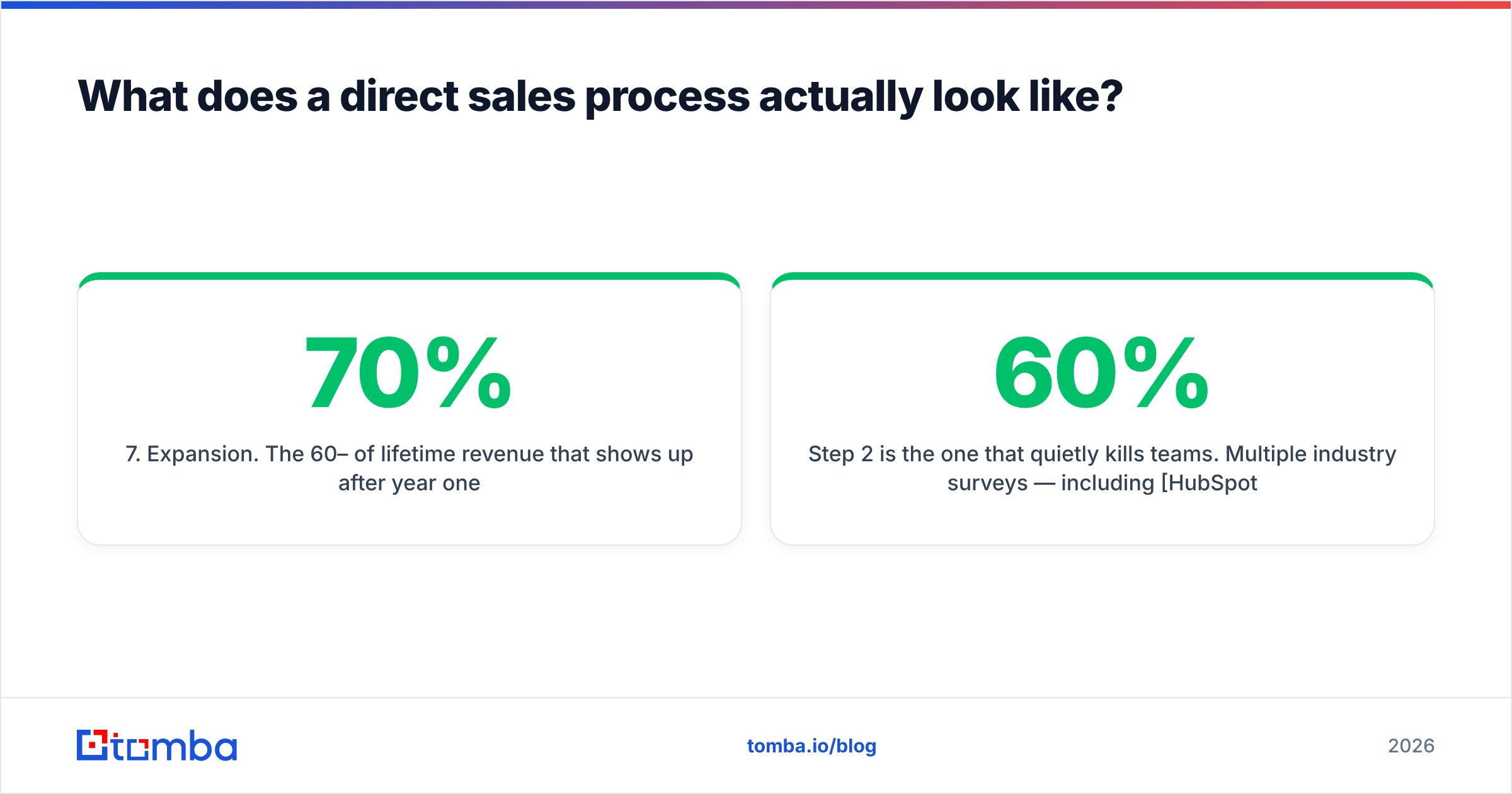
- Expansion. The 60–70% of lifetime revenue that shows up after year one.
Step 2 is the one that quietly kills teams. Multiple industry surveys — including HubSpot's State of Sales research — put the share of a rep's week spent on non-selling work above 60%, with data hunting and CRM hygiene at the top. You are paying $200K for someone to do manual research.
Which metrics tell you if direct sales is working?#
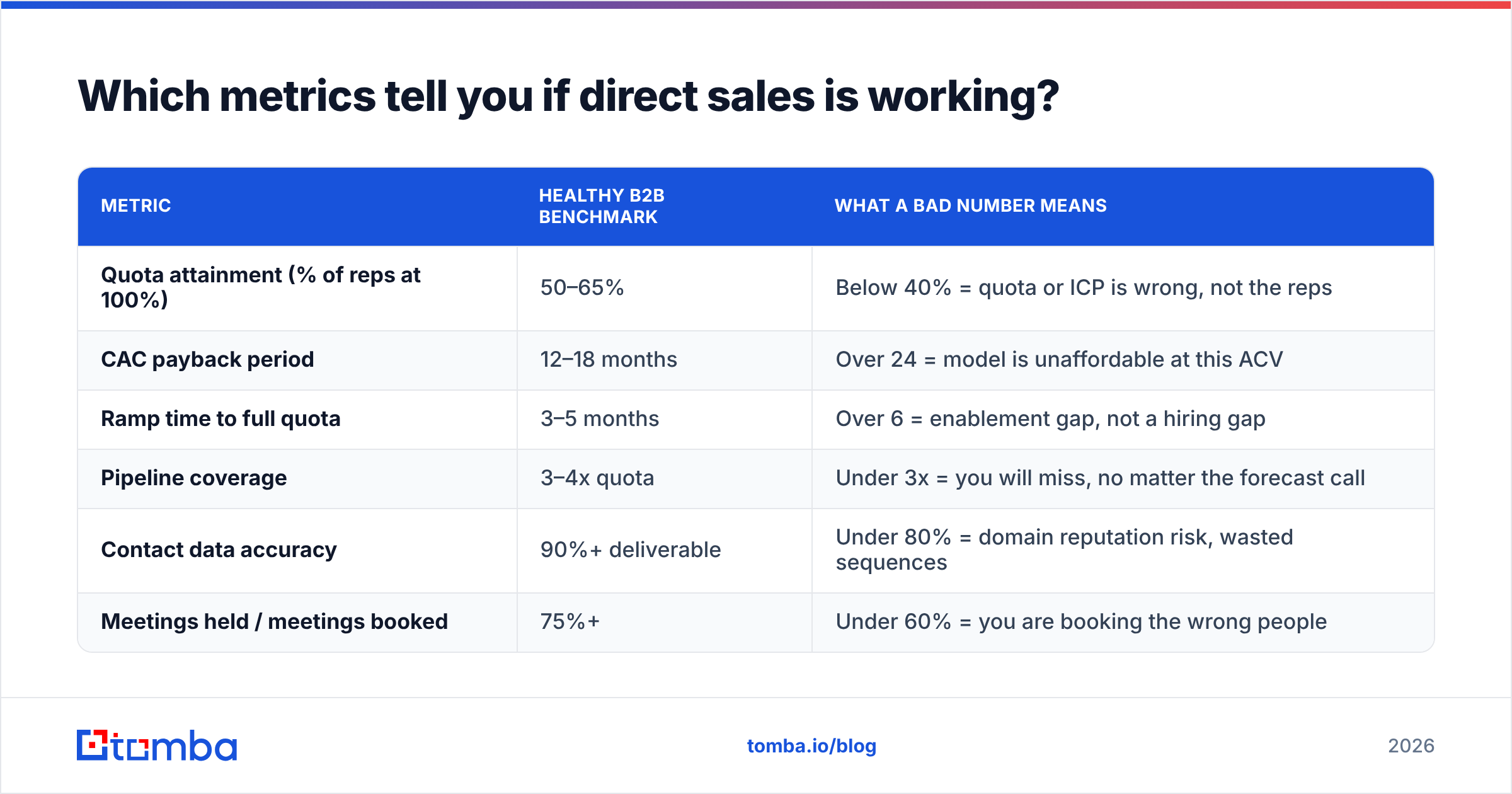
Pipeline coverage and win rate are table stakes. These five are the ones that predict trouble early:
| Metric | Healthy B2B benchmark | What a bad number means |
|---|---|---|
| Quota attainment (% of reps at 100%) | 50–65% | Below 40% = quota or ICP is wrong, not the reps |
| CAC payback period | 12–18 months | Over 24 = model is unaffordable at this ACV |
| Ramp time to full quota | 3–5 months | Over 6 = enablement gap, not a hiring gap |
| Pipeline coverage | 3–4x quota | Under 3x = you will miss, no matter the forecast call |
| Contact data accuracy | 90%+ deliverable | Under 80% = domain reputation risk, wasted sequences |
| Meetings held / meetings booked | 75%+ | Under 60% = you are booking the wrong people |
That last-but-one row is the sleeper. A 70%-accurate contact list does not just waste time — it torches your sender reputation with bounces, which then suppresses the deliverability of every clean email you send afterward. One bad list poisons the whole quarter.
What does a direct sales stack cost in 2026?#
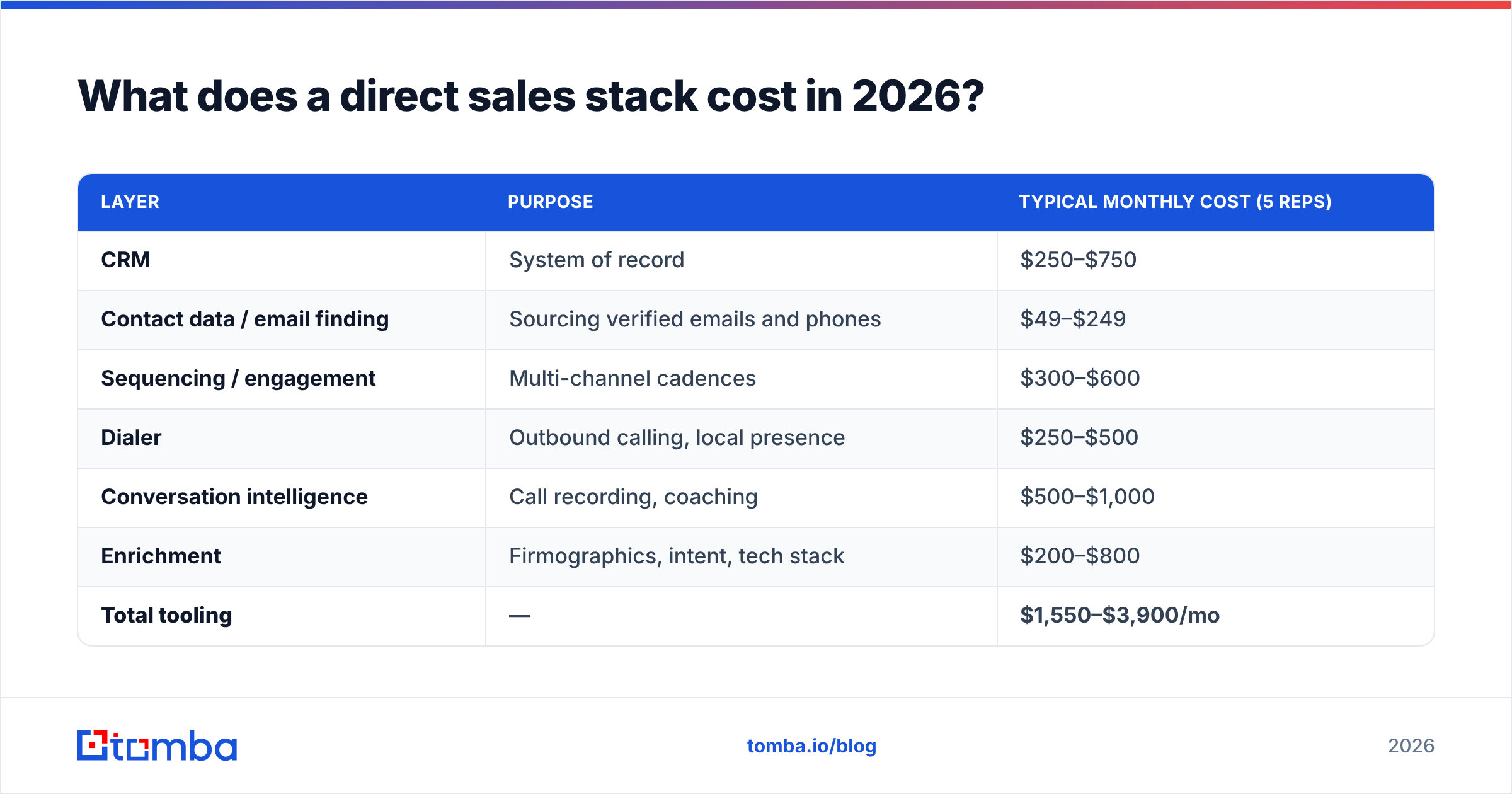
Assume a five-rep team. Rough monthly ranges:
| Layer | Purpose | Typical monthly cost (5 reps) |
|---|---|---|
| CRM | System of record | $250–$750 |
| Contact data / email finding | Sourcing verified emails and phones | $49–$249 |
| Sequencing / engagement | Multi-channel cadences | $300–$600 |
| Dialer | Outbound calling, local presence | $250–$500 |
| Conversation intelligence | Call recording, coaching | $500–$1,000 |
| Enrichment | Firmographics, intent, tech stack | $200–$800 |
| Total tooling | — | $1,550–$3,900/mo |
| Fully loaded rep cost | Salary, commission, benefits, tax | $75,000–$104,000/mo |
Read those last two rows together. Tooling is 2–4% of what you spend on the people. Underspending on the data layer to save $150/month, while five reps burn hours on manual lookups, is the single most common false economy in direct sales.
For the data layer specifically, an email finder that returns verified addresses with a confidence score is the difference between a sequence that lands and one that bounces. Tomba's Tomba pricing starts at a free tier with 25 searches/month, Starter at $49/mo, Growth at $99/mo, and Pro at $249/mo — which puts a five-rep team's contact data cost below what most teams spend on coffee. Pair it with an email verifier pass before every send, and use domain search when you need the full contact map inside a target account rather than one name at a time.
Other credible options in this layer: BookYourData is strong if you want pay-as-you-go verified B2B records without a subscription commitment, and works well as a complement when you need bulk list coverage in a new segment. Apollo and RocketReach bundle data with sequencing, which suits teams that want one vendor and can accept the trade-off in per-record accuracy.
How do you hire and ramp a direct sales team?#
Hire in pairs, not singles. One rep is a data point; two reps let you separate "the person isn't working" from "the motion isn't working." If both miss, the problem is your ICP or your pricing.
The ramp sequence that actually works:
- Week 1–2: Product and buyer, not pitch. Reps should be able to explain the buyer's job before they explain your features.
- Week 3–4: Shadow and reverse-shadow. They listen to ten calls, then run five with a manager listening.
- Week 5–8: Live pipeline, capped territory. Give them 50 accounts, not 500. Depth teaches faster than volume.
- Week 9–12: Full territory, first close expected. If no close by month four in a sub-$25K ACV motion, dig in now rather than at month six.
- Ongoing: Weekly deal review, monthly call review. Pipeline reviews check status; call reviews change behavior. Do both, separately.
Compensation should be roughly 50/50 base to variable for AEs, 60/40 or 70/30 for SDRs. Accelerators above 100% are not generosity — they are the only thing that makes a rep push a deal into this quarter instead of parking it for next.
What kills direct sales teams most often?#
- Quota set from a board deck, not from capacity. If your top rep did $600K last year, setting $900K for everyone is not ambition, it's attrition.
- Territory churn. Reassigning accounts mid-year destroys the relationship compounding that justified direct sales in the first place.
- Bad data tolerated as normal. Bounce rates above 3% are a fixable process failure, not a cost of doing business. Run a bulk verify pass on any list older than 90 days — B2B contact data decays roughly 2–2.5% per month as people change jobs.
- No handoff discipline. Deals closed on promises the product can't keep churn at renewal and take the CSM's credibility with them.
- Confusing activity with progress. 80 calls a day into a badly defined ICP is not effort. It's noise with a dashboard.
Is direct sales right for your company?#
Run this test. Score one point each:
- Your ACV is above $5,000.
- Your buyer needs approval from at least two other people.
- Your sales cycle is longer than 30 days.
- Customers regularly ask questions your website cannot answer.
- Expansion revenue is or should be more than 30% of new ARR.
Four or five points: direct sales is your primary motion, build it properly. Two or three: run a hybrid — PLG for the tail, a small direct team on the top 20% of accounts by potential. Zero or one: put the money into product and lifecycle marketing instead. You will get more revenue per dollar.
The model is not dying. What died is direct sales as a volume game — hire twenty reps, buy a list, hope. What replaced it is a tighter version: fewer reps, sharper ICP, better data, and a process where the human is deployed only on the parts of the deal that genuinely need a human.
Where should you start?#
Start with the list, not the sequence. Every direct sales problem that looks like a messaging problem is usually a targeting problem wearing a costume.
Pick 100 accounts that match your ICP exactly. Map the real decision-makers inside each one with Tomba Email Finder — search by domain, name, or company, get verified addresses with confidence scoring, and export straight into your CRM or sequencer. The free tier gives you 25 searches to test the accuracy on accounts you already know, before you spend a cent. If the data holds up on companies whose contacts you can verify by hand, it will hold up on the 99 you can't.
Then, and only then, write the email.
Related guides#
Ready to find emails that actually work?
Join 150,000+ professionals who stopped guessing and started sending. Free credits on signup — no credit card required.
Get the Tomba newsletter
Practical outbound tactics and product updates — once every two weeks.
About the author