Direct Sales Channels: How They Work and When to Use Them
Direct sales channels put you in control of the customer relationship — and the cost. Here's how outbound, inside sales, field sales, and self-serve compare in 2026, with real economics.
TL;DR
- A direct sales channel means your company sells to the end customer with no reseller, marketplace, or partner in between — you own the pricing, the data, and the relationship.
- The four working models are self-serve, inside sales, outbound/SDR-led, and field sales. They differ by roughly 40x in cost per closed deal.
- Direct channels win on margin and feedback loops. Indirect channels win on reach and speed into unfamiliar markets. Most companies past $5M ARR run both.
- The single biggest failure mode in direct outbound is not messaging — it's contact data. Bad emails inflate bounce rates, wreck sender reputation, and make a working playbook look broken.
- Pick your channel by deal size: under $2K ACV go self-serve, $2K–$25K go inside sales, $25K+ justifies outbound plus field.
What are direct sales channels?#
A direct sales channel is any route to market where your company sells to the buyer without an intermediary taking a cut or owning the relationship. Your website checkout is a direct channel. Your SDR emailing a VP of Ops is a direct channel. A reseller in Germany, an AWS Marketplace listing, or an affiliate blog is not.
The distinction matters for three concrete reasons:
- Margin. Channel partners typically take 15–35% of first-year revenue. Direct keeps that.
- Data. In a direct channel you see every objection, every churn reason, every pricing conversation. Through a reseller you see an invoice.
- Control. You set the discount policy, the onboarding standard, and the roadmap feedback loop. You also carry the whole cost of acquisition.
That last point is the honest trade. Direct is not free — you are paying with headcount, tooling, and time instead of a partner margin. The question is never "direct or indirect," it's "which motion earns its cost at my deal size."

What are the four types of direct sales channels?#
Most direct sales conversations collapse into "hire SDRs." That's one of four options, and often the wrong one.
- Self-serve / product-led. The buyer finds you, signs up, and pays by card. No human touch. Cost per acquisition is whatever your content and ads cost. Works when the product demonstrates value in under 10 minutes and the price is under a credit-card approval threshold.
- Inside sales. A rep works inbound demo requests and trial signups by video and phone from a desk. Deal cycles run 14–45 days. This is the highest-leverage direct channel for most B2B SaaS between $2K and $25K ACV.
- Outbound / SDR-led. Reps identify accounts that have never heard of you, find the right contact, and start a conversation cold — email, phone, LinkedIn. Highest control over pipeline volume, highest dependence on data quality.
- Field sales. An account executive travels, runs on-site workshops, and works a named account list for six to eighteen months. Only defensible above roughly $50K ACV, or in industries where procurement will not sign without a handshake.
- Founder-led sales. Not a permanent channel, but the correct first one. Before product-market fit, no SDR can articulate the wedge better than the person who built it.
The mistake is running a field-sales cost structure against an inside-sales deal size. That is how companies end up with a 3:1 CAC-to-LTV ratio pointed the wrong way.
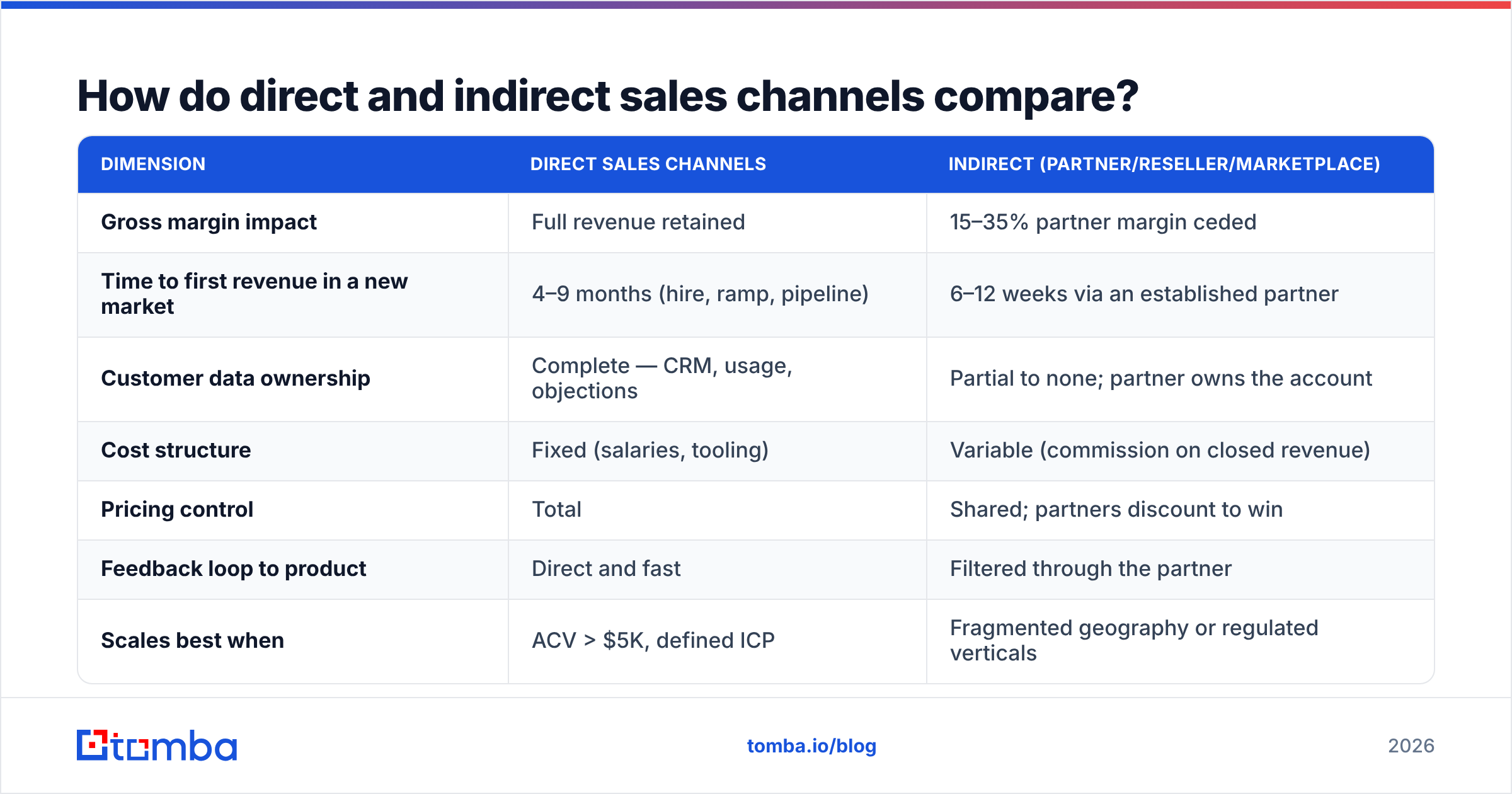
How do direct and indirect sales channels compare?#
| Dimension | Direct sales channels | Indirect (partner/reseller/marketplace) |
|---|---|---|
| Gross margin impact | Full revenue retained | 15–35% partner margin ceded |
| Time to first revenue in a new market | 4–9 months (hire, ramp, pipeline) | 6–12 weeks via an established partner |
| Customer data ownership | Complete — CRM, usage, objections | Partial to none; partner owns the account |
| Cost structure | Fixed (salaries, tooling) | Variable (commission on closed revenue) |
| Pricing control | Total | Shared; partners discount to win |
| Feedback loop to product | Direct and fast | Filtered through the partner |
| Scales best when | ACV > $5K, defined ICP | Fragmented geography or regulated verticals |
| Main risk | High fixed burn before ramp | Channel conflict, brand dilution |
Neither column is the winner. A vertical SaaS selling $80K contracts to US hospitals should be almost entirely direct. The same product entering Japan will move faster with a local partner who already sits in procurement meetings.
What does each direct channel actually cost?#
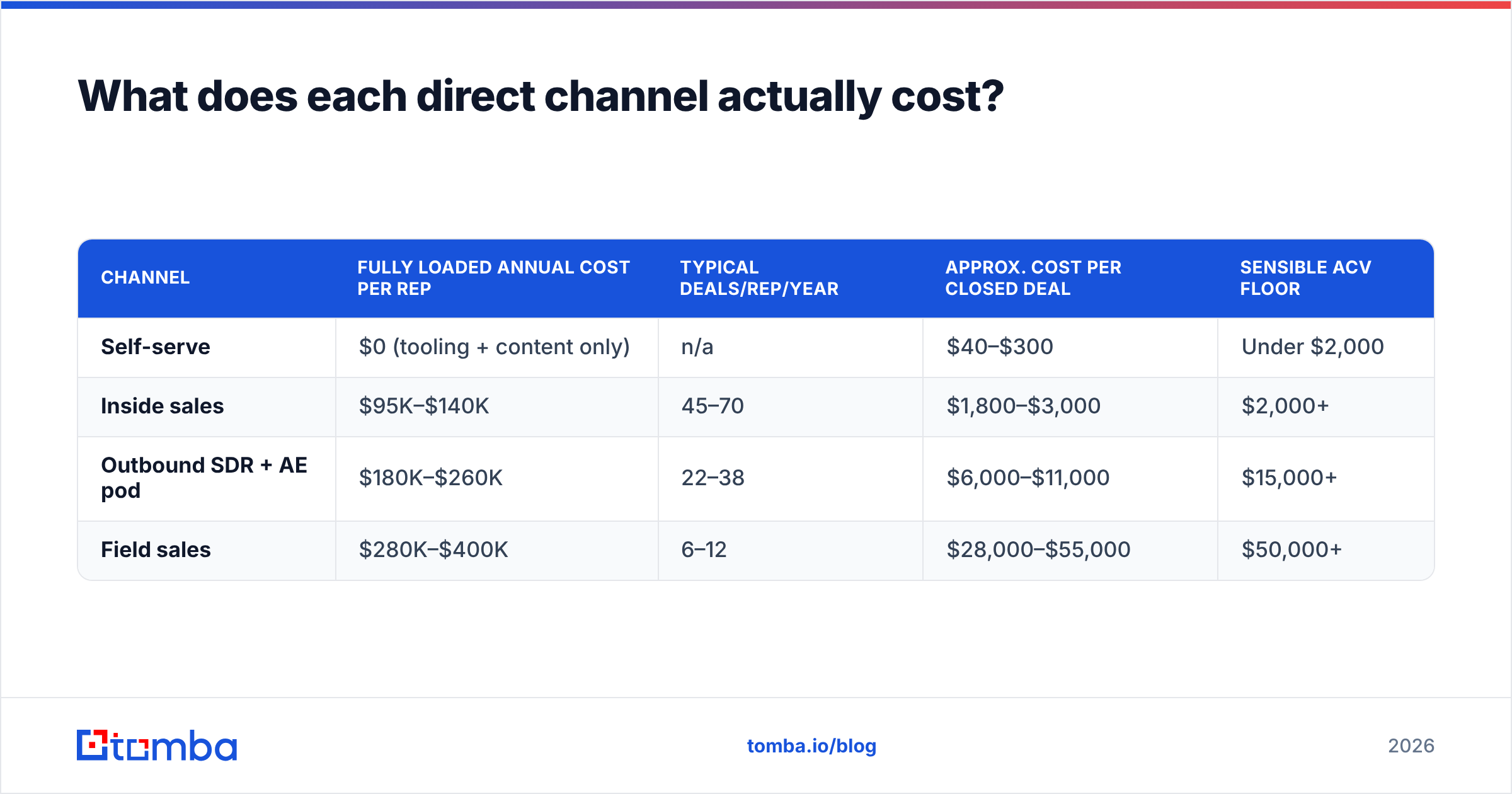
Here is where most channel decisions get made on vibes instead of arithmetic. Rough 2026 North American benchmarks:
| Channel | Fully loaded annual cost per rep | Typical deals/rep/year | Approx. cost per closed deal | Sensible ACV floor |
|---|---|---|---|---|
| Self-serve | $0 (tooling + content only) | n/a | $40–$300 | Under $2,000 |
| Inside sales | $95K–$140K | 45–70 | $1,800–$3,000 | $2,000+ |
| Outbound SDR + AE pod | $180K–$260K | 22–38 | $6,000–$11,000 | $15,000+ |
| Field sales | $280K–$400K | 6–12 | $28,000–$55,000 | $50,000+ |
Fully loaded means base, commission at quota, benefits, management overhead, and tooling. The number that surprises people is the field-sales column — a $30K cost per deal is fine on a $150K contract and catastrophic on a $20K one.
Run this calculation before you hire, not after the first quarter misses. If your ACV cannot absorb the cost-per-deal figure at a 3–5x ratio, that channel is not available to you yet no matter how well the reps perform.
Why does contact data decide whether outbound works?#
Because everything downstream of the contact record inherits its errors.
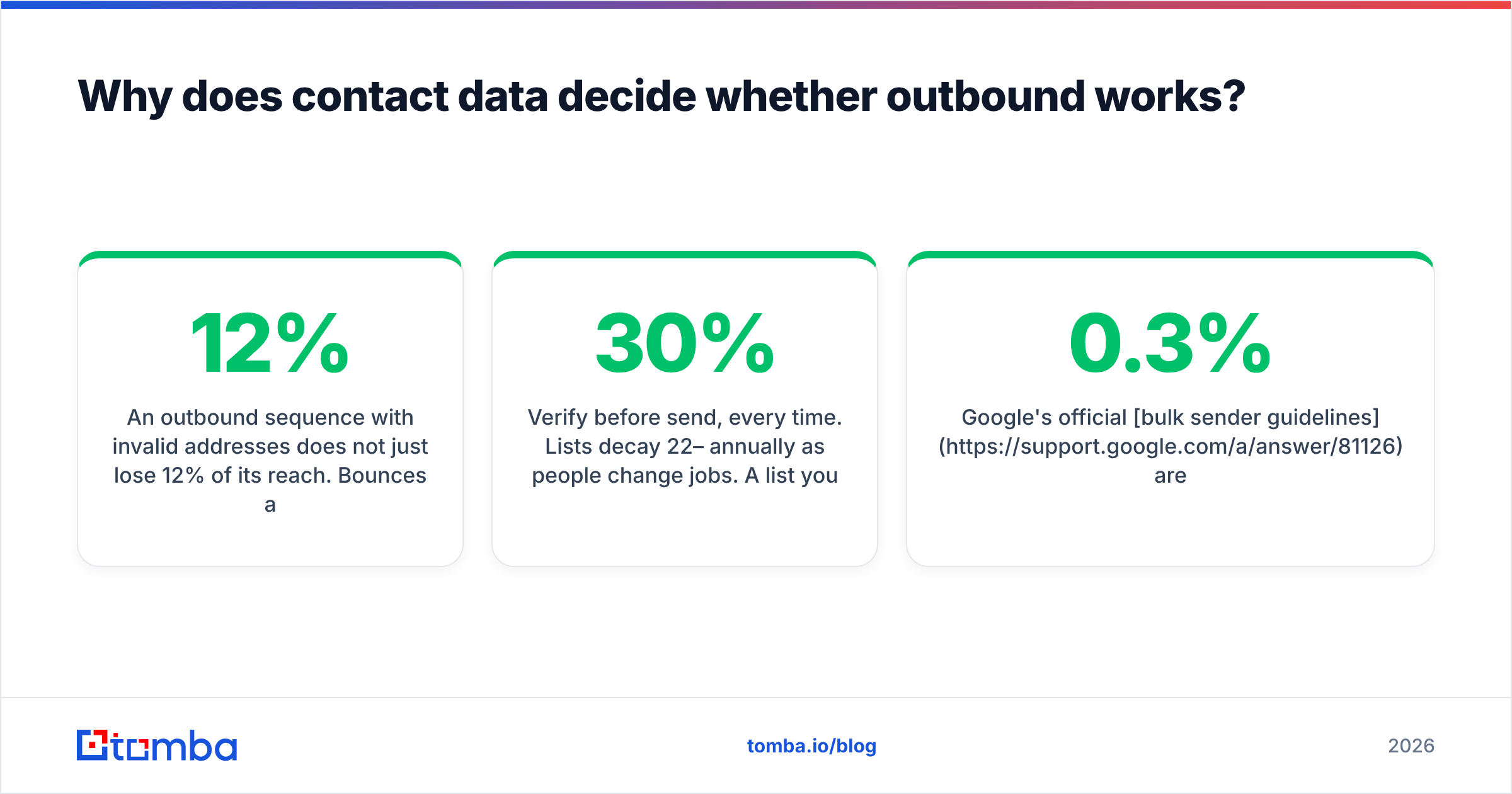
An outbound sequence with 12% invalid addresses does not just lose 12% of its reach. Bounces above roughly 3% start degrading domain reputation with Gmail and Microsoft, which suppresses inbox placement for the 88% of addresses that were fine. You lose the bad contacts, then you lose the good ones, then you conclude that outbound doesn't work.
The fix is unglamorous and mostly mechanical:
- Find contacts at the person level, not the info@ level. A domain search that returns role-holders with titles beats scraping a generic contact page.
- Verify before send, every time. Lists decay 22–30% annually as people change jobs. A list you built in January is meaningfully wrong by July. Run an email verifier pass on every import.
- Handle catch-all domains explicitly. Roughly one in five B2B domains accepts all mail at the SMTP layer, which means a standard verification returns "unknown." A dedicated catch-all verifier resolves a large share of those instead of forcing you to guess.
- Keep enrichment attached to the record. Title, seniority, headcount, and tech stack are what make personalization possible at volume. Data enrichment that runs on write, not as a quarterly cleanup project, is the difference.
- Watch the reputation signals. Bounce rate, spam complaint rate, and sender reputation are the early-warning system for a direct channel that is about to stop producing meetings.
Google's official bulk sender guidelines are explicit that complaint rates must stay under 0.3% and that authentication is mandatory. Those thresholds are the actual constraint on outbound volume — not your rep's capacity.
How do you pick the right direct channel mix?#
Work through these in order. Each one eliminates options.
- Start with ACV. Divide your average contract value by 5. That's your ceiling for cost per closed deal. Cross off every channel above it in the cost table.
- Check buyer behavior. Does your buyer research and purchase software independently, or does procurement require a named vendor contact? Self-serve dies instantly in the second case.
- Measure the education gap. If prospects already know they have the problem, inbound plus inside sales is enough. If you're creating category awareness, you need outbound — nobody searches for a solution they don't know exists.
- Count your addressable accounts. Under 2,000 target accounts means a named-account approach with deep research. Over 50,000 means volume systems and automation.
- Audit what you can staff. A great outbound motion needs an SDR manager, a data operator, and content support. Hiring two SDRs into a vacuum reliably fails and reliably gets blamed on the SDRs.
Most companies land on a stacked model: self-serve for the long tail, inside sales for the mid-market, and a small outbound pod pointed only at named enterprise accounts. That stack lets each channel absorb the deals it can afford to serve.
What metrics should you track per channel?#
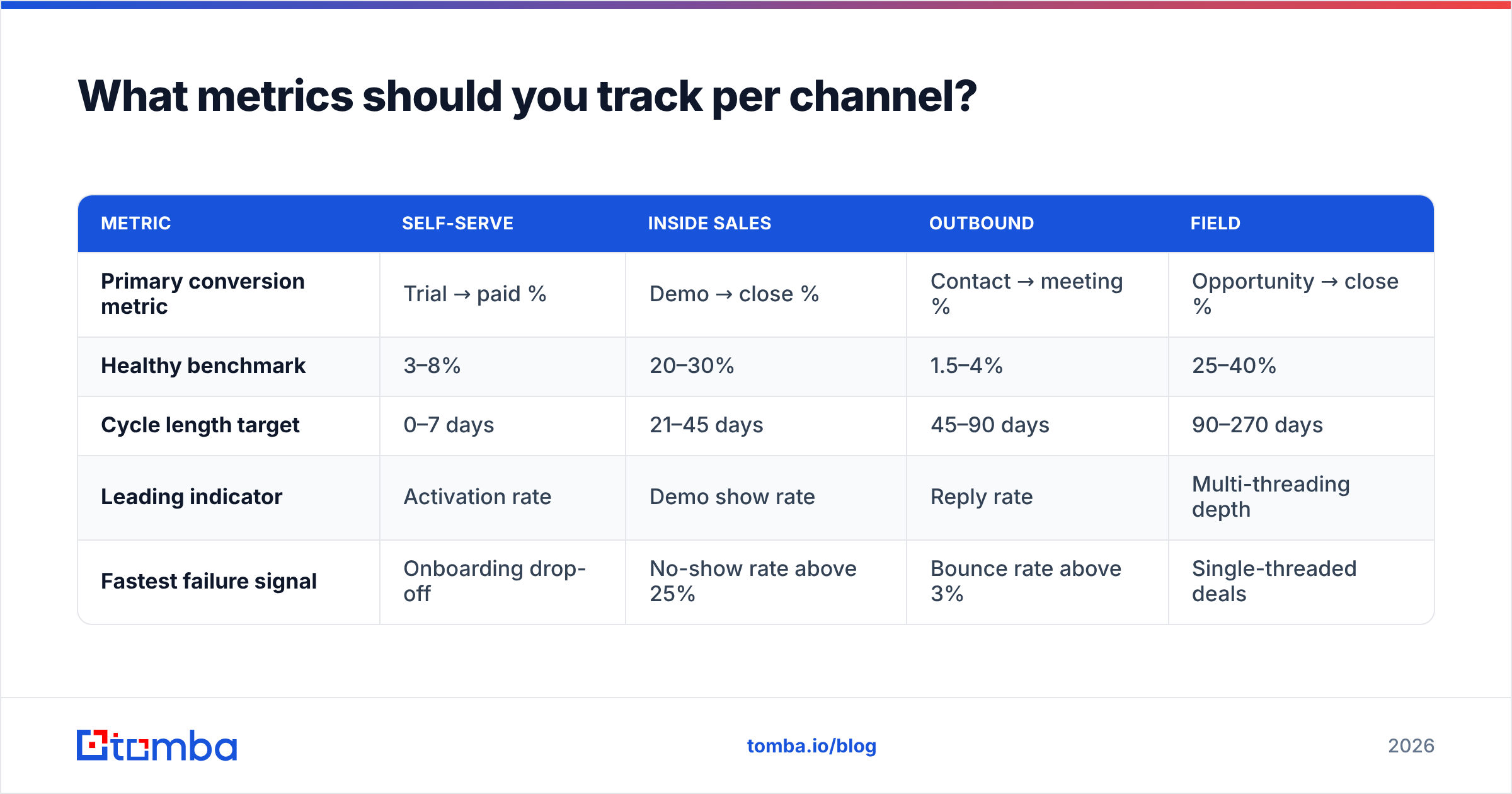
Track these separately per channel. Blended numbers hide the channel that's quietly losing money.
| Metric | Self-serve | Inside sales | Outbound | Field |
|---|---|---|---|---|
| Primary conversion metric | Trial → paid % | Demo → close % | Contact → meeting % | Opportunity → close % |
| Healthy benchmark | 3–8% | 20–30% | 1.5–4% | 25–40% |
| Cycle length target | 0–7 days | 21–45 days | 45–90 days | 90–270 days |
| Leading indicator | Activation rate | Demo show rate | Reply rate | Multi-threading depth |
| Fastest failure signal | Onboarding drop-off | No-show rate above 25% | Bounce rate above 3% | Single-threaded deals |
The response rate column for outbound is the one worth arguing about. A 1.5% contact-to-meeting rate on a well-targeted 3,000-account list produces 45 meetings — enough to feed two AEs. The same rate on a badly built list produces noise, because the denominator includes contacts who were never real.
For broader benchmarking, G2's software buyer behavior research and HubSpot's annual sales reports publish channel-level conversion data worth checking your numbers against. Peers like BookYourData take a pay-as-you-go approach to list building that suits teams running periodic campaigns rather than always-on outbound — a reasonable fit if your direct motion is seasonal.
When should you add an indirect channel on top?#
Add partners when one of these is true, and not before:
- Geographic reach exceeds your hiring plan. You have demand in three countries and headcount for one.
- A regulated buyer requires a local entity. Public sector and healthcare procurement often will not contract with a foreign vendor directly.
- A platform owns the buying moment. If your buyer is already in a marketplace with budget allocated, listing there is cheaper than intercepting them.
- Your product is one component of a larger implementation. Systems integrators sell the project; you sell the piece.
The failure mode is adding partners to fix a broken direct motion. If your direct channel can't convert, handing the same product and the same pitch to a reseller who has ten other products to sell will not fix it — it will just move the failure somewhere you can't observe it.
How do you build the data layer behind a direct channel?#
A direct channel is only as good as the account list feeding it. The practical build order:
- Define the ICP tightly enough to exclude things. "B2B SaaS companies" is not an ICP. "Series A–B SaaS companies, 50–300 employees, with a named RevOps hire" is.
- Build the account list before the contact list. Accounts first, then find the two to four people per account who matter.
- Find and verify in one pass. Sourcing an email and confirming it's deliverable should be one step in your workflow, not two teams and a spreadsheet handoff.
- Push into the CRM with source attribution. You need to know later which list, which enrichment run, and which sequence produced the deal.
- Re-verify on a 90-day cycle. Anything older than a quarter in an untouched segment should be checked again before it gets sent to.
Tomba fits at steps 3 and 5. Free tier is 25 searches/month for testing the workflow; Starter runs $49/mo, Growth $99/mo, and Pro $249/mo, with volume-based Tomba pricing above that. The Tomba API is what you use when this needs to run inside your own enrichment job rather than through a UI.
What's the fastest way to start?#
Pick one channel. Run it for a full sales cycle plus 30 days before judging it. Instrument the five metrics in the table above from day one, because retrofitting attribution onto a running channel is significantly harder than building it in.
If that channel is outbound, start with the list. Use the Tomba Email Finder to build a verified contact set for your first 500 target accounts, run it through verification before the first send, and you'll be diagnosing your messaging instead of your bounce rate. That's the difference between a direct channel you can iterate on and one that just produces confusing numbers.
Related guides#
Ready to find emails that actually work?
Join 150,000+ professionals who stopped guessing and started sending. Free credits on signup — no credit card required.
Get the Tomba newsletter
Practical outbound tactics and product updates — once every two weeks.
About the author