Direct Sales vs Indirect Sales: Which Model Wins in 2026?
Direct sales gives you margin and control. Indirect sales gives you reach and cheap scale. Here's the honest cost, CAC, and margin math on which model fits your ACV — plus how most teams end up running both.
TL;DR
- Direct sales means your own reps own the customer relationship end to end. You keep the full margin, all the data, and all the payroll cost.
- Indirect sales means partners — resellers, distributors, affiliates, marketplaces, VARs — sell on your behalf. You trade 15-40% of revenue for reach you didn't have to hire for.
- The deciding variable is usually ACV, not preference. Under roughly $5K annual contract value, a direct rep rarely pays for themselves. Above $50K, partners rarely handle the complexity well alone.
- Direct wins on margin, control, and feedback loops. Indirect wins on speed to new markets, variable cost, and local trust.
- Most companies past Series A run both, with a written rule of engagement to stop channel conflict. That's not a compromise — it's the mature end state.
What is direct sales?#
Direct sales is when your company sells to the end customer with no intermediary. Your SDR books the meeting, your AE runs the demo, your CS team onboards, and your logo goes on the invoice.
Think of it like a restaurant that owns its own dining room. You control the menu, the pricing, the service, and every dollar the customer spends stays in the building. You also pay the rent, the chefs, and the servers whether the seats are full or not.
Concretely, direct sales covers:
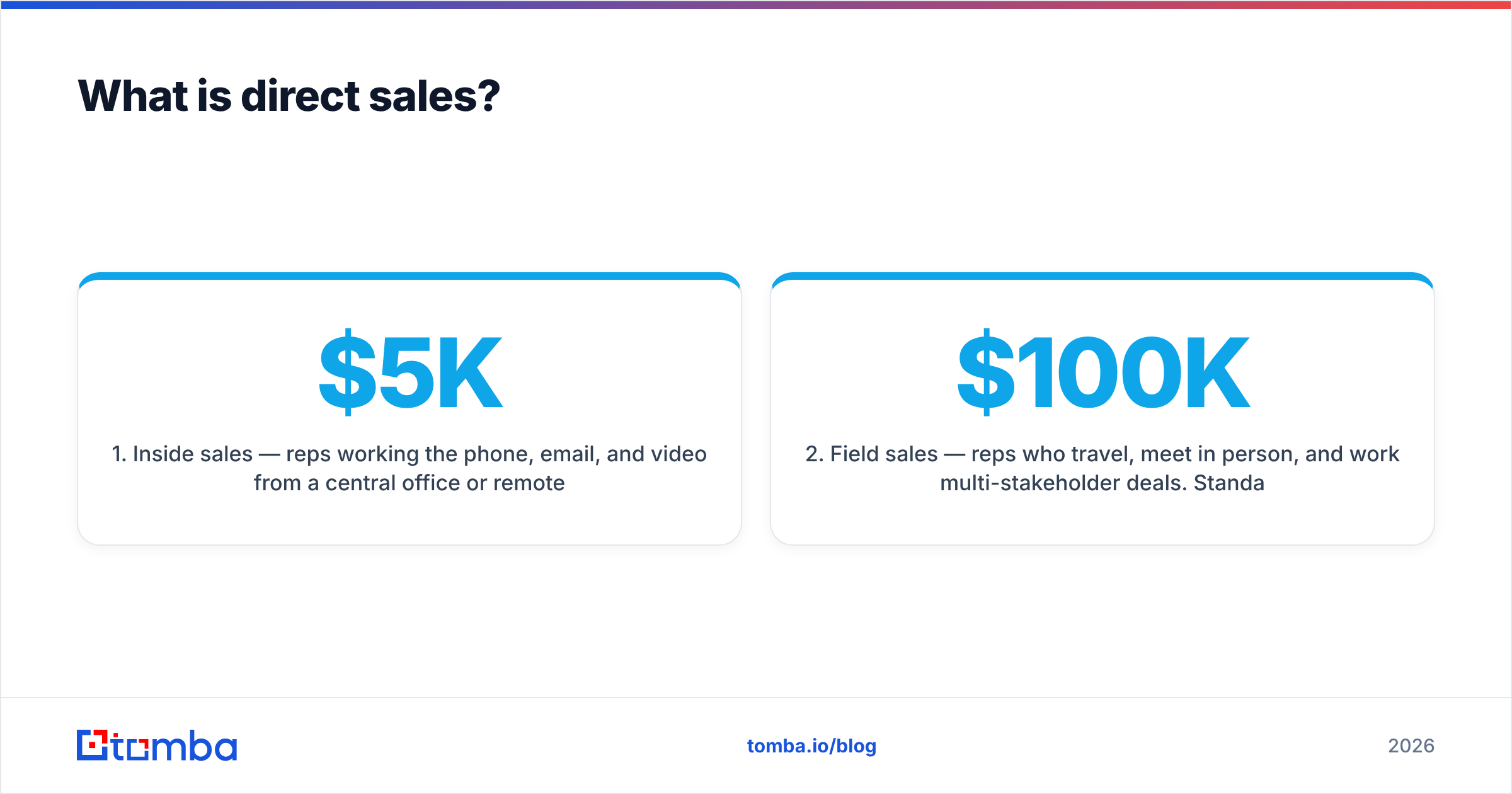
- Inside sales — reps working the phone, email, and video from a central office or remotely. The dominant model for SaaS between $5K and $100K ACV.
- Field sales — reps who travel, meet in person, and work multi-stakeholder deals. Standard above $100K ACV or in industries where a handshake still closes.
- Self-serve / PLG — no rep at all, but still direct. The customer buys from your site. Cheapest possible direct motion, and the reason so many tools now put a credit card form before a demo form.
- Outbound prospecting — you build the list, you find the contacts, you own the sequence. This is where a solid email finder and disciplined list hygiene decide whether the model works at all.
The defining trait isn't the channel — it's ownership. In direct sales, you own the customer record, the pricing conversation, the renewal, and the blame.

What is indirect sales?#
Indirect sales routes revenue through a third party who owns some or all of the customer relationship. You supply the product; the partner supplies the audience, the trust, or the local presence.
The main flavors:
- Resellers / VARs — buy at a discount, sell at list, keep the spread. Value-added resellers bundle in implementation or hardware.
- Distributors — sell to resellers, not end users. Common in hardware, security, and anything with regional compliance friction.
- Referral / affiliate partners — send you leads, take a percentage. Lowest commitment on both sides. Tomba's own affiliate program is this shape.
- Marketplaces — AWS Marketplace, Salesforce AppExchange, Shopify App Store. You get discovery and procurement rails; they take 3-20%.
- OEM / white-label — your product ships inside someone else's, often unbranded. Highest volume potential, lowest brand equity.
- Agencies and consultancies — implement your product as part of a larger engagement and influence the buying decision without formally reselling.
Indirect isn't "outsourced sales." It's borrowed distribution. The partner is monetizing an audience relationship they already built, and you're renting it.
Direct sales vs indirect sales: how do they actually compare?#
Here's the honest side-by-side. Numbers reflect typical B2B SaaS ranges — your mileage varies by vertical.
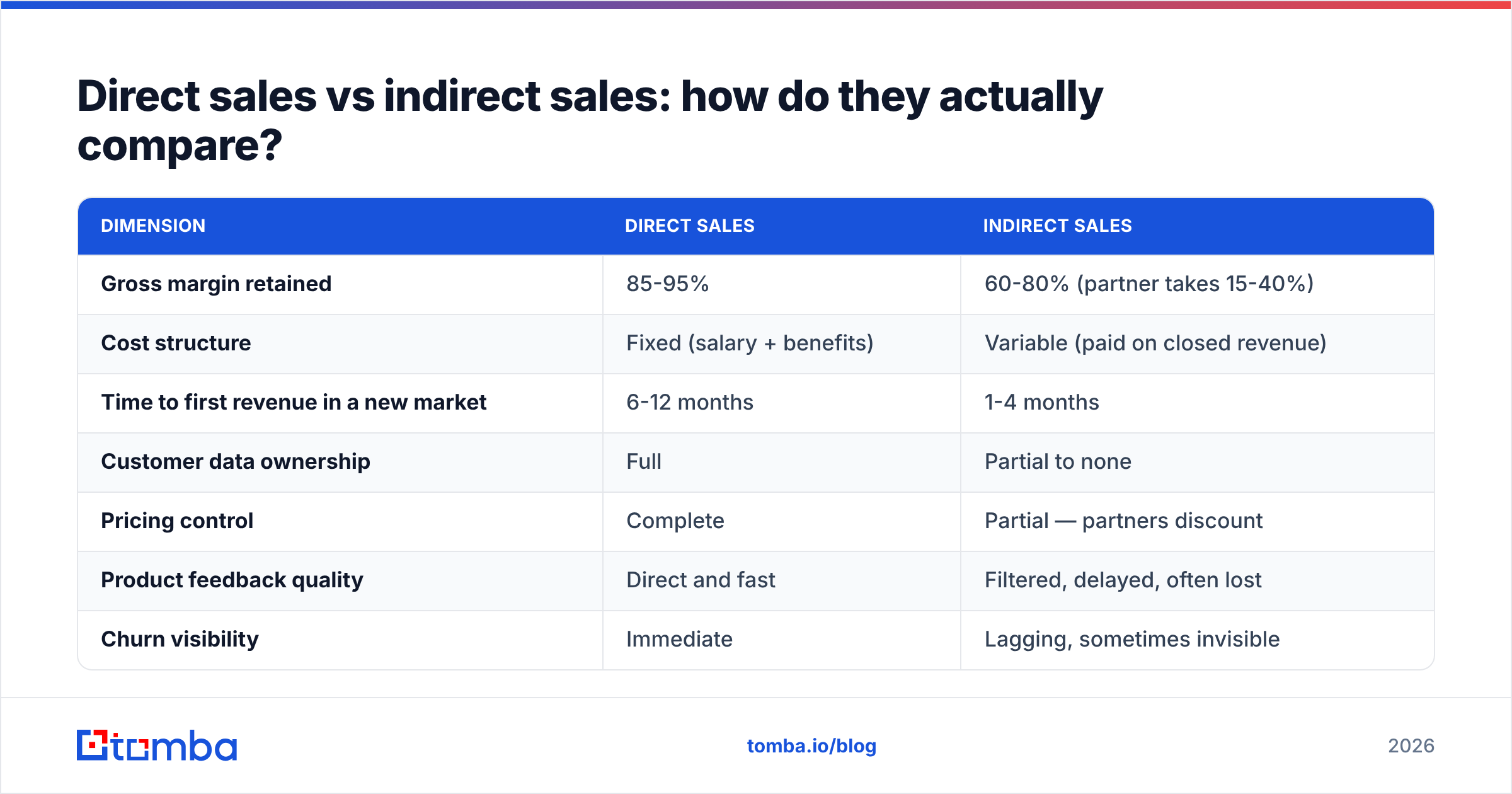
| Dimension | Direct sales | Indirect sales |
|---|---|---|
| Gross margin retained | 85-95% | 60-80% (partner takes 15-40%) |
| Cost structure | Fixed (salary + benefits) | Variable (paid on closed revenue) |
| Time to first revenue in a new market | 6-12 months | 1-4 months |
| Customer data ownership | Full | Partial to none |
| Pricing control | Complete | Partial — partners discount |
| Product feedback quality | Direct and fast | Filtered, delayed, often lost |
| Churn visibility | Immediate | Lagging, sometimes invisible |
| Typical CAC payback | 12-24 months | 6-14 months |
| Scales best at ACV | $10K-$500K+ | $500-$25K, or geo-constrained deals |
| Brand control | Total | Depends on partner behavior |
| Ramp cost per new seller | $50K-$120K (hire + ramp) | $2K-$15K (enablement + portal) |
| Deal complexity handled | High | Low to medium |
Read the table as a trade curve, not a scoreboard. Every advantage on one side has a matching cost on the other. Direct margin is high because you carry fixed payroll. Indirect scales cheaply because you gave up the customer conversation.
Which model is cheaper — and does CAC tell the truth?#
Indirect looks cheaper on a spreadsheet and often isn't. Here's the math people skip.
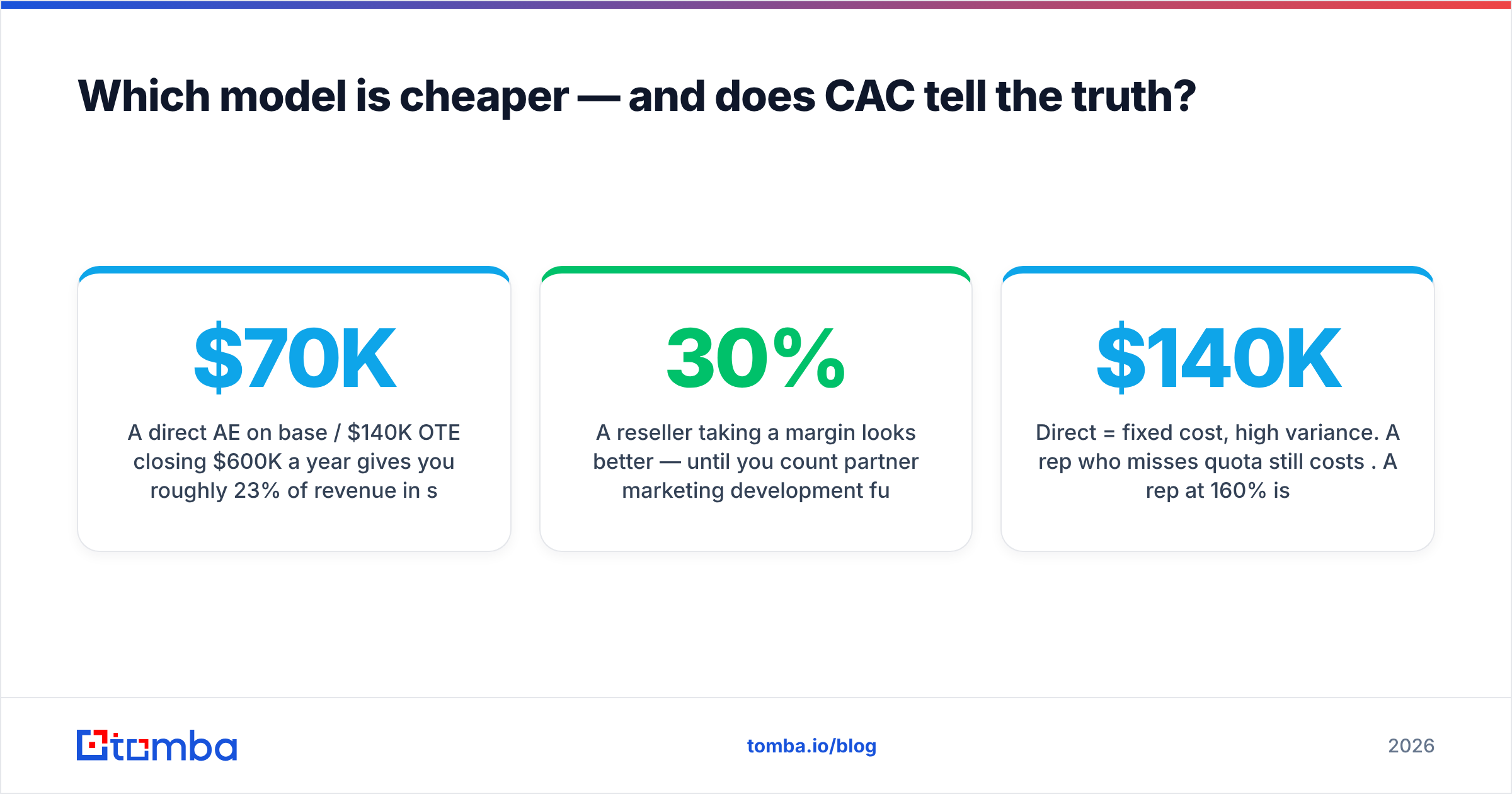
A direct AE on $70K base / $140K OTE closing $600K a year gives you roughly 23% of revenue in seller cost, before SDR support, tooling, and management. Add those and you're near 35-40% fully loaded.
A reseller taking a 30% margin looks better — until you count partner marketing development funds (MDF), the channel account manager you hired at $110K to keep 40 partners alive, the enablement content, the deal-reg portal, and the 20% of registered deals that leak to a competitor's partner anyway. Fully loaded indirect often lands at 35-45%.
The real difference isn't cost level. It's cost shape:
- Direct = fixed cost, high variance. A rep who misses quota still costs $140K. A rep at 160% is the best deal in your P&L.
- Indirect = variable cost, low variance. You pay only on revenue. But you also can't force a partner to sell more this quarter — they have their own priorities, and your product is one of forty in their catalog.
If you have cash and want predictable ownership, direct is the safer bet. If cash is tight and you need coverage across ten countries next year, indirect is the only realistic path.
One more caveat worth naming: partner-sourced pipeline is notoriously hard to attribute. Forrester's channel research has flagged for years that most vendors can't cleanly separate partner-sourced from partner-influenced revenue, which means channel ROI numbers you see in board decks are usually generous.
When should you choose direct sales?#
Pick direct when any of these are true:
- Your ACV is above $25K. Complex deals need someone who knows the roadmap, can negotiate terms, and can escalate internally. Partners rarely have that depth.
- Your product is early or changing fast. Enabling 30 partners on a product that ships breaking changes monthly is a full-time job that produces bad demos.
- You need product feedback. Direct is the only model where the person hearing the objection can walk it to engineering the same day.
- Your market is concentrated. If 400 accounts represent 80% of your TAM, you don't need distribution — you need four good reps and a clean target list.
- Compliance or security review is heavy. Enterprise procurement wants the vendor in the room, not a reseller relaying answers.
Direct also demands operational discipline that indirect doesn't. Your reps live or die on data quality: a target list built from stale contacts burns the same hours as a good one. Verified contact data — run through an email verifier before it ever hits a sequence — is the difference between a 40% and a 12% connect rate. Weak data also silently wrecks email deliverability, which compounds across every future campaign from that domain.
When should you choose indirect sales?#
Go indirect when:
- Your ACV is under $10K and your TAM is huge. The unit economics of a rep don't work; the economics of 200 affiliates do.
- You're entering a market you don't understand. Language, procurement norms, and local vendor lists take years to learn. A local partner already has them.
- Your product plugs into someone else's workflow. If agencies already implement adjacent tools, they'll happily bolt yours on.
- You need to scale coverage faster than you can hire. Recruiting and ramping 20 reps takes a year. Signing 20 partners takes a quarter.
- Procurement rails matter. Selling through AWS Marketplace lets a buyer spend committed cloud budget. That alone closes deals a direct rep can't.
The failure mode to watch: signing partners and assuming they'll sell. They won't. Partner programs follow a brutal power law — typically 10-20% of partners produce 80%+ of channel revenue. Everyone else signs the agreement, downloads the deck, and never sends a lead. Budget for recruiting three to five times more partners than you need producers.

Can you run both without causing channel conflict?#
Yes, and most companies past $10M ARR do. The mechanism is a written rule of engagement — not goodwill.
What actually works:
- Segment by deal size. Direct owns anything above a threshold (say $50K ACV); partners own everything below. Simple, enforceable, and nobody argues about it in a QBR.
- Segment by geography. Direct covers your home market; partners own regions where you have no legal entity. Clean lines, obvious ownership.
- Segment by vertical. Partners with deep healthcare or government expertise own those verticals outright, direct takes the rest.
- Deal registration with teeth. First to register owns the deal for 90 days, full stop. If your direct team can override registrations, your partners will quietly stop registering — and then you've lost pipeline visibility entirely.
- Compensate direct reps on partner-sourced deals in their territory. This is the single most effective anti-conflict lever. If a rep loses commission when a partner closes in their patch, they will sabotage the partner. Pay them anyway; it costs less than the conflict.
The teams that get this wrong usually skipped step 4 or 5. Channel conflict is almost never a partner problem — it's a comp plan problem.
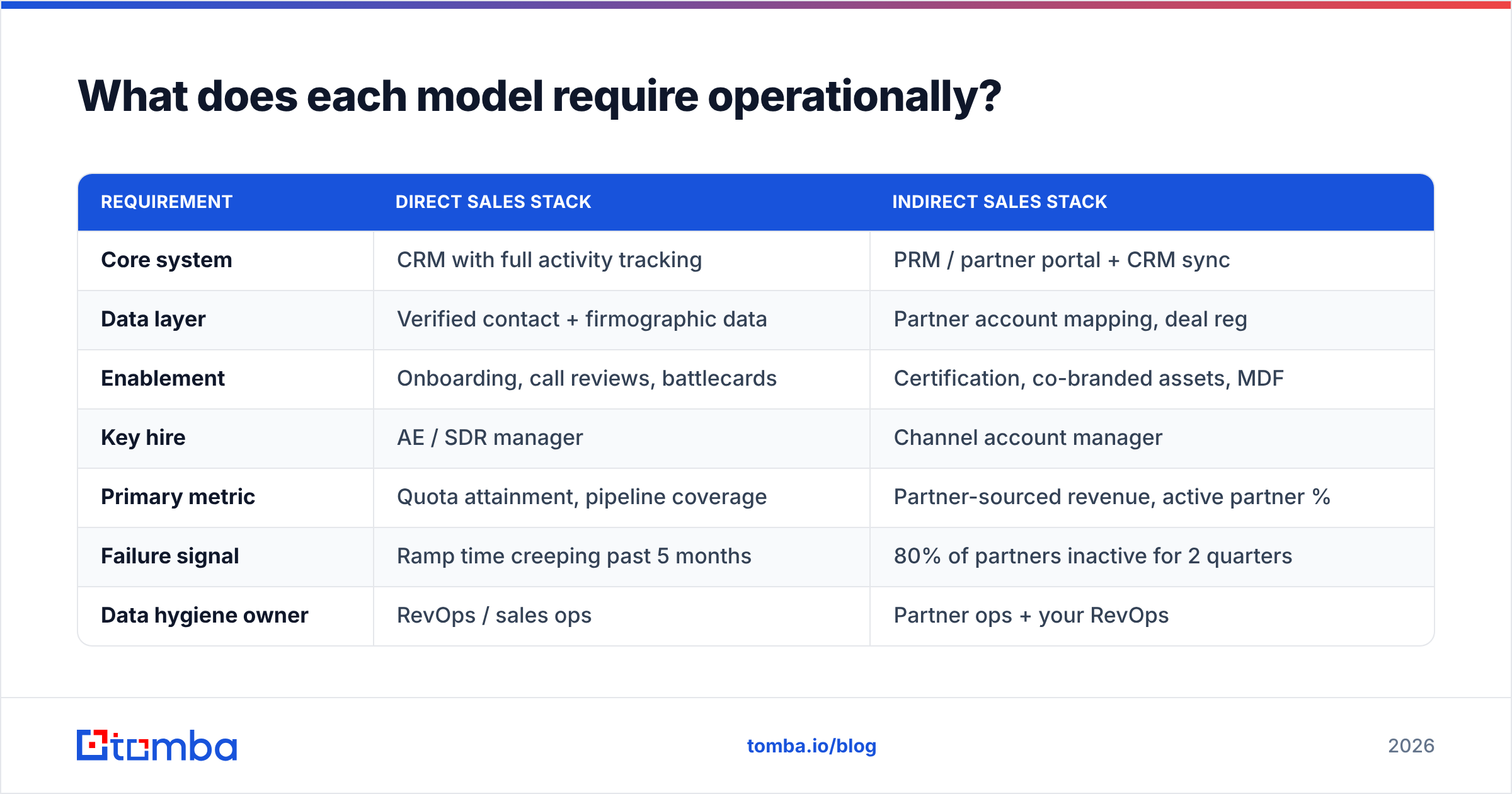
What does each model require operationally?#
Different models, different infrastructure. Here's what you actually have to build.
| Requirement | Direct sales stack | Indirect sales stack |
|---|---|---|
| Core system | CRM with full activity tracking | PRM / partner portal + CRM sync |
| Data layer | Verified contact + firmographic data | Partner account mapping, deal reg |
| Enablement | Onboarding, call reviews, battlecards | Certification, co-branded assets, MDF |
| Key hire | AE / SDR manager | Channel account manager |
| Primary metric | Quota attainment, pipeline coverage | Partner-sourced revenue, active partner % |
| Failure signal | Ramp time creeping past 5 months | 80% of partners inactive for 2 quarters |
| Data hygiene owner | RevOps / sales ops | Partner ops + your RevOps |
Both models need clean data underneath. Direct teams need it for prospecting; indirect teams need it for account mapping — figuring out which of your target accounts a partner already has a relationship with. That mapping exercise fails without accurate company and contact records, which is why data enrichment shows up in both stacks.
For direct teams specifically, the prospecting layer is where most of the leverage is. Running domain search across a target account list gives your reps every relevant contact at a company in one pass, rather than hunting one name at a time. For channel teams, the same capability powers partner recruitment — you're prospecting for partners using the exact same motion.
How do you decide? A quick decision framework#
Run your business through these five questions. Three or more "direct" answers means build direct first.
- What's your ACV? Under $5K → indirect. $5K-$25K → either, test both. Over $25K → direct.
- How complex is implementation? Plug-and-play → indirect works. Requires services, integration, or change management → direct, or VARs who deliver services.
- How fast is your product changing? Weekly releases → direct. Stable quarterly cadence → indirect is viable.
- How much cash do you have? 18+ months runway → direct is affordable. Under 12 → indirect's variable cost is safer.
- Is your buyer geographically concentrated or dispersed? Concentrated → direct. Dispersed across regions or languages → indirect.
A caveat on sequencing: it is far easier to add indirect on top of a working direct motion than the reverse. Direct teaches you the objections, the pricing elasticity, and the ICP. Partners can't discover those for you — they'll just report that your product "didn't fit." Nail direct on a small segment, document what works, then hand that playbook to partners.
What most teams get wrong#
- Launching channel to fix a broken direct motion. If your reps can't sell it, partners definitely can't. Channel amplifies a working motion; it doesn't repair a broken one.
- Treating partners as a headcount substitute. A partner will invest in you proportional to what you invest in them. No enablement, no leads, no revenue.
- Ignoring the data layer. Both models die on bad records. Direct reps burn hours on bounced sends; channel teams can't map accounts they can't identify. Start from a clean B2B database and enforce verification at the point of import.
- No exit clause. Exclusive territory deals signed in year one become anchors in year four. Cap exclusivity with performance thresholds.
- Measuring channel with direct metrics. Partner-sourced revenue ramps on a different curve. Judging a nine-month-old partner program against a mature direct team's quota attainment guarantees you kill it early.
If you want a broader vocabulary for these motions before you brief your board, G2's channel software category and HubSpot's sales strategy library both maintain useful primers on program structure and partner economics.
The verdict#
Direct sales and indirect sales aren't competing philosophies — they're different answers to the question "who is cheapest to put in front of this specific buyer?"
If your buyer is high-value, complex, and reachable by your own team, direct wins on margin and learning speed. If your buyer is small, numerous, or hiding behind a language or procurement barrier you can't cross, indirect wins on economics and reach. The strongest go-to-market orgs don't pick one — they define crisp boundaries, pay everyone fairly across those boundaries, and let each motion do what it's good at.
Whichever side you land on, both models run on the same fuel: accurate contact data. Direct reps need verified emails to book meetings; channel teams need clean account records to map partner overlap and recruit new partners. Start there with the Tomba Email Finder — the free tier gives you 25 searches a month to test accuracy against your own target list, and paid plans start at $49/mo on Tomba pricing when you're ready to scale either motion.
Related guides#
Ready to find emails that actually work?
Join 150,000+ professionals who stopped guessing and started sending. Free credits on signup — no credit card required.
Get the Tomba newsletter
Practical outbound tactics and product updates — once every two weeks.
About the author