Direct vs Indirect Competitors: How to Map Both in 2026
Most B2B teams lose deals to companies that never show up in their competitive battlecards. Here's how direct and indirect competitors actually differ, and how to map both without guessing.
TL;DR
- A direct competitor sells a similar product to the same buyer for the same job. An indirect competitor solves the same job with a different product, a different category, or no product at all (spreadsheets, interns, "we'll do it later").
- Direct competitors shape your pricing and feature roadmap. Indirect competitors shape your messaging and category education — and they win the majority of "no decision" losses.
- Closed-lost data usually undercounts indirect competition badly, because reps log the logo they recognize, not the alternative that actually won.
- A usable competitive map needs three layers: direct, indirect, and replacement (the status quo). Two layers is not enough.
- You can build the whole map with public signals — job posts, review sites, hiring pages, tech stacks — plus contact data to actually talk to the buyers who chose someone else.
If you have ever run a win/loss review and found that 40% of your losses are labeled "no decision," you have an indirect competitor problem, not a direct one. And no amount of feature-by-feature battlecard polish will fix it.
What is a direct competitor?#
A direct competitor sells a substitutable product, to the same buyer persona, for the same job to be done, at a roughly comparable price point.
Think of it like two coffee shops on the same block. Same product, same customer, same moment of need. When a buyer picks one, they are explicitly not picking the other, and the decision usually comes down to price, quality, convenience, or brand.
In B2B software, direct competition means:
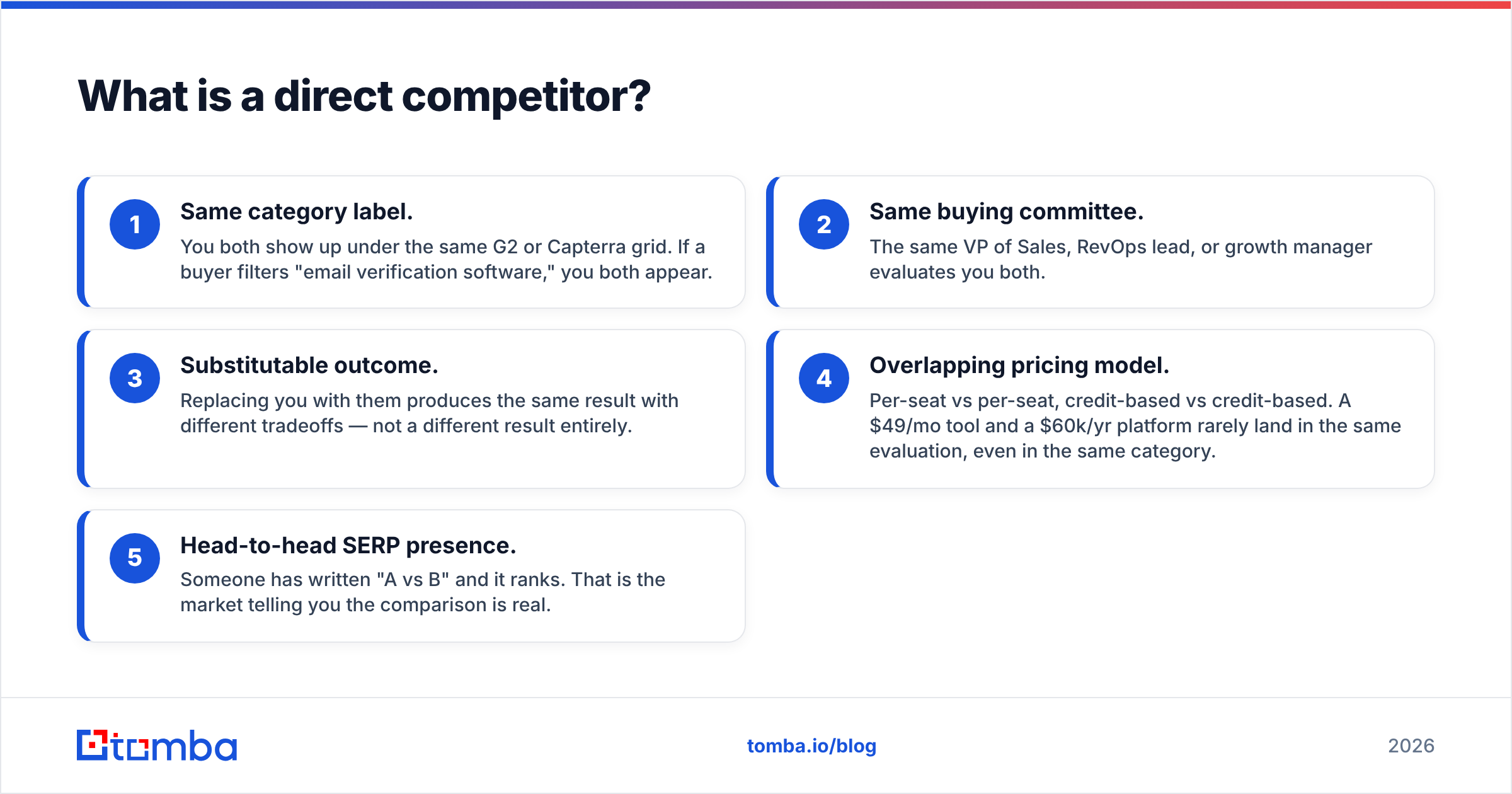
- Same category label. You both show up under the same G2 or Capterra grid. If a buyer filters "email verification software," you both appear.
- Same buying committee. The same VP of Sales, RevOps lead, or growth manager evaluates you both.
- Substitutable outcome. Replacing you with them produces the same result with different tradeoffs — not a different result entirely.
- Overlapping pricing model. Per-seat vs per-seat, credit-based vs credit-based. A $49/mo tool and a $60k/yr platform rarely land in the same evaluation, even in the same category.
- Head-to-head SERP presence. Someone has written "A vs B" and it ranks. That is the market telling you the comparison is real.
Direct competitors are the easy ones to find and the dangerous ones to obsess over. They show up in your CRM, in your sales calls, in your review-site alerts. Because they are visible, teams over-index on them — and end up building a roadmap that wins feature comparisons while losing budget battles.
What is an indirect competitor?#
An indirect competitor solves the same underlying problem with a different mechanism, category, or business model.
The coffee shop analogy holds here too: the coffee shop's indirect competitors are the office Keurig, the energy drink in the vending machine, and the coworker who brings a thermos. None of them sell coffee by the cup. All of them absorb the same demand.
In B2B, indirect competitors come in four recurring shapes:
- Adjacent-category tools. A sales engagement platform that added a built-in data feature competes with standalone data vendors — badly, but for free, which is often enough.
- Bundled suites. The buyer already pays for a large platform that "kind of does this." Procurement loves consolidation more than your product team loves differentiation.
- Services and agencies. Instead of buying a prospecting tool, the buyer hires a lead-gen agency or an offshore researcher. Different line item, same outcome.
- Build-it-yourself. A scraper, a Python script, a Google Sheet with three VLOOKUPs and a maintenance owner who quit six months ago.
Indirect competition is where most revenue leaks, because it never gets logged. A rep who loses to a competitor logs the competitor. A rep who loses to "the client's ops analyst said she'd just do it manually" logs "no decision" and moves on.
How do direct and indirect competitors differ in practice?#
The distinction matters because each type demands a different response. Fighting an indirect competitor with a feature comparison table is how you lose a deal you technically should have won.
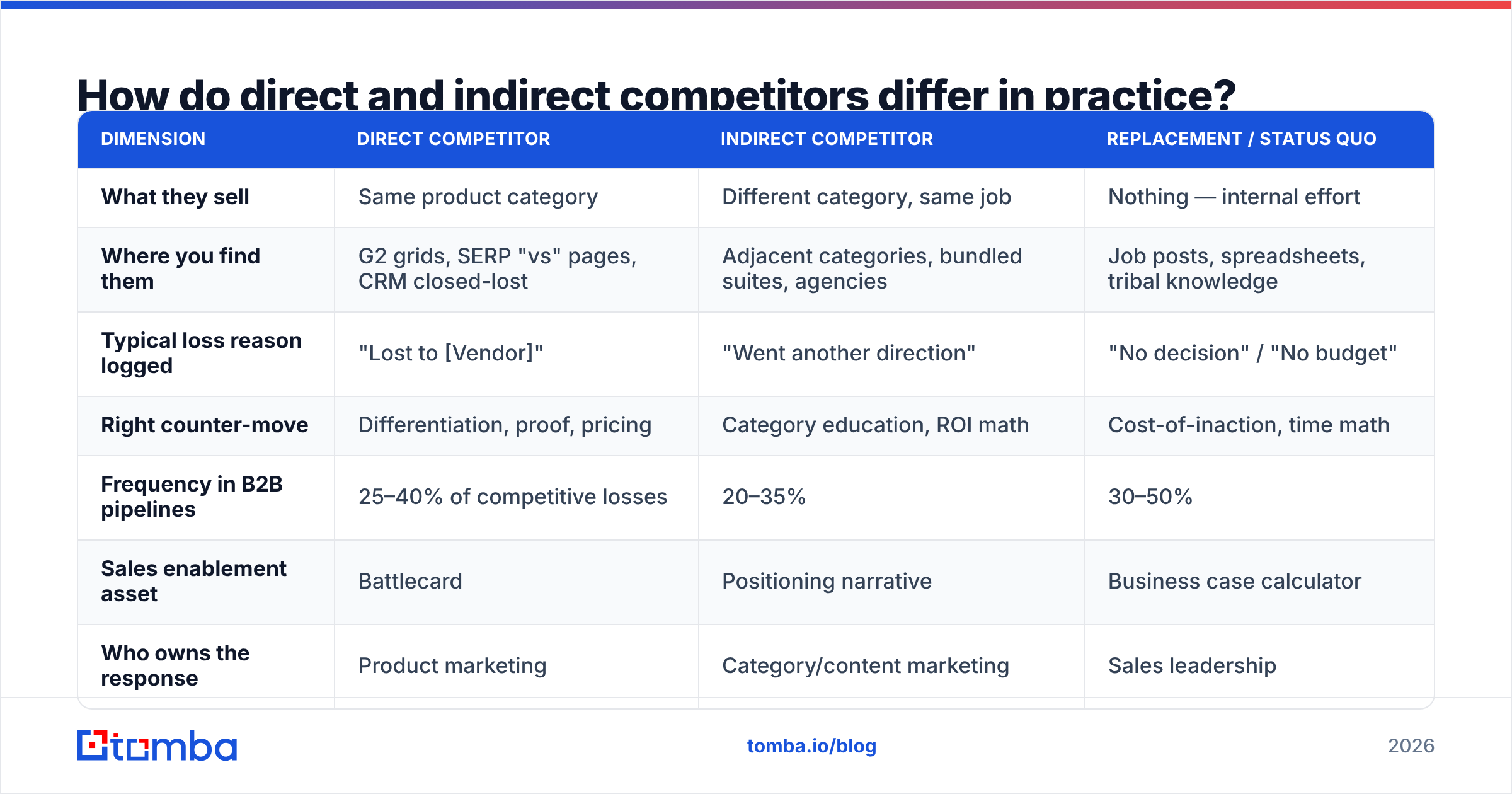
| Dimension | Direct competitor | Indirect competitor | Replacement / status quo |
|---|---|---|---|
| What they sell | Same product category | Different category, same job | Nothing — internal effort |
| Where you find them | G2 grids, SERP "vs" pages, CRM closed-lost | Adjacent categories, bundled suites, agencies | Job posts, spreadsheets, tribal knowledge |
| Typical loss reason logged | "Lost to [Vendor]" | "Went another direction" | "No decision" / "No budget" |
| Right counter-move | Differentiation, proof, pricing | Category education, ROI math | Cost-of-inaction, time math |
| Frequency in B2B pipelines | 25–40% of competitive losses | 20–35% | 30–50% |
| Sales enablement asset | Battlecard | Positioning narrative | Business case calculator |
| Who owns the response | Product marketing | Category/content marketing | Sales leadership |
The frequency column is the uncomfortable one. Most competitive-intel budgets go almost entirely to the first column, while the third column quietly consumes the largest share of pipeline. Gartner's research on B2B buying has consistently found that buying groups spend the majority of their evaluation time on independent research and internal deliberation — not talking to vendors. Most of that deliberation is about whether to solve the problem at all.
Why do most competitive maps miss indirect competitors?#
Three structural reasons, and none of them are laziness.
Your CRM has a picklist problem. The "Primary Competitor" field is a dropdown populated with logos. There is no option for "customer's internal data team," so reps pick the closest logo or leave it blank. Your competitive dashboard then reports on a filtered, self-fulfilling view of the market.
Review sites are category-scoped by design. G2 and Capterra organize by category because that is how buyers browse. That structure is genuinely useful for finding direct competitors and structurally incapable of surfacing indirect ones. A tool that competes with you from an adjacent grid will never appear in your grid's comparison view.
Win/loss interviews happen too late. By the time you interview a lost buyer, they have rationalized the decision into a clean story. "We went with the incumbent" is the story. "Our VP of RevOps had already built a Clay workflow and didn't want to explain a new line item to finance" is what happened.
The fix is not better dropdown hygiene. It is a second research motion that starts from the buyer's job, not from your category.
How do you actually map direct vs indirect competitors?#
Here's the process that produces a map you can act on, ordered by effort.
1. Start from the job, not the category. Write the buyer's problem in their words: "I need verified contact data for 500 target accounts this quarter." Then list every way that sentence gets resolved — a tool, a database, an agency, an intern, a partner referral, doing nothing. That list is your competitive universe. Everything after this is classification.
2. Pull direct competitors from three public sources. G2 and Capterra category grids give you the recognized set. SERP scraping for "[your category] alternatives" and "[your product] vs" gives you the set buyers actually search. Your own closed-lost field gives you the set reps encounter. The union of all three is more honest than any single one.
3. Find indirect competitors in hiring and tech-stack signals. Job postings are the highest-signal public artifact in competitive intel. A company hiring a "Data Operations Analyst — build and maintain prospect lists" has chosen the build path over the buy path. A company posting for "RevOps Manager, experience with Clay and Apollo required" has told you their stack. Run a website tech stack check across your target accounts and you get the buy-side picture at scale.
4. Identify the replacement layer through customer interviews. Ask new customers one question: "What were you doing before us?" Not "who else did you evaluate" — that returns direct competitors. "What were you doing before" returns the status quo you displaced, which is the same thing your lost deals stayed with.
5. Score each competitor on two axes. Threat (how often they appear, how often they win) and addressability (how much a message change moves the outcome). A high-threat, high-addressability indirect competitor — usually the DIY path — deserves more content investment than a direct competitor you already beat 70% of the time.
6. Refresh quarterly, not annually. Categories collapse and merge fast. A tool that was indirect last year ships one feature and becomes direct. Forrester's B2B research has repeatedly flagged category convergence as a core planning risk for exactly this reason.
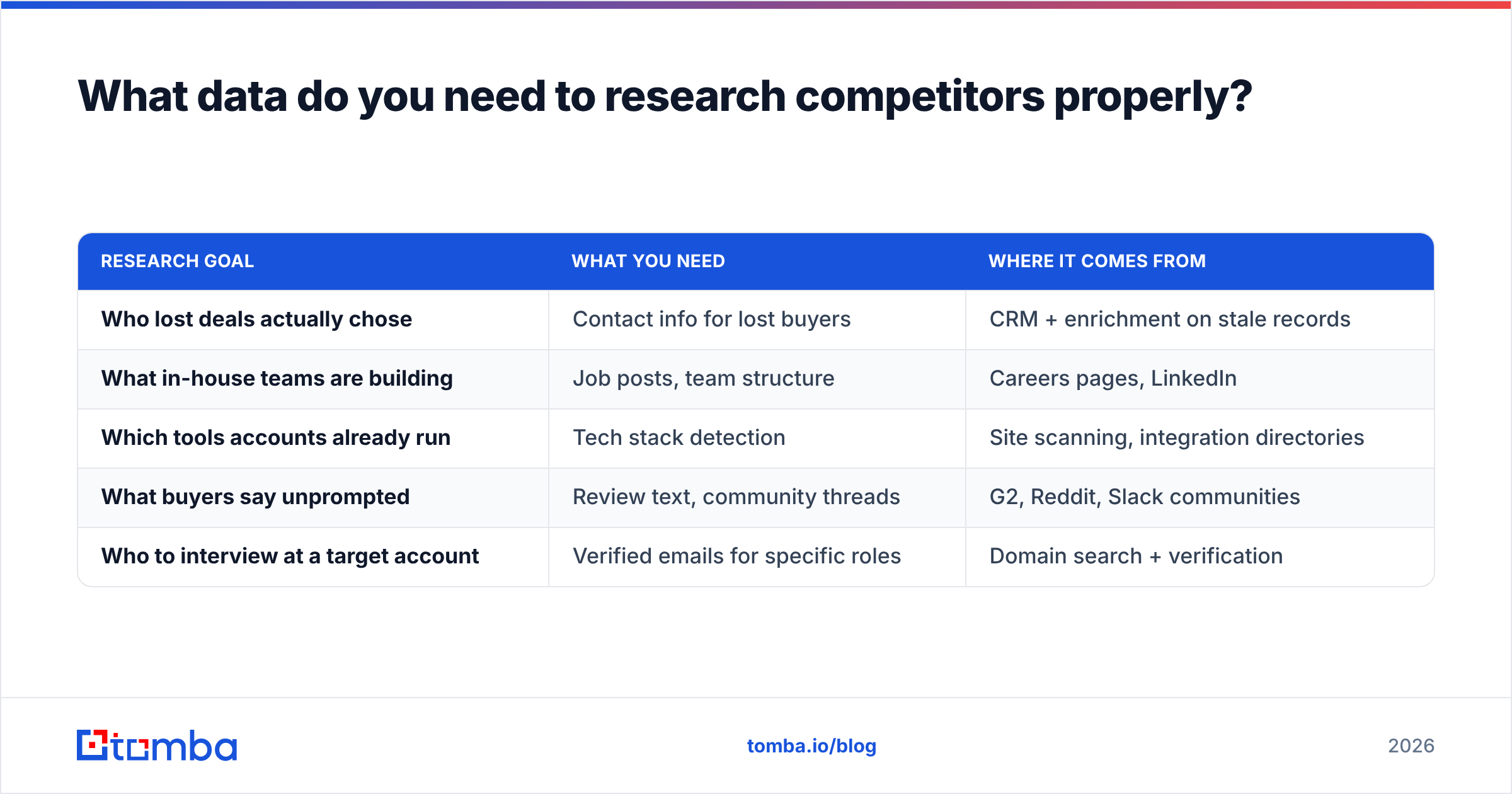
What data do you need to research competitors properly?#
Competitive research fails on access, not analysis. You know what you want to learn; you can't reach the people who know.
The practical needs break down like this:
| Research goal | What you need | Where it comes from |
|---|---|---|
| Who lost deals actually chose | Contact info for lost buyers | CRM + enrichment on stale records |
| What in-house teams are building | Job posts, team structure | Careers pages, LinkedIn |
| Which tools accounts already run | Tech stack detection | Site scanning, integration directories |
| What buyers say unprompted | Review text, community threads | G2, Reddit, Slack communities |
| Who to interview at a target account | Verified emails for specific roles | Domain search + verification |
That last row is where most competitive programs stall. You identify the exact person to interview — the RevOps lead at an account that churned to an indirect competitor — and then you cannot reach them because the CRM email bounced eight months ago.
A domain search against the company domain returns the current contact set by role, and running those through an email verifier before outreach keeps your research emails out of spam folders. It is unglamorous plumbing, but the quality of your competitive map is capped by how many real buyers you can actually talk to.
For teams doing this across dozens of accounts, bulk verify workflows turn a three-week manual research sprint into an afternoon.
Is one type of competitor more dangerous than the other?#
Yes — indirect competitors are more dangerous, for a specific and non-obvious reason: you cannot lose to them on merit.
When you lose to a direct competitor, you get a scoreboard. They had SOC 2 and you didn't. Their integration was native and yours was Zapier. Their price was 20% lower. Every one of those is a solvable input, and you know it is solvable because someone solved it.
When you lose to an indirect competitor, you often don't know you lost. The deal shows as stalled. The buyer goes quiet. Six months later they show up on a webinar talking about the internal tool they built. There is no post-mortem, no feedback, no scoreboard — just a slot in your forecast that never closed.
There is a second asymmetry. Direct competitors validate your category. When BookYourData, Tomba, and a dozen other contact-data vendors all publish about email verification, the collective effect is that buyers learn the category exists and matters. That is genuinely useful. Indirect competitors do the opposite — every time a bundled suite claims "and we do data too," the buyer's perceived need for a specialist shrinks.
So the strategic split looks like this:
- Against direct competitors: compete on proof. Accuracy benchmarks, response-time data, transparent pricing, real customer numbers. Specificity wins.
- Against indirect competitors: compete on scope clarity. Show what "we also do data" actually means in practice — coverage gaps, refresh cadence, bounce rates.
- Against the status quo: compete on math. Hours per week, cost per verified contact, bounce-driven sender reputation damage. Make inaction expensive on a slide.
How should this change your positioning?#
Positioning is downstream of the competitive map, so a map with a missing layer produces messaging with a missing layer.
If your homepage only addresses direct competitors, it reads as "we're better than the tools you already know about." That message only lands on buyers who have already decided to buy something in your category — a minority of your addressable market, and the most contested slice of it.
Add the indirect layer and your messaging gains a second job: explaining why the category deserves a line item at all. That is what "cost of manual research" content does, what ROI calculators do, and what most product-marketing teams under-invest in because it doesn't map to a competitor logo.
A practical test: take your top three marketing pages and ask, for each one, "which competitor type does this page fight?" If all three answer "direct," you have found your gap. HubSpot's positioning framework is a reasonable starting template for rebuilding the missing layer — it forces you to name the alternative explicitly rather than assuming a category.
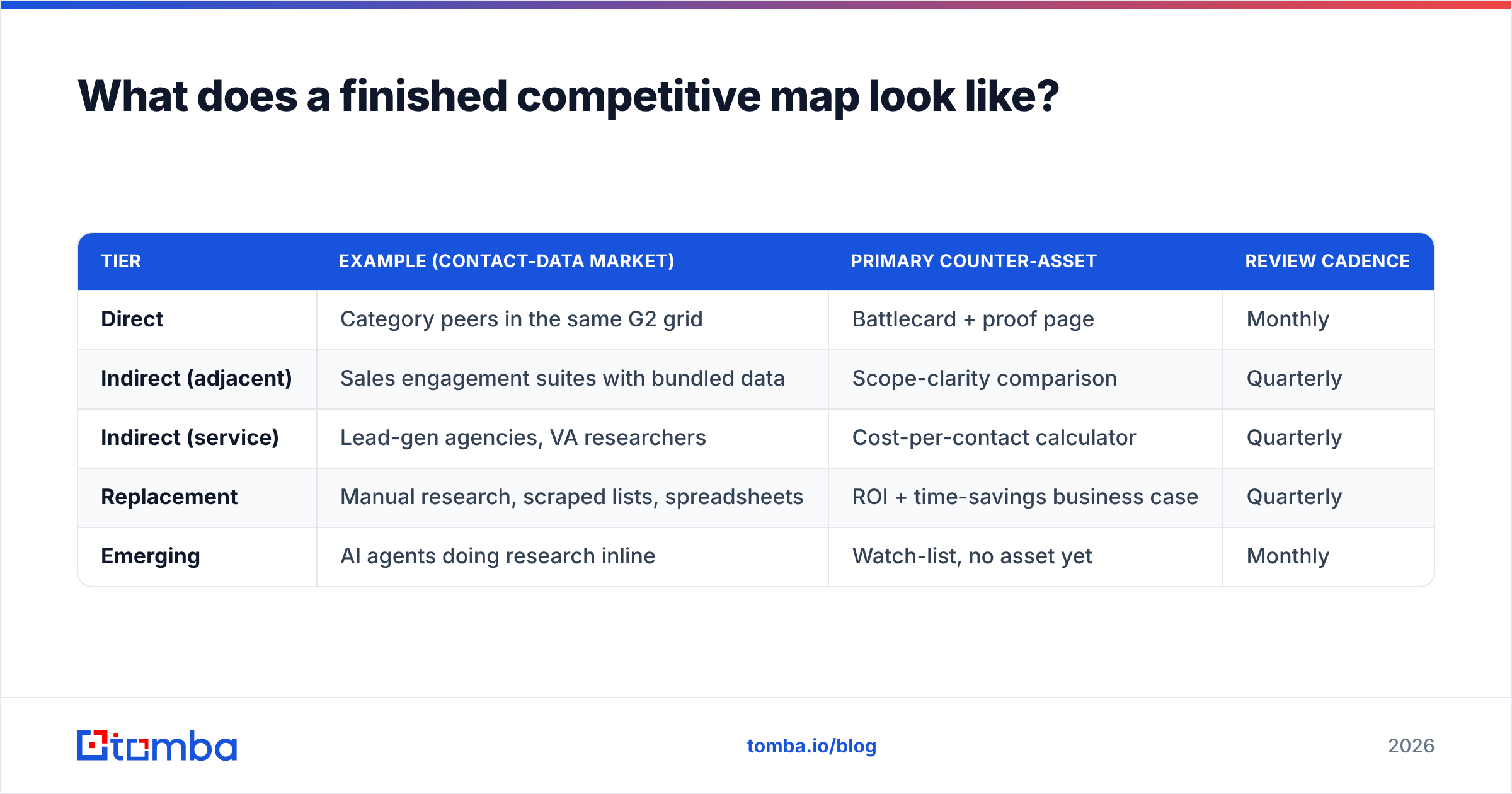
What does a finished competitive map look like?#
One page, three tiers, updated quarterly, with an owner per tier.
| Tier | Example (contact-data market) | Primary counter-asset | Review cadence |
|---|---|---|---|
| Direct | Category peers in the same G2 grid | Battlecard + proof page | Monthly |
| Indirect (adjacent) | Sales engagement suites with bundled data | Scope-clarity comparison | Quarterly |
| Indirect (service) | Lead-gen agencies, VA researchers | Cost-per-contact calculator | Quarterly |
| Replacement | Manual research, scraped lists, spreadsheets | ROI + time-savings business case | Quarterly |
| Emerging | AI agents doing research inline | Watch-list, no asset yet | Monthly |
Note the last row. Every market now has an emerging tier where an AI-native approach is starting to absorb demand without ever appearing in a category grid. Treating that as a watch-list item — rather than pretending it isn't happening — is the difference between a map that ages well and one you rewrite in panic next year.
The owner column matters as much as the content. A map nobody owns is a slide deck. A map where product marketing owns direct, content owns indirect, and sales leadership owns replacement is an operating system.
Where do you start if you have nothing today?#
Do these three things this week, in order:
- Export your closed-lost deals from the last four quarters and manually re-code 30 of them by reading the notes, not the picklist. You will find indirect competitors that the dashboard never showed.
- Interview five recent customers with the "what were you doing before?" question. Five is enough to find the pattern.
- Pick one indirect competitor and build one asset against it. Not a battlecard — a piece of content that reframes the buyer's option set. Measure whether deals that touch it close at a higher rate.
That's it. You do not need a competitive intelligence platform to start. You need honest closed-lost data, a handful of real conversations, and a willingness to admit that the biggest threat to your pipeline probably does not have a logo.
Getting the conversations started is the hard part. Competitive research runs on reaching the right person at the right company — the RevOps lead who chose a competitor, the ops manager who built it in-house, the buyer who went quiet. The Tomba Email Finder gives you verified professional emails by name and domain, so your research outreach reaches inboxes instead of bouncing. Start on the free tier with 25 searches a month, or move to Starter at $49/mo when your map gets serious.
Related guides#
Ready to find emails that actually work?
Join 150,000+ professionals who stopped guessing and started sending. Free credits on signup — no credit card required.
Get the Tomba newsletter
Practical outbound tactics and product updates — once every two weeks.
About the author