Director of Revenue Operations: Role, Salary, and 2026 Playbook
What a director of revenue operations actually does, what the role pays in 2026, how it differs from sales ops and a CRO, and the 30/60/90 plan that separates good hires from expensive ones.
TL;DR
- A director of revenue operations owns the systems, data, and process across marketing, sales, and customer success — not just the sales team's CRM hygiene.
- US base salary in 2026 lands roughly $145k–$195k, with total comp $175k–$240k depending on company stage and equity.
- The role becomes worth it somewhere around $5M–$10M ARR, 15+ quota-carrying reps, or three-plus GTM tools that don't talk to each other.
- The single biggest early win is almost always data quality — bad contact records break forecasting, routing, attribution, and outbound at the same time.
- Hire for systems thinking and revenue fluency, not Salesforce certifications. Certs are trainable; judgment about which number to trust is not.
What is a director of revenue operations?#
A director of revenue operations owns the operational spine that connects marketing, sales, and customer success — the CRM, the data flowing through it, the process rules, the reporting, and the tech stack budget.
Think of a restaurant. The chefs cook, the servers sell, the host seats guests. The general manager makes sure the ticket system works, the inventory counts are right, and nobody's arguing about whose table it was. RevOps is that general manager, except the "inventory" is pipeline data and the arguments are about attribution.
Technically, the role sits one level below a VP of RevOps or a CRO and typically manages 2–6 people: a sales ops analyst, a marketing ops specialist, a CRM admin, sometimes a data analyst. In companies without that headcount yet, the director does all four jobs personally — which is exactly why the first RevOps hire tends to be senior.
The function exists because GTM teams stopped being separable. Marketing's MQL definition affects sales' pipeline coverage which affects CS's renewal forecast. When three teams optimize their own funnel stage independently, you get a company that hits every departmental target and misses revenue. Revenue operations exists to make the handoffs legible.
What does a director of revenue operations actually do all day?#
Four buckets, roughly in order of time spent:
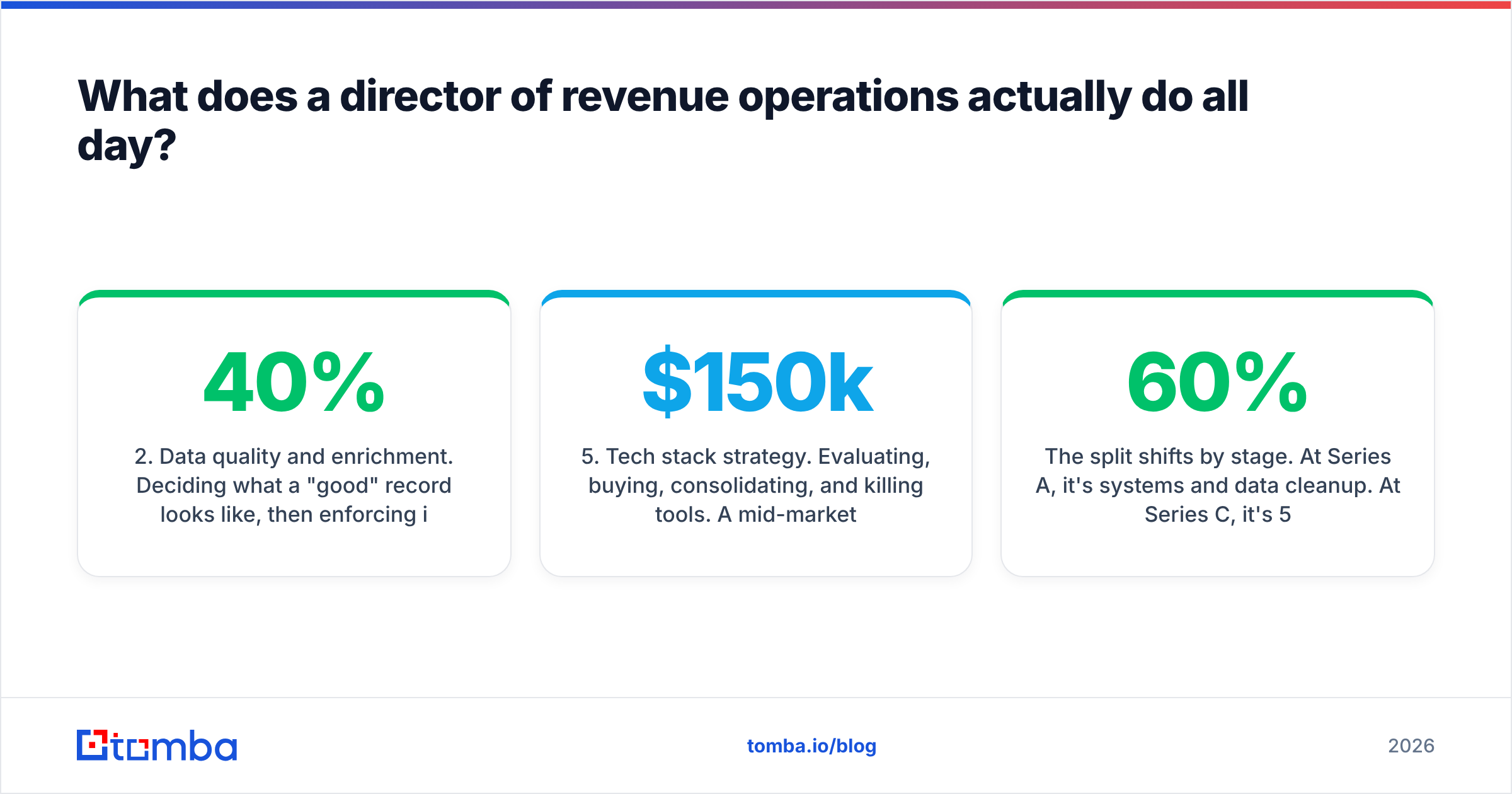
- Systems ownership. Administering and integrating the CRM, marketing automation platform, sales engagement tool, CPQ, and data providers. This includes the unglamorous work: field governance, permission sets, deduplication rules, sandbox testing before releases.
- Data quality and enrichment. Deciding what a "good" record looks like, then enforcing it. Contact-level accuracy, firmographic completeness, account hierarchy, territory mapping. Most RevOps directors inherit a CRM where 30–40% of contact emails are stale.
- Process design. Lead routing rules, stage-exit criteria, forecast categories, deal desk workflow, handoff SLAs between SDR and AE and CS. The goal is making the right behavior the path of least resistance inside the tool.
- Reporting and forecasting. Building the dashboards leadership actually uses, running the weekly forecast call mechanics, and — the hard part — being the person who says the number is wrong when it's wrong.
- Tech stack strategy. Evaluating, buying, consolidating, and killing tools. A mid-market GTM stack runs $150k–$400k/year. The director owns whether that spend produces anything.
- Enablement support. Not owning training content, but owning the systems that make training stick — playbook fields in the CRM, call-recording integrations, activity capture.
The split shifts by stage. At Series A, it's 60% systems and data cleanup. At Series C, it's 50% process and forecasting, because the systems are mostly built and the problem becomes discipline.
How is RevOps different from sales operations?#
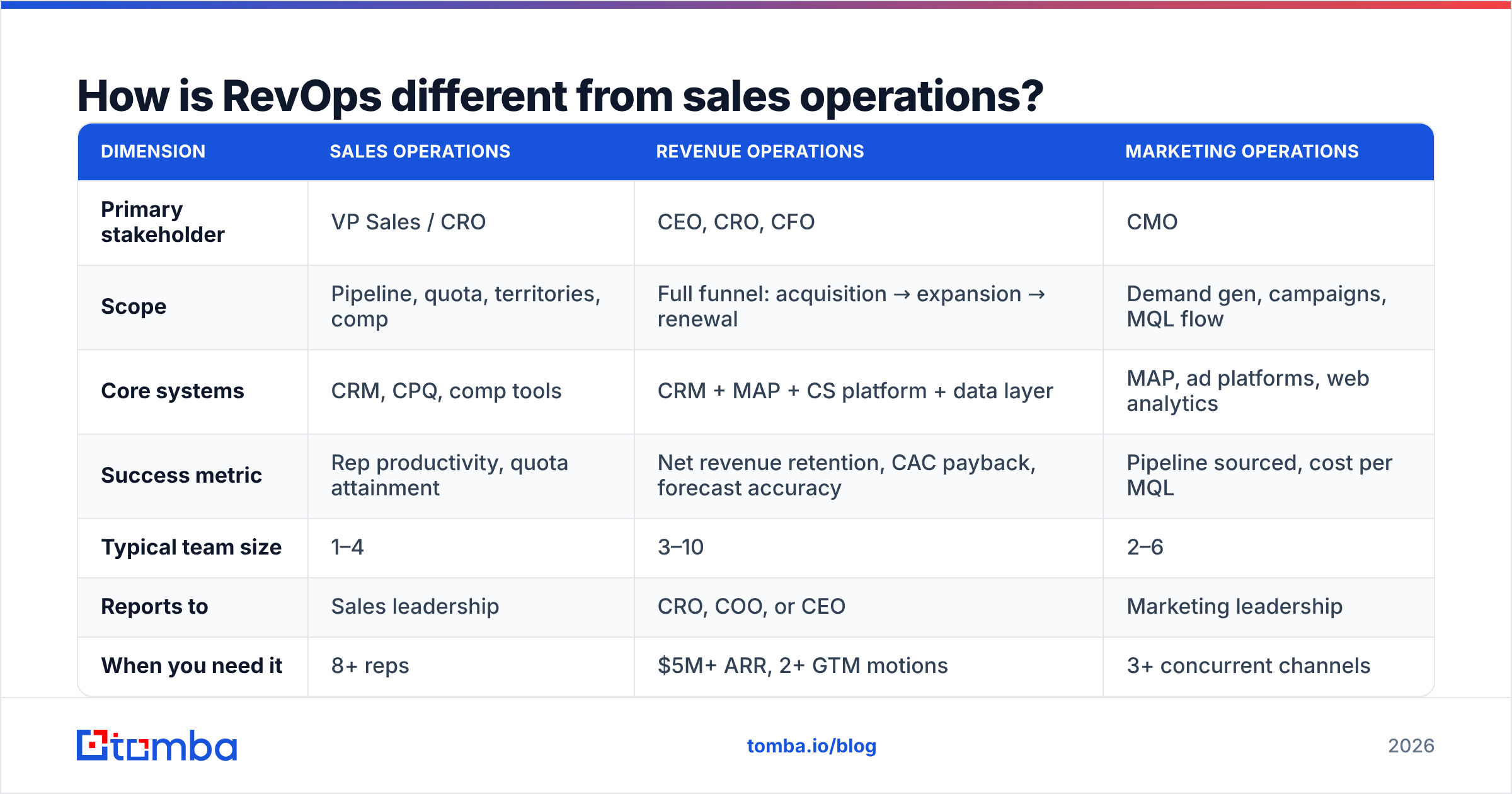
Scope and reporting line. Sales ops serves the sales team; RevOps serves the revenue number across all customer-facing functions.
| Dimension | Sales Operations | Revenue Operations | Marketing Operations |
|---|---|---|---|
| Primary stakeholder | VP Sales / CRO | CEO, CRO, CFO | CMO |
| Scope | Pipeline, quota, territories, comp | Full funnel: acquisition → expansion → renewal | Demand gen, campaigns, MQL flow |
| Core systems | CRM, CPQ, comp tools | CRM + MAP + CS platform + data layer | MAP, ad platforms, web analytics |
| Success metric | Rep productivity, quota attainment | Net revenue retention, CAC payback, forecast accuracy | Pipeline sourced, cost per MQL |
| Typical team size | 1–4 | 3–10 | 2–6 |
| Reports to | Sales leadership | CRO, COO, or CEO | Marketing leadership |
| When you need it | 8+ reps | $5M+ ARR, 2+ GTM motions | 3+ concurrent channels |
The practical test: if the person's job description ends at "closed-won," it's sales ops. If it includes churn, expansion, and cost of acquisition, it's RevOps.
There's a second distinction people miss. Sales ops is usually reactive — the VP asks for a report, ops builds it. RevOps is supposed to be proactive: noticing that win rates dropped in one segment before anyone asks. That requires trusted data, which is why data quality keeps showing up as the first project.
What should a director of revenue operations earn in 2026?#
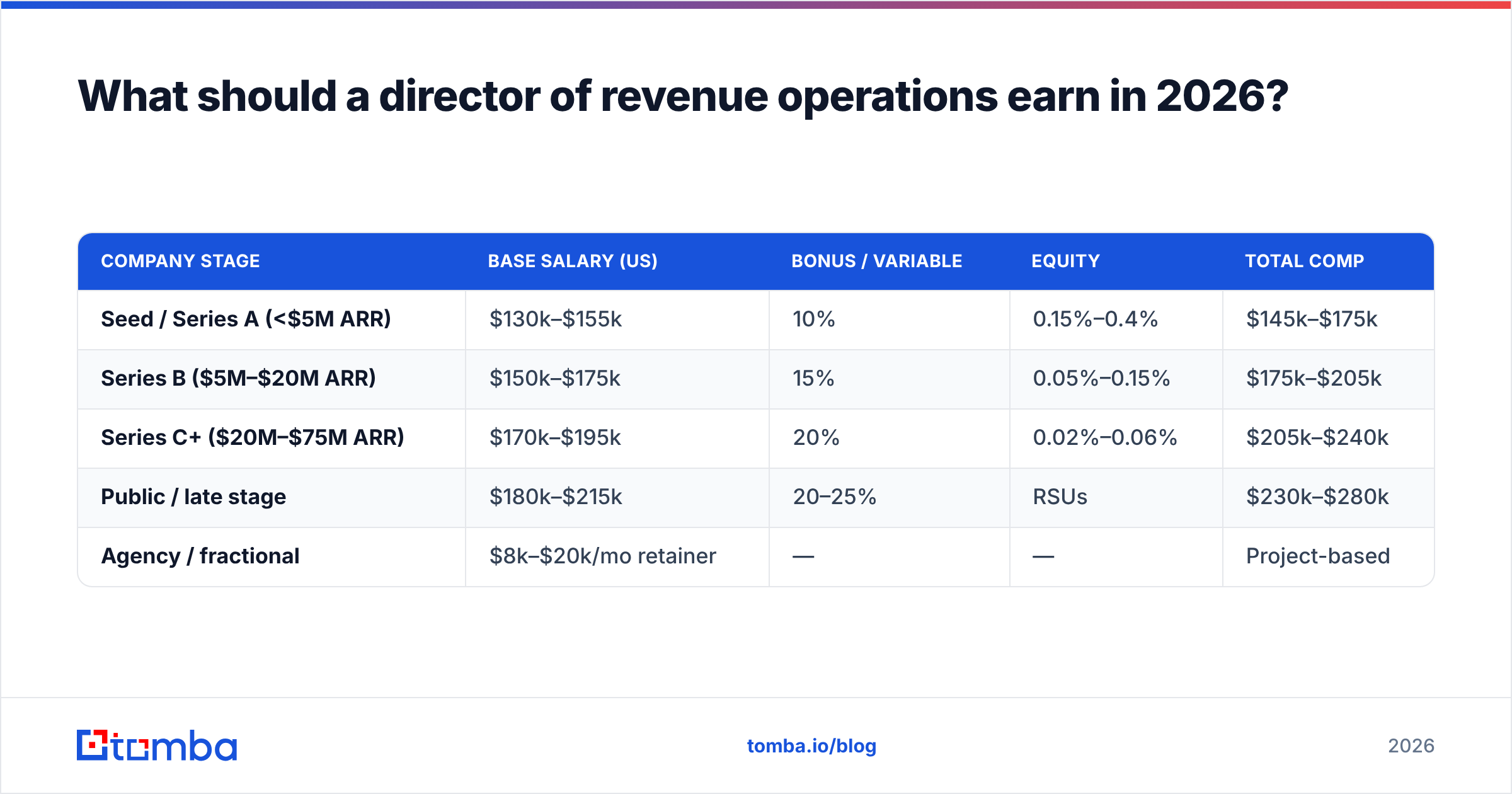
Compensation tracks company stage more than years of experience.
| Company stage | Base salary (US) | Bonus / variable | Equity | Total comp |
|---|---|---|---|---|
| Seed / Series A (<$5M ARR) | $130k–$155k | 10% | 0.15%–0.4% | $145k–$175k |
| Series B ($5M–$20M ARR) | $150k–$175k | 15% | 0.05%–0.15% | $175k–$205k |
| Series C+ ($20M–$75M ARR) | $170k–$195k | 20% | 0.02%–0.06% | $205k–$240k |
| Public / late stage | $180k–$215k | 20–25% | RSUs | $230k–$280k |
| Agency / fractional | $8k–$20k/mo retainer | — | — | Project-based |
Two notes on the numbers. First, geography still matters but less than it did — remote RevOps roles have compressed the Bay Area premium to roughly 10–15% over national mid-market rates. Second, the variable component is usually tied to company revenue attainment, not individual MBOs, which is a good sign: it means the role is being treated as revenue-adjacent rather than as overhead.
If you're benchmarking, cross-check against user-submitted ranges on G2's category pages for tool spend and public salary aggregators for comp. Do not benchmark a RevOps director against a Salesforce admin — the ranges overlap at the bottom and diverge sharply above it.
When is your company ready to hire one?#
You're ready when at least three of these are true:
- Forecast accuracy is below 80% and nobody can explain the variance without a spreadsheet rebuild.
- You have 15+ quota-carrying reps or two distinct GTM motions (say, self-serve plus enterprise).
- Three or more GTM tools don't share data cleanly — the CRM says one thing, the marketing platform another.
- Leadership meetings burn 20+ minutes on whose number is right instead of what to do about it.
- Deal cycles are slowing and you can't tell whether it's the market, the segment, or the process.
- Someone senior is doing ops as a side job — a VP Sales spending 10 hours a week in Salesforce is expensive ops labor.
If only one is true, hire a strong sales ops analyst instead and revisit in two quarters. RevOps directors hired too early end up as glorified CRM admins, get bored, and leave in 14 months. That's a $200k lesson.
The inverse failure is hiring too late. By the time you have 40 reps and five years of CRM debt, the first 12 months of the role is pure archaeology.
What does the first 90 days look like?#
The strongest RevOps directors follow roughly the same sequence, because the dependencies are real: you can't fix process on top of broken data, and you can't fix data on top of an undocumented system.
Days 1–30 — Audit, change nothing. Map every system, every integration, every field that a report depends on. Sit in on forecast calls without commenting. Interview 6–10 reps and every GTM leader. Produce one document: what exists, what's broken, what it costs.
Days 31–60 — Fix the data layer. Deduplicate accounts and contacts. Run every contact record through verification. Establish enrichment rules and a source of truth for firmographics. This is where teams underestimate the work — a 50,000-record CRM with 35% decayed contact data is not a reporting problem, it's a revenue problem. Every bounced sequence, misrouted lead, and inflated TAM traces back here. A bulk pass through an email verifier plus contact enrichment is usually the highest-ROI 30 days a new RevOps director will ever have.
Days 61–90 — Ship one visible process improvement. Lead routing, stage definitions, or forecast categories. Pick the one leadership complains about most. Instrument it, document it, and publish a before/after number. Credibility in RevOps is earned with one measurable win, not with a 40-slide strategy deck.
What tools does a revenue operations director own?#
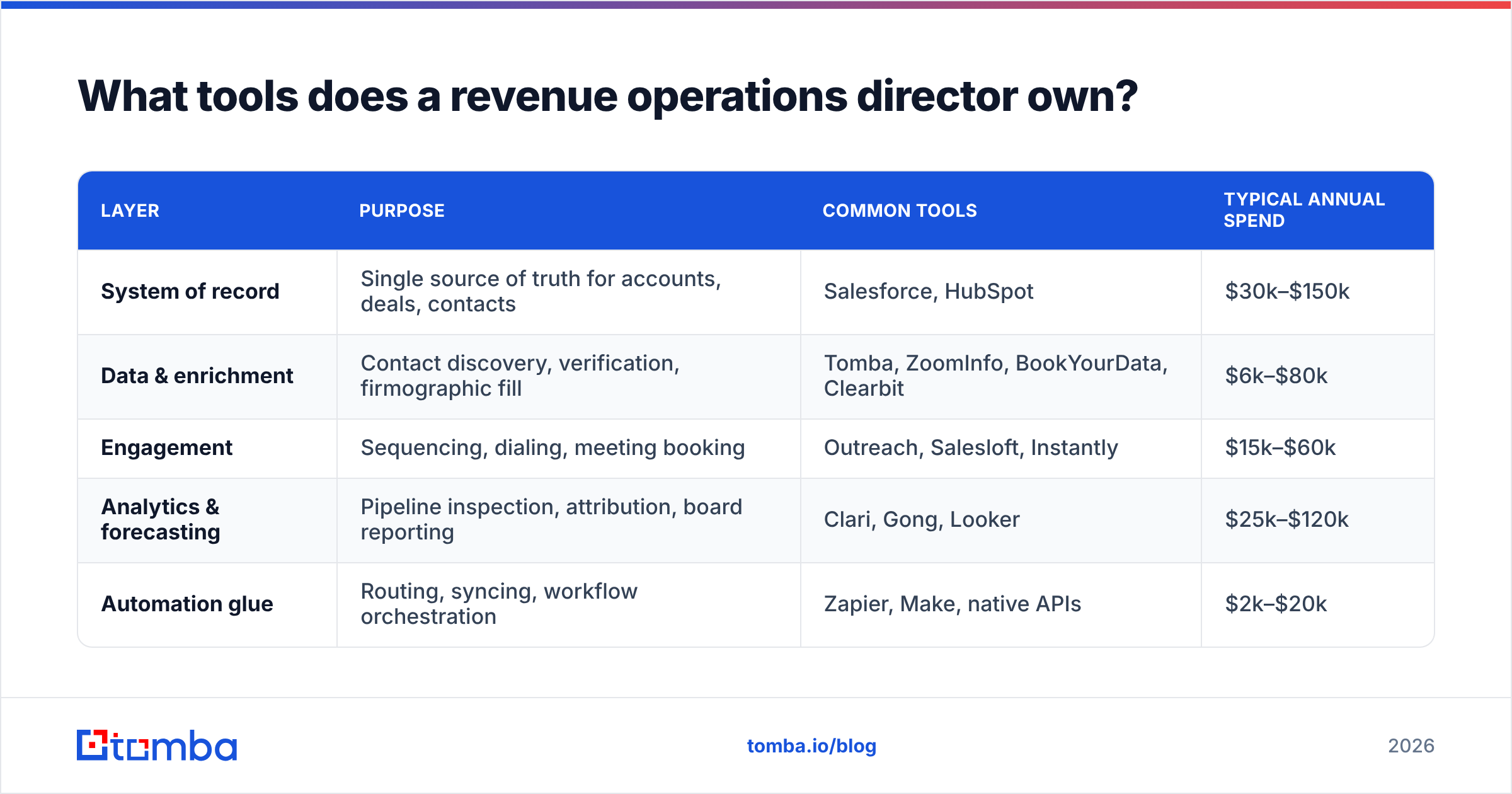
The stack breaks into five layers. Owning all five is what distinguishes the role from any single-tool admin.
| Layer | Purpose | Common tools | Typical annual spend |
|---|---|---|---|
| System of record | Single source of truth for accounts, deals, contacts | Salesforce, HubSpot | $30k–$150k |
| Data & enrichment | Contact discovery, verification, firmographic fill | Tomba, ZoomInfo, BookYourData, Clearbit | $6k–$80k |
| Engagement | Sequencing, dialing, meeting booking | Outreach, Salesloft, Instantly | $15k–$60k |
| Analytics & forecasting | Pipeline inspection, attribution, board reporting | Clari, Gong, Looker | $25k–$120k |
| Automation glue | Routing, syncing, workflow orchestration | Zapier, Make, native APIs | $2k–$20k |
A few opinions worth stating plainly.
The data layer is the one most companies underfund and most RevOps directors regret underfunding. A $100k analytics tool sitting on top of a CRM where a third of the emails bounce produces confident, wrong dashboards. Tools like BookYourData and Tomba solve overlapping but different problems — BookYourData is strong when you want a pre-built, filterable list to buy outright; Tomba's email finder and domain search fit better when you're enriching accounts you already have or verifying at the moment of use rather than in bulk purchases. Plenty of RevOps teams run both.
The automation layer is the one most companies overfund. Before buying a fourth iPaaS seat, check whether your existing tools expose an API. Most modern data vendors do — Tomba's email finder API drops into a routing workflow in an afternoon, and native HubSpot or Salesforce connectors remove the middleware entirely.
Budget planning note: expect total GTM tech spend to land between 5% and 12% of revenue depending on ACV. Anything above 15% and your first RevOps project is consolidation, not optimization.
What metrics does the role own?#
RevOps owns the definitions more than the outcomes. Sales owns bookings; RevOps owns whether "booking" means the same thing in every system.
Core metrics a director should be accountable for:
- Forecast accuracy — target ±5% at the 30-day mark. This is the number that gets the role a seat at the exec table.
- Data completeness — percentage of accounts with verified contact, firmographic, and owner fields populated. Target 90%+ on active pipeline.
- Pipeline coverage — 3x–4x for most B2B motions, tracked by segment rather than in aggregate.
- Speed to lead — minutes from form fill to first touch. Sub-5 minutes changes conversion materially.
- CAC payback and net revenue retention — the two numbers that force marketing, sales, and CS into the same conversation.
- Win rate by segment and source — the diagnostic that tells you whether a problem is targeting, messaging, or execution.
Notice what's missing: activity metrics. A RevOps director who reports call volume as a headline metric has been captured by sales management. Activity belongs on the sales manager's dashboard, not the revenue operations one.
How do you hire and evaluate one?#
Screen for three things, in this order.
Systems judgment over tool certifications. Ask a candidate to describe a system they decommissioned and why. Anyone can add tools. Removing one requires understanding what it was actually doing.
Revenue fluency. They should be able to explain, unprompted, how a change to lead routing affects CAC payback. If they only speak in fields and workflows, they're an admin with a bigger title.
A written artifact. Ask for a redacted forecast dashboard or process doc they built. RevOps is a documentation job disguised as a systems job; people who can't write clearly will not fix your process discipline problem.
Two interview questions that separate candidates fast:
- "Our CRM has 60,000 contacts and we don't know how many are valid. What do you do in week one?" Good answers start with sampling and measurement, not with buying a tool.
- "Marketing and sales disagree on pipeline sourced. How do you resolve it?" Good answers redefine the metric and get both leaders to sign the definition. Bad answers build a third dashboard.
For a broader framing of how the function maps to org design, Gartner's sales operations research is a reasonable neutral reference, and Forrester's B2B revenue coverage tracks the marketing-side alignment questions well.
What's changing about the role in 2026?#
Three shifts worth planning around.
AI has moved the bottleneck. Generating outreach copy, summarizing calls, and drafting reports are close to free now. What isn't free is the input data. A RevOps director in 2026 spends proportionally more time on data provenance and less on report building, because the reports build themselves and the data still doesn't.
Consolidation is real. The 2021-era stack of 14 point solutions is being cut to 6–8 at most companies. Directors who can defend spend with usage data keep budget; those who can't lose tools they actually needed.
Titles are compressing upward. "Director of RevOps" increasingly reports directly to the CEO at companies under $30M ARR, which is a meaningful change from the 2020 pattern of reporting into sales. That's mostly good — RevOps reporting into the org it's supposed to hold accountable was always awkward — but it raises the bar on executive communication.
Where should you start?#
Start with the data, because every other RevOps project is downstream of it. Before you redesign routing, rebuild the forecast, or buy an attribution platform, find out how much of your CRM is actually real. Sample 500 contact records, verify them, and calculate the decay rate. If it's above 20% — and at most companies it is — you have your first project and your first credibility win in the same place.
Tomba's email finder is built for exactly that motion: find and verify professional email addresses by domain, name, or company, in bulk or through the API, so the records feeding your pipeline reports are ones you can defend in a board meeting. The free tier covers 25 searches a month if you just want to test decay rates on a sample; Tomba pricing starts at $49/mo for Starter and $99/mo for Growth when you're ready to run the full CRM through it. Clean inputs first, then everything else you build on top of them is worth trusting.
Related guides#
Ready to find emails that actually work?
Join 150,000+ professionals who stopped guessing and started sending. Free credits on signup — no credit card required.
Get the Tomba newsletter
Practical outbound tactics and product updates — once every two weeks.
About the author