DiscoverOrg vs Ditlead (2026): Which One Does Your Team Need?
DiscoverOrg is now ZoomInfo, and Ditlead is a low-cost outreach engine. They solve different halves of the same problem. Here is the honest breakdown of cost, data quality, and which one you actually need in 2026.
DiscoverOrg vs Ditlead is a strange matchup, and that is the useful part. DiscoverOrg (now ZoomInfo) sells data. Ditlead sells sending. One tells you who to email. The other gets the email out. Here is the cost, the data quality, and the stack most teams land on instead.
TL;DR — what you actually need to know#
- DiscoverOrg no longer exists on its own. It merged with ZoomInfo in 2019 and the brand was folded in. When people say "DiscoverOrg" today, they mean ZoomInfo's enterprise data platform.
- Ditlead is not really a competitor. DiscoverOrg/ZoomInfo sells data. Ditlead sells sending — multichannel sequences, inbox rotation, warmup, and a light CRM.
- The prices sit worlds apart. ZoomInfo is quote-only, seat-based, and annual. Deals usually run into five figures. Ditlead publishes flat monthly plans in the tens of dollars.
- The real decision is rarely "which one." Most teams under 50 reps need two things: a data source and a sending tool. Buying the enterprise bundle to get both wastes a lot of money.
- Cheapest honest stack: a pay-per-use data API for contacts, plus a low-cost sequencer for delivery. That usually lands under $150/mo for a small team.
Why is DiscoverOrg vs Ditlead a confusing comparison?#
Because you are comparing a database to a delivery truck.
For two decades, DiscoverOrg built human-researched org charts and direct-dial data. Its buyers sat in IT, marketing, finance, and HR. Depth was the selling point. You got more than an email address. You saw who reports to whom, which tools a company runs, and which projects have budget. In 2019 the company merged and rebranded under ZoomInfo. Today that data lives inside ZoomInfo Sales and Copilot. Search for DiscoverOrg pricing and you land on a ZoomInfo demo form.
Ditlead comes from the other direction. It is a cold outreach tool built for volume senders. You connect unlimited mailboxes and rotate sends across them. You warm them up. You run email, LinkedIn, and call steps in one sequence. Replies land in a built-in pipeline. It bundles some contact search, but sourcing is not the point.
So the honest framing of DiscoverOrg vs Ditlead is simple. DiscoverOrg answers "who should I contact, and why now?" Ditlead answers "how do I reach 3,000 of them this month without burning my domain?"
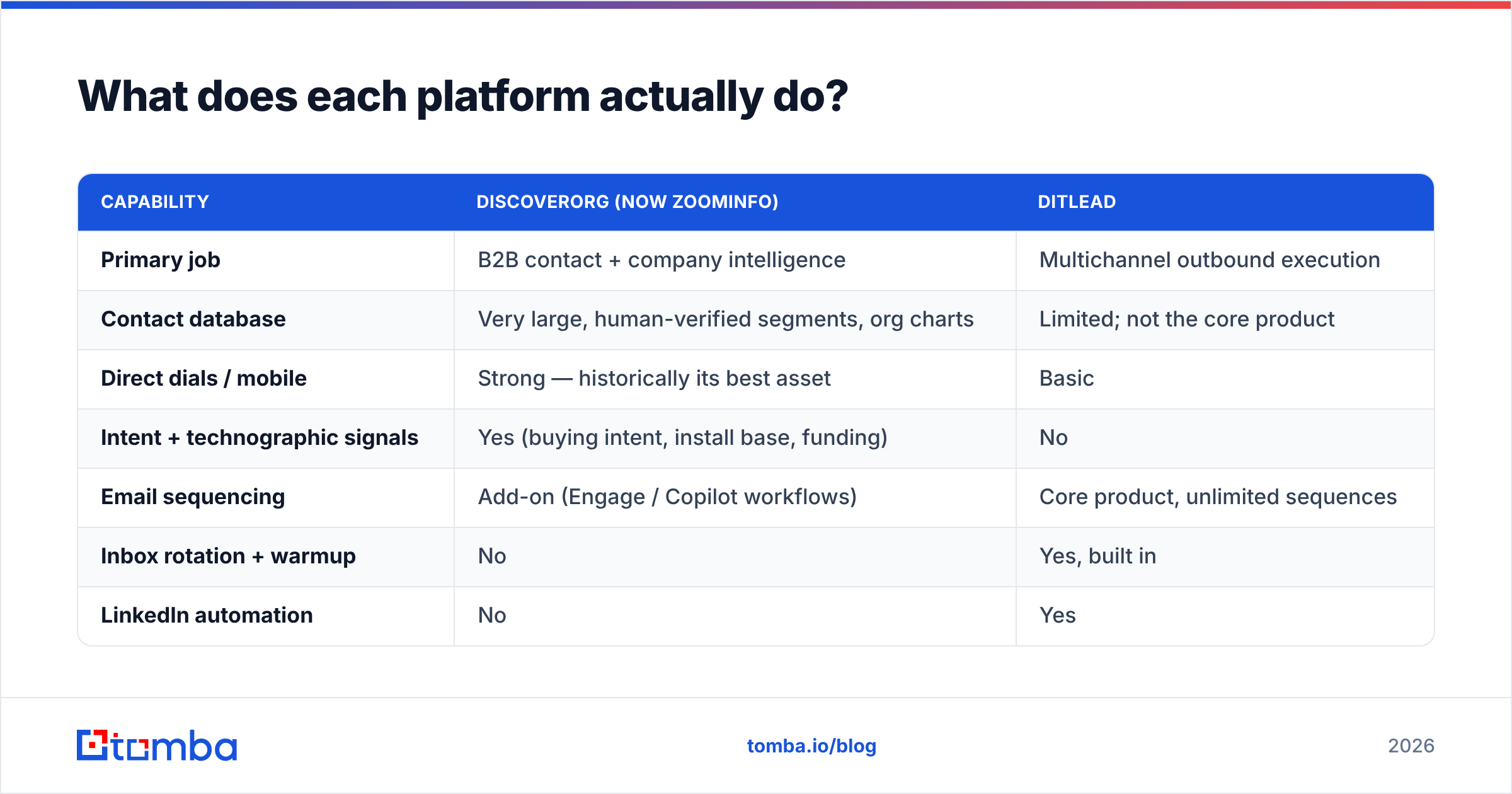
DiscoverOrg vs Ditlead: what does each platform actually do?#
Here is the split, feature by feature. Treat the pricing rows as directional. ZoomInfo is quote-only and Ditlead adjusts its published tiers, so check both before you sign.
| Capability | DiscoverOrg (now ZoomInfo) | Ditlead |
|---|---|---|
| Primary job | B2B contact + company intelligence | Multichannel outbound execution |
| Contact database | Very large, human-verified segments, org charts | Limited; not the core product |
| Direct dials / mobile | Strong — historically its best asset | Basic |
| Intent + technographic signals | Yes (buying intent, install base, funding) | No |
| Email sequencing | Add-on (Engage / Copilot workflows) | Core product, unlimited sequences |
| Inbox rotation + warmup | No | Yes, built in |
| LinkedIn automation | No | Yes |
| Built-in CRM / pipeline | No (syncs to Salesforce, HubSpot) | Yes, lightweight |
| Pricing model | Annual contract, per seat, quote-only | Flat monthly, published |
| Typical entry cost | Five figures per year | Tens of dollars per month |
| Contract flexibility | Annual minimum, seat minimums common | Month-to-month |
| Best for | Enterprise ABM, complex org navigation | SMB agencies, high-volume cold email |
The table makes the gap obvious. Only two rows overlap at all: contact search and sequencing. Each one is a side feature for one of the two tools. That is the whole DiscoverOrg vs Ditlead overlap.
DiscoverOrg vs Ditlead pricing: what does each really cost?#
Most comparison posts go quiet here. Let's be specific about what is knowable and what is not.
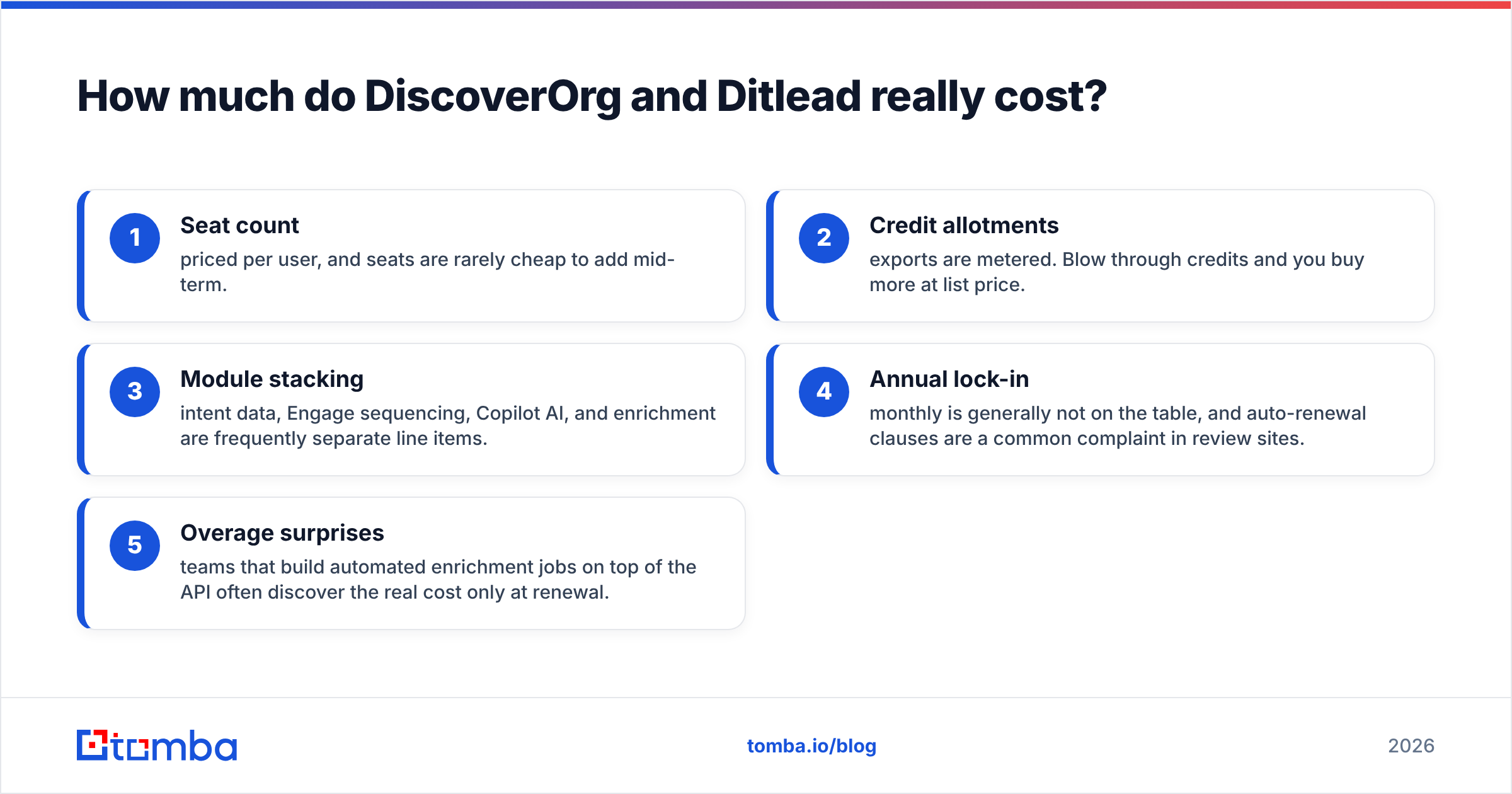
ZoomInfo (the DiscoverOrg successor) does not publish prices. Reviews on G2 and buyer forums point to annual deals starting in the low five figures for small teams. Larger rollouts reach six figures. Five things drive the cost:
- Seat count. You pay per user. Adding seats mid-contract is rarely cheap.
- Credit limits. Exports are metered. Run out and you buy more at list price.
- Module stacking. Intent data, sequencing, AI, and enrichment are often separate line items.
- Annual lock-in. Monthly is rarely on the table. Auto-renewal clauses draw frequent complaints on review sites.
- Overage surprises. Teams that automate enrichment through the API often learn the real cost at renewal.
Ditlead publishes flat tiers. Entry plans sit in the low tens of dollars per month. Higher tiers scale on contacts, active leads, and mailbox count. It charges by sending capacity, not per seat. So an agency can share access across client campaigns without multiplying the bill. The trade-off is simple: you are buying a pipe, not a data asset.

The mismatch matters more than the raw numbers. Buy ZoomInfo just for email addresses and you pay enterprise prices for a research layer you never open. Buy Ditlead hoping for a targeted list of VP Engineering contacts at Series B fintechs and the sourcing will let you down.
DiscoverOrg vs Ditlead: which one has better data accuracy?#
DiscoverOrg earned its reputation on human verification. ZoomInfo inherited that strength in the enterprise segments it covers well. Accuracy slips in four predictable places:
- Outside the US. European and Asian coverage is thinner. Privacy rules also force some records to be suppressed, so they go stale.
- Small companies. Startup records age fast. A researcher has probably never touched them.
- Job changes. Any static database decays 2–3% per month as people move roles. After a year, a quarterly-refreshed record is close to a coin flip.
- Direct dials. Strong next to rivals. Still, mobile numbers decay faster than any other field in B2B data.
Ditlead does not sell its contact data as research grade, and you should not treat it that way. Its edge is indirect. Warmup and inbox rotation come built in, so delivery problems that look like data problems get fixed at the sending layer.
Both tools leave one job to you: verification at send time. A fresh check right before a campaign is what protects your bounce rate. Run the list through an email verifier just before launch. That catches the churn no database can, at any price.
When should you pick DiscoverOrg over Ditlead?#
Choose the ZoomInfo/DiscoverOrg path when all of these are true:
- You sell to enterprise accounts with buying committees. You need the chain: this manager reports to a VP, who reports to a CIO. You also need the three stakeholders sitting beside them.
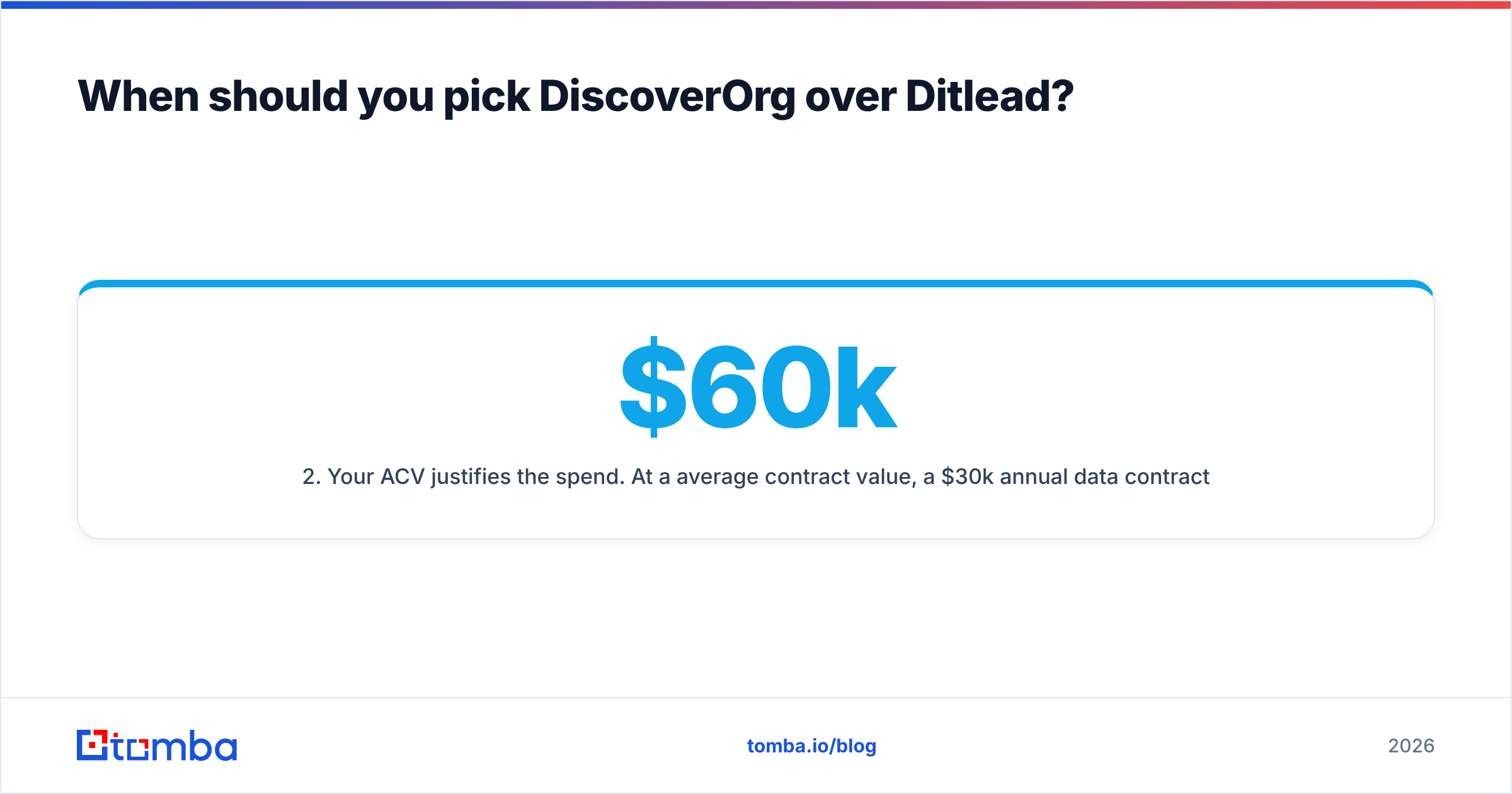
- Your deal size justifies the spend. At a $60k average contract value, a $30k data contract is defensible. At $500/mo, it is not.
- You run account-based campaigns on intent signals. Buying-intent topics and install-base data are hard to copy cheaply.
- You already live in Salesforce. ZoomInfo's CRM enrichment and dedupe tools are mature. They save your ops team real hours.
- Your procurement team prefers one vendor. Sometimes the bundle wins on governance, not features.
If fewer than three apply, the enterprise contract is probably the wrong buy.
When is Ditlead the better buy?#
Pick Ditlead when your bottleneck is execution, not targeting:
- You already have a list source. Scraped, exported, purchased, or API-sourced. You just need to send.
- You run high volume across many mailboxes. Rotation and warmup are first-class here. Paying for a separate warmup tool adds up.
- You are an agency with several client workspaces. Flat pricing beats per-seat pricing the moment you add a third campaign manager.
- You want month-to-month flexibility. Cold outbound programs get paused. Annual contracts do not.
- You need LinkedIn and email in one sequence. One tool beats duct-taping two subscriptions together.
Ditlead competes with Instantly, Smartlead, and Reply.io far more than it competes with DiscoverOrg. If that is your real shortlist, our Instantly alternative and Reply.io alternative breakdowns will help more than this one.
Can you replace either one with a cheaper stack?#
Usually, yes. Most teams land here after one renewal cycle.
Split the problem into three jobs and buy each on its own merits:
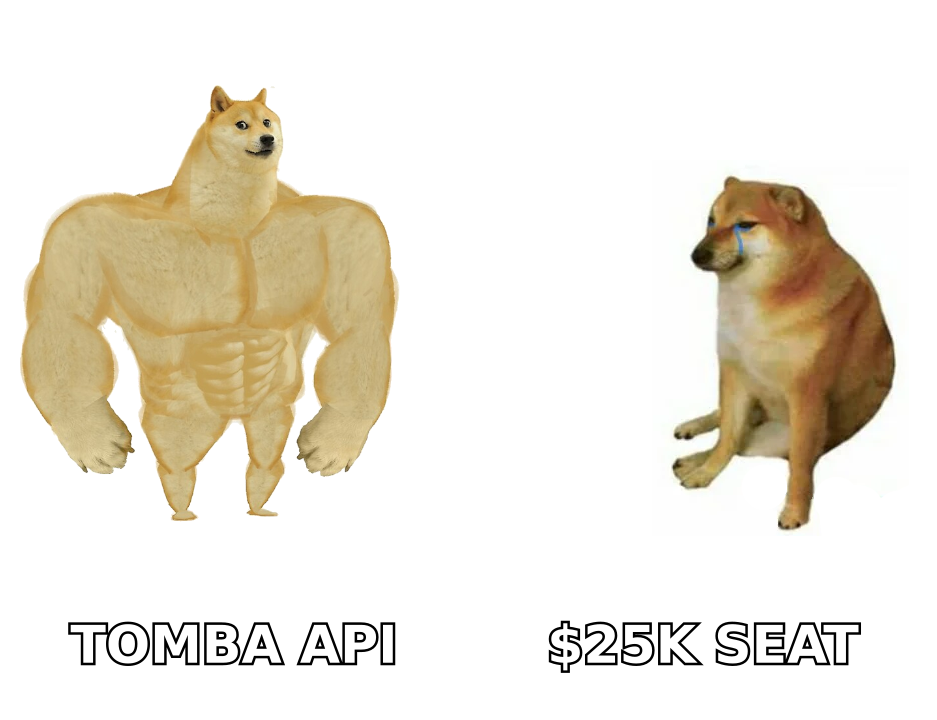
- Find and verify contacts. A pay-per-use data API means you pay for the records you actually work, not for seats. Tomba's email finder resolves a contact from a name plus a domain. Domain search pulls every discoverable address at a company. Every result is verified before it leaves the system. Tomba pricing starts free at 25 searches per month. Paid tiers are $49/mo (Starter), $99/mo (Growth), and $249/mo (Pro). No annual lock, no seat minimums.
- Enrich and dedupe. Push records into your CRM with company details attached. Data enrichment and the Tomba API cover the automated path. The Google Sheets and Excel add-ins cover the manual one.
- Send and track. Keep Ditlead, Smartlead, or whatever sequencer your team already knows. This layer is cheap and there are many good options.
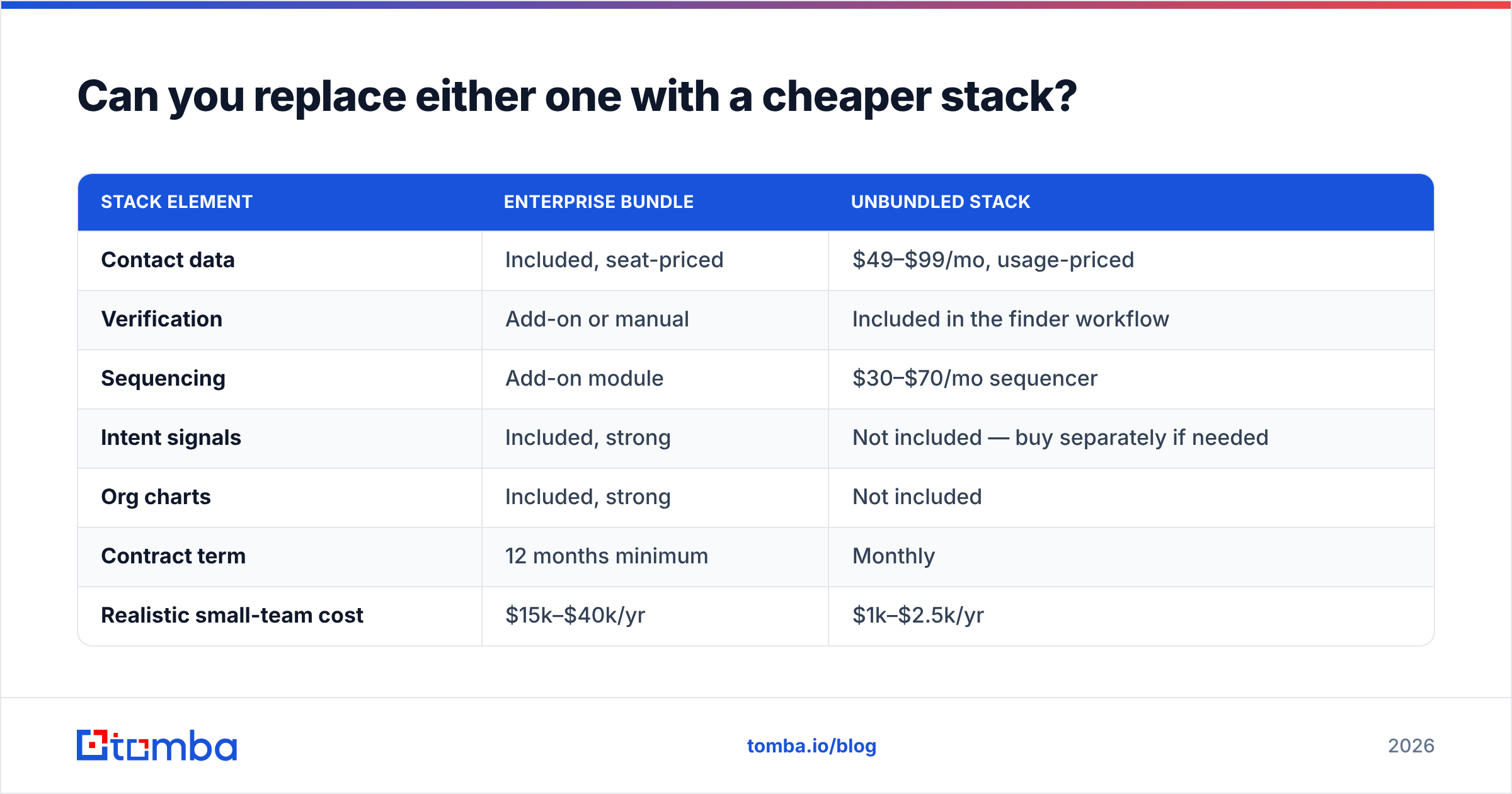
Compare the unbundled stack against one enterprise suite:
| Stack element | Enterprise bundle | Unbundled stack |
|---|---|---|
| Contact data | Included, seat-priced | $49–$99/mo, usage-priced |
| Verification | Add-on or manual | Included in the finder workflow |
| Sequencing | Add-on module | $30–$70/mo sequencer |
| Intent signals | Included, strong | Not included — buy separately if needed |
| Org charts | Included, strong | Not included |
| Contract term | 12 months minimum | Monthly |
| Realistic small-team cost | $15k–$40k/yr | $1k–$2.5k/yr |
| Switching cost if it fails | High | Low |
One honest caveat. The unbundled stack loses on intent data and org charts. If those two rows drive your pipeline, pay for the bundle. If you would use them twice a quarter, you are paying for features you never open.
What do buyers most often get wrong here?#
Four recurring mistakes, drawn from how these purchases go sideways:
- Buying data volume instead of data freshness. A 200-million-record database sounds better than a targeted API call. It is not, if 30% of the records you touch are 18 months old. Freshness at the moment of send beats raw count.
- Skipping verification because the vendor is expensive. Premium data still decays. Check where the data comes from and verify anyway.
- Mixing up delivery problems with data problems. If replies dried up but bounces stayed low, the problem is your domain reputation or your copy. It is not your list. Warmup and authentication fix that. A bigger database does not.
- Signing an annual deal before proving the play. Run 500 contacts through a monthly stack first. If the segment converts, negotiate the enterprise contract with evidence instead of hope.
The verdict: DiscoverOrg vs Ditlead in 2026#
The DiscoverOrg vs Ditlead answer depends on which half of your funnel is broken. The two are not substitutes.
- If you cannot find the right people: the DiscoverOrg lineage inside ZoomInfo is still the deepest option for enterprise org charts and intent data. It is priced to match. Get a firm quote with seat and credit terms in writing first.
- If you can find people but cannot reach them at volume: Ditlead is cheaper, faster, and more flexible. Its warmup and rotation stack solves a real problem that data vendors ignore.
- If both halves are broken and your budget is finite: unbundle. Source and verify with a usage-priced API. Send with a low-cost sequencer. Revisit the enterprise bundle when your deal sizes can carry it.
Start with the sourcing layer. A great sequencer sending to bad addresses is just a fast way to damage your domain. Run your first list through the Tomba Email Finder. The free tier gives you 25 searches to test accuracy against your own target list. If it holds up, Starter at $49/mo replaces the data half of a five-figure contract. Feed the verified contacts into whichever sequencer you like. Save the enterprise conversation for the quarter when you can prove the pipeline math.
Related guides#
Ready to find emails that actually work?
Join 150,000+ professionals who stopped guessing and started sending. Free credits on signup — no credit card required.
Get the Tomba newsletter
Practical outbound tactics and product updates — once every two weeks.
About the author