DiscoverOrg vs EasyLeadz: B2B Data Compared for 2026
DiscoverOrg no longer exists as a standalone product, and EasyLeadz plays a much narrower game than most buyers expect. Here is the honest head-to-head, with pricing, coverage, and a cheaper third option.
TL;DR
- DiscoverOrg is not a product you can buy in 2026. It merged with ZoomInfo in 2019 and the brand was retired — searching "DiscoverOrg" today lands you on ZoomInfo's enterprise sales-intelligence platform.
- EasyLeadz (and its Chrome extension, Mr. E) is a much smaller, credit-based tool built primarily around finding direct-dial mobile numbers from LinkedIn profiles.
- They are not really competitors. One is a $20k+/year data platform with intent signals, org charts, and CRM sync. The other is a per-credit lookup tool you can start using in an afternoon.
- Pick ZoomInfo (ex-DiscoverOrg) if you need territory-wide coverage, intent data, and enterprise governance. Pick EasyLeadz if you're a small team dialing prospects in India, APAC, or SMB segments.
- If what you actually need is verified work email addresses at a predictable price, a focused email finder beats both on cost per usable contact.
What happened to DiscoverOrg?#
DiscoverOrg was one of the original B2B contact databases — founded in 2007, known for human-verified org charts and technographic detail in IT and engineering departments. In February 2019 it acquired ZoomInfo, and by mid-2019 the combined company adopted the ZoomInfo name. The DiscoverOrg product line was folded in.
That matters for your evaluation. If a comparison post promises you a live DiscoverOrg trial, it's out of date. What you're really evaluating is ZoomInfo, whose current packaging centers on Sales, Marketing, Talent, and Operations bundles plus a Copilot AI layer.
What survived from DiscoverOrg is the philosophy: deep, researched, hierarchy-aware account data rather than a scraped contact list. ZoomInfo still leans on a research team, phone-verification workflows, and a contributory network from users who install its email-sync tools. That's why coverage in North American mid-market and enterprise accounts is genuinely strong — and why it costs what it costs.
What is EasyLeadz and who is it for?#
EasyLeadz is an India-headquartered contact-data company whose flagship is Mr. E — a Chrome extension that reveals a prospect's direct mobile number while you're looking at their LinkedIn profile. You buy credits, you spend a credit per successful reveal, you dial.
The positioning is deliberately narrow:
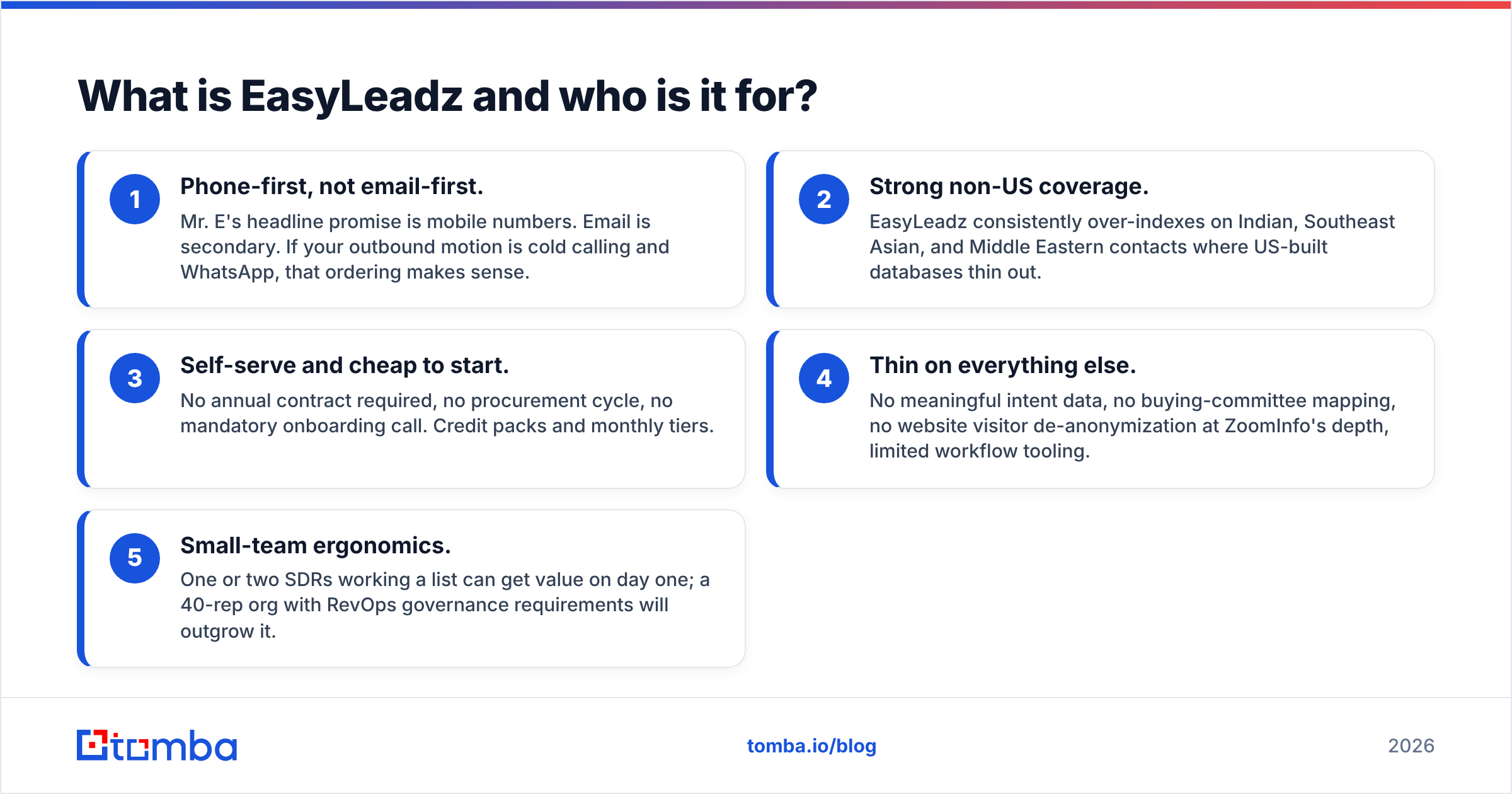
- Phone-first, not email-first. Mr. E's headline promise is mobile numbers. Email is secondary. If your outbound motion is cold calling and WhatsApp, that ordering makes sense.
- Strong non-US coverage. EasyLeadz consistently over-indexes on Indian, Southeast Asian, and Middle Eastern contacts where US-built databases thin out.
- Self-serve and cheap to start. No annual contract required, no procurement cycle, no mandatory onboarding call. Credit packs and monthly tiers.
- Thin on everything else. No meaningful intent data, no buying-committee mapping, no website visitor de-anonymization at ZoomInfo's depth, limited workflow tooling.
- Small-team ergonomics. One or two SDRs working a list can get value on day one; a 40-rep org with RevOps governance requirements will outgrow it.
That's a legitimate product. It is just not the same category of purchase as an enterprise data platform, and treating them as interchangeable is how teams end up disappointed with both.

DiscoverOrg vs EasyLeadz: how do they compare head-to-head?#
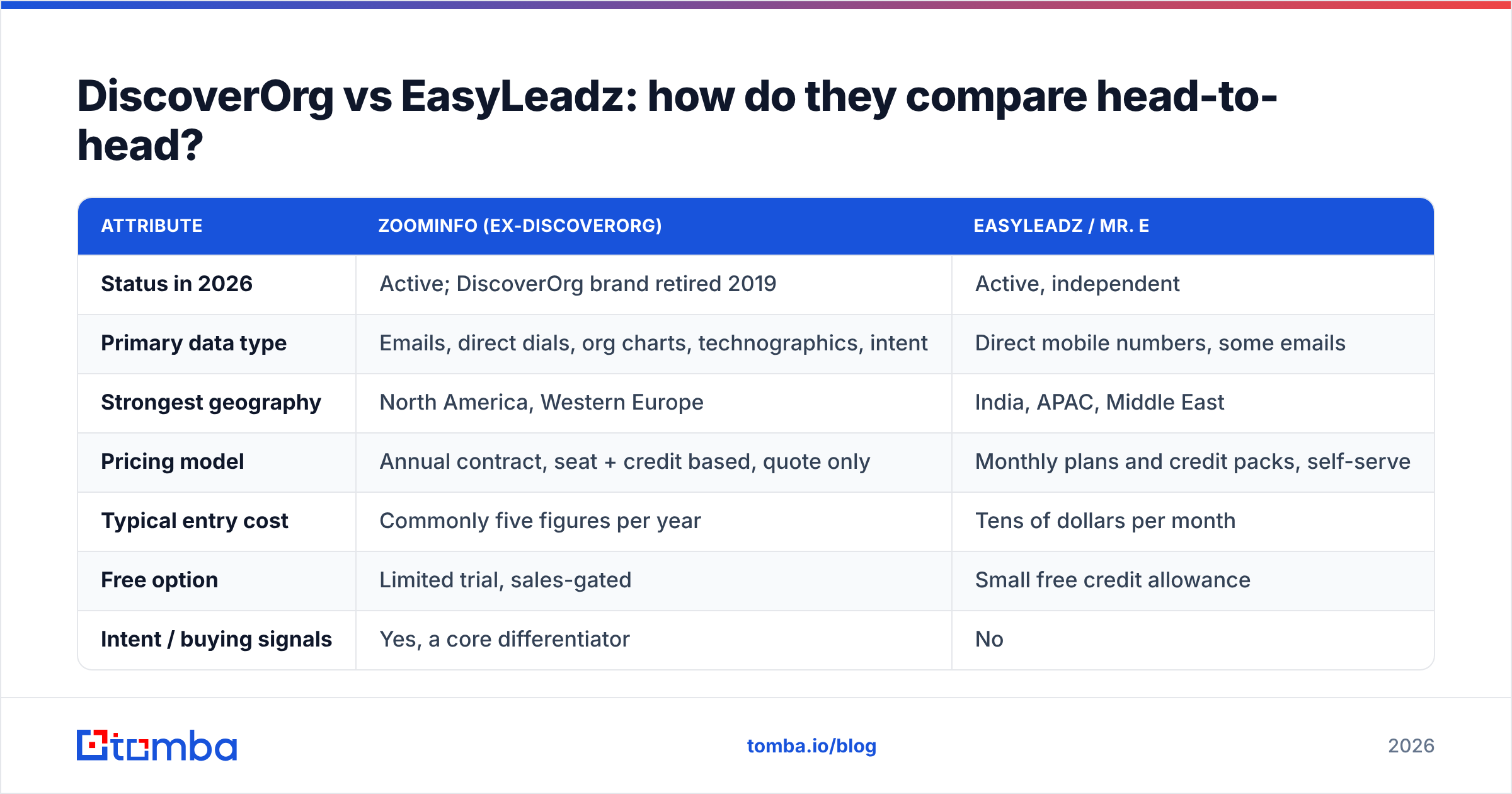
| Attribute | ZoomInfo (ex-DiscoverOrg) | EasyLeadz / Mr. E |
|---|---|---|
| Status in 2026 | Active; DiscoverOrg brand retired 2019 | Active, independent |
| Primary data type | Emails, direct dials, org charts, technographics, intent | Direct mobile numbers, some emails |
| Strongest geography | North America, Western Europe | India, APAC, Middle East |
| Pricing model | Annual contract, seat + credit based, quote only | Monthly plans and credit packs, self-serve |
| Typical entry cost | Commonly five figures per year | Tens of dollars per month |
| Free option | Limited trial, sales-gated | Small free credit allowance |
| Intent / buying signals | Yes, a core differentiator | No |
| CRM sync | Native Salesforce, HubSpot, Dynamics | Basic export and integrations |
| Compliance tooling | GDPR/CCPA workflows, suppression, DPA | Lighter |
| Best for | Enterprise and mid-market GTM teams | SMB and solo SDRs, calling motions |
| Worst for | Small teams with under 5 seats | Territory-wide TAM building |
The honest summary: ZoomInfo wins on breadth, depth, and governance. EasyLeadz wins on price, speed to value, and non-Western phone coverage. Neither wins on "best value per verified email address," which is the metric most outbound teams actually optimize for once they've run a quarter of campaigns.
How accurate is the data in each?#
Accuracy claims from vendors are close to worthless because everyone measures differently. A provider that returns fewer results can claim a higher accuracy rate; a provider with aggressive coverage looks worse on bounce rate but gives you more reachable people in absolute terms. You need both numbers — match rate and validity rate — to compare anything.

Here's what holds up in practice across both tools:
- ZoomInfo's email accuracy on North American corporate domains is reliably good — high match rates on companies above roughly 200 employees, weaker on sub-20-person firms and non-English domains. Its phone data is the differentiator; the direct-dial layer is deeper than almost anything else on the market.
- EasyLeadz's mobile numbers are its best asset, especially in India, and its email match rate is noticeably lower. Treat every email it returns as unverified until you run it through a separate check.
- Both decay. B2B contact data goes stale at roughly 2–3% per month as people change jobs. A record pulled in January is measurably worse by June, regardless of vendor.
The operational fix is the same either way: verify before you send. Run every exported address through an email verifier so you catch invalid mailboxes before your sending domain absorbs the bounce. Bounce rates above 3–4% start damaging sender reputation, and no amount of database spend undoes that damage once it's done. For domains that accept everything at the SMTP layer, a dedicated catch-all verifier is the only way to get a usable signal.
What does each one actually cost?#
This is where the two tools diverge hardest, and where most buyers make the decision.
ZoomInfo does not publish prices. Public reviews on G2 and buyer reports consistently describe annual commitments starting in the low five figures and climbing quickly with seats, credit volume, and add-on modules like intent or Copilot. Multi-year terms, auto-renewal clauses, and per-module upsells are standard. Budget for procurement time as well as license fees.
EasyLeadz publishes tiered monthly plans and credit packs at a small fraction of that, with a modest free allowance to test. You can be live the same day.
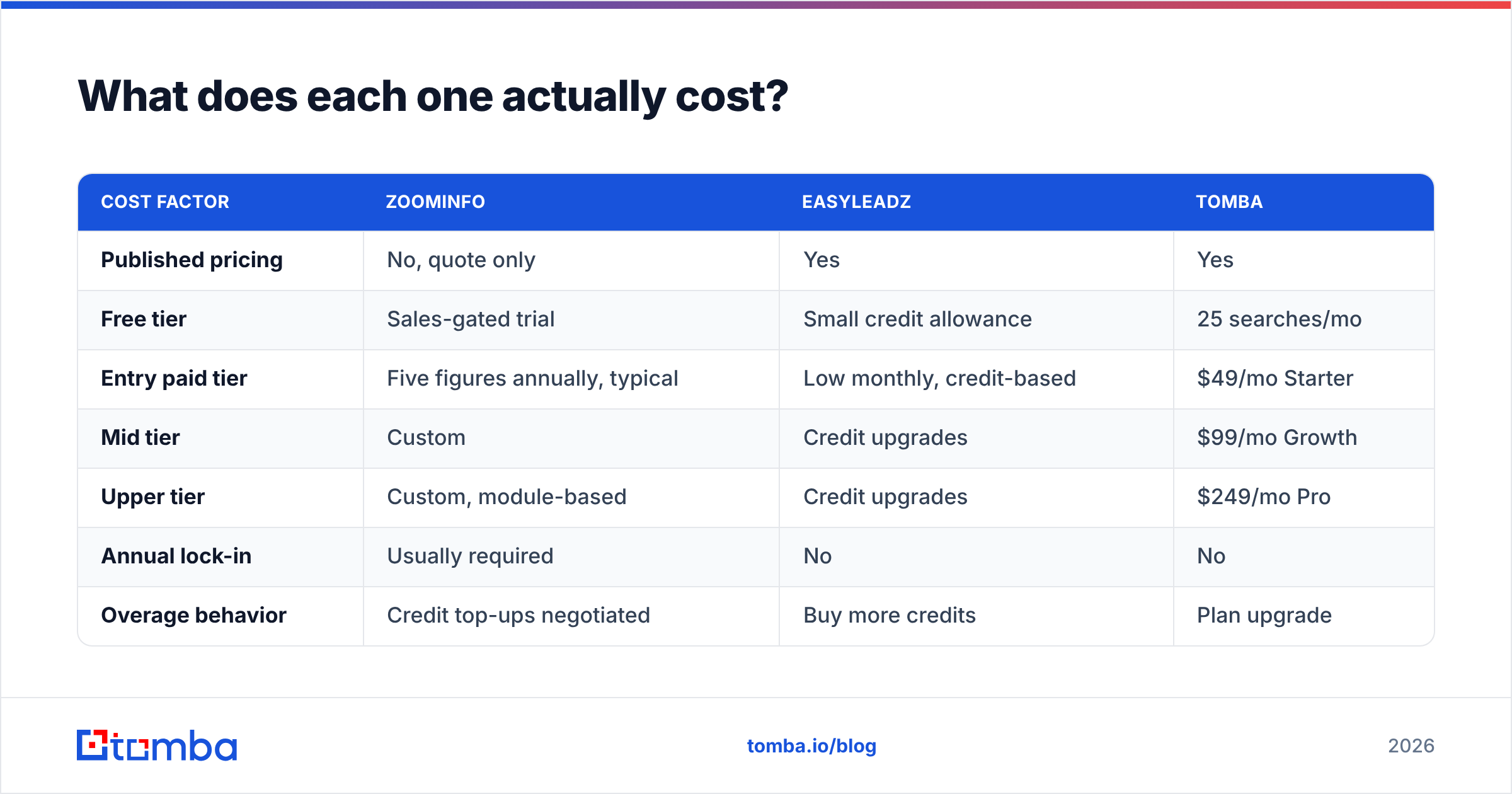
| Cost factor | ZoomInfo | EasyLeadz | Tomba |
|---|---|---|---|
| Published pricing | No, quote only | Yes | Yes |
| Free tier | Sales-gated trial | Small credit allowance | 25 searches/mo |
| Entry paid tier | Five figures annually, typical | Low monthly, credit-based | $49/mo Starter |
| Mid tier | Custom | Credit upgrades | $99/mo Growth |
| Upper tier | Custom, module-based | Credit upgrades | $249/mo Pro |
| Annual lock-in | Usually required | No | No |
| Overage behavior | Credit top-ups negotiated | Buy more credits | Plan upgrade |

The pattern worth noticing: the expensive option isn't expensive because its emails are dramatically better. It's expensive because you're also buying intent signals, org charts, workflow automation, and an account team. If you don't use those, you're paying enterprise rates for a lookup you could get for $49 a month. Compare the Tomba pricing tiers against a ZoomInfo quote line by line and ask which line items you'd actually open in a given week.
Which one fits your team?#
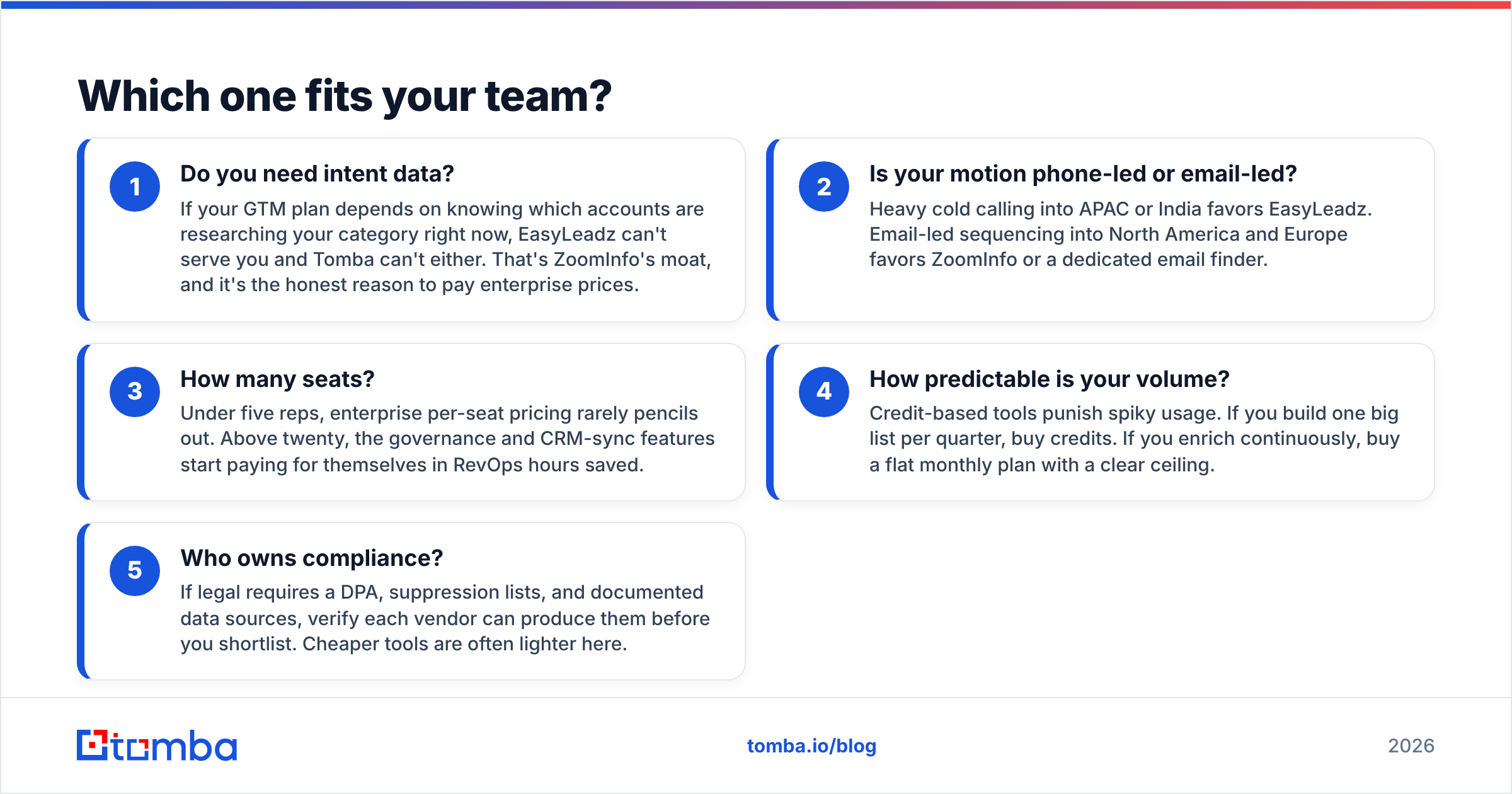
Run yourself through these five checks before you talk to either sales team.
- Do you need intent data? If your GTM plan depends on knowing which accounts are researching your category right now, EasyLeadz can't serve you and Tomba can't either. That's ZoomInfo's moat, and it's the honest reason to pay enterprise prices.
- Is your motion phone-led or email-led? Heavy cold calling into APAC or India favors EasyLeadz. Email-led sequencing into North America and Europe favors ZoomInfo or a dedicated email finder.
- How many seats? Under five reps, enterprise per-seat pricing rarely pencils out. Above twenty, the governance and CRM-sync features start paying for themselves in RevOps hours saved.
- How predictable is your volume? Credit-based tools punish spiky usage. If you build one big list per quarter, buy credits. If you enrich continuously, buy a flat monthly plan with a clear ceiling.
- Who owns compliance? If legal requires a DPA, suppression lists, and documented data sources, verify each vendor can produce them before you shortlist. Cheaper tools are often lighter here.

Where does a dedicated email finder fit?#
There's a third shape of tool that neither of these represents well: the focused, API-first email finder. It doesn't try to be your CRM, your intent platform, or your dialer. It answers one question — what's this person's verified work email — accurately, cheaply, and at volume.
That's the gap most teams land in after running the numbers. You've got firmographic targeting from LinkedIn or a list vendor. You've got a sequencer. What you need is the connective tissue: emails that don't bounce, at a cost per contact you can forecast.
Practically, that stack looks like:
- Domain search to pull every discoverable address at a target company, plus the company's email pattern, so you can reason about accounts rather than one contact at a time.
- Email finder for first-name, last-name, domain lookups when you already know who you want to reach.
- Phone finder when a sequence needs a call step and you'd otherwise be buying a second tool for it.
- Bulk email finder for list-level jobs, and the Tomba API when enrichment needs to live inside your own product or workflow rather than a UI.
The trade-off is real and worth stating plainly: you give up intent scoring, buying-committee visualization, and the account team. If those are load-bearing for your strategy, buy the platform. If they're features you'd admire in a demo and never open again, they're the most expensive part of your quote.
Is there a clear winner in DiscoverOrg vs EasyLeadz?#
No — because they answer different questions, and one of them doesn't exist anymore under that name.
If you're an enterprise GTM team in North America with budget and a RevOps function, ZoomInfo (the platform DiscoverOrg became) is the defensible choice, and its intent layer is the reason. If you're a lean team dialing SMB or APAC prospects and you need mobile numbers this week, EasyLeadz gets you moving for a rounding error of that cost.
And if you looked at both quotes and realized you're mostly paying for a lookup — that's the signal to evaluate a focused email finder instead. Same core job, one-tenth the invoice, no annual lock-in.
Start with the Tomba Email Finder on the free tier: 25 searches a month, no card, no sales call. Run 25 of your hardest target contacts through it, verify the results, and compare the usable-email count against whatever quote is sitting in your inbox. If the numbers favor the platform, buy the platform with confidence. If they don't, you just saved five figures — and Starter at $49/mo keeps going from there.
Related guides#
Ready to find emails that actually work?
Join 150,000+ professionals who stopped guessing and started sending. Free credits on signup — no credit card required.
Get the Tomba newsletter
Practical outbound tactics and product updates — once every two weeks.
About the author