DiscoverOrg vs Endole: Which B2B Data Tool Wins in 2026?
DiscoverOrg (now ZoomInfo) sells US-heavy contact intelligence on enterprise contracts. Endole sells UK company filings and credit data for a fraction of the price. They barely overlap — here's which one your pipeline actually needs.
TL;DR: DiscoverOrg vs Endole is not a real fight. The two tools do different jobs. Here is the short version.
- DiscoverOrg is gone as a standalone product. It merged with ZoomInfo in 2019 and the brand was retired. If a vendor pitches you "DiscoverOrg" in 2026, you are buying ZoomInfo.
- Endole is not a rival to DiscoverOrg. Endole is a UK company-intelligence platform. It is built on Companies House filings, accounts, and credit data. It sells firmographics and risk scores, not direct dials.
- The price gap is about 50x. ZoomInfo deals often land between $15,000 and $40,000 a year. Endole plans cost tens of pounds a month.
- Neither one is a full prospecting stack. ZoomInfo gives you contacts, but locks you into seats and credit caps. Endole gives you UK company depth, but few verified work emails.
- The cheap middle path: pick a company-data source for targeting. Then add a dedicated email finder for the contact layer. That starts at $49/mo, not five figures.
What are DiscoverOrg and Endole, actually?#
Start here. The two tools get compared far more often than they get understood. Half the posts on this query are written by people who have used neither.
DiscoverOrg was a US B2B contact and org-chart database, founded in 2007. Its edge was human-researched org charts. Real analysts phoned people to check who reported to whom in IT, marketing, finance, and HR. In February 2019, DiscoverOrg bought ZoomInfo. It then took the ZoomInfo name for the combined company. The DiscoverOrg dataset still lives inside the ZoomInfo platform. The brand does not. If a reseller still sells you "DiscoverOrg licences," you are buying a ZoomInfo seat with an old label.
Endole is a UK business-intelligence platform. It pulls together Companies House filings, statutory accounts, director records, charges, county court judgments, and credit scores. You search all of it in one place. Its core users are credit controllers, accountants, insolvency practitioners, M&A researchers, and UK sales teams. They need to know if a limited company is solvent before they sign a contract. Endole Explorer adds list-building on top. Filter UK firms by SIC code, turnover, staff count, region, and financial health, then export.
So the honest framing of DiscoverOrg vs Endole is not "which tool is better." It is this: do you need people or companies, and in which country?
DiscoverOrg vs Endole: how do they compare head-to-head?#
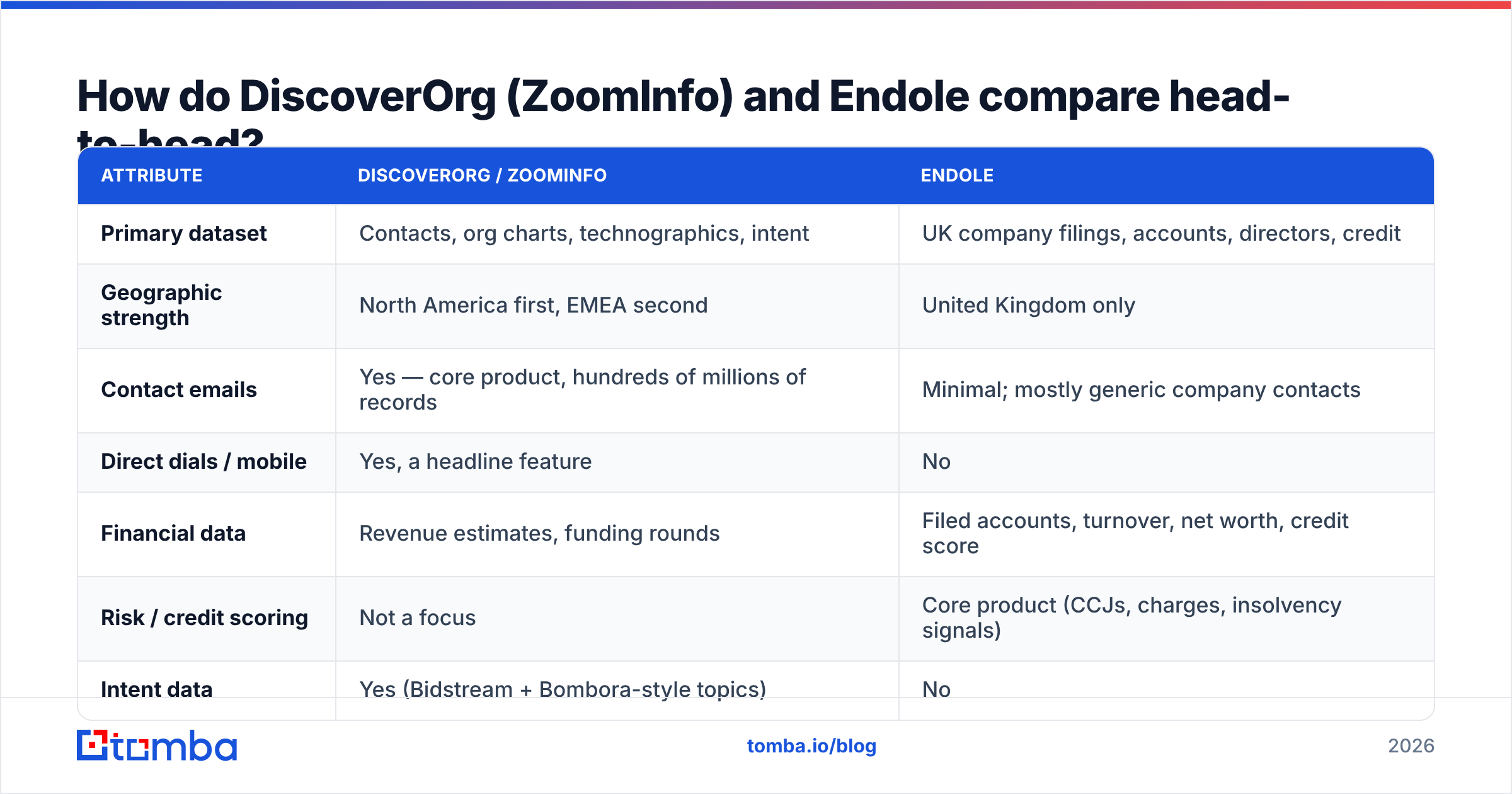
| Attribute | DiscoverOrg / ZoomInfo | Endole |
|---|---|---|
| Primary dataset | Contacts, org charts, technographics, intent | UK company filings, accounts, directors, credit |
| Geographic strength | North America first, EMEA second | United Kingdom only |
| Contact emails | Yes — core product, hundreds of millions of records | Minimal; mostly generic company contacts |
| Direct dials / mobile | Yes, a headline feature | No |
| Financial data | Revenue estimates, funding rounds | Filed accounts, turnover, net worth, credit score |
| Risk / credit scoring | Not a focus | Core product (CCJs, charges, insolvency signals) |
| Intent data | Yes (Bidstream + Bombora-style topics) | No |
| Buying motion | Annual contract, seat-based, sales-led demo | Self-serve subscription, monthly or annual |
| Typical annual spend | Five figures | Low hundreds of pounds |
| CRM integrations | Salesforce, HubSpot, Dynamics, Outreach, Salesloft | Limited; API and CSV export |
| Best for | US/global outbound SDR teams at scale | UK credit, compliance, and territory research |
The table makes the mismatch clear. These tools solve different jobs. The only real overlap is list-building. Both can hand you a filtered set of target accounts. After that, they part ways.

What does DiscoverOrg vs Endole cost in 2026?#
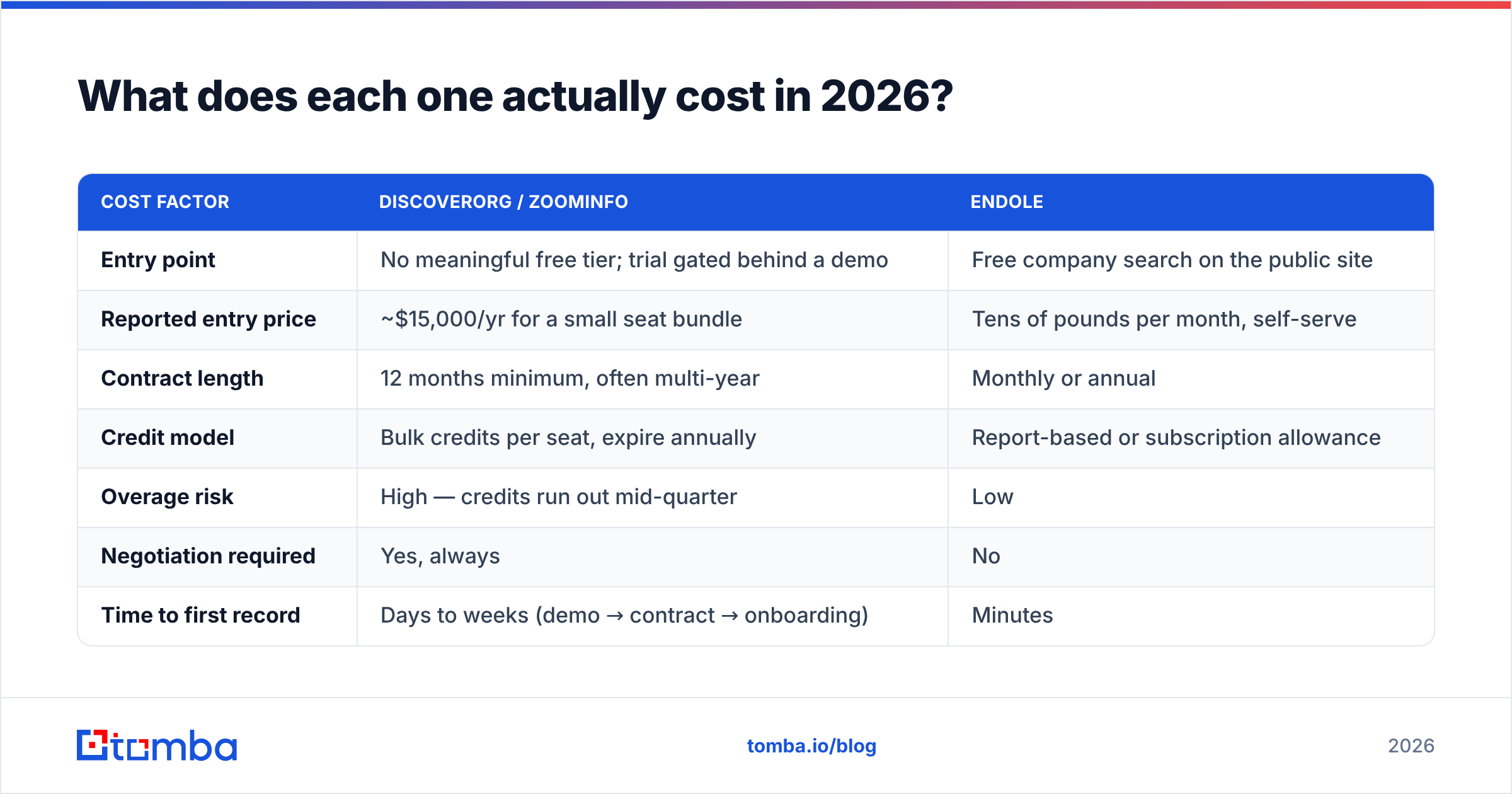
Neither vendor posts a clean price list. Treat the numbers below as rough ranges. They come from public review sites, procurement records, and buyer reports, not from a quote.
| Cost factor | DiscoverOrg / ZoomInfo | Endole |
|---|---|---|
| Entry point | No meaningful free tier; trial gated behind a demo | Free company search on the public site |
| Reported entry price | ~$15,000/yr for a small seat bundle | Tens of pounds per month, self-serve |
| Contract length | 12 months minimum, often multi-year | Monthly or annual |
| Credit model | Bulk credits per seat, expire annually | Report-based or subscription allowance |
| Overage risk | High — credits run out mid-quarter | Low |
| Negotiation required | Yes, always | No |
| Time to first record | Days to weeks (demo → contract → onboarding) | Minutes |
Three buying realities are worth naming.
- ZoomInfo's price scales with seats, not value. Adding a fifth SDR to a four-seat deal is rarely a 25% bump. Buyers often report step pricing that resets the whole talk.
- Credit expiry is the hidden cost. Unused export credits rarely roll over. Teams that go quiet in Q1 and Q2 find out in Q4 that they paid for records they never pulled.
- Endole is cheap, but narrow. You pay UK-registry prices for UK-registry data. The moment your ICP includes a German GmbH or a US startup, the tool goes quiet.
Check the current G2 category listings before any renewal. Buyer-reported pricing there is fresher than any blog post, this one included.
DiscoverOrg vs Endole: which one has better data accuracy?#
They are accurate about different things. Both also decay in ways you can predict.
Endole starts from statutory data, so its floor is high. Companies House filings are required by law. Registered address, incorporation date, SIC code, director names, and filed accounts are as close to ground truth as B2B data gets.
The weak spots are lag and abstraction. Small firms can file short accounts up to nine months after year end. So a turnover figure may describe a business that has since doubled or halved. A registered office is also often an accountant's address, not a real workplace.
ZoomInfo's accuracy is a matter of odds. Contact records come from web crawling, contributory networks, public profiles, and human research. Users who install the extension share their address books, and that feeds the pool.
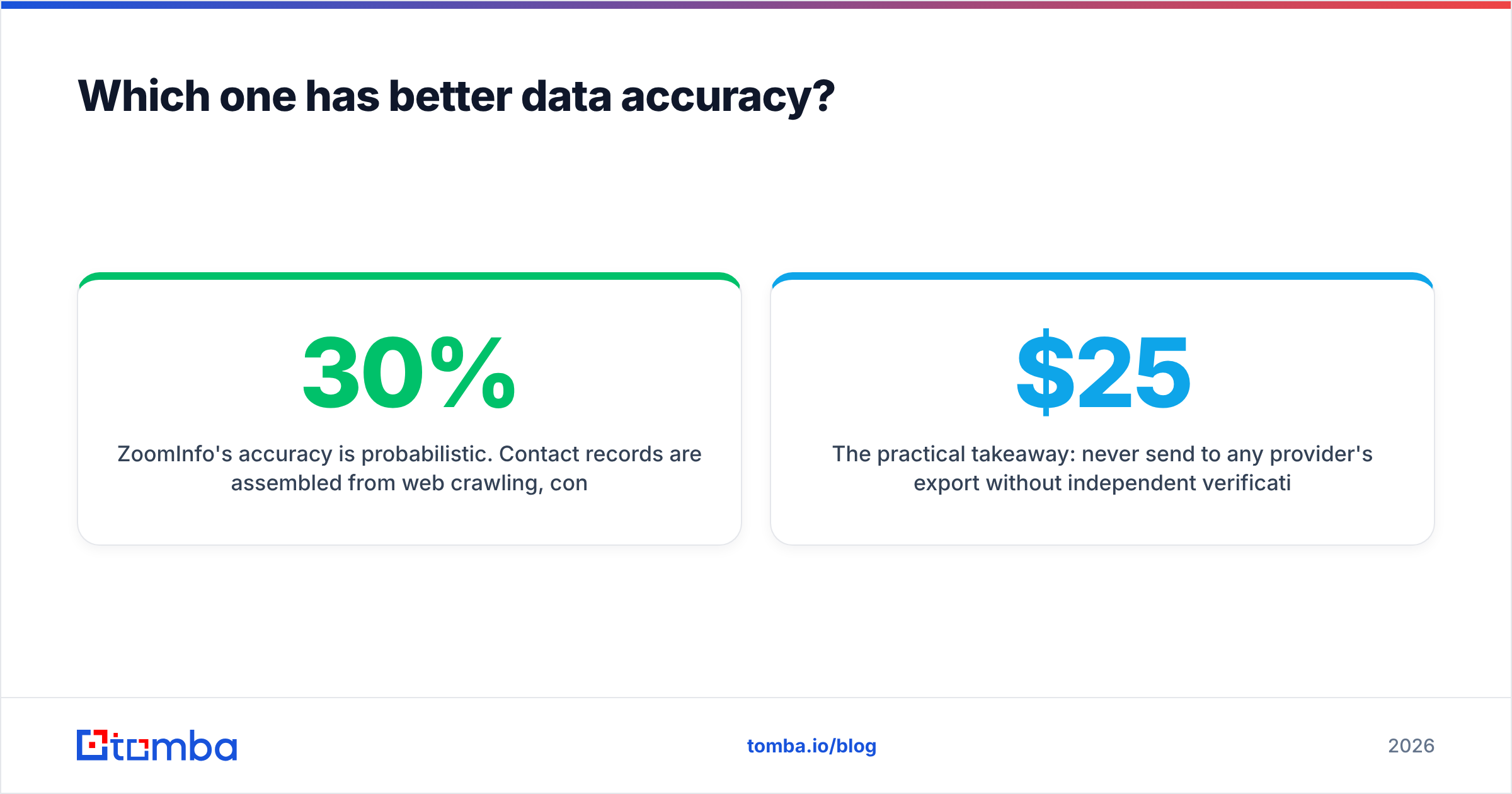
The result is breadth no registry can match. But B2B contact data decays by roughly 25–30% a year as people change jobs. No vendor escapes that. Tests keep showing the same pattern. The gap between claimed accuracy and real bounce rate is widest in the mid-market and SMB tail, where coverage is thinnest.
The takeaway is simple. Never send to a raw export. It does not matter if the record came from a $25,000 contract or a £30 plan. Run it through an email verifier first. A 4% bounce rate is the line between a campaign that lands and a domain you spend a quarter repairing.
Who should choose DiscoverOrg (ZoomInfo)?#
Pick ZoomInfo when all of these are true.
- Your ICP is North America first. The data is deepest there, so the price starts to make sense.
- You have three or more full-time SDRs. Seat pricing punishes small teams and rewards heavy users.
- You need direct dials, not just emails. Dials are the hardest thing to source cheaply, and ZoomInfo is still one of the best.
- Intent signals change how you work. If reps reorder the call list based on surging topics, you are using a feature no registry tool offers.
- You can absorb an annual commitment. There is no monthly escape hatch.
If two or more of those are false, you are almost certainly overbuying. That is the most common finding in renewal audits. Teams pay enterprise rates for work a $99/mo stack can do.
Who should choose Endole?#
Pick Endole when:
- Your market is UK limited companies. Not "UK plus Europe." UK.
- Financial health gates the deal. Credit terms, factoring, insurance, lending, and big-ticket services all need CCJ and solvency data first.
- You want filed turnover, not estimates. Real numbers beat modelled ones for scoring.
- You need director-level ownership mapping. Group structures, PSCs, and cross-directorships are Endole's home turf.
- You are budget-constrained and self-serve. No demo, no contract, no procurement cycle.
Endole will not hand you firstname.lastname@company.co.uk for the Head of Operations. That is not a flaw in the product. It is a scope line. Contact discovery is a separate layer. Pretending otherwise is how teams end up with two subscriptions and still no way to reach a human.

Is there a middle path between the two?#
Yes. It is how most lean outbound teams are built in 2026. Split the targeting layer from the contact layer.
The stack looks like this:
- Targeting layer — you decide which companies matter. Use Endole for the UK, a registry equivalent elsewhere, your own closed-won analysis, or a website visitor tool.
- Contact layer — you turn a company into a named person with a working address. A dedicated email finder does this. Big platforms bundle it at a heavy markup.
- Verification layer — you protect deliverability before you send.
- Enrichment layer — you fill in title, seniority, LinkedIn, and phone for the records that survive.
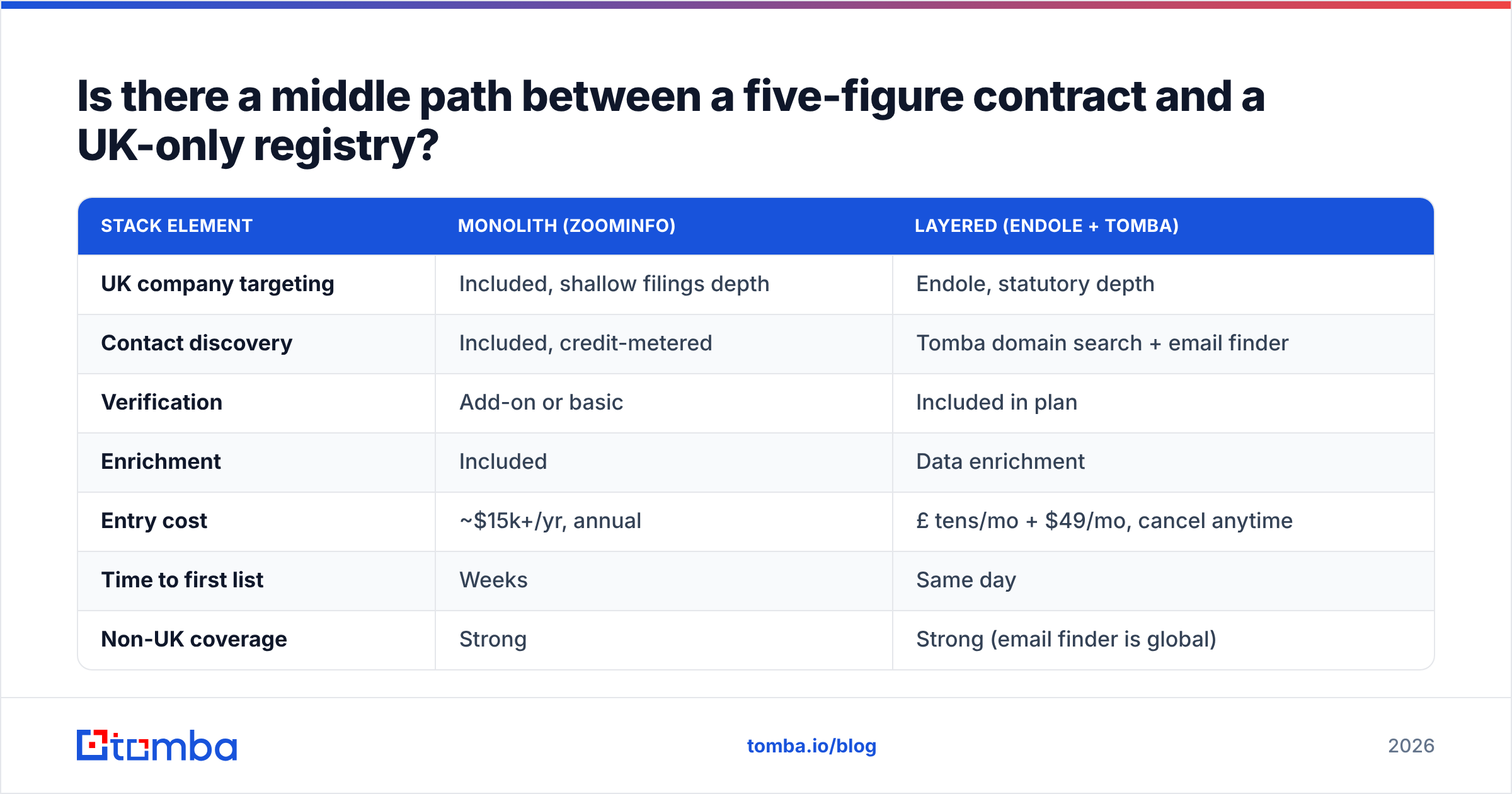
Here is how the layered stack prices out against one monolith:
| Stack element | Monolith (ZoomInfo) | Layered (Endole + Tomba) |
|---|---|---|
| UK company targeting | Included, shallow filings depth | Endole, statutory depth |
| Contact discovery | Included, credit-metered | Tomba domain search + email finder |
| Verification | Add-on or basic | Included in plan |
| Enrichment | Included | Data enrichment |
| Entry cost | ~$15k+/yr, annual | £ tens/mo + $49/mo, cancel anytime |
| Time to first list | Weeks | Same day |
| Non-UK coverage | Strong | Strong (email finder is global) |
Tomba's pricing is public and deliberately boring. A free tier gives 25 searches a month. Starter is $49/mo, Growth $99/mo, Pro $249/mo, and Enterprise is custom. Full Tomba pricing sits on the site, with no demo gate. For lists at volume, the bulk email finder takes a CSV in and gives verified contacts out. That is the job most people mean when they say they need a "data platform."
What mistakes do buyers make here?#
They compare the tools without checking scope. If you searched "DiscoverOrg vs Endole," someone on your team may have put both in a sheet because both showed up in one category listing. Categories lie. Read the datasets.
They buy for the demo, not the workflow. ZoomInfo demos very well, and the intent dashboard looks great on a screen share. Ask a duller question. How many records will my team export in month four? What happens when credits run out in month nine?
They assume registry data means live contacts. Endole gives you a company and its directors. A director's name is not an email address. Guessing j.smith@ without checks is how bounce rates climb.
They skip verification. Every provider ships some dead records, cheap or costly, US or UK. Verifying costs a fraction of a burned sending domain.
They ignore catch-all domains. Many UK corporate domains accept all mail, so normal checks return "unknown." Handle them with a catch-all verifier instead of blanket-sending or blanket-binning.
DiscoverOrg vs Endole: so which one wins?#
For US and global outbound at scale, with budget: ZoomInfo, the product once sold as DiscoverOrg. Nothing here matches its direct-dial and intent coverage. Use it hard and the price works.
For UK company research, credit risk, and financial checks: Endole. It is cheaper, faster to adopt, and sourced from filings rather than estimates. Within its scope it is excellent.
For finding and verifying the real email addresses of people at those companies, neither one is the efficient answer. Both audiences need that job done. It belongs to a tool that charges for what you find, not for how many seats you hold.
Start with the Tomba Email Finder. Feed it the companies your targeting layer produced. Get verified professional emails back. Then keep whatever mix of ZoomInfo, Endole, or neither makes sense for research. The free tier gives you 25 searches a month, so test it on a list you already know. That is the only benchmark that counts.
Related guides#
Ready to find emails that actually work?
Join 150,000+ professionals who stopped guessing and started sending. Free credits on signup — no credit card required.
Get the Tomba newsletter
Practical outbound tactics and product updates — once every two weeks.
About the author