DiscoverOrg vs Exellius: B2B Data Comparison for 2026
DiscoverOrg (now ZoomInfo) and Exellius sell B2B contact data in completely different ways: one is a six-figure platform, the other a managed list service. Here is how they actually compare on coverage, accuracy, pricing and contract risk.
TL;DR
- DiscoverOrg no longer exists as a standalone product. It merged with ZoomInfo in 2019 and its org-chart data now lives inside ZoomInfo's platform, so "buying DiscoverOrg" in 2026 means signing a ZoomInfo contract.
- Exellius is a managed B2B data vendor: you brief them on an ICP, they build and deliver a list. It is a service model, not a self-serve database you log into.
- The two are not really substitutes. One sells always-on platform access with a seat-based annual contract; the other sells project-based data delivery with per-record or per-project pricing.
- Both are priced and structured for buyers who want data handed to them. If you already know your target accounts and just need verified contact details, a self-serve email finder at $49/mo covers the same job for a fraction of the spend.
- The decision comes down to three questions: do you need org charts and intent signals, do you need a list built for you, or do you just need working email addresses for accounts you already picked?
What is DiscoverOrg in 2026?#
DiscoverOrg was a B2B data provider built around deep, human-researched org charts. Its pitch was that a researcher had actually verified who reported to whom inside a target account, which mattered enormously for enterprise sales teams selling into IT, HR or finance departments where the buying committee has eight people and you need to know which one signs.
In 2019 DiscoverOrg acquired ZoomInfo and adopted the ZoomInfo name. If you search for DiscoverOrg today, you land on ZoomInfo. The merger history is worth understanding because it explains the product you'd actually be buying: ZoomInfo's scale plus DiscoverOrg's research-led org data, sold as one platform with modules for sales, marketing, talent and operations.
What that means practically:
- You cannot buy "DiscoverOrg" à la carte. Legacy DiscoverOrg accounts were migrated. New buyers sign for ZoomInfo SalesOS or a bundled equivalent.
- Pricing is quote-only and annual. Public G2 and Vendr data consistently put entry contracts in the five figures, with mid-market deployments landing between roughly $15,000 and $40,000 per year depending on seats, credits and modules.
- Credits are the real currency. Your seat count sets the license fee; your export credits set how much data you can actually take out. Running out mid-year is a common complaint.
- Auto-renewal clauses are strict. Multiple public reviews flag notice windows and renewal terms as the biggest source of buyer regret, not the data quality.
The data itself is genuinely strong for enterprise and upper mid-market accounts in North America. Where it thins out is small business, non-US markets, and fast-moving startup teams where titles change quarterly.
What is Exellius, and how does it actually work?#
Exellius sits in a different category: managed B2B data and demand generation. Instead of licensing a searchable database, you brief a team on your ideal customer profile — industry, headcount, geography, tech stack, seniority — and they return a list built to that spec, usually with verified emails and sometimes direct dials.
Public information on Exellius is thinner than on ZoomInfo. Pricing is not published, there is no free trial to self-serve into, and independent review volume on sites like G2 is limited compared to the incumbents. That is not a knock on data quality; it means you have less third-party signal to work from before you commit, so your diligence burden is higher.
The service model has real advantages when it fits:
- You pay for output, not access. No seat licenses sitting idle in month seven.
- Custom criteria beat filter menus. If your ICP is "manufacturers running a specific ERP in three US states with a recent facilities expansion," no self-serve filter set gets you there cleanly. A human researcher can.
- Lower commitment. A project engagement is easier to walk away from than a 12-month platform contract.
And real disadvantages:
- Latency. A list takes days, not seconds. You cannot look up one contact before a call.
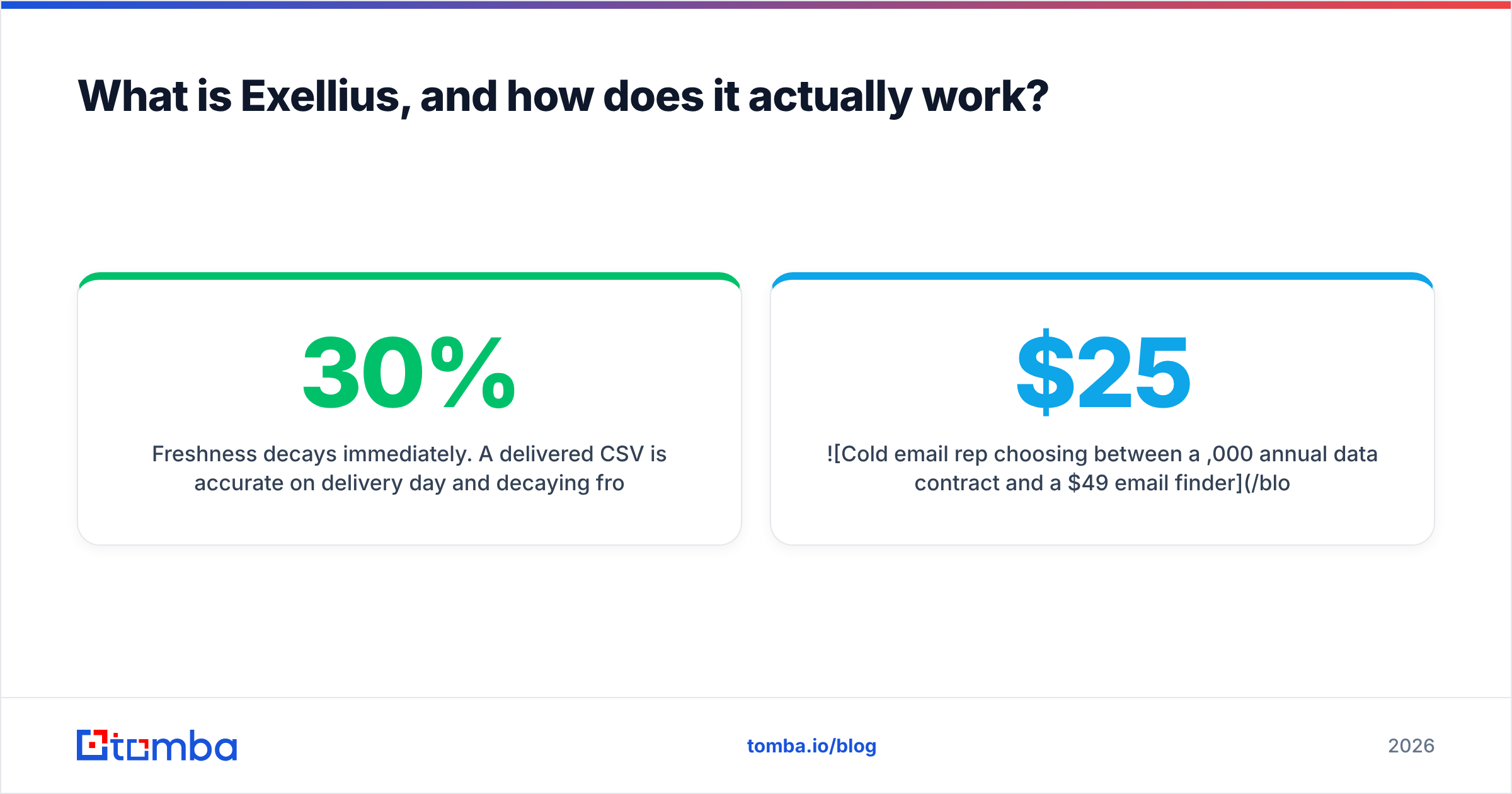
- Freshness decays immediately. A delivered CSV is accurate on delivery day and decaying from then on. B2B contact data goes stale at roughly 25–30% per year, and job changes cluster in Q1.
- No API-first workflow. Managed delivery does not slot into a CRM enrichment pipeline the way a data API does.
- Verification is on trust. You should re-run every delivered list through an independent email verifier before it touches your sending domain. This is not optional with any vendor, including the expensive ones.

DiscoverOrg vs Exellius: how do they compare head to head?#
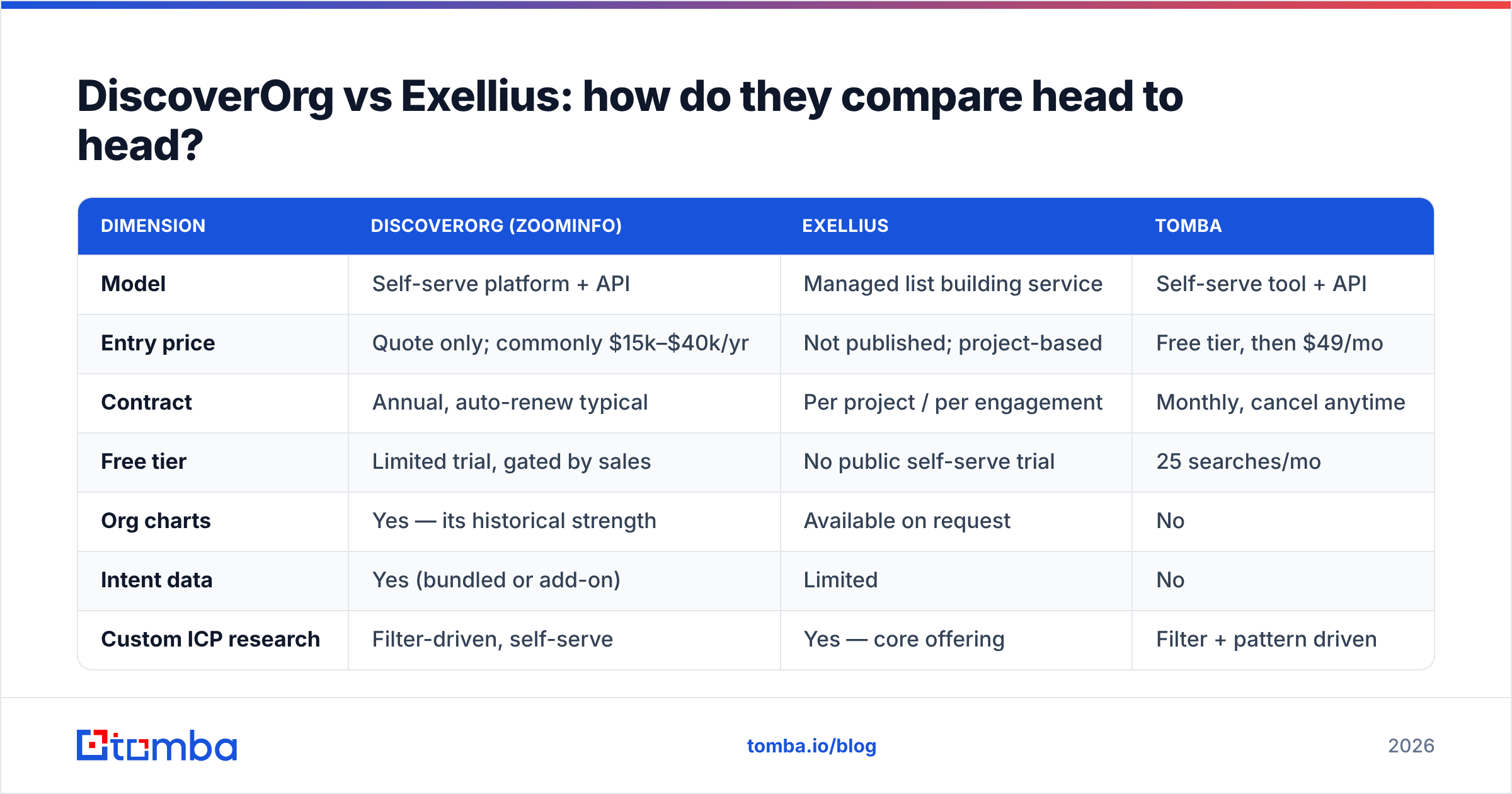
Here is the honest side-by-side. Where a cell says "not published," that reflects genuine public opacity rather than an assumption about the vendor.
| Dimension | DiscoverOrg (ZoomInfo) | Exellius | Tomba |
|---|---|---|---|
| Model | Self-serve platform + API | Managed list building service | Self-serve tool + API |
| Entry price | Quote only; commonly $15k–$40k/yr | Not published; project-based | Free tier, then $49/mo |
| Contract | Annual, auto-renew typical | Per project / per engagement | Monthly, cancel anytime |
| Free tier | Limited trial, gated by sales | No public self-serve trial | 25 searches/mo |
| Org charts | Yes — its historical strength | Available on request | No |
| Intent data | Yes (bundled or add-on) | Limited | No |
| Custom ICP research | Filter-driven, self-serve | Yes — core offering | Filter + pattern driven |
| Turnaround for one contact | Seconds | Days | Seconds |
| Verification included | Yes, platform-side | Vendor-verified on delivery | Yes, with confidence score |
| Best for | Enterprise ABM teams | One-off custom list projects | Precision lookups at volume |

The table makes the core distinction obvious: these tools solve adjacent problems. ZoomInfo answers "who should I be talking to across this whole market, and who reports to whom." Exellius answers "build me the list I described." Neither is optimised for "I have 400 named accounts and I need working email addresses for the VP of Engineering at each one" — which, for most outbound teams, is the actual daily job.
Which one has better data accuracy?#
Accuracy claims from data vendors are close to meaningless without a definition, so define it before you compare.
There are three separate things vendors call accuracy:
- Syntactic validity — the address is well-formed and the domain has MX records. Trivial to achieve, and some vendors quietly report this number.
- Deliverability — the mailbox accepts mail without bouncing. This is what your sending reputation actually cares about.
- Correctness — the address belongs to the person you think it belongs to, and they still work there. Hardest to measure and the one that determines reply rate.
ZoomInfo publishes high accuracy figures and backs them with a large research and contribution network, which genuinely helps on enterprise accounts. Independent user reports on review sites are more mixed, with the common pattern being excellent coverage of US enterprise and noticeably weaker results for EMEA, APAC and sub-50-employee companies. Managed providers like Exellius often score well on correctness for the specific brief, because a human checked it, but you have no way to audit the process before you buy.
The practical answer for either vendor: verify independently. Run any purchased list through a third-party verifier and reject anything that comes back risky. Catch-all domains deserve their own treatment — a catch-all verifier gives you a probabilistic read on domains that accept everything, which is exactly where naive verification tools report false positives and where your bounce rate gets destroyed.
A reasonable QA standard before any list touches your sequencer:
- Bounce budget under 2%. Google and Microsoft treat sustained higher rates as a spam signal.
- Reject role accounts — info@, sales@, support@ — unless you specifically want them.
- Re-verify anything older than 60 days. Delivered-fresh does not mean still-fresh.
- Sample manually. Pull 25 random records and check them against LinkedIn by hand. If more than two are wrong, the whole batch is suspect.
- Track reply rate by source. It is the only accuracy metric that pays your salary.
What does each option really cost per usable contact?#
Sticker price is the wrong unit. Cost per usable contact is the right one. Usable means verified, correct, in your ICP, and reachable.
Work a scenario. You need 5,000 verified contacts this year.
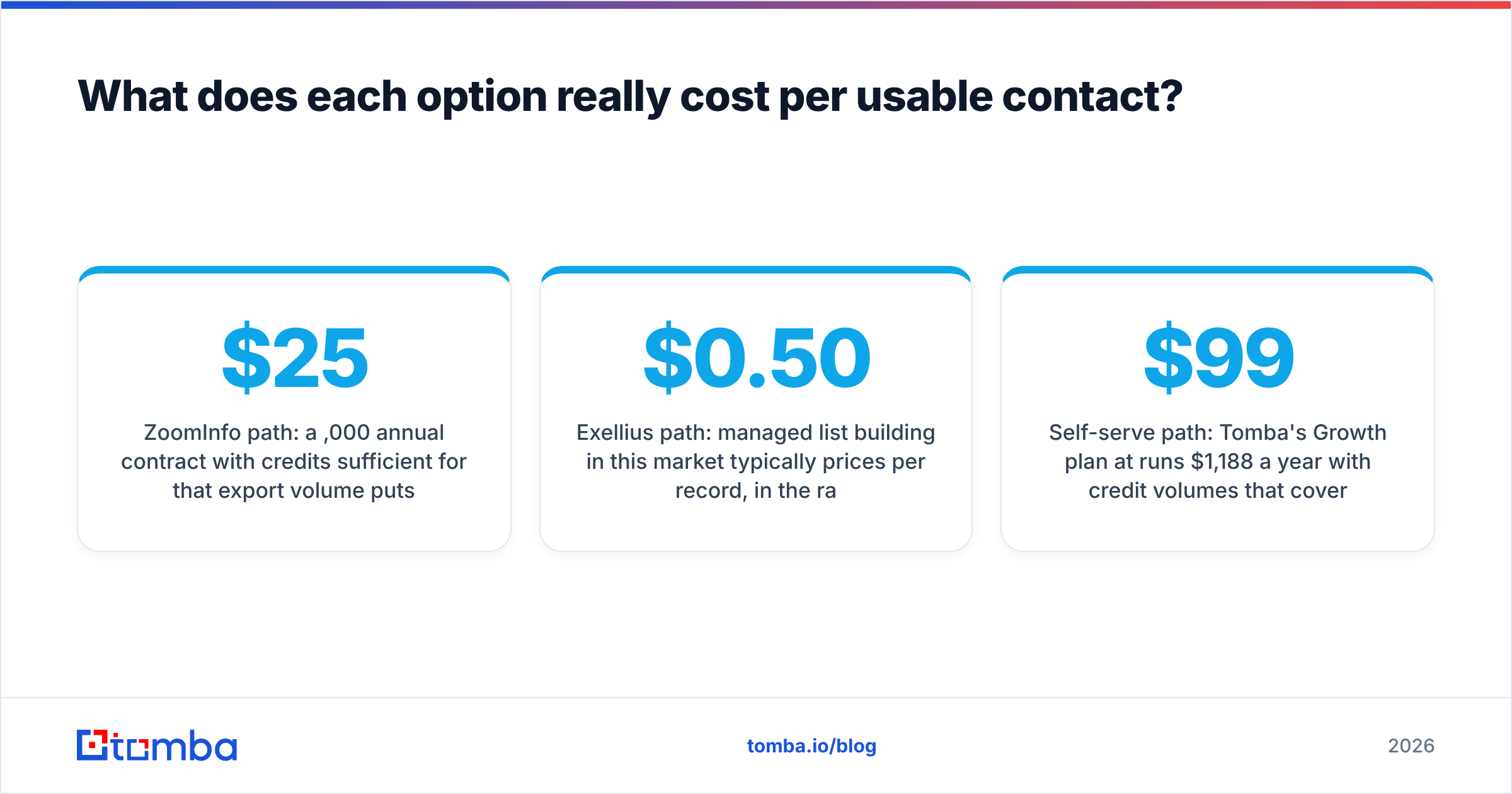
ZoomInfo path: a $25,000 annual contract with credits sufficient for that export volume puts you at $5.00 per contact — but only if you use the full allocation. Teams routinely use 40–60% of their credits before renewal, which pushes the effective cost to $8–$12 per contact. On the upside, you also get search, org charts, intent and integrations bundled in, so the platform value isn't purely per-record.
Exellius path: managed list building in this market typically prices per record, in the range of roughly $0.50 to several dollars depending on enrichment depth and how exotic your criteria are. For 5,000 records that could land anywhere from $2,500 to $15,000. You get exactly what you asked for and nothing else — no ongoing lookup capability, no self-serve tool for the rep who needs one address before a 2pm call.
Self-serve path: Tomba's Growth plan at $99/mo runs $1,188 a year with credit volumes that cover most mid-sized outbound programs, and Tomba pricing starts at $49/mo for Starter. You do your own targeting, which is the trade — you supply the account list, the tool supplies the contact details. If your ICP is already defined and living in your CRM, that trade is heavily in your favour.

When should you actually pick each one?#
Choose ZoomInfo (the DiscoverOrg lineage) when:
- You sell six-figure deals into enterprise accounts with multi-person buying committees.
- Org charts and reporting structure change your messaging, not just your contact list.
- Intent data feeds a real ABM motion — not a slide in a board deck.
- You have budget authority for a five-figure annual line item and a RevOps person to administer it.
Choose a managed provider like Exellius when:
- Your targeting criteria cannot be expressed as database filters.
- You need one list, once, for a specific campaign or event, and don't want an ongoing subscription.
- You have no internal resource to build lists and would rather buy the output than the tooling.
- You're testing a new market segment before committing to a platform contract.
Choose a self-serve finder when:
- You already know your accounts and just need contacts inside them.
- Reps need one-off lookups in real time, mid-workflow, from a browser or CRM.
- You want to enrich existing records rather than acquire new ones — that's what data enrichment endpoints are for.
- You want the cost to scale with usage rather than with seat count.
Most teams that sign a five-figure data contract are actually in the third bucket. They buy a market-mapping platform to solve a contact-lookup problem, use maybe 15% of the feature surface, and renew out of inertia. Before you commit, audit what your reps actually did in the tool last quarter — search sessions or exports? If it's overwhelmingly exports of accounts they already knew about, you're paying platform prices for a lookup utility.
How do you evaluate either vendor without getting burned?#
Run the same evaluation regardless of which side you lean toward.
- Demand a live blind test. Give the vendor 100 records from accounts you already have verified contacts for. Compare their output to your ground truth. Do not accept a curated sample deck.
- Ask for bounce guarantees in writing. "High accuracy" in a demo is marketing. A contractual credit for bounces above a threshold is a commitment.
- Read the renewal clause first. With annual platform contracts, the notice window is where money leaks. Diary the cancellation date the day you sign.
- Check coverage in your actual geography. North American coverage numbers say nothing about DACH or LATAM. Test the markets you sell into.
- Confirm export rights. Some contracts restrict what you can keep after termination. Know before, not after.
- Price the alternative honestly. Get a quote from a self-serve tool covering the same volume. If the gap is 10x, the platform needs to justify 10x of value, not 1.2x.
Analyst coverage from firms like Gartner is useful for market context, but it skews enterprise by design. For a 12-person sales team, the peer reviews of buyers your size will tell you more than any quadrant.
The bottom line#
DiscoverOrg vs Exellius isn't really a fair fight because they're selling different things. ZoomInfo (carrying the DiscoverOrg data heritage) is a market-intelligence platform priced for enterprise ABM. Exellius is a managed data service priced per project, well suited to bespoke ICPs and one-off campaigns, though with less public transparency to diligence against.
The question worth asking before either is simpler: do you need someone to tell you who to target, or do you already know and just need to reach them? If it's the second — and for most outbound teams running a defined ICP, it is — you can skip the six-figure platform and the custom project entirely.
That's the gap Tomba fills. The Tomba Email Finder finds professional email addresses by domain, name or company, returns a confidence score with every result, and runs through a browser extension, Google Sheets, a REST API, or bulk CSV upload. Free tier gives you 25 searches a month to test it against your own known-good contacts, Starter is $49/mo, and there's no annual lock-in to negotiate your way out of. Test it on 100 accounts you already have verified data for — then compare the hit rate to whatever quote is sitting in your inbox.

Related guides#
Ready to find emails that actually work?
Join 150,000+ professionals who stopped guessing and started sending. Free credits on signup — no credit card required.
Get the Tomba newsletter
Practical outbound tactics and product updates — once every two weeks.
About the author