DiscoverOrg vs FAC Intelligence: Which B2B Data Wins?
One of these brands no longer exists under its own name, and the other has almost no public footprint. Here is what DiscoverOrg vs FAC Intelligence actually means in 2026 — and what to buy instead.
DiscoverOrg vs FAC Intelligence is an odd matchup. One brand no longer exists. The other has almost no public trace. Here is what each name really points to in 2026, what a fair comparison can claim, and what to buy instead.
TL;DR
- DiscoverOrg no longer exists as its own product. It merged with ZoomInfo in 2019. The database and the contracts now sit inside ZoomInfo. If a rep pitches you "DiscoverOrg," you are buying ZoomInfo.
- FAC Intelligence has almost no public footprint. No G2 category listing. No published pricing. No documented coverage numbers. Treat any hard specs you see as unverified.
- The real question is not A vs B. Do you need a full suite with intent data and org charts? Or do you need accurate contact data at a price your budget can carry?
- Enterprise suites start in the five figures per year. They are quote-only and lock you in for a year. Focused data tools start at $49/mo with a free tier.
- Our pick for teams under 50 reps: an email-finding and enrichment layer plus your CRM.
What is DiscoverOrg in 2026?#
Short answer: it is ZoomInfo.
DiscoverOrg launched in 2007. It built its name on something most databases skipped: human-verified org charts for IT, marketing, finance, and HR teams. Instead of scraping and hoping, it ran a research team. Those researchers phoned into companies and mapped reporting lines. That is why it charged premium prices while cheap scrapers undercut it.
In February 2019, DiscoverOrg bought ZoomInfo. The combined company took the ZoomInfo name and went public in 2020. The ZoomInfo platform you can buy today is the descendant of both. The DiscoverOrg brand is retired. You will still see it in old comparison posts, legacy contracts, and the odd reseller listing. You will not see it on a current order form. The company history on Wikipedia confirms the merger timeline if you want a neutral source.
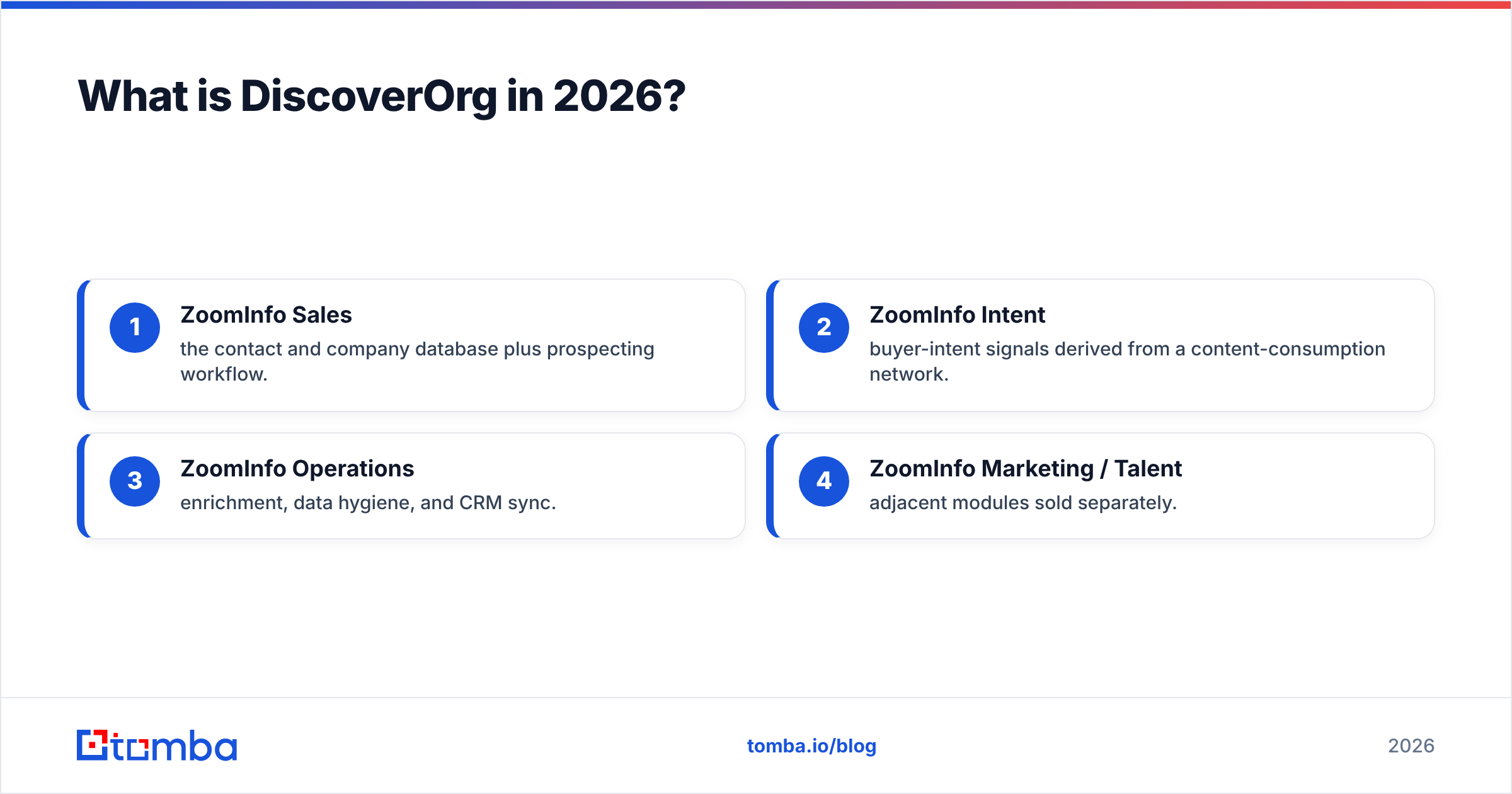
This matters in practice. If you are looking at "DiscoverOrg" today, you are really looking at:
- ZoomInfo Sales — the contact and company database plus prospecting workflow.
- ZoomInfo Intent — buyer-intent signals from a content-consumption network.
- ZoomInfo Operations — enrichment, data hygiene, and CRM sync.
- ZoomInfo Marketing / Talent — adjacent modules sold separately.
Each module is priced on its own, and the total climbs fast. That is the real thing you are comparing against.
What is FAC Intelligence, and can you verify it?#
Here is where a normal comparison post would invent a spec sheet. We will not.
"FAC Intelligence" shows up as a search query. It does not show up where B2B data vendors are normally documented. There is no established category listing on G2. There is no published pricing page, no widely cited coverage figure, and no analyst coverage. The name also collides with unrelated groups using the FAC acronym in finance, aviation, and government contracting.
That leaves three options. Work out which one applies before you spend a dollar:
- It is a very small or regional provider with a real product and a tiny marketing footprint. That is possible, and it is not disqualifying. Plenty of good niche vendors are invisible on review sites.
- It is a rebrand or a reseller of another database. This is common. You would pay a markup for data you could license directly.
- The query is a mis-remembered name for something else.
Before you shortlist any low-footprint data vendor, ask for these five things in writing:
- A sample file of 500 records for your exact ICP — not a curated demo list. Run it through an independent email verifier and count how many bounce.
- The data sourcing statement. Where does the data come from? What is the legal basis for processing it under GDPR and CCPA? A vendor who cannot answer that in one paragraph is a liability.
- Refresh cadence per field. "Updated regularly" is not an answer. Job titles in B2B decay by roughly 25–30% a year. A database refreshed once a year is half wrong by month twelve.
- A named reference customer in your segment who will take a 15-minute call.
- Month-to-month terms or a 30-day out. If the only option is a 12-month prepaid contract from a vendor you cannot verify, that is your answer.
DiscoverOrg vs FAC Intelligence: how do the two options compare?#
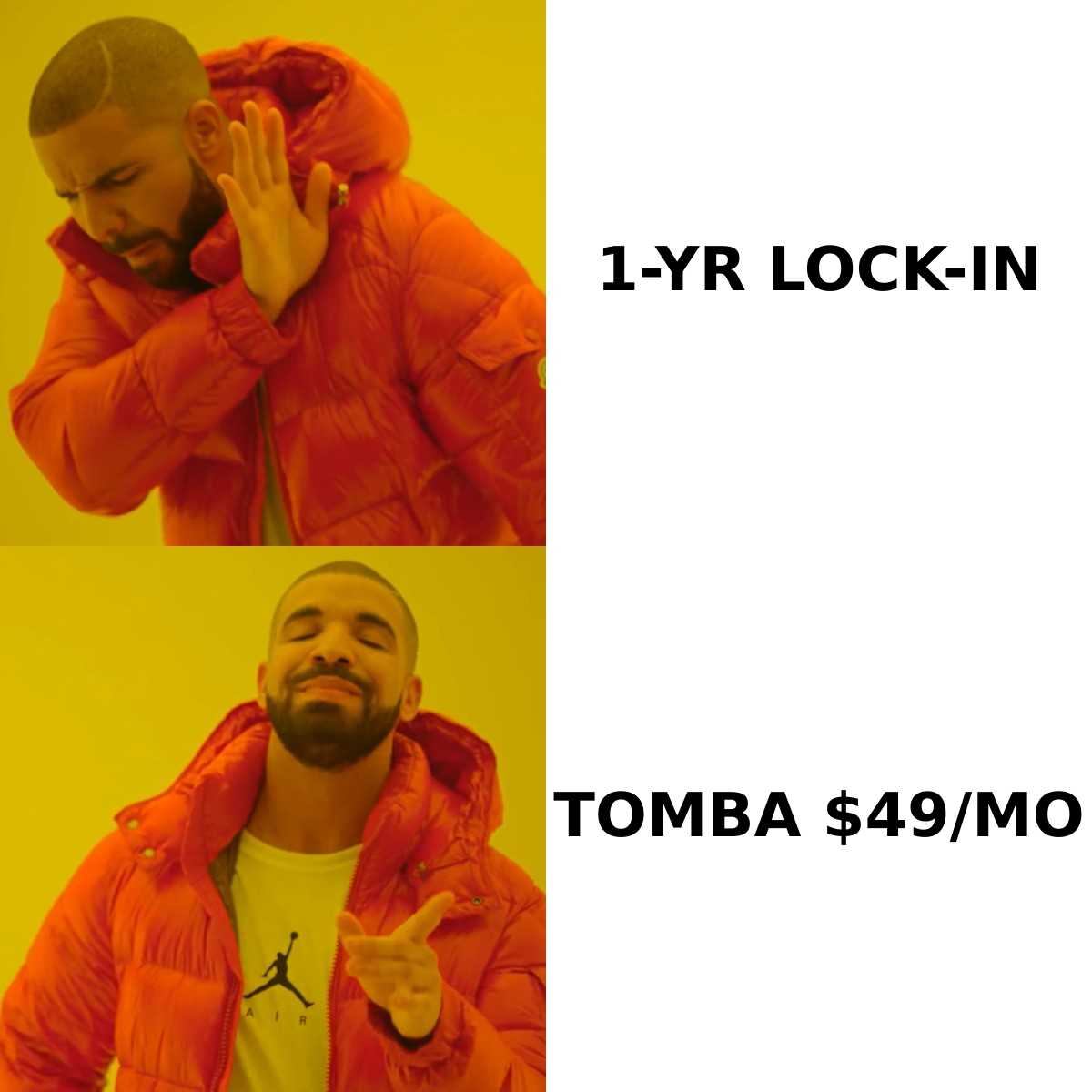
One side of this matchup cannot be verified. So the honest DiscoverOrg vs FAC Intelligence table compares the category DiscoverOrg/ZoomInfo sits in against the options you would realistically pick instead. A low-footprint niche vendor appears as a class, not as a spec sheet.
| Attribute | ZoomInfo (ex-DiscoverOrg) | Unverified niche vendor (FAC-class) | Focused finder + enrichment (Tomba-class) |
|---|---|---|---|
| Entry price | Quote-only, commonly $15k–$40k/yr | Unknown / quote-only | $49/mo Starter, free tier available |
| Free tier | No (limited trial) | Unknown | Yes — 25 searches/mo |
| Contract | Annual, often multi-year | Unknown, assume annual | Monthly, cancel anytime |
| Seat model | Per-seat + credit caps | Unknown | Credit-based, seats not metered the same way |
| Org charts | Yes — a genuine differentiator | Unverified | No |
| Intent data | Yes, paid add-on | Unverified | No |
| Email verification | Included in platform | Unverified | Included, plus catch-all handling |
| Phone / direct dials | Extensive | Unverified | Yes, via phone finder |
| API access | Yes, higher tiers | Unknown | Yes, on all paid plans |
| Time to first value | 2–6 weeks (onboarding, CRM mapping) | Unknown | Same day |
| Best for | Enterprise ABM teams with budget | Only after full due diligence | SMB and mid-market outbound teams |
Two things fall out of that table.
First, ZoomInfo's org charts and intent data are real moats. Say your motion is enterprise ABM. You need to know that the VP of Infrastructure reports to the CTO. You also need to know the account is researching your category this quarter. Nothing on the cheap end does that. Pay for it.
Second, most teams do not need any of it. If a rep's job is "find 200 marketing managers at Series B SaaS companies and email them," you are paying enterprise prices for a simple lookup.
What does each option actually cost per usable contact?#
Price per seat is a vanity metric. The number that matters is cost per usable contact. A usable contact is deliverable, correctly titled, and in your ICP.
Work it out like this:
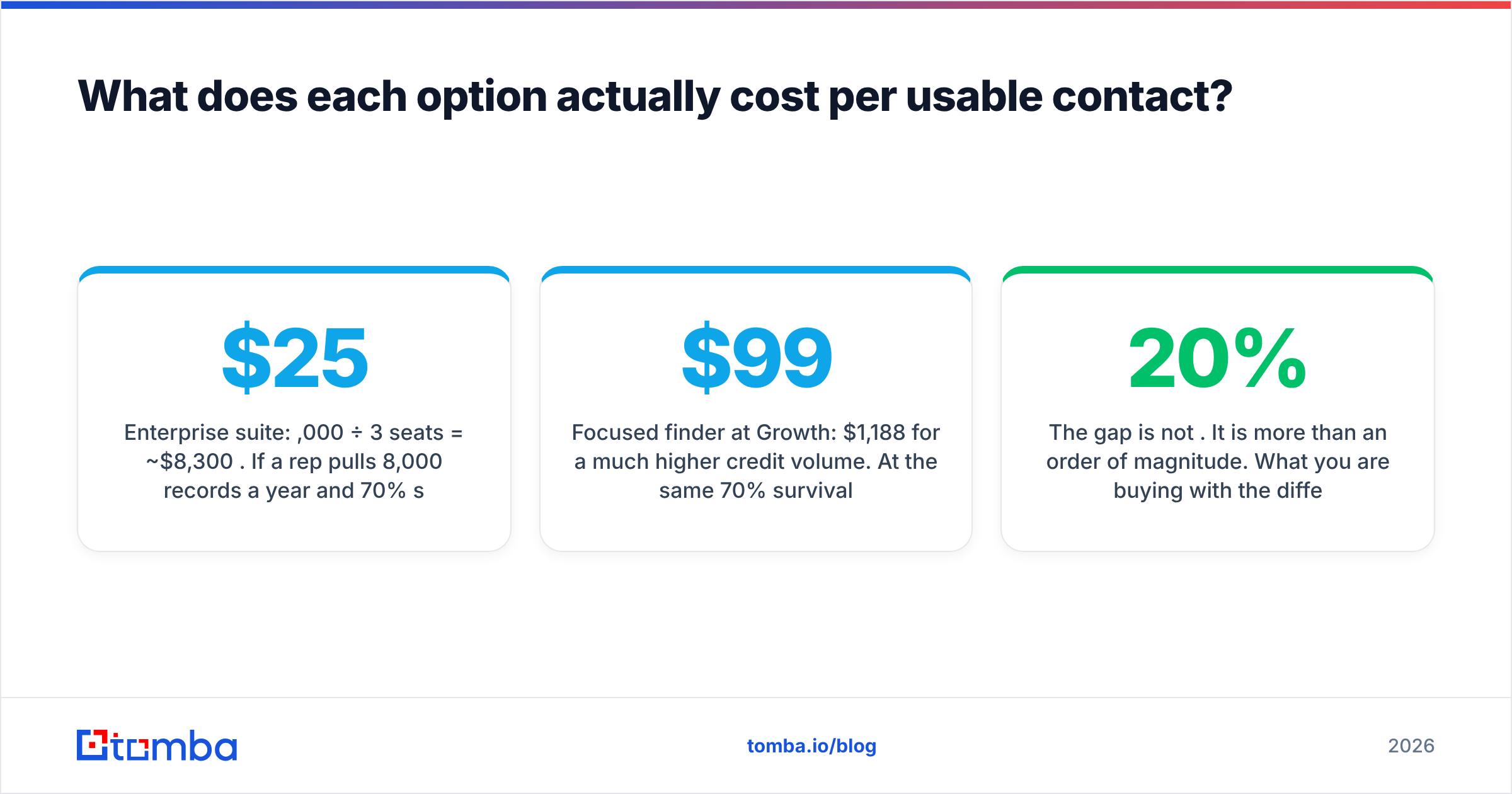
- Enterprise suite: $25,000/yr ÷ 3 seats = about $8,300 per seat. Say a rep pulls 8,000 records a year and 70% survive verification and ICP filtering. That is roughly $1.48 per usable contact.
- Focused finder at $99/mo Growth: $1,188/yr for a far higher credit volume. At the same 70% survival rate on 20,000 lookups, that is roughly $0.08 per usable contact.
The gap is not 20%. It is more than ten times. The extra money buys four things: the org-chart layer, the intent signals, senior support, and the comfort of buying from a public company. Those are fair things to buy. Just name them out loud instead of filing them under "the cost of data."
Also budget for the hidden line items on enterprise contracts:
- Credit overages — mid-year top-ups rarely come at your negotiated rate.
- Module unbundling — intent, enrichment, and marketing are separate SKUs.
- Onboarding and CRM mapping fees — often one-time, often four figures.
- Auto-renewal windows — 60–90 day notice clauses are standard. Diary the date the day you sign.
- Seat minimums — you may not be able to shrink the contract mid-term if headcount drops.
Is there a better way to build the same capability?#
Yes, for most teams: unbundle it. That is the option the DiscoverOrg vs FAC Intelligence framing hides.
An enterprise suite is really four products in one bundle. There is a company database, a contact database, a verification engine, and an intent feed. You can match the first three for a fraction of the price. Buy intent on its own later, and only if your funnel proves it earns its keep.
A practical stack looks like this:
- Company targeting. Build the account list from your closed-won patterns, a firmographic filter, or a B2B database query. Accounts first, contacts second. Always.
- Contact discovery. Use a domain search to pull every address at a target domain. Use an email finder when you already have a first name, last name, and company.
- Verification. Run everything through verification before it touches your sending setup. That includes catch-all domains, which cheap tools quietly mark "unknown" and bill you for anyway.
- Enrichment. Fill in title, seniority, location, and tech stack with data enrichment. Your segmentation needs something to work with.
- Automation. Wire it to your CRM with the Tomba API or a no-code connector. Lists should refresh without a human exporting CSVs at 11pm.
That stack runs roughly $49–$249/mo depending on volume. See Tomba pricing for the exact tiers. Set that against a five-figure annual commitment. For any team under about 50 reps, the payback question answers itself.

When should you still buy the enterprise suite?#
Be honest here. Sometimes the expensive option is the right one.
Buy ZoomInfo (or a similar enterprise suite) when:
- You sell into enterprise accounts with 6+ stakeholders. You need verified reporting lines to map the buying committee.
- Intent data really changes how you prioritize. You have run a pilot that proves it, not just a rep's hunch.
- Procurement, security review, and SOC 2 docs are hard gates in your org. One public vendor clears them faster than three small ones.
- You have a RevOps function that will actually use the data. A suite with nobody owning hygiene is the priciest spreadsheet you will ever buy.
Skip it when:
- Your ACV is under about $15k and your motion is volume outbound.
- You are pre-product-market-fit. Your ICP will change twice before the contract renews.
- Your bottleneck is messaging, not data volume. Most teams who "need better data" need better email deliverability and a tighter list. More records into a broken sending setup just burns the domain faster.
- Nobody can name the specific question the intent feed will answer.
That last one is the tell. If you cannot write down the decision the data will change, you are buying reassurance, not intelligence.
What should you do next?#
Run a 100-record bake-off before you sign anything. It takes an afternoon, and it settles DiscoverOrg vs FAC Intelligence faster than any demo.
- Pick 100 real target accounts from your pipeline. Not a clean demo list.
- Ask every vendor on your shortlist, including whoever "FAC Intelligence" turns out to be, to return contacts for those exact accounts.
- Verify all outputs with the same independent verifier. Nobody grades their own homework.
- Score on four axes: match rate, deliverability after verification, title accuracy (spot-check 20 against LinkedIn), and all-in annual cost.
- Divide cost by usable contacts. Compare the numbers, not the demos.
Nine times out of ten the winner is not the vendor with the best deck. It is the one with the highest verified match rate per dollar.
Most SMB and mid-market evaluations land in the same place. You need accurate, deliverable contact data without a five-figure commitment. Start with the Tomba Email Finder. The free tier gives you 25 searches a month, so you can run your own bake-off before you spend anything. Starter is $49/mo, and every plan includes API access, so the data flows into your CRM instead of a dead spreadsheet. Test it against whatever quote lands in your inbox. Let the match rate decide.
Related guides#
Ready to find emails that actually work?
Join 150,000+ professionals who stopped guessing and started sending. Free credits on signup — no credit card required.
Get the Tomba newsletter
Practical outbound tactics and product updates — once every two weeks.
About the author