DiscoverOrg vs FinalScout: Which B2B Data Tool Wins in 2026
DiscoverOrg no longer exists as a standalone product, and FinalScout only works where LinkedIn does. Here's an honest look at what you actually buy in 2026 — pricing, coverage, accuracy, and the contract traps nobody warns you about.
DiscoverOrg vs FinalScout is an odd matchup. One is a huge sales database. The other is a LinkedIn email tool. Here is what you actually buy in 2026.
TL;DR
- DiscoverOrg is no longer a product you can buy. It merged into ZoomInfo after the 2019 deal, and the DiscoverOrg brand was retired. Search for it in 2026 and you land on a ZoomInfo quote form.
- FinalScout is a LinkedIn-first email finder with AI writing built in. It is cheap and self-serve. It only works when a LinkedIn profile is open in front of you.
- In short, DiscoverOrg vs FinalScout is not a fair fight. One is a six-figure data platform sold on yearly contracts. The other costs under $100 a month for one rep.
- Coverage is the real split. ZoomInfo (ex-DiscoverOrg) gives you org charts, intent, and phone numbers. FinalScout gives you one email at a time.
- Want the middle ground? A dedicated email finder priced per lookup often wins on cost per usable contact.
What happened to DiscoverOrg, and does it still exist?#
Short answer: you cannot sign up for DiscoverOrg today. It lives on inside ZoomInfo.
DiscoverOrg spent a decade building human-checked org charts. Researchers called into companies to confirm who reported to whom. IT and security teams loved it for that.
In 2019 DiscoverOrg bought ZoomInfo. It then took the ZoomInfo name, which had wider recall. By 2021 the DiscoverOrg product line was folded in. Today the ZoomInfo platform is what you actually buy.
That changes the DiscoverOrg vs FinalScout question in three ways:
- You cannot price DiscoverOrg on its own. Any "DiscoverOrg pricing" page is a scrape or an SEO trap. You get a ZoomInfo quote. It is seat-based and annual.
- The human-checked pitch is diluted. ZoomInfo's scale comes from bulk collection and a data-sharing network. The old "we called and confirmed it" depth mostly survives in the org-chart and tech datasets.
- The buying motion is enterprise. Expect demos, seat minimums, credit pools, and auto-renewal clauses. A two-person team is not the target buyer.
So the real question behind the search is simple. Do you need a full data platform, or do you just need emails?

What is FinalScout, and who is it for?#
FinalScout is a LinkedIn-first email finder. It adds AI email writing on top.
The flow is simple. You install the Chrome add-on. You browse LinkedIn or Sales Navigator. You scrape profiles into a list. FinalScout then finds work emails for those people. It can also draft a personal opener from the profile text.
The pitch on finalscout.com leans on two things. First, deliverability, with claims near 98% valid emails. Second, the LinkedIn-native flow. For a solo founder or an SDR who lives in Sales Navigator, that flow is fast.
Where it gets narrow:
- No LinkedIn profile, no contact. If a buyer is not on LinkedIn, or the profile is locked down, FinalScout has nothing to work from. Plant managers, franchise owners, city buyers, and most of Japan's mid-market are invisible.
- Scraping risk sits with you. Any tool that automates LinkedIn browsing works against the site's terms. Account limits are a real cost that never shows on the invoice.
- No org insight. You get a person and an email. You do not get their boss, the tech stack, the buying group, or intent signals.
FinalScout is a tactic. ZoomInfo is a system you build on. That gap frames the whole comparison.
DiscoverOrg vs FinalScout: how do they compare head-to-head?#
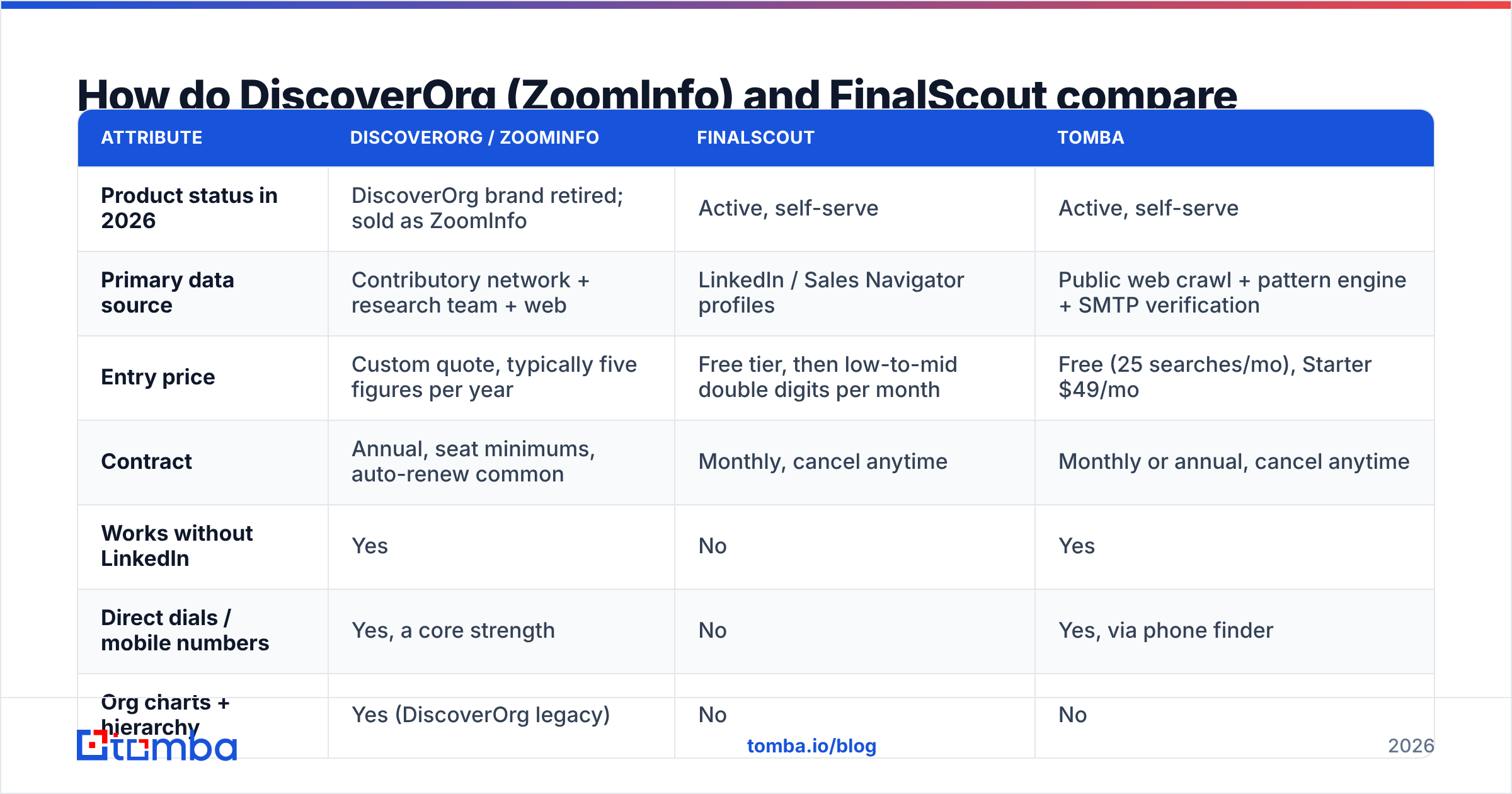
| Attribute | DiscoverOrg / ZoomInfo | FinalScout | Tomba |
|---|---|---|---|
| Product status in 2026 | DiscoverOrg brand retired; sold as ZoomInfo | Active, self-serve | Active, self-serve |
| Primary data source | Contributory network + research team + web | LinkedIn / Sales Navigator profiles | Public web crawl + pattern engine + SMTP verification |
| Entry price | Custom quote, typically five figures per year | Free tier, then low-to-mid double digits per month | Free (25 searches/mo), Starter $49/mo |
| Contract | Annual, seat minimums, auto-renew common | Monthly, cancel anytime | Monthly or annual, cancel anytime |
| Works without LinkedIn | Yes | No | Yes |
| Direct dials / mobile numbers | Yes, a core strength | No | Yes, via phone finder |
| Org charts + hierarchy | Yes (DiscoverOrg legacy) | No | No |
| Intent data | Yes | No | No |
| Built-in email verification | Add-on / included by tier | Claimed pre-send validation | Yes, email verifier included |
| API access | Enterprise tier | Limited | All paid tiers, documented API |
| Time to first email | Days (demo → contract → onboarding) | Minutes | Minutes |
The table makes the split clear. No team weighs both against the same budget line. What really happens is this. A team outgrows FinalScout. ZoomInfo quotes $30k. The team then hunts for something in between.
How accurate is the data in DiscoverOrg vs FinalScout?#
Accuracy claims mean little without a definition. Vendors use one word for three things:
- Match rate — of the contacts you searched, how many came back with any email.
- Validity rate — of the emails returned, how many pass a check without a hard bounce.
- Freshness — how long ago the record was last confirmed. A clean email at a job someone left 14 months ago still bounces.
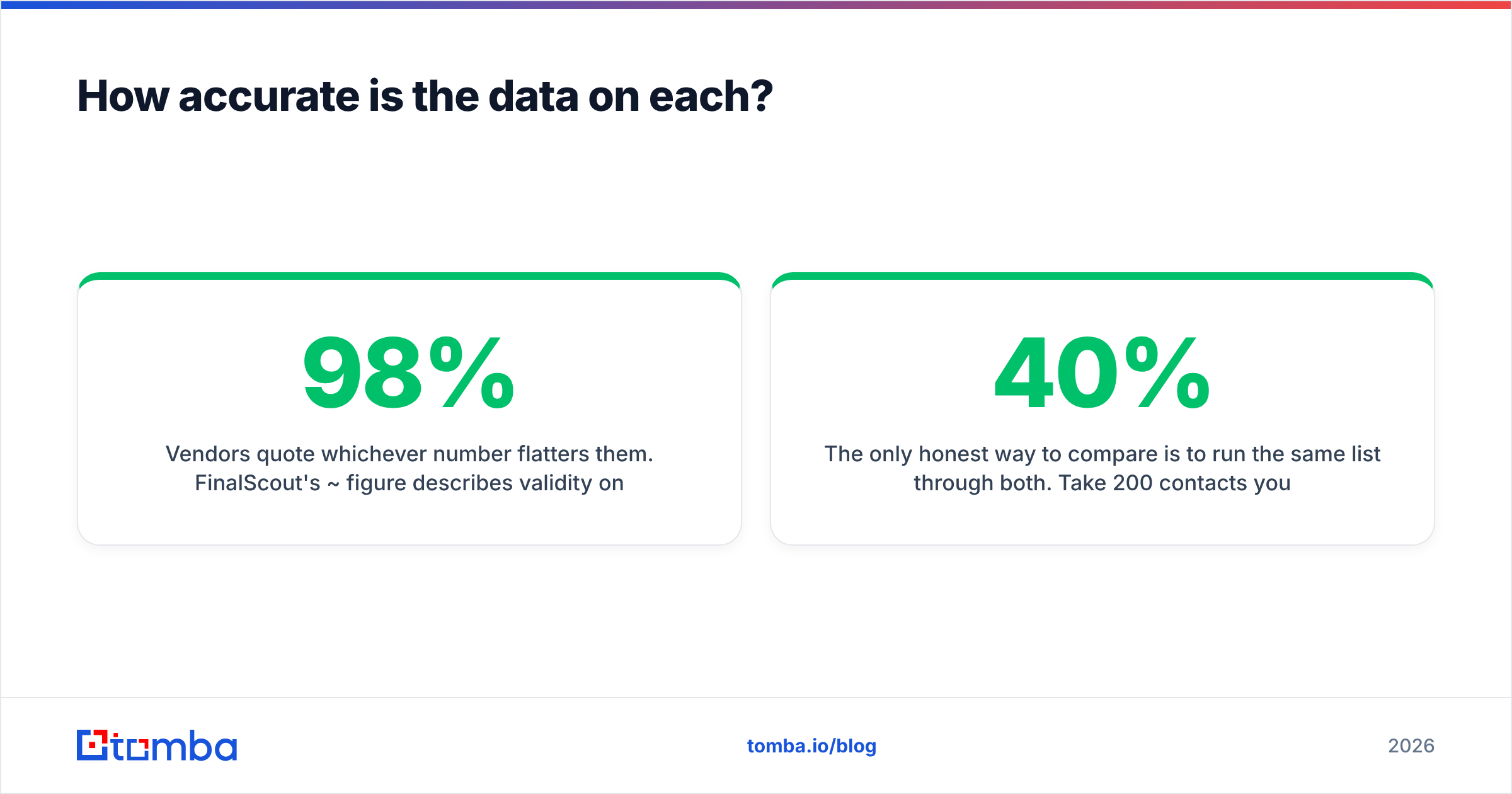
Vendors quote the number that flatters them. FinalScout's ~98% figure covers only the emails it does return. It says nothing about how many searches came back empty.
ZoomInfo's coverage is huge in raw counts. But B2B data decays by roughly 22–30% a year as people change jobs. Big databases are not immune to that. Reviews on G2 flag stale records and phone numbers that ring the wrong desk, next to real praise for breadth.

The only fair test is your own list. Take 200 contacts you know are good. Closed-won accounts work well. So do people who replied to you last quarter.
Run that list through both tools. Measure match rate and bounce rate on their own. Do it during the trial, not after you sign.
Here is why that matters. A tool that returns 40% of your list at 98% validity is worse than one that returns 80% at 92%. No marketing page will say that out loud.
Whatever you pick, verify before you send. A separate check on the export catches the decay that no finder removes on its own.
What does DiscoverOrg vs FinalScout cost in 2026?#
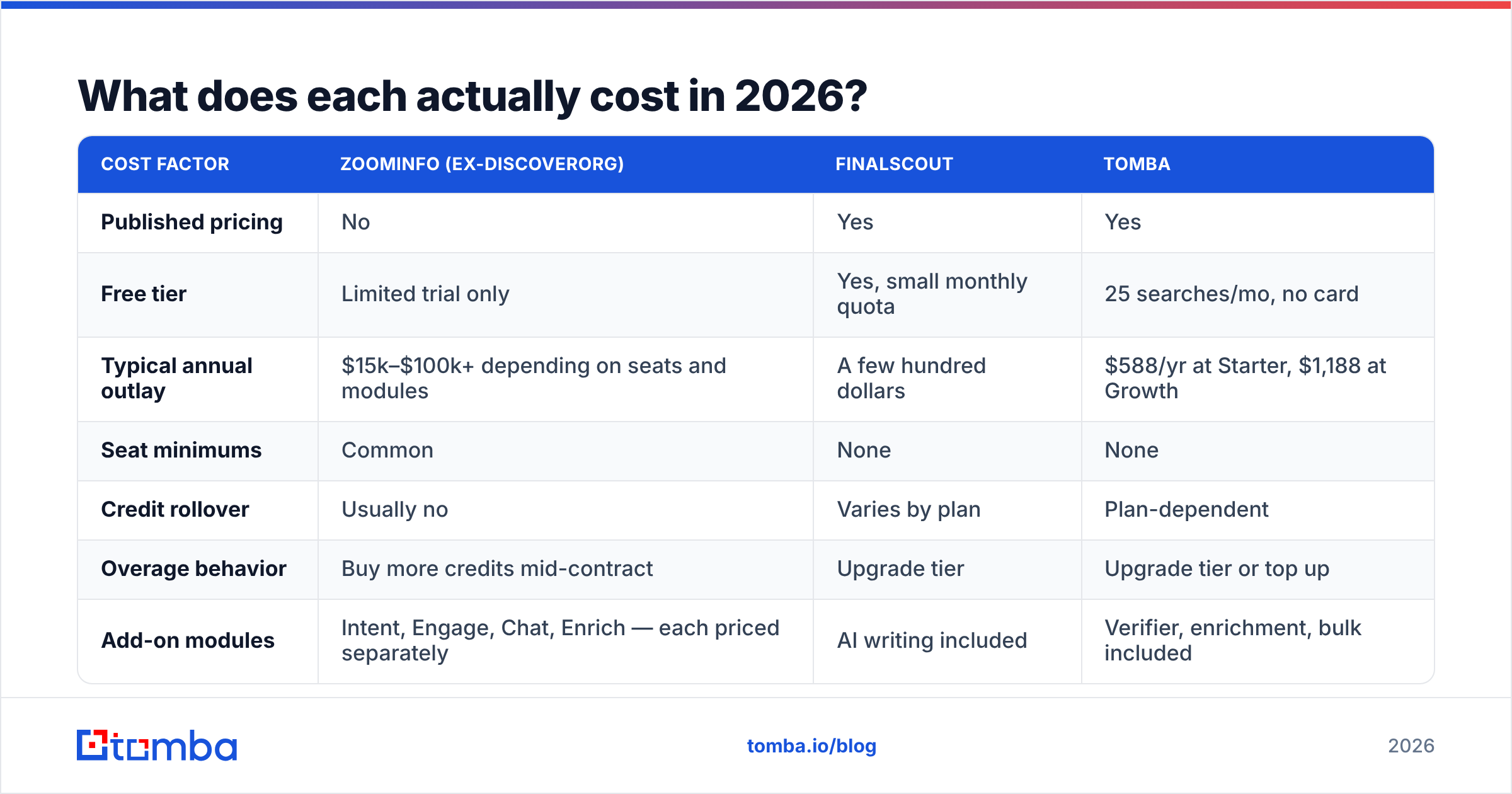
| Cost factor | ZoomInfo (ex-DiscoverOrg) | FinalScout | Tomba |
|---|---|---|---|
| Published pricing | No | Yes | Yes |
| Free tier | Limited trial only | Yes, small monthly quota | 25 searches/mo, no card |
| Typical annual outlay | $15k–$100k+ depending on seats and modules | A few hundred dollars | $588/yr at Starter, $1,188 at Growth |
| Seat minimums | Common | None | None |
| Credit rollover | Usually no | Varies by plan | Plan-dependent |
| Overage behavior | Buy more credits mid-contract | Upgrade tier | Upgrade tier or top up |
| Add-on modules | Intent, Engage, Chat, Enrich — each priced separately | AI writing included | Verifier, enrichment, bulk included |
Two things to watch on the enterprise side. First, credits and seats are separate levers. The quote you sign in month one rarely matches your renewal.
Second, auto-renewal with a 30–60 day cancel window is standard. Miss it and you own another year. That is not unique to ZoomInfo. It is how the whole category is sold. It is also the top source of buyer's remorse here.
On the self-serve side, list prices move. FinalScout, Tomba, and their peers adjust tiers a few times a year. Treat any published figure as a snapshot. Check the vendor's own page before you buy. Current Tomba pricing runs Free, Starter $49/mo, Growth $99/mo, and Pro $249/mo, with custom Enterprise.

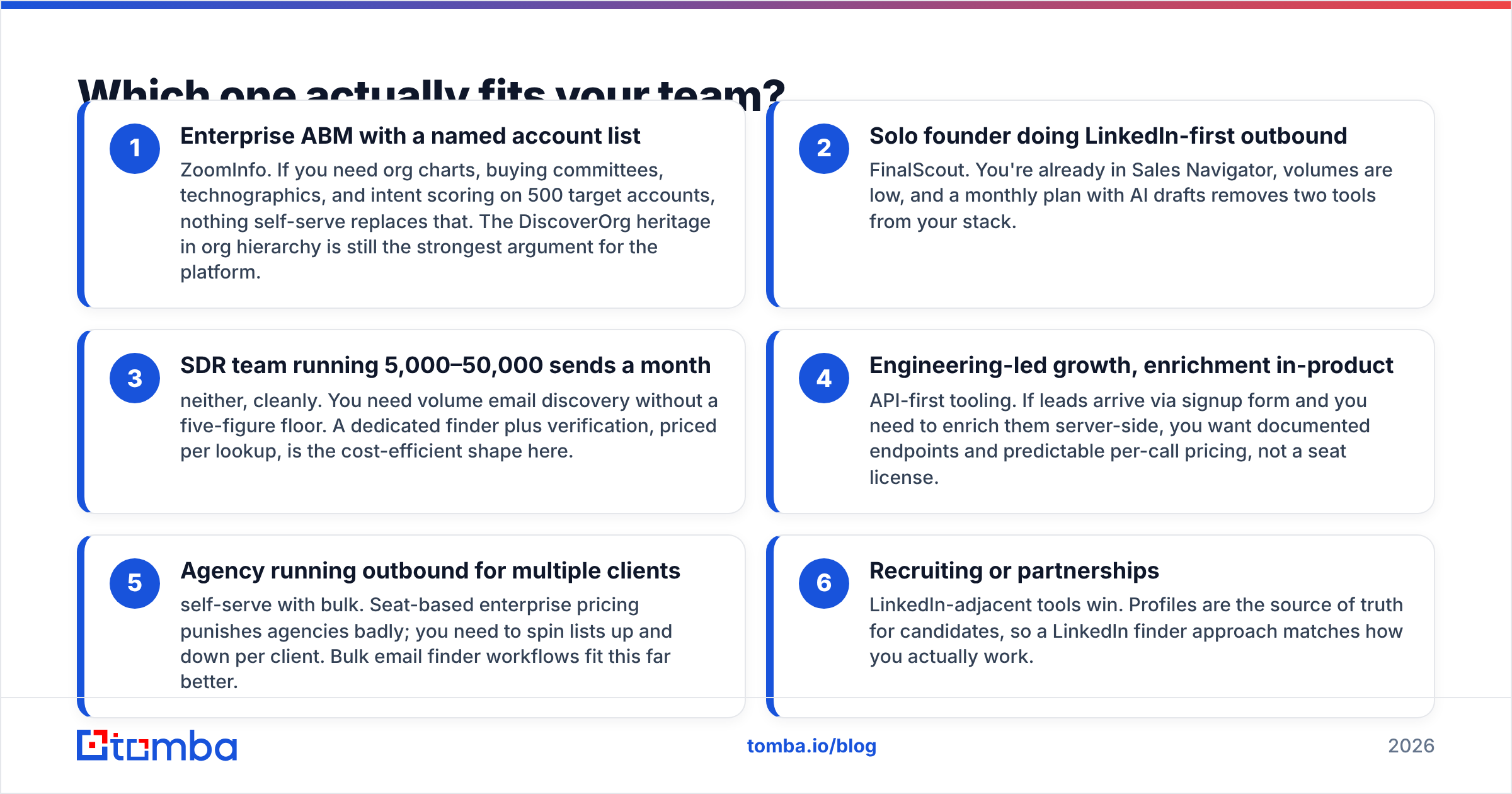
Which one actually fits your team?#
Pick by motion, not by feature count.
- Enterprise ABM with a named account list — ZoomInfo. Org charts, buying groups, tech signals, and intent on 500 accounts have no self-serve match. The DiscoverOrg heritage in org data is still its best argument.
- Solo founder doing LinkedIn-first outbound — FinalScout. You already live in Sales Navigator. Volume is low. A monthly plan with AI drafts cuts two tools from your stack.
- SDR team sending 5,000–50,000 emails a month — neither, honestly. You need volume without a five-figure floor. A finder plus verification, priced per lookup, fits better.
- Engineering-led growth with in-product enrichment — API-first tools. If leads arrive by signup form, you want clear endpoints and per-call pricing, not a seat license.
- Agency running outbound for many clients — self-serve with bulk. Seat pricing punishes agencies. You need to spin lists up and down per client. Bulk email finder flows fit that far better.
- Recruiting or partnerships — LinkedIn-based tools win. Profiles are the source of truth for candidates. A LinkedIn finder matches how you already work.

Where does each one break down?#
ZoomInfo's weak spots. Cost per usable contact climbs when your buyers sit outside its core. Non-US SMBs, non-tech fields, and firms under 20 staff are thinner.
Credits also burn fast when reps run loose searches. And the platform is heavy. Onboarding, admin, and list cleanup are real staffing costs on top of the license.
FinalScout's weak spots. Coverage stops the moment a buyer is off LinkedIn or has a locked profile. There is no backup path. No domain search. No pattern guess from a company site.
Volume is capped by how fast you can browse. LinkedIn's limits cap it again. The account risk is yours, not the vendor's.
The shared weak spot. Neither tool tells you when a record goes stale. You learn it from the bounce, after your sender reputation takes the hit. So build a check into the flow. Make it a gate before every send. It is the highest-return habit in outbound.
Is there a middle option between the two?#
Yes. It is where most teams land.
Many teams need more reach than a LinkedIn scraper. They still cannot justify a full platform. What they need is narrow. Find verified work emails at scale, by domain or by name, through a UI and an API, with per-lookup pricing and no yearly lock-in.
That is the shape of a focused email stack:
- Domain search to pull every contact at a target company, with role and seniority, and no LinkedIn URL needed.
- Name plus domain lookup for someone you found on a podcast, a speaker list, or a customer intro.
- Verification as a required step before export, with catch-all handling. That domain type quietly causes most "verified" bounces.
- Enrichment to fill in titles, company size, and social handles on records you already own.
- API and integrations so the whole thing runs inside your CRM, not as a weekly CSV chore.
You give up intent data and org charts. If your block is "we do not have enough valid emails," that trade is worth it. You can add intent later, once volume earns it.
DiscoverOrg vs FinalScout: which should you choose?#
Have an enterprise budget, named accounts, and a need for org data and intent? Pick ZoomInfo, the platform DiscoverOrg became. Negotiate hard. Cap seats. Set a reminder 75 days before renewal.
Are you one person doing LinkedIn-first outbound at low volume? FinalScout does its narrow job well and costs very little.
Sit somewhere in the middle? Then neither shape fits. Buy the one capability you are short on, not a platform or a plugin.
Start with the free tier of the Tomba Email Finder. You get 25 searches a month, no card, no demo call. Run your 200-contact control list through it beside anything else you test. Compare match rate and bounce rate. Let the numbers settle your own DiscoverOrg vs FinalScout test. If Tomba wins, Starter is $49/mo and you can cancel any time. The enterprise quote in your inbox will not offer that.
Related guides#
Ready to find emails that actually work?
Join 150,000+ professionals who stopped guessing and started sending. Free credits on signup — no credit card required.
Get the Tomba newsletter
Practical outbound tactics and product updates — once every two weeks.
About the author