DiscoverOrg vs FINTRX: Which B2B Data Platform Wins in 2026?
DiscoverOrg is now ZoomInfo, and FINTRX only covers private wealth. One is a broad B2B database, the other a niche family-office file. Here's the honest breakdown of coverage, pricing, and who should buy which.
TL;DR
- DiscoverOrg no longer exists as a product. It merged with ZoomInfo in 2019 and the brand was retired; if a rep pitches you "DiscoverOrg," they are selling you ZoomInfo. Price and packaging changed with it.
- FINTRX is not a general B2B database. It is a private wealth file — family offices, RIAs, and the people inside them. Outside that vertical, its coverage is thin by design.
- These two rarely compete. The real question is "do I sell to the private wealth ecosystem or to everyone else?" not "which platform is better."
- Both are annual, seat-based, and quote-only. Expect five figures a year, a 12-month minimum, and an export cap you will hit in month four.
- If you just need verified work emails and a way to enrich a list you already built, a per-credit email finder does that job for a fraction of the cost — no contract, no seat math.
Why does DiscoverOrg vs FINTRX come up at all?#
Because both are sold as "the database that fills your pipeline," and buyers evaluating one usually get a demo request from the other in the same week. That's where the similarity ends.
DiscoverOrg built its reputation on human-verified org charts for IT, marketing, and finance departments — deep hierarchy data on who reports to whom inside mid-market and enterprise accounts. In February 2019 it acquired ZoomInfo, kept the ZoomInfo name, and folded the DiscoverOrg data into what is now the ZoomInfo platform (GTM Studio, Copilot, and the various "OS" bundles). The ZoomInfo product line is what you actually buy today.
FINTRX went the opposite direction: instead of covering everything, it went one inch wide and one mile deep on private wealth. Family offices, registered investment advisors, single- and multi-family office structures, allocator mandates, and the individual decision-makers inside them. If you're raising a fund, distributing an alternative investment product, or selling services to allocators, FINTRX is a category tool, not a general database.
So the honest framing for discoverorg vs fintrx is: broad horizontal coverage versus one vertical covered properly.

What does each platform actually give you?#
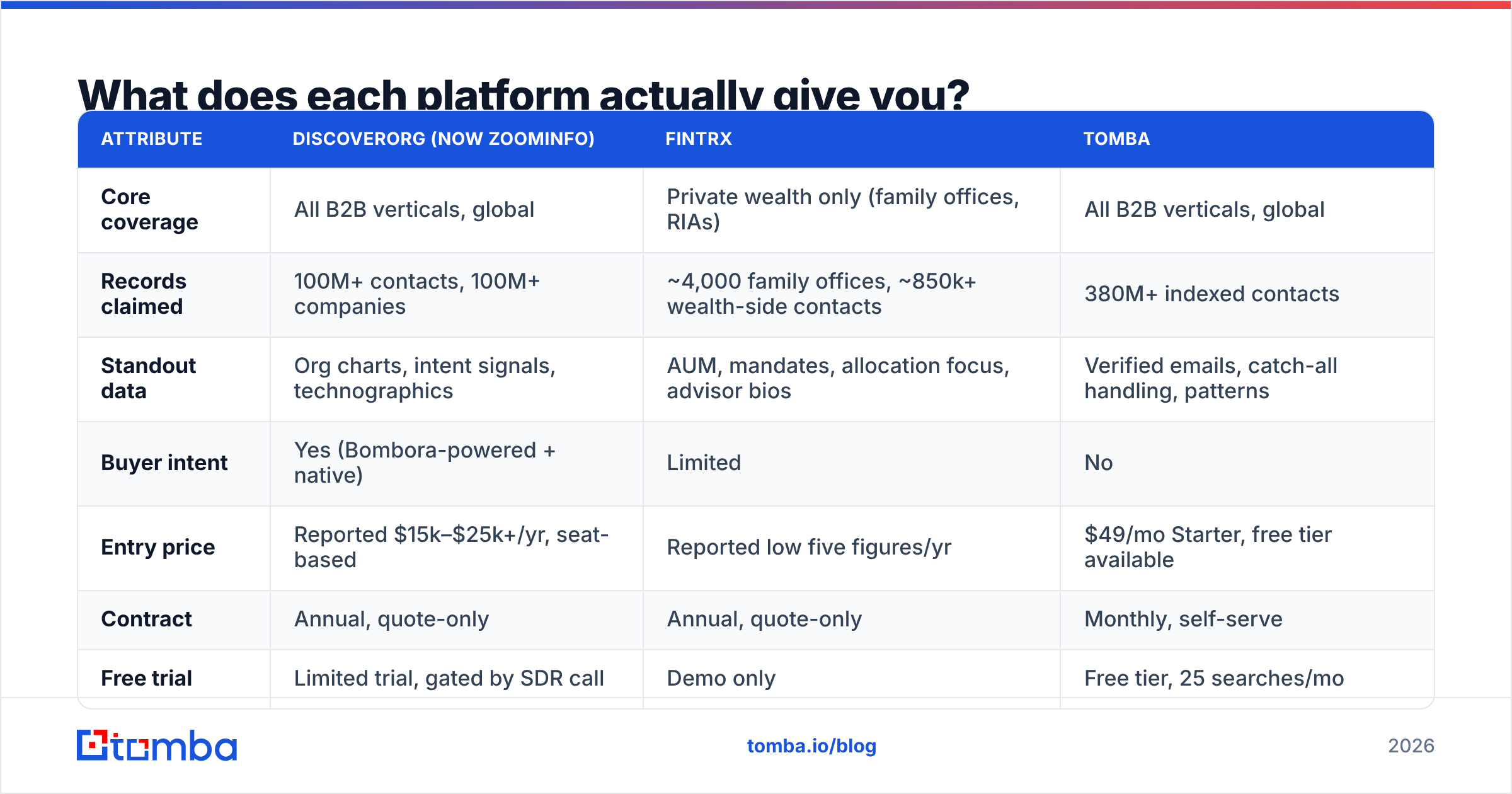
Here's the practical difference, attribute by attribute. Pricing figures below are the ranges buyers commonly report on review sites — neither vendor publishes a public price list, so treat them as directional, not quoted.
| Attribute | DiscoverOrg (now ZoomInfo) | FINTRX | Tomba |
|---|---|---|---|
| Core coverage | All B2B verticals, global | Private wealth only (family offices, RIAs) | All B2B verticals, global |
| Records claimed | 100M+ contacts, 100M+ companies | ~4,000 family offices, ~850k+ wealth-side contacts | 380M+ indexed contacts |
| Standout data | Org charts, intent signals, technographics | AUM, mandates, allocation focus, advisor bios | Verified emails, catch-all handling, patterns |
| Buyer intent | Yes (Bombora-powered + native) | Limited | No |
| Entry price | Reported $15k–$25k+/yr, seat-based | Reported low five figures/yr | $49/mo Starter, free tier available |
| Contract | Annual, quote-only | Annual, quote-only | Monthly, self-serve |
| Free trial | Limited trial, gated by SDR call | Demo only | Free tier, 25 searches/mo |
| Export limits | Credit-capped per seat | Capped per license | Credit-based, no seat tax |
| API | Yes, usually a paid add-on | Yes | Yes, included on paid plans |
The row that decides most deals is not "records claimed" — it's contract shape. Both incumbents want an annual commitment before you know whether their coverage matches your ICP. That's a reasonable ask if you're a 40-rep org with a defined territory. It's a terrible ask if you're a five-person team testing three segments this quarter.
Is DiscoverOrg still worth buying in 2026?#
Yes — but only as ZoomInfo, and only if you use more than the contact records.
What survived the merger is genuinely hard to replicate: verified reporting structures inside large accounts. When you're running an ABM motion into 300 named enterprises and you need to know that the VP of Infrastructure reports to a CIO who reports to a COO, that hierarchy is the product. Scraped data does not give you that.
Where ZoomInfo earns the price:
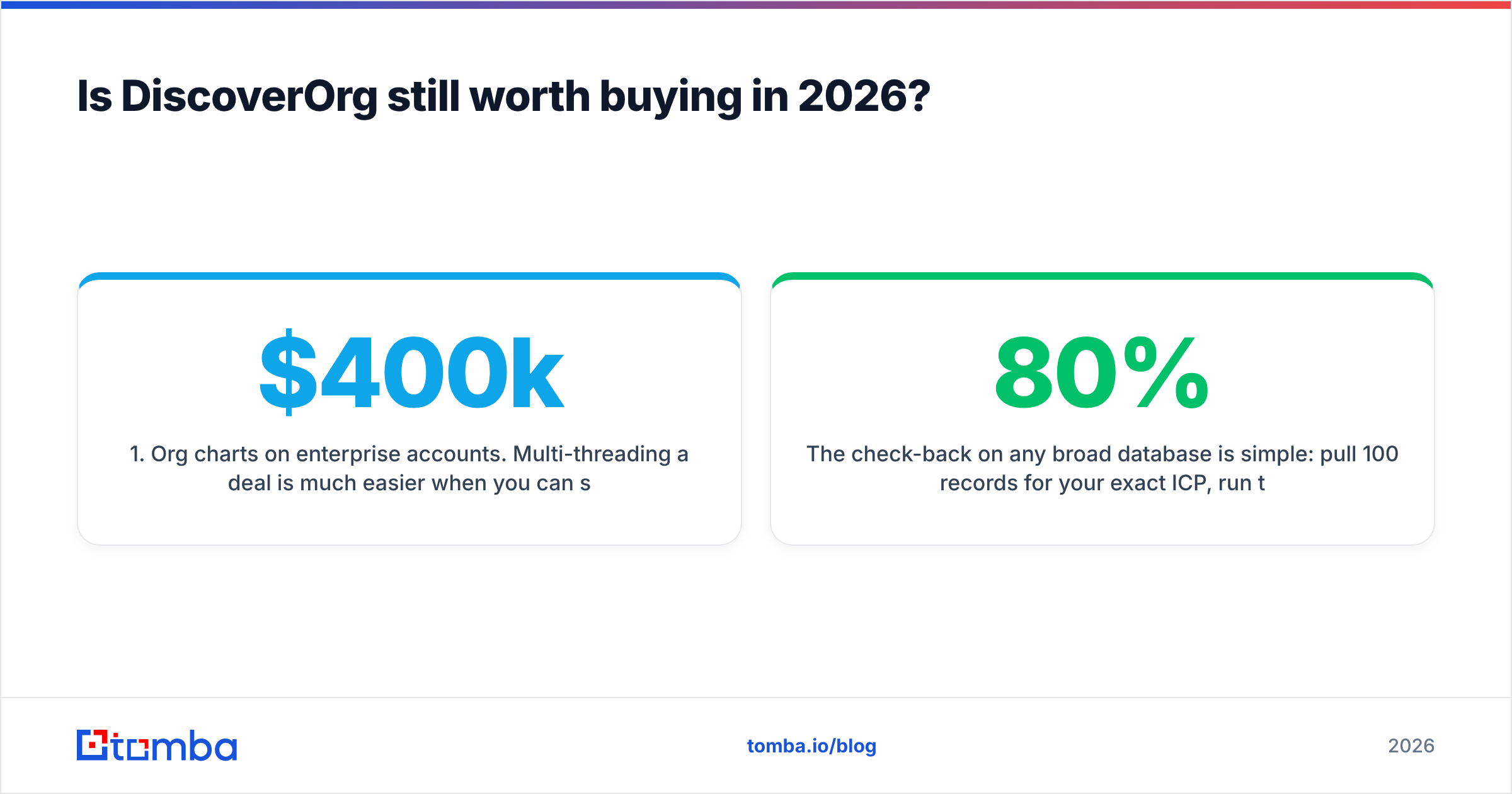
- Org charts on enterprise accounts. Multi-threading a $400k deal is much easier when you can see the org tree before the first call.
- Intent data at scale. Topic surges across your account list, refreshed weekly, feeding a prioritized queue.
- Technographics. Filtering to "runs Snowflake, doesn't run dbt" is a real segmentation lever if you sell into a stack.
- Workflow automation. Native routing, enrichment on form fill, and CRM writeback that ops teams actually configure once and forget.
- Conversation intelligence bundles. If you also buy the call-recording module, everything lives on one contract.
Where it disappoints:
- Seat math punishes small teams. Ten seats at enterprise rates is a real budget line, and credits do not pool as generously as you'd like.
- Data decay is real. Job-change churn in B2B runs high; any database, including this one, will hand you contacts who left six months ago. Always run a second-pass verification before you send.
- Renewal leverage sits with the vendor. Once your CRM enrichment depends on their fields, unwinding is a project, not a decision.
- Auto-renewal clauses. Read the notice window. Buyers on G2 have written entire reviews about this one clause.
The check-back on any broad database is simple: pull 100 records for your exact ICP, run them through an independent email verifier, and see how many survive. If 80%+ come back valid, the data is doing its job. If you're under 65%, you're paying enterprise rates for a list you'll have to clean anyway.
Is FINTRX better than DiscoverOrg for finding investors?#
For private wealth, yes — and it isn't close.
FINTRX's value is that it models the wealth ecosystem the way the people in it actually think about it. A general database will tell you a family office exists and give you a generic info@ address. FINTRX tells you the AUM band, the allocation focus, whether they invest directly or through funds, which asset classes they've historically backed, and who inside the office runs diligence. That structural context is the difference between a mail-merge and a warm, relevant first line.
Who should shortlist FINTRX:
- Fund managers raising capital from family offices and RIAs, where the entire addressable market is a few thousand entities.
- Alternative investment distributors who need mandate-level filtering, not headcount filtering.
- Wealth-tech vendors selling software into RIA operations teams.
- Placement agents and IR teams who need relationship history, not volume.
Who should not:
- Anyone selling horizontal software, services, or products to normal companies. The file simply doesn't cover your market, and no amount of good UI fixes that.
- Teams that need 5,000 net-new contacts a month. The universe is small on purpose.
The mistake I see repeatedly: a generalist SaaS team buys FINTRX because a board member mentioned family offices, then discovers three months in that their real ICP is 200-person logistics companies. That's not a product failure. That's a scoping failure.
How do pricing and contracts actually compare?#
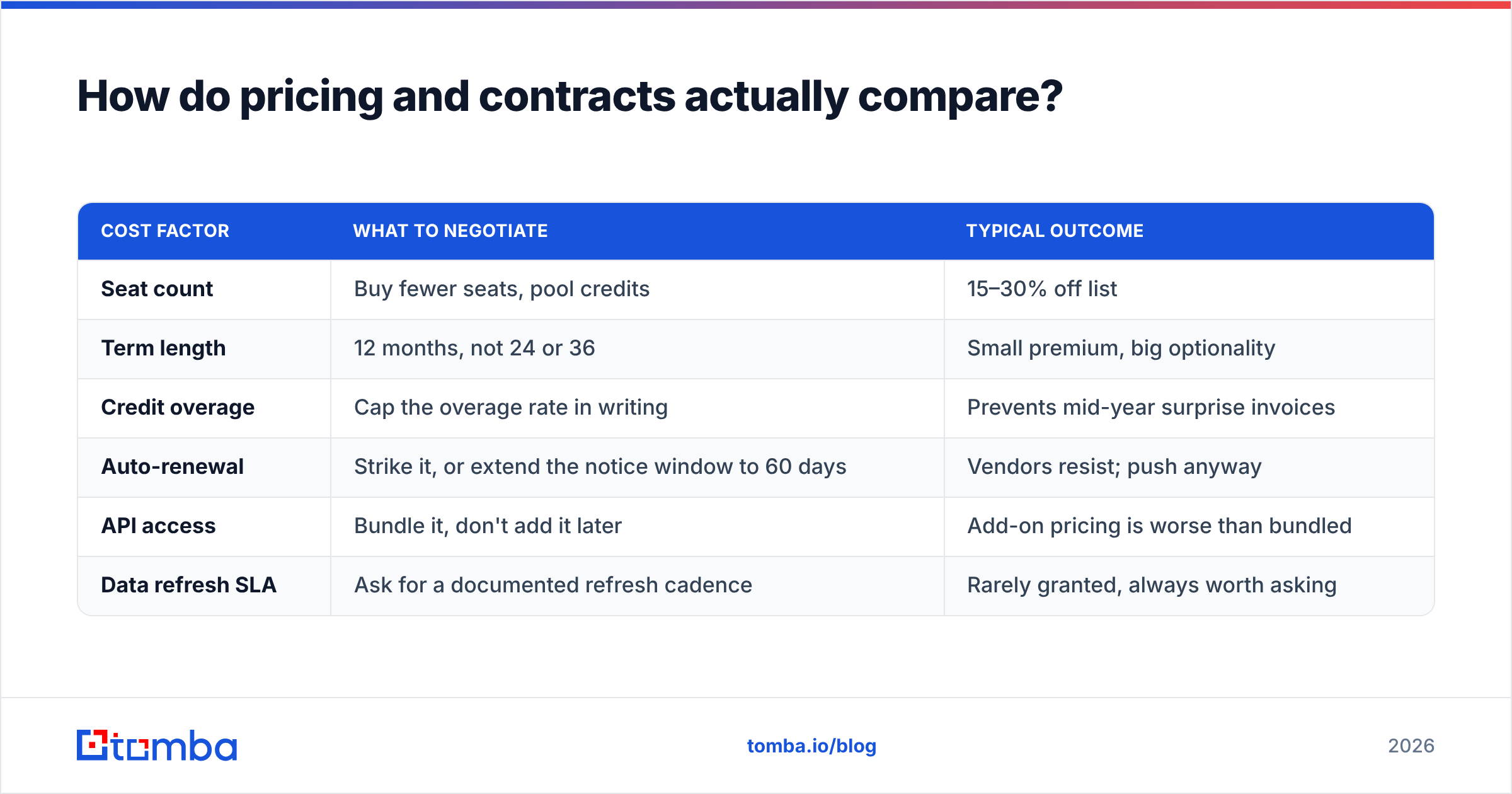
Neither vendor publishes prices, which tells you the pricing is negotiated and varies by seat count, credit volume, and how close you are to their fiscal quarter end. What you can control:
| Cost factor | What to negotiate | Typical outcome |
|---|---|---|
| Seat count | Buy fewer seats, pool credits | 15–30% off list |
| Term length | 12 months, not 24 or 36 | Small premium, big optionality |
| Credit overage | Cap the overage rate in writing | Prevents mid-year surprise invoices |
| Auto-renewal | Strike it, or extend the notice window to 60 days | Vendors resist; push anyway |
| API access | Bundle it, don't add it later | Add-on pricing is worse than bundled |
| Data refresh SLA | Ask for a documented refresh cadence | Rarely granted, always worth asking |
If you buy at the end of a quarter with a signed order form ready, you have leverage. If you buy in week two of a quarter with an open-ended timeline, you don't.
There's a third path worth naming: buying the intelligence layer from one vendor and the contact layer from another. Plenty of teams license FINTRX for the wealth-entity structure, then use a cheap per-credit tool to resolve and verify the actual work emails for the people they've identified. That's usually cheaper and more accurate than paying either incumbent for both jobs.
What are the credible alternatives to both?#
Depending on which half of the job you need, the field looks different.
If you want broad B2B coverage without the enterprise contract:
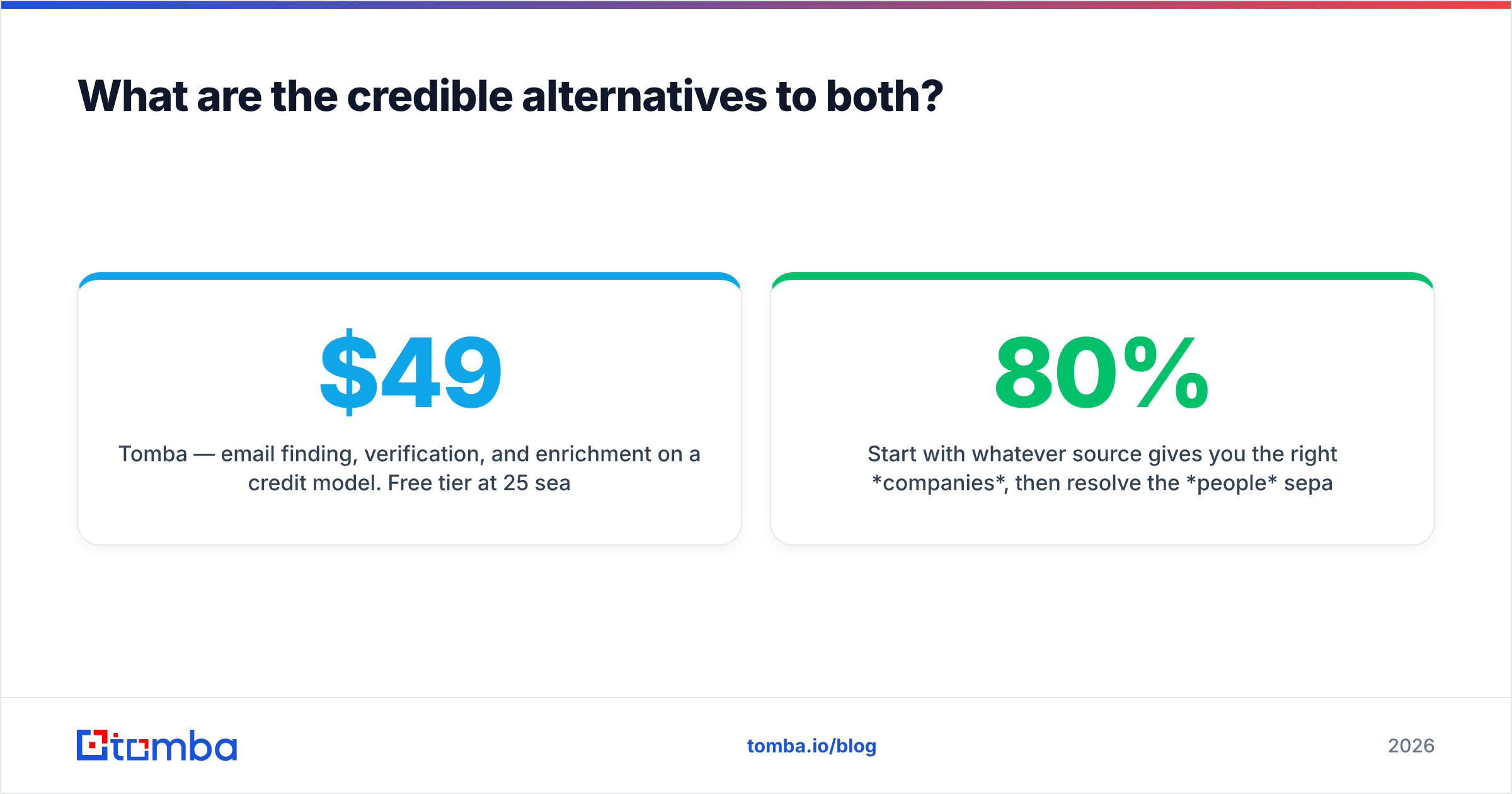
- Tomba — email finding, verification, and enrichment on a credit model. Free tier at 25 searches/mo, Starter $49/mo, Growth $99/mo, Pro $249/mo. Full Tomba pricing is public, which by itself narrows the evaluation cycle from six weeks to an afternoon.
- BookYourData — a strong option when you want to buy a targeted, pre-built list outright rather than run searches over time. Pay-as-you-go pricing and a stated accuracy guarantee make it a clean fit for one-off campaign lists, and it sidesteps the seat-license model entirely.
- Apollo — database plus sequencer in one, if you want the sending layer bundled. Coverage is broad, depth is shallower than ZoomInfo on enterprise org charts.
If you want depth in a specific vertical:
There is no general substitute for FINTRX in private wealth. The realistic alternatives are building the entity list manually from SEC Form ADV filings and industry directories, then enriching it yourself — which costs analyst hours instead of license fees, and only makes sense if your team already has that muscle.
If you're doing the hybrid approach:
Start with whatever source gives you the right companies, then resolve the people separately. A domain search returns the verified email addresses associated with a company domain along with the pattern the company uses, so you can extrapolate to contacts the database missed. Pair that with a bulk email finder run and you've rebuilt 80% of the contact layer for a rounding error on an enterprise contract.
Which should you choose?#
Answer three questions in order.
1. Is your entire ICP inside the private wealth ecosystem? If yes, evaluate FINTRX first and treat the general databases as optional. Nothing else models allocators properly.
2. Do you sell into enterprise accounts where multi-threading decides the deal? If yes, ZoomInfo (the DiscoverOrg lineage) is worth the contract — specifically for org charts and intent, not for raw email volume. Budget for verification on top; every large database decays.
3. Do you mostly need verified work emails for people you've already identified? Then neither. You're paying enterprise data prices for a lookup problem. A credit-based email finder solves that at 1–5% of the annual cost, with no seat licenses and no renewal negotiation.
Most teams that agonize over discoverorg vs fintrx are actually in bucket three and don't realize it yet. The tell: your sales team already knows which accounts to hit, and the bottleneck is getting a reachable address for the right person — not discovering the account.
One more discipline point regardless of what you buy. Run every list through verification before it touches your sending domain. Bounce rate is the single fastest way to torch email deliverability, and a 12% bounce on a purchased list can cost you weeks of inbox placement recovery — which is far more expensive than the credits you saved by skipping the check.
Start with the layer you actually need#
If your bottleneck is finding and verifying real work emails — not buying an org chart or a family-office file — start there and skip the annual contract entirely.
Tomba's Email Finder resolves professional email addresses by name and domain, returns a confidence score with the sources behind it, and verifies deliverability in the same call. The free tier gives you 25 searches a month to test coverage against your own ICP before you spend anything, Starter is $49/mo, and everything is available through the Tomba API if you'd rather wire it into your existing stack than log into another dashboard. Pull 100 of your target accounts, run them, and compare the hit rate to whatever the enterprise rep quoted you. That test costs nothing and settles the question faster than any demo.
Related guides#
Ready to find emails that actually work?
Join 150,000+ professionals who stopped guessing and started sending. Free credits on signup — no credit card required.
Get the Tomba newsletter
Practical outbound tactics and product updates — once every two weeks.
About the author