DiscoverOrg vs Gamalogic in 2026: Which B2B Data Tool Wins?
DiscoverOrg is now ZoomInfo and sells six-figure-adjacent annual contracts. Gamalogic sells cheap email lookups by the credit. Here is which one actually fits your pipeline in 2026 — and when neither does.
DiscoverOrg vs Gamalogic is an odd match-up. One is an enterprise sales intelligence platform. The other is a cheap email lookup tool. This guide walks through the DiscoverOrg vs Gamalogic decision on data quality, real price, and contract terms — and flags when a third option beats both.
TL;DR
- DiscoverOrg no longer exists as a standalone product. It was folded into ZoomInfo after the 2019 merger. So "buying DiscoverOrg" in 2026 means signing a ZoomInfo contract: annual, seat-based, and quote-only.
- Gamalogic is the opposite shape. It is a lean, credit-priced email finder and verifier with published rates, no seat minimums, and no sales call.
- In a DiscoverOrg vs Gamalogic match-up, the two are not really competitors. One sells an org chart, intent signals, and a CRM-integrated database. The other sells verified email addresses at a low per-lookup cost.
- Pick DiscoverOrg/ZoomInfo if account intelligence drives your territory planning. Pick Gamalogic if you already know who to email and just need the address.
- Want ZoomInfo-grade email accuracy without the annual contract? A dedicated finder-plus-verifier stack (Tomba, BookYourData, and similar) usually costs 90% less for the same job.
What is DiscoverOrg in 2026?#
DiscoverOrg started in 2007 as a human-researched B2B database. Its pitch was always depth over breadth: verified direct dials, reporting structures, installed technologies, and department budgets. It covered a curated set of mid-market and enterprise accounts. Researchers phoned companies to confirm records. That is expensive, and the price tag reflected it.
In February 2019, DiscoverOrg acquired ZoomInfo and then took the ZoomInfo name. By 2026 the DiscoverOrg brand is effectively retired. The technology, the research team, and the contact graph all live inside ZoomInfo's platform. When a prospect asks you about "DiscoverOrg," they mean ZoomInfo Copilot, ZoomInfo Sales, or whichever SKU their rep quoted.
What you get today under that lineage:
- Account intelligence, not just contacts. Org charts, headcount by department, funding events, technographics, and hiring signals.
- Intent data. Third-party topic surges that flag accounts researching your category before they fill in a form.
- Native CRM sync. Deep Salesforce and HubSpot integrations, plus enrichment workflows that keep records fresh automatically.
- Direct dials at scale. This remains the strongest single argument for the platform — mobile numbers are genuinely hard to source elsewhere.
- Compliance tooling. GDPR/CCPA controls, suppression lists, and notice workflows that enterprise legal teams ask for.
The catch is the commercial model. Pricing is quote-only. Contracts run annual. Credits are allocated per seat, and overages are billed. Public reports and buyer reviews put realistic entry spend in the low five figures a year. It climbs fast as you add seats and modules.
What is Gamalogic?#
Gamalogic is a much smaller, much narrower product. It is a bulk email finder and verifier built around one workflow: give it names and domains, get back deliverable addresses. It sells credits and publishes its rates. You also get an API and spreadsheet-friendly bulk uploads.
It has no intent data, no org charts, no technographics, no CRM-native enrichment, and no direct dials. That is not a criticism. It is the whole positioning. Gamalogic competes on cost per verified email. You can also start using it in ten minutes without talking to anyone.
For a two-person agency running 3,000 cold emails a month, that trade is often correct. For a 40-rep enterprise team that needs territory planning, it is not enough on its own.

DiscoverOrg vs Gamalogic: how do they compare head to head?#
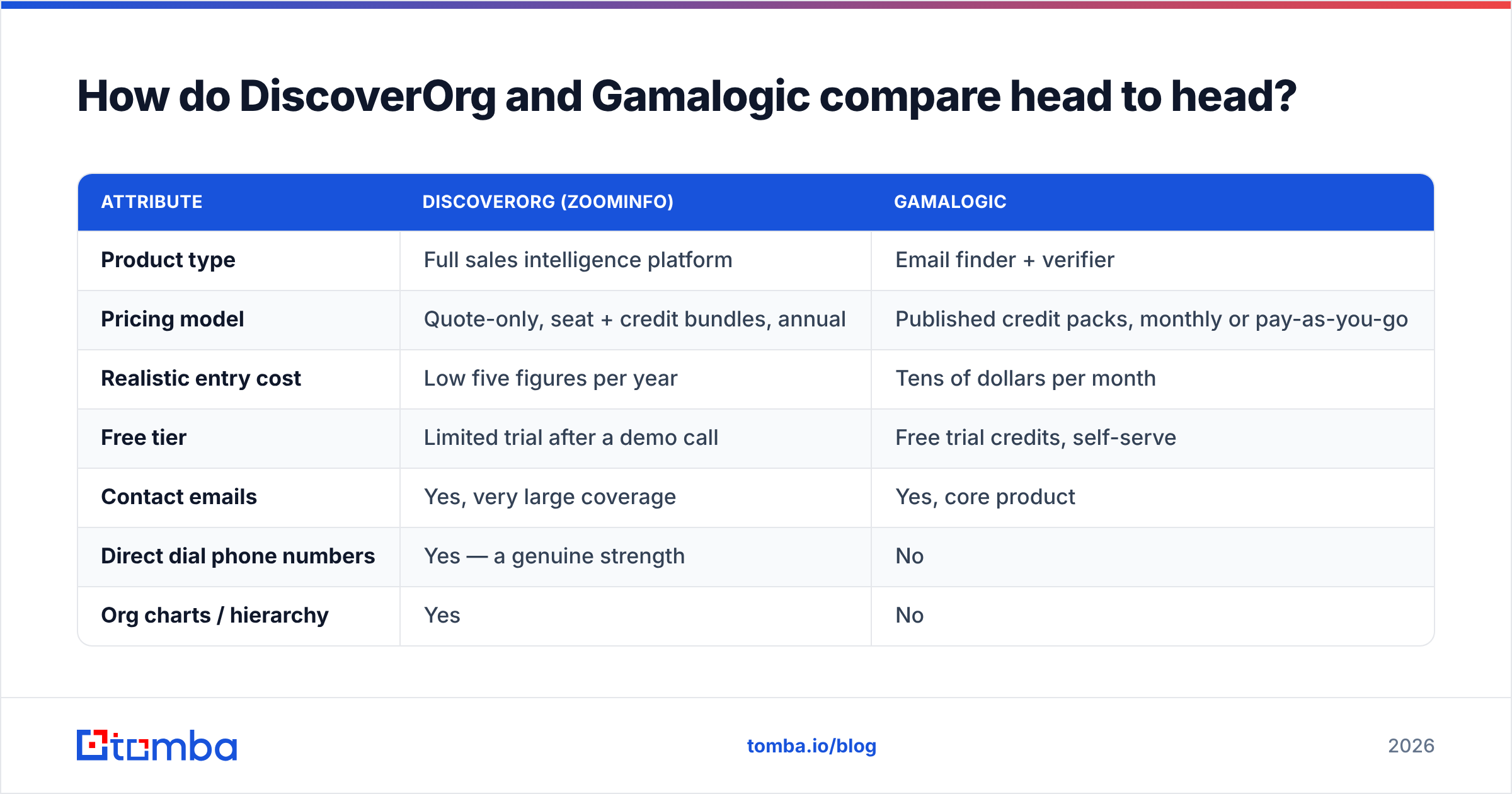
Here is the honest side-by-side. Prices are list or widely reported figures at the time of writing. Always confirm on the vendor's own page before you budget.
| Attribute | DiscoverOrg (ZoomInfo) | Gamalogic |
|---|---|---|
| Product type | Full sales intelligence platform | Email finder + verifier |
| Pricing model | Quote-only, seat + credit bundles, annual | Published credit packs, monthly or pay-as-you-go |
| Realistic entry cost | Low five figures per year | Tens of dollars per month |
| Free tier | Limited trial after a demo call | Free trial credits, self-serve |
| Contact emails | Yes, very large coverage | Yes, core product |
| Direct dial phone numbers | Yes — a genuine strength | No |
| Org charts / hierarchy | Yes | No |
| Intent data | Yes (proprietary + Bombora-style topics) | No |
| Technographics | Yes | No |
| Catch-all handling | Marked, with confidence signals | Basic; catch-alls often returned as unknown |
| Bulk enrichment | Yes, at platform scale | Yes, CSV + API |
| CRM integrations | Native Salesforce, HubSpot, Outreach, Salesloft | API-first; connect via Zapier or custom code |
| Contract flexibility | Annual, auto-renew clauses common | Cancel anytime |
| Best for | Enterprise ABM and territory planning | Solo founders, agencies, lean outbound teams |
The table makes the real decision obvious. This is not a feature race. It is a budget-and-scope question. You are choosing between a research platform and a lookup utility.
Which one has better data accuracy?#
On DiscoverOrg vs Gamalogic accuracy, ZoomInfo wins on coverage. It loses less often on obscure titles, non-US companies, and mid-market accounts. Those rarely show up in scraped datasets. Its direct dial accuracy is the number most buyers cite when they renew despite the cost.
Gamalogic's accuracy is respectable for the price. But it does a different job: pattern inference plus SMTP validation. On clean domains with obvious formats (first.last@), hit rates are high. Results drop on catch-all domains, on small businesses with no public email footprint, and behind Google Workspace's blanket accept-all setting.
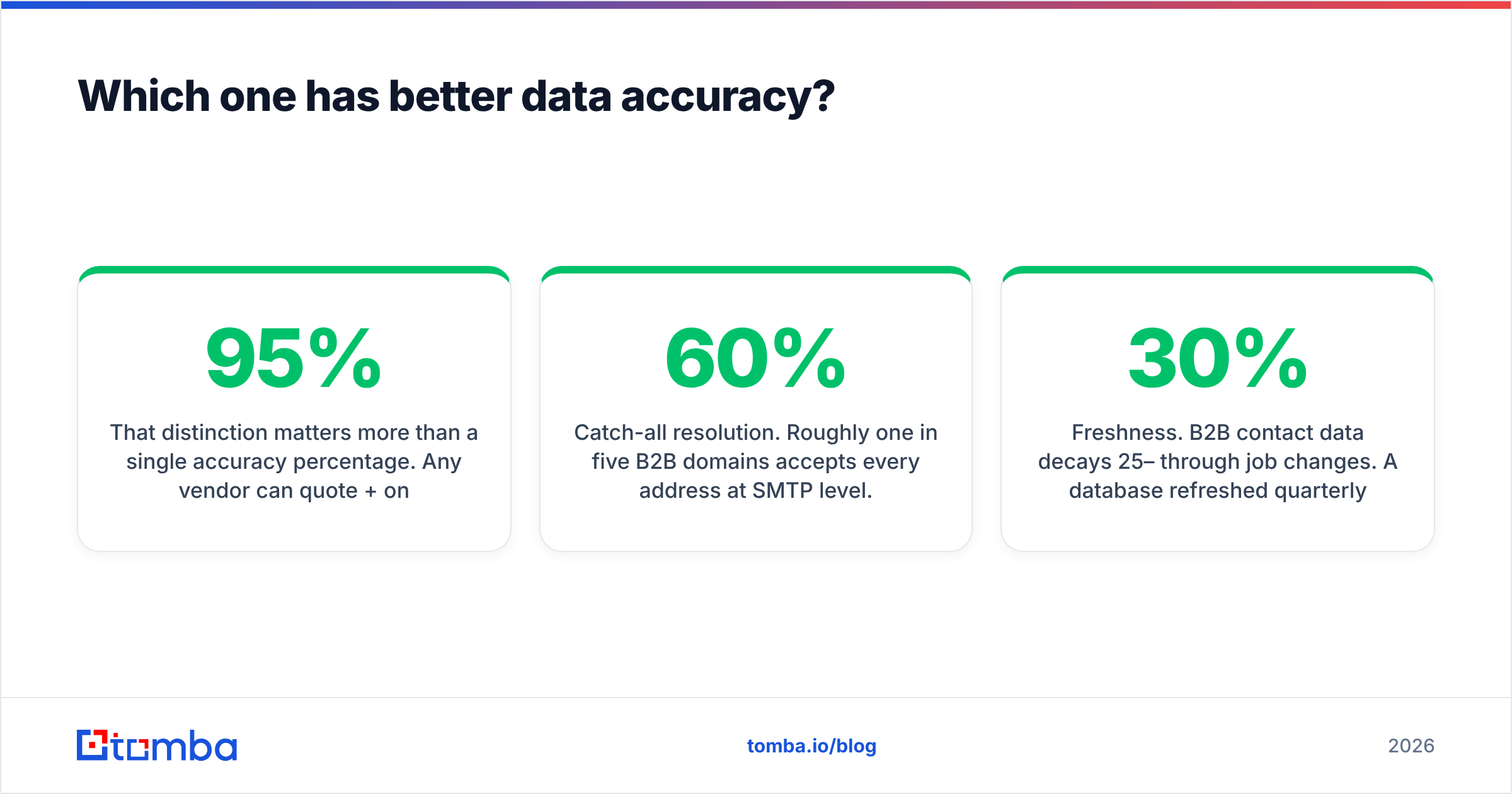
That distinction matters more than a single accuracy percentage. Any vendor can quote 95%+ on an easy sample. What separates tools in production is:
- Catch-all resolution. Roughly one in five B2B domains accepts every address at SMTP level. If a tool returns "unknown" there, you either guess or skip the account. A dedicated catch-all verifier is the difference between a usable list and a 60% coverage list.
- Freshness. B2B contact data decays 25–30% per year through job changes. A database refreshed quarterly is much worse than one refreshed continuously.
- Bounce liability. Invalid addresses waste credits. Worse, they damage your sender reputation, which costs far more than the credits did.

If you run cold outbound at any volume, treat finding and verifying as two separate steps. Even the best finder needs an email verifier pass after it. Do that before the list touches your sending domain.
What does each one actually cost?#
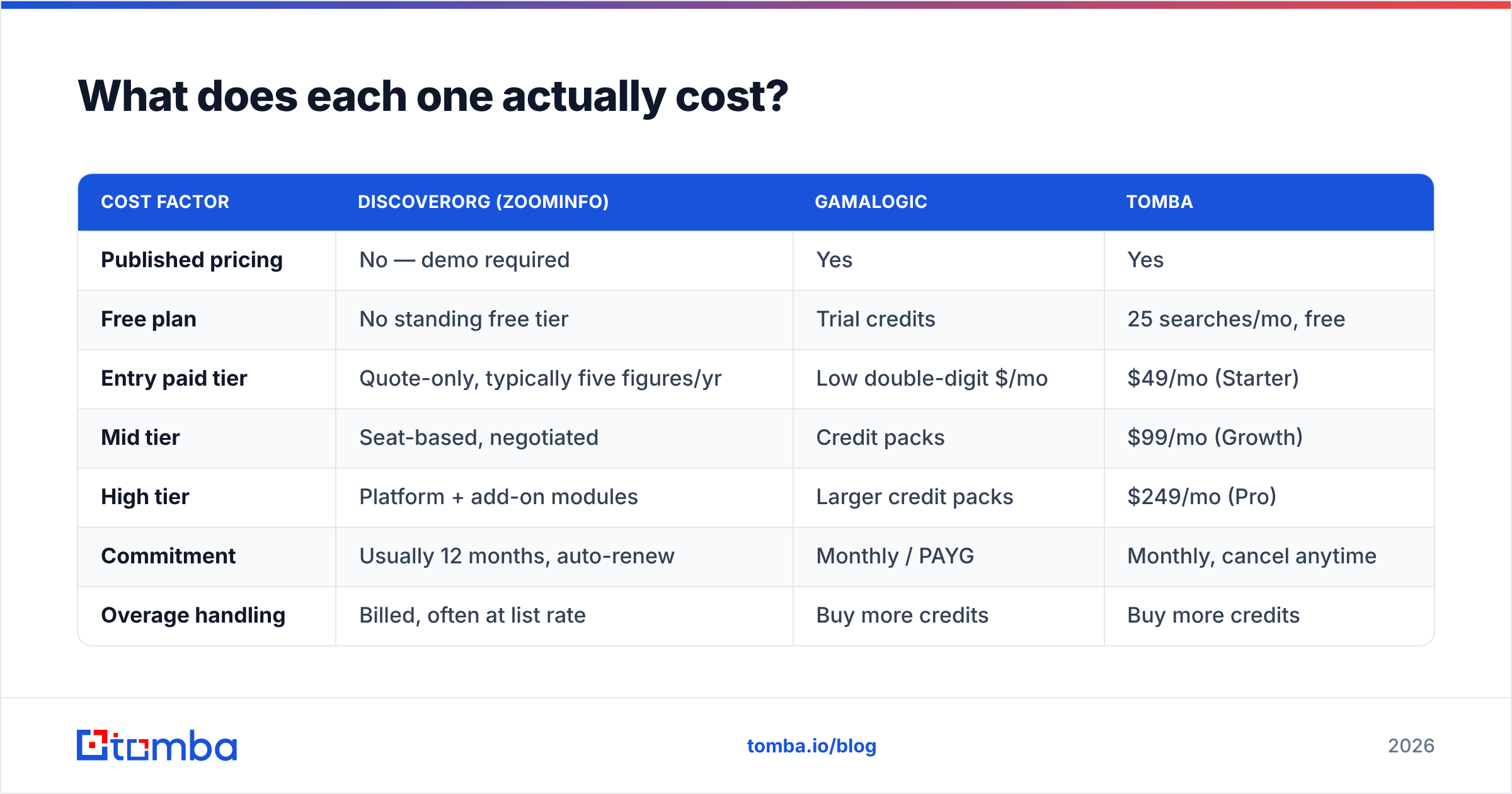
The DiscoverOrg vs Gamalogic price gap is enormous. This is where most evaluations end.
| Cost factor | DiscoverOrg (ZoomInfo) | Gamalogic | Tomba |
|---|---|---|---|
| Published pricing | No — demo required | Yes | Yes |
| Free plan | No standing free tier | Trial credits | 25 searches/mo, free |
| Entry paid tier | Quote-only, typically five figures/yr | Low double-digit $/mo | $49/mo (Starter) |
| Mid tier | Seat-based, negotiated | Credit packs | $99/mo (Growth) |
| High tier | Platform + add-on modules | Larger credit packs | $249/mo (Pro) |
| Commitment | Usually 12 months, auto-renew | Monthly / PAYG | Monthly, cancel anytime |
| Overage handling | Billed, often at list rate | Buy more credits | Buy more credits |
Two things regularly surprise enterprise buyers. First, credits are usually allocated per seat. Adding a junior SDR costs a full seat, even if they use a fraction of the data. Second, auto-renewal clauses are standard. The notice window is often 30–60 days before term end. Diary it the day you sign.

Gamalogic's risk profile is the mirror image. There is almost no commercial downside. But you may hit a coverage ceiling and buy a second tool anyway. That "two-tool tax" is the hidden cost of going too lean.
Who should use DiscoverOrg vs Gamalogic?#
Match the tool to how your team actually sources pipeline.
- Enterprise ABM teams with named accounts — DiscoverOrg/ZoomInfo. You need org charts, buying committees, and intent to time outreach. Nothing cheaper replicates that.
- Teams that live on the phone — DiscoverOrg/ZoomInfo. Direct dial coverage is the one capability the budget tools genuinely cannot match.
- Solo founders and small agencies — Gamalogic. You know your ICP, you have a scraped list of companies, you need addresses. Pay by the credit.
- Recruiters and one-off list builds — Gamalogic or a pay-as-you-go finder. Annual contracts make no sense for project work.
- Growth teams doing 5k–50k emails/month — Neither, alone. You want a finder with a strong API, a separate verification layer, and predictable monthly pricing.
- RevOps teams enriching an existing CRM — Depends on record volume. Under ~50k records, a credit-based data enrichment run is much cheaper than a platform seat.
Where do both tools fall short?#
DiscoverOrg/ZoomInfo weak points: opaque pricing slows procurement. Seat-based economics punish growing teams. Contract terms are hard to exit mid-year. And the UI is far bigger than most reps use. Reviews on G2's lead intelligence category cite value for money and renewal talks as the friction, not data quality.
Gamalogic weak points: no phone data, no firmographic context, weaker performance on catch-all domains, and integration work that falls on you. Does your workflow depend on native CRM sync, or on a Chrome extension reps will actually adopt? You will feel the gap right away.
Shared weak point: neither is a sending platform. You still need sequencing, warmup, and deliverability monitoring elsewhere. Neither vendor is accountable for your reply rate.
What are the best DiscoverOrg and Gamalogic alternatives?#
The DiscoverOrg vs Gamalogic head-to-head may leave you unsatisfied. It should: the two products barely overlap. Most teams land in the middle of the market.
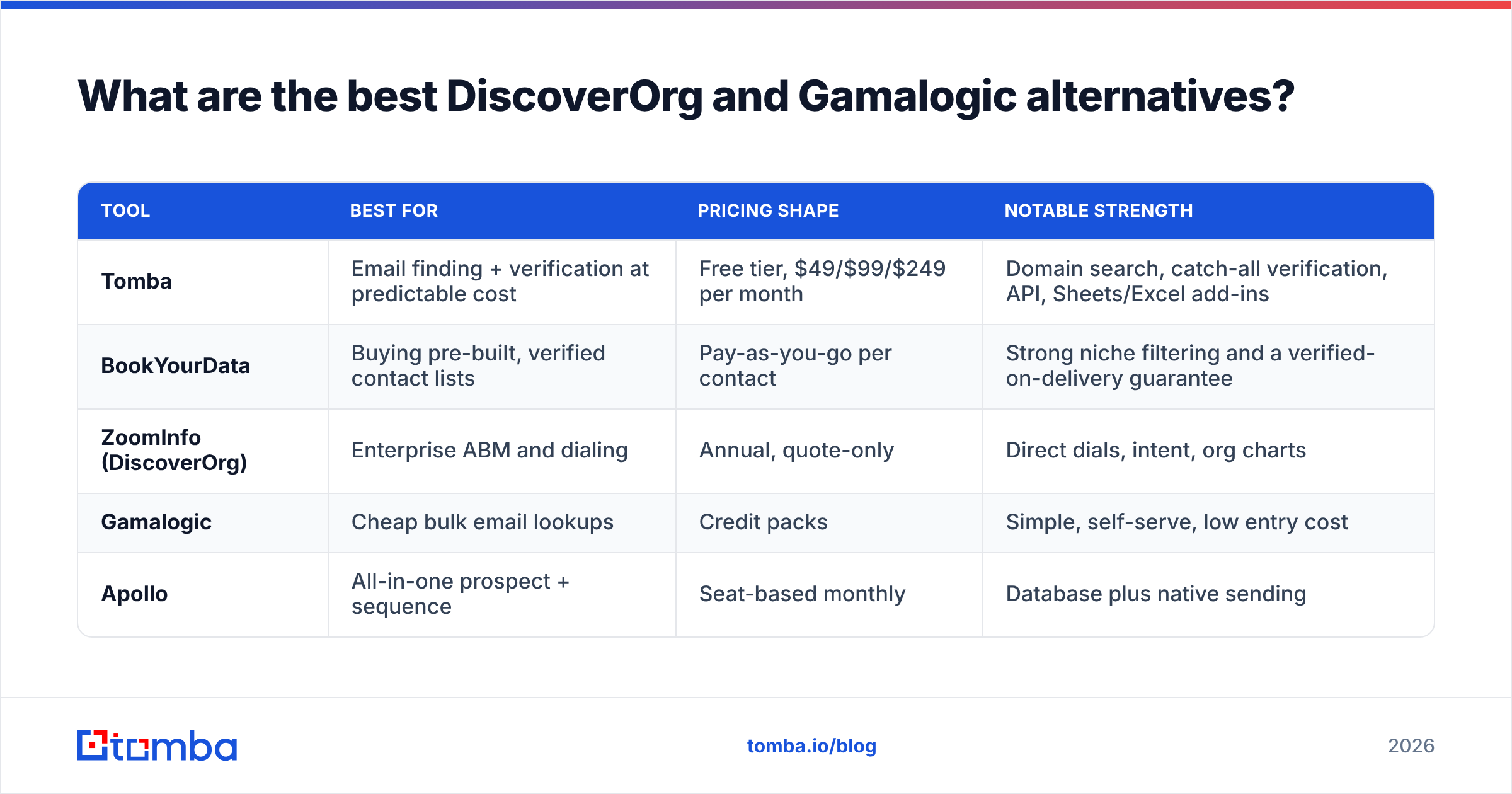
| Tool | Best for | Pricing shape | Notable strength |
|---|---|---|---|
| Tomba | Email finding + verification at predictable cost | Free tier, $49/$99/$249 per month | Domain search, catch-all verification, API, Sheets/Excel add-ins |
| BookYourData | Buying pre-built, verified contact lists | Pay-as-you-go per contact | Strong niche filtering and a verified-on-delivery guarantee |
| ZoomInfo (DiscoverOrg) | Enterprise ABM and dialing | Annual, quote-only | Direct dials, intent, org charts |
| Gamalogic | Cheap bulk email lookups | Credit packs | Simple, self-serve, low entry cost |
| Apollo | All-in-one prospect + sequence | Seat-based monthly | Database plus native sending |
BookYourData is worth a look if your motion is "buy a clean list once per quarter" rather than "look up contacts continuously." At low frequency, buying a list beats paying for a subscription. Apollo makes sense when you want database and sequencing under one login and can live with a seat model.

Most teams sit between "solo founder" and "enterprise ABM." The practical stack for them is simple: a company list from your own research or a database, an email finder to resolve contacts, a verification pass before send, and your existing sequencer. That stack costs a few hundred dollars a month, not a few thousand. Every part of it is replaceable.
How should you run the evaluation?#
Do not compare marketing pages. Run the same DiscoverOrg vs Gamalogic test on both tools.
- Take 200 real target contacts from your ICP — names plus company domains, including at least 30 known catch-all domains.
- Run them through each tool. Record hit rate, not just "found."
- Send the results through an independent verifier. Record how many the source tool got wrong.
- Divide total spend by the count of addresses that survived verification. That is your true cost per usable contact.
- Repeat on a second list from a different geography. Coverage varies a lot by region. A single US-heavy sample will mislead you.
Most buyers find their ranking flips at step four. Say one tool is cheap but verifies at 55%. Another costs twice as much and verifies at 85%. The second can be cheaper per usable lead. Run the numbers on your own data, not the vendor's sample.
The bottom line#
The DiscoverOrg vs Gamalogic answer comes down to budget and scope. DiscoverOrg — which is to say ZoomInfo — is right when account intelligence and direct dials drive revenue. You also need the budget and the patience for an annual contract. Gamalogic is right when you already know who to contact and want the cheapest reliable path to their address. Anything in between? A purpose-built finder with transparent pricing serves you better.
If that describes you, start with the Tomba Email Finder. The free tier gives you 25 searches a month. Test coverage against your own list before you spend anything. Starter is $49 a month with no annual lock-in. Domain search, catch-all verification, and the API are included, not sold as add-on modules. Compare the Tomba pricing tiers against the quote you were given, run the 200-contact test above, and let your own hit rate decide.
Related guides#
Ready to find emails that actually work?
Join 150,000+ professionals who stopped guessing and started sending. Free credits on signup — no credit card required.
Get the Tomba newsletter
Practical outbound tactics and product updates — once every two weeks.
About the author