DiscoverOrg vs Generect: Which B2B Data Tool Wins in 2026?
DiscoverOrg no longer exists as a standalone product, and Generect plays a very different game. Here is an honest breakdown of coverage, accuracy, pricing, and who each one actually fits in 2026.
DiscoverOrg vs Generect is an odd matchup. One of the two has not been sold under its own name since 2019. Here is the short version first.
TL;DR
- DiscoverOrg is not a tool you can buy today. It merged with ZoomInfo in 2019, and the name now points to ZoomInfo's top data tier.
- Generect is much younger. It is a LinkedIn-first lead data tool built for search, list building, and an API. It is priced for small teams.
- The two are not real rivals on features. They fight for one budget line: where do our contact records come from?
- ZoomInfo (ex-DiscoverOrg) wins on org charts, intent data, and tech stacks. Generect wins on speed, price, and fresh LinkedIn profiles.
- If you only need verified work emails, a focused email finder like Tomba starts at $49/mo. There is a free tier, no seat minimums, and no yearly lock-in.
Most people who search DiscoverOrg vs Generect want to weigh an old enterprise giant against a cheap new data source. That framing is close, but it hides one fact. Only one of the two is still sold under its own name. Here is what each one is today, how the data holds up, and how to choose.
What happened to DiscoverOrg — is it still a product?#
DiscoverOrg launched in 2007 as a human-checked B2B database for IT teams. Real analysts called into companies. They mapped org charts and refreshed records on a set schedule. That made it costly, and very accurate for its time.
In February 2019, DiscoverOrg bought ZoomInfo. It then took the ZoomInfo name for the joint company. Today ZoomInfo is the brand that survives. The old DiscoverOrg data now sits inside ZoomInfo Copilot, SalesOS, and the data packs sold on top. You cannot log in to a DiscoverOrg product in 2026.
That shapes any DiscoverOrg vs Generect review in three ways:
- You are quoting ZoomInfo prices, not DiscoverOrg prices. Old DiscoverOrg contracts moved over years ago.
- The human-checked promise has changed shape. ZoomInfo mixes network data, web crawling, AI extraction, and a research layer. It is wider than old DiscoverOrg, and less of it is checked by hand.
- The buying motion is enterprise. Expect yearly deals, seat minimums, credit packs, and a sales cycle. You cannot self-serve at the tier that holds the best data.
So DiscoverOrg vs Generect really means one thing: a heavy enterprise data platform against a light, modern lead tool.

What is Generect and who is it for?#
Generect is a B2B lead data provider. It leans on LinkedIn as its main signal. You search firms and people with filters that mirror Sales Navigator: headcount, industry, region, job title, and seniority. Then you pull records with work emails, plus phone numbers on some plans. It also has an API, so your team can wire lead pulls into your own systems instead of moving CSV files by hand.
Its stance is the opposite of DiscoverOrg's. It is fast, self-serve, and monthly. It suits agencies, recruiters, and lean outbound teams. The catch is simple. A LinkedIn-based set inherits LinkedIn's blind spots. Stale, private, or missing profiles leave gaps. Those gaps cluster in fields that skip LinkedIn: factories, freight, local services, much of Japan, and parts of Europe.
Neither model is wrong. They fail in different ways, and that gap is the whole choice.
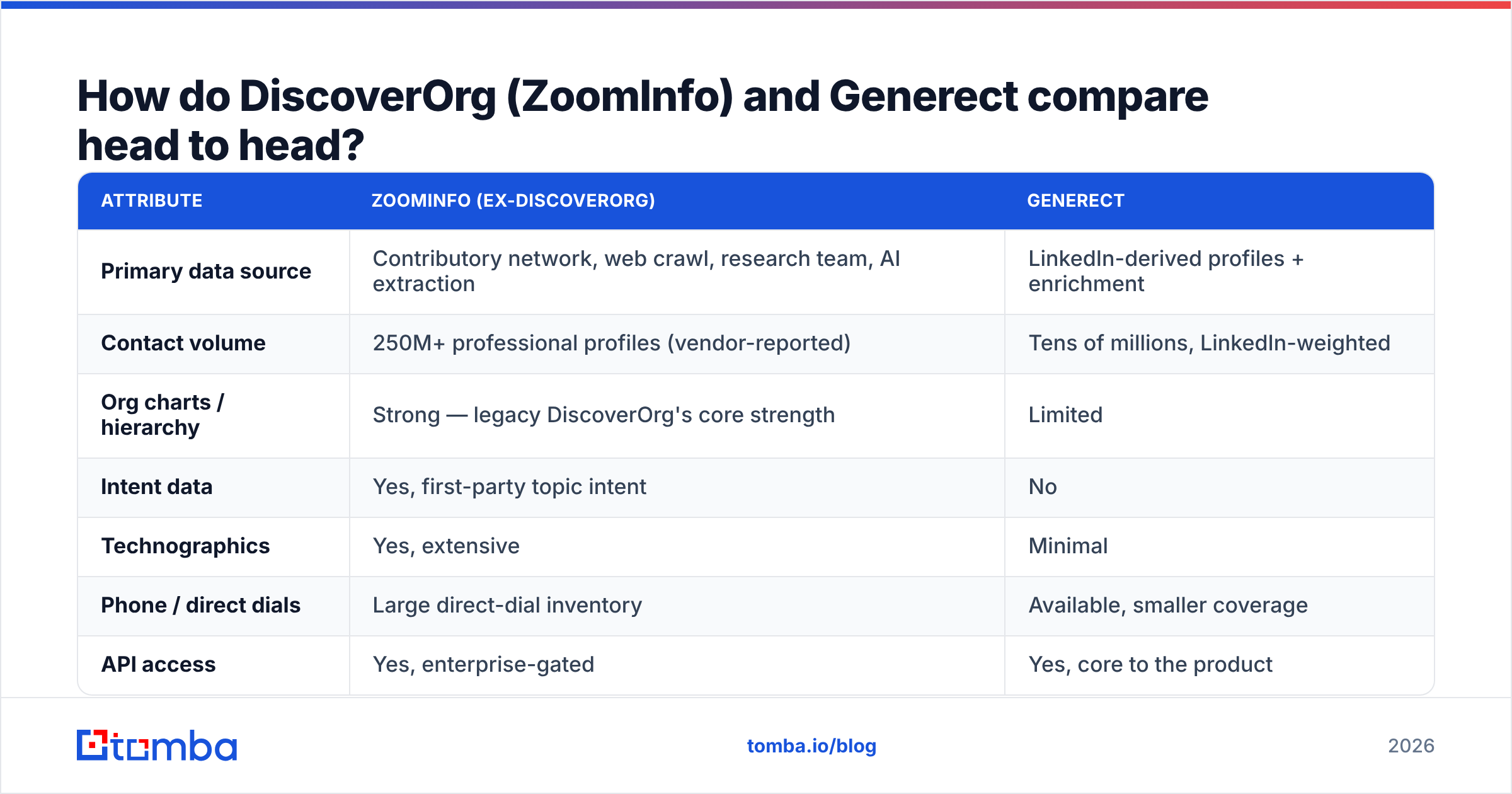
How do DiscoverOrg (ZoomInfo) and Generect compare head to head?#
| Attribute | ZoomInfo (ex-DiscoverOrg) | Generect |
|---|---|---|
| Primary data source | Contributory network, web crawl, research team, AI extraction | LinkedIn-derived profiles + enrichment |
| Contact volume | 250M+ professional profiles (vendor-reported) | Tens of millions, LinkedIn-weighted |
| Org charts / hierarchy | Strong — legacy DiscoverOrg's core strength | Limited |
| Intent data | Yes, first-party topic intent | No |
| Technographics | Yes, extensive | Minimal |
| Phone / direct dials | Large direct-dial inventory | Available, smaller coverage |
| API access | Yes, enterprise-gated | Yes, core to the product |
| Buying motion | Annual contract, sales-led | Self-serve, monthly |
| Typical entry cost | Five figures per year | Low hundreds per month |
| Free tier | No (limited trial only) | Trial credits |
| Best fit | Enterprise ABM, RevOps, large SDR orgs | Agencies, recruiters, lean outbound teams |
Read the table as two tools that share one budget line. Say your plan needs intent signals and org charts across 500 named accounts. Generect will not replace ZoomInfo. Say your plan is 3,000 targeted contacts a month, then sequences. In that case ZoomInfo is a costly way to buy a spreadsheet.
Which one has better data accuracy?#
Treat every vendor accuracy claim with doubt. They all quote a number. None of them run the same test. The number that counts is how many emails bounce when your domain mails your ICP. You cannot see it until you try it.
Here is how the two behave in the field:
- ZoomInfo is stronger on company data. Size, revenue band, HQ, reporting lines, and installed tech are where its research layer pays off. Need to know who reports to the VP of Infrastructure at a 4,000-person insurer? Use this set.
- Generect is often fresher on job changes. LinkedIn updates the day someone moves. Crawl-based sets lag that by weeks or months.
- Both slip on email delivery without a check. A record can name the right person and still hold a dead address. Catch-all domains make it worse. The server accepts every address, so a lazy check marks them all valid.

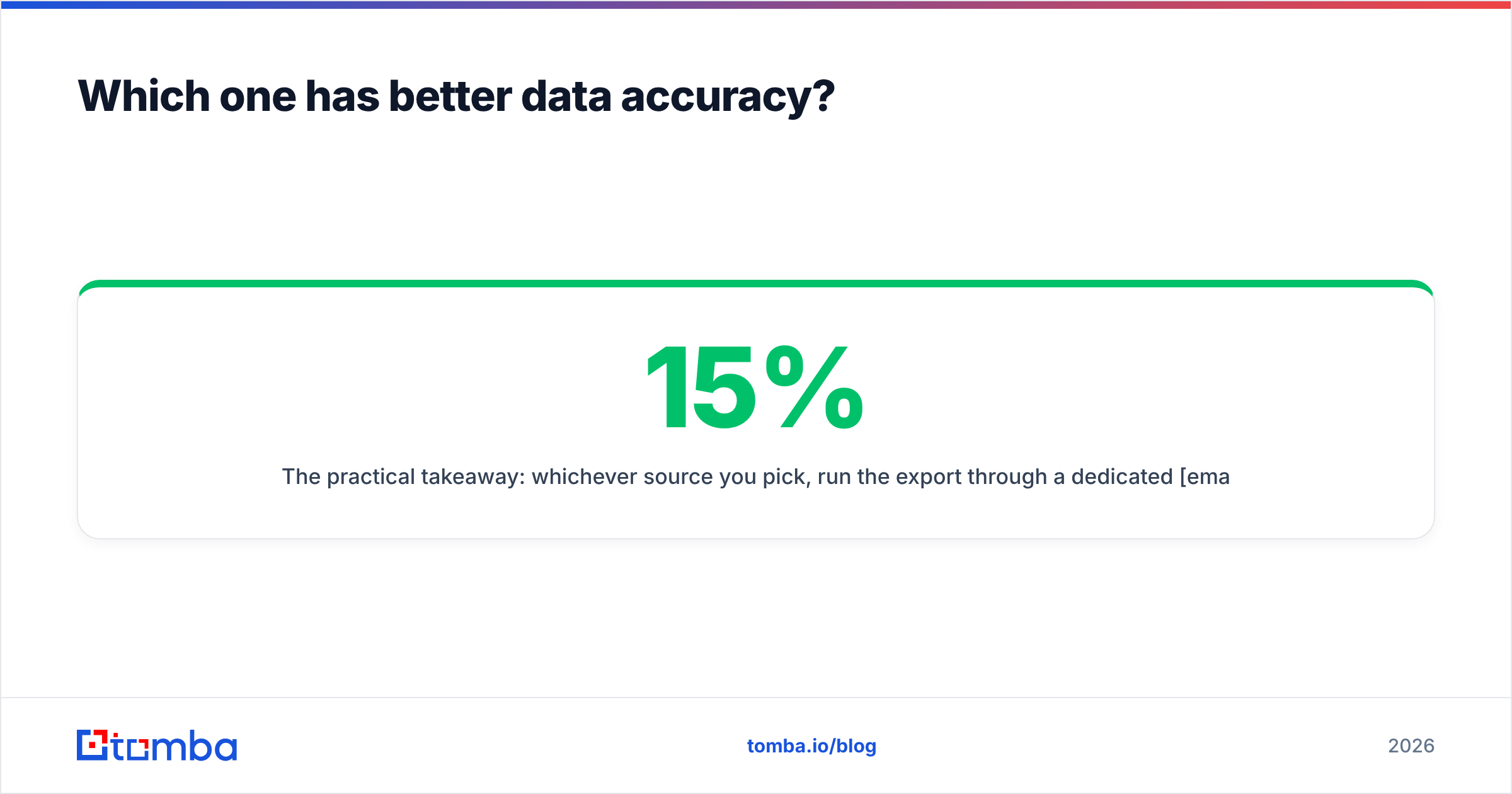
So pick either source, then run the export through a real email verifier before you send. Teams that skip this step often see 8–15% bounces on so-called verified data. Two campaigns like that can dent your sender reputation. On domains that accept everything, a catch-all verifier is the gap between a 2% bounce rate and a 9% one.
How does pricing actually compare?#
Most reviews stop here, so let's be exact — and clear about what is public.
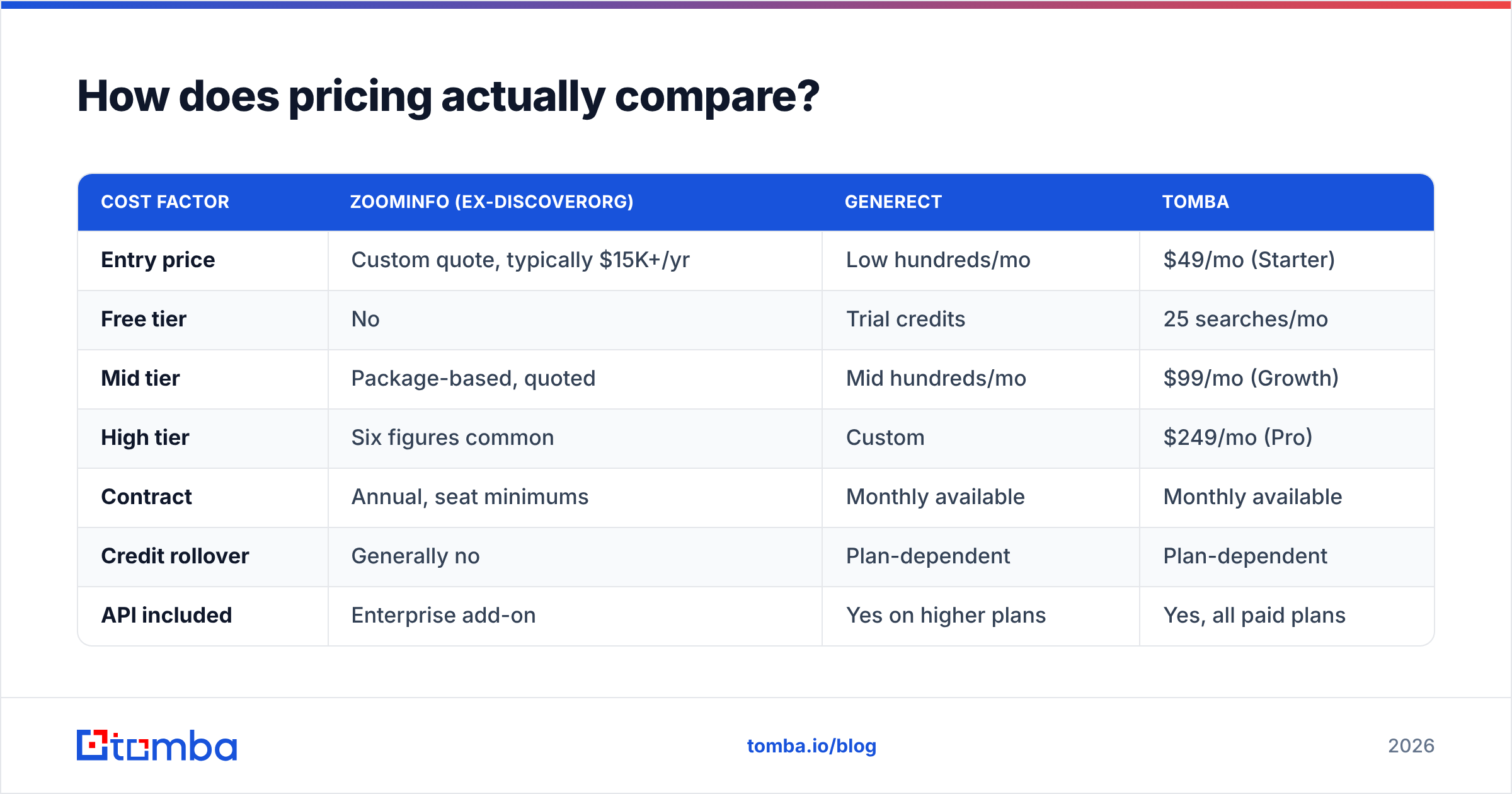
ZoomInfo does not list prices. Reported deals on G2 and public records cluster at $15,000–$40,000 a year for a small or mid-size sales team. Add intent data, seats, and credits, and it clears six figures. Credits burn on export, and leftovers rarely roll over. A yearly term is normal. Auto-renewal clauses are common, so read them.
Generect lists plans in the low hundreds per month, billed monthly or yearly. Each tier ships with credits. Higher plans include API access. Tiers shift, so check the vendor page before you set a budget.
| Cost factor | ZoomInfo (ex-DiscoverOrg) | Generect | Tomba |
|---|---|---|---|
| Entry price | Custom quote, typically $15K+/yr | Low hundreds/mo | $49/mo (Starter) |
| Free tier | No | Trial credits | 25 searches/mo |
| Mid tier | Package-based, quoted | Mid hundreds/mo | $99/mo (Growth) |
| High tier | Six figures common | Custom | $249/mo (Pro) |
| Contract | Annual, seat minimums | Monthly available | Monthly available |
| Credit rollover | Generally no | Plan-dependent | Plan-dependent |
| API included | Enterprise add-on | Yes on higher plans | Yes, all paid plans |
Full Tomba pricing is public for a plain reason. When the number is on the page, you can do the math before a demo, not after.

Which should you choose for your use case?#
Pick by motion, not by feature count.
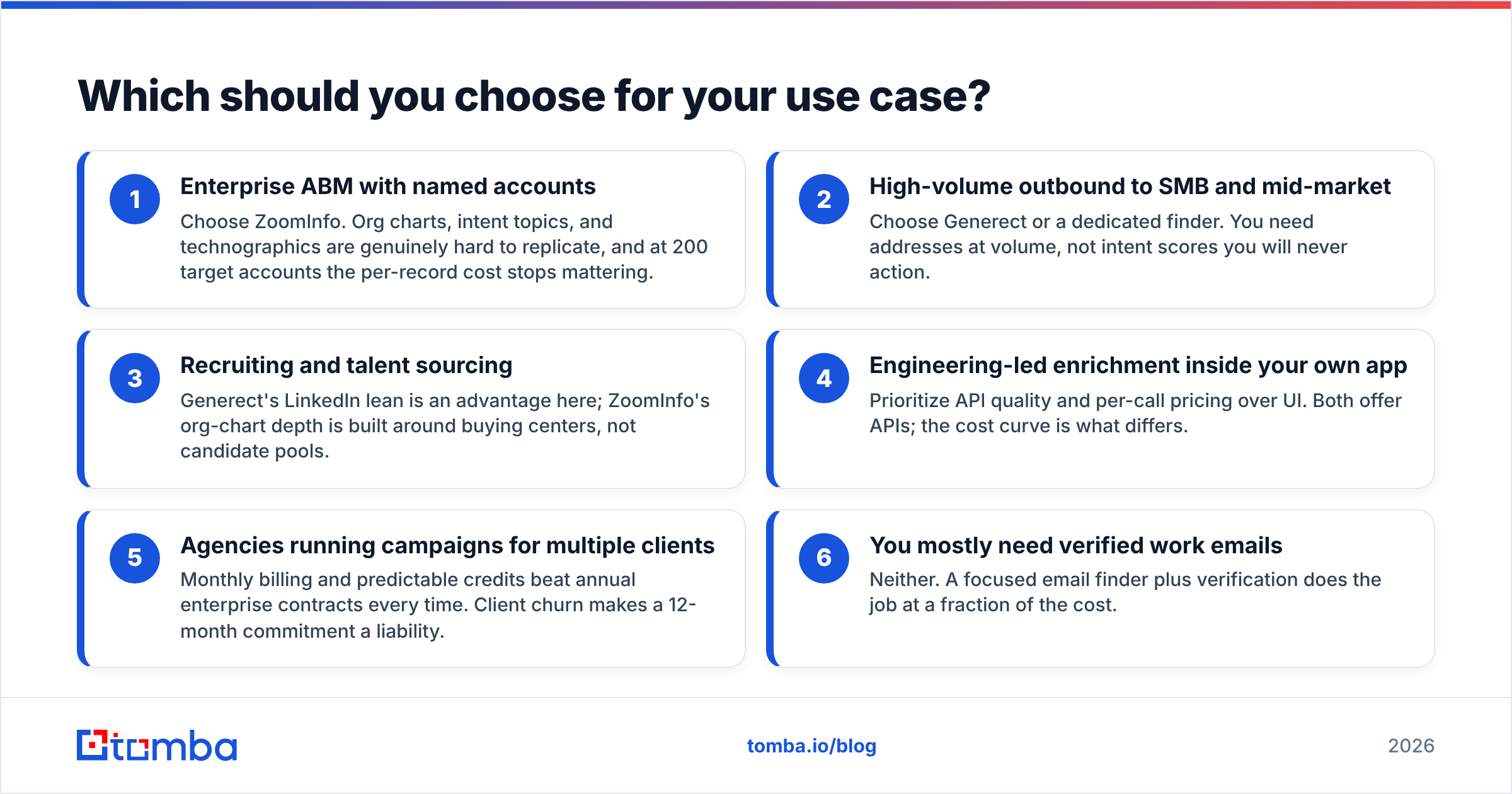
- Enterprise ABM with named accounts — Choose ZoomInfo. Org charts, intent topics, and tech stacks are hard to copy. At 200 target accounts, the cost per record stops mattering.
- High-volume outbound to SMB and mid-market — Choose Generect or a focused finder. You need addresses at volume, not intent scores you will never use.
- Recruiting and talent sourcing — Generect's LinkedIn lean helps here. ZoomInfo maps buying centers, not candidate pools.
- Engineering-led enrichment in your own app — Put API quality and per-call price first. Both have APIs. The cost curve is what differs.
- Agencies running campaigns for many clients — Monthly billing and steady credits beat yearly deals. Client churn makes a 12-month term a risk.
- You mostly need verified work emails — Neither. A focused email finder plus a verifier does the job for far less.
That last case is more common than vendors admit. Many teams buy a full platform, use the filters and the export button, then ignore 80% of what they paid for.

What are the honest downsides of each?#
ZoomInfo (ex-DiscoverOrg) drawbacks:
- Cost grows with seats, and seat minimums make small pilots awkward.
- Running out of credits mid-quarter is a real problem. Teams start to ration exports.
- Privacy review is harder for network-sourced data, above all under GDPR. Your legal team will ask.
- The platform is broad. Training five people on a tool built for fifty costs you ramp time.
Generect drawbacks:
- Coverage inherits LinkedIn's skew by region and industry.
- Company data is thinner. There is no real intent or tech-stack layer.
- Smaller vendor, smaller support desk, and less paperwork for security reviews.
- Email validity still needs its own check before you send.
The shared drawback: both sell you records. Neither one is on the hook for what happens when you mail them. Delivery is your job. Build the check into your pipeline before the first send, not after the first bounce report.
How do you test either one without burning a quarter?#
Run the same test on both, with your own list.
- Pull 200 records from your exact ICP. Same titles, same headcount band, same region. Use the segment you really sell to.
- Check field completeness. How many have a work email? A direct dial? The right current employer?
- Verify every email on your own. Use a third-party tool, not the vendor's status field. Count valid, invalid, catch-all, and unknown apart.
- Spot-check 20 records by hand against LinkedIn and the company site. Job-change lag shows up fast.
- Price it per usable record. Total cost divided by verified contacts in your ICP. That is the only number that compares across vendors.
Teams that run this test often find their cost per usable record is 2–4x the headline credit price. A slice of every export is stale, out of ICP, or dead. That math pushes many of them toward a leaner stack: a finder for contacts, a verifier for hygiene, and one more tool only for the fields they truly use. At scale, the bulk email finder handles list-level lookups with no per-seat contract, and data enrichment fills company gaps on records you already own.
What is the verdict on DiscoverOrg vs Generect?#
Choose ZoomInfo (the platform DiscoverOrg became) if you run enterprise ABM, need org charts and intent signals, have a buying process, and can defend five figures a year against pipeline. It is still the deepest B2B data set on the market.
Choose Generect if you need volume, speed, and monthly billing. It fits LinkedIn-heavy segments in North America and Western Europe. It also fits agencies and recruiters, where yearly terms do not work.
Choose neither if your real need is simple: correct, deliverable work emails for people you already know. That is a smaller job. Paying platform prices for it is the most common overspend in the outbound stack.
Tomba was built for that smaller job. Find the address, verify it, move on. Start with the Tomba Email Finder on the free tier: 25 searches a month, no card, no demo call. If it holds up on your ICP, Starter is $49/mo. You keep the rest of that $30,000 contract for work that builds pipeline.
Related guides#
Ready to find emails that actually work?
Join 150,000+ professionals who stopped guessing and started sending. Free credits on signup — no credit card required.
Get the Tomba newsletter
Practical outbound tactics and product updates — once every two weeks.
About the author