DiscoverOrg vs Global Database: B2B Data Compared for 2026
DiscoverOrg (now ZoomInfo) sells curated org charts at enterprise prices. Global database providers sell reach. Here's which one actually fills your pipeline in 2026 — and what each really costs.
TL;DR
- DiscoverOrg no longer exists as a standalone product — it merged into ZoomInfo in 2019, and its curated org-chart data now sits inside ZoomInfo SalesOS at enterprise contract prices (typically $15K–$40K+/year, annual commit).
- A "global database" is the opposite bet: breadth over depth. Providers like BookYourData, Cognism, and Lusha cover far more countries and companies, usually with self-serve pricing and no annual lock-in.
- Choose curated depth (DiscoverOrg/ZoomInfo) when you sell six-figure deals into US enterprise IT and need verified reporting lines. Choose a global database when you sell into many markets, many company sizes, or need to control cost per contact.
- Neither approach solves staleness. B2B contact data decays roughly 25–30% per year, so verification at send time matters more than the size of the database you bought.
- The pragmatic 2026 stack for most teams: a broad database or targeted list source for coverage, plus a real-time email verifier and finder layer to confirm every address before it enters a sequence.
What is DiscoverOrg, and does it still exist?#
DiscoverOrg was a B2B sales-intelligence provider founded in 2007 that built its reputation on human-researched data: analysts phoned companies, mapped IT departments, and maintained org charts showing who reported to whom. That was genuinely rare. Most competitors scraped and inferred; DiscoverOrg paid people to confirm.
In February 2019, DiscoverOrg acquired ZoomInfo and adopted the ZoomInfo name. Today, when someone says "DiscoverOrg," they mean one of two things: legacy contracts still running under the old branding, or the curated org-chart and technographic layer inside ZoomInfo SalesOS. There is no separate DiscoverOrg you can buy in 2026.
That matters for your evaluation. You are not comparing two live products — you are comparing a philosophy (deep, human-verified, US-enterprise-weighted, expensive) against a different philosophy (wide, machine-assembled, multi-region, cheaper per record).
What does "global database" actually mean?#
"Global database" is a category, not a product. It describes any B2B contact provider whose selling point is coverage: tens or hundreds of millions of contacts across dozens of countries, sold either as list downloads or as a searchable platform.
The category splits into three practical shapes:
- Downloadable list vendors — You filter by industry, title, geography, and company size, then export a CSV. BookYourData is a well-known example, with pay-as-you-go credits and a strong reputation for delivering what the filters promise. Good when you need a defined segment fast and don't want a platform subscription.
- Subscription intelligence platforms — Cognism, Apollo, and Lusha sell seats plus credits, layering intent signals, sequencing, or CRM sync on top of the raw records. You pay for the workflow as much as the data.
- API-first finders and verifiers — Tools like Tomba, Hunter, and Findymail don't try to hand you the whole world. You bring a company domain or a name, and they return a verified address on demand. Cost tracks usage, not inventory.
Understanding which shape you're buying prevents the most common evaluation mistake: comparing a $49/month finder against a $25,000/year platform on "number of contacts" and concluding the platform is better value. They solve different problems.
How do DiscoverOrg and global databases compare on the specs that matter?#
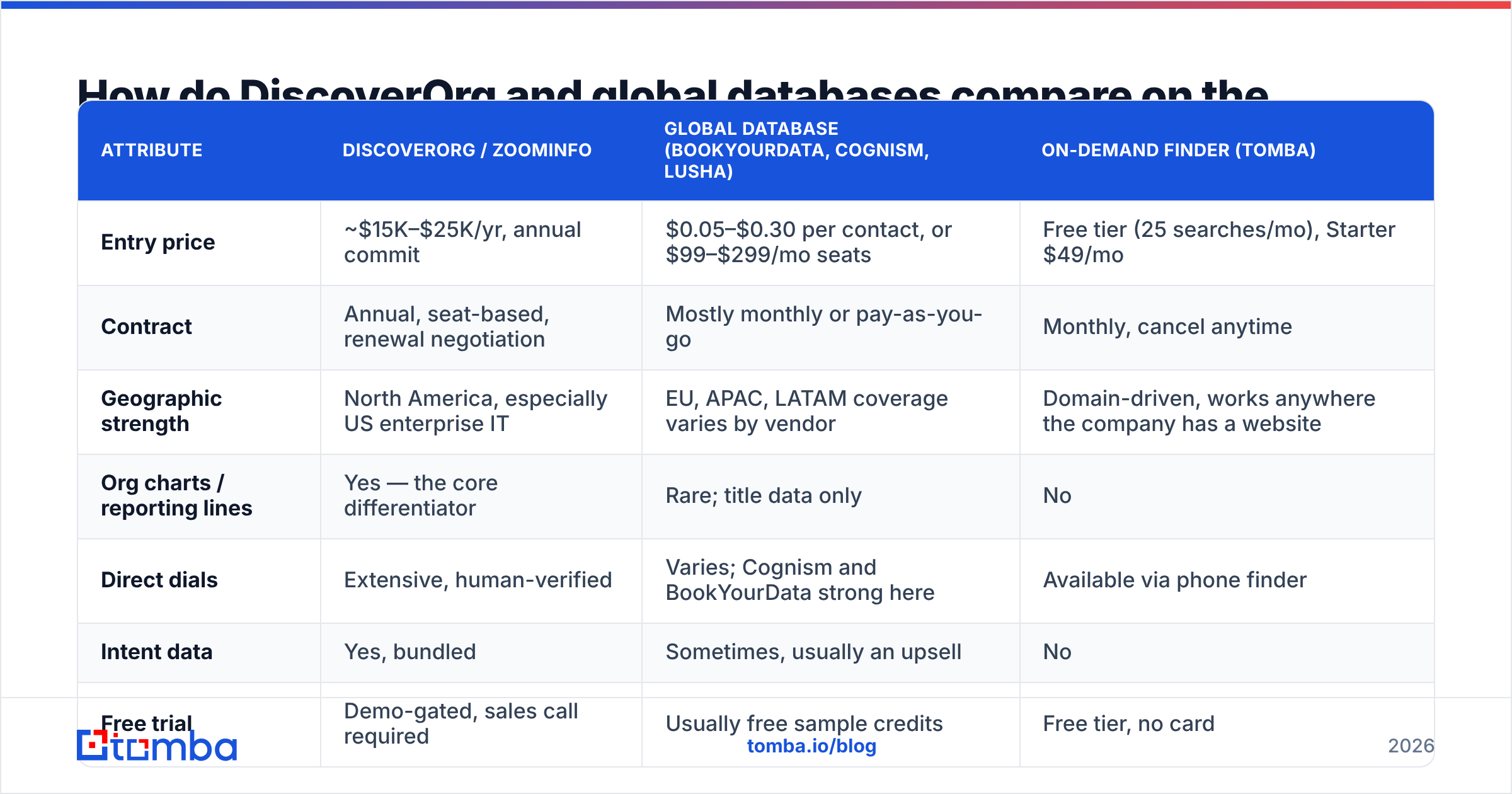
Here's the honest side-by-side. Prices reflect publicly reported ranges and vendor-published pricing as of mid-2026; enterprise contracts vary widely by seat count and negotiated terms.
| Attribute | DiscoverOrg / ZoomInfo | Global database (BookYourData, Cognism, Lusha) | On-demand finder (Tomba) |
|---|---|---|---|
| Entry price | ~$15K–$25K/yr, annual commit | $0.05–$0.30 per contact, or $99–$299/mo seats | Free tier (25 searches/mo), Starter $49/mo |
| Contract | Annual, seat-based, renewal negotiation | Mostly monthly or pay-as-you-go | Monthly, cancel anytime |
| Geographic strength | North America, especially US enterprise IT | EU, APAC, LATAM coverage varies by vendor | Domain-driven, works anywhere the company has a website |
| Org charts / reporting lines | Yes — the core differentiator | Rare; title data only | No |
| Direct dials | Extensive, human-verified | Varies; Cognism and BookYourData strong here | Available via phone finder |
| Intent data | Yes, bundled | Sometimes, usually an upsell | No |
| Free trial | Demo-gated, sales call required | Usually free sample credits | Free tier, no card |
| Best fit | Enterprise ABM into US IT/finance | Multi-region outbound at volume | Targeted, verified sending at any scale |
The table makes the trade obvious. DiscoverOrg's descendant sells you certainty about a small, high-value universe. Global databases sell you access to a large universe with less certainty per record. Finders sell you certainty on demand, one record at a time.
Which one has better data accuracy?#
Accuracy claims in this category are close to meaningless without a defined test, because every vendor measures differently. Some count "deliverable" (the mailbox accepts), some count "correct person" (the address belongs to who they said), and some quietly exclude catch-all domains from the denominator.
What holds up across independent buyer reviews on G2 and Capterra:
- DiscoverOrg-lineage data is genuinely strong on US enterprise org structure. If you need to know that the VP of Infrastructure reports to the CIO at a 4,000-person manufacturer in Ohio, this is the best money can buy. Human research shows up in the output.
- Global databases degrade unevenly by region. A provider with excellent DACH coverage may have thin data for Brazil or Southeast Asia. Ask for a region-specific sample before signing, not a global average.
- Everyone decays at roughly the same rate. Job changes, restructures, and domain migrations move about a quarter of B2B contacts per year. A record verified in January is a coin flip by December.
- Catch-all domains are the hidden failure mode. Many enterprises accept all mail at the SMTP layer, so "verified" often means "we couldn't prove it's wrong." A dedicated catch-all verifier is the only way to separate real mailboxes from accept-everything servers.
That last point is why database size is a weak proxy for pipeline. A 200-million-record database with a 15% bounce rate produces fewer conversations than a 5-million-record segment verified at send time — and it burns your sender reputation doing it.
Is DiscoverOrg worth the enterprise price in 2026?#
Yes, under three conditions. No, otherwise.
Buy it when:
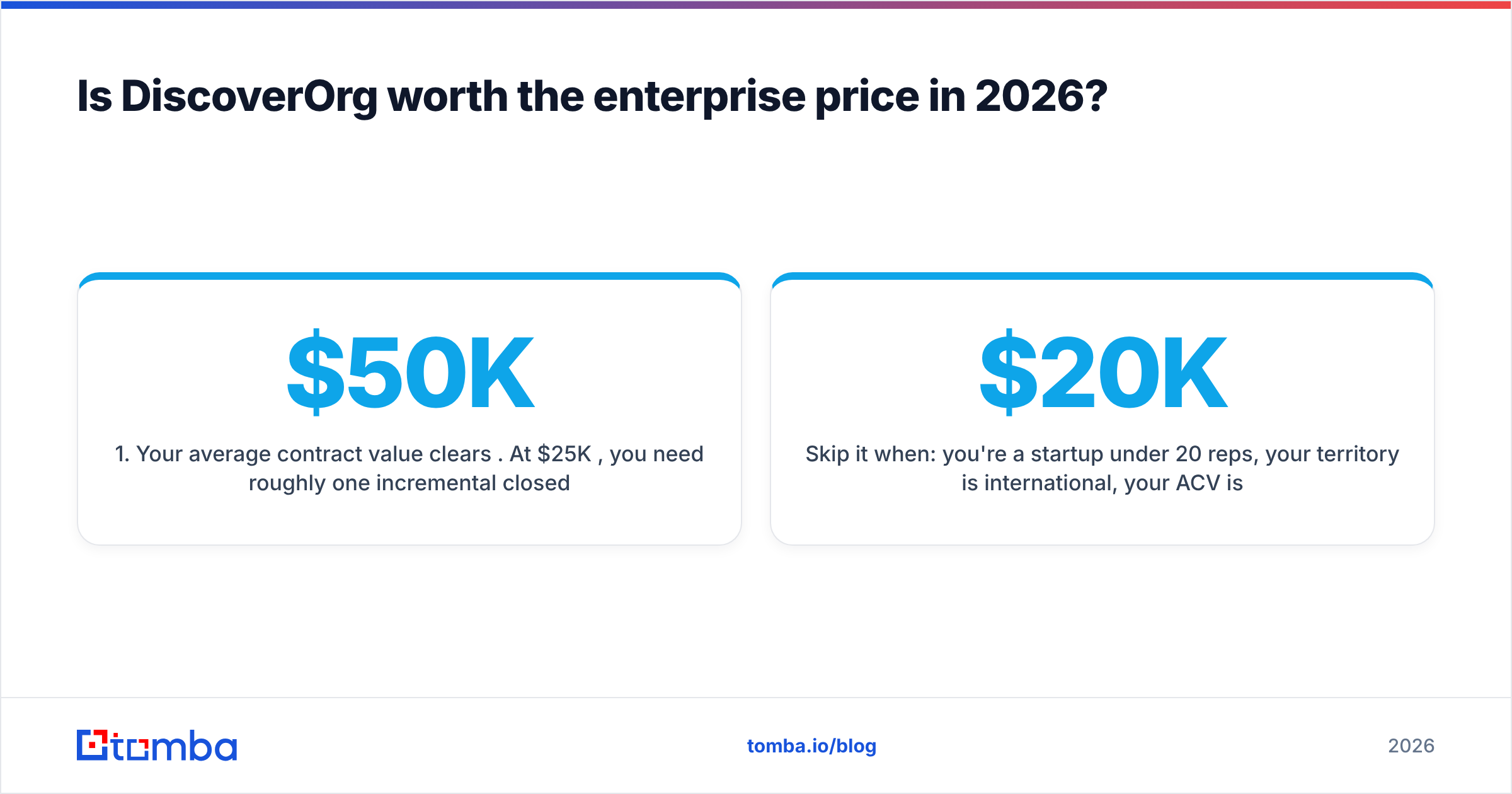
- Your average contract value clears $50K. At $25K/year, you need roughly one incremental closed deal to break even. If your ACV is $8K, the math needs 3–4 extra deals attributable purely to the data — a hard case to make.
- You sell into US enterprise IT, security, or finance. This is where the human research concentrates and where the org charts are deepest. Selling to European SMBs with this tool is paying a premium for coverage you won't use.
- You run account-based motions where hierarchy drives the play. If your reps need to know the buying committee before the first call, reporting lines are worth real money. If they're running volume outbound to a single title, they're not.
Skip it when: you're a startup under 20 reps, your territory is international, your ACV is under $20K, or your primary bottleneck is message quality rather than contact discovery. In all four cases the money buys more pipeline elsewhere — usually in sequencing tooling, better cold email templates, or simply more sending capacity.
One more consideration buyers routinely underestimate: contract friction. Enterprise data platforms are annual commitments with usage caps, credit expiry, and renewal negotiations that consume real RevOps time. If your motion is still changing shape quarter to quarter, that rigidity is a genuine cost.
What should you actually buy — a decision framework?#
Work through these in order. Stop at the first match.
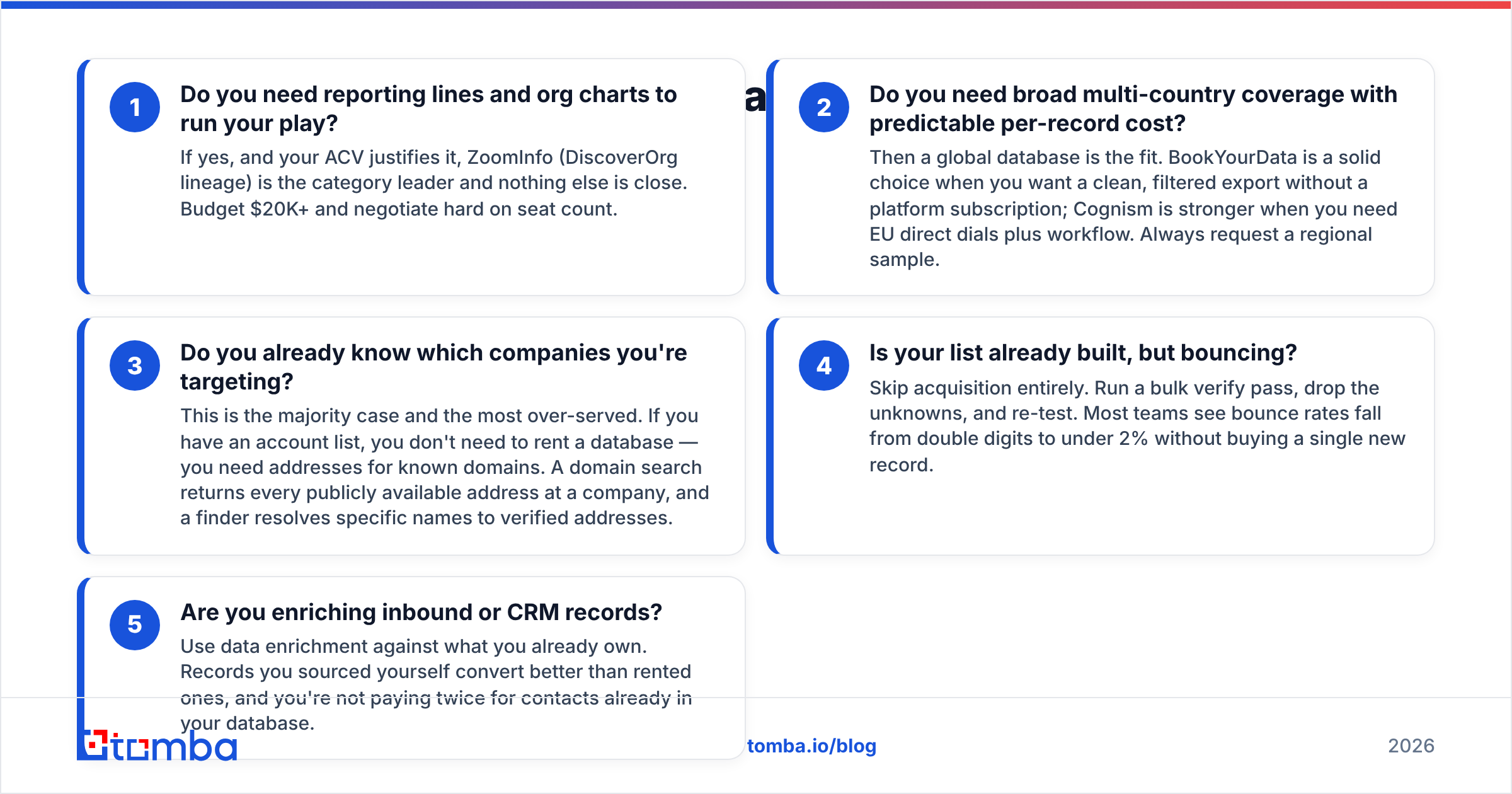
- Do you need reporting lines and org charts to run your play? If yes, and your ACV justifies it, ZoomInfo (DiscoverOrg lineage) is the category leader and nothing else is close. Budget $20K+ and negotiate hard on seat count.
- Do you need broad multi-country coverage with predictable per-record cost? Then a global database is the fit. BookYourData is a solid choice when you want a clean, filtered export without a platform subscription; Cognism is stronger when you need EU direct dials plus workflow. Always request a regional sample.
- Do you already know which companies you're targeting? This is the majority case and the most over-served. If you have an account list, you don't need to rent a database — you need addresses for known domains. A domain search returns every publicly available address at a company, and a finder resolves specific names to verified addresses.
- Is your list already built, but bouncing? Skip acquisition entirely. Run a bulk verify pass, drop the unknowns, and re-test. Most teams see bounce rates fall from double digits to under 2% without buying a single new record.
- Are you enriching inbound or CRM records? Use data enrichment against what you already own. Records you sourced yourself convert better than rented ones, and you're not paying twice for contacts already in your database.
How do the costs compare over a full year?#
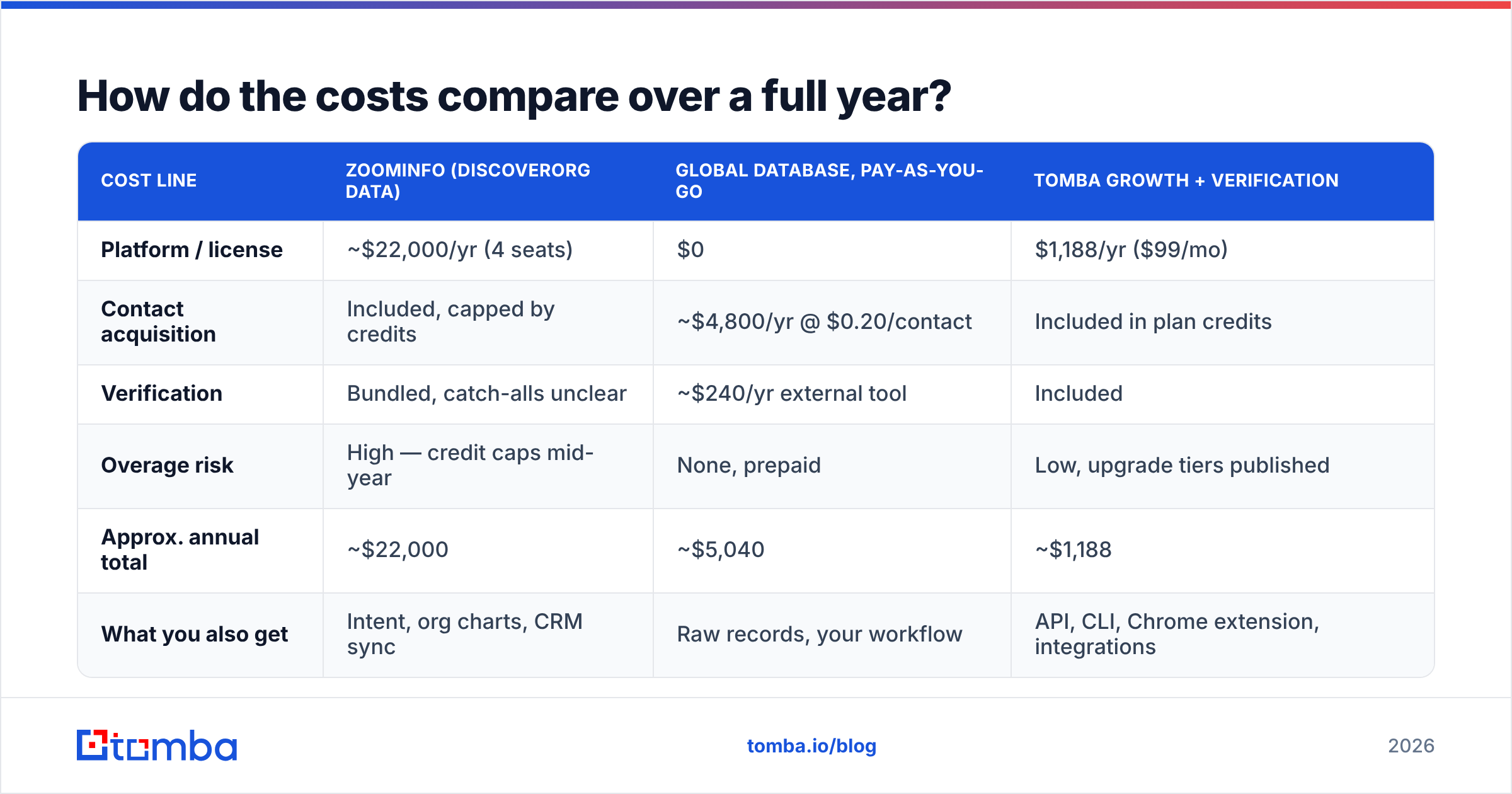
Run the numbers on a concrete scenario: a four-rep team sending 2,000 cold emails per month, needing roughly 24,000 verified contacts per year.
| Cost line | ZoomInfo (DiscoverOrg data) | Global database, pay-as-you-go | Tomba Growth + verification |
|---|---|---|---|
| Platform / license | ~$22,000/yr (4 seats) | $0 | $1,188/yr ($99/mo) |
| Contact acquisition | Included, capped by credits | ~$4,800/yr @ $0.20/contact | Included in plan credits |
| Verification | Bundled, catch-alls unclear | ~$240/yr external tool | Included |
| Overage risk | High — credit caps mid-year | None, prepaid | Low, upgrade tiers published |
| Approx. annual total | ~$22,000 | ~$5,040 | ~$1,188 |
| What you also get | Intent, org charts, CRM sync | Raw records, your workflow | API, CLI, Chrome extension, integrations |
The gap is not a trick — it reflects genuinely different products. ZoomInfo's price includes intent signals, org hierarchy, and enterprise support that the cheaper options don't provide. The question is whether you use those things. Plenty of teams pay for intent data and never build a play around it.
If cost per verified contact is your governing metric, published Tomba pricing sits at the low end of the market because you pay for lookups rather than inventory. If org-chart certainty is your governing metric, you pay ZoomInfo and stop optimizing.
What about accuracy at the moment of send?#
This is where most comparisons stop too early. Whichever source you pick, the record's accuracy at purchase time is not the number that matters. The number that matters is accuracy the second your sequencer hits send.
Three habits close that gap:
- Verify immediately before the first send, not at list-build time. A 90-day-old verification is not a verification. Real-time checks catch the job change that happened last week.
- Segment catch-all domains into their own sequence. Send them at lower volume from a secondary domain so an unexpected bounce cluster doesn't damage your primary email deliverability.
- Track bounce rate by source, not in aggregate. If your global-database segment bounces at 9% and your finder-sourced segment bounces at 1.5%, you now know exactly where to spend next quarter — and no vendor benchmark can tell you that.
Teams that instrument this well often discover their expensive database and their cheap finder produce similar deliverability, and that the real variance is regional. That's an argument for hybrid sourcing: buy depth where depth pays, and resolve everything else on demand.
Frequently asked questions#
Can I still buy DiscoverOrg separately? No. It's part of ZoomInfo SalesOS. Legacy DiscoverOrg contracts migrate to ZoomInfo at renewal.
Is a global database GDPR-compliant? Depends entirely on the vendor. Reputable EU-focused providers document their lawful basis and maintain suppression lists against national do-not-contact registries. Ask for the documentation in writing before you buy — "we're compliant" in a sales call is not a legal position.
Do I need both? Some teams do. A common pattern: ZoomInfo for the top 200 named accounts where org charts drive the play, and a cheaper finder for the long tail. That's a reasonable split if the enterprise tier is genuinely earning its keep on those 200 accounts.
What's the fastest way to test a vendor? Take 100 contacts you already know are correct — your own customers, ideally — and run them through the vendor's tool. Measure match rate and correctness against ground truth. Vendor-published accuracy figures never survive this test intact.
Where should you start?#
If you're comparing DiscoverOrg vs global database options because your current list isn't converting, the odds are the problem isn't coverage. It's that a quarter of your addresses are dead and you can't tell which quarter.
Start there. Point the Tomba Email Finder at your target account domains, verify what comes back, and measure your bounce rate against your current source. The free tier gives you 25 searches a month with no card, and Starter runs $49/mo if you want volume. If the verified addresses outperform your existing list, you've saved yourself a five-figure contract. If they don't, you now have hard evidence that a premium data platform is worth the spend — which is a much better position to negotiate from than a vendor demo.
Related guides#
Ready to find emails that actually work?
Join 150,000+ professionals who stopped guessing and started sending. Free credits on signup — no credit card required.
Get the Tomba newsletter
Practical outbound tactics and product updates — once every two weeks.
About the author