DiscoverOrg vs Goava: Which B2B Data Platform Wins in 2026
DiscoverOrg no longer exists as a standalone product, and Goava only really covers the Nordics. Here is what that means for your 2026 data stack, plus pricing, coverage, and the cheaper middle path.
DiscoverOrg vs Goava is a trick question in 2026. One of the two is gone. DiscoverOrg was folded into ZoomInfo. Goava is still here, but it sells mainly to the Nordics. Here is what each tool does, what it costs, and when you need neither.
TL;DR
- DiscoverOrg vs Goava is really ZoomInfo vs Goava. DiscoverOrg merged with ZoomInfo in 2019. The brand is gone. You cannot buy it today.
- ZoomInfo wins on scale. It holds tens of millions of North American contacts, org charts, and intent data. It also wins on price, in the wrong way. Expect five figures a year and a 12-month deal.
- Goava wins in the Nordics. Pick it if your buyers sit in Sweden, Norway, Denmark, or Finland. It pairs clean registry data with a tool that tells reps who to call next.
- Neither fits if you only need work emails. That job costs $49 a month, not $25,000 a year.
- Most teams should split the stack. Buy the platform that fits your map. Then add an email finder to fill the gaps.
What happened to DiscoverOrg?#
DiscoverOrg bought ZoomInfo in February 2019. It then took the ZoomInfo name. The merged firm went public in 2020. The old DiscoverOrg product was pulled into the ZoomInfo platform. Sales teams used to praise it for hand-checked IT org charts. Search for DiscoverOrg today and you land on zoominfo.com. Every "DiscoverOrg login" query goes there too.
That matters here for three reasons.
- The data story changed. DiscoverOrg put staff on the phone to confirm titles, direct dials, and who reports to whom. ZoomInfo kept some of that. But it leans much harder on bots, on data shared from users' inboxes, and on AI. Coverage went up. Care per record went down.
- The pricing changed. DiscoverOrg sold by dataset: IT, marketing, finance. ZoomInfo sells seats, plus credits, plus modules. The modules are where the bill grows.
- The rival set changed. DiscoverOrg fought other data vendors. ZoomInfo now fights full sales platforms. It also loses small deals to focused tools like Goava, Cognism, or a plain email finder that costs 1% as much.
So treat any page that still sells "DiscoverOrg" as out of date. Read it as ZoomInfo. Then check the price again.

What is Goava and who is it for?#
Goava is a sales intelligence tool from Stockholm. It is built for Nordic B2B teams. Its core loop differs from ZoomInfo's. You do not get a search bar over a global database. Instead, Goava scores accounts against the deals you have already won. It then flags a reason to call today: new funding, new hires, new offices, tech installs, or news.
The data base under it matters most. Nordic states publish rich company records. Annual accounts, board members, staff counts, and org numbers are all public and clean. Goava sits on top of that. This is why its Swedish and Norwegian records tend to beat what a US-first database holds for the same firms.
Where it is thinner:
- Contacts outside the Nordics. If you sell to German mid-market or US SaaS, Goava is the wrong tool.
- Personal emails and mobile numbers. Nordic vendors stay careful under GDPR. They share role-based and company contacts more freely than mobile numbers. That is a legal stance, not a flaw. But it changes what your reps can do with an export.
- Sending email. Goava scores accounts and cleans CRM records. Your sequencer lives somewhere else.
DiscoverOrg vs Goava: how do they compare head to head?#
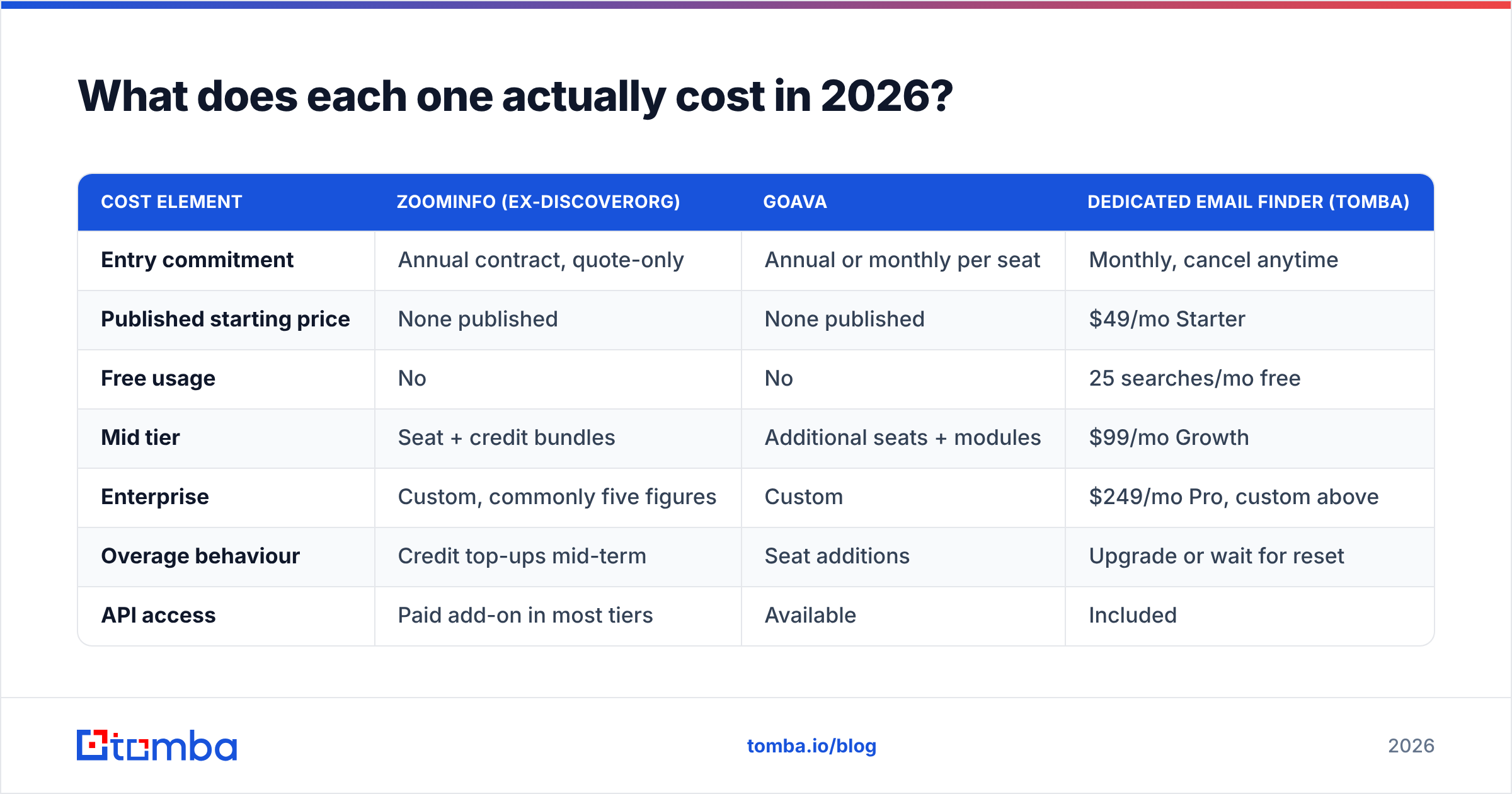
| Dimension | ZoomInfo (ex-DiscoverOrg) | Goava |
|---|---|---|
| Primary geography | North America first, EMEA/APAC secondary | Sweden, Norway, Denmark, Finland |
| Company records | Tens of millions globally | Deep Nordic registry coverage, limited elsewhere |
| Contact records | Very large; work emails + direct dials | Moderate; strongest at company and role level |
| Standout feature | Intent data, org charts, Copilot-style AI plays | Account recommendations from your closed-won profile |
| Signals / triggers | Intent topics, funding, hiring, technographics | Financials, hiring, news, registry changes, tech |
| CRM integrations | Salesforce, HubSpot, Dynamics, Outreach, Salesloft | HubSpot, Salesforce, Upsales, Lime, Pipedrive |
| Contract shape | Annual, seat + credit + module based | Annual or monthly per-seat, far smaller ACV |
| Typical entry cost | Five figures per year in most quoted deals | Low four figures per year per seat range |
| Free tier | No — trial/demo only | No — demo only |
| Best for | Global outbound teams with budget | Nordic account-based teams |
Two notes on that table. First, neither firm posts a price list. Any number you read online, including on G2 threads, is one buyer's story. It is not a rate card. Second, ZoomInfo's cost rides on seat count and credit use. Two firms can buy "the same" product and pay 3x apart.
Which one has better data quality?#
Ask a sharper question. Better at what?
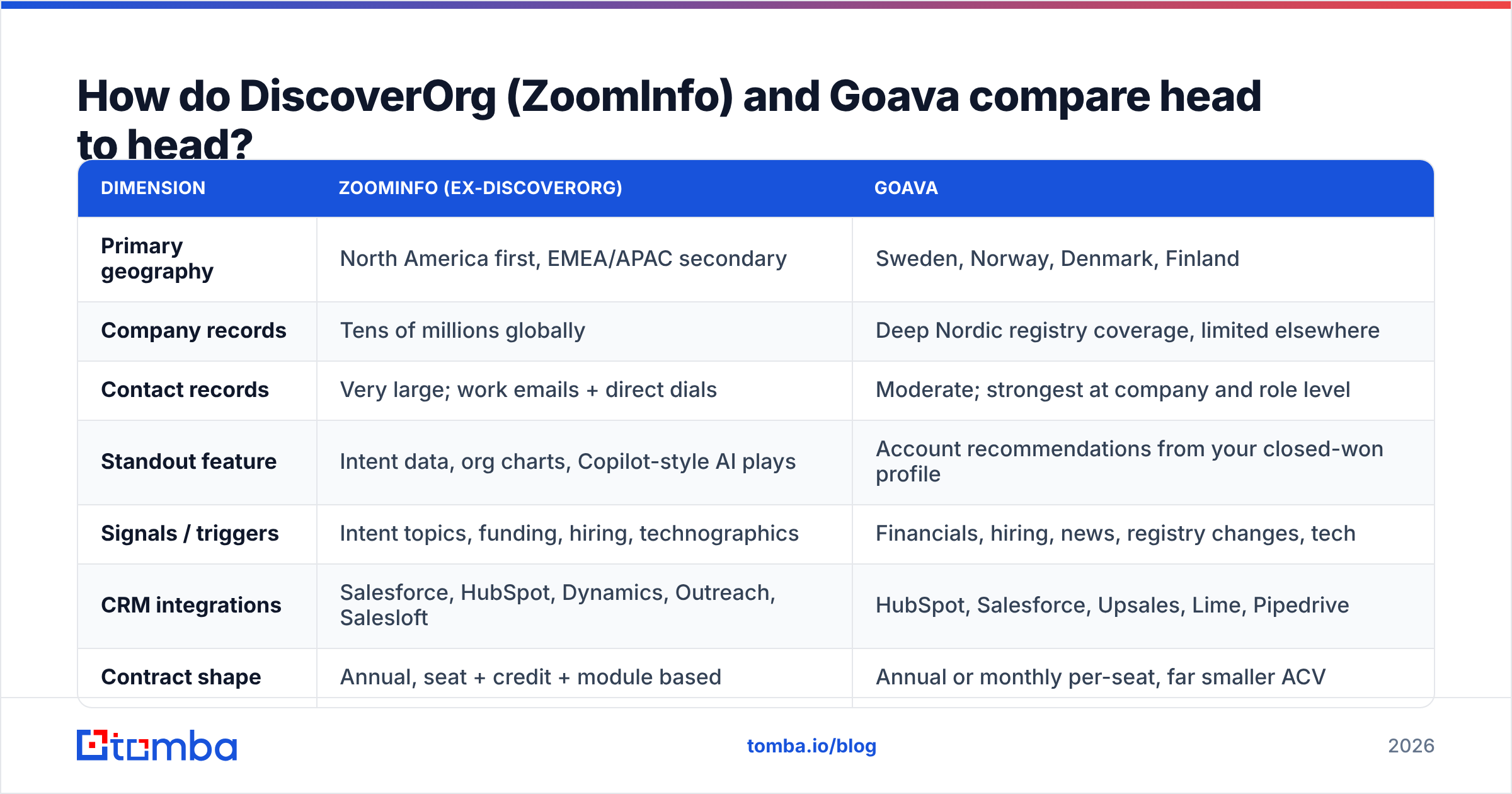
ZoomInfo is better at breadth. Say you need 4,000 VPs of Engineering at US firms with 200 to 2,000 staff who run Kubernetes. ZoomInfo builds that list in minutes. Goava cannot build it at all.
Goava is better at Nordic depth. Say you need every Swedish maker with revenue growth above 15% and a fresh board change. Goava's registry data beats a global tool that treats Sweden as a rounding error.
Both slip on the same point: contact freshness. B2B contact data rots by 25% to 30% a year from job moves alone. That hits every vendor. So the emails you export on Monday are not safe to blast on Friday. Check them first. Good outbound teams run every list through an email verifier before it touches a sending domain. A bounce rate above 3% hurts your sender score, no matter what you paid for the data.
Here is a test plan that beats a sales demo. Any DiscoverOrg vs Goava trial should follow it.
- Pull 200 records from your own ICP. Not the vendor's sample. Not a famous logo set. Your buyers, your map.
- Verify the emails elsewhere. Use a third-party tool. Log the valid, catch-all, and invalid split.
- Call 25 direct dials. Count how many reach the named person. Count the switchboards and dead lines too.
- Check 50 titles against LinkedIn. Old data shows its age here first.
- Run the same pull again 30 days later. Count what changed. Data that never moves is stale data.
- Price the result per usable contact. Not per credit. A $25,000 deal that yields 6,000 good contacts costs $4.17 each.
Most teams skip step 6. That is how a legacy contract survives three renewals.
DiscoverOrg vs Goava: what does each one cost in 2026?#
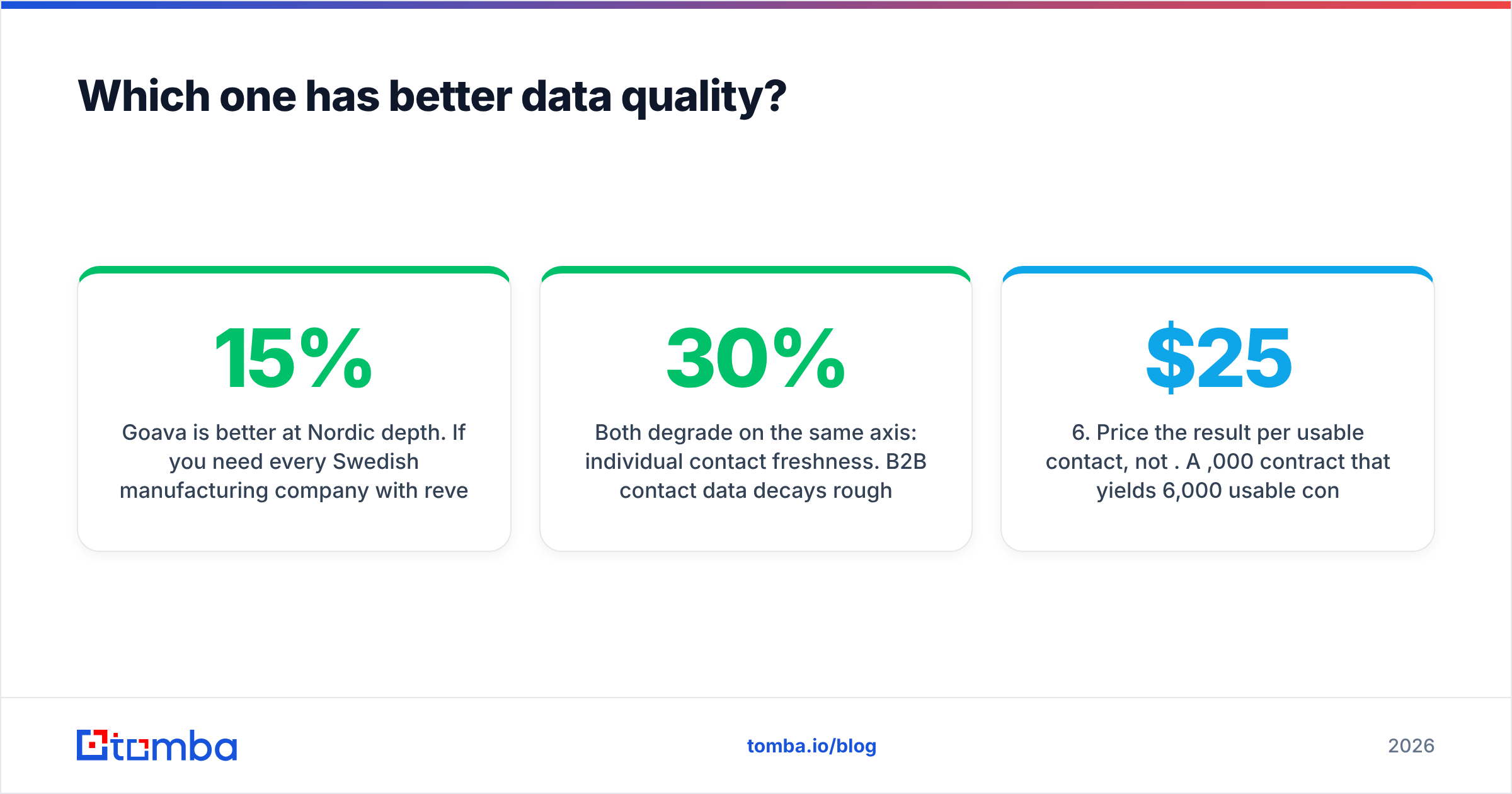
| Cost element | ZoomInfo (ex-DiscoverOrg) | Goava | Dedicated email finder (Tomba) |
|---|---|---|---|
| Entry commitment | Annual contract, quote-only | Annual or monthly per seat | Monthly, cancel anytime |
| Published starting price | None published | None published | $49/mo Starter |
| Free usage | No | No | 25 searches/mo free |
| Mid tier | Seat + credit bundles | Additional seats + modules | $99/mo Growth |
| Enterprise | Custom, commonly five figures | Custom | $249/mo Pro, custom above |
| Overage behaviour | Credit top-ups mid-term | Seat additions | Upgrade or wait for reset |
| API access | Paid add-on in most tiers | Available | Included |
That last column is the whole point of this post. Platform pricing bundles data, workflow, intent, and enrichment into one number. Use all four and the price makes sense. Bought it for one job? Then you pay platform rates for a simple lookup. That one job is often just "get me valid work emails for these 3,000 firms."
Compare it against the full Tomba pricing yourself. Tomba does not replace ZoomInfo's intent graph. It is not meant to. The point is that most teams never use that intent graph.

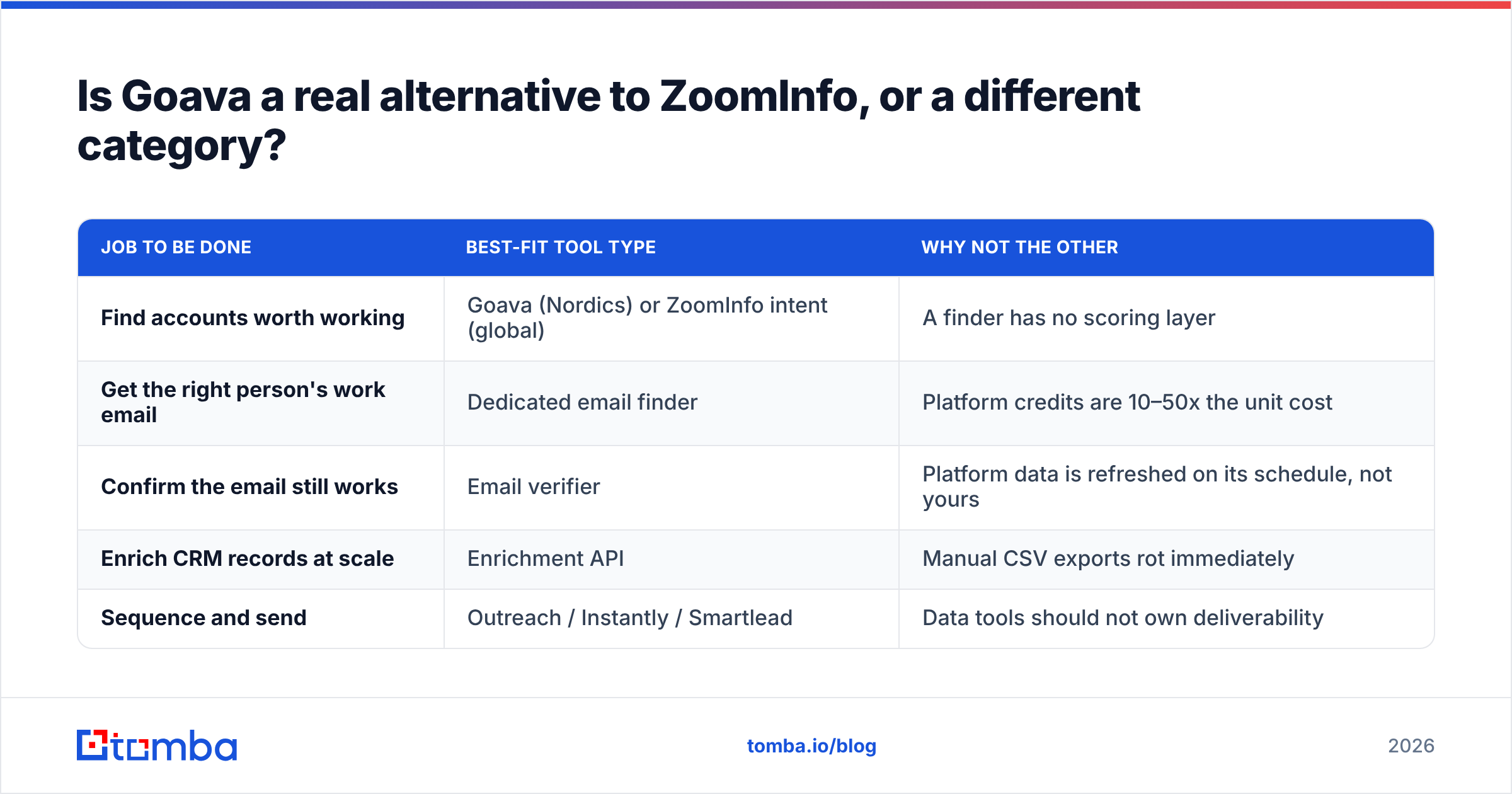
Is Goava a real alternative to ZoomInfo, or a different category?#
It is a different category. The two overlap at the edges.
ZoomInfo is a sales operating system. Data, intent, call analysis, sequencing, enrichment, and workflow sit under one login. You buy it to merge tools.
Goava is a focus layer. It answers one question: which Nordic accounts should I work this week, and why? You buy it to aim.
A Nordic team that moves from ZoomInfo to Goava gets better local data and less global reach. That is the trade you would expect. A US team should stop the trial early. The coverage will not carry you.
The better question is what a hybrid stack looks like. That is where most 2026 teams land.
| Job to be done | Best-fit tool type | Why not the other |
|---|---|---|
| Find accounts worth working | Goava (Nordics) or ZoomInfo intent (global) | A finder has no scoring layer |
| Get the right person's work email | Dedicated email finder | Platform credits are 10–50x the unit cost |
| Confirm the email still works | Email verifier | Platform data is refreshed on its schedule, not yours |
| Enrich CRM records at scale | Enrichment API | Manual CSV exports rot immediately |
| Sequence and send | Outreach / Instantly / Smartlead | Data tools should not own deliverability |
That table is the real advice. Split the work by job. Then you stop paying platform rates for simple lookups. Use a data enrichment API for CRM hygiene. Use a finder for contact discovery. Use a scoring tool to pick accounts. That mix costs less and works better than one vendor doing all three at a C grade.
What should you do if your DiscoverOrg contract is renewing?#
Run these five steps before the renewal call, not during it.
Audit use. Pull credit use by seat for the last 12 months. In most accounts, 20% to 30% of seats use almost nothing. Those seats are your first cut and your best lever.
Split the modules. List what you opened last quarter: search, intent, enrichment, org charts, call analysis. Anything untouched for 90 days gets cut, or gets a written plan to fix that.
Price the swap. A Nordic-only team may do better on Goava for a fraction of the cost. A global team likely cannot leave ZoomInfo. But it can move enrichment and email lookups to a per-use vendor, then drop to a smaller credit tier.
Run a 30-day bake-off. Push the same 500 accounts through both tools. Compare valid-email rate, title accuracy, and cost per usable contact. Bring that sheet to the call.
Watch the auto-renew clause. These deals often renew on their own with a 60 to 90 day notice window. Put the notice date in your calendar the day you sign.
Which one should you pick?#
- Global outbound, budget above $20k a year, real use for intent data: ZoomInfo. Nothing else matches its breadth. The DiscoverOrg heritage still shows in org-chart quality for enterprise IT buyers.
- Nordic, account-based, small or mid-size sales team: Goava. Better local data, better focus, and a much smaller cheque.
- You mainly need verified contacts and clean CRM records: neither. Buy a finder and a verifier. Keep the rest of the money.
- You need all three: go hybrid. A scoring tool for the who. A finder for the how do I reach them. A verifier before every send.
Do not treat the DiscoverOrg vs Goava choice as a coin flip. DiscoverOrg vanished into ZoomInfo on its own schedule. Vendors merge and rebrand like that all the time. Your need for a current, working email address does not change. Own that layer yourself and vendor moves stop being migrations.
Start with the layer that pays for itself fastest. Run your next target list through Tomba's Email Finder. Find work emails by domain, name, or company. Verify them in the same pass. Push them to your CRM through the API. The free tier gives you 25 searches a month, enough to benchmark your current contract. Starter is $49 a month if the numbers hold up. Test it against your ZoomInfo or Goava export on the same 200 accounts. Then decide what you actually need to renew.
Related guides#
Ready to find emails that actually work?
Join 150,000+ professionals who stopped guessing and started sending. Free credits on signup — no credit card required.
Get the Tomba newsletter
Practical outbound tactics and product updates — once every two weeks.
About the author