DiscoverOrg vs Grata: Which B2B Data Platform Wins in 2026?
DiscoverOrg is now ZoomInfo. Grata now belongs to Datasite. Here's what each platform actually does in 2026, what it costs, and which one deserves your data budget.
TL;DR
- DiscoverOrg no longer exists as a standalone product. It merged with ZoomInfo in 2019, and the brand was folded into ZoomInfo's platform — if a rep pitches you "DiscoverOrg," you are buying ZoomInfo.
- Grata is not a sales-contact database. It's a private-company search engine built for private equity, M&A, and corp-dev teams, and it was acquired by Datasite in late 2024.
- The two barely overlap. DiscoverOrg/ZoomInfo answers "who do I email at this account?" Grata answers "which companies like this one exist at all?"
- Both are annual-contract, quote-only, five-figure purchases. Neither publishes a price. Expect $15K–$40K+ per year depending on seats and data credits.
- If your actual need is verified work emails for a list of companies you already know, neither platform is the efficient buy. A dedicated email finder does that job at a fraction of the cost.
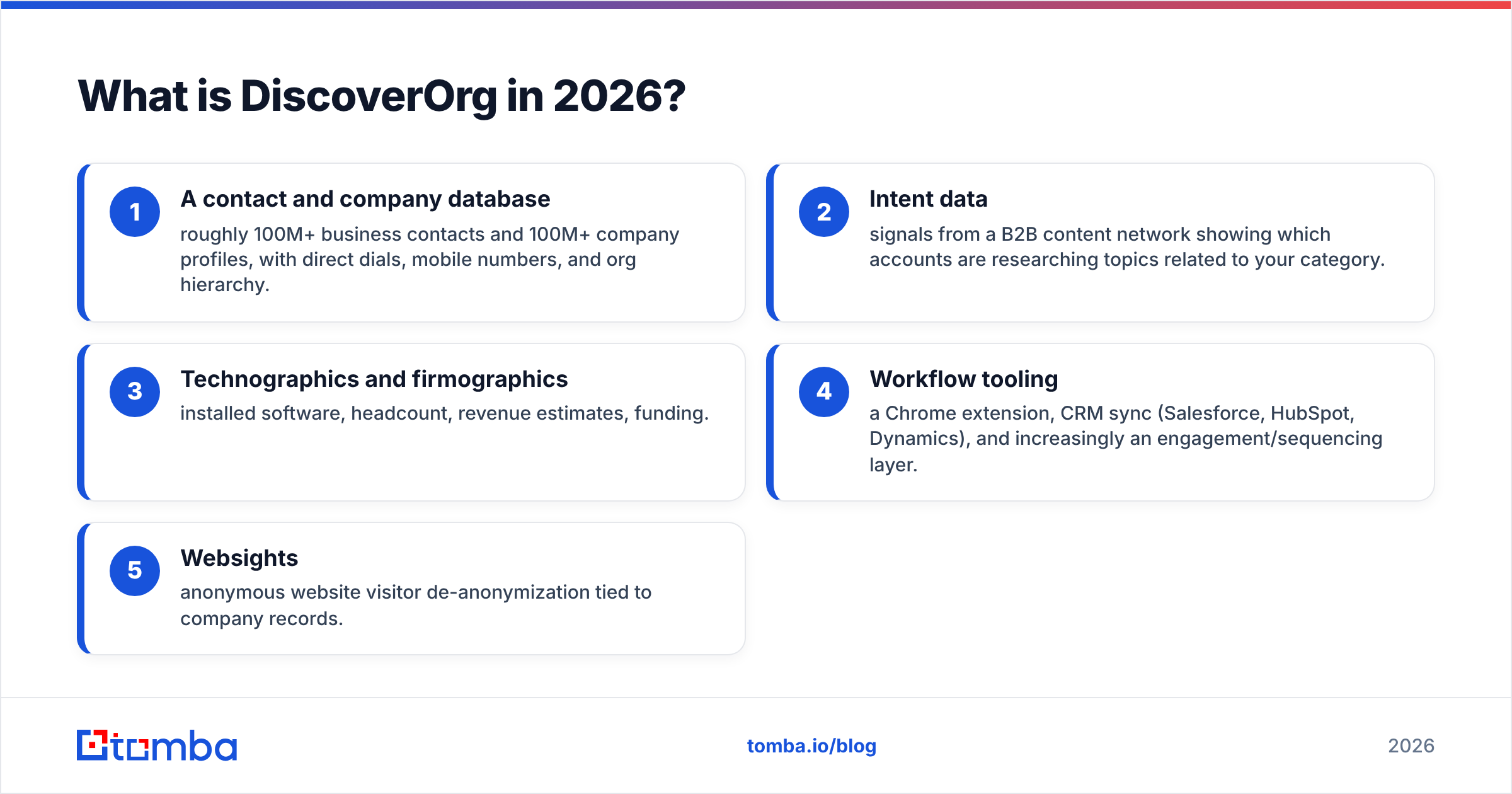
What is DiscoverOrg in 2026?#
DiscoverOrg is a legacy brand name. The company merged with ZoomInfo in February 2019, and by 2020 the combined entity was operating entirely under the ZoomInfo name — it went public on Nasdaq as ZI. The old discoverorg.com domain redirects to zoominfo.com.
What survived the merger is the philosophy. DiscoverOrg's original pitch was human-verified org charts: real researchers calling into IT, finance, and marketing departments to map reporting structures, tech stacks, and budgets. ZoomInfo's pitch was scale — hundreds of millions of contact records gathered through a contributory network and web crawling. The merged product tries to be both: broad coverage with a verification layer on top.
In practice, what you buy today is:
- A contact and company database — roughly 100M+ business contacts and 100M+ company profiles, with direct dials, mobile numbers, and org hierarchy.
- Intent data — signals from a B2B content network showing which accounts are researching topics related to your category.
- Technographics and firmographics — installed software, headcount, revenue estimates, funding.
- Workflow tooling — a Chrome extension, CRM sync (Salesforce, HubSpot, Dynamics), and increasingly an engagement/sequencing layer.
- Websights — anonymous website visitor de-anonymization tied to company records.
The strength is depth on North American mid-market and enterprise accounts, especially in tech. The weakness is that you pay enterprise pricing for a full platform even when your team only uses the contact lookup.
What is Grata, and who is it for?#
Grata is a private-company intelligence platform. It indexes millions of private businesses — the ones that don't file with the SEC, don't appear in Crunchbase with a funding round, and don't have an analyst covering them — and makes them searchable by what they actually do.
The core interaction is different from every sales database. Instead of filtering by SIC code and headcount, you describe a business in natural language ("companies that install commercial HVAC systems for data centers in the Southeast") and Grata's models surface matches by reading websites, job posts, and public filings. It also does "similar company" search: feed it one target, get a ranked list of comparable businesses.
Grata's buyers are almost never SDR teams. They are:
- Private equity associates building thesis lists and running proprietary deal sourcing
- M&A advisors and investment banks building buyer lists and comps
- Corporate development teams scanning for tuck-in acquisitions
- Some GTM teams at companies selling into fragmented, hard-to-segment verticals
Datasite — the virtual data room provider used across M&A — acquired Grata in November 2024. That confirmed what the product roadmap already implied: Grata is deal-flow infrastructure, not a prospecting tool. You can find contacts inside it, but contact coverage is thinner and less refreshed than a dedicated sales database, because that isn't the point.
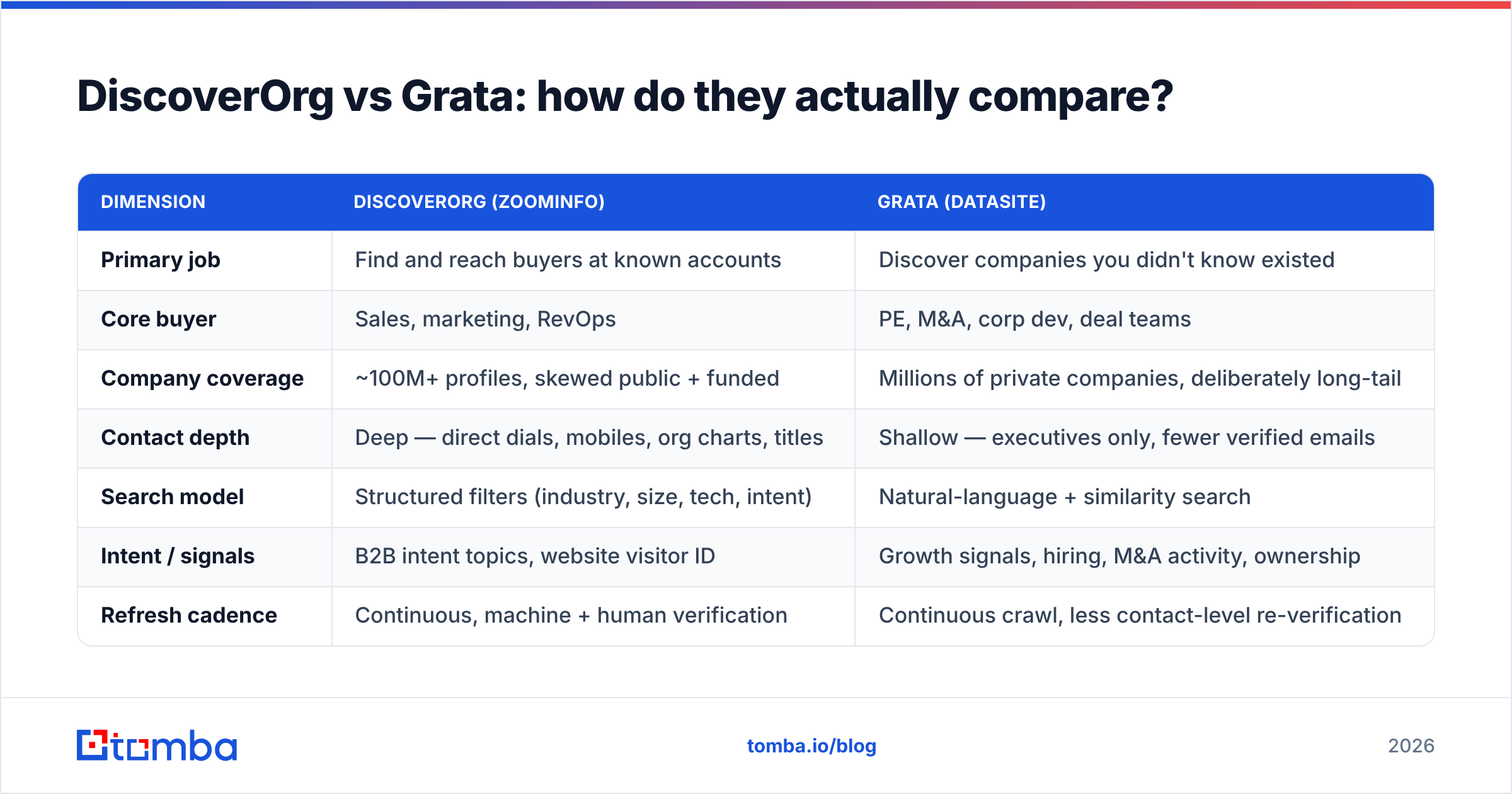
DiscoverOrg vs Grata: how do they actually compare?#
| Dimension | DiscoverOrg (ZoomInfo) | Grata (Datasite) |
|---|---|---|
| Primary job | Find and reach buyers at known accounts | Discover companies you didn't know existed |
| Core buyer | Sales, marketing, RevOps | PE, M&A, corp dev, deal teams |
| Company coverage | ~100M+ profiles, skewed public + funded | Millions of private companies, deliberately long-tail |
| Contact depth | Deep — direct dials, mobiles, org charts, titles | Shallow — executives only, fewer verified emails |
| Search model | Structured filters (industry, size, tech, intent) | Natural-language + similarity search |
| Intent / signals | B2B intent topics, website visitor ID | Growth signals, hiring, M&A activity, ownership |
| Refresh cadence | Continuous, machine + human verification | Continuous crawl, less contact-level re-verification |
| CRM integrations | Salesforce, HubSpot, Dynamics, Outreach, Salesloft | Salesforce, HubSpot, DealCloud, Affinity |
| Pricing model | Annual contract, seats + credits, quote only | Annual contract, seats, quote only |
| Typical entry cost | ~$15K–$25K/yr, commonly higher | ~$20K–$30K/yr reported by users |
| Free tier | No (limited trial) | No (demo only) |
| Contract flexibility | Rigid — multi-year, auto-renew common | Rigid — annual minimum |
The table makes the honest conclusion obvious: this is not a head-to-head. It's two tools that happen to both be called "B2B data platforms." Choosing between them is like choosing between a phone book and a metal detector. The right question is which job you're hiring for.
Which one should you buy for outbound sales?#
If you run outbound, DiscoverOrg/ZoomInfo is the closer fit — with three caveats worth pricing in.
1. You're buying a suite, not a lookup. ZoomInfo's list price assumes you'll use intent, Websights, and the engagement layer. If your reps only pull emails and phone numbers, you're paying for four modules to use one. Teams routinely discover in year two that seat utilization is under 50%.
2. Credit models bite. Export credits are metered, and bulk enrichment burns them fast. The "unlimited" feel of the UI does not survive contact with a 20,000-row list. Read the credit schedule in the order form, not the sales deck.
3. Email accuracy is good, not perfect. Independent G2 reviews consistently praise coverage and criticize staleness on records that haven't been touched in a while. Any large export should still pass through an email verifier before it hits your sending infrastructure — bounce rates above 3% start damaging sender reputation regardless of who sold you the list.
Grata for outbound only makes sense in one scenario: you sell into a fragmented, poorly-classified market where standard NAICS filters return garbage. Selling compliance software to independent pharmacy chains, or equipment to regional food processors, is exactly that. Grata will build a better company list than ZoomInfo will. You'll then need a separate way to get contacts at those companies.
Which one should you buy for deal sourcing?#
Grata, without much debate.
ZoomInfo's index is optimized for companies that buy software and have identifiable buying committees. Grata's index is optimized for companies that exist — including the 40-employee family-owned manufacturer with a 2011-era website that no sales database bothers to profile. For a search fund or a lower-middle-market PE firm, that long tail is the entire deal universe.
Grata's differentiators for deal teams:
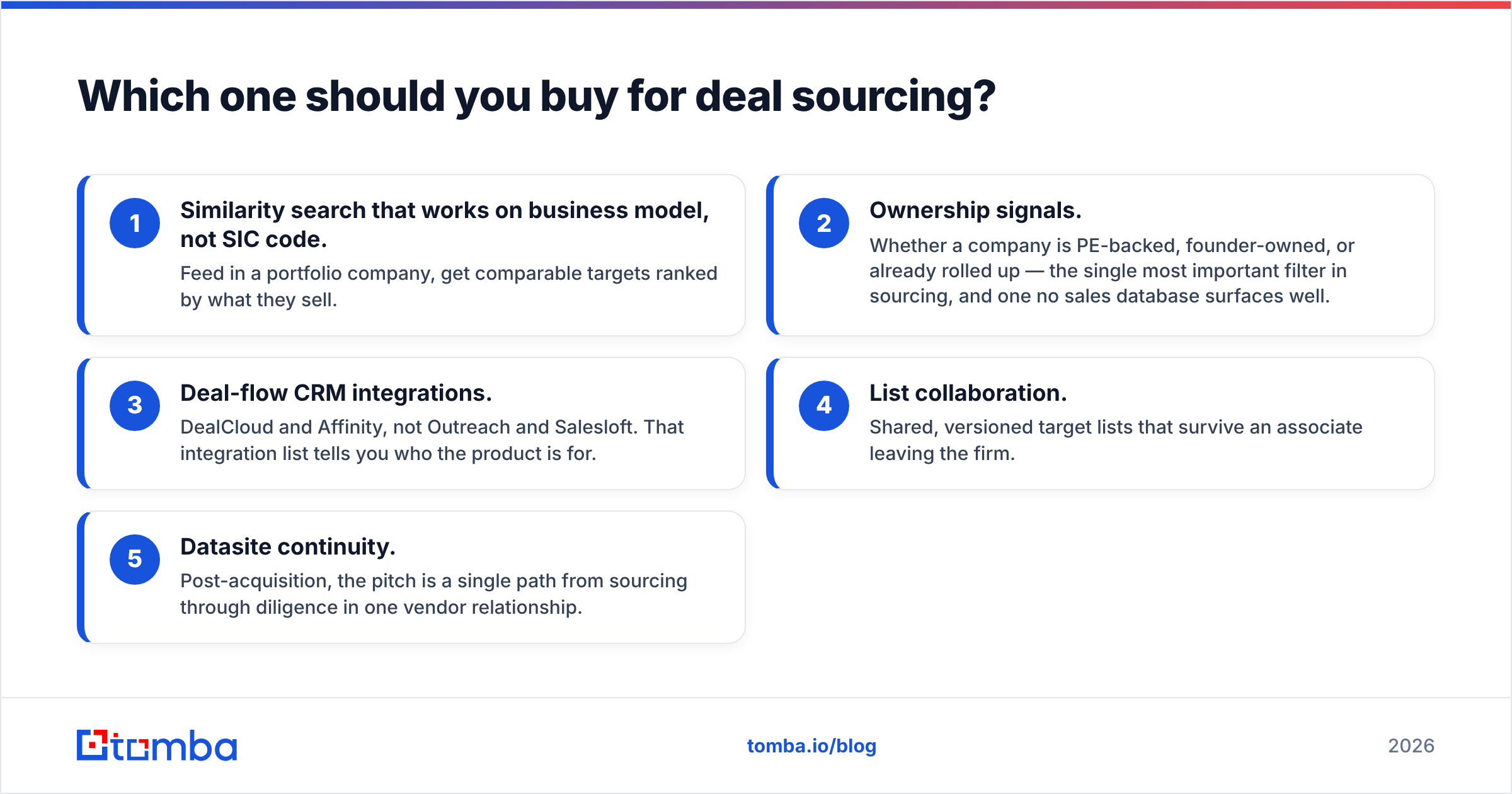
- Similarity search that works on business model, not SIC code. Feed in a portfolio company, get comparable targets ranked by what they sell.
- Ownership signals. Whether a company is PE-backed, founder-owned, or already rolled up — the single most important filter in sourcing, and one no sales database surfaces well.
- Deal-flow CRM integrations. DealCloud and Affinity, not Outreach and Salesloft. That integration list tells you who the product is for.
- List collaboration. Shared, versioned target lists that survive an associate leaving the firm.
- Datasite continuity. Post-acquisition, the pitch is a single path from sourcing through diligence in one vendor relationship.
The trade-off: once you have your target list, you still need to reach the owner. Grata will often give you a name and a LinkedIn profile. Getting a deliverable email at a company with no public directory is a different problem — one solved by pattern-based lookup and verification, not by a bigger database.

What do DiscoverOrg and Grata actually cost?#
Neither publishes pricing, which is the first thing to factor into your evaluation. Quote-only pricing means the number is a function of how much your company appears to be able to pay, not what the data costs to produce.
Publicly reported ranges from buyers and review sites:
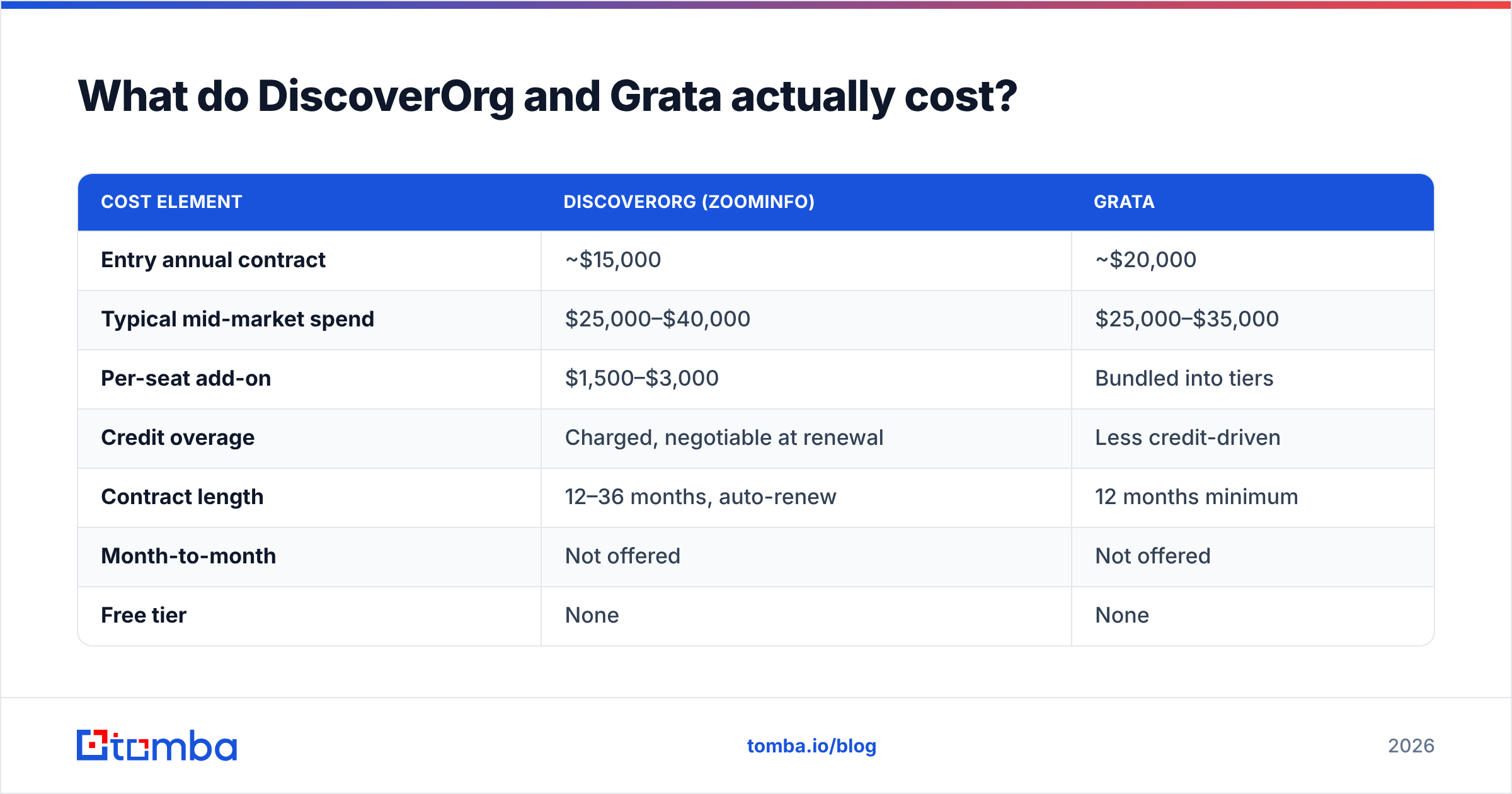
| Cost element | DiscoverOrg (ZoomInfo) | Grata |
|---|---|---|
| Entry annual contract | ~$15,000 | ~$20,000 |
| Typical mid-market spend | $25,000–$40,000 | $25,000–$35,000 |
| Per-seat add-on | $1,500–$3,000 | Bundled into tiers |
| Credit overage | Charged, negotiable at renewal | Less credit-driven |
| Contract length | 12–36 months, auto-renew | 12 months minimum |
| Month-to-month | Not offered | Not offered |
| Free tier | None | None |
Compare that to a per-lookup model. Tomba pricing starts free at 25 searches a month, then $49/mo for Starter, $99/mo for Growth, and $249/mo for Pro — no annual lock-in, no seat minimum, no procurement cycle. A full year on the Growth plan costs less than the first month of a typical ZoomInfo contract.
That comparison is not apples-to-apples, and pretending otherwise would be dishonest. ZoomInfo gives you intent data, org charts, and direct dials that a lookup tool doesn't. Grata gives you a discovery engine that nothing else replicates. But most teams evaluating these platforms have a narrower job than the platforms are priced for.
When is neither DiscoverOrg nor Grata the right answer?#
Run this honest diagnostic before you take the demo:
- You already know which companies to target. You have an ICP, a list of domains, maybe a scraped conference attendee list. You don't need discovery — you need contacts. A domain search returns every findable email at a company plus the pattern the company uses, and you skip the five-figure contract entirely.
- Your list is under 5,000 contacts a month. Enterprise credit models are built to make small volumes uneconomical. Per-lookup pricing wins decisively below that threshold.
- You need EU or APAC coverage. Both platforms are strongest in North America. Verify sample coverage in your actual territory before signing — ask for a 50-row test file from your exact ICP, not a curated demo list.
- Deliverability is your bottleneck, not volume. If you're bouncing at 6%, buying a bigger database makes it worse. Fix verification first with a catch-all verifier and a clean sending setup.
- You need programmatic access. Enterprise API access is usually a paid add-on with rate limits negotiated per contract. A straightforward email finder API with documented pricing is faster to ship against.
The pattern most efficient GTM teams land on: use a discovery tool only when you genuinely don't know your universe, then handle contact acquisition and verification with a cheaper, faster, purpose-built layer. Paying enterprise platform rates for contact lookup is the single most common line item in an inflated data budget.
What's the verdict on DiscoverOrg vs Grata?#
Buy ZoomInfo (formerly DiscoverOrg) if you have a funded sales team of 10+ reps working North American mid-market accounts, you'll actually use intent and website visitor data, and your finance team is comfortable with a multi-year commitment. It remains the deepest contact dataset in the category.
Buy Grata if you source deals — PE, M&A advisory, corp dev — or if you sell into a vertical so fragmented that standard industry codes are useless. Nothing else finds the long tail of private companies as well, and the Datasite acquisition makes it a safer long-term bet, not a riskier one.
Buy neither if what you actually need is verified work emails for companies you can already name. That's the majority of teams that end up on these demo calls, and it's the cheapest problem in the stack to solve well.
Whichever platform you land on, your data still has to be deliverable on the day you send. Run your target domains through Tomba's Email Finder — free for your first 25 searches, $49/mo after that — and see how much of your list you can fill and verify before you ever sign an annual contract. If the answer is "most of it," you just saved a five-figure line item.
Related guides#
Ready to find emails that actually work?
Join 150,000+ professionals who stopped guessing and started sending. Free credits on signup — no credit card required.
Get the Tomba newsletter
Practical outbound tactics and product updates — once every two weeks.
About the author