DiscoverOrg vs Istariai: Which B2B Data Tool Wins in 2026?
DiscoverOrg is now ZoomInfo. Istari.ai mines company websites with AI instead of selling contact lists. Here is how the two actually compare in 2026 — and which one belongs in your GTM stack.
DiscoverOrg vs Istariai (Istari.ai) is not a fair fight — the two tools do different jobs. One sells contact records. The other reads company websites and scores them. This guide covers what each one does, what it costs, and which one your team needs in 2026.
TL;DR
- DiscoverOrg no longer exists as a standalone product. It merged with ZoomInfo in 2019, and the brand was retired. If you shop for "DiscoverOrg" today, you are shopping for ZoomInfo.
- Istari.ai is not a contact database. It is an AI web-mining platform. It reads company websites at scale and turns them into firmographic and technology signals. No direct dials, no verified inbox addresses.
- They are not really competitors. One answers who do I call. The other answers which companies look like they need us right now. Teams that pit them head-to-head usually buy the wrong thing.
On price and fit:
- Both are enterprise-priced and quote-gated. Neither publishes a price page. Both push annual contracts. Both are a heavy lift for a team under 20 reps.
- The cheapest path for most teams: use a signal source to build the account list. Then use a per-contact tool like the Tomba Email Finder to get the actual addresses. That beats paying five figures for a bundle you use 20% of.
What happened to DiscoverOrg?#
DiscoverOrg bought ZoomInfo in February 2019 and kept the ZoomInfo name. The discoverorg.com domain now redirects to zoominfo.com. The org-chart data that made DiscoverOrg famous now sits inside ZoomInfo's platform, as part of its contact and org-hierarchy layer.
That history matters, because the two pitches were never the same. DiscoverOrg sold human-verified org charts for IT, marketing, finance, and HR teams. Researchers called companies to confirm who reported to whom, on a set refresh cycle. ZoomInfo's pitch was machine scale: more contacts, refreshed more often, at a lower cost per record.
The merged product leans toward the ZoomInfo model. You still get org hierarchy and direct dials. But the "we called this person to confirm" promise is thinner than it was in 2016. If someone on your team remembers DiscoverOrg fondly from an old job, check what the data holds now before you sign. The SKU changed, and so did the refresh method.
What is Istari.ai and why is it different?#
Istari.ai is a German company data platform, spun out of research work in Mannheim. It takes a different route. Instead of buying, brokering, or crowdsourcing contact records, it crawls and reads company websites with NLP models, then turns that unstructured text into structured indicators.
Practically, that means Istari can tell you things a contact database structurally cannot:
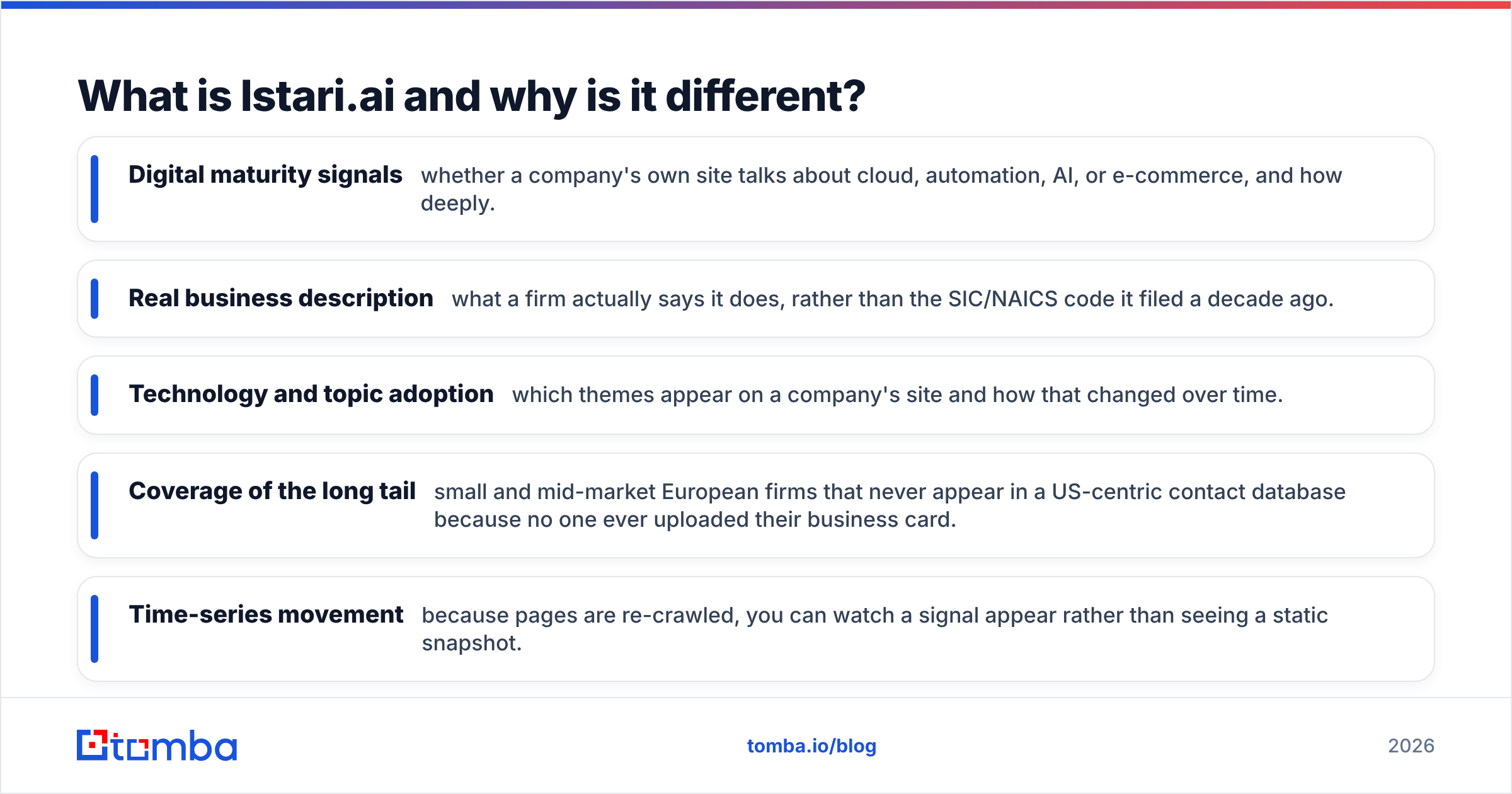
- Digital maturity signals — whether a company's own site talks about cloud, automation, AI, or e-commerce, and how deeply.
- Real business description — what a firm actually says it does, rather than the SIC/NAICS code it filed a decade ago.
- Technology and topic adoption — which themes appear on a company's site, and how that changed over time.
- Coverage of the long tail — small and mid-market European firms that never show up in a US-centric contact database.
- Time-series movement — pages are re-crawled, so you can watch a signal appear instead of reading a static snapshot.
What you do not get is a person. Istari.ai can tell you that a 60-person industrial supplier in Baden-Württemberg started publishing about supply-chain automation last quarter. It will not tell you that the person to email is m.becker@ at that domain. You need a separate layer for that, and that is where an email finder or your own enrichment step comes in.

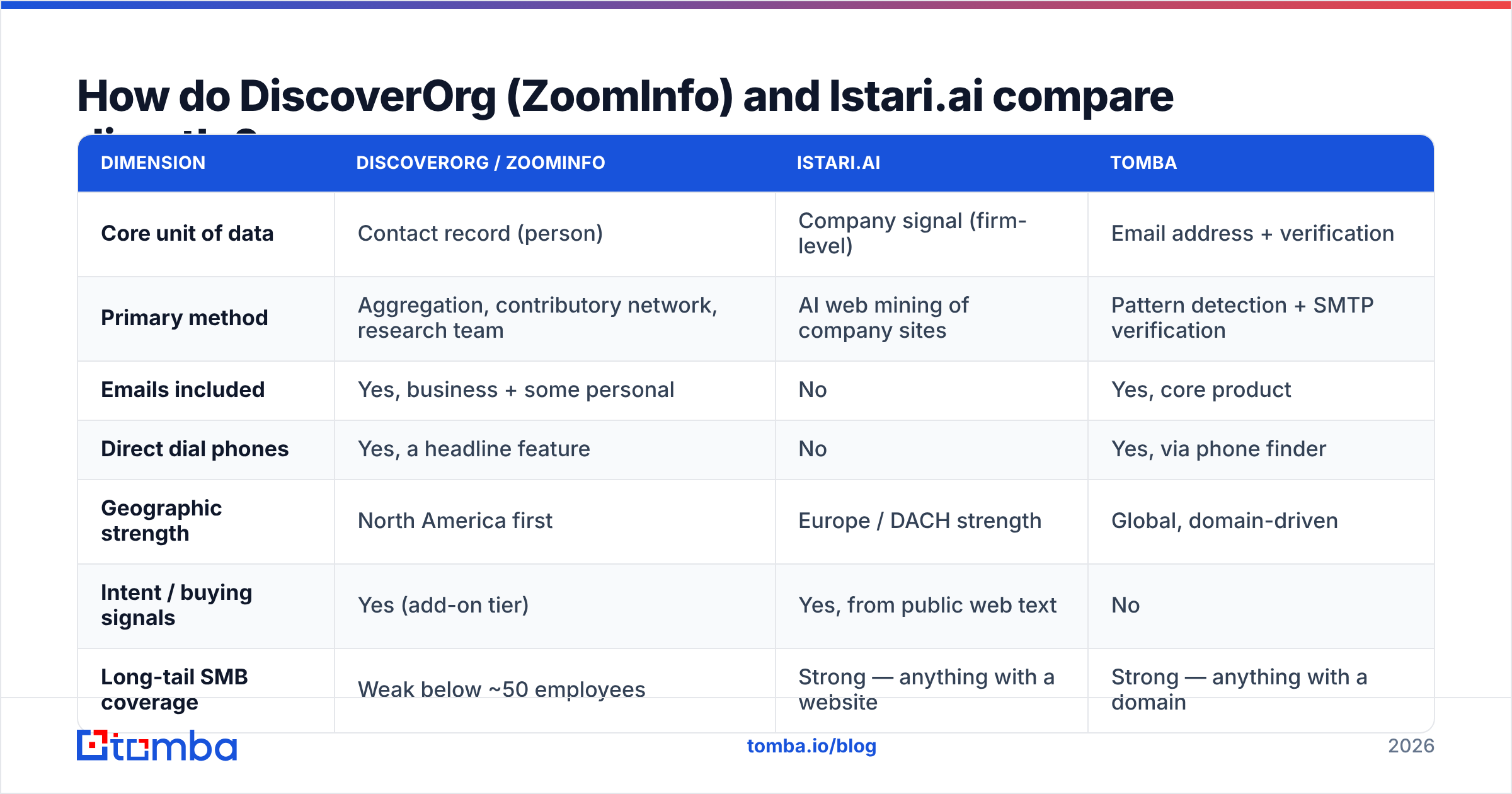
DiscoverOrg vs Istariai: how do the two compare directly?#
| Dimension | DiscoverOrg / ZoomInfo | Istari.ai | Tomba |
|---|---|---|---|
| Core unit of data | Contact record (person) | Company signal (firm-level) | Email address + verification |
| Primary method | Aggregation, contributory network, research team | AI web mining of company sites | Pattern detection + SMTP verification |
| Emails included | Yes, business + some personal | No | Yes, core product |
| Direct dial phones | Yes, a headline feature | No | Yes, via phone finder |
| Geographic strength | North America first | Europe / DACH strength | Global, domain-driven |
| Intent / buying signals | Yes (add-on tier) | Yes, from public web text | No |
| Long-tail SMB coverage | Weak below ~50 employees | Strong — anything with a website | Strong — anything with a domain |
| Pricing transparency | None public, annual contract | None public, annual contract | Public: free tier, $49, $99, $249 |
| Realistic entry cost | Five figures/year (commonly reported) | Quote-based, enterprise | $0–$49/month |
| Time to first value | Weeks (onboarding, seats) | Weeks (scoping, integration) | Minutes (self-serve) |
| Best for | Enterprise AE teams working NA mid-market+ | RevOps / market intelligence / EU manufacturing ICPs | Any team that needs deliverable addresses |
Neither vendor publishes pricing. Treat any number you read online — even on review sites — as a data point, not a quote. Check current buyer reports on G2 before you walk into a negotiation. Then ask both vendors to define, in writing, what counts as a "credit," an "export," and a "seat." Those three definitions are where enterprise data contracts get expensive.
Which one is more accurate?#
Wrong question. They measure different things, so one accuracy number cannot cover both.
For ZoomInfo (DiscoverOrg lineage), accuracy means four things: is this person still at this company, is the title right, does the email deliver, and does the phone ring the right desk? The failure mode is decay. B2B contact data goes stale at roughly 25–30% per year in most published estimates, and job-change churn since 2022 has pushed that higher in tech.
Even a well-run database is fighting entropy. That is why every serious sender runs an email verifier pass before a campaign, no matter where the list came from.
For Istari.ai, accuracy means something else: did the model read the website correctly, and does the site reflect reality? A company with a neglected website looks less digitally mature than it is. A company with a marketing-heavy site looks more advanced than it is. Web mining measures stated activity, not audited activity.
So never treat an Istari signal as a qualified lead on its own. And never treat a ZoomInfo record as verified just because it was expensive. Score with signals, then verify before you send. Those are two different steps. Skipping the second is the most common reason a domain lands in spam folders, which is why email deliverability discipline sits downstream of both tools.
What does each one actually cost you?#
Neither vendor lists prices, but the shape of the cost is predictable.
- Seat licenses — ZoomInfo-style contracts price per seat, and seats are the number most likely to grow at renewal. If 12 people need access, price 12 seats. Three shared logins usually breaks the contract anyway.
- Credit ceilings — exports are metered. Ask what happens when you hit the ceiling in month seven: overage billing, hard stop, or a mid-term upsell call.
- Annual commitment — both platforms run on annual terms. Monthly cancellation is rarely on the table, so a bad fit costs you a full year.
- Integration and onboarding — signal data usually needs someone in RevOps to build the scoring logic. That is internal engineering time, and it is not free.
- The second tool you buy anyway — signal platforms need a contact layer, and contact platforms need a verification layer. Budget for the gap before you sign, not after.
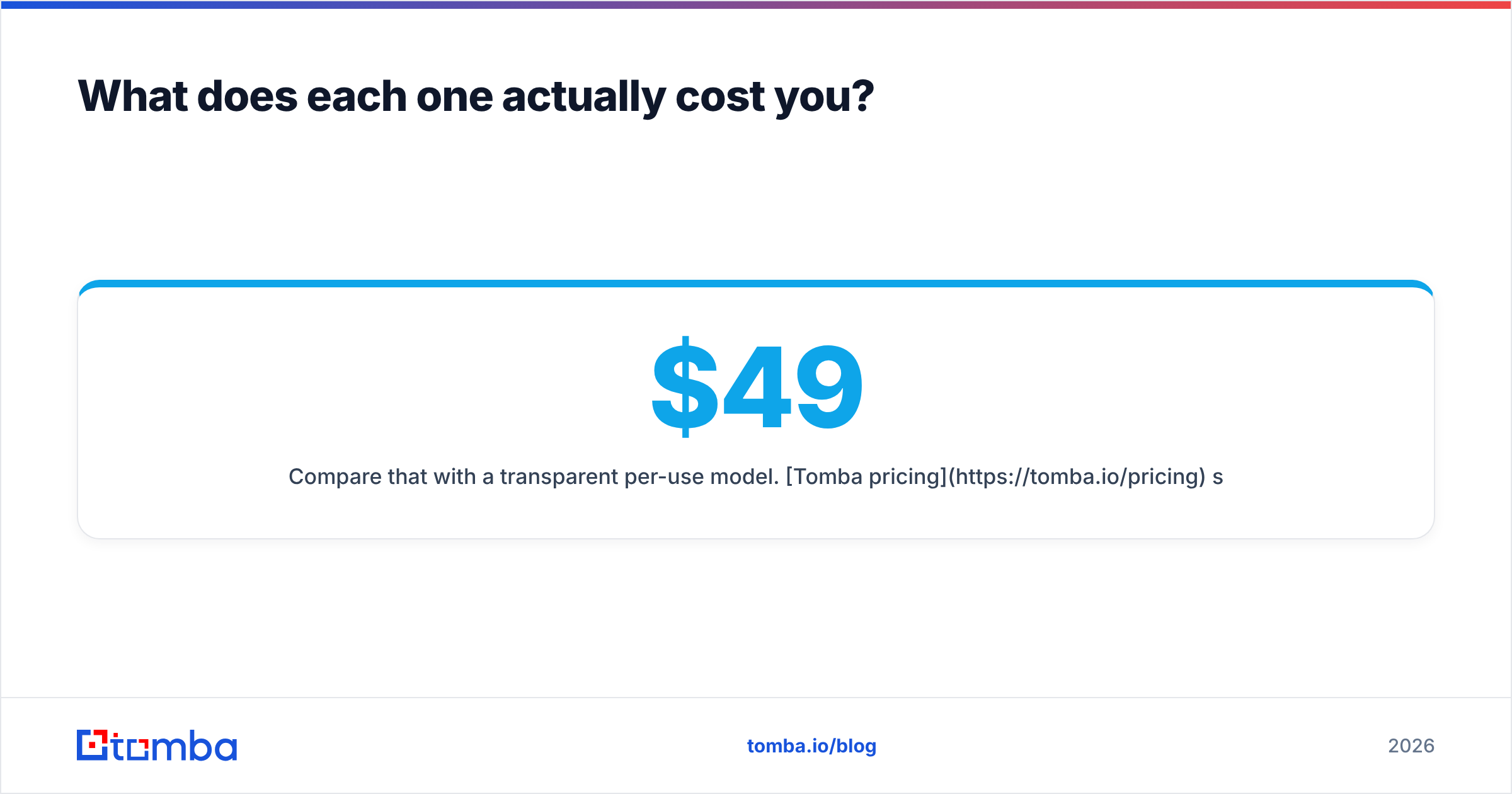
Compare that with a transparent per-use model. Tomba pricing starts with a free tier at 25 searches per month, then Starter at $49/month, Growth at $99/month, and Pro at $249/month. Enterprise is quoted for volume.
It is a narrower product, and it does not pretend to be a full GTM intelligence suite. But you can test it this afternoon and cancel next month if it does not fit. For a team of five, the whole annual Tomba spend is often less than one enterprise seat.
Is Istari.ai a real DiscoverOrg alternative?#
Only for a specific job. Here is the honest split:
Choose the ZoomInfo/DiscoverOrg lineage when:
- Your ICP is North American mid-market or enterprise, and you need org charts.
- Direct-dial phone numbers really drive your pipeline, in a live cold-calling motion.
- You have the budget and the headcount to consume a platform contract.
- Your reps need one interface rather than a stitched-together stack.
Choose Istari.ai when:
- Your ICP is European, industrial, or long-tail SMB — segments where US-first databases go thin.
- You are doing market sizing, TAM analysis, or account scoring rather than day-one outbound.
- You care about change over time more than a static list.
- You have a RevOps function that can turn signals into a prioritized account list.
Choose neither (yet) when:
- You are under ~20 reps and still validating your ICP. Both contracts will outlast your assumptions.
- You already know your target accounts and just need the addresses. That is a domain search problem, not a data-platform problem.
- Your bottleneck is reply rate, not list size. Buying more contacts to fix a copy problem is the most expensive mistake in outbound.
How do you combine signals and contacts without paying twice?#
The stack that works for most mid-market teams has three layers. Only one of them needs to be enterprise-priced.
Layer 1 — Account selection. Decide which companies matter. This is where a web-mining source like Istari.ai earns its keep. You can also approximate it cheaply with public data: job postings, funding news, tech-stack detection, and site changes. Whatever the source, the output is a list of domains.
Layer 2 — Contact resolution. Turn domains into people. Run the domain list through a finder to get named contacts and pattern-matched addresses, then push the result into your CRM. A bulk email finder handles this in batch, and the Tomba API handles it inside your own pipeline if RevOps prefers to own the flow.
Layer 3 — Verification and hygiene. Verify everything before it touches a sending domain, including addresses that came from an expensive database. Catch-all domains need special handling. A standard SMTP check returns "accept-all" and tells you nothing, which is why a dedicated catch-all verifier exists as a separate step.
Notice what this does to your budget. You buy expensive data only for the layer where expensive data is genuinely differentiated, and you commodity-price the rest. Enterprise platforms make their margin by bundling all three layers and charging platform prices for the commodity parts.
What should you ask on the demo call?#
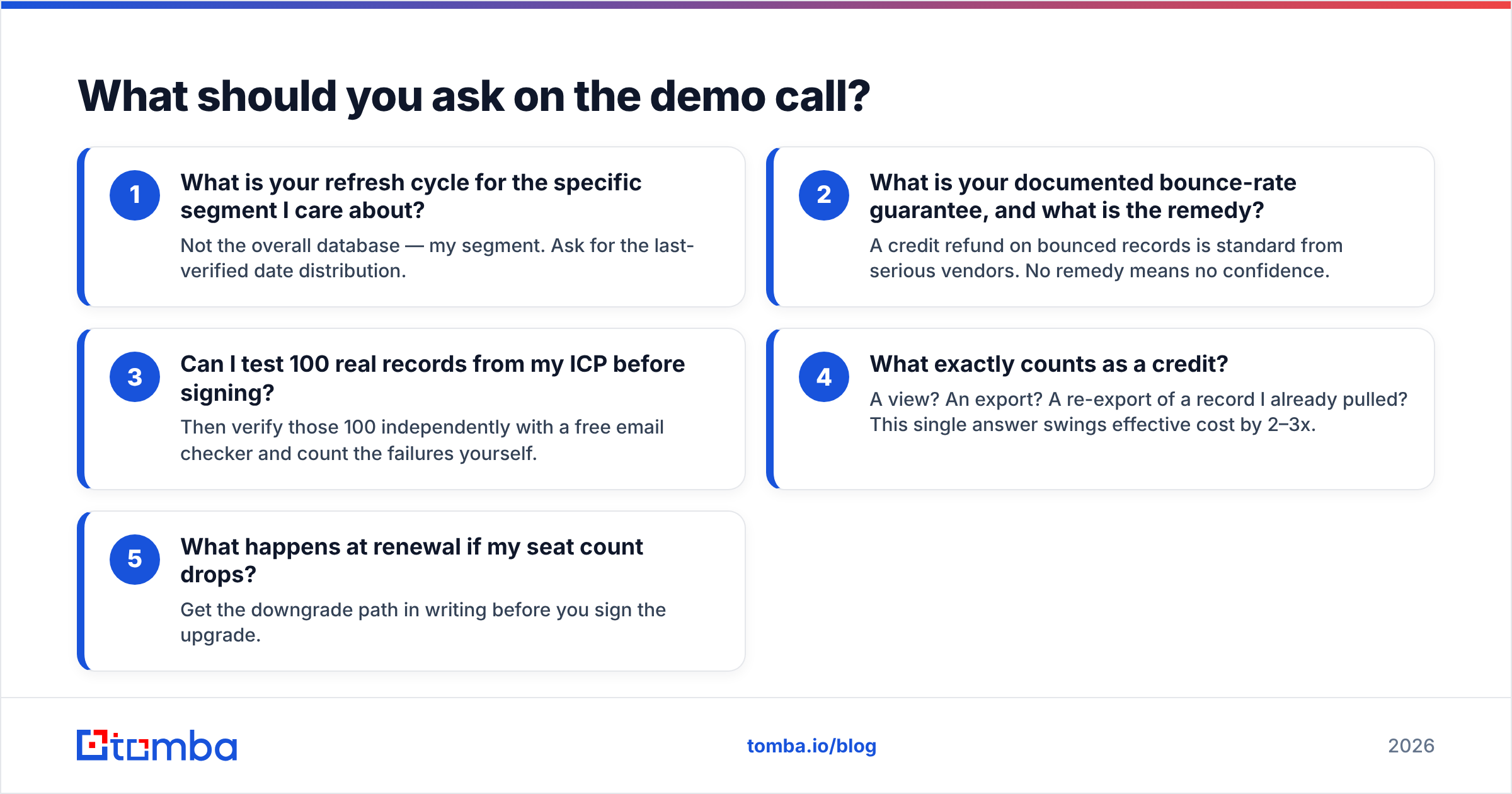
Bring these five questions to both vendors, and compare the answers side by side instead of the marketing pages:
- What is your refresh cycle for the specific segment I care about? Not the overall database — my segment. Ask for the last-verified date distribution.
- What is your documented bounce-rate guarantee, and what is the remedy? A credit refund on bounced records is standard from serious vendors. No remedy means no confidence.
- Can I test 100 real records from my ICP before signing? Then verify those 100 yourself with a free email checker and count the failures.
- What exactly counts as a credit? A view? An export? A re-export of a record I already pulled? This one answer swings effective cost by 2–3x.
- What happens at renewal if my seat count drops? Get the downgrade path in writing before you sign the upgrade.
If a vendor will not give you a live sample against your own ICP, that is information. Both categories of tool are testable in a week. A procurement process that takes two months to prove nothing is a bad sign about the data underneath.
The verdict#
DiscoverOrg vs Istariai comes down to one question: which layer of your stack is actually broken?
DiscoverOrg is a legacy brand living inside ZoomInfo. It is still the strongest option if you need North American org charts and direct dials at enterprise scale, with enterprise pricing and an annual commitment attached. Istari.ai is a different animal. It is AI web mining that produces company-level signals, strong on European and long-tail firms, and useful for scoring and market intelligence rather than day-one outbound. Comparing the two like for like is a category error.
If the broken layer is "we know who to target but not how to reach them," you do not need a five-figure platform. Start with the Tomba Email Finder. It is free for 25 searches a month and $49 to run a real campaign, with verification and catch-all handling built in, so your addresses arrive deliverable rather than merely purchased. Prove the motion works first. Then spend the enterprise budget on the layer that truly needs it.
Related guides#
Ready to find emails that actually work?
Join 150,000+ professionals who stopped guessing and started sending. Free credits on signup — no credit card required.
Get the Tomba newsletter
Practical outbound tactics and product updates — once every two weeks.
About the author