DiscoverOrg vs Jeeva AI: Data Giant or AI SDR in 2026?
DiscoverOrg (now ZoomInfo) sells the database. Jeeva AI sells the SDR that works it. Here is how the two actually compare on data, pricing, contracts, and the workflows each one breaks.
TL;DR
- These are not the same category. DiscoverOrg is a B2B contact database (absorbed into ZoomInfo after the 2019 merger); Jeeva AI is an AI SDR agent that researches, writes, and sends outreach. Comparing them is comparing a warehouse to a delivery driver.
- DiscoverOrg/ZoomInfo is the expensive, deep option. Buyers consistently report annual contracts in the five figures, seat minimums, and credit caps that bite mid-year.
- Jeeva AI is the cheap, fast option — but it is only as good as the data you feed it. An AI SDR pointed at stale contacts sends confident emails to people who left in 2023.
- Most teams under 50 reps do not need either at full price. A dedicated email finder plus a sequencer covers 80% of the job for a fraction of the spend.
- The real decision is whether your bottleneck is knowing who to contact (data problem → ZoomInfo/DiscoverOrg tier) or having time to contact them (capacity problem → AI SDR tier).
What are DiscoverOrg and Jeeva AI, actually?#
Start here, because half the confusion in the DiscoverOrg vs Jeeva AI debate comes from treating them as substitutes.
DiscoverOrg launched as a human-verified org-chart database for IT and sales teams. Its pitch was research depth: not just an email address, but reporting lines, installed tech, budget cycles, and direct dials — collected and re-verified by human researchers on a rolling schedule. In 2019 DiscoverOrg acquired ZoomInfo and adopted the ZoomInfo name. Today, when someone says "we use DiscoverOrg," they almost always mean a ZoomInfo contract with the legacy DiscoverOrg data lineage baked in. The brand still carries weight in enterprise IT and security sales, where knowing that a company just hired a new CISO is worth more than the raw email.
Jeeva AI is a newer product built for a different bottleneck. It positions itself as an autonomous AI SDR: it ingests an ICP definition, sources leads, researches each account, drafts personalized sequences, sends them, and handles replies until a human takes over. The promise is headcount replacement — one operator supervising a fleet of AI agents instead of five junior reps grinding through lists.
So the honest framing:
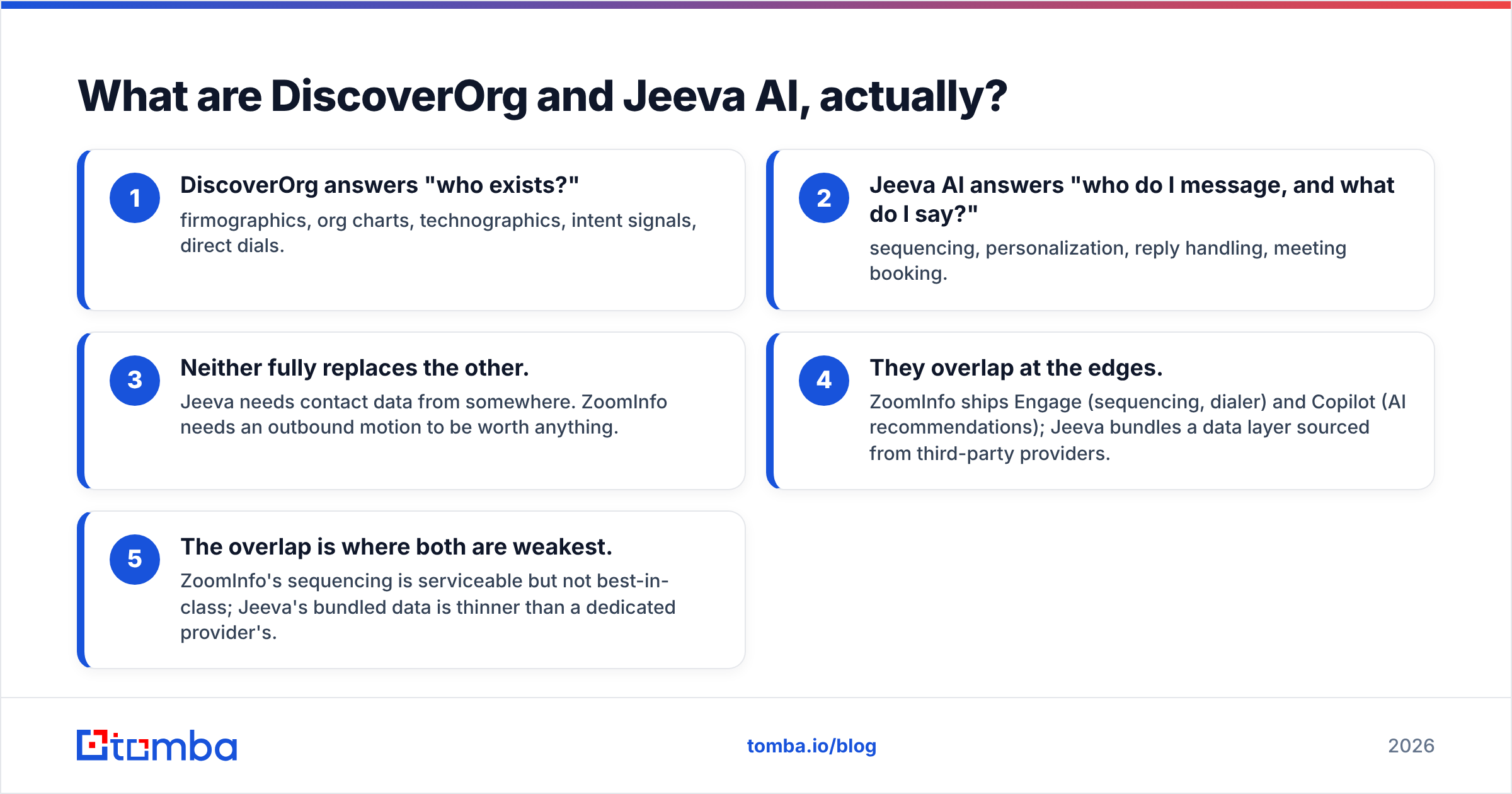
- DiscoverOrg answers "who exists?" — firmographics, org charts, technographics, intent signals, direct dials.
- Jeeva AI answers "who do I message, and what do I say?" — sequencing, personalization, reply handling, meeting booking.
- Neither fully replaces the other. Jeeva needs contact data from somewhere. ZoomInfo needs an outbound motion to be worth anything.
- They overlap at the edges. ZoomInfo ships Engage (sequencing, dialer) and Copilot (AI recommendations); Jeeva bundles a data layer sourced from third-party providers.
- The overlap is where both are weakest. ZoomInfo's sequencing is serviceable but not best-in-class; Jeeva's bundled data is thinner than a dedicated provider's.

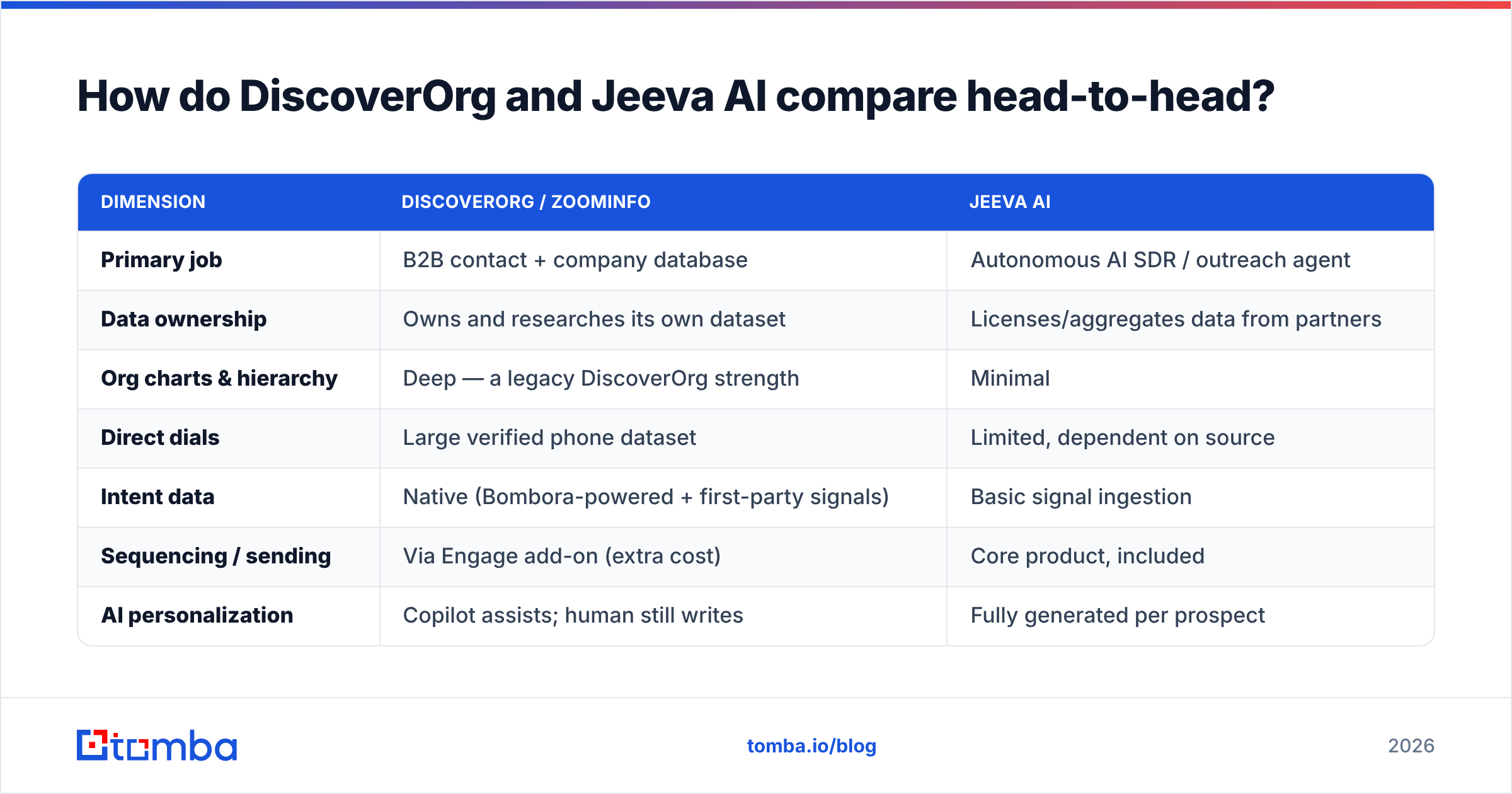
How do DiscoverOrg and Jeeva AI compare head-to-head?#
| Dimension | DiscoverOrg / ZoomInfo | Jeeva AI |
|---|---|---|
| Primary job | B2B contact + company database | Autonomous AI SDR / outreach agent |
| Data ownership | Owns and researches its own dataset | Licenses/aggregates data from partners |
| Org charts & hierarchy | Deep — a legacy DiscoverOrg strength | Minimal |
| Direct dials | Large verified phone dataset | Limited, dependent on source |
| Intent data | Native (Bombora-powered + first-party signals) | Basic signal ingestion |
| Sequencing / sending | Via Engage add-on (extra cost) | Core product, included |
| AI personalization | Copilot assists; human still writes | Fully generated per prospect |
| Reply handling | Manual | Automated with human handoff |
| Typical contract | Annual, multi-seat, five figures reported | Monthly or annual, per-agent/per-seat |
| Entry price (reported) | ~$15,000+/yr for a small team | Low hundreds per month per agent |
| Free tier | No — demo/trial gated by sales | Trial available, gated |
| Credit model | Annual credit pool, overages billed | Per-lead / per-send limits |
| Time to first value | 2–6 weeks (onboarding, CRM sync) | Days |
| Best for | Enterprise ABM, IT/security sales | Seed–Series B teams without SDR headcount |
Two things fall out of that table.
First, the price gap is not marginal — it is roughly an order of magnitude. ZoomInfo does not publish a price list, and the numbers buyers report on G2 and in procurement threads cluster in the $15k–$40k/year range depending on seats, credits, and modules. Jeeva AI operates on modern SaaS pricing: monthly, self-serve-ish, cancellable. If budget is the constraint, this is a short conversation.
Second, the capability gap runs the other direction. Nothing in Jeeva's stack reproduces a decade of human-verified org-chart research. If your sales motion depends on knowing that the VP of Infrastructure reports to a newly appointed CTO who just signed a three-year Snowflake deal, no AI SDR is going to infer that from a LinkedIn scrape.
What does DiscoverOrg (ZoomInfo) actually cost in 2026?#
There is no public price list, and that is deliberate. What buyers consistently describe:
- Annual commitment, no monthly option on any tier that matters.
- Seat minimums — typically three, often more, which inflates the floor even for a two-person team.
- Credit pools that reset annually, not monthly. Burn through your export credits in Q1 and you buy more at list price, mid-cycle, with no leverage.
- Modules priced separately. Engage (sequencing), Chat, Data-as-a-Service, and advanced intent are add-ons, not inclusions.
- Auto-renewal clauses with notice windows that catch teams out. Read the termination terms before you sign, not in month eleven.
The value case holds when your ACV is high enough that a single closed deal repays the contract. At $80k ACV in enterprise security, one meeting sourced from an accurate org chart pays for the year. At $6k ACV selling to SMBs, the math collapses.
What does Jeeva AI cost, and what is the catch?#
Jeeva prices per AI agent or per seat, monthly, in the range you would expect from a modern sales tool — the low hundreds per month at entry, with custom enterprise pricing above that. Check jeeva.ai directly, since AI SDR pricing has been moving fast and tiers get renamed quarterly.
The catch is not the price. It is what happens downstream.
An AI SDR increases send volume by an order of magnitude. If your list quality is mediocre, you have just built a machine that damages your sending domain at scale. Bounces above 3–5% get you throttled by Google and Microsoft; sustained bounce rates torch sender reputation in weeks. The tool sends confidently either way — it has no opinion about whether the mailbox exists.
This is the single most common failure mode we see with AI SDR adoption:
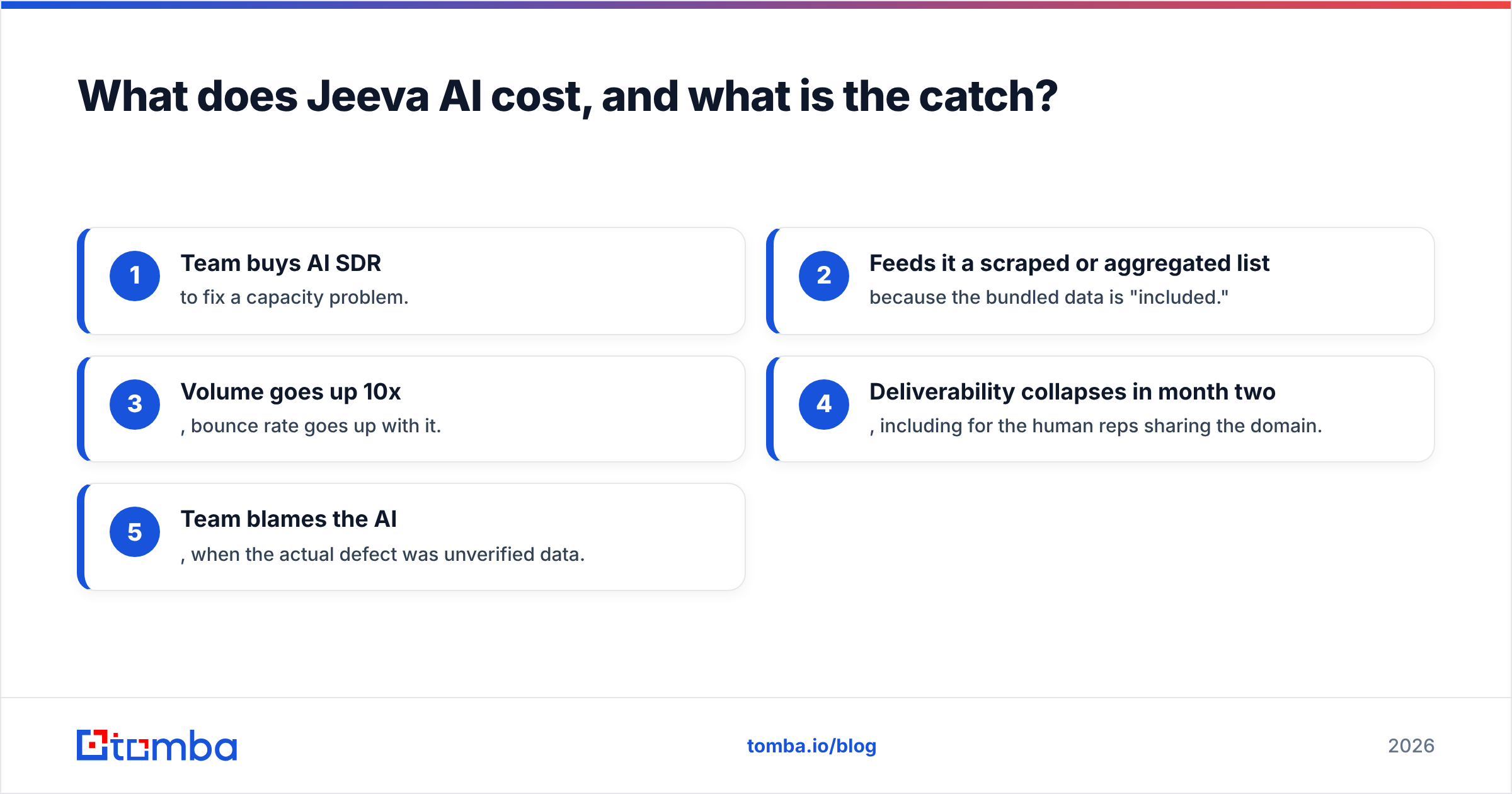
- Team buys AI SDR to fix a capacity problem.
- Feeds it a scraped or aggregated list because the bundled data is "included."
- Volume goes up 10x, bounce rate goes up with it.
- Deliverability collapses in month two, including for the human reps sharing the domain.
- Team blames the AI, when the actual defect was unverified data.
Run every list through an email verifier before an AI agent touches it. This is not optional hygiene — it is the load-bearing step.

Which one has better data accuracy?#
DiscoverOrg's lineage wins on depth; neither wins on freshness in the way vendors claim.
Some context on how B2B data decays. Roughly 25–30% of contact data goes stale annually through job changes alone, and that rate spiked during the 2023–2025 layoff cycles. Any vendor claiming 95%+ accuracy is quoting a lab number measured at a favorable moment, not what you will see on a list pulled in March and mailed in June.
What separates providers in practice:
- Re-verification cadence. DiscoverOrg built its reputation on human researchers re-checking records on a schedule. That is genuinely expensive and genuinely differentiated — and it is why the contract costs what it costs.
- Verification at the moment of export. A record verified six months ago and sitting in a database is a guess. A record verified at export time is a fact. This is where lighter, API-first tools often outperform the enterprise incumbents on the specific contacts you care about.
- Catch-all handling. Roughly a fifth of B2B domains accept all mail, so a standard SMTP check returns "valid" for every address. Providers that do not distinguish catch-all domains inflate their accuracy numbers by default. A dedicated catch-all verifier is the only honest way to score these.
If you are evaluating both, do not accept the vendor's accuracy PDF. Pull 200 contacts from each, verify them independently, and count real bounces on a live send. Vendors will not love this; it is still the only test that means anything.
Is an AI SDR a real replacement for a data provider?#
No — and the vendors selling "all-in-one" are quietly agreeing with you by licensing their data from third parties.
Think of it like a restaurant. The database is your supplier; the AI SDR is your kitchen. A great kitchen with bad ingredients produces bad food faster. A great supplier with no kitchen produces nothing at all. The teams that get outbound working buy both functions deliberately, and refuse to let a bundle hide which one is underperforming.
The practical architecture most efficient teams land on in 2026:
- A source of truth for accounts — CRM, plus firmographic enrichment.
- A contact-resolution layer that turns a name and a domain into a verified, deliverable email or phone number on demand.
- A sequencer or AI agent that handles the sending, personalization, and reply routing.
- A deliverability layer — warmup, domain rotation, SPF/DKIM/DMARC monitoring, bounce suppression.
Notice that steps 2 and 3 are separable. Bundling them into one vendor feels tidy and costs you leverage at renewal.
Where does a lighter stack beat both?#
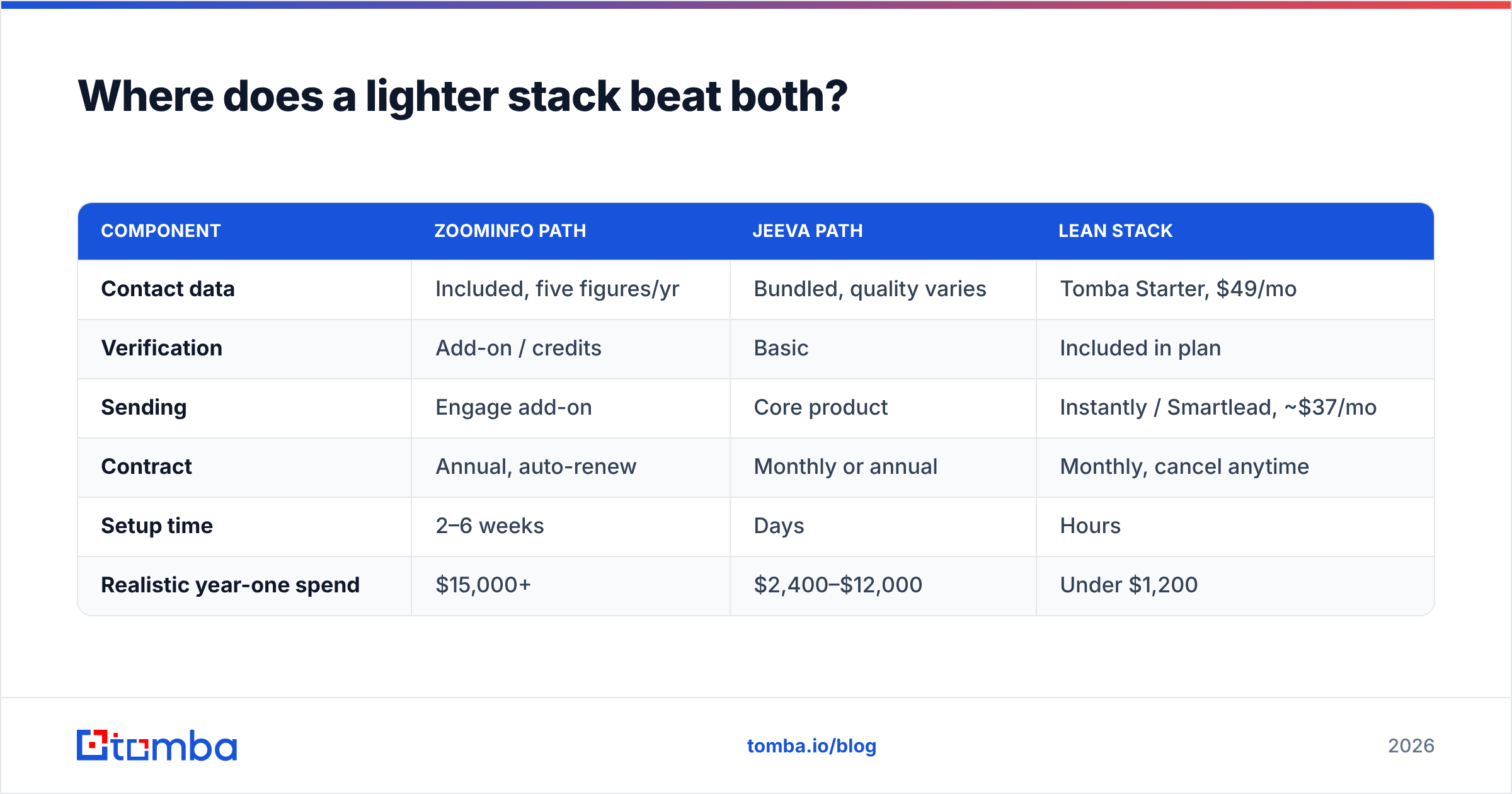
If you are a team of two to twenty, running outbound to a definable list of accounts, the enterprise contract is dead weight and the fully autonomous SDR is premature.
Here is what that alternative looks like on cost and control:
| Component | ZoomInfo path | Jeeva path | Lean stack |
|---|---|---|---|
| Contact data | Included, five figures/yr | Bundled, quality varies | Tomba Starter, $49/mo |
| Verification | Add-on / credits | Basic | Included in plan |
| Sending | Engage add-on | Core product | Instantly / Smartlead, ~$37/mo |
| Contract | Annual, auto-renew | Monthly or annual | Monthly, cancel anytime |
| Setup time | 2–6 weeks | Days | Hours |
| Realistic year-one spend | $15,000+ | $2,400–$12,000 | Under $1,200 |
Tomba sits in the contact-resolution slot. The Tomba pricing ladder starts free at 25 searches per month, then $49/mo Starter, $99/mo Growth, and $249/mo Pro, with enterprise custom — monthly, no seat minimum, no annual credit pool to blow through in Q1. The Tomba API means your AI agent, your Clay table, or your own script can resolve and verify a contact at the moment of send rather than trusting a six-month-old snapshot.
That is not a claim that Tomba replaces ZoomInfo's org charts or intent graph. It does not. If you sell $200k deals into the Fortune 500 and you need to know who reports to whom before you write a word, buy the enterprise data. What Tomba replaces is the reason most teams overbuy: they needed verified emails, and the only vendor that would talk to them wanted $18,000 and a year of commitment.
Which should you choose?#
Choose DiscoverOrg/ZoomInfo if: your ACV clears $50k, you sell into IT/security/enterprise where org structure drives the play, you need intent data natively, and you have a RevOps function that will actually operationalize the platform. Do not buy it because a board member said to. Negotiate hard — discounts of 20–40% off list are routinely reported by buyers willing to walk.
Choose Jeeva AI if: your bottleneck is human hours, not target identification. You know exactly who you want to reach, you cannot afford three SDRs, and you are willing to supervise an agent closely for the first 90 days. Bring your own verified data. Budget for deliverability tooling separately.
Choose neither yet if: you have not proven the message converts manually. An AI SDR scales whatever you give it, including a bad pitch. Ten manual emails a day for two weeks will teach you more than any platform will.
Run a hybrid if: you are mid-market. Enterprise data for the top 200 named accounts, lean stack for the long tail. This is what most efficient GTM teams actually do, even when their vendor case study says otherwise.
Ready to fix the data layer first?#
Whichever platform you land on, the contact data underneath it decides whether the whole thing works. Start with the Tomba Email Finder — find and verify professional email addresses by domain, name, or company, with catch-all detection built in and no annual contract. Free tier is 25 searches a month, enough to test accuracy against your current provider before you sign anything. Verify a sample from ZoomInfo, verify a sample from Jeeva, and let the bounce rates make the argument for you.
Related guides#
Ready to find emails that actually work?
Join 150,000+ professionals who stopped guessing and started sending. Free credits on signup — no credit card required.
Get the Tomba newsletter
Practical outbound tactics and product updates — once every two weeks.
About the author