DiscoverOrg vs Kaspr: Which B2B Data Tool Wins in 2026?
DiscoverOrg no longer exists as a standalone product, and Kaspr is now a Cognism subsidiary. Here's what each one actually costs, where the data comes from, and which one deserves your budget in 2026.
TL;DR
- DiscoverOrg is not a product you can buy anymore. It merged with ZoomInfo in 2019 and the brand was folded into ZoomInfo — so "DiscoverOrg vs Kaspr" is really "ZoomInfo vs Kaspr."
- Kaspr is a LinkedIn-first Chrome extension owned by Cognism since 2022. It shines when your prospecting happens inside LinkedIn and Sales Navigator, and it publishes its prices.
- ZoomInfo (ex-DiscoverOrg) is an enterprise data platform with intent signals, org charts, and a sales engine. It does not publish prices; annual contracts commonly land in the five figures.
- The two tools solve different problems. ZoomInfo is a system of record; Kaspr is a point solution for grabbing mobile numbers and emails off a profile.
- If you mostly need verified work emails at a predictable price, a dedicated email finder costs a fraction of either and skips the seat minimums entirely.
What happened to DiscoverOrg?#
DiscoverOrg bought ZoomInfo in February 2019 and then adopted the acquired company's name. By the 2020 IPO, everything shipped under the ZoomInfo banner. The DiscoverOrg product line — human-verified org charts, IT install data, and department-level contact sets built for enterprise sales teams — became the backbone of ZoomInfo's "verified" data tier.
That matters for your evaluation. If a rep, a consultant, or a legacy RFP still says "DiscoverOrg," they are describing a sales motion from roughly 2015–2019: analyst-researched org charts, deep technographics, annual seat contracts, and a heavy CRM sync. Those characteristics carried into ZoomInfo. What did not carry over is the pricing — ZoomInfo's platform bundles (SalesOS, MarketingOS, intent, conversation intelligence) are priced far above the old DiscoverOrg base.
So when you search "DiscoverOrg vs Kaspr" in 2026, you are comparing:
- A retired brand inside a public data platform — ZoomInfo, sold on annual contracts, seat minimums, and credit pools.
- A €-priced LinkedIn extension — Kaspr, sold self-serve, per user, with a free tier you can start on today.
They barely overlap in shape, even though they overlap in output.
What is Kaspr and who owns it?#
Kaspr launched in Paris in 2018 as a Chrome extension that reveals phone numbers and emails on LinkedIn profiles. Cognism acquired it in November 2022 and kept it running as a separate, lower-priced product — Cognism for enterprise-grade European data, Kaspr for individual reps and small teams who live inside Sales Navigator.
The workflow is simple and that's the point:
- Open a LinkedIn profile or a Sales Navigator list. The extension sidebar appears automatically.
- Reveal contact data. Kaspr surfaces mobile numbers, direct dials where available, and professional email addresses.
- Bulk-enrich a list. Run it against a Sales Navigator search or a group of profiles instead of one at a time.
- Push to your stack. Native sends to HubSpot, Pipedrive, Salesforce, Lemlist, and Zapier, plus CSV export.
- Work from lead lists. Basic list management and tagging inside the Kaspr dashboard.
The strength is European mobile coverage, especially France, the UK, and DACH — inherited from Cognism's data operation. The weakness is scope: Kaspr does not give you buying intent, org charts, technographics, or a broad company database you can query without LinkedIn as the entry point.

DiscoverOrg vs Kaspr: how do they actually compare?#
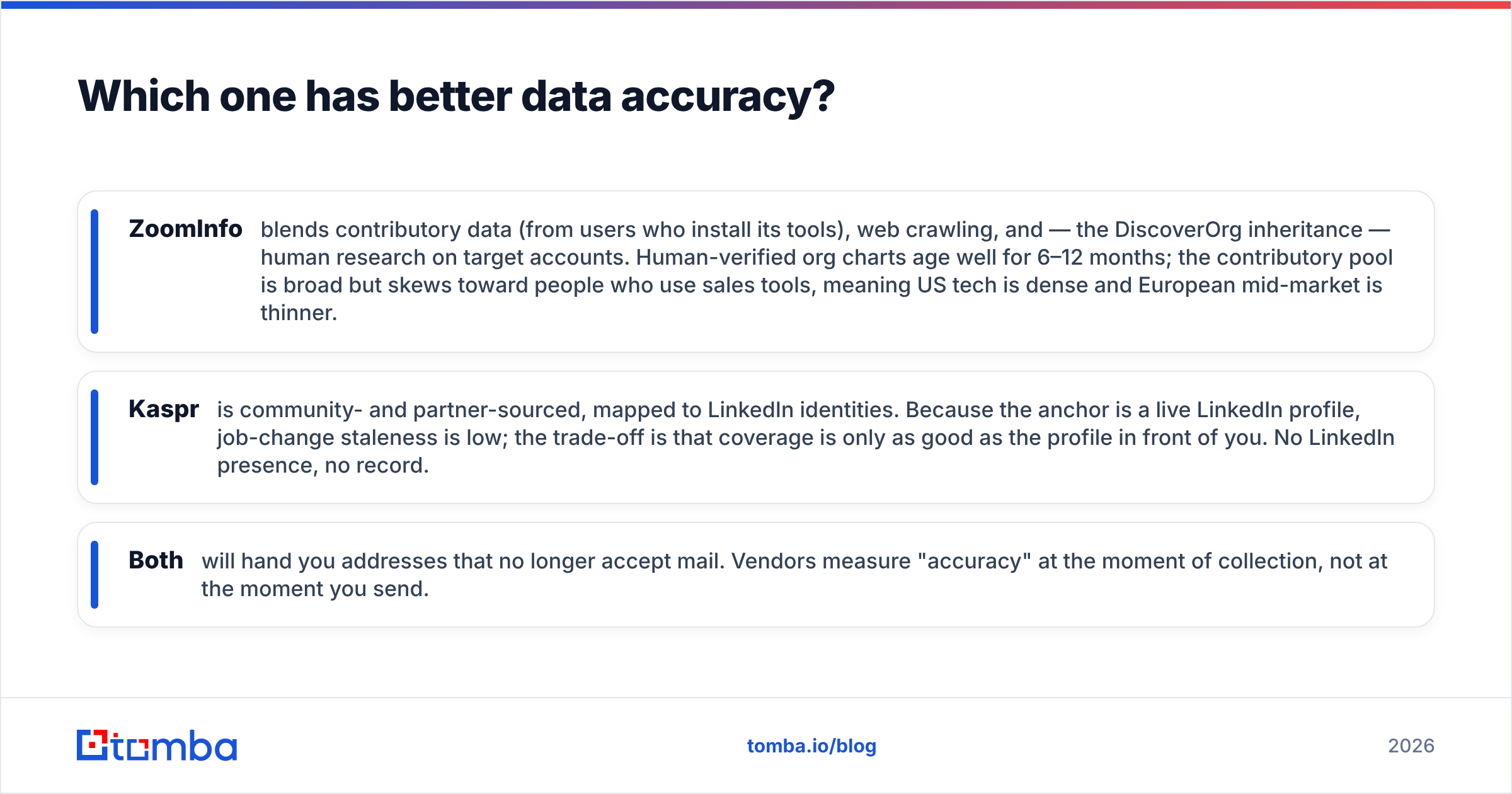
Here is the head-to-head, with ZoomInfo standing in for the DiscoverOrg product line and Tomba included as a price reference point for teams that only need contact discovery.
| Attribute | ZoomInfo (ex-DiscoverOrg) | Kaspr | Tomba |
|---|---|---|---|
| Entry point | Web app + CRM sync | LinkedIn Chrome extension | Web app, API, extension, Sheets |
| Published pricing | No — quote only | Yes, per user | Yes, from $49/mo |
| Free tier | Trial only, gated | Free plan, limited credits | 25 searches/mo |
| Mobile / direct dials | Strong in US | Strong in EU (FR, UK, DACH) | Phone finder module |
| Buying intent data | Yes | No | No |
| Org charts & technographics | Yes (DiscoverOrg legacy) | No | No |
| Bulk enrichment | Yes, credit-based | Yes, from LinkedIn lists | Yes, CSV + API |
| Contract length | Typically 12 months | Monthly or annual | Monthly or annual |
| Best-fit team size | 20+ seats | 1–15 reps | 1–50 reps |
The pattern is clear. ZoomInfo wins on breadth and signal; Kaspr wins on speed, price transparency, and European phone coverage; a focused email finder wins when the only deliverable you need is a verified address at a known cost per record.
How much do DiscoverOrg and Kaspr cost?#
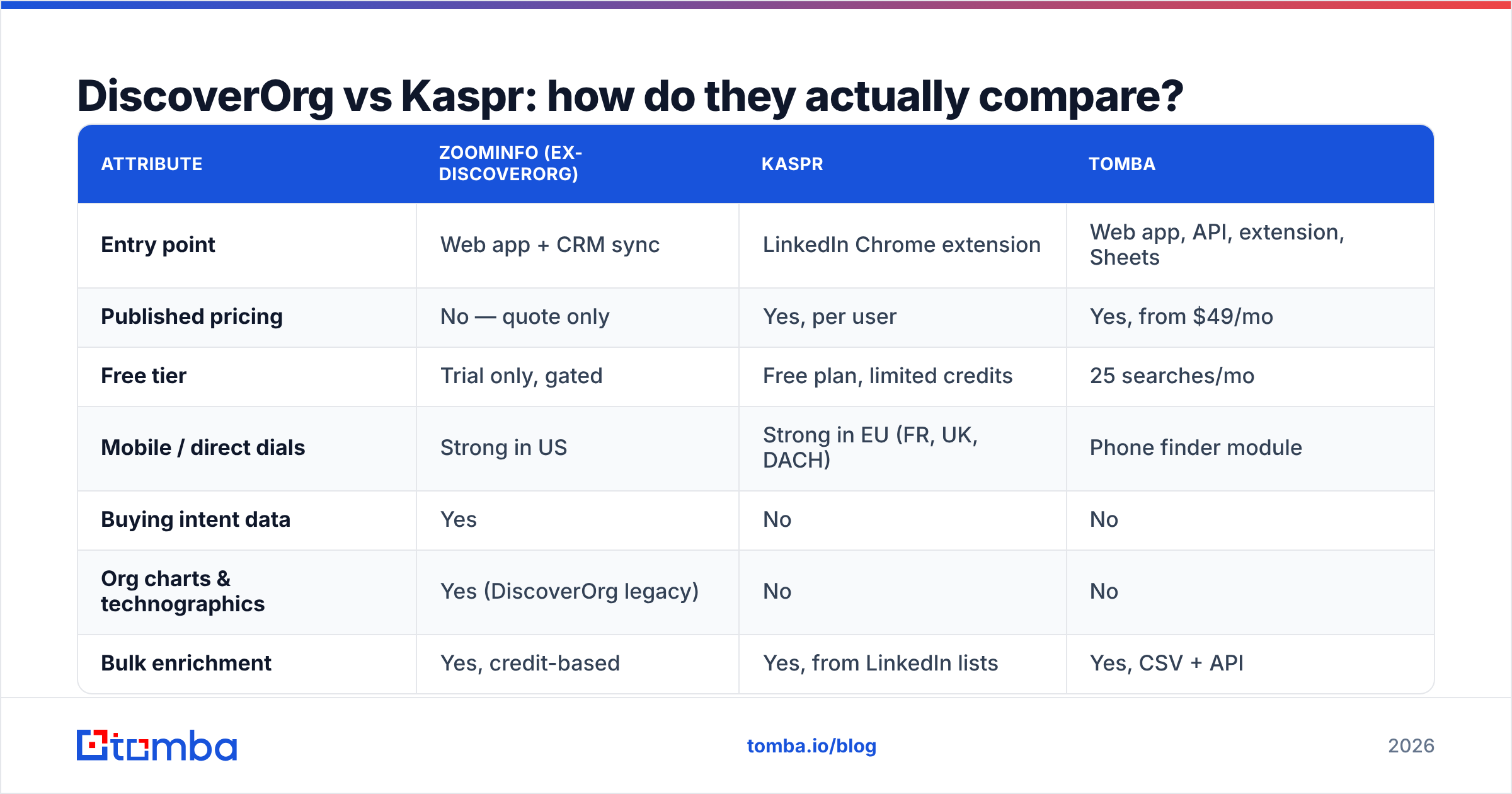
Kaspr publishes its prices. ZoomInfo does not, and that asymmetry is half the buying decision.
| Plan | Kaspr | ZoomInfo (ex-DiscoverOrg) | Tomba |
|---|---|---|---|
| Free | Limited credits, LinkedIn only | Not offered | 25 searches/mo |
| Entry paid | ~€49/user/mo (Starter) | Quote only | $49/mo (Starter) |
| Mid tier | ~€79/user/mo (Business) | Quote only | $99/mo (Growth) |
| Upper tier | ~€99/user/mo (Organization) | Quote only | $249/mo (Pro) |
| Typical annual spend | €600–€1,200 per rep | Commonly $15,000+ | $588–$2,988 total |
| Seat minimum | 1 | Often 3+ | 1 |
Two caveats. First, Kaspr's published rates assume annual billing and are quoted per user — five reps on Business is five subscriptions, not one. Second, ZoomInfo pricing varies enormously by module mix, credit volume, and seat count; buyer reviews on G2 consistently describe five-figure annual commitments with limited flexibility mid-term. Ask for the credit overage rate and the renewal uplift clause in writing before you sign anything.
For comparison, Tomba pricing starts at $49/mo for the Starter plan with no seat minimum, and the free tier gives you 25 searches a month to sanity-check coverage against your own ICP before spending a cent.
Which one has better data accuracy?#
Neither vendor's marketing number should be your input. Both claim high accuracy; both are measured against their own test sets. What you should compare is how the data is produced, because that predicts where it decays.

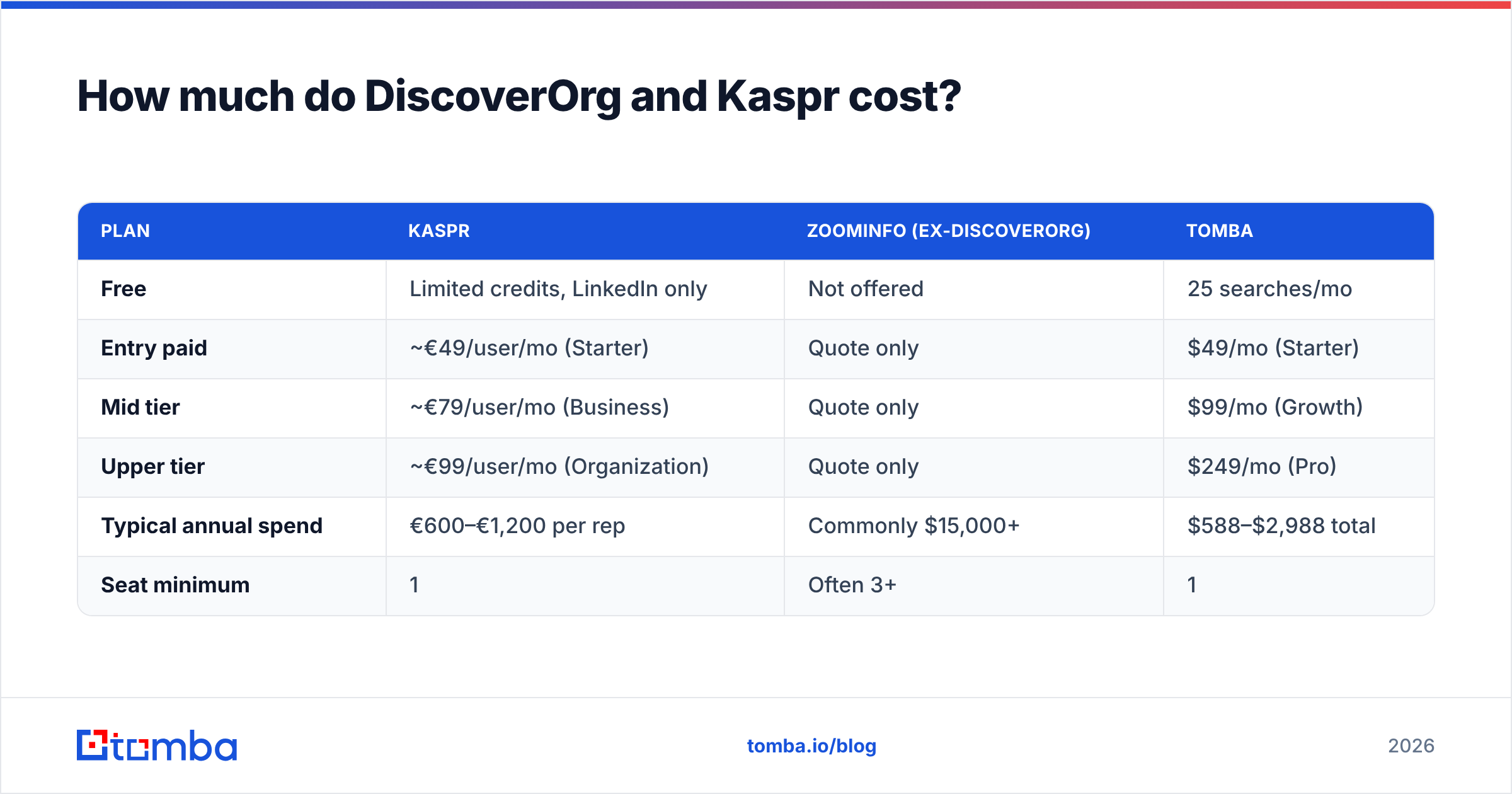
- ZoomInfo blends contributory data (from users who install its tools), web crawling, and — the DiscoverOrg inheritance — human research on target accounts. Human-verified org charts age well for 6–12 months; the contributory pool is broad but skews toward people who use sales tools, meaning US tech is dense and European mid-market is thinner.
- Kaspr is community- and partner-sourced, mapped to LinkedIn identities. Because the anchor is a live LinkedIn profile, job-change staleness is low; the trade-off is that coverage is only as good as the profile in front of you. No LinkedIn presence, no record.
- Both will hand you addresses that no longer accept mail. Vendors measure "accuracy" at the moment of collection, not at the moment you send.
The practical fix is the same regardless of vendor: run every export through an independent email verifier before it enters a sequence. A 12% bounce rate on a "98% accurate" list is not a contradiction — it's the gap between collection time and send time. Treat verification as a separate line item, not a vendor promise.
For catch-all domains — common in enterprise and in European SMBs — a standard SMTP check returns "unknown" and most tools give up. A dedicated catch-all verifier uses pattern confidence and historical delivery signals to make those records usable instead of discarding them.
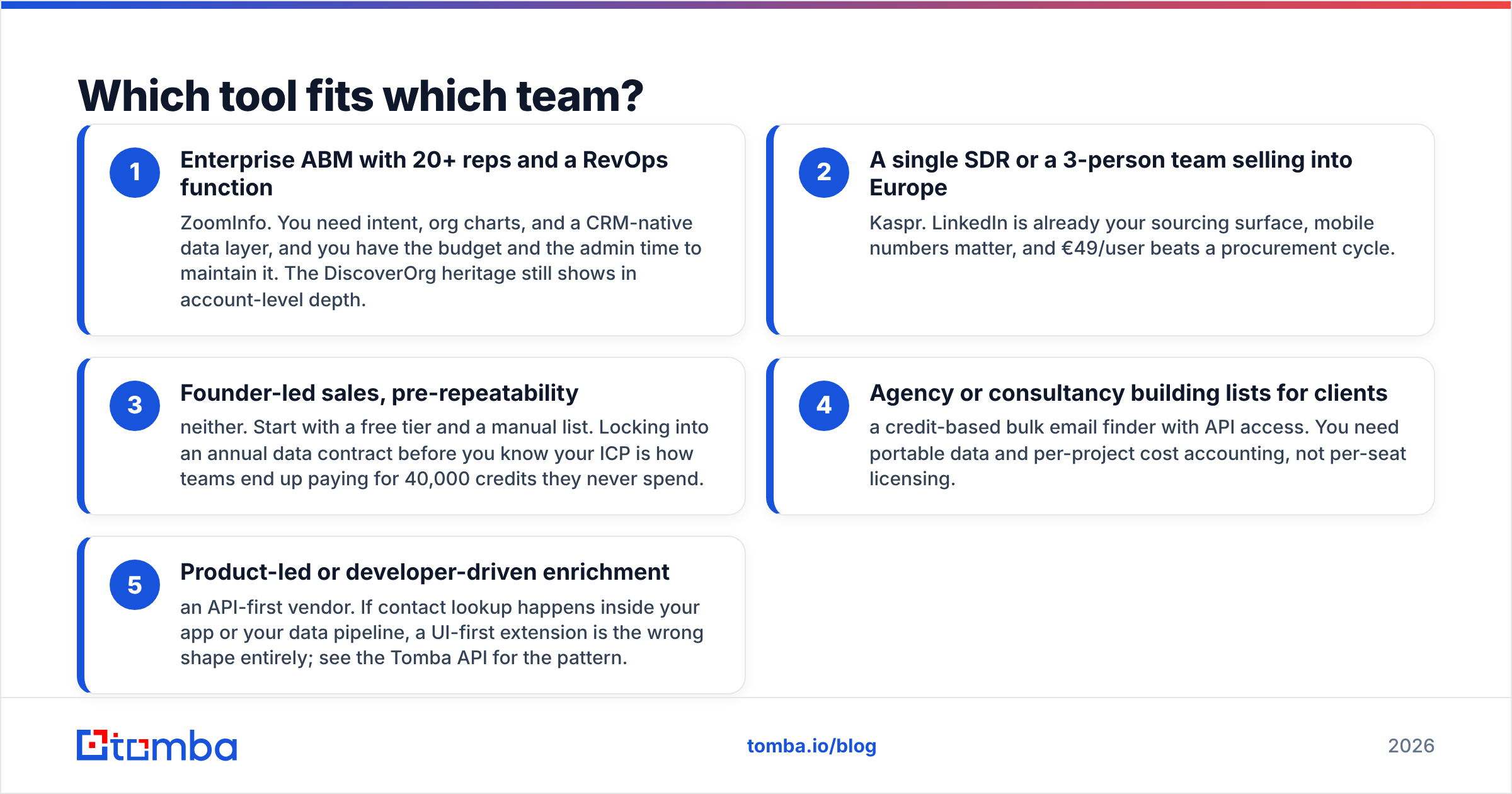
Which tool fits which team?#
Pick based on your motion, not on the feature matrix.
- Enterprise ABM with 20+ reps and a RevOps function — ZoomInfo. You need intent, org charts, and a CRM-native data layer, and you have the budget and the admin time to maintain it. The DiscoverOrg heritage still shows in account-level depth.
- A single SDR or a 3-person team selling into Europe — Kaspr. LinkedIn is already your sourcing surface, mobile numbers matter, and €49/user beats a procurement cycle.
- Founder-led sales, pre-repeatability — neither. Start with a free tier and a manual list. Locking into an annual data contract before you know your ICP is how teams end up paying for 40,000 credits they never spend.
- Agency or consultancy building lists for clients — a credit-based bulk email finder with API access. You need portable data and per-project cost accounting, not per-seat licensing.
- Product-led or developer-driven enrichment — an API-first vendor. If contact lookup happens inside your app or your data pipeline, a UI-first extension is the wrong shape entirely; see the Tomba API for the pattern.

What about GDPR and compliance?#
If you sell into the EU, this is not a footnote.
Kaspr, as a Cognism company, operates under a European compliance posture: notification to contacts, DNC list screening across several European countries, and documented lawful-basis handling. That is a genuine differentiator versus US-first databases, and it's the main reason European teams pick it over a bigger platform.
ZoomInfo publishes its own privacy and compliance documentation and supports opt-out requests, but its contributory data model — where contact records are contributed by users of its own tools — has drawn regulatory and press scrutiny in Europe over the years. Ask your target vendor these three questions before signing:
- What is the lawful basis for processing each contact record in the EU?
- Do you screen against national do-not-call registers, and which ones?
- What is the SLA for honoring a deletion request, and does it propagate to my exported CSVs?
The third one catches most teams. Once a record leaves the platform and lands in your CRM, the vendor's deletion propagation stops mattering — your own hygiene process takes over.
Where do both tools fall short?#
ZoomInfo (ex-DiscoverOrg):
- Pricing opacity makes budgeting a negotiation exercise. Renewal uplifts are a common complaint.
- Credit pools expire. Unused credits at year-end are money burned.
- Overkill for teams under ~15 reps. You pay for intent and org charts you will not operationalize.
- Data density falls off outside US tech and US mid-market.
Kaspr:
- LinkedIn dependency. No profile, no data — you cannot build a list from a company domain alone.
- Per-user pricing scales linearly, so a 10-rep team pays 10 subscriptions.
- No intent, no technographics, no firmographic filtering beyond what LinkedIn gives you.
- Credit types are split (phone, email, export) and it's easy to exhaust one while sitting on the others.

If neither profile fits, the third path is unbundling: use a domain-first tool to build the list, a verifier to clean it, and your sequencer of choice to send it. A domain search returns every discoverable address at a company plus the email pattern, which is often all you need to construct contacts for people whose profiles are private or nonexistent. Teams selling into industries with light LinkedIn adoption — manufacturing, logistics, local services, public sector — routinely get better coverage this way than from either platform above.
Is there a middle ground between the two?#
Yes, and it's where most teams under 50 reps end up.
The honest read on "DiscoverOrg vs Kaspr" is that the question is a category error. One is an enterprise data platform with a retired name; the other is a €49 browser extension. If you are seriously evaluating both, what you probably want is neither extreme: predictable pricing, verified emails, phone data where it exists, an API for the parts you automate, and no annual lock-in.
That's the slot a focused contact-discovery tool fills. You give up intent scoring and org charts. You gain a cost per verified record you can actually forecast, and the freedom to cancel in a month if coverage on your ICP disappoints.
Whichever way you go, run the same test before you buy: take 100 real accounts from your pipeline, run them through the free tier of each candidate, send to a seed list, and measure bounce rate and connect rate. Thirty minutes of that beats thirty pages of vendor benchmark.
Ready to test coverage on your own list?#
Start with the Tomba Email Finder. The free tier gives you 25 searches a month — enough to run a real sample of your ICP against it and compare hit rate against whatever quote is sitting in your inbox. Paid plans start at $49/mo with no seat minimum, no annual commitment, and no credit-expiry cliff, and every result runs through built-in verification before it reaches you. If the numbers hold up on your accounts, you'll know in an afternoon. If they don't, you've spent nothing finding out.
Related guides#
Ready to find emails that actually work?
Join 150,000+ professionals who stopped guessing and started sending. Free credits on signup — no credit card required.
Get the Tomba newsletter
Practical outbound tactics and product updates — once every two weeks.
About the author