DiscoverOrg vs Kitt AI: B2B Data Tools Compared (2026)
DiscoverOrg (now ZoomInfo) and Kitt.AI solve completely different problems — one sells B2B contact data, the other was a conversational AI toolkit. Here's what each actually does in 2026 and what to buy instead.
DiscoverOrg vs Kitt AI is a matchup that never really made sense. One sold B2B contact data. The other built voice and chat tools. Neither still trades under its own name.
TL;DR
- These two never competed. DiscoverOrg was a B2B contact and org-chart database. ZoomInfo bought it in 2019 and folded it into the ZoomInfo platform.
- Kitt.AI was a conversational AI toolkit: wake words (Snowboy), intent parsing (NLU), and chat flows (ChatFlow). Baidu bought it in 2017.
- Saw DiscoverOrg vs Kitt AI on a vendor list? Someone mixed up two unrelated categories. Pick your real problem first: find buyers, or build a voice interface.
- ZoomInfo, the heir to DiscoverOrg, is very much alive and costly. Plan on five figures a year, seat minimums, and a 12-month term.
- Kitt.AI's tools are dead. The hosted Snowboy service closed in December 2020. Community forks live on, but do not plan a 2026 roadmap on them.
- Want verified contact data without a five-figure deal? Tomba ($49/mo Starter) and Apollo cover most of what teams bought DiscoverOrg for.
Why Is DiscoverOrg vs Kitt AI Even a Comparison?#
Blame search-engine drift, not real buyers.
Both names were tagged as "AI sales tech" in old listicles around 2018 and 2019. Aggregator sites scraped those tags. They then spun up automatic "X vs Y" pages, and the pairing stuck. If you landed here from one of those pages, here is the honest answer. You are comparing a filing cabinet to a microphone.
Here is the split in plain terms. DiscoverOrg answered one question: who at Acme Corp runs IT, what is their email, and who do they report to? Kitt.AI answered another: how do I make a device wake up when someone says "hey robot"?
Both were good at their jobs. Neither replaces the other. And most stale comparison pages skip the key fact: neither is sold as a standalone product in 2026.

What Was DiscoverOrg, and What Is It Now?#
DiscoverOrg was a human-verified B2B database, founded in 2007. It was known for depth, not breadth.
Rivals bragged about hundreds of millions of records. DiscoverOrg sold research rigor instead. Human researchers called into companies to confirm titles, direct dials, reporting lines, and installed tech. The result was an org chart you could actually walk. You could see the four directors under a VP of Engineering, and get a direct dial for each.
The trade-off was coverage and price. DiscoverOrg focused on mid-market and enterprise accounts in tech, finance, marketing, and HR. If your ICP was a 12-person agency in Lisbon, you were out of luck.
In February 2019, DiscoverOrg acquired ZoomInfo and took the ZoomInfo name. The DiscoverOrg brand was retired. Today you buy ZoomInfo, which pairs DiscoverOrg's verified depth with ZoomInfo's larger contributory dataset.
What that means for you:
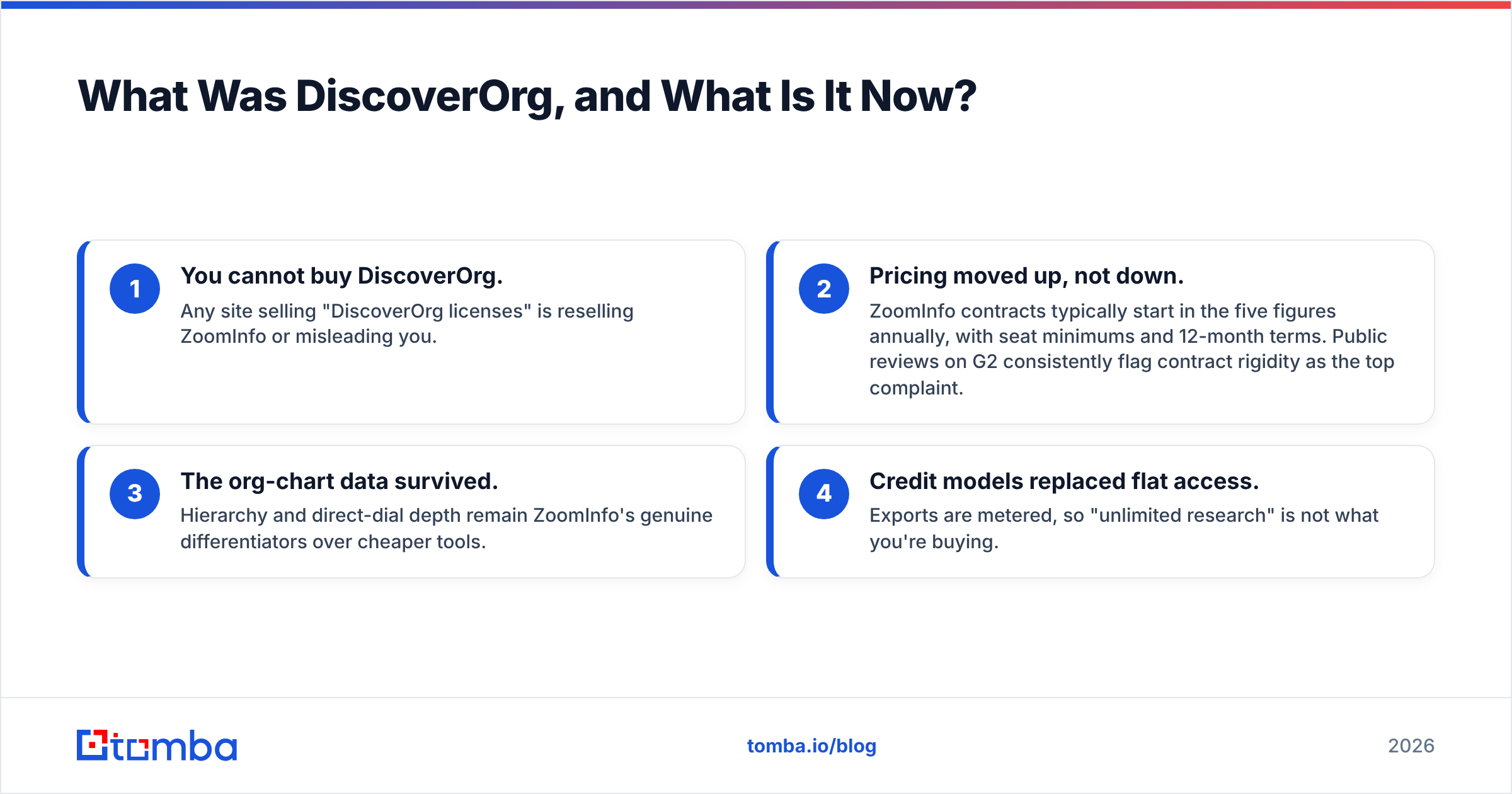
- You cannot buy DiscoverOrg. Any site selling "DiscoverOrg licenses" is reselling ZoomInfo, or misleading you.
- Prices went up, not down. ZoomInfo deals usually start in the five figures a year. Expect seat minimums and 12-month terms. Reviews on G2 flag contract rigidity as the top gripe.
- The org-chart data survived. Hierarchy and direct-dial depth are still ZoomInfo's real edge over cheaper tools.
- Credits replaced flat access. Exports are metered, so you are not buying unlimited research.
What Was Kitt.AI, and Should You Still Consider It?#
Kitt.AI was a Seattle conversational-AI startup, spun out of University of Washington research. Its products are no longer maintained.
It shipped three things developers liked:
- Snowboy — a light, custom hotword engine. You trained your own wake word ("hey jarvis") and ran it on a Raspberry Pi. Makers loved it.
- NLU — an intent classifier that worked out what a user meant from free text.
- ChatFlow — a visual builder for chatbot dialogue.
Baidu acquired Kitt.AI in July 2017. The team was absorbed. The hosted Snowboy service shut down at the end of December 2020. The code is open source and forks exist. But there is no vendor, no SLA, and no roadmap.
So, should you consider it in 2026? No. For wake words, look at Picovoice Porcupine or openWakeWord. For intent parsing, any modern LLM API handles it. Neither has anything to do with B2B prospecting.
DiscoverOrg vs Kitt AI: How Do They Actually Compare?#
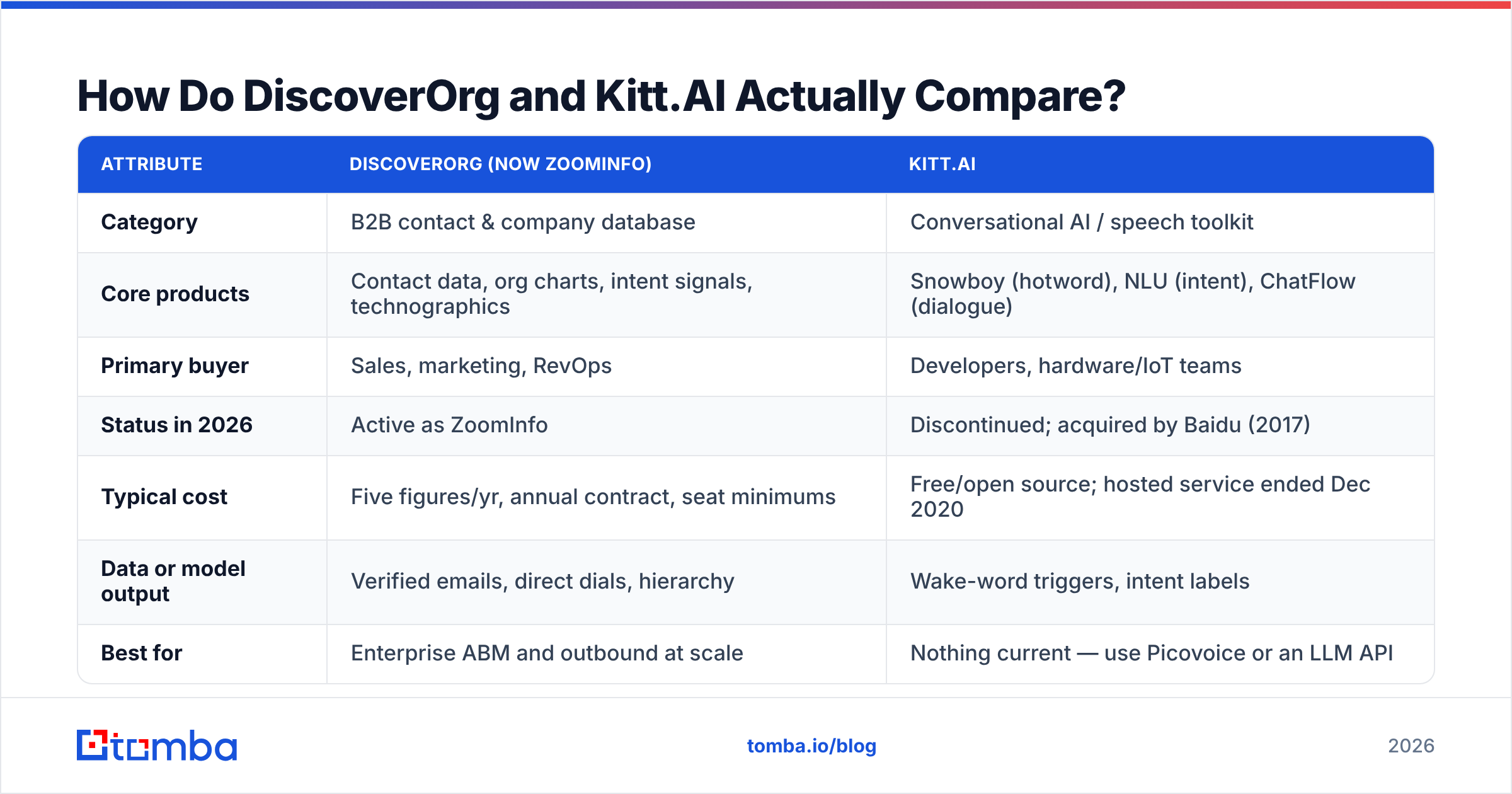
| Attribute | DiscoverOrg (now ZoomInfo) | Kitt.AI |
|---|---|---|
| Category | B2B contact & company database | Conversational AI / speech toolkit |
| Core products | Contact data, org charts, intent signals, technographics | Snowboy (hotword), NLU (intent), ChatFlow (dialogue) |
| Primary buyer | Sales, marketing, RevOps | Developers, hardware/IoT teams |
| Status in 2026 | Active as ZoomInfo | Discontinued; acquired by Baidu (2017) |
| Typical cost | Five figures/yr, annual contract, seat minimums | Free/open source; hosted service ended Dec 2020 |
| Data or model output | Verified emails, direct dials, hierarchy | Wake-word triggers, intent labels |
| Best for | Enterprise ABM and outbound at scale | Nothing current — use Picovoice or an LLM API |
| Realistic alternative | Tomba, Apollo, Cognism, BookYourData | Picovoice Porcupine, openWakeWord |
The table makes the point better than paragraphs can. There is no row where these two fight for the same budget line.
What Should You Buy Instead of DiscoverOrg?#
Pick based on how much org-chart depth you truly need. Most teams over-buy it.
DiscoverOrg's real value was hierarchy plus direct dials at large accounts. Do you sell six-figure deals into Fortune 2000 IT teams? Do you need to map a nine-person buying committee? Then that depth is worth paying for. If you run volume outbound to SMB and mid-market, you are paying enterprise rates for a feature you touch twice a quarter.
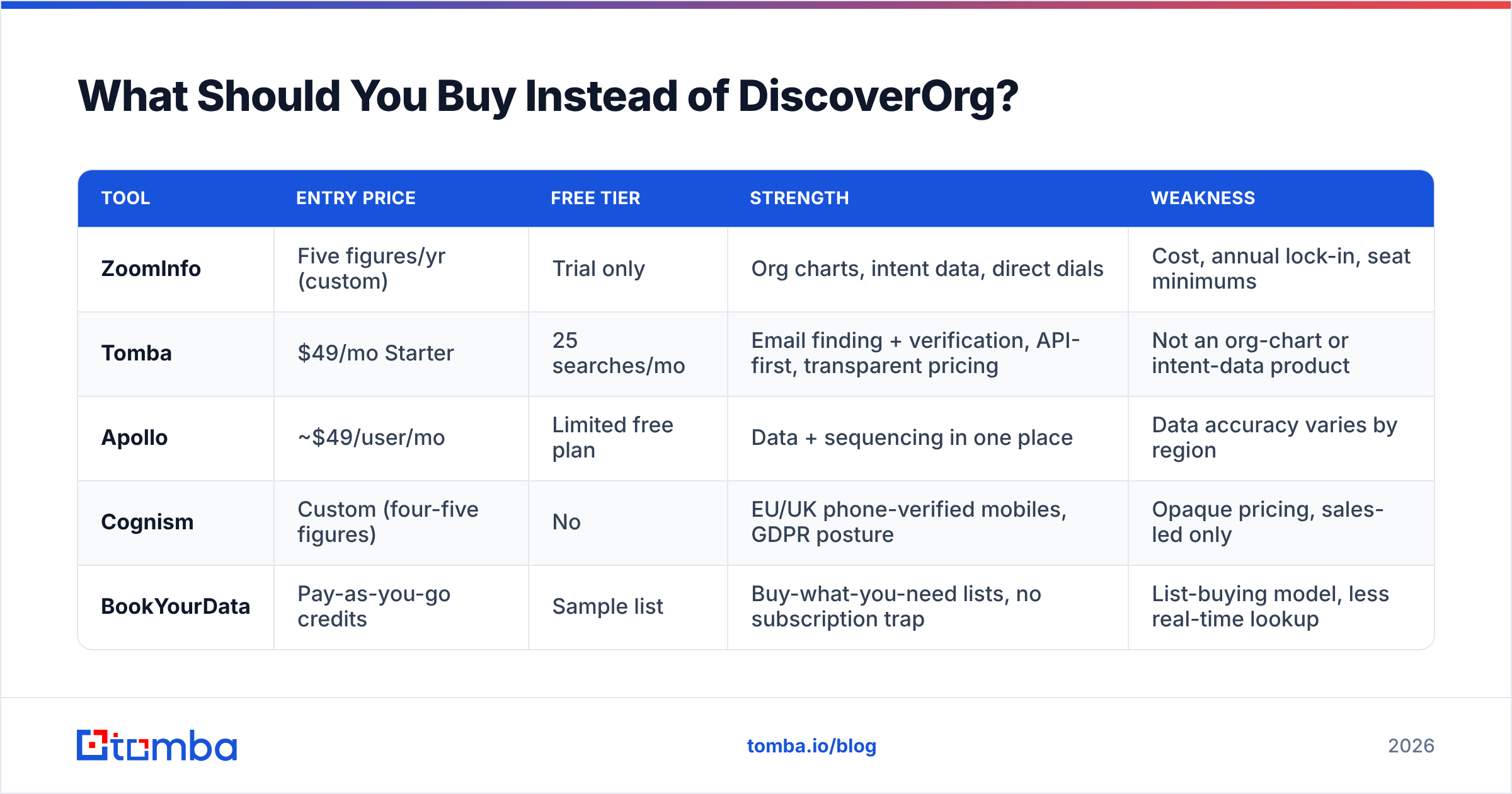
Here is how the practical options stack up:
| Tool | Entry price | Free tier | Strength | Weakness |
|---|---|---|---|---|
| ZoomInfo | Five figures/yr (custom) | Trial only | Org charts, intent data, direct dials | Cost, annual lock-in, seat minimums |
| Tomba | $49/mo Starter | 25 searches/mo | Email finding + verification, API-first, transparent pricing | Not an org-chart or intent-data product |
| Apollo | ~$49/user/mo | Limited free plan | Data + sequencing in one place | Data accuracy varies by region |
| Cognism | Custom (four-five figures) | No | EU/UK phone-verified mobiles, GDPR posture | Opaque pricing, sales-led only |
| BookYourData | Pay-as-you-go credits | Sample list | Buy-what-you-need lists, no subscription trap | List-buying model, less real-time lookup |
A few honest notes on that table. Cognism is the closest swap if your motion is phone-heavy in Europe. BookYourData fits when you want a defined list without a platform subscription. Its pay-per-record model is kinder to small teams than annual seats. Apollo bundles data and sequencing. That is handy, but you inherit their sending setup. Tomba is the narrow, cheap option. It does email finding and email verification well, and does not pretend to be an ABM platform.
How Do You Replace DiscoverOrg's Workflow Without the Enterprise Price?#
Rebuild the workflow in pieces. One platform that does all of it is either weak or costly.
DiscoverOrg users ran the same loop: pick target accounts, find the right people inside them, get verified details, push to CRM. You can assemble that for far less.
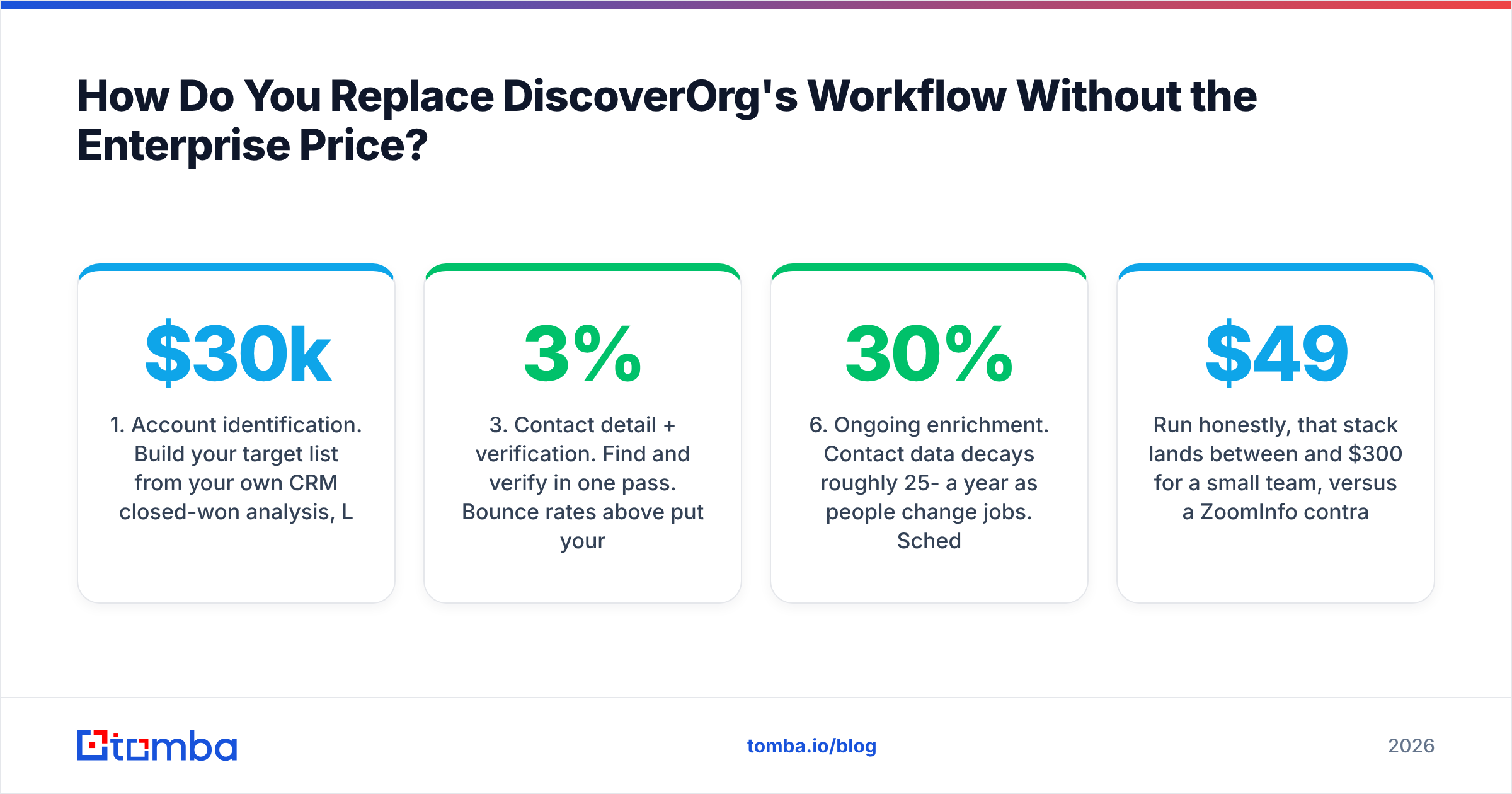
- Find accounts. Build the list from closed-won analysis in your CRM, LinkedIn Sales Navigator filters, or a firmographic export. People assume this step needs a $30k tool. It rarely does.
- Find people. Use domain search to pull every known role at a company. Then filter down to your buying committee.
- Get and verify contacts. Do both in one pass. Bounce rates above 3% put your sender reputation at risk. Run a bulk verify before any large campaign.
- Add phones where they matter. Direct dials were DiscoverOrg's crown jewel. If calling is core to your motion, add a phone finder.
- Sync to CRM. Push enriched records into HubSpot or Salesforce so reps never work from a spreadsheet.
- Re-enrich often. Contact data decays 25-30% a year as people switch jobs. Schedule a quarterly refresh.
That stack costs $49 to $300 a month for a small team. A ZoomInfo contract starts an order of magnitude higher. You do lose intent signals and deep hierarchy. Decide whether you ever used them.
What About the Kitt.AI Side — What Replaced It?#
Came here for conversational AI? The market has moved twice since Kitt.AI closed.
Wake-word detection settled on two options. Picovoice Porcupine is commercial, runs on-device, and licenses cleanly. openWakeWord is open source and community-run. Both do Snowboy's job better, and both are still maintained.
Intent classification and dialogue flow stopped being separate products. What ChatFlow and NLU did with rules and trained classifiers, you now do with one LLM prompt plus function calling. That is a better developer story. No retraining, no intent taxonomy to maintain, and it handles phrasing you never planned for.
Watch one thing: on-device latency and privacy. LLM APIs are network calls. If your hardware must answer locally, keep wake words and simple intents on the device. Save the model call for the hard cases.
Which One Is Right for You?#
Answer one question and the choice makes itself.
"I need to reach more of the right buyers." You need contact data. Enterprise and budgeted? ZoomInfo is DiscoverOrg's heir. Otherwise, build a leaner stack on an email finder plus verification. Kitt.AI is irrelevant to you.
"I need to build a voice or chat interface." You need Picovoice, openWakeWord, or an LLM API. Kitt.AI's lineage points there. DiscoverOrg and ZoomInfo are irrelevant to you.
"I saw them compared and wondered what I was missing." Nothing. It is a directory-page artifact. You can close the tab.
There is one real lesson in the pairing. This category churns fast. DiscoverOrg led its market and no longer exists under its own name. Kitt.AI was loved by developers and shut down within three years of its sale. So favor tools with clear pricing, an accessible API, and month-to-month terms. Then a vendor pivot cannot strand your workflow.
Ready to Rebuild Your Prospecting Data Without an Enterprise Contract?#
Was your real need the DiscoverOrg half of this comparison? Start with the Tomba Email Finder. Search by domain, name, or company. Get verified addresses with a confidence score. Pull them into your CRM through the API or a native integration.
The free tier gives you 25 searches a month, so you can test coverage against your own ICP first. Tomba pricing starts at $49/mo, with no annual lock-in and no seat minimums. Run 50 of your hardest-to-find accounts through it. Then compare the hit rate to the quote sitting in your inbox.
Related guides#
Ready to find emails that actually work?
Join 150,000+ professionals who stopped guessing and started sending. Free credits on signup — no credit card required.
Get the Tomba newsletter
Practical outbound tactics and product updates — once every two weeks.
About the author