DiscoverOrg vs Lead Carrot: Which B2B Data Tool Wins in 2026?
One is an enterprise sales-intelligence database that now lives inside ZoomInfo. The other is a low-cost list builder for agencies. Here's the honest breakdown of cost, data accuracy, and who each one actually fits.
DiscoverOrg vs Lead Carrot is an odd matchup. One is an enterprise database that no longer sells under its own name. The other is a $47/month list builder for agencies. Here is the plain-English comparison of price, data quality, and fit.
TL;DR
- DiscoverOrg no longer exists as a standalone product. It merged with ZoomInfo in 2019 and the brand was folded in. discoverorg.com now redirects to zoominfo.com. If a rep pitches you "DiscoverOrg," you are buying ZoomInfo.
- DiscoverOrg vs Lead Carrot is not a fair fight. ZoomInfo is an enterprise sales-intelligence platform with org charts, intent data, and annual contracts that often run $15,000–$40,000+. Lead Carrot is a sub-$100/month list builder for agencies and solo founders.
- Lead Carrot wins on price and speed to first list. DiscoverOrg wins on depth, technographics, org hierarchy, and enterprise coverage. Neither wins on cost per verified contact.
- Both have the same weak point: verification. Databases go stale at roughly 25–30% per year. Whatever you buy, you need a verification layer before you send.
- The pragmatic 2026 stack for most teams under 50 reps is a targeted finder plus a verifier. Not a five-figure database contract you use 8% of.
What happened to DiscoverOrg?#
ZoomInfo bought DiscoverOrg in 2019 and merged the two companies. The combined business kept the ZoomInfo name. The old DiscoverOrg domain now resolves to zoominfo.com. Anything you read about "DiscoverOrg pricing" from before the merger describes a product you can no longer buy.
That matters for one practical reason. You cannot buy DiscoverOrg at DiscoverOrg's old price. You buy ZoomInfo, on ZoomInfo's terms: an annual commitment, seat licenses, credit pools, and paid add-ons for intent, call recording, and workflow.
One thing did survive the merger. DiscoverOrg built its name on human-checked org charts and IT department mapping. Researchers confirmed who reports to whom, who owns the security budget, and what sits in the tech stack. That work still shows up in ZoomInfo's enterprise tiers.
What is Lead Carrot, and who is it for?#
Lead Carrot sits at the other end of the market. It is a browser-based lead list builder. The buyers are marketing agencies, local-service sellers, and solo consultants.
They need a few thousand businesses with emails, phone numbers, and website signals. They need them fast and cheap, with no procurement cycle.
The workflow is simple. Pick an industry and a city. Pull a list of businesses. Filter by signals like "no website" or "running Facebook ads." Export to CSV and load it into your sequencer. Published entry pricing has sat around $47/month, with higher tiers for volume. Check current plans yourself, since low-cost tools change pricing often.
It is genuinely useful for that job. It is not a sales-intelligence platform. There are no org charts, no verified reporting lines, no intent signals, no CRM-grade enrichment, and no enterprise data governance story.

DiscoverOrg vs Lead Carrot: how do they compare?#
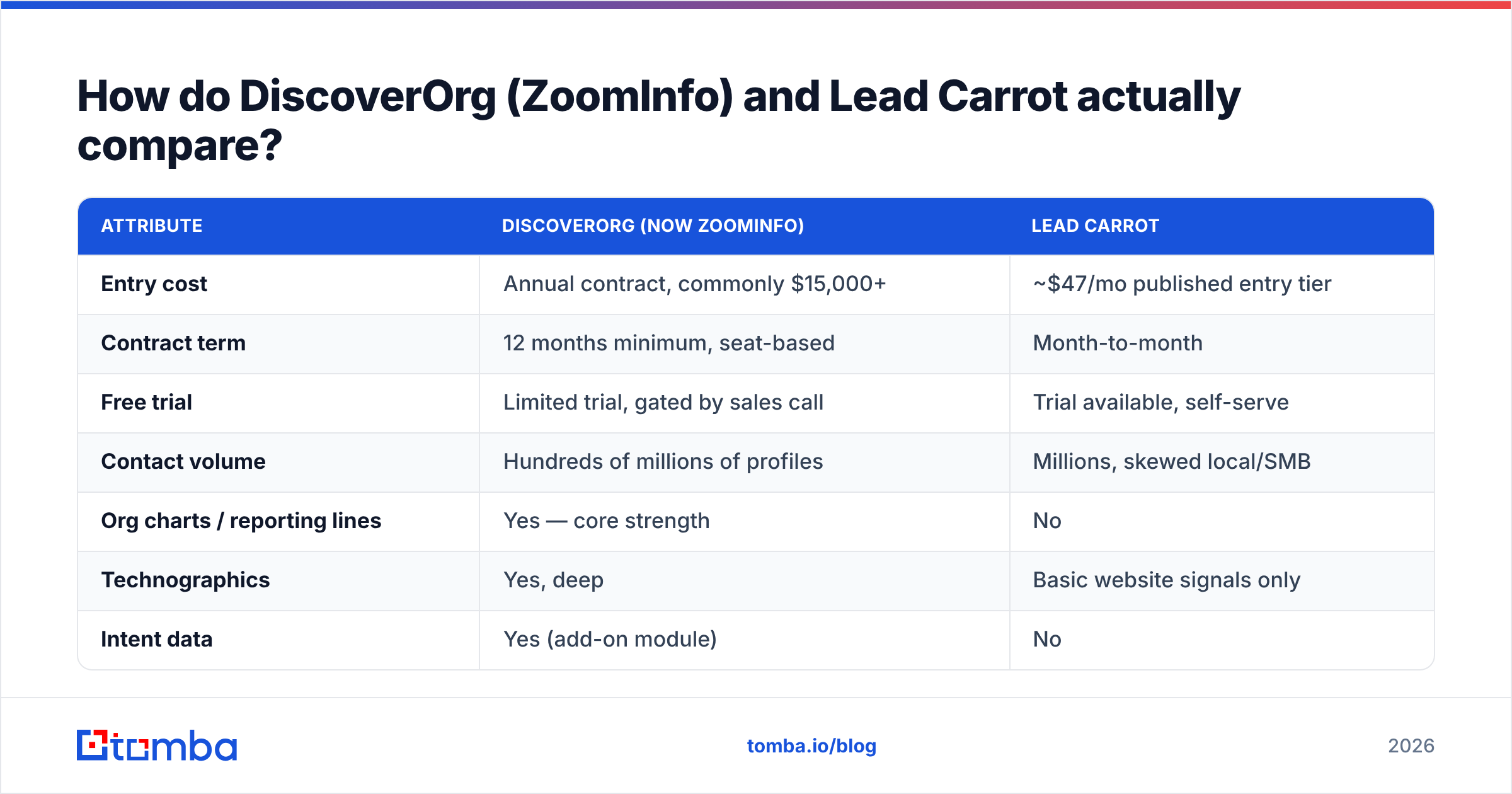
Here is the DiscoverOrg vs Lead Carrot head-to-head on the things that change a buying decision. Treat every price as directional. Enterprise quotes are negotiated, and neither vendor publishes one rate card.
| Attribute | DiscoverOrg (now ZoomInfo) | Lead Carrot |
|---|---|---|
| Entry cost | Annual contract, commonly $15,000+ | ~$47/mo published entry tier |
| Contract term | 12 months minimum, seat-based | Month-to-month |
| Free trial | Limited trial, gated by sales call | Trial available, self-serve |
| Contact volume | Hundreds of millions of profiles | Millions, skewed local/SMB |
| Org charts / reporting lines | Yes — core strength | No |
| Technographics | Yes, deep | Basic website signals only |
| Intent data | Yes (add-on module) | No |
| Phone / direct dials | Yes, large direct-dial set | Business numbers, mostly listed |
| Email verification | Built in, quality varies by segment | Minimal |
| CRM sync | Native Salesforce, HubSpot, Dynamics | CSV export, Zapier |
| API access | Yes, enterprise tier | Limited |
| Best-fit buyer | Enterprise SaaS, 50+ reps, ABM | Agencies, local services, solo GTM |
| Worst-fit buyer | 3-person startup | Enterprise ABM team |
The table makes the real conclusion obvious. These tools are not substitutes. If you are seriously weighing both, your requirements list is probably wrong. One of the two answers a question you never asked.
DiscoverOrg vs Lead Carrot: which has better data accuracy?#
Neither wins in a way that survives a real send. Here is the honest framing, in the order that costs you money.
- Decay beats vendor choice. B2B contact data goes stale at roughly a quarter of records per year. People change jobs, teams get cut, domains move, mailboxes close. A database refreshed six months ago is already wrong in places, whoever built it.
- Coverage depends on your segment. ZoomInfo's inherited DiscoverOrg research is strongest in North American tech and larger companies. Lead Carrot is strongest in local and SMB niches, where ZoomInfo thins out. Ask for a sample against your target list, not their showcase accounts.
- "Verified" means two different things. A researcher confirming a job title is one thing. A server confirming the mailbox still accepts mail is another. Both claims land on the same sales deck.
- Catch-all domains distort every accuracy stat. Many company domains accept all mail at the server. A "valid" result there proves little without deeper checks. That gap explains why vendor accuracy claims rarely match your real bounce rate.
- Bounce rate is the only number that matters. Above 3%, mailbox providers start throttling you. Your email deliverability then drops across every campaign, including the ones built on good data.
So run whatever list you buy through an email verifier before it reaches your sequencer.
Treat every database export as a guess, not a fact. Teams that skip this step are the ones posting angry accuracy reviews. Read those reviews on G2 closely and most "bad data" complaints are really "unverified data" complaints.
Is DiscoverOrg's price justified in 2026?#
It depends on whether you use the parts you pay for.
ZoomInfo's value sits in three places: org hierarchy, intent signals, and automatic enrichment into your CRM. If you run named accounts, sell to buying committees, and have a RevOps team to wire it up, the stack can pay for itself. Analysts at firms like Gartner rank data infrastructure among the higher-ROI go-to-market buys — when someone actually uses it.
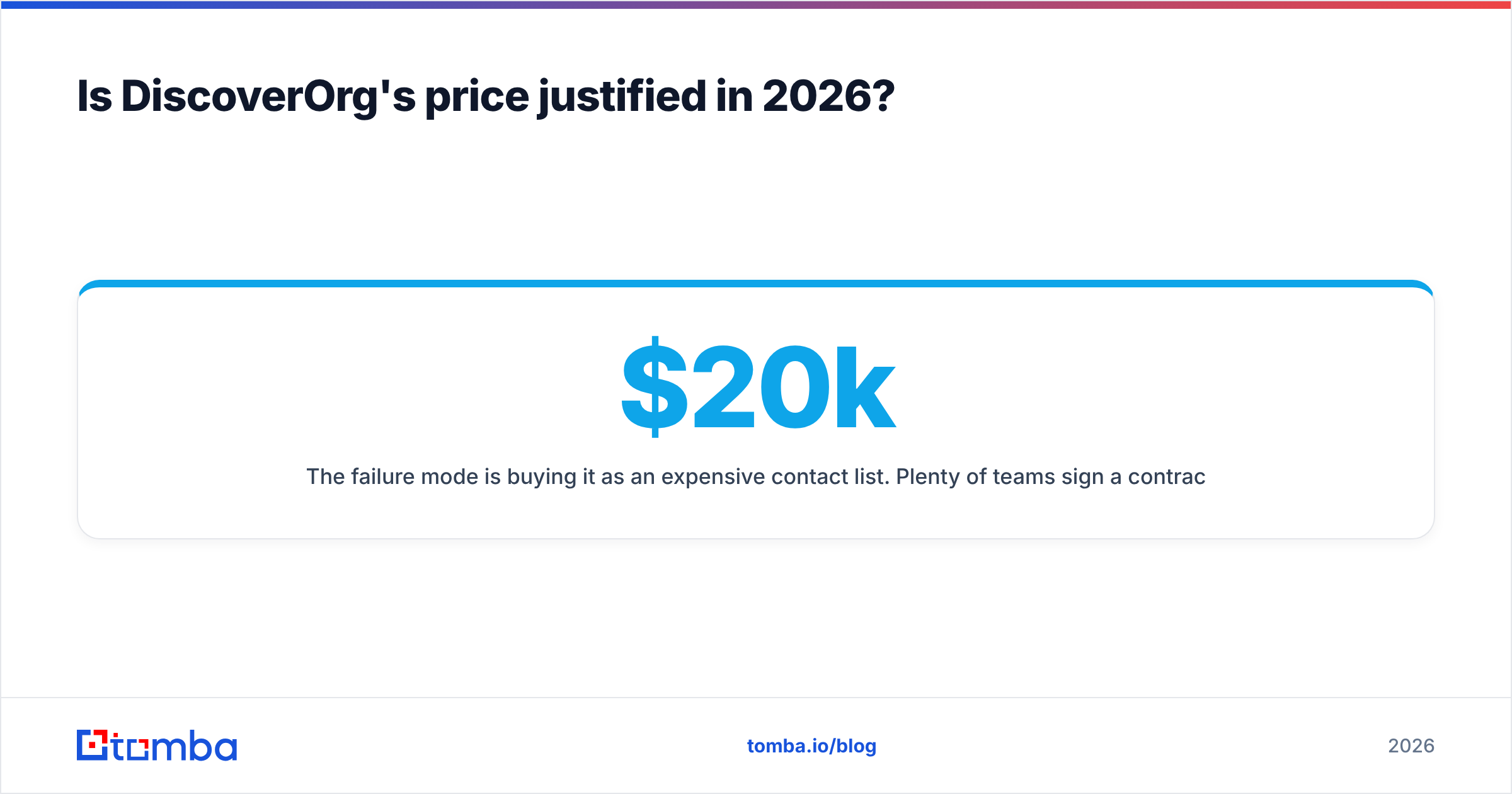
The failure mode is buying it as an expensive contact list. Plenty of teams sign a $20k deal, look up emails one at a time in the Chrome extension, and burn 8% of their credits by renewal. That is a $20,000 email finder.
Three questions predict whether the enterprise contract is worth it:
- Do you sell to committees of four or more people? If not, org charts do not earn their keep.
- Will intent data change what you do tomorrow? If nobody acts on a spike, the module is decoration.
- Is enrichment automated into your CRM? If your team still exports CSVs, you bought a database and built manual work on top of it.
Answer "no" twice and you should shop in a different price bracket.
Is Lead Carrot too cheap to be good?#
No. But it is narrow, and that is the trade you accept.
Lead Carrot does one job well. It turns an industry-plus-city query into a usable outbound list in minutes. For an agency selling websites to dentists in three metros, that is the exact shape of the problem. The data comes mostly from public business listings and web crawls. That is why it is cheap, and why it is strong in local niches.
Where it breaks down:
- Role targeting. You get the business, often a generic inbox, sometimes an owner. You will not reliably get the VP of Marketing at a 400-person company.
- Enterprise coverage. Thin. This is not the tool for a named-account motion.
- Verification depth. Lists need a scrub before you send. Generic inboxes like info@ and contact@ raise risk and lower reply rates, even when they deliver.
- Data governance. Enterprise buyers run procurement and privacy reviews. A small vendor may not have documented answers.
If your deal size is under $5,000 and your motion is volume, none of this is a dealbreaker. If your deal size is $50,000 and you need one director at one account, Lead Carrot cannot do the job at any price.

DiscoverOrg vs Lead Carrot: what should you buy instead?#
For most teams the honest answer is neither. Or at least, not either one alone.
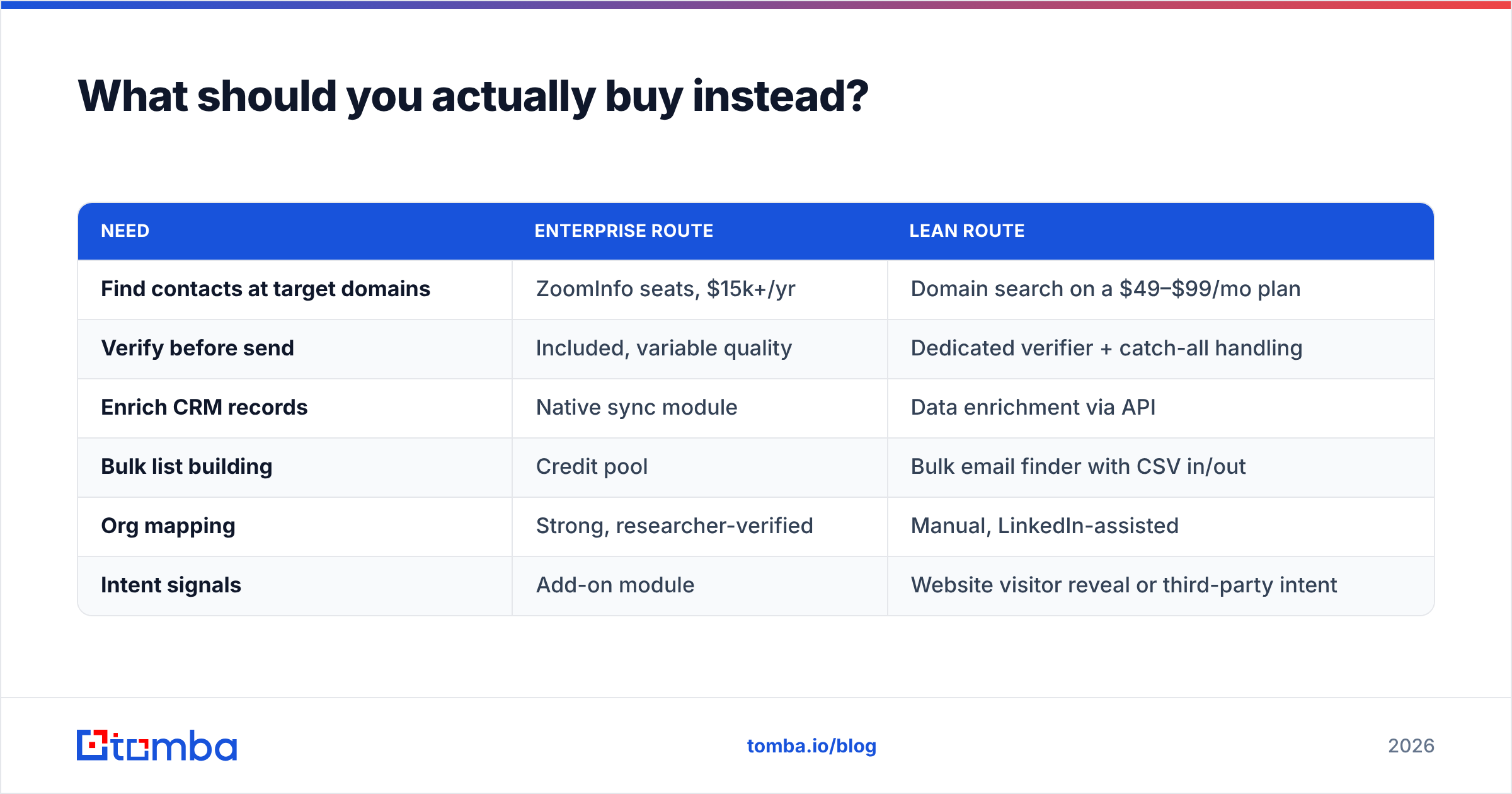
The middle of this market has improved a lot since the DiscoverOrg merger. You no longer have to pick between a five-figure enterprise contract and a scraped local-business CSV. A modern stack looks like this:
| Need | Enterprise route | Lean route |
|---|---|---|
| Find contacts at target domains | ZoomInfo seats, $15k+/yr | Domain search on a $49–$99/mo plan |
| Verify before send | Included, variable quality | Dedicated verifier + catch-all handling |
| Enrich CRM records | Native sync module | Data enrichment via API |
| Bulk list building | Credit pool | Bulk email finder with CSV in/out |
| Org mapping | Strong, researcher-verified | Manual, LinkedIn-assisted |
| Intent signals | Add-on module | Website visitor reveal or third-party intent |
Tomba sits in that gap on purpose. The free tier gives you 25 searches a month, so you can test coverage against your own target list. Starter is $49/mo, Growth is $99/mo, and Pro is $249/mo. Enterprise is quoted for teams that need volume and SLAs. The full breakdown is on the Tomba pricing page.
The point is not the price. The point is that you can test data quality on your own accounts before you commit. A 12-month enterprise contract takes that option away.
Other lean options are good at specific jobs too. BookYourData, for example, is a solid pick for a pay-as-you-go purchased list with no subscription. The category is healthy. What changed is that "enterprise contract or scraped CSV" is no longer the whole menu.
How do you run a fair evaluation?#
Skip the demo-first approach. Run this instead.
- Build a 100-account ground-truth list from deals you already won or lost. You know the real contacts, so you can score each vendor honestly.
- Ask every vendor for those same 100 accounts. Match rate on your target list is the only coverage number that means anything.
- Verify every returned email yourself. Do not accept the vendor's own validity flag as proof.
- Send one small real campaign from a warmed domain. Record the actual bounce and reply rates. Claimed accuracy and observed bounce rate are different numbers, and only one affects your sender reputation.
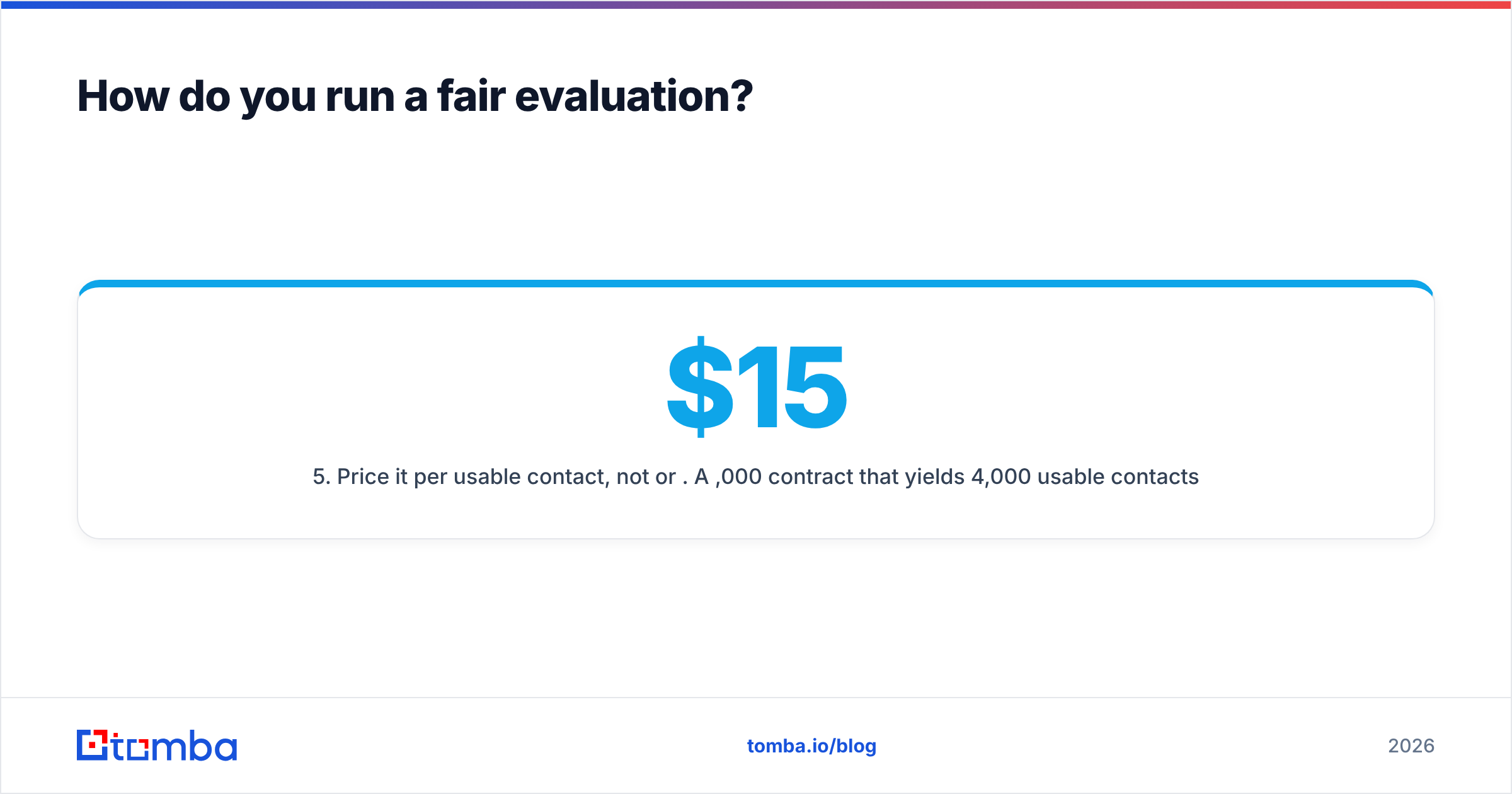
- Price it per usable contact. Not per seat, not per credit. A $15,000 contract yielding 4,000 usable contacts costs $3.75 each. A $99/month plan yielding 800 usable contacts costs $0.12 each. Now the comparison is real.
Most teams who run this test find they need to spend far less than the first quote suggested.
The verdict on DiscoverOrg vs Lead Carrot#
Choose ZoomInfo (the product once sold as DiscoverOrg) if you run enterprise ABM and sell to multi-stakeholder committees. You also need RevOps capacity to act on intent data, and a deal size that makes a five-figure annual contract small change.
Choose Lead Carrot if you are an agency or solo operator in local and SMB niches. You need lists this week, and you can live with generic inboxes and manual role research.
Choose neither if you are a 5–50 person B2B team selling to named roles at known companies. That describes most people who search "DiscoverOrg vs Lead Carrot" in the first place. One tool over-serves them and the other under-serves them.
Start with the Tomba Email Finder and run the 100-account ground-truth test above. The free tier gives you 25 searches a month. That is enough to measure match rate on accounts where you already know the answers.
If coverage holds up on your list, $49/month replaces a procurement cycle. If it does not, you lost an afternoon. Either way, you walk into the enterprise demo with real numbers instead of a vendor's slide.
Related guides#
Ready to find emails that actually work?
Join 150,000+ professionals who stopped guessing and started sending. Free credits on signup — no credit card required.
Get the Tomba newsletter
Practical outbound tactics and product updates — once every two weeks.
About the author