DiscoverOrg vs LeadFuze: Which B2B Data Tool Wins in 2026?
DiscoverOrg is now ZoomInfo, LeadFuze still sells flat-rate lead lists, and the two are aimed at completely different budgets. Here's the honest head-to-head, plus when neither is the right buy.
TL;DR
- DiscoverOrg no longer exists as a standalone product. It merged with ZoomInfo in 2019 and the brand was folded into the ZoomInfo platform, so "buying DiscoverOrg" in 2026 means signing a ZoomInfo contract.
- LeadFuze is a much smaller, self-serve lead-list builder with public pricing that has sat around $147/month for 500 leads and roughly $397/month for its unlimited tier.
- The two are not really competitors. One is a six-figure-capable GTM data platform with intent signals and org charts; the other is a flat-rate list machine for solo founders and small agencies.
- Neither is optimised for the narrow job most teams actually need: finding and verifying a specific person's work email on demand.
- If your bottleneck is contact accuracy rather than list volume, a dedicated finder-plus-verifier stack costs a fraction of either and is far easier to cancel.
What happened to DiscoverOrg, and is it still a product in 2026?#
DiscoverOrg is gone as a brand. It merged with ZoomInfo in February 2019, the combined company kept the ZoomInfo name, and by the early 2020s the DiscoverOrg login and product pages had been retired into ZoomInfo. If a sales rep pitches you "DiscoverOrg" today, they are selling you ZoomInfo Sales — usually the Professional or Advanced tier.
That matters for your evaluation in three concrete ways.
- You inherit ZoomInfo's commercial model, not DiscoverOrg's. Annual contracts, seat-based licensing, credit allocations, and auto-renewal clauses are the norm. Public pricing does not exist; you get a quote after a discovery call.
- The data assets were merged. DiscoverOrg's original edge was human-verified org charts and IT installed-technology data for enterprise accounts. That research layer still exists inside ZoomInfo, but it now sits alongside a much larger machine-assembled contact database of varying quality.
- The pricing floor moved up. DiscoverOrg was already expensive. Buyer reviews on G2 consistently describe five-figure annual commitments for small teams, with add-ons for intent, enrich, and workflow modules.
So the real comparison is: a merged enterprise data platform versus a $147/month list tool. Framing it as an even fight would be dishonest.
What is LeadFuze and who is it actually for?#
LeadFuze is a lead-list builder with two core search modes. Market Based Search lets you describe a persona — role, industry, headcount, technology used, ad spend — and returns matching people. Account Based Search takes a list of companies and finds people inside them. Its automation feature, Fuzebot, tops up your list on a schedule and de-duplicates against contacts you already have.
The pitch is simplicity. You pick filters, you get rows with names, job titles, company data, emails, and sometimes phone numbers, then you push them to a CRM or a sequencer. There is no intent-data module, no org chart research team, no conversation intelligence.
Who it fits:
- Solo founders who need 200–500 net-new contacts a month and cannot justify a platform contract.
- Small agencies building prospect lists for multiple clients where cost per lead matters more than depth per account.
- Recruiters and partnership teams doing volume outreach against loose criteria.
Who it does not fit: anyone selling into named enterprise accounts where you need to map an eleven-person buying committee, or anyone whose compliance team requires documented data provenance for every record.
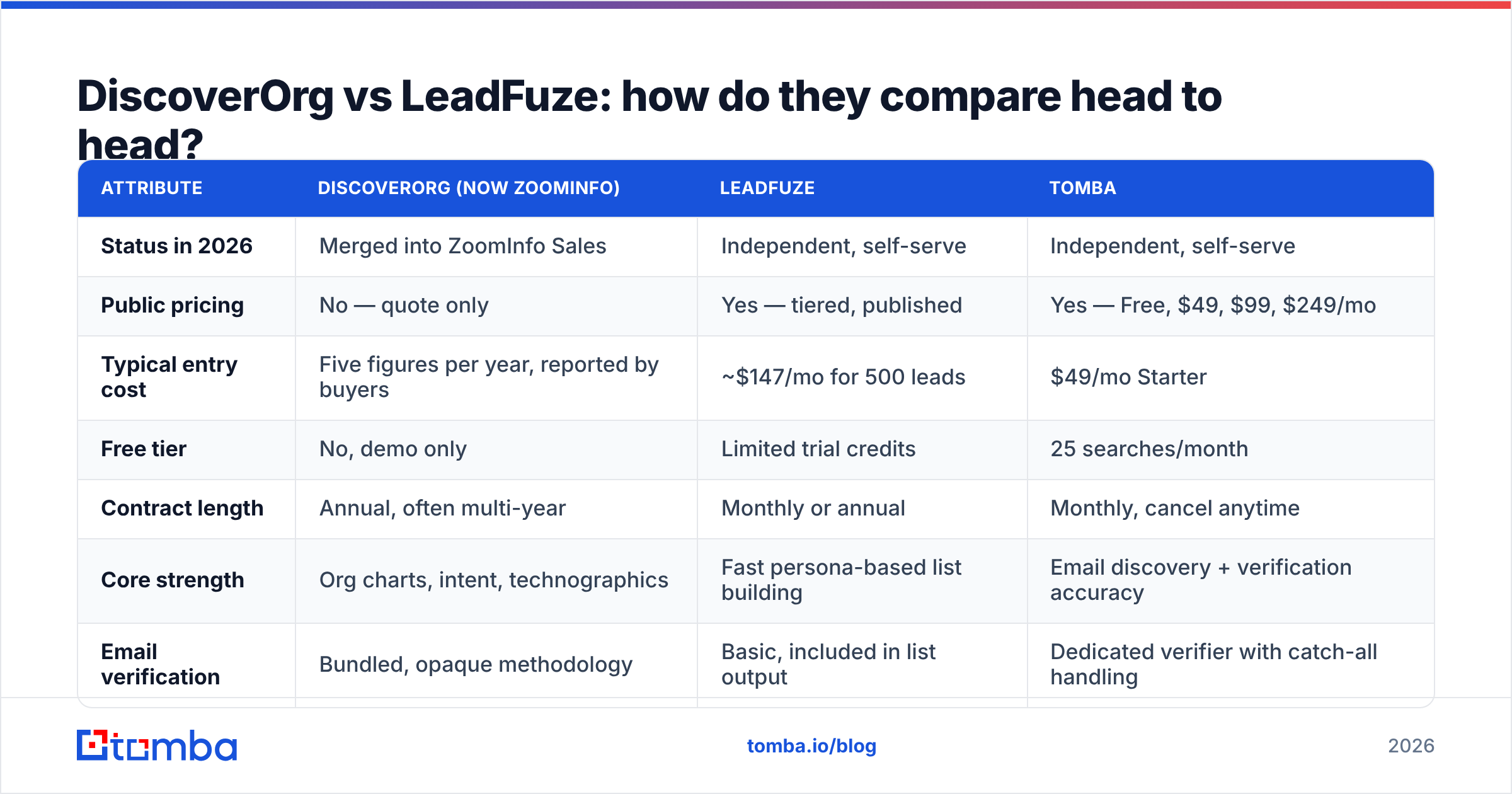
DiscoverOrg vs LeadFuze: how do they compare head to head?#
| Attribute | DiscoverOrg (now ZoomInfo) | LeadFuze | Tomba |
|---|---|---|---|
| Status in 2026 | Merged into ZoomInfo Sales | Independent, self-serve | Independent, self-serve |
| Public pricing | No — quote only | Yes — tiered, published | Yes — Free, $49, $99, $249/mo |
| Typical entry cost | Five figures per year, reported by buyers | ~$147/mo for 500 leads | $49/mo Starter |
| Free tier | No, demo only | Limited trial credits | 25 searches/month |
| Contract length | Annual, often multi-year | Monthly or annual | Monthly, cancel anytime |
| Core strength | Org charts, intent, technographics | Fast persona-based list building | Email discovery + verification accuracy |
| Email verification | Bundled, opaque methodology | Basic, included in list output | Dedicated verifier with catch-all handling |
| Phone/direct dials | Extensive, a genuine differentiator | Partial coverage | Phone finder available |
| API access | Yes, usually a paid add-on | Yes, on higher tiers | Yes, on all paid tiers |
| Best for | Enterprise ABM and named accounts | SMB volume prospecting | Precision contact discovery at scale |
| Worst for | Teams under 5 reps or tight budgets | Named-account committee mapping | Full intent-signal ABM programs |
The row that decides most evaluations is contract length. ZoomInfo's annual commitment means a bad fit costs you twelve months. LeadFuze and Tomba pricing both let you leave at the end of a month, which changes the risk calculus entirely for a team that is still figuring out its ICP.
How do the pricing models actually differ?#
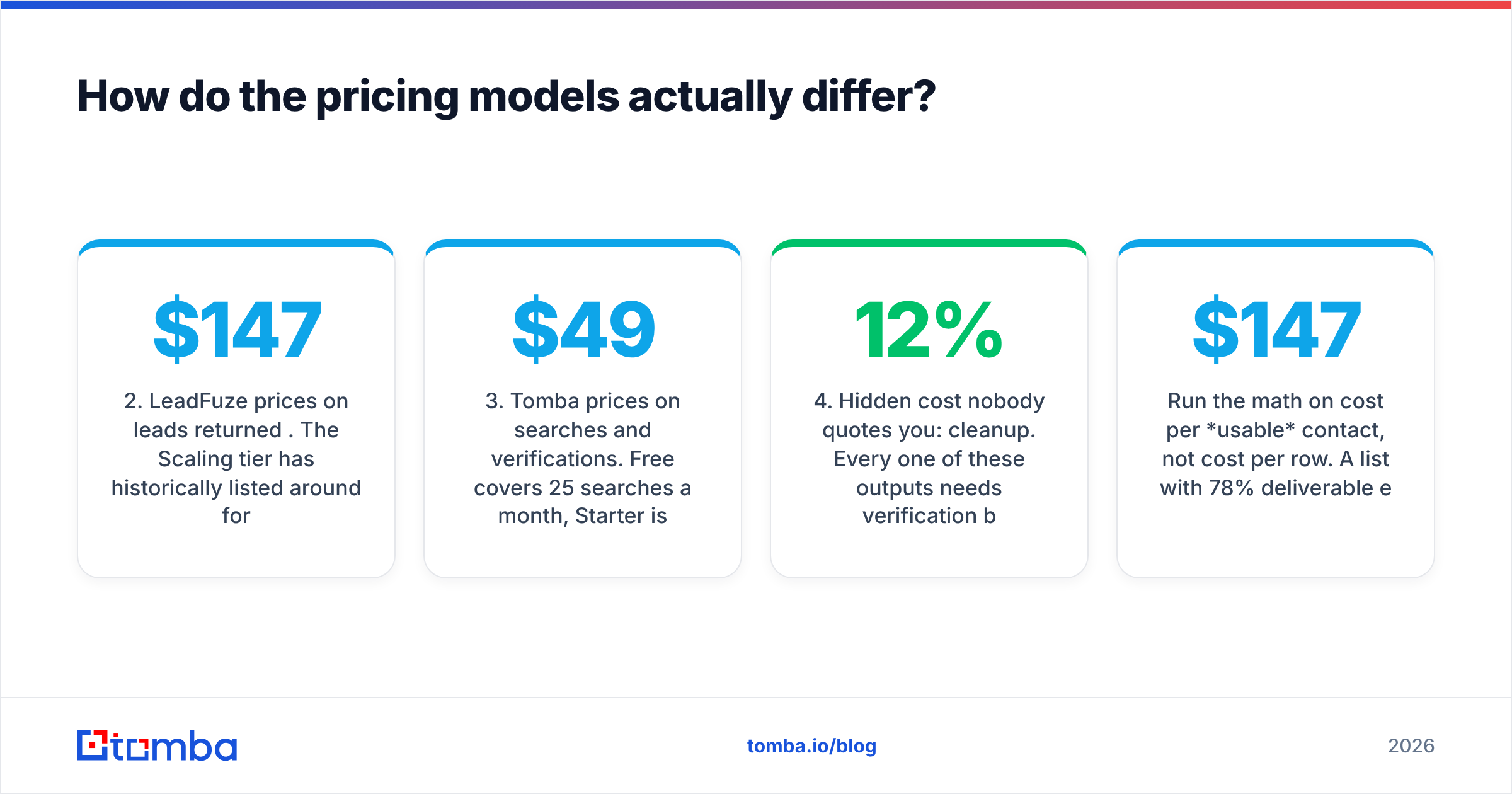
The three tools price on three different units, which is why buyers routinely compare them badly.
- ZoomInfo prices on seats plus credits plus modules. Your quote is a function of how many reps need logins, how many records you export per year, and which add-ons (Intent, Enrich, Copilot, Workflows) you attach. Overages and mid-year upgrades are common, and unused credits usually do not roll forward.
- LeadFuze prices on leads returned per month. The Scaling tier has historically listed around $147/month for 500 leads, with an unlimited tier around $397/month. Simple to forecast, but you pay for every row whether or not the email bounces.
- Tomba prices on searches and verifications. Free covers 25 searches a month, Starter is $49/mo, Growth is $99/mo, Pro is $249/mo, and Enterprise is custom. You pay for lookups, not for seats.
- Hidden cost nobody quotes you: cleanup. Every one of these outputs needs verification before it hits a sending domain. If 12% of a 500-row list is invalid, that is 60 bounces you paid twice for — once to acquire, once in sender reputation damage.
- Second hidden cost: seat sprawl. Platform contracts scale with headcount. A credit-based email finder does not care whether two people or twenty are hitting the API.
Run the math on cost per usable contact, not cost per row. A $147 list with 78% deliverable emails costs more per usable contact than a $99 plan that returns fewer rows at 95%+ deliverability.
Which one has better data accuracy?#
Honest answer: they win in different categories, and both degrade in the same place.
ZoomInfo's inherited DiscoverOrg research layer is genuinely strong on enterprise firmographics, reporting structures, and direct dials. If you sell a $250k platform into IT departments at 5,000-employee companies, that org-chart depth is hard to replicate with any cheaper tool. Its weakness is long-tail SMB coverage and staleness — the database is enormous, and enormous databases decay. B2B contact data decays at roughly 25–30% per year as people change jobs, which no vendor fully escapes.
LeadFuze is competitive on breadth for SMB and mid-market personas, and its double-verification claim on emails is a real feature rather than marketing. Its weakness is depth per account: you get the person, not the buying committee, and its technographic and behavioural filters are thinner.
Both share the catch-all problem. When a domain accepts mail for any address, neither platform can prove a specific mailbox exists — it just gets flagged and passed to you. That is where a dedicated catch-all verifier earns its keep, because the difference between "accepted by the server" and "actually delivered to a human" is where cold campaigns quietly die.
A practical test before you sign anything: take 100 contacts you already know are correct, run them through each vendor's trial, and score three things — match rate, format accuracy, and how many are flagged catch-all. Vendors will not volunteer this benchmark. Run it yourself.
Which one fits your team?#
Match the tool to the motion, not to the feature list.
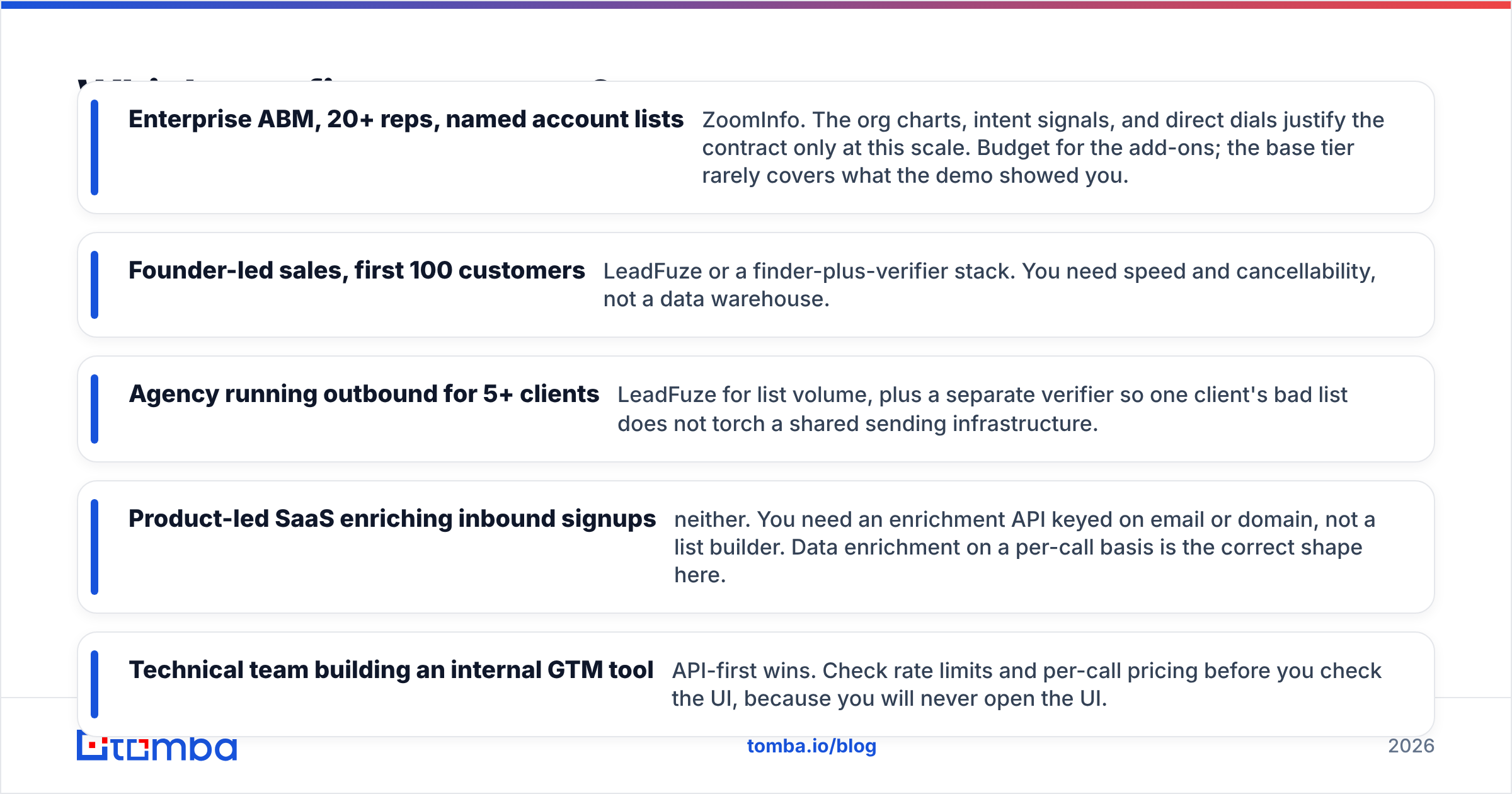
- Enterprise ABM, 20+ reps, named account lists — ZoomInfo. The org charts, intent signals, and direct dials justify the contract only at this scale. Budget for the add-ons; the base tier rarely covers what the demo showed you.
- Founder-led sales, first 100 customers — LeadFuze or a finder-plus-verifier stack. You need speed and cancellability, not a data warehouse.
- Agency running outbound for 5+ clients — LeadFuze for list volume, plus a separate verifier so one client's bad list does not torch a shared sending infrastructure.
- Product-led SaaS enriching inbound signups — neither. You need an enrichment API keyed on email or domain, not a list builder. Data enrichment on a per-call basis is the correct shape here.
- Technical team building an internal GTM tool — API-first wins. Check rate limits and per-call pricing before you check the UI, because you will never open the UI.
Worth noting that the "buy one platform for everything" instinct is usually the expensive mistake. Teams that unbundle — a list source, a verifier, a sequencer, a CRM — routinely pay less and switch faster than teams locked into a suite. The counter-argument is real too: four vendors means four invoices, four security reviews, and four places for data to drift. Pick unbundling if your process changes often; pick a suite if it does not.
Where does a dedicated email finder fit alongside either tool?#
Most teams that end up unhappy with either platform have the same underlying complaint: they bought a database when they needed a lookup service.
The distinction is simple. A database sells you access to rows it already has. A lookup service answers a question you bring to it — "what is the work email for this person at this company?" — and returns a verified answer with a confidence score. If your prospecting starts from a list of target companies or a LinkedIn export rather than from filter checkboxes, you want the second thing.
That is the gap Tomba fills. Feed it a domain and get the contact pattern plus known addresses via domain search; feed it a name and company and get the specific address; run the output through the email verifier before it touches your sending domain. The Tomba API is available on every paid tier rather than gated behind an enterprise upgrade, which matters if you plan to wire this into your own workflow.
It is not a replacement for ZoomInfo's intent data or org charts — if you need those, you need ZoomInfo. It is a replacement for the contact discovery portion of either tool, at a materially lower cost, with no annual lock-in.
What should you check before signing either contract?#
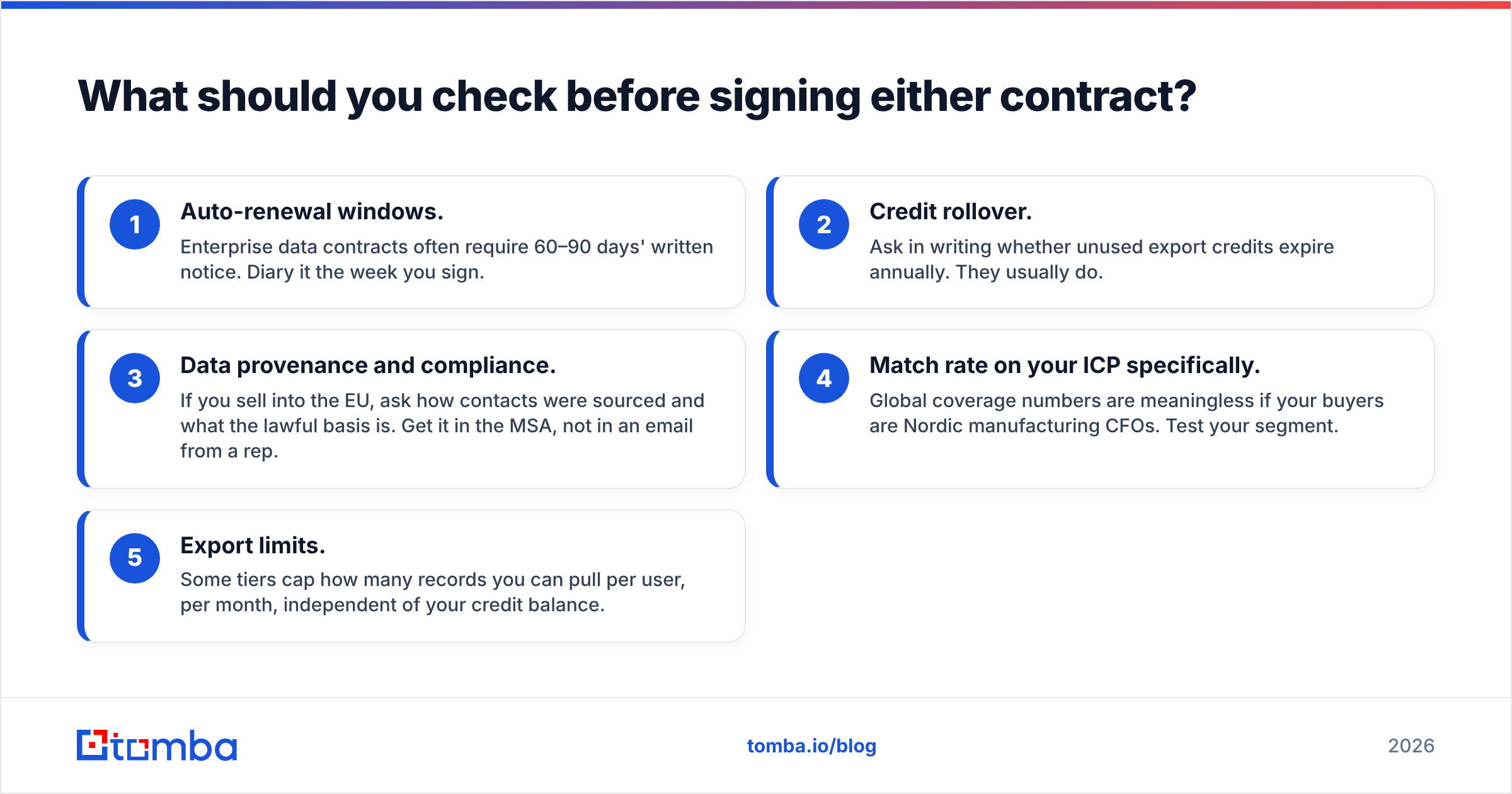
Five things buyers skip and regret:
- Auto-renewal windows. Enterprise data contracts often require 60–90 days' written notice. Diary it the week you sign.
- Credit rollover. Ask in writing whether unused export credits expire annually. They usually do.
- Data provenance and compliance. If you sell into the EU, ask how contacts were sourced and what the lawful basis is. Get it in the MSA, not in an email from a rep.
- Match rate on your ICP specifically. Global coverage numbers are meaningless if your buyers are Nordic manufacturing CFOs. Test your segment.
- Export limits. Some tiers cap how many records you can pull per user, per month, independent of your credit balance.
Run the same five questions at both vendors. The answers separate them faster than any feature grid.
The bottom line#
DiscoverOrg vs LeadFuze is a comparison between a product that no longer exists under that name and a tool built for a completely different buyer. ZoomInfo — DiscoverOrg's successor — is the right call for enterprise ABM teams with budget and a need for org charts, intent, and direct dials. LeadFuze is the right call for small teams that want predictable flat-rate list volume without a sales call.
If what you actually need is accurate, verified work emails for people you have already identified — and you would rather not commit to a year of anything — start with the Tomba Email Finder. The free tier gives you 25 searches a month to benchmark match rates against your own known-good list, Starter is $49/mo, and you can leave whenever your process changes. Test it against your ICP before you sign anyone's annual contract.
Related guides#
Ready to find emails that actually work?
Join 150,000+ professionals who stopped guessing and started sending. Free credits on signup — no credit card required.
Get the Tomba newsletter
Practical outbound tactics and product updates — once every two weeks.
About the author