DiscoverOrg vs LeadGenius: Which B2B Data Tool Wins in 2026?
DiscoverOrg no longer exists as its own product, and LeadGenius sells something completely different from what most buyers assume. Here's the honest 2026 comparison, including what each actually costs.
DiscoverOrg vs LeadGenius is the wrong fight in 2026. DiscoverOrg is gone as a product — it is ZoomInfo now. LeadGenius was never a database at all. Here is what each one really sells, what it costs, and when a $49 email finder beats both.
TL;DR
DiscoverOrg is not a standalone product anymore. It bought ZoomInfo in 2019 and took the ZoomInfo name. The old platform was folded in. If a vendor pitches you "DiscoverOrg" in 2026, you are buying ZoomInfo.
LeadGenius is not a database. It is a managed research service. Humans plus ML build custom datasets and custom fields to your spec. Different product. Different buying process. Different failure modes.
Both are enterprise-priced. Reported annual contracts start in the low five figures and climb fast. Neither posts a price page. Neither has a real self-serve tier.
Most teams comparing them need neither. Say your real need is verified work emails for a known list of people. A per-lookup tool at $49–$99/mo covers that for a fraction of the cost.
The honest DiscoverOrg vs LeadGenius split: ZoomInfo for broad US coverage, intent, and org charts. LeadGenius for odd custom fields no database tracks. A focused email finder for everything in between.
What actually happened to DiscoverOrg?#
DiscoverOrg acquired ZoomInfo in February 2019. Then it took the acquired company's name, in one of the odder brand moves in sales tech. The combined company went public in 2020 as ZoomInfo Technologies (NASDAQ: ZI). The DiscoverOrg product was absorbed into the ZoomInfo platform.
That matters for your evaluation in three concrete ways:
DiscoverOrg's original edge was human-verified org charts in IT, marketing, finance, and HR. That research discipline still lives inside ZoomInfo's org-chart data. But it is one feature among dozens now, not the whole product.
The pricing model changed. DiscoverOrg sold department-scoped datasets. ZoomInfo sells seats plus credits plus modules (Intent, Engage, Chat, Operations). The quote grows with every module you attach.
Old DiscoverOrg reviews are stale. Anything written before 2020 describes a product that no longer exists. Filter your G2 research to the last 18 months, or you will compare against a ghost.
So the real 2026 version of DiscoverOrg vs LeadGenius is ZoomInfo (formerly DiscoverOrg) against LeadGenius. One is a giant fixed database. The other is a made-to-order research operation.

What is LeadGenius, and why is it not a database?#
LeadGenius sells custom B2B data. You describe the accounts and attributes you care about. A mix of machine extraction and a distributed human research team builds the dataset and refreshes it on a set cadence. Delivery runs through their Flow browser extension, CSV, API, or direct CRM sync.
That distinction is the whole point. A database vendor answers "what do you already have on this company?" LeadGenius answers "can you go find out?" That unlocks fields no off-the-shelf provider tracks:
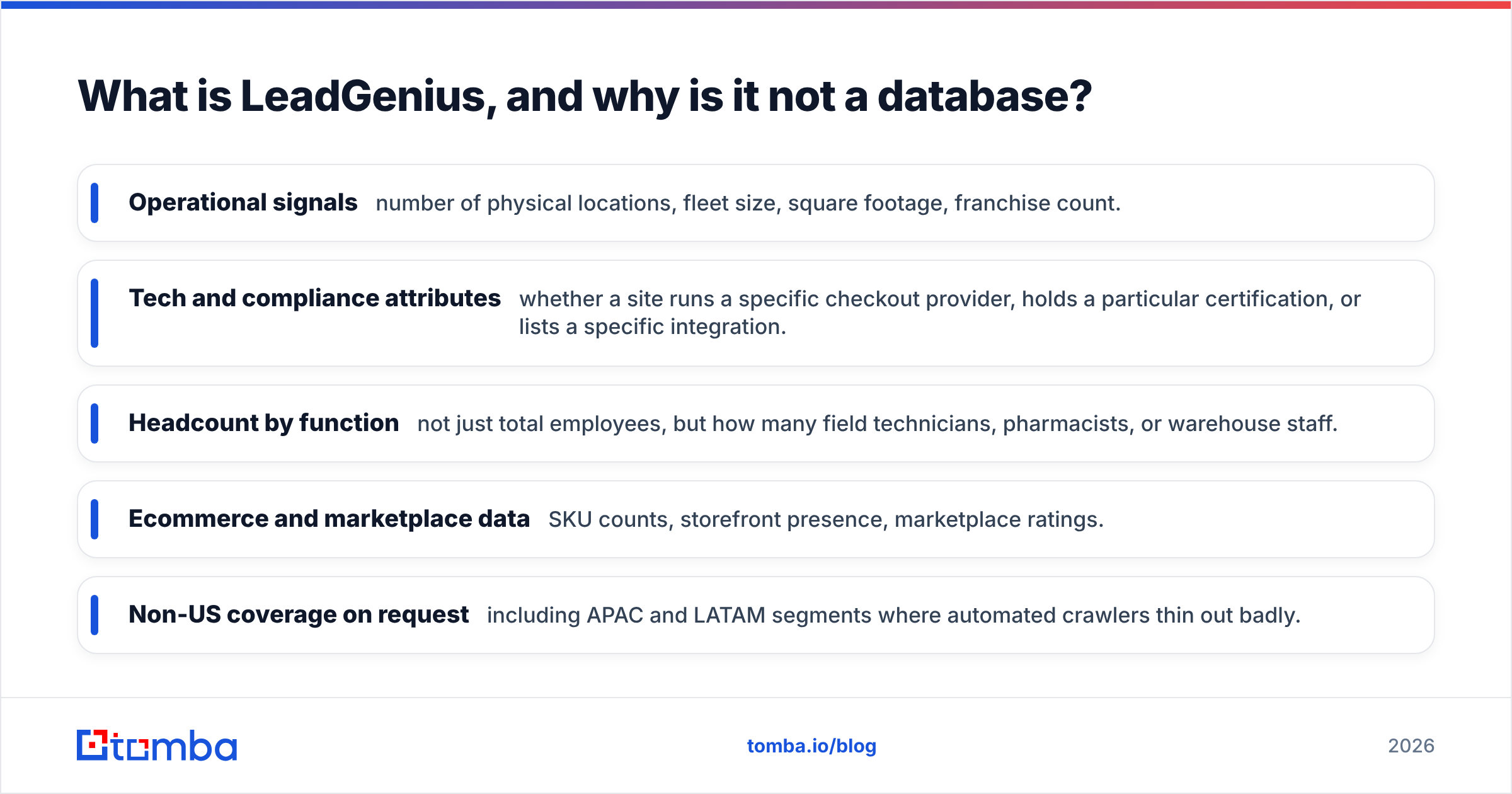
- Operational signals — number of physical locations, fleet size, square footage, franchise count.
- Tech and compliance attributes — whether a site runs a specific checkout provider, holds a certification, or lists an integration.
- Headcount by function — not just total employees, but how many field technicians, pharmacists, or warehouse staff.
- Ecommerce and marketplace data — SKU counts, storefront presence, marketplace ratings.
- Non-US coverage on request — including APAC and LATAM, where automated crawlers thin out badly.
The tradeoff is speed. First delivery takes weeks, not minutes. Refresh cycles are contractual, not instant. You are buying a research team, not a search box.
DiscoverOrg vs LeadGenius: how do they compare head to head?#
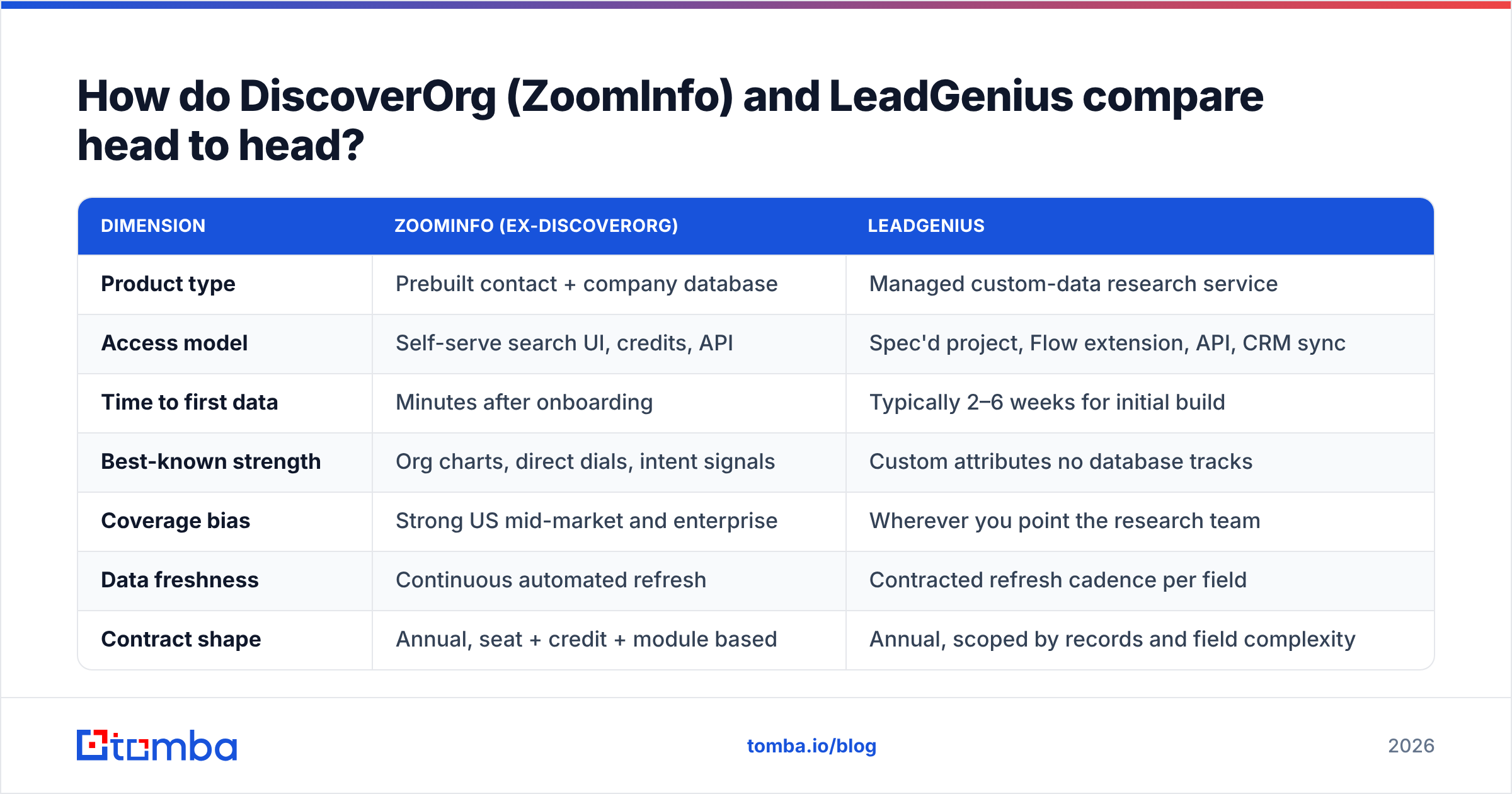
| Dimension | ZoomInfo (ex-DiscoverOrg) | LeadGenius |
|---|---|---|
| Product type | Prebuilt contact + company database | Managed custom-data research service |
| Access model | Self-serve search UI, credits, API | Spec'd project, Flow extension, API, CRM sync |
| Time to first data | Minutes after onboarding | Typically 2–6 weeks for initial build |
| Best-known strength | Org charts, direct dials, intent signals | Custom attributes no database tracks |
| Coverage bias | Strong US mid-market and enterprise | Wherever you point the research team |
| Data freshness | Continuous automated refresh | Contracted refresh cadence per field |
| Contract shape | Annual, seat + credit + module based | Annual, scoped by records and field complexity |
| Reported entry cost | Low five figures per year | Low-to-mid five figures per year |
| Free tier | No (limited trial via sales) | No |
| Who it fits | Broad outbound at volume | Narrow, high-value, unusual ICP |
Read that table twice before you shortlist. These are not two versions of the same thing. Pick on price alone and you get the wrong tool at the right number.
Which one has better data accuracy?#
Every DiscoverOrg vs LeadGenius thread lands here. It is the wrong question. Ask instead: accurate about what?
ZoomInfo is strong on the fields it maintains at scale. Think company firmographics, job titles, and corporate emails at established US companies. It slips where every large database slips: recent job changes, sub-50-employee companies, non-English markets, and catch-all domains. Buyer reports and review-site commentary put bounce rates for large aggregators in the mid single digits to low teens. The exact number depends on segment and list age.
LeadGenius is usually more accurate on custom fields, because a human checked each one. But the sample is smaller and the cost per record is higher. The data also ages between contracted refreshes. A "number of retail locations" field checked in March is not a March fact by October.
Two practical rules apply to either vendor:
Never trust a purchased list without re-verification at send time. Records decay roughly 2–2.5% per month as people change jobs. A six-month-old export is much worse than the day it landed. Run it through an email verifier before it touches your sequencer.
Test with your own list, not their sample. Hand each vendor the same 200 accounts from your real pipeline. Compare match rate, field completeness, and bounce rate. Vendor samples are curated by definition.
What do they actually cost in 2026?#
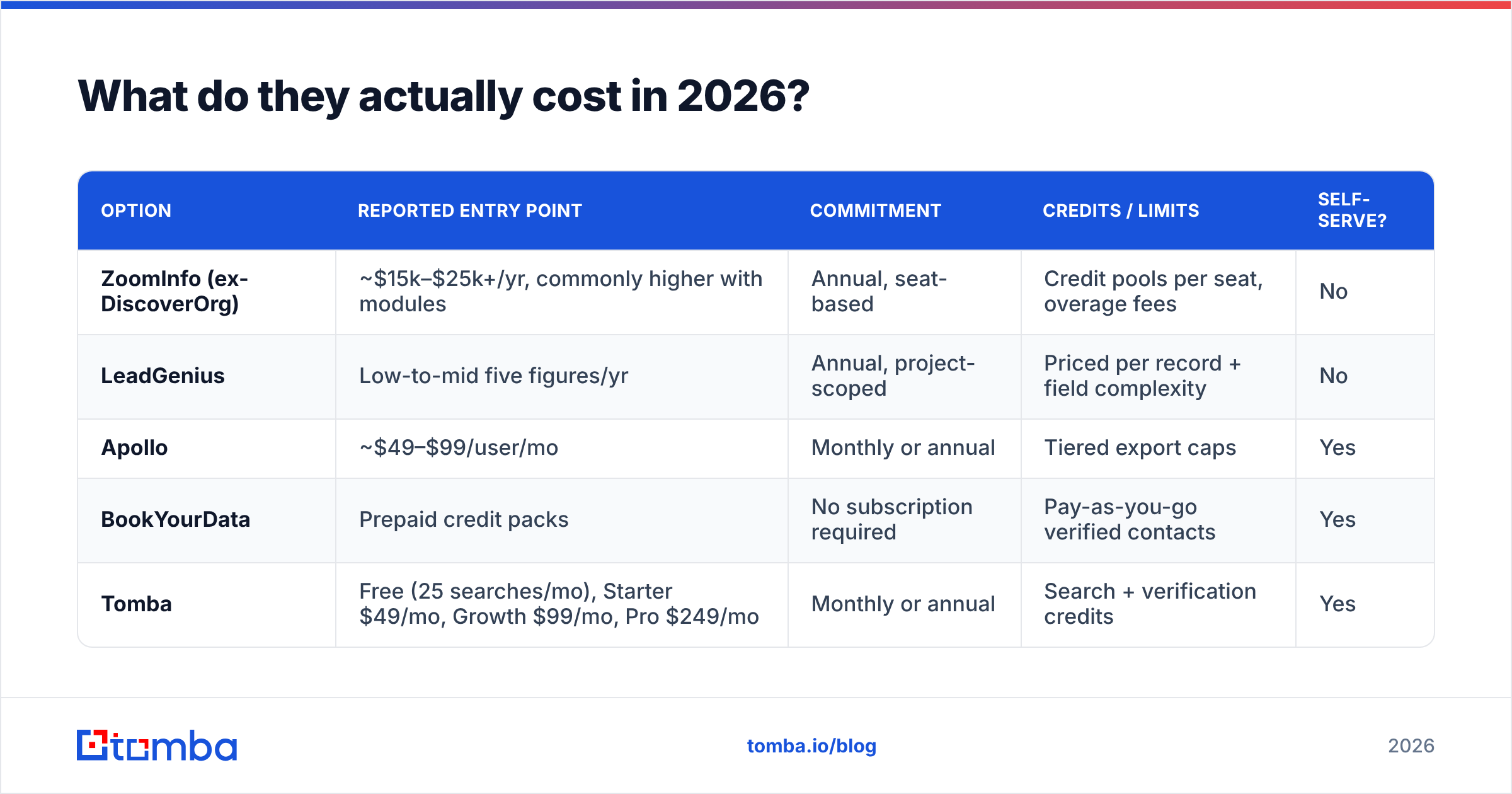
Neither vendor publishes DiscoverOrg vs LeadGenius pricing, and that silence is itself a signal about the buying process. Here is what buyers report, with self-serve options for context.
| Option | Reported entry point | Commitment | Credits / limits | Self-serve? |
|---|---|---|---|---|
| ZoomInfo (ex-DiscoverOrg) | ~$15k–$25k+/yr, commonly higher with modules | Annual, seat-based | Credit pools per seat, overage fees | No |
| LeadGenius | Low-to-mid five figures/yr | Annual, project-scoped | Priced per record + field complexity | No |
| Apollo | ~$49–$99/user/mo | Monthly or annual | Tiered export caps | Yes |
| BookYourData | Prepaid credit packs | No subscription required | Pay-as-you-go verified contacts | Yes |
| Tomba | Free (25 searches/mo), Starter $49/mo, Growth $99/mo, Pro $249/mo | Monthly or annual | Search + verification credits | Yes |
Two honest notes on that table. First, both enterprise quotes swing wildly by scope. The numbers above are reported ranges, not list prices. Your quote will reflect headcount, modules, and how much leverage you have.
Second, BookYourData is worth a look if your problem is procurement friction rather than data depth. Prepaid credits with no annual contract help teams who cannot get a five-figure PO approved this quarter.
Tomba's pricing sits at the other end on purpose. It does one job — find and verify professional email addresses — and charges per lookup instead of per seat.

Who should pick which?#
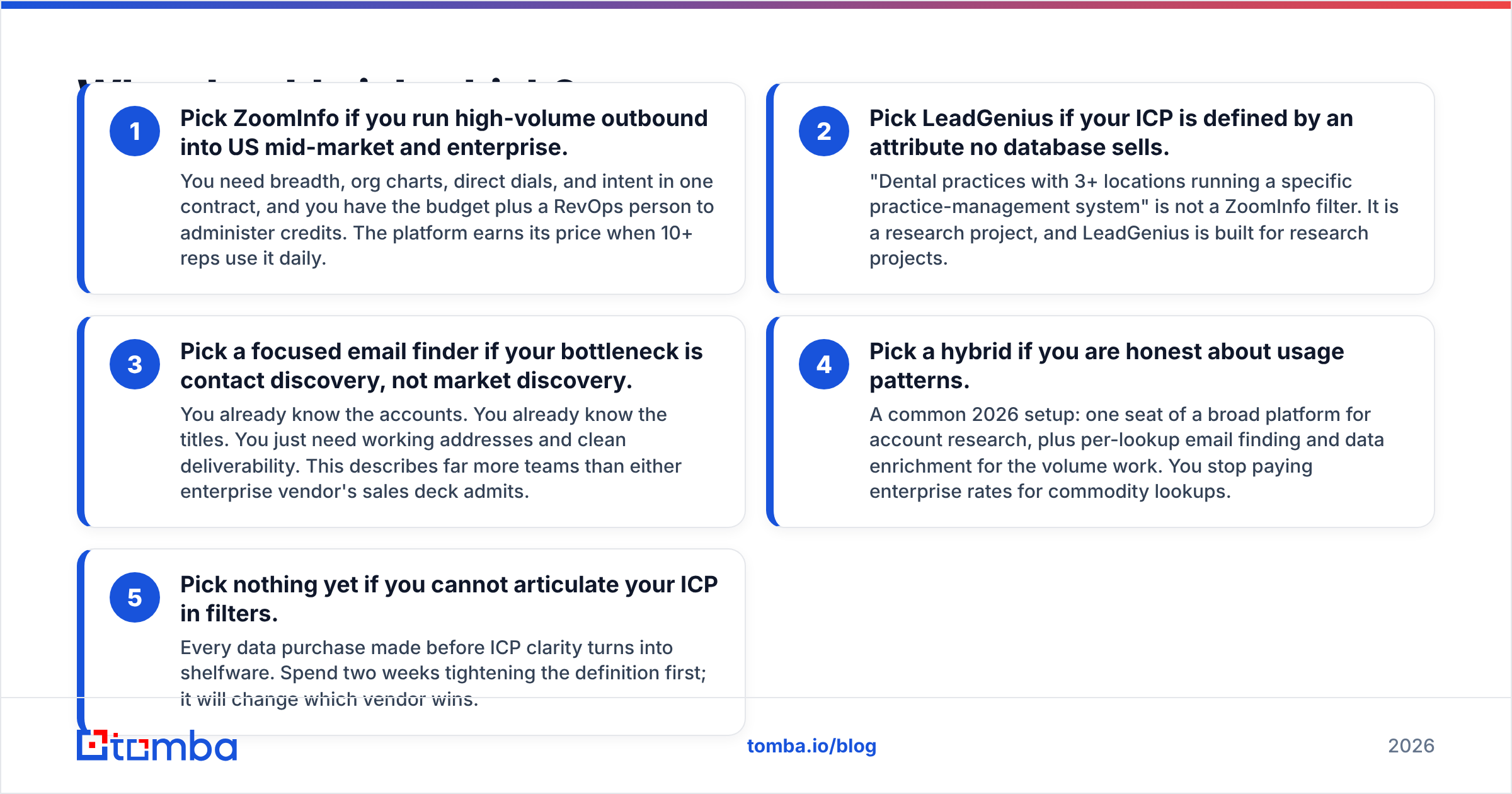
Pick ZoomInfo if you run high-volume outbound into US mid-market and enterprise. You want breadth, org charts, direct dials, and intent in one contract. You also need the budget and a RevOps person to manage credits. The platform earns its price when 10+ reps use it daily.
Pick LeadGenius if your ICP depends on an attribute no database sells. "Dental practices with 3+ locations running a specific practice-management system" is not a ZoomInfo filter. It is a research project, and LeadGenius is built for research projects.
Pick a focused email finder if your bottleneck is contact discovery, not market discovery. You already know the accounts. You already know the titles. You just need working addresses and clean deliverability. That describes more teams than either sales deck admits.
Pick a hybrid if you are honest about usage. A common 2026 setup: one seat of a broad platform for account research, plus per-lookup email finding and data enrichment for volume work. You stop paying enterprise rates for commodity lookups.
Pick nothing yet if you cannot state your ICP in filters. Data bought before ICP clarity turns into shelfware. Spend two weeks tightening the definition first. It will change which vendor wins.
How do you run a fair DiscoverOrg vs LeadGenius test in one week?#
Skip the six-week enterprise dance. Compress it:
Day 1 — Build the test set. Pull 200 real target accounts from your CRM. Include 40 you already have verified contacts for. Those 40 are your answer key.
Day 2 — Define the fields that matter. Write down the five attributes you would actually filter on. If three are exotic, LeadGenius moves up. If all five are standard firmographics, it drops.
Day 3 — Request identical trials. Give every vendor the same 200 accounts and the same field spec. Refuse curated samples.
Day 4 — Score match rate and completeness. What share of accounts returned a contact? What share of contacts had all five fields filled in?
Day 5 — Score deliverability yourself. Run every returned address through a third-party verifier. Vendor-reported accuracy and observed bounce rate are different numbers. Only one of them costs you sender reputation.
Day 6 — Price per usable record. Divide annual cost by the records that passed steps 4 and 5. This is the only cost metric that matters, and it often reorders shortlists.
Day 7 — Check the exit. Can you export your data? Who owns enriched records when the contract ends? Enterprise data contracts have teeth here.
What about catch-all domains and job changes?#
This is where most comparisons quietly fall apart. Handle it head on.
Roughly a fifth of B2B domains are catch-all. The mail server accepts anything at that domain, so standard SMTP checks return an unhelpful "maybe." Large databases treat this inconsistently. Some mark catch-alls as valid, which inflates their accuracy stat. Others drop them, which shrinks coverage. Ask each vendor how they classify catch-alls. Then confirm the answer with a dedicated catch-all verifier.
Job changes are the second leak. Someone who moved in March still sits in a Q1 export as a valid contact at the old employer. Neither a database refresh nor a quarterly research cadence catches that fast enough for outbound. The fix is process, not vendor: re-verify at send time, every time. Teams that wire verification into the sequencer with the Tomba API stop thinking about it.
The verdict#
DiscoverOrg vs LeadGenius in 2026 is really ZoomInfo's breadth against LeadGenius's bespoke depth. Both will cost you five figures a year. ZoomInfo wins on speed, coverage, and daily usability for large outbound teams. LeadGenius wins when your ICP depends on attributes no database sells and you can wait weeks for the answer.
There is an uncomfortable third option. Many teams weighing these two have a contact-discovery problem and an enterprise-data budget. If your target accounts are already written down, and you only need verified work emails, the enterprise contract is overkill.
Start there before you sign anything. Run your target domains through Tomba Email Finder on the free tier — 25 searches a month, no card. See what share of your list resolves to a verified address. If the hit rate covers your pipeline, Starter at $49/mo replaces a contract that costs 300 times more. If it does not, you will know exactly which gaps justify the enterprise call. And you will walk into that call with data instead of a demo.
Related guides#
Ready to find emails that actually work?
Join 150,000+ professionals who stopped guessing and started sending. Free credits on signup — no credit card required.
Get the Tomba newsletter
Practical outbound tactics and product updates — once every two weeks.
About the author