DiscoverOrg vs LeadGibbon: B2B Data Tools Compared 2026
DiscoverOrg no longer exists as a standalone product, and LeadGibbon plays a completely different game. Here is what each one actually is in 2026, what they cost, and which fits your outbound motion.
TL;DR#
- DiscoverOrg vs LeadGibbon has a catch: you cannot buy DiscoverOrg anymore. It merged with ZoomInfo in 2019. The brand is gone. Say "DiscoverOrg" in 2026 and you mean ZoomInfo.
- LeadGibbon is a LinkedIn-first list builder. It is a Chrome extension that pulls contacts into a sheet. Nothing more.
- The price gap is huge. ZoomInfo deals often run five figures a year. LeadGibbon costs a low monthly fee.
- Pick ZoomInfo for org charts, intent data, and wide coverage. Pick LeadGibbon if one to five reps build lists off LinkedIn.
- Want accuracy and an API with no sales call? A dedicated email finder is often the cheaper third path.
Why DiscoverOrg vs LeadGibbon is really ZoomInfo vs LeadGibbon#
DiscoverOrg bought ZoomInfo in 2019. It then took the ZoomInfo name. The DiscoverOrg brand was retired. Land on a "DiscoverOrg pricing" page today and you get an old article or a redirect to zoominfo.com.
Three things changed, and each one matters:
- The data changed. DiscoverOrg sold deep, hand-checked org charts for IT and marketing teams. Narrow, but rich. ZoomInfo is broader, built by machine, and refreshed at scale. You gain reach. You lose some of the hand-built depth.
- The pricing changed. DiscoverOrg sold datasets by department. ZoomInfo sells seats plus credits, then add-ons for intent, call review, and outreach. Your quote depends on what the rep adds.
- Old reviews mislead. G2 and Capterra posts from before 2020 describe a tool that is gone. Sort reviews by date, or you judge a ghost.
So DiscoverOrg vs LeadGibbon is really ZoomInfo vs LeadGibbon: a large data platform against a small list builder.
What is LeadGibbon, exactly?#
LeadGibbon is a list tool built around LinkedIn Sales Navigator. You run a search. The extension grabs the results. It then adds work emails and company fields, and exports to Google Sheets or CSV. Its own site sells it as a fast way to turn a Sales Navigator search into an outbound list.
What you get:
- Speed on one job. Search, list, export. A few minutes, and no CRM setup.
- Pay for what you pick. You buy credits and spend them on the leads you want.
- Low switching cost. There is nothing to roll out. If it flops, you cancel.
What you do not get: intent signals, deep tech data, org charts, buying committee maps, territory-wide exports, or a real enterprise API. Those gaps are on purpose. They sit outside the product. That is the core split in DiscoverOrg vs LeadGibbon: reach against speed.
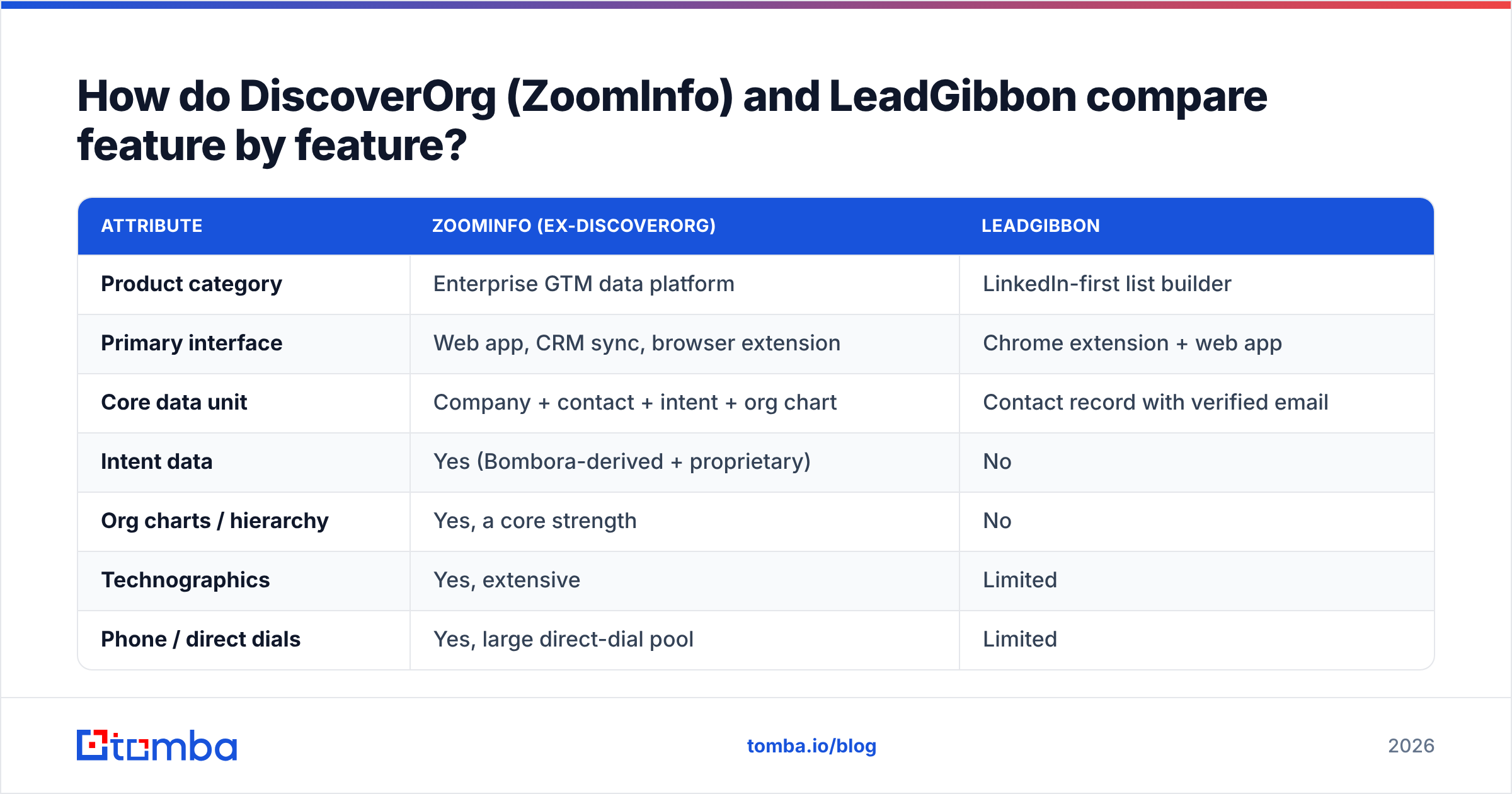
DiscoverOrg vs LeadGibbon: feature-by-feature comparison#
| Attribute | ZoomInfo (ex-DiscoverOrg) | LeadGibbon |
|---|---|---|
| Product category | Enterprise GTM data platform | LinkedIn-first list builder |
| Primary interface | Web app, CRM sync, browser extension | Chrome extension + web app |
| Core data unit | Company + contact + intent + org chart | Contact record with verified email |
| Intent data | Yes (Bombora-derived + proprietary) | No |
| Org charts / hierarchy | Yes, a core strength | No |
| Technographics | Yes, extensive | Limited |
| Phone / direct dials | Yes, large direct-dial pool | Limited |
| Native CRM sync | Salesforce, HubSpot, Dynamics, more | Export to Sheets/CSV; Zapier-style workarounds |
| API access | Yes, enterprise tier | Minimal |
| Contract | Annual, seat + credit based | Monthly, credit based |
| Typical buyer | 20+ rep sales org, RevOps-led | Founder, solo rep, small agency |
| Time to first list | Days (onboarding + training) | Minutes |
| Free trial | Gated demo, limited free tier | Small free allowance |
The honest summary: these two are not rivals. They meet in one comparison because both hand you a work email. Everything around that email is different.
Which one has better data accuracy?#
Data accuracy is where DiscoverOrg vs LeadGibbon gets interesting. ZoomInfo wins on breadth. LeadGibbon can win on freshness in its slice, because people update their own LinkedIn profiles.
Here is the split most buyers miss. B2B data fails in two ways:
- Nothing found. You search and the tool has no record. Large databases fail here less often.
- Stale record. The tool answers with confidence, but the person left 14 months ago. Large databases fail here more often. The same record gets served again until something forces a refresh.
Every static database decays. Published estimates put B2B contact decay near 25-30% a year, mostly from job changes. That number moves with the job market, so treat it as a rough scale. The lesson holds either way. Whatever you buy, verify before you send.

That is why many teams split the job. They use a database to find people. Then they use a separate email verifier as a gate, right before the list enters a sequence. A record that passed an SMTP check this morning beats one marked "human verified" 18 months ago.
Do your targets sit on catch-all domains? Add a catch-all verifier too. Standard SMTP checks return "accept all" there and tell you nothing.
What does DiscoverOrg vs LeadGibbon cost?#
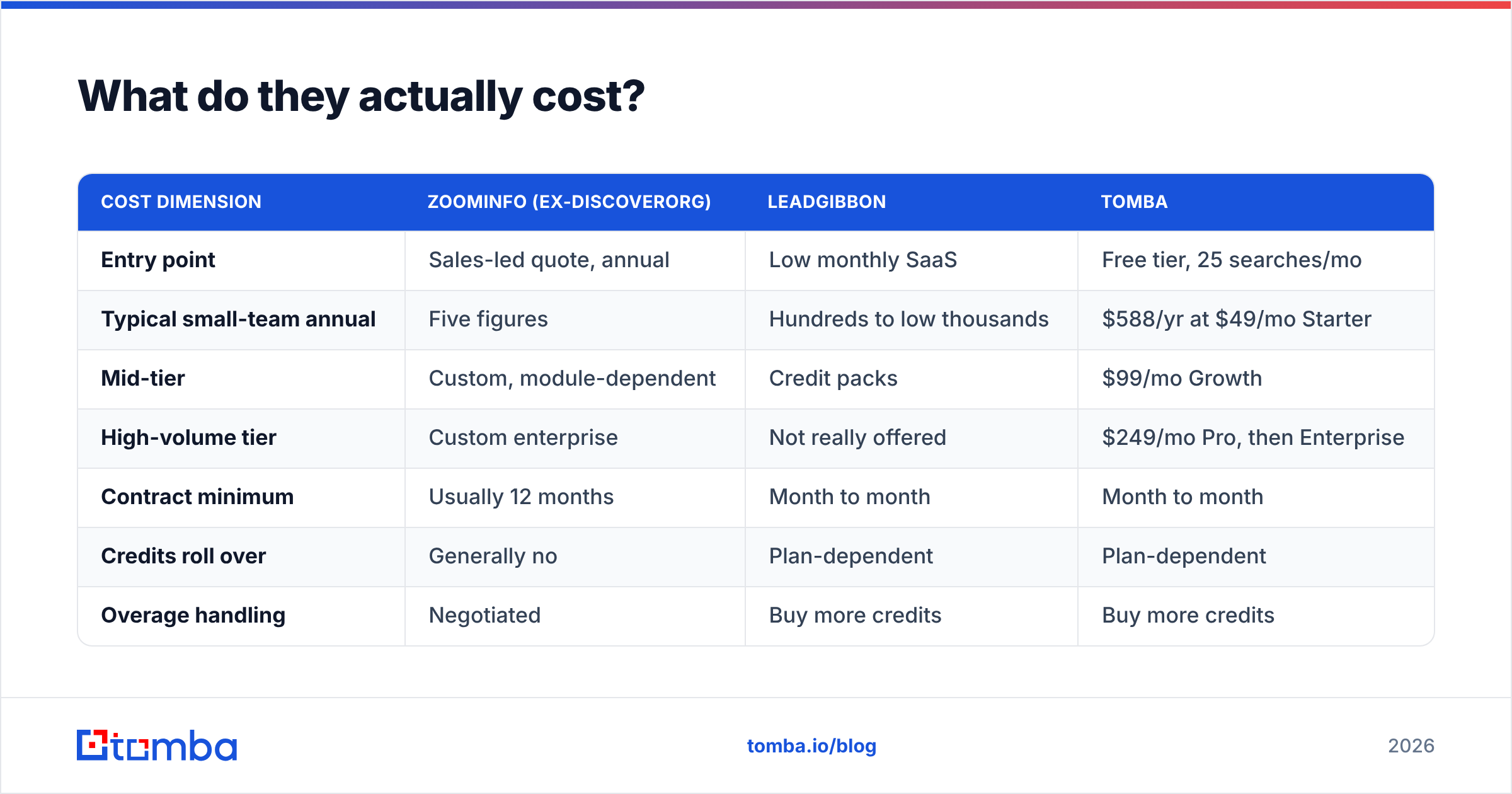
Neither vendor posts a clear price list at the top end. Treat the table below as a planning range and confirm with the vendor. Prices change. The shape of the pricing does not.
| Cost dimension | ZoomInfo (ex-DiscoverOrg) | LeadGibbon | Tomba |
|---|---|---|---|
| Entry point | Sales-led quote, annual | Low monthly SaaS | Free tier, 25 searches/mo |
| Typical small-team annual | Five figures | Hundreds to low thousands | $588/yr at $49/mo Starter |
| Mid-tier | Custom, module-dependent | Credit packs | $99/mo Growth |
| High-volume tier | Custom enterprise | Not really offered | $249/mo Pro, then Enterprise |
| Contract minimum | Usually 12 months | Month to month | Month to month |
| Credits roll over | Generally no | Plan-dependent | Plan-dependent |
| Overage handling | Negotiated | Buy more credits | Buy more credits |
Three cost traps worth naming:
- Seat minimums. Large data platforms often set a floor on seats. A team of three may still be quoted for five or ten. Ask about the floor early.
- Add-on bundling. Intent, call review, and visitor tracking are sold on top, and they raise the number a lot. If you only need contact data, say so and ask for that price alone.
- A year of lock-in on a decaying asset. You pay 12 months up front. The data loses about a quarter of its accuracy over the same 12 months. That trade works at scale. At five seats it does not.
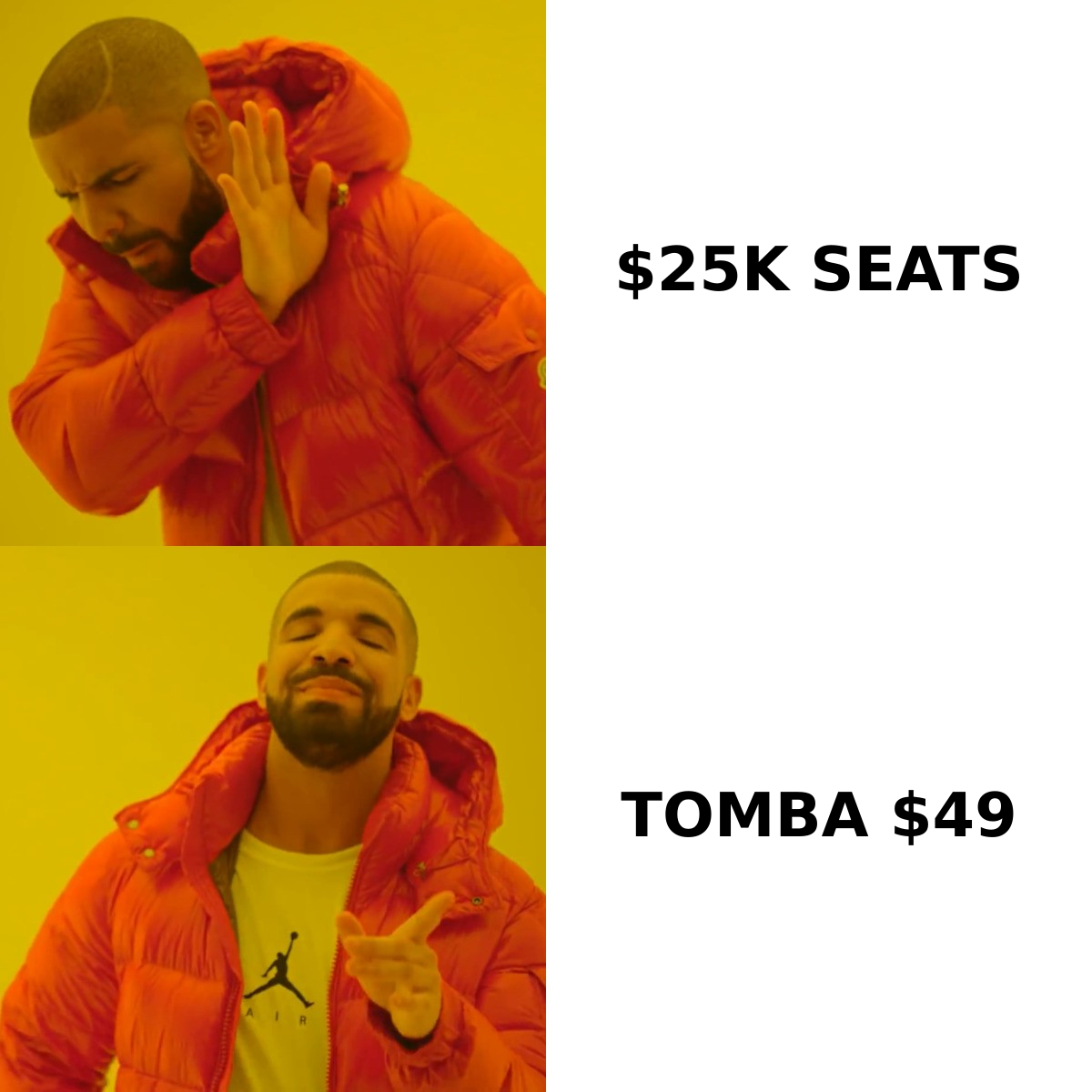
See Tomba pricing for a clear comparison point. The plans are public, month to month, and start free, so you can measure hit rate on your own domains before you spend.
Who should choose which?#
Pick by the shape of your motion, not by the feature grid.
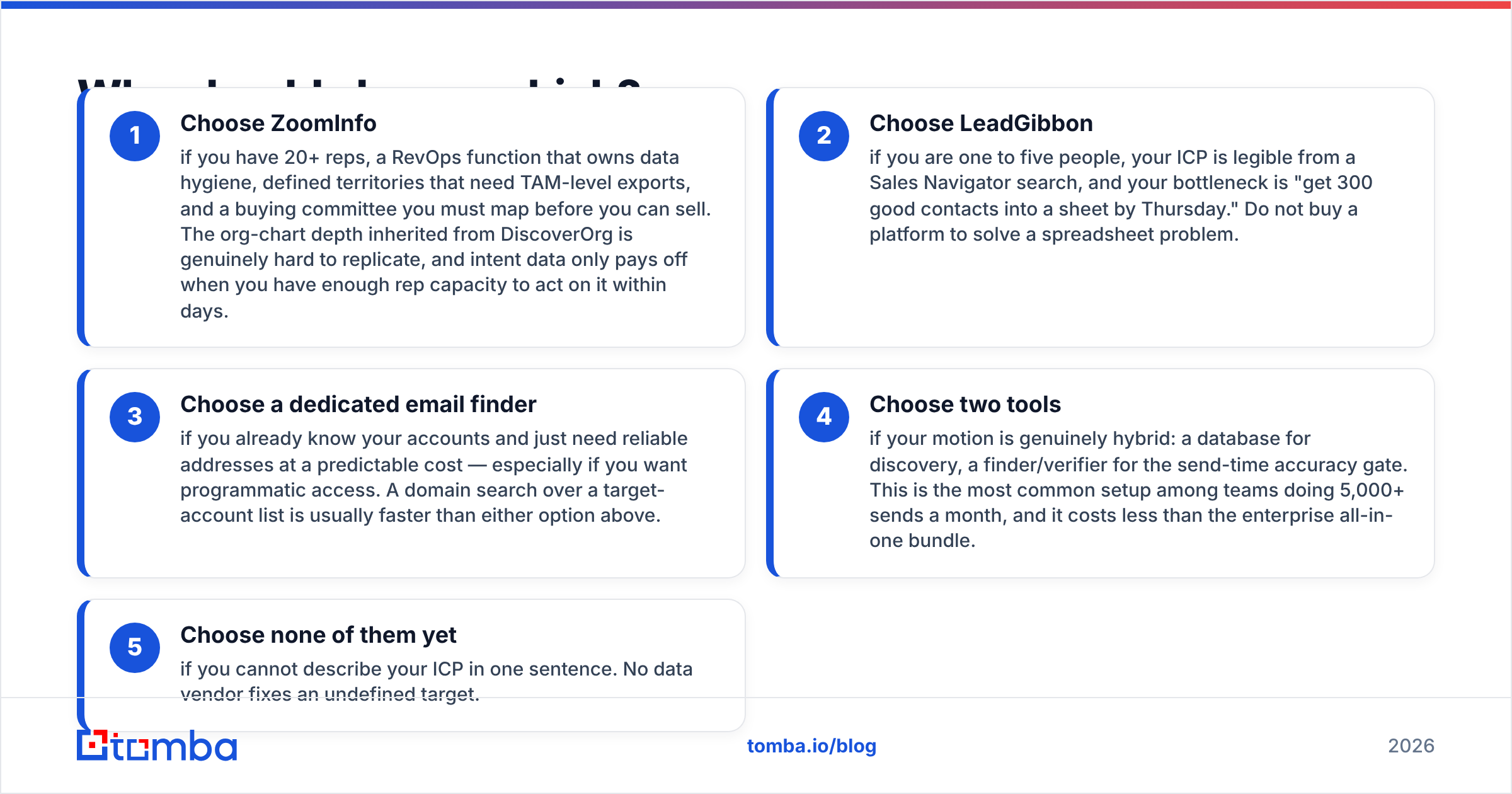
- Choose ZoomInfo if you have 20+ reps, a RevOps team that owns data quality, set territories that need TAM-level exports, and a buying group you must map. The org-chart depth from DiscoverOrg is hard to match. Intent data pays off only when reps can act on it fast.
- Choose LeadGibbon if you are one to five people, your ICP shows up in a Sales Navigator search, and your problem is "get 300 good contacts into a sheet by Thursday." Do not buy a platform to fix a spreadsheet.
The DiscoverOrg vs LeadGibbon choice is not the only one on the table. Three other paths often beat both:
- Choose a dedicated email finder if you know your accounts and just need good addresses at a set price. That is truer still if you want API access. A domain search over a target-account list is often faster than either tool above.
- Choose two tools if your motion is hybrid. Use a database to find people, then a finder and verifier as the accuracy gate before the send. Teams doing 5,000+ sends a month land here, and it costs less than one all-in-one bundle.
- Choose none of them yet if you cannot state your ICP in one sentence. No vendor fixes a fuzzy target.

What are the alternatives to both?#
The DiscoverOrg vs LeadGibbon framing leaves a gap in the middle. Some teams need more accuracy and volume than a Chrome extension, yet do not want a year-long contract. Several tools live in that gap.

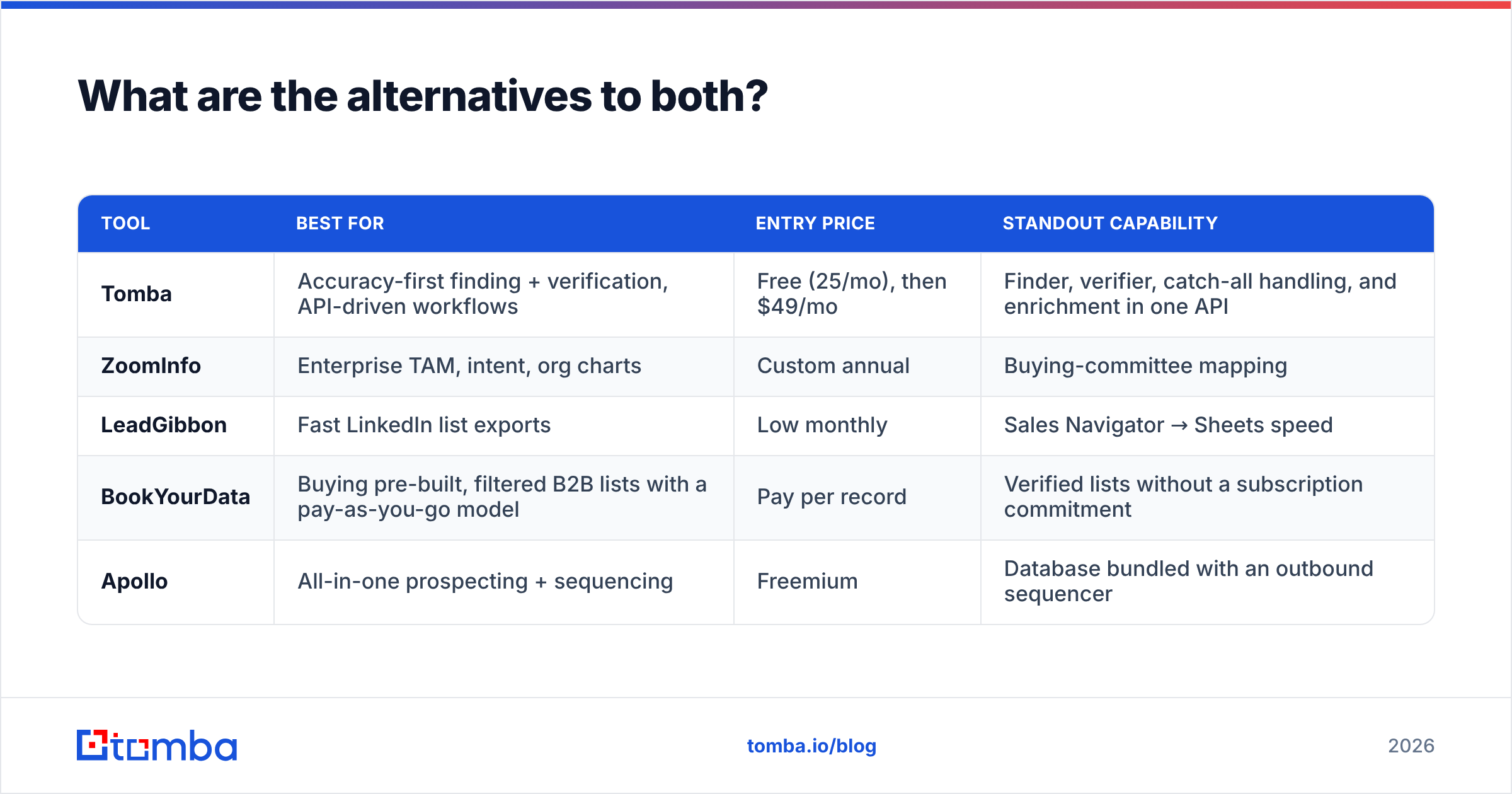
| Tool | Best for | Entry price | Standout capability |
|---|---|---|---|
| Tomba | Accuracy-first finding + verification, API-driven workflows | Free (25/mo), then $49/mo | Finder, verifier, catch-all handling, and enrichment in one API |
| ZoomInfo | Enterprise TAM, intent, org charts | Custom annual | Buying-committee mapping |
| LeadGibbon | Fast LinkedIn list exports | Low monthly | Sales Navigator → Sheets speed |
| BookYourData | Buying pre-built, filtered B2B lists with a pay-as-you-go model | Pay per record | Verified lists without a subscription commitment |
| Apollo | All-in-one prospecting + sequencing | Freemium | Database bundled with an outbound sequencer |
BookYourData is worth a look if your issue with ZoomInfo is the contract, not the data. Its pay-as-you-go model drops the annual commitment, still ships verified records, and avoids the credit-expiry problem.
Are you leaving a ZoomInfo-class contract? The path is simple. Export your account list. Run bulk email finding against those domains. Verify the output. Then track bounce rate for two weeks against your old baseline. That test costs a rounding error next to a renewal, and it gives you a real number to negotiate with.
For engineering-led teams, the API decides it. ZoomInfo gates its API behind top tiers. LeadGibbon barely has one. If enrichment runs inside a workflow rather than a UI, judge the email finder API on latency, rate limits, and cost per call. Database size claims do not matter.
What should you check before you sign?#
Run this list against any vendor you shortlist. It takes an afternoon and often saves five figures.
- Hit rate on your list, not theirs. Hand over 200 real contacts from your ICP. Count how many come back with a live address. Ignore total database counts.
- Bounce rate in production. Send to 100 of those addresses through your usual tool. Record the hard-bounce rate. Anything above 3% will hurt your sender score.
- Refresh cadence, in writing. Ask when a record was last verified, not when it was last "touched."
- Exit terms. Check what happens to exported data when the contract ends. Some deals limit later use.
- Credit expiry. Credits that vanish each month are a real cost, not a technicality.
Check dated reviews on G2 before you commit. Weigh the last 12 months far more than the rest.
The bottom line#
DiscoverOrg vs LeadGibbon compares a brand that no longer exists with a tool built for a much smaller job. Read it as ZoomInfo vs LeadGibbon and the answer turns on company size. Large, RevOps-backed teams take the data platform. Small teams take the list builder. Most readers sit in the middle, where you need top accuracy at small-team prices.
If that is you, start with accuracy, not features. Run your real target domains through the Tomba Email Finder free tier. Verify the results. Compare the hit rate with the quote sitting in your inbox. Twenty-five searches show the pattern, and $49/mo runs a full outbound motion with nothing signed for a year.
Related guides#
Ready to find emails that actually work?
Join 150,000+ professionals who stopped guessing and started sending. Free credits on signup — no credit card required.
Get the Tomba newsletter
Practical outbound tactics and product updates — once every two weeks.
About the author