DiscoverOrg vs LeadRocks 2026: Which B2B Data Tool Wins?
DiscoverOrg (now ZoomInfo) and LeadRocks sit at opposite ends of the B2B data market: enterprise contracts versus lifetime deals. Here's the honest breakdown of price, coverage, and who should buy which.
DiscoverOrg vs LeadRocks is an odd matchup. One tool is an enterprise data platform. The other is a cheap list builder sold on lifetime deals. This DiscoverOrg vs LeadRocks guide covers price, data quality, and who should buy which.
TL;DR
- DiscoverOrg is not a standalone product any more. It merged into ZoomInfo in 2019. Today it sells as ZoomInfo Sales, on annual deals that often start near $15,000–$25,000 and climb fast.
- LeadRocks is a light contact database built around LinkedIn. It sells as a cheap plan or a lifetime deal. The database holds a few hundred million records. There is no intent data, no org charts, and no workflow layer.
- The two tools are not real rivals. One is a full data platform. The other is a cheap list tool. It is like comparing a warehouse to a USB stick.
- Need accurate work emails at a price you can predict? A focused email finder like Tomba starts at $49/mo and checks each address one by one.
- DiscoverOrg vs LeadRocks in one line: buy ZoomInfo if you have a funded RevOps team, buy LeadRocks if you are a solo founder testing outbound, and buy neither if you just want verified emails on demand.
DiscoverOrg vs LeadRocks: what are you actually buying in 2026?#
Start with the name confusion. It causes most of the bad buys here. DiscoverOrg was an enterprise B2B data provider. It was known for human-checked org charts and deep tech profiles in IT, marketing, finance, and HR. In 2019 it bought ZoomInfo and took the ZoomInfo name. The DiscoverOrg brand has been retired since then.
So when you search "DiscoverOrg vs LeadRocks" in 2026, you are really comparing ZoomInfo's sales platform with LeadRocks' contact database. Some resellers and old contracts still use the DiscoverOrg label. Old review pages on G2 still carry it too. But the product you would sign for today is ZoomInfo.
Here is what you get on that side. Hundreds of millions of company and contact records. Org charts and tech profiles. Intent signals from a shared web-activity network. Website visitor ID, a Chrome extension, and CRM sync. On top of that sits a growing workflow layer for sequences, call review, and data hygiene. It is a full go-to-market system, and it is priced like one.
LeadRocks sits somewhere else. It is a browser extension plus a web app. It pulls contact details from LinkedIn profiles. You can also search a stored database by title, company, industry, and location.
It grew through lifetime deals on AppSumo-style sites. That is why it shows up next to enterprise tools in search. Buyers hope it is a $99-forever swap for a $25,000-a-year platform. It is not. But that does not make it useless.

DiscoverOrg vs LeadRocks head to head#
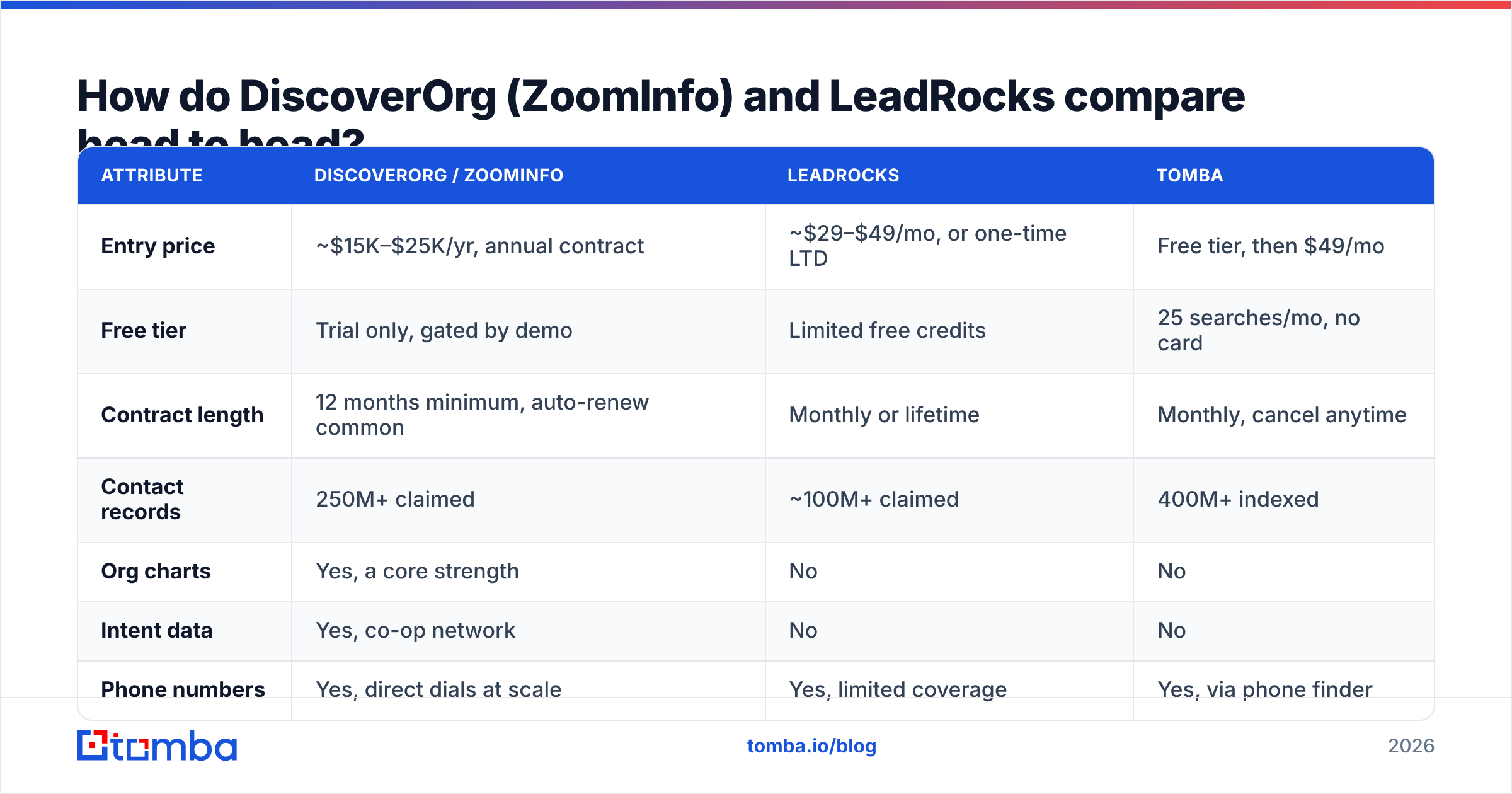
Here is the practical comparison. ZoomInfo does not publish prices. The cost swings a lot by seat count, credit volume, and modules. The figures below come from buyer reviews and procurement chats, not a quoted rate card.
| Attribute | DiscoverOrg / ZoomInfo | LeadRocks | Tomba |
|---|---|---|---|
| Entry price | ~$15K–$25K/yr, annual contract | ~$29–$49/mo, or one-time LTD | Free tier, then $49/mo |
| Free tier | Trial only, gated by demo | Limited free credits | 25 searches/mo, no card |
| Contract length | 12 months minimum, auto-renew common | Monthly or lifetime | Monthly, cancel anytime |
| Contact records | 250M+ claimed | ~100M+ claimed | 400M+ indexed |
| Org charts | Yes, a core strength | No | No |
| Intent data | Yes, co-op network | No | No |
| Phone numbers | Yes, direct dials at scale | Yes, limited coverage | Yes, via phone finder |
| Email verification | Included, platform-level | Basic | Per-address SMTP + catch-all |
| API access | Yes, enterprise tier | Limited | Yes, all paid plans |
| Best for | Enterprise SDR teams, ABM | Solo founders, agencies | Teams that need accurate emails |
The pattern is clear. ZoomInfo wins on breadth and depth. LeadRocks wins on cost of entry. A focused email finder wins on cost per accurate email, if that is the only job you are hiring a tool for.
DiscoverOrg vs LeadRocks: which one has better data quality?#
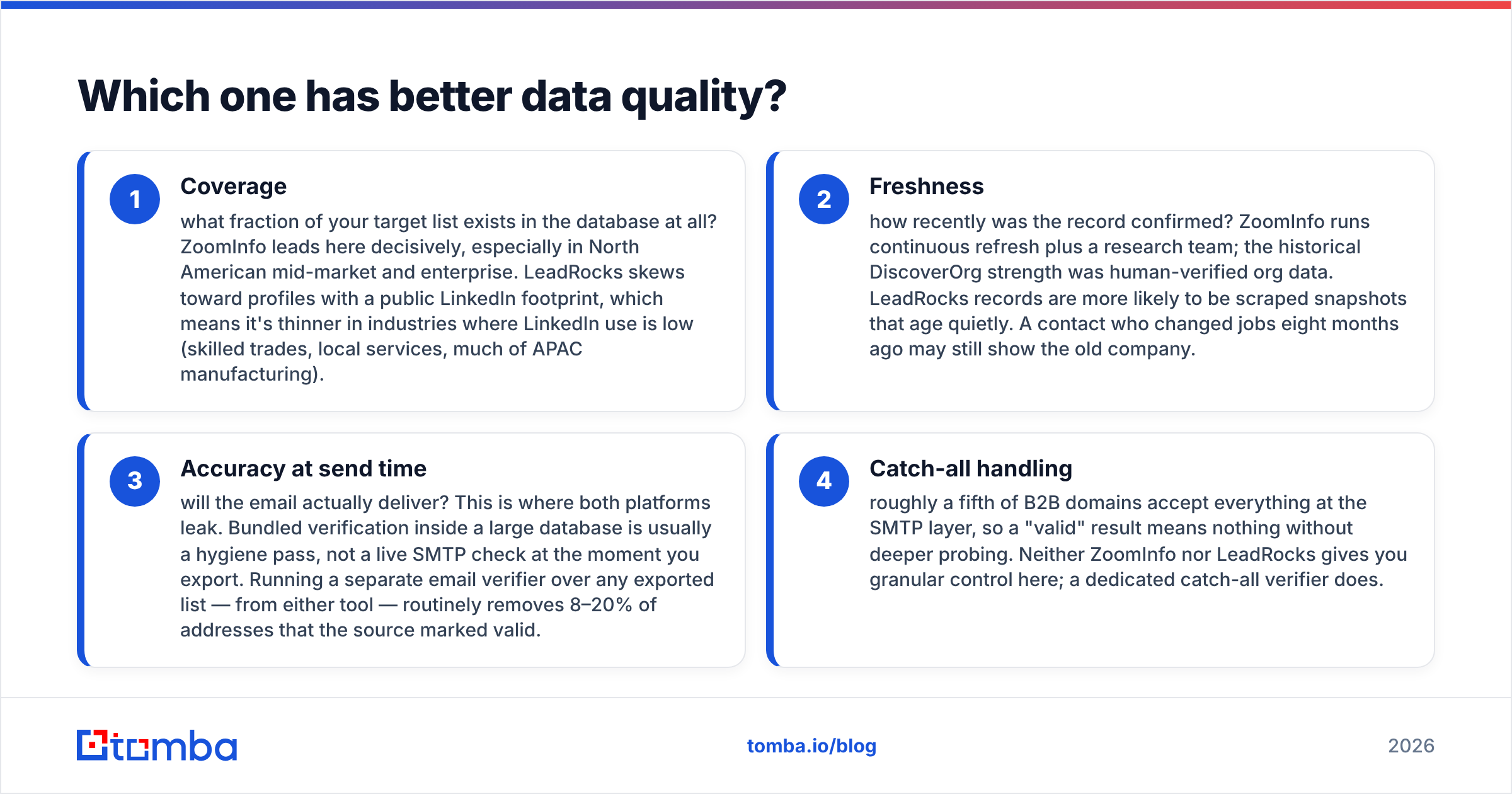
Data quality is really four questions. Vendors like to blur them together.
1. Coverage. What share of your target list is in the database at all? ZoomInfo leads here, and the gap is wide in North American mid-market and enterprise. LeadRocks leans on profiles with a public LinkedIn footprint. So it thins out where LinkedIn use is low, such as skilled trades, local services, and much of APAC manufacturing.
2. Freshness. How recently was the record confirmed? ZoomInfo refreshes data all the time and runs a research team. The old DiscoverOrg strength was human-checked org data. LeadRocks records are more often scraped snapshots that age quietly. A contact who moved jobs eight months ago may still show the old company.
3. Accuracy at send time. Will the email actually land? Both platforms leak here. Bundled checks inside a big database are usually a cleanup pass, not a live SMTP check at the moment you export. Run a separate email verifier over any exported list, from either tool. It routinely drops 8–20% of addresses the source marked valid.
4. Catch-all handling. About a fifth of B2B domains accept every address at the SMTP layer. So a "valid" result means little without a deeper probe. Neither tool gives you fine control here. A dedicated catch-all verifier does.
The honest summary is short. ZoomInfo's data is better on every measure. It also costs 20–50x more. Whether that trade makes sense depends on your average deal size.

Is DiscoverOrg / ZoomInfo worth the enterprise price?#
It is worth it in some cases and a waste in others.
It is worth it when:
- Your average deal is above roughly $20,000. A few extra closed deals then pay for the contract.
- You run account-based plays. Org charts and buying-committee maps really do change your sequencing.
- You have a RevOps person who will use intent data. Otherwise it just decorates a dashboard.
- You need CRM enrichment at scale, with mapped fields instead of CSV round trips.
It is not worth it when:
- You have fewer than 10 sellers and buy it "because everyone uses it."
- Your buyers are SMB or outside the US, where the coverage lead shrinks.
- You mainly need emails and a sending tool. The rest of the platform then goes unused.
- You cannot live with an annual term and auto-renewal.
That last point is worth a beat. Buyer reviews on Capterra and G2 flag renewal friction and mid-contract price hikes as the top complaints. That is a buying risk, not a data risk. It is still real money.
The credit model matters too. ZoomInfo meters exports. Teams often burn through their allocation faster than planned. Then you either pay overage or ration lookups, which defeats the point of buying it.
Is LeadRocks good enough for real outbound?#
For a narrow use case, yes.
LeadRocks works if you build modest lists, say a few thousand contacts a month. It also helps if your buyers live on LinkedIn. And it suits people who would rather pay once than defend a subscription. Agencies that spin up campaigns for many small clients like it for that reason.
Here is where it breaks down:
- Gaps on unusual titles. Search for "VP of Revenue Operations" at 500 mid-market SaaS firms and you get partial results.
- No org context. You get a person, not their manager, team size, or who else to loop in.
- Shallow checks. Exported addresses need a second pass before you send. If you skip it, bounces climb and your sender reputation takes the hit.
- Lifetime-deal risk. Some LTD-funded tools drift away from the first cohort as they move upmarket. That is a business risk you accept, not a bug.
Weighing LeadRocks against other budget options? The same test applies to peers like BookYourData. It sells verified B2B lists on a pay-as-you-go basis. That is a good fit when you want a one-time buy with a bounce guarantee instead of a seat-based platform. Different mechanism, similar buyer.
What should you actually buy for cold outbound in 2026?#
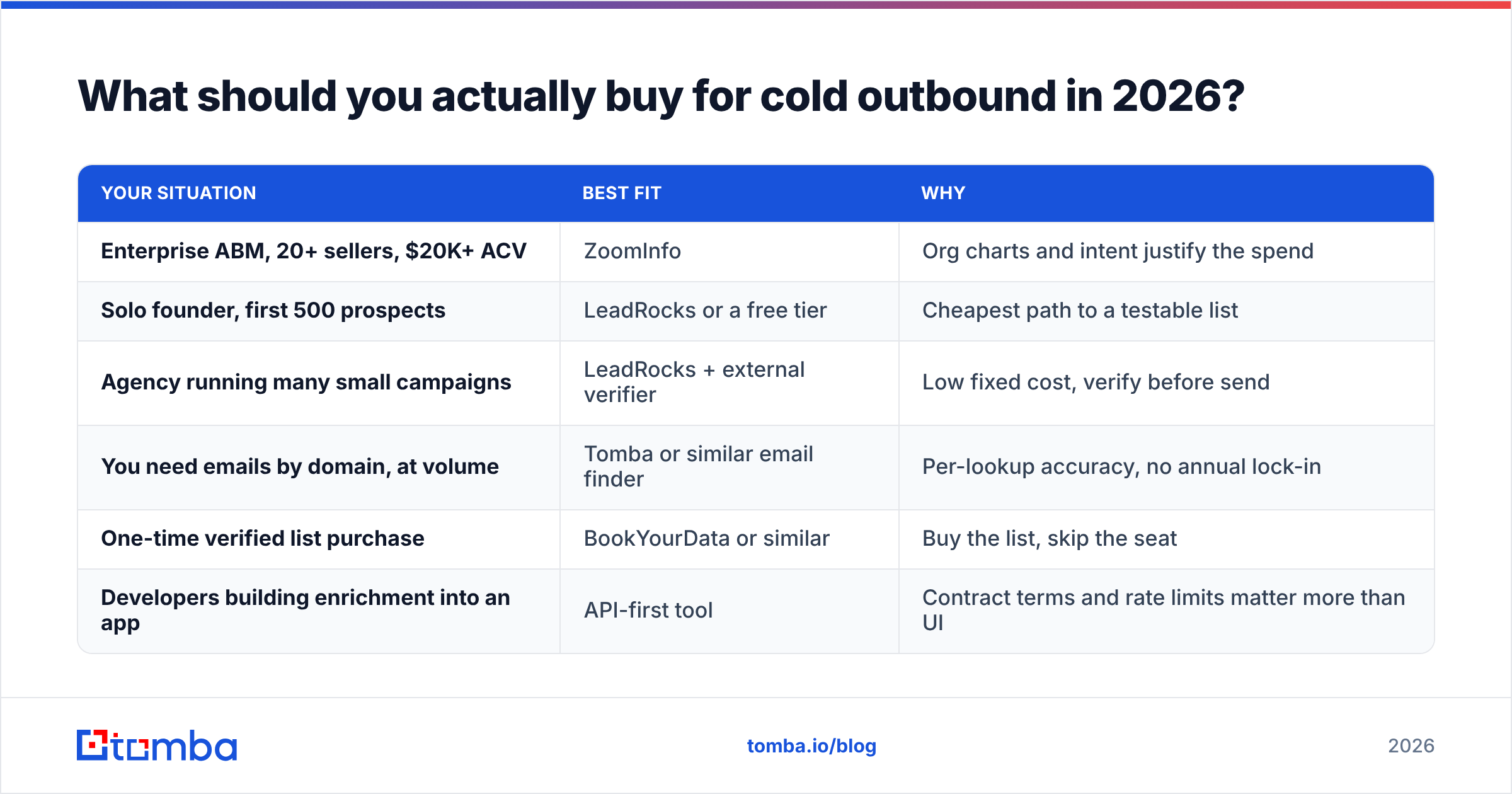
Map the tool to the job, not to the brand.
| Your situation | Best fit | Why |
|---|---|---|
| Enterprise ABM, 20+ sellers, $20K+ ACV | ZoomInfo | Org charts and intent justify the spend |
| Solo founder, first 500 prospects | LeadRocks or a free tier | Cheapest path to a testable list |
| Agency running many small campaigns | LeadRocks + external verifier | Low fixed cost, verify before send |
| You need emails by domain, at volume | Tomba or similar email finder | Per-lookup accuracy, no annual lock-in |
| One-time verified list purchase | BookYourData or similar | Buy the list, skip the seat |
| Developers building enrichment into an app | API-first tool | Contract terms and rate limits matter more than UI |
In four of six rows, the enterprise platform is not the answer. Most teams searching "DiscoverOrg vs LeadRocks" are asking a simpler question. Where do I get emails that do not bounce, at a price I can predict?
That is a different product category. An email finder resolves an address from a name plus a domain. It then runs SMTP and catch-all checks and charges per lookup. A domain search pulls every public address at a company in one call. Neither one needs a 12-month signature.
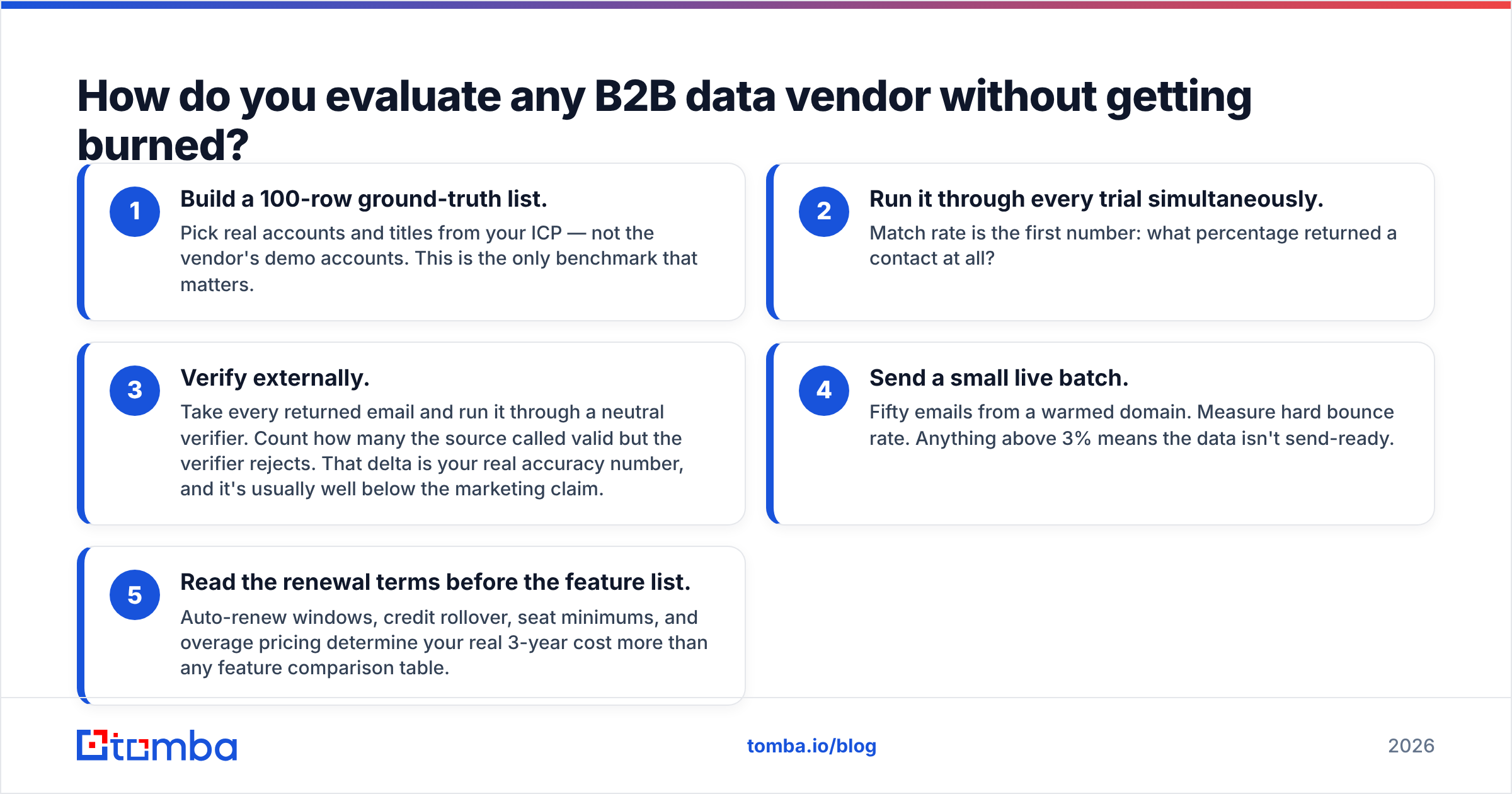
How do you evaluate any B2B data vendor without getting burned?#
Run the same five-step test on every vendor, including the two in this post.
1. Build a 100-row ground-truth list. Pick real accounts and titles from your ICP. Do not use the vendor's demo accounts. This is the only benchmark that counts.
2. Run it through every trial at once. Match rate is the first number. What share of rows returned a contact at all?
3. Verify with an outside tool. Take every returned email and run it through a neutral verifier. Count how many the source called valid but the verifier rejects. That gap is your real accuracy number. It is usually well below the marketing claim.
4. Send a small live batch. Fifty emails from a warmed domain is enough. Measure the hard bounce rate. Anything above 3% means the data is not ready to send.
5. Read the renewal terms before the feature list. Auto-renew windows, credit rollover, seat minimums, and overage rates set your real three-year cost. They matter more than any feature table.
Most buyers do steps 1 and 5 badly. Then they skip steps 2 through 4. That is how a team ends up with a five-figure contract and a 22% bounce rate.
One more practical note. Keep verification separate from your data vendor. Bundled checks carry an obvious conflict, since the vendor that sells the record also grades it. An independent pass through bulk verification or an email verification API at send time keeps the grader apart from the seller.
Frequently asked questions#
Is DiscoverOrg the same as ZoomInfo? Effectively yes. DiscoverOrg bought ZoomInfo in 2019 and took the ZoomInfo name. If a reseller quotes you "DiscoverOrg" in 2026, you are being quoted ZoomInfo.
Is DiscoverOrg vs LeadRocks even a fair comparison? Not really. One is an enterprise data platform. The other is a low-cost list tool. They only share a search results page, not a use case.
Does LeadRocks have a free plan? LeadRocks gives limited free credits so you can test the database. Real volume needs a paid plan or one of its lifetime deals.
Which is cheaper over three years? LeadRocks, by a wide margin, in almost every case. Whether it is cheaper per closed deal depends on what the coverage gaps cost you in pipeline.
Can I use both? Yes, and some teams do. They use enterprise data for named accounts and a cheap tool for long-tail prospecting. Just do not spend enterprise credits on long-tail lookups.
What is the biggest hidden cost with enterprise data platforms? Credit overages and auto-renewal. Model your export volume honestly before you sign. Then put the renewal notice window on your calendar the same day.
The bottom line#
DiscoverOrg vs LeadRocks is not one question. It is two. If you need org charts, intent, and wide coverage, and your deal sizes support a five-figure contract, ZoomInfo is the defensible pick. If you just need a cheap list to test whether outbound works at all, LeadRocks does that for a rounding error of the cost. So do pay-as-you-go list vendors like BookYourData.
But strip the question down to what most outbound teams really need. A verified work email for a specific person at a specific company. Priced per lookup. No annual commitment. Neither tool is the efficient answer.
That is the gap the Tomba Email Finder fills. Search by domain, name, or company across 400M+ indexed addresses. You get an SMTP-verified result with a confidence score and the sources behind it. Pull it through the API, the Chrome extension, Google Sheets, or a bulk CSV. Start free with 25 searches a month. Move to the $49/mo Starter plan when your volume justifies it, and see full Tomba pricing for the Growth and Pro tiers. No annual contract, no procurement cycle, no renewal fight.
Related guides#
Ready to find emails that actually work?
Join 150,000+ professionals who stopped guessing and started sending. Free credits on signup — no credit card required.
Get the Tomba newsletter
Practical outbound tactics and product updates — once every two weeks.
About the author