DiscoverOrg vs LeadsRush: Which B2B Data Tool Wins in 2026?
DiscoverOrg is now ZoomInfo and priced like enterprise software. LeadsRush is cheap and opaque. Here is an honest breakdown of coverage, accuracy, contracts, and who each one actually fits.
TL;DR
- DiscoverOrg no longer exists as a standalone product. It merged with ZoomInfo in 2019 and its org charts, intent data, and technographics now live inside the ZoomInfo platform — sold on annual contracts that typically start in the five figures.
- LeadsRush sits at the opposite end: cheap, self-serve, and light on public documentation. It works as a volume list source, not as a system of record.
- The honest comparison is not "which has better data." It is "how much data infrastructure do you actually need, and how much are you willing to pre-pay for it."
- Most teams under 20 reps overbuy. They sign a ZoomInfo-class contract for org charts they open twice and pay per-seat for a database they use like a lookup tool.
- If your real job is "get a verified work email for a named person at a named company," a usage-priced email finder does that for a fraction of either tool's cost.
What are DiscoverOrg and LeadsRush?#
They solve overlapping problems with completely different business models.
DiscoverOrg launched in 2007 as a human-verified B2B contact and org-chart database, originally focused on IT departments. Its selling point was researcher-verified data: real people calling into companies to confirm reporting lines, budgets, and installed technology. In 2019 it acquired ZoomInfo and adopted the ZoomInfo name. Today, when a vendor sells you "DiscoverOrg," you are buying a ZoomInfo subscription — the DiscoverOrg brand survives mostly in legacy contracts and search queries. That history matters for this comparison, because the pricing model came with it: annual commitment, credit allotments, seat licenses, and a sales cycle.
LeadsRush is a much smaller, self-serve lead data tool aimed at agencies, freelancers, and small outbound teams. The pitch is volume at low cost — search a niche or geography, export contacts, load them into a sequencer. Be straight about what is knowable here: LeadsRush publishes far less about its data sourcing, refresh cadence, and compliance posture than enterprise vendors do. There is no public accuracy SLA, no third-party audit, and pricing pages have changed repeatedly. Any comparison that claims precise LeadsRush match rates is guessing. This one won't.
So you are comparing a mature, expensive, heavily governed data platform against a lightweight, cheap, lightly documented list source. Neither is "the winner" in the abstract.

How do DiscoverOrg and LeadsRush compare head-to-head?#
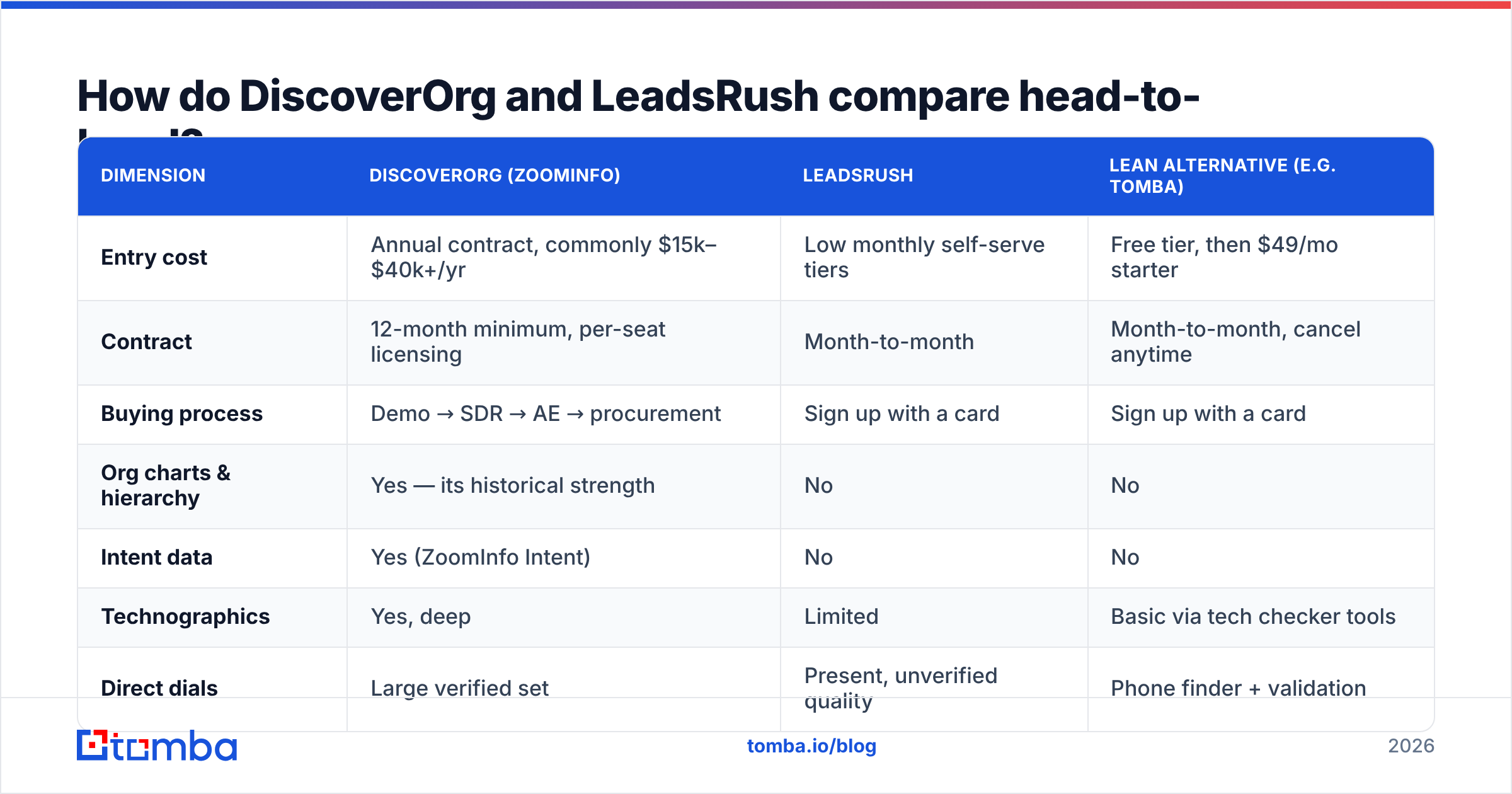
| Dimension | DiscoverOrg (ZoomInfo) | LeadsRush | Lean alternative (e.g. Tomba) |
|---|---|---|---|
| Entry cost | Annual contract, commonly $15k–$40k+/yr | Low monthly self-serve tiers | Free tier, then $49/mo starter |
| Contract | 12-month minimum, per-seat licensing | Month-to-month | Month-to-month, cancel anytime |
| Buying process | Demo → SDR → AE → procurement | Sign up with a card | Sign up with a card |
| Org charts & hierarchy | Yes — its historical strength | No | No |
| Intent data | Yes (ZoomInfo Intent) | No | No |
| Technographics | Yes, deep | Limited | Basic via tech checker tools |
| Direct dials | Large verified set | Present, unverified quality | Phone finder + validation |
| Email verification | Included, platform-side | Minimal / unclear | Dedicated verifier with catch-all handling |
| API access | Yes, gated by tier | Limited | Yes, on all paid plans |
| Best for | Enterprise ABM, 20+ reps | Cheap volume lists | Precision lookup + enrichment |
| Worst for | Small teams, spiky usage | Regulated or enterprise buying | Org-chart-driven ABM |
Two things jump out of that table.
First, DiscoverOrg's differentiators — org charts, intent, technographics — are ABM features. They pay off when you are running committee-level campaigns into 500 named accounts and need to know who reports to whom. They do almost nothing for a two-person agency emailing 300 e-commerce founders.
Second, LeadsRush's differentiator is price, and price alone. That is a legitimate advantage when your funnel math tolerates noise. It stops being an advantage the moment bounced sends start eating your sender reputation.
What does DiscoverOrg actually cost in 2026?#
Nobody publishes it, which is itself the answer. ZoomInfo quotes are built from seats, credit volume, module add-ons, and contract length, so two companies of similar size routinely see quotes that differ by 3x.
Patterns reported consistently across G2 reviews and buyer forums:
- Base platform entry lands in the mid-five figures annually for a small team on a standard package — before intent or enrichment modules.
- Seats are the main multiplier. Adding reps costs more than adding credits in most quotes.
- Credits expire. Unused annual allotments generally do not roll forward, so slow quarters are simply lost spend.
- Auto-renewal clauses are real. Notice windows of 30–60 days before renewal appear in many contracts; miss the window and you own another year.
- Modules are unbundled. Intent, Engage (sequencing), Chat, and enrichment are separate line items, and the demo you saw often included features your quote does not.
None of that is scandalous — it is standard enterprise software. It just means the honest cost comparison is not "$X/mo vs $Y/mo." It is "a committed annual budget vs a credit card." If your outbound volume swings hard by quarter, committed annual spend is structurally the wrong shape.
LeadsRush's cost profile is the inverse: trivially cheap to start, no procurement, and no leverage if the data underperforms. You are not locked in, but you also have no SLA to point at.
Is LeadsRush accurate enough for outbound?#
The right way to answer this is not to trust anyone's marketing number, including this article's. Run the same test on both.
Build a 100-row control list you can verify by hand — companies you know, roles you can confirm on LinkedIn or a team page. Pull that list through each tool and measure four things:
- Match rate. What percentage returned any contact at all? Vendors quote this number because it's the flattering one.
- Deliverable rate. Of those matches, how many survive independent verification? This is the number that matters. Run the exports through an email verifier that is not the tool that supplied the data. Grading your own homework produces suspiciously good grades.
- Role accuracy. How many contacts still hold the title the database claims? Job changes are the single largest source of B2B data decay, and databases rebuilt quarterly will always lag.
- Catch-all share. Domains that accept everything can't be verified by SMTP ping alone. A vendor that counts every catch-all as "valid" is inflating its numbers. Handle them explicitly with a catch-all verifier rather than letting them ride into your sequencer.
In practice, enterprise databases like ZoomInfo win on breadth — obscure mid-market accounts, direct dials, non-US coverage — because they invest heavily in acquisition and refresh. Budget list tools win on cost per row and lose on freshness. What you cannot assume is that either one's stated accuracy applies to your ICP. Accuracy is segment-specific: a provider that's excellent on US SaaS mid-market can be poor on European manufacturing.
One more thing the test will reveal: how each tool handles "no result." A database that returns a low-confidence guess instead of an honest null is actively harmful, because it converts an empty cell into a bounce.
Which one should you choose for your team?#
Pick by the shape of your motion, not by feature count.
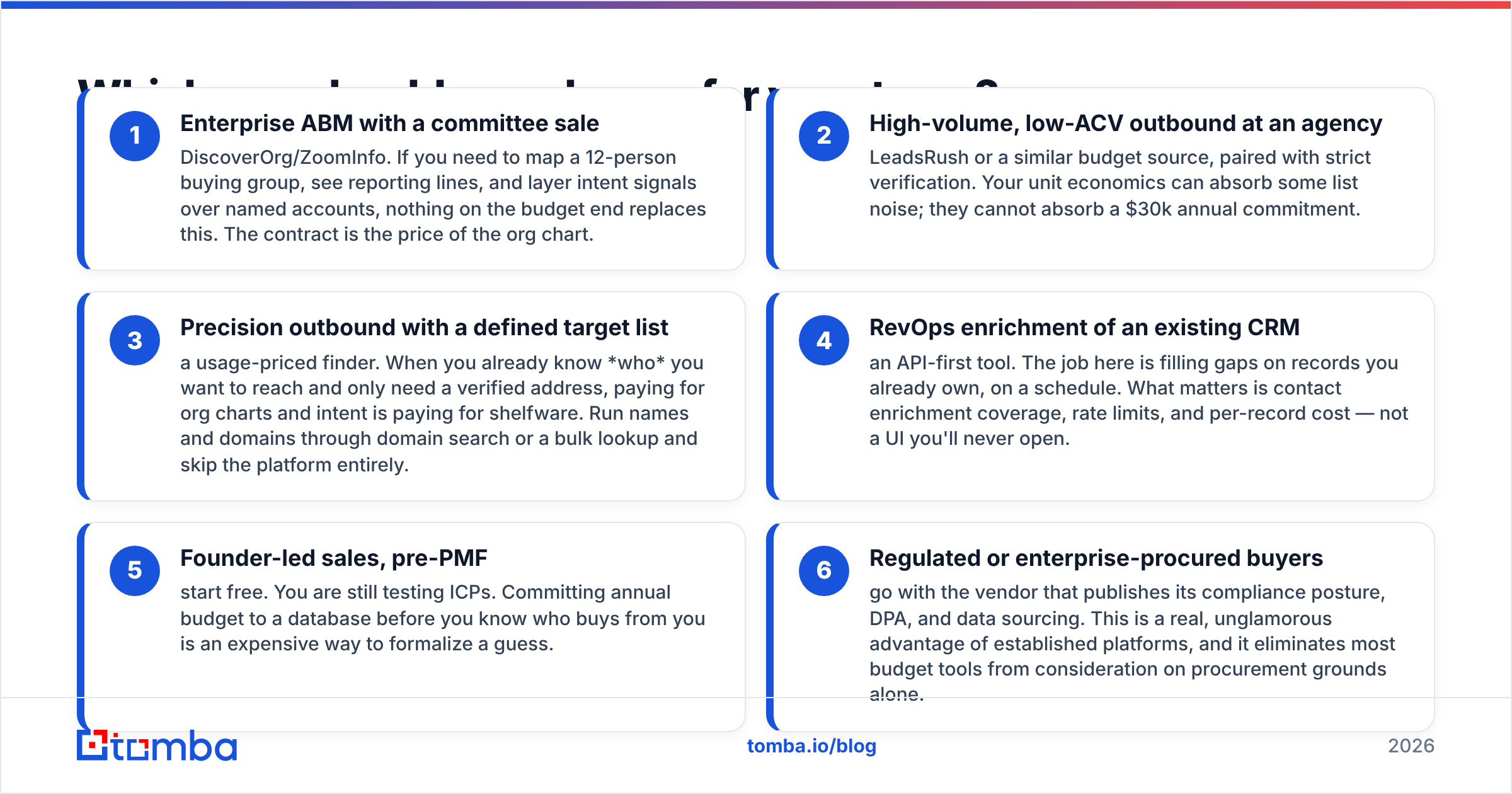
- Enterprise ABM with a committee sale — DiscoverOrg/ZoomInfo. If you need to map a 12-person buying group, see reporting lines, and layer intent signals over named accounts, nothing on the budget end replaces this. The contract is the price of the org chart.
- High-volume, low-ACV outbound at an agency — LeadsRush or a similar budget source, paired with strict verification. Your unit economics can absorb some list noise; they cannot absorb a $30k annual commitment.
- Precision outbound with a defined target list — a usage-priced finder. When you already know who you want to reach and only need a verified address, paying for org charts and intent is paying for shelfware. Run names and domains through domain search or a bulk lookup and skip the platform entirely.
- RevOps enrichment of an existing CRM — an API-first tool. The job here is filling gaps on records you already own, on a schedule. What matters is contact enrichment coverage, rate limits, and per-record cost — not a UI you'll never open.
- Founder-led sales, pre-PMF — start free. You are still testing ICPs. Committing annual budget to a database before you know who buys from you is an expensive way to formalize a guess.
- Regulated or enterprise-procured buyers — go with the vendor that publishes its compliance posture, DPA, and data sourcing. This is a real, unglamorous advantage of established platforms, and it eliminates most budget tools from consideration on procurement grounds alone.

Where do lighter tools beat both options?#
There is a third category this comparison keeps circling: single-purpose contact tools priced by usage. They don't try to be a system of record. They answer one question well — what is this person's verified work email? — and charge per answer.
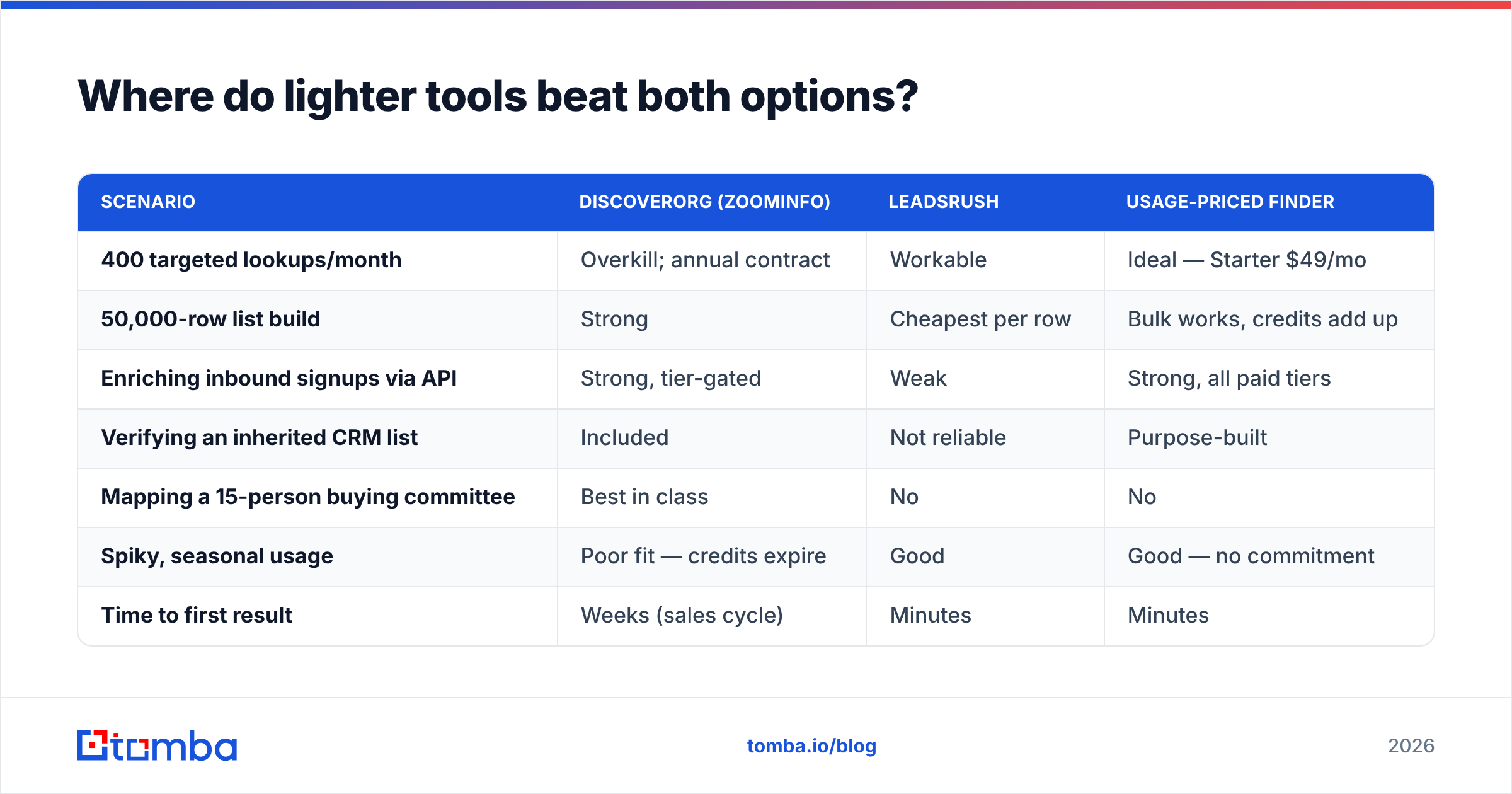
| Scenario | DiscoverOrg (ZoomInfo) | LeadsRush | Usage-priced finder |
|---|---|---|---|
| 400 targeted lookups/month | Overkill; annual contract | Workable | Ideal — Starter $49/mo |
| 50,000-row list build | Strong | Cheapest per row | Bulk works, credits add up |
| Enriching inbound signups via API | Strong, tier-gated | Weak | Strong, all paid tiers |
| Verifying an inherited CRM list | Included | Not reliable | Purpose-built |
| Mapping a 15-person buying committee | Best in class | No | No |
| Spiky, seasonal usage | Poor fit — credits expire | Good | Good — no commitment |
| Time to first result | Weeks (sales cycle) | Minutes | Minutes |
For reference, Tomba pricing runs Free (25 searches/mo), Starter $49/mo, Growth $99/mo, Pro $249/mo, and custom Enterprise — month to month, with API access on paid plans. That is roughly the annual cost of one ZoomInfo seat spread across a year of self-serve usage. The tradeoff is explicit and worth stating plainly: you get finding, verification, enrichment, and B2B phone numbers; you do not get org charts, intent scoring, or a conversational ABM layer.
Buy the platform when you need the platform. Don't buy it to look up emails.
What should you check before you sign anything?#
Whichever direction you lean, these five checks prevent the most common regrets:
- Test on your ICP, not a demo account. Ask for a trial file of 100 records from your exact target segment. If a vendor won't run a sample against your list, that is information.
- Verify externally. Never accept a vendor's own validity flag as proof. Independent verification is the only number your bounce rate cares about.
- Read the renewal clause. Note the cancellation window in your calendar the day you sign. Auto-renew disputes are the top complaint in enterprise data reviews.
- Ask where the data comes from. Contributory networks, public web, licensed panels, and community opt-ins carry different compliance risk. Reputable vendors document this — see how Tomba describes its own data sources as a baseline for what a straight answer looks like.
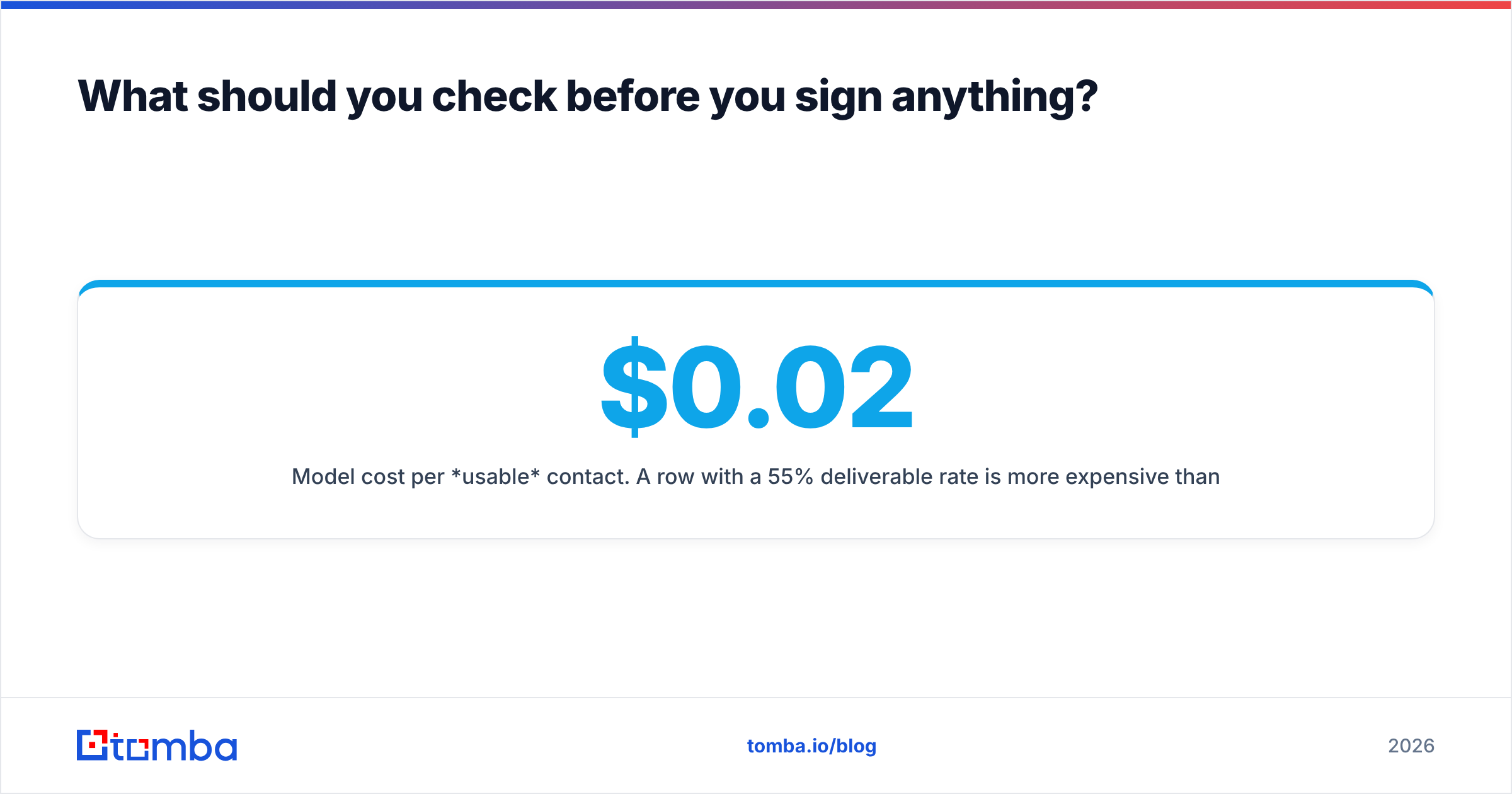
- Model cost per usable contact. A $0.02 row with a 55% deliverable rate is more expensive than a $0.05 row at 92%, and worse for your domain reputation. Sales intelligence buying research from Gartner consistently shows data quality, not volume, driving pipeline outcomes.
What's the verdict on DiscoverOrg vs LeadsRush?#
DiscoverOrg — now ZoomInfo — wins on data depth, coverage, org intelligence, and governance, and charges accordingly. It is the right call for enterprise ABM teams with a committee sale, a budget cycle, and reps who will actually use hierarchy and intent data every week. If that's not you, the annual contract will feel like rent on a house you visit twice a month.
LeadsRush wins on cost and speed to first export. It is a defensible choice for agencies and solo operators running volume plays where some list noise is acceptable — provided you verify everything independently before it touches a sequencer. It is not a defensible choice if your buyers' procurement teams will ask where the data came from.
And for the large middle group — teams who already know their accounts and just need verified contact details on demand — neither extreme fits. You want per-use pricing, an API, real verification, and no annual commitment.
That's the gap Tomba fills. Start with the Tomba Email Finder on the free tier: run 25 searches against companies you already target, verify the results independently, and compare the deliverable rate to whatever quote is sitting in your inbox. Twenty minutes of testing beats a year of contract regret.
Related guides#
// get started
Find, verify and enrich your first contacts today
Start on the free plan with 25 searches a month, then scale when your team is ready.
Free plan · No credit card required · GDPR & CCPA
// about the author