DiscoverOrg vs LeadzenAI in 2026: Which B2B Data Tool Wins?
DiscoverOrg is now ZoomInfo, priced like enterprise software. LeadzenAI sells the opposite bet: cheap credits and AI search. Here is how the two actually compare on data, cost, and fit.
DiscoverOrg vs LeadzenAI is an odd match-up in 2026. One brand no longer exists. The other is a cheap, self-serve tool. Here is what you are really choosing between.
TL;DR
- DiscoverOrg is not a standalone product. It merged with ZoomInfo in 2019. The ZoomInfo name stayed, and the DiscoverOrg name was retired. If a rep pitches you "DiscoverOrg," you are buying ZoomInfo.
- LeadzenAI is much younger and much cheaper. It is an AI-driven prospecting tool built around search, a LinkedIn extension, and credit-based contact reveals.
- The two are not real rivals on features. ZoomInfo is a full data platform with intent, org charts, technographics, and CRM enrichment. LeadzenAI just finds contacts, at a small fraction of the depth and the price.
- ZoomInfo contracts often run five figures a year, with seat minimums. LeadzenAI is a monthly self-serve buy that you can cancel.
- For most teams under 50 reps, neither one is the clear answer. A focused finder plus a verifier, priced per credit, usually wins on cost per booked meeting.
Wait, does DiscoverOrg still exist in 2026?#
Short answer: no. You cannot buy a product under that name.
DiscoverOrg started in 2007. It built its name on human-verified org charts for IT, marketing, finance, and HR teams. The research was deep and the price was high. It was very good at one thing: showing who reported to whom inside a target account.
In 2019 DiscoverOrg bought ZoomInfo. It then took the ZoomInfo name and merged the two datasets. By the early 2020s, every DiscoverOrg login page, doc, and contract had moved to ZoomInfo.
That matters here in two ways.
First, when you search "DiscoverOrg vs LeadzenAI," you are really comparing today's ZoomInfo with LeadzenAI. Any review that quotes DiscoverOrg's 2018 price or screens is stale.
Second, the DiscoverOrg roots still show. ZoomInfo is strong on firmographics, hierarchy maps, and department-level contacts in North America. That research history is the best reason to pay enterprise money.
What is LeadzenAI, and who is it built for?#
LeadzenAI is a B2B lead intelligence tool. It uses AI-assisted search over a contact database. A browser extension pulls contacts while you browse LinkedIn and company sites.
Its pitch is the opposite of the legacy players. You sign up yourself. You buy credit packs. You pay monthly. The price targets solo founders, agencies, and small sales teams, not enterprise RevOps.
A typical LeadzenAI workflow looks like this:
- Search by criteria — industry, location, job title, company size. Or paste a company domain.
- Reveal contacts with credits — each email or phone number costs credits from your monthly allowance.
- Use the extension on LinkedIn — grab a work email while you are already prospecting.
- Export to CSV and push it into your sequencer or CRM.
There is no intent engine here. There is no real technographic layer. There is no org-chart product. That is not a knock. It is just the category it plays in. You are buying contact discovery, not a go-to-market platform.
DiscoverOrg vs LeadzenAI: how do they compare head to head?#
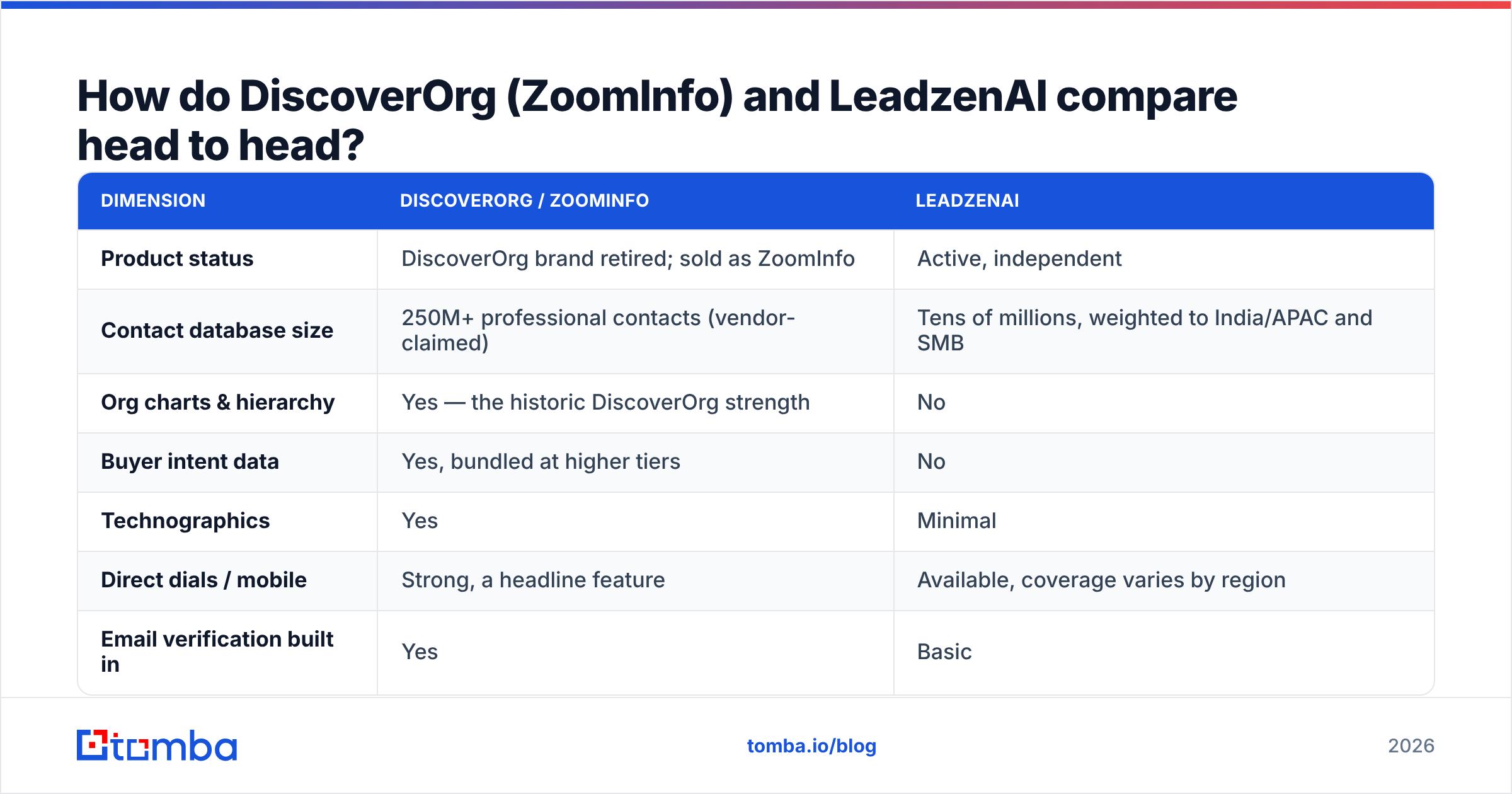
Here is the honest side by side. Prices are the ranges buyers report. Both vendors negotiate, and ZoomInfo never publishes list pricing.
| Dimension | DiscoverOrg / ZoomInfo | LeadzenAI |
|---|---|---|
| Product status | DiscoverOrg brand retired; sold as ZoomInfo | Active, independent |
| Contact database size | 250M+ professional contacts (vendor-claimed) | Tens of millions, weighted to India/APAC and SMB |
| Org charts & hierarchy | Yes — the historic DiscoverOrg strength | No |
| Buyer intent data | Yes, bundled at higher tiers | No |
| Technographics | Yes | Minimal |
| Direct dials / mobile | Strong, a headline feature | Available, coverage varies by region |
| Email verification built in | Yes | Basic |
| Browser extension | Yes (ZoomInfo Engage / extension) | Yes, LinkedIn-focused |
| CRM sync (Salesforce/HubSpot) | Native, bi-directional, enterprise-grade | Export-driven, lighter integrations |
| Typical annual cost | $15,000–$40,000+ with seat minimums | Low hundreds to low thousands per year |
| Contract | Annual, sales-led, seat-based | Monthly self-serve, cancellable |
| Free trial | Gated demo, no open free tier | Free/low-cost entry credits |
| Best fit | 50+ rep orgs with RevOps and a data budget | Founders, agencies, small outbound teams |
The table makes the trade-off clear. You are not comparing two versions of one thing. You are comparing a platform to a tool.
DiscoverOrg vs LeadzenAI: which one has better data?#
ZoomInfo wins on North American coverage. It also knows far more about each account. LeadzenAI wins on cost per verified contact, as long as your ICP sits where it has good coverage.
Both claims need caveats.
ZoomInfo records go stale like everyone else's. B2B contact data decays about 20–30% a year as people change jobs. No vendor escapes that. Reviews on G2 praise the coverage. They also flag bounced emails and old direct dials. The gaps show up outside the US, and at companies under 50 people. You pay for breadth and structure, not for a guarantee.
LeadzenAI accuracy swings more by segment. Users report good hit rates on India-based and wider APAC mid-market contacts. Coverage thins out on US enterprise, senior European roles, and niche technical titles. If your ICP is "VP of Engineering at a US Series B," you will feel that gap. If it is "operations lead at a 200-person Indian manufacturer," LeadzenAI may beat a tool that costs forty times more.
With either vendor, do the same thing: never trust the source. Run every exported list through a standalone email verifier before it touches your sending domain.
Here is why that matters. A 4% bounce rate on a 5,000-contact import can hurt your sender reputation for weeks. Neither platform's built-in check replaces a real verification pass. Catch-all domains are the worst case, and most built-in validators simply shrug at them.
DiscoverOrg vs LeadzenAI: what does each one cost?#
Most reviews stop here, because the gap is not small.
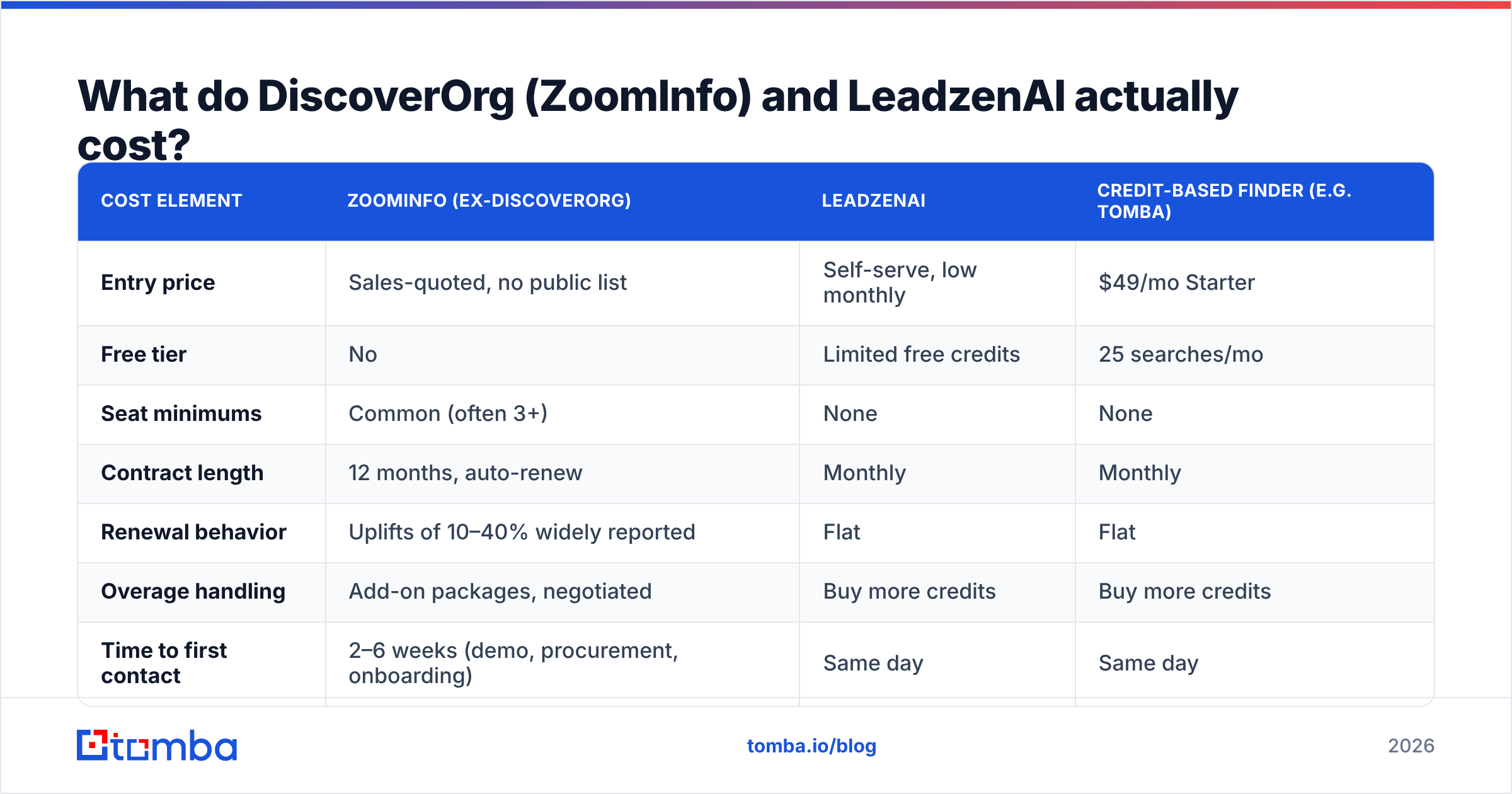
| Cost element | ZoomInfo (ex-DiscoverOrg) | LeadzenAI | Credit-based finder (e.g. Tomba) |
|---|---|---|---|
| Entry price | Sales-quoted, no public list | Self-serve, low monthly | $49/mo Starter |
| Free tier | No | Limited free credits | 25 searches/mo |
| Seat minimums | Common (often 3+) | None | None |
| Contract length | 12 months, auto-renew | Monthly | Monthly |
| Renewal behavior | Uplifts of 10–40% widely reported | Flat | Flat |
| Overage handling | Add-on packages, negotiated | Buy more credits | Buy more credits |
| Time to first contact | 2–6 weeks (demo, procurement, onboarding) | Same day | Same day |
Two rows deserve emphasis.
The auto-renew uplift is the top complaint in enterprise data contracts. Teams sign for a year. They use 60% of their credits. Then they get a higher quote at renewal, because usage tiers ratchet up. Budget for it, or negotiate a cap in writing before you sign.
The time-to-first-contact row is easy to miss. Say you are a five-person team testing an outbound motion this quarter. A six-week buying cycle is not a small delay. It eats the whole test window. That one factor rules out ZoomInfo for many of the teams who search for it.
DiscoverOrg vs LeadzenAI: which should your team pick?#
Pick based on what you are buying, not on brand name.
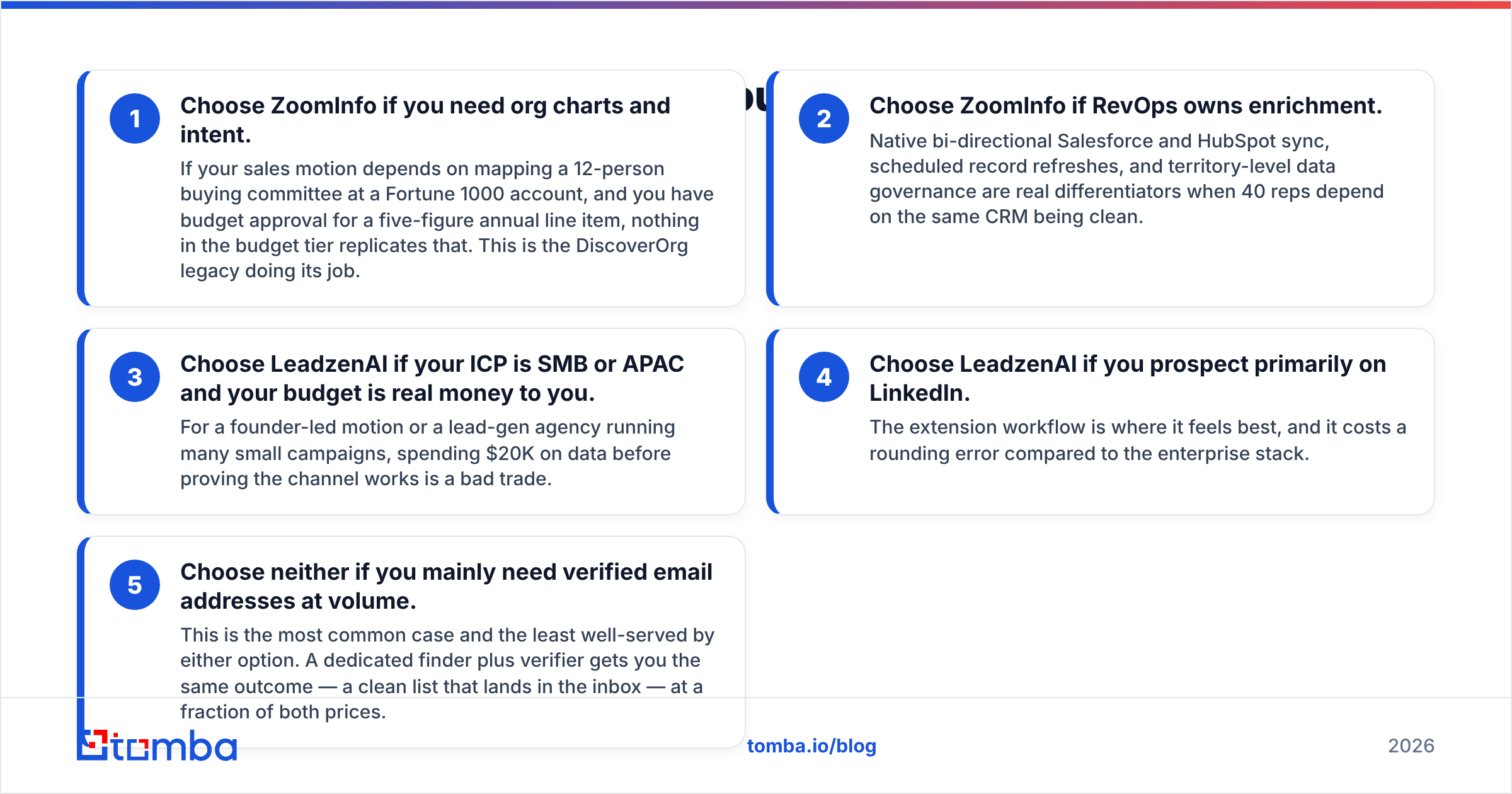
- Choose ZoomInfo if you need org charts and intent. Some deals hinge on mapping a 12-person buying committee at a Fortune 1000 account. If you have budget for a five-figure line item, no cheap tool matches that. This is the DiscoverOrg legacy at work.
- Choose ZoomInfo if RevOps owns enrichment. You get native two-way Salesforce and HubSpot sync, scheduled record refreshes, and territory-level data rules. Those matter when 40 reps share one CRM.
- Choose LeadzenAI if your ICP is SMB or APAC and budget is tight. A founder-led motion or a lead-gen agency runs many small campaigns. Spending $20K on data before the channel works is a bad trade.
- Choose LeadzenAI if you prospect mainly on LinkedIn. The extension workflow is where it shines. It costs a rounding error next to the enterprise stack.
- Choose neither if you just need verified emails at volume. This is the most common case. It is also the one both tools serve worst. A dedicated finder plus a verifier gets you the same clean list for far less.
That fifth path needs more explaining. It is where most teams who search "DiscoverOrg vs LeadzenAI" actually end up.
What are the alternatives worth testing first?#
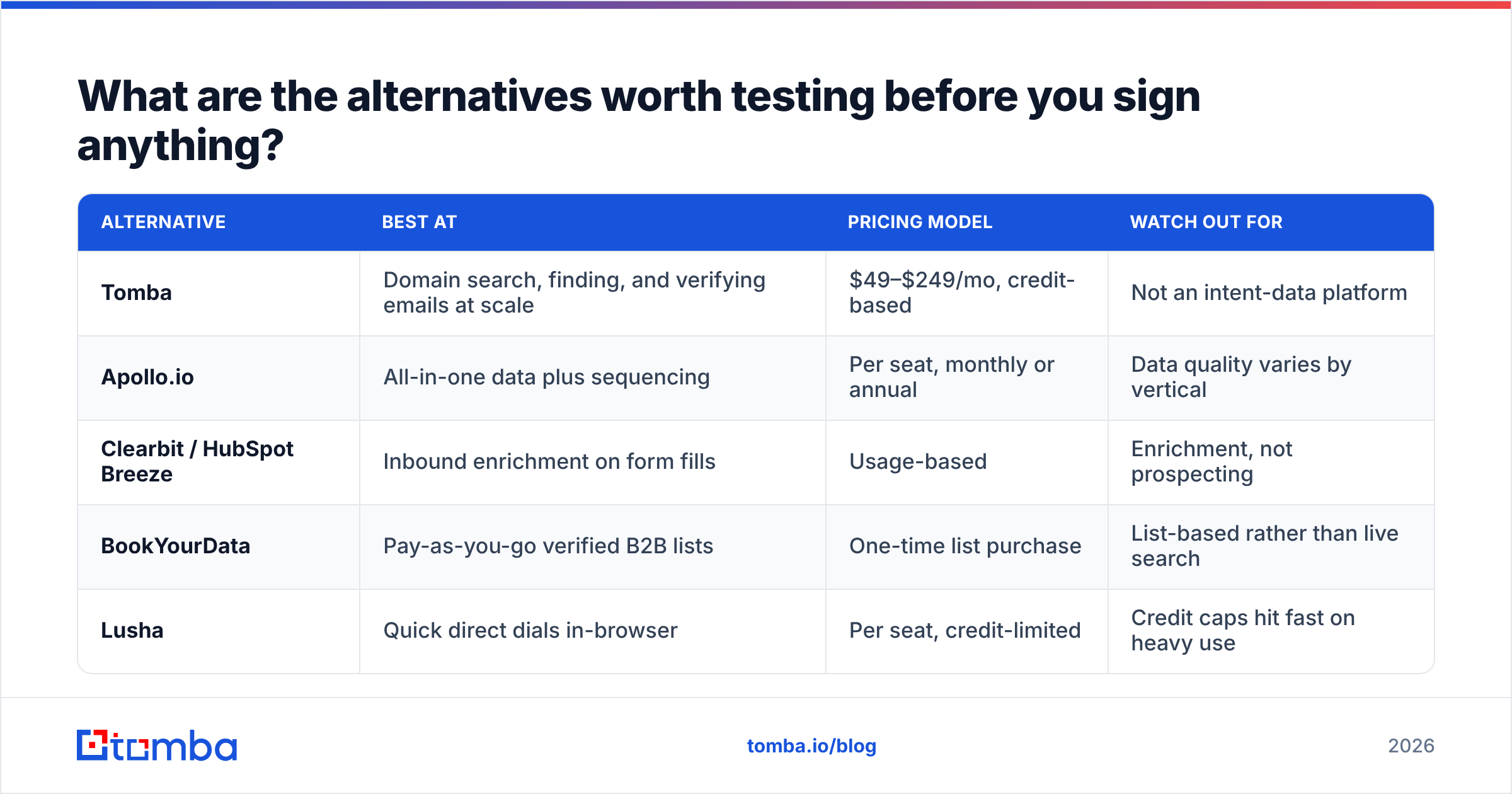
The middle ground between a $49 tool and a $30,000 platform is crowded now. Several options solve one slice better than either contender.
| Alternative | Best at | Pricing model | Watch out for |
|---|---|---|---|
| Tomba | Domain search, finding, and verifying emails at scale | $49–$249/mo, credit-based | Not an intent-data platform |
| Apollo.io | All-in-one data plus sequencing | Per seat, monthly or annual | Data quality varies by vertical |
| Clearbit / HubSpot Breeze | Inbound enrichment on form fills | Usage-based | Enrichment, not prospecting |
| BookYourData | Pay-as-you-go verified B2B lists | One-time list purchase | List-based rather than live search |
| Lusha | Quick direct dials in-browser | Per seat, credit-limited | Credit caps hit fast on heavy use |
BookYourData deserves a mention for teams that dislike subscriptions. It sells verified contact lists on a pay-as-you-go basis, with a stated accuracy guarantee. That suits one-off campaigns and territory launches better than a monthly seat.
Say your need is simple: accurate work emails for a set list of companies. Then this workflow beats both sides of DiscoverOrg vs LeadzenAI on cost per usable contact.
- Build the account list from your CRM, a conference page, or a funding database. You almost certainly have it already.
- Run domain search to pull every public contact and the company's email pattern.
- Verify before export, catch-all domains included, so bounces stay under 2%.
- Enrich the survivors with role, seniority, and company data through a data enrichment pass.
- Sync to CRM and let the sequencer do its job.
That pipeline costs credits, not seats. Nobody has to sit in a procurement meeting.
What is the verdict on DiscoverOrg vs LeadzenAI?#
Do you have enterprise budget, a North American ICP, and a RevOps team to run it? Then ZoomInfo — the platform DiscoverOrg became — is still the most complete B2B data product on the market. You will pay for it. You will haggle at renewal. You will still verify emails before you send.
Are you a small team, an agency, or a founder testing outbound? Then LeadzenAI is a fair starter pick, especially with an APAC-weighted ICP. Test the free credits against 50 known contacts from your own CRM first. That one test tells you more than any review, this one included.
Many readers sit in the large middle. You need accurate emails at volume. You do not need intent scoring. You will not sign an annual contract to get either. In that case, DiscoverOrg vs LeadzenAI is the wrong question. Look at credit-based tooling instead. Check the Tomba pricing tiers against your monthly contact volume before you book a ZoomInfo demo. Most teams find their real need was 3,000 verified emails a month, not a data platform.
Want to test that on your own list? Start with the Tomba Email Finder — 25 free searches a month, no seat minimums, and no annual contract. Run it against the same 50 contacts you use to judge every other vendor. Compare the verified hit rate. Let the numbers pick your vendor.
Related guides#
Ready to find emails that actually work?
Join 150,000+ professionals who stopped guessing and started sending. Free credits on signup — no credit card required.
Get the Tomba newsletter
Practical outbound tactics and product updates — once every two weeks.
About the author