DiscoverOrg vs Market Location: B2B Data Compared (2026)
DiscoverOrg is now ZoomInfo. Market Location is a UK list licensor. They solve different problems, and picking the wrong one costs five figures. Here is the honest breakdown of coverage, pricing, contracts, and who each one actually fits.
DiscoverOrg vs Market Location — TL;DR
- DiscoverOrg no longer exists on its own. It merged with ZoomInfo in 2019. When a vendor pitches you "DiscoverOrg" in 2026, you are buying ZoomInfo at ZoomInfo's contract terms.
- Market Location is a UK-first B2B list licensor, not a live SaaS platform. You buy segmented business records, not seats. Pricing is per record or per licence period.
- Each one wins a different job. ZoomInfo wins on North American org charts, intent, and tech-stack data. Market Location wins on UK small-business coverage, phone-checked firm data, and postal records.
- Both are quote-only. Budget five figures a year for ZoomInfo. Budget a negotiated per-record fee for Market Location. Neither one lists a price.
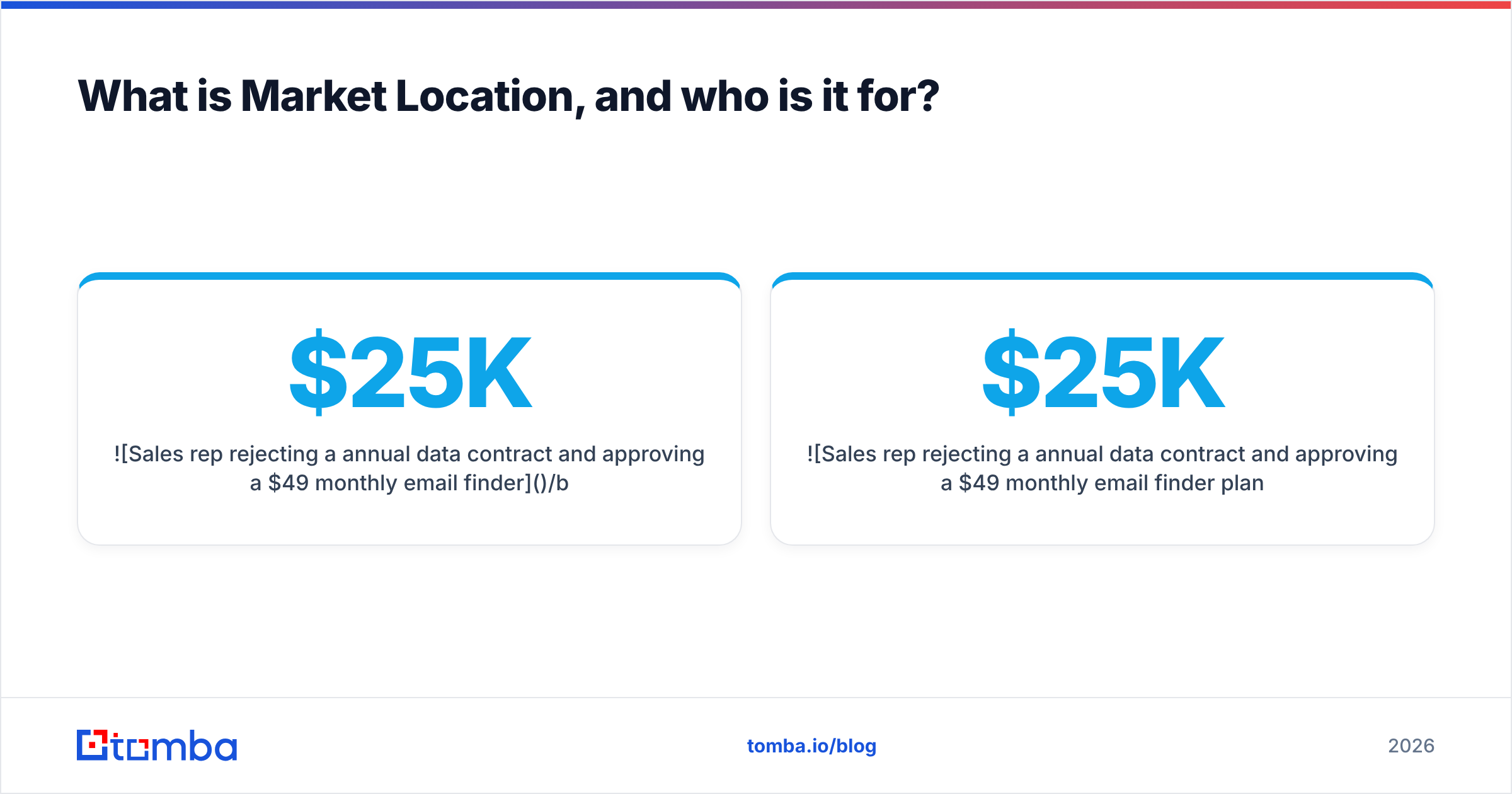
If your real job is finding and checking work emails cheaply, a dedicated email finder at $49/mo does that one job for a fraction of either contract.
What happened to DiscoverOrg, and what is it in 2026?#
DiscoverOrg was a data company in Vancouver, Washington. It was known for org charts built by hand. Real analysts called into IT departments and mapped who reported to whom. It cost a lot. It was also accurate for the accounts it covered.
In February 2019, DiscoverOrg bought ZoomInfo and then took the ZoomInfo name. The old product line was folded into what is now the ZoomInfo platform. So in 2026, DiscoverOrg vs Market Location really means ZoomInfo (ex-DiscoverOrg) vs Market Location.
That matters for three reasons:
- The pricing model changed. The old research-led packages became seat-plus-credit contracts. They run yearly, and they auto-renew. Buyers on G2 flag that clause often.
- The data mix changed. Hand research got blended with a shared contributor network and web crawling. Depth on the old IT accounts held up. Reach went up. Per-record human checking thinned out.
- The buyer changed. DiscoverOrg sold to IT sales teams. ZoomInfo sells to the whole go-to-market org — marketing, RevOps, and sales on one contract.
If your vendor spreadsheet still has a "DiscoverOrg" column with 2018 pricing in it, delete it and start again.
What is Market Location, and who is it for?#
Market Location is a UK business data provider. It has licensed B2B records for decades. Its pitch is very different from a software tool.
It keeps a database of UK business sites and contacts. You can slice that database by SIC code, staff count, turnover, region, and job function. Then you licence the slice you need for a campaign.
The typical buyer is a UK agency, a direct-mail house, a telemarketing team, or a mid-market brand running a regional campaign. You say "manufacturing sites in the North West, 50–250 staff, operations decision-makers." You get a counted, priced, licensed file back.
Here is what Market Location is not. It is not a Chrome extension your reps click while browsing LinkedIn. It is not a live API your product calls at signup. It is not an intent platform.
It is list infrastructure, so judge it as such. For UK small firms that never show up in US-built databases, the coverage is genuinely useful. The phone-checked layer on each record is a real edge for teams doing cold calling into UK SMEs.

DiscoverOrg vs Market Location: how do they compare?#
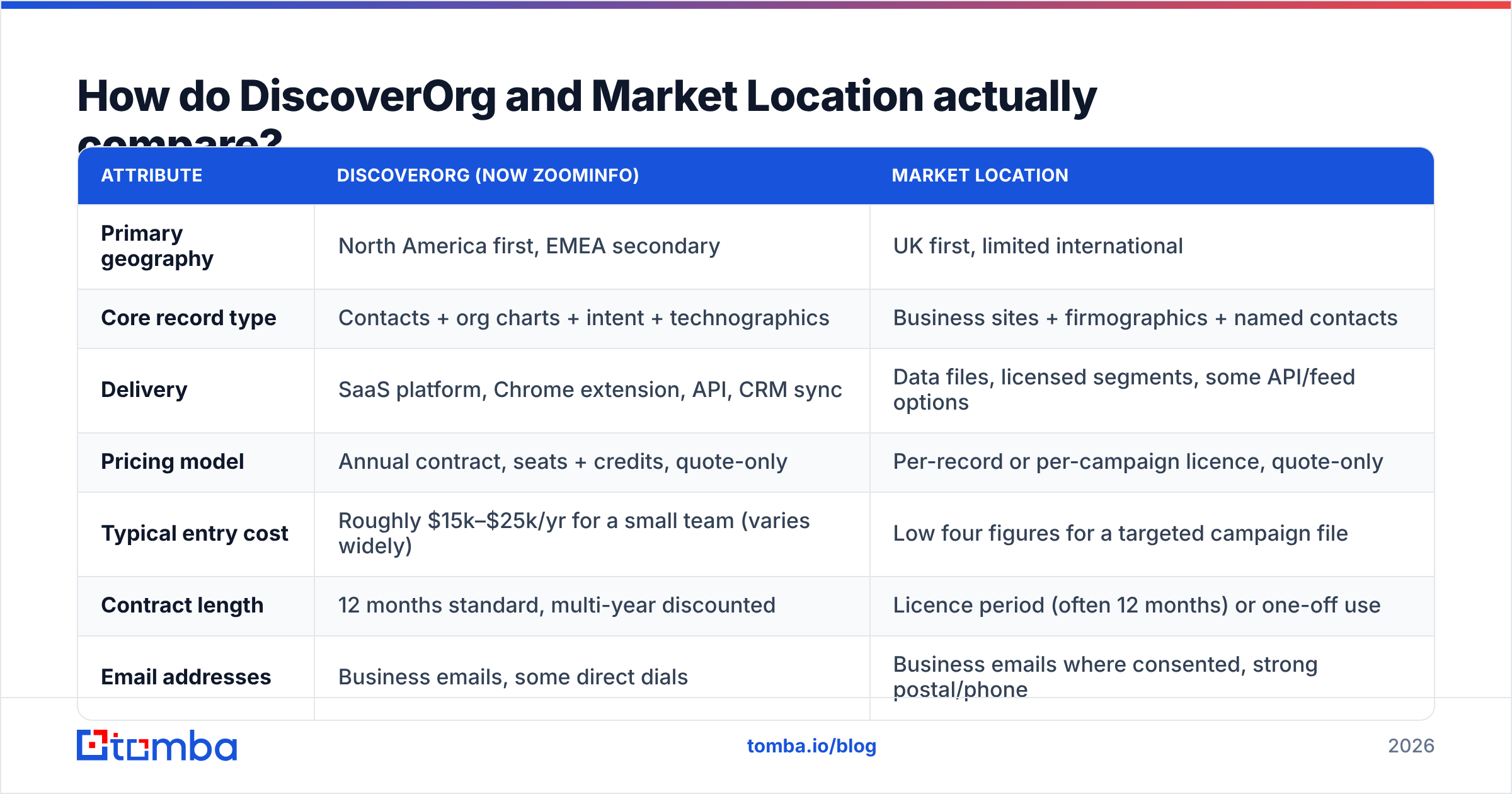
Here is the whole comparison in one table.
| Attribute | DiscoverOrg (now ZoomInfo) | Market Location |
|---|---|---|
| Primary geography | North America first, EMEA secondary | UK first, limited international |
| Core record type | Contacts + org charts + intent + technographics | Business sites + firmographics + named contacts |
| Delivery | SaaS platform, Chrome extension, API, CRM sync | Data files, licensed segments, some API/feed options |
| Pricing model | Annual contract, seats + credits, quote-only | Per-record or per-campaign licence, quote-only |
| Typical entry cost | Roughly $15k–$25k/yr for a small team (varies widely) | Low four figures for a targeted campaign file |
| Contract length | 12 months standard, multi-year discounted | Licence period (often 12 months) or one-off use |
| Email addresses | Business emails, some direct dials | Business emails where consented, strong postal/phone |
| SME depth (UK) | Thin below ~50 employees | Deep — micro and small business coverage |
| Enterprise depth (US) | Very strong, especially IT hierarchies | Not the focus |
| Best fit | US/global outbound teams needing org intel | UK multichannel campaigns and territory marketing |
Two honest caveats on that table. Every price shown is an observed range from public buyer reports, not a rate card. Both vendors negotiate.
The "email addresses" row also hides a lot. ZoomInfo returns far more emails per account. But neither vendor's file is a substitute for checking deliverability before you send.
DiscoverOrg vs Market Location: which has better data accuracy?#
There is no universal answer, because the two measure different things.
ZoomInfo is strongest where the signal is loudest. Think public US companies, mid-to-large tech firms, and IT or security buyers. Coverage is deep there, and refresh cycles are fast. Accuracy drops as you move down-market, outside the US, and into roles that leave no digital trail. Job changes are the constant complaint. A record that was right in January is not automatically right in July.
Market Location is strongest where it does phone work. Human-checked firm data on UK sites holds up well. Its postal data is genuinely campaign-grade. Its weak spot is the one every list licensor has. Named contacts age. If your licence runs twelve months, the file you got in month one is not the file you hold in month eleven.
The useful conclusion is the same for both vendors. Treat any bought list as a guess, not a fact. Run every address through an email verifier before the first send. A 12% bounce rate will damage your sender reputation far more than the list cost you.
That is not a knock on either vendor. Contact data decays about 2–3% a month, whatever the source. Worry about the vendors who claim otherwise.
DiscoverOrg vs Market Location: how does pricing compare?#
Neither one publishes prices. Here is the shape of each deal in practice.
- ZoomInfo sells seats plus credits. You commit to a minimum team size and a per-seat licence. Exports draw down a yearly credit pool. Add-on modules cost extra. Overages and upsells are where the invoice grows.
- ZoomInfo contracts auto-renew. Buyer reviews mention notice windows of 30 to 60 days. Put that date in your calendar the day you sign, not the month you want to leave.
- Market Location sells volume. Price scales with record count, selection complexity, and usage rights. A single-use licence costs less than a twelve-month one on the same file. Ask which you are buying.
The real gap shows up once you compare cost per usable record.
- Market Location can beat ZoomInfo on cost per usable record for a narrow UK segment. It loses badly if you need always-fresh access rather than a snapshot.
- Neither includes deliverability tooling. Verification, warmup, and sending infrastructure all sit on top of either contract.
- Both discount for multi-year deals. Both also hold firm if you look rushed. Start early, before your current notice window closes.
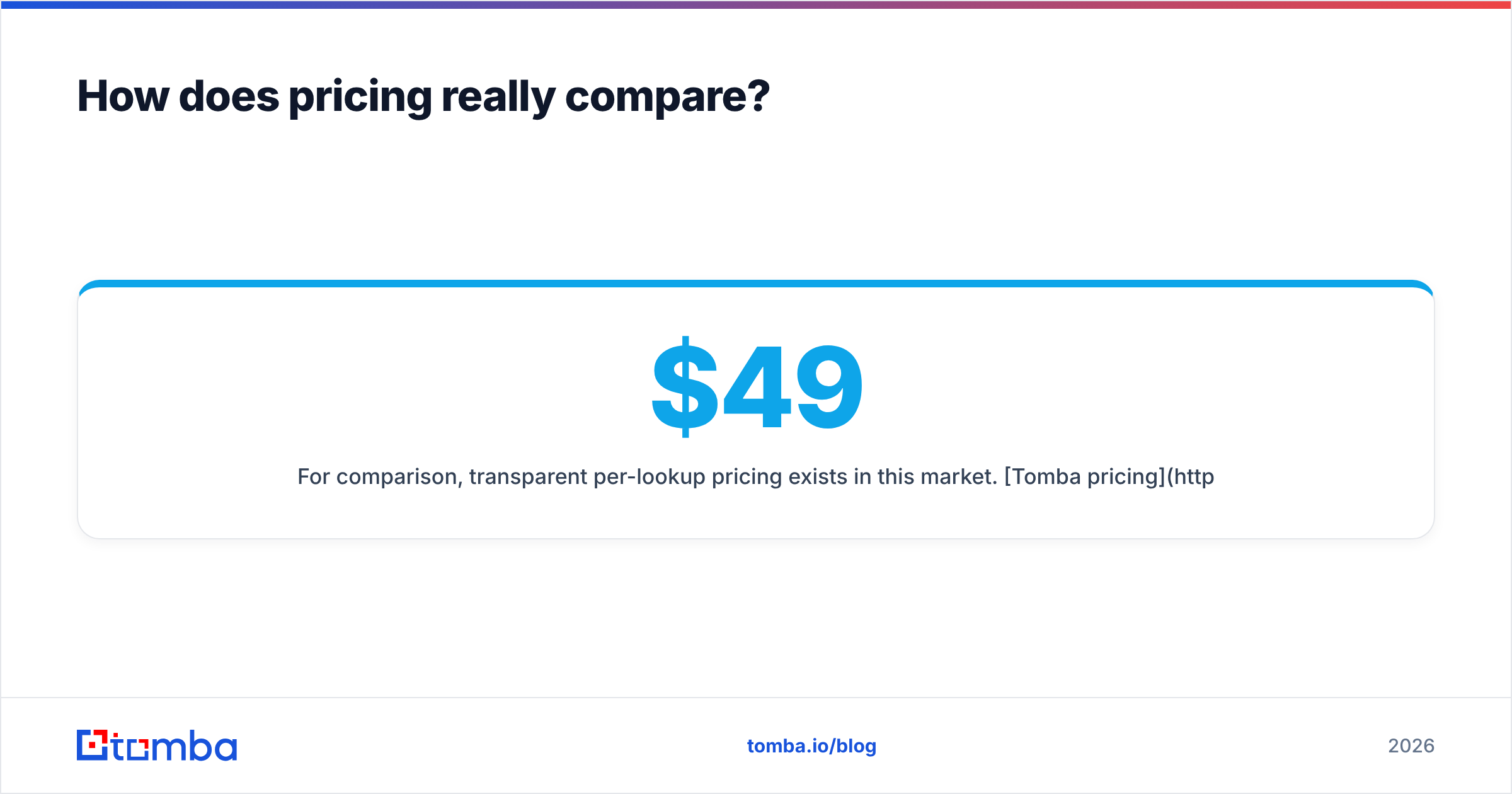
For comparison, transparent per-lookup pricing does exist in this market. Tomba pricing runs a free tier at 25 searches/mo, Starter at $49/mo, Growth at $99/mo, and Pro at $249/mo. It is published, monthly, and cancellable.
That does not replace org-chart intelligence or UK postal data. It is a different line item. Separate it out before you sign a five-figure contract to solve a problem a $49 tool already solves.

DiscoverOrg vs Market Location: which fits your GTM motion?#
Match the tool to the motion, not to the feature list.
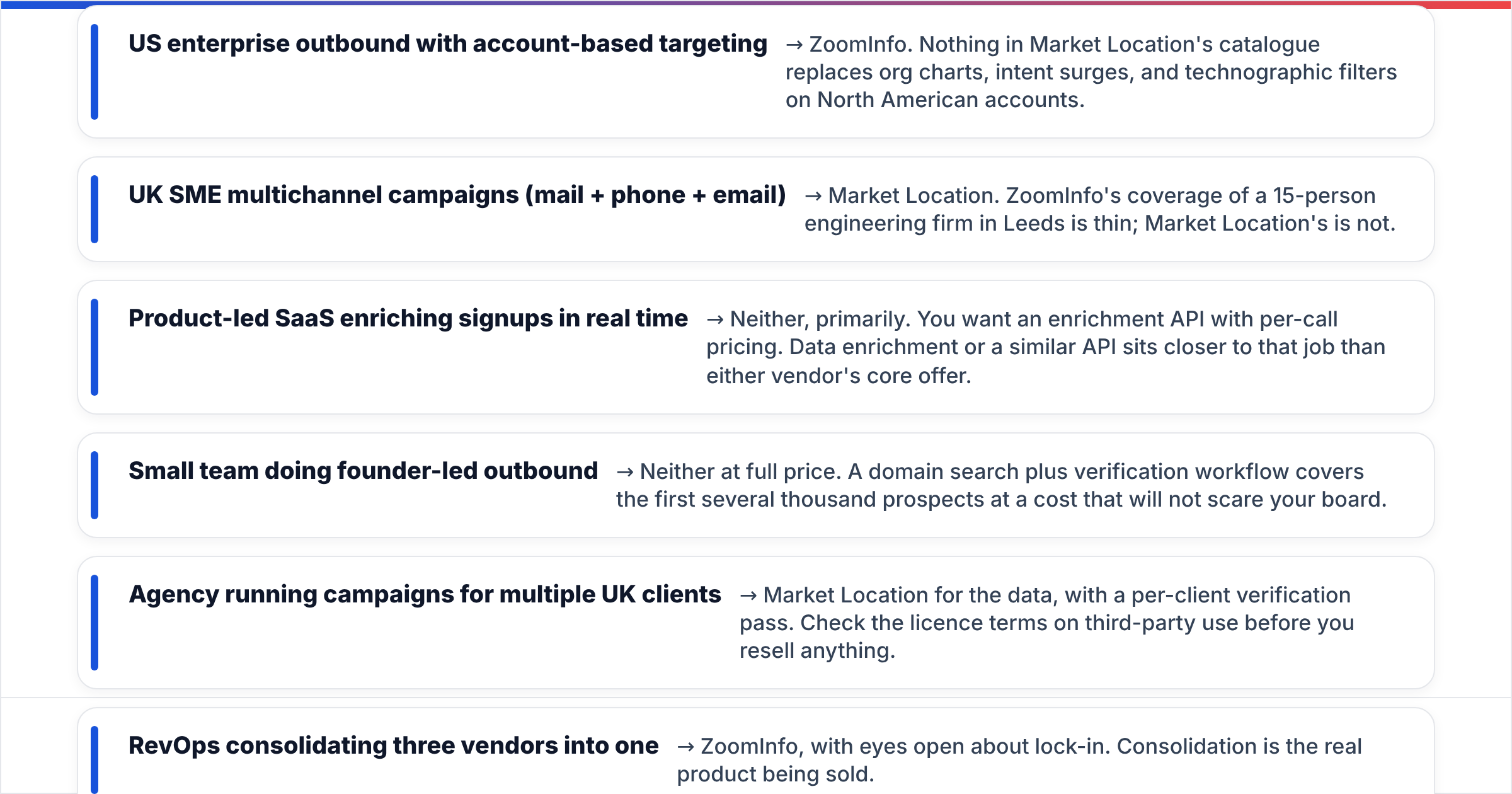
- US enterprise outbound with account-based targeting → ZoomInfo. Nothing in Market Location's catalogue replaces org charts, intent surges, and tech-stack filters on North American accounts.
- UK SME campaigns across mail, phone, and email → Market Location. ZoomInfo barely covers a 15-person engineering firm in Leeds. Market Location does.
- Product-led SaaS enriching signups in real time → Neither, mostly. You want an enrichment API with per-call pricing. Data enrichment sits closer to that job than either vendor's core offer.
The picture changes again for smaller teams and agencies.
- Small team doing founder-led outbound → Neither at full price. A domain search plus a verification step covers your first few thousand prospects cheaply.
- Agency running UK campaigns for several clients → Market Location for the data, with a verification pass per client. Check the licence terms on third-party use before you resell anything.
- RevOps merging three vendors into one → ZoomInfo, with eyes open about lock-in. Consolidation is the real product being sold.
If you are shortlisting more widely, BookYourData is another solid option here. It is pay-as-you-go, has no annual commitment, and publishes accuracy guarantees. It sits between the two on commitment, so get a quote from all three.
What do buyers complain about most?#
About ZoomInfo: contract rigidity, auto-renewal surprises, and credits running out mid-quarter. Buyers also flag the gap between demo data and production data outside the US. The platform itself is rarely the complaint. The commercial terms are.
About Market Location: files are a snapshot in time, and there is less self-service than SaaS buyers expect. Reach narrows the moment your ICP crosses the Channel. It is a data business, not a software business. Buyers who arrive expecting a dashboard sometimes leave disappointed.
About both: neither hands you a send-ready list. You still have to verify. You still have to handle catch-all domains, and a catch-all verifier matters more than most teams think on UK domains. You still need warmed sending infrastructure. Budget for that layer, or your open rates will make the data look worse than it is.
Is there a middle path?#
Yes. The DiscoverOrg vs Market Location choice is not binary, and most teams under 50 reps end up somewhere in the middle: unbundle the stack.
Buy intelligence where you need intelligence — org charts and intent for your top 200 accounts. Buy local data where geography is the constraint — a UK file for a UK campaign. Buy contact discovery as a cheap, metered utility for everything else. Finding a work email is a commodity job. It does not justify a five-figure yearly commitment.
In practice that looks like one narrow enterprise contract, or none at all. Add one campaign data purchase per quarter. Then run a per-lookup finder and verifier underneath both, all the time. It is less tidy on a procurement slide. It costs far less, and it fails softer when one vendor disappoints.
Check the G2 grid for sales intelligence before you commit. The review-volume gap between these two categories tells you which one is a software purchase and which one is a data purchase.
The verdict#
DiscoverOrg vs Market Location is not really a head-to-head. It is a question about what you are buying. If your ICP is North American and your team needs live org intelligence, the ZoomInfo platform that absorbed DiscoverOrg is the stronger product. It is also the bigger commitment.
If your ICP is UK small business, and your campaigns run on post and phone as much as email, Market Location gives you coverage ZoomInfo simply does not have. It costs a fraction of the contract value, too.
What neither one gives you is a cheap, verified, always-fresh supply of work email addresses. That is what most outbound teams run out of first.
That is the gap Tomba Email Finder fills. Search by domain, name, or company. Get verified professional emails back. Pay $49/mo on Starter instead of negotiating a yearly contract. A free tier of 25 searches lets you test accuracy on your own ICP before you spend anything.
Run it alongside whichever data vendor you choose. Or run it instead of one, while you find out how much intelligence you genuinely need.
Related guides#
Ready to find emails that actually work?
Join 150,000+ professionals who stopped guessing and started sending. Free credits on signup — no credit card required.
Get the Tomba newsletter
Practical outbound tactics and product updates — once every two weeks.
About the author